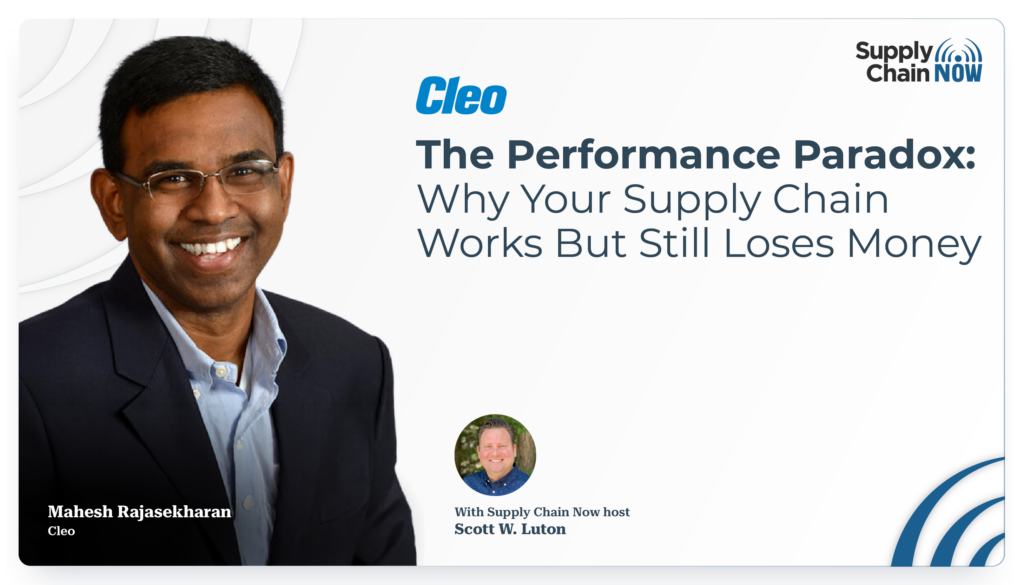
[00:00:00] Mahesh Rajasekharan: We call it the performance paradox. So in the survey where we talked to so many folks across business supply chain and technology globally across industries, 63%, which is two out of three survey participants, said their supply chains operated as intended, while 73% of those same companies report losing revenue because of supply chain issues.
[00:00:23] Just think about that
[00:00:26] Scott W Luton: Welcome to Supply Chain Now, the number one voice of supply chain. Join us as we share critical news, key insights, and real supply chain leadership from across the globe, one conversation at a time. Hey, good morning, good afternoon, good evening, wherever you may be. Scott Luton here with you on Supply Chain Now.
[00:00:43] Welcome to today’s show. So folks, I got a question for you. What happens when your supply chain is working exactly as it has been designed, but it’s still costing your business money and making customers mad? Well, that’s one of the fascinating questions we’re gonna explore here today, because new research from Cleo res- reveals really a troubling disconnect.
[00:01:04] Sixty-three percent of companies believe their supply chains are performing as designed, yet seventy-three percent report losing money. Makes me think, what’s broken? But we’re gonna talk about that, and how can organizations move beyond simply connecting systems and tracking shipments to truly orchestrating their supply chains.
[00:01:24] We’re also gonna be diving into the growing role of AI, the challenges of automation and all the complexity it might can bring, and the persistent gap between planning and execution. And as if that’s not enough, what it really takes to turn supply chain intelligence into business results. So folks, stick around for a great discussion that’s gonna offer up tons of actionable insights about a container load.
[00:01:47] And part of those insights today are gonna be delivered by one of the dynamos in the industry. So our special guest here today, we sat down with Mahesh at Gartner last spring in one of my favorite conversations, and not just because we talked about football, but he brings an, uh, uh, a energy and a been there, done that spirit that we need more of in supply chain.
[00:02:08] So Mahesh Rajasekharan is a accomplished global technology executive with deep expertise in supply chain management, enterprise software, and business strategy. Now since 2012, he’s led Cleo’s transformation into a high-growth cloud software business. Previously, amongst other roles, Mahesh served as COO of SumTotal Systems, where he helped turn around a $100 million multinational software company.
[00:02:33] He’s also been named a 2022 EY Entrepreneur of the Year for the Midwest region. He holds a PhD in industrial engineering from Texas A&M. Go Aggies, if Tevin Taylor’s out there listening. And get this, he’s earned an MBA from UC Berkeley’s Haas School of Business, where he graduated first in his class. Wow.
[00:02:54] But as we learned in Orlando, Ma- Mahesh is the biggest Dallas Cowboys fan in the continental United States, so I’m delighted to welcome in the pride of Austin, Texas, Mahesh Rajasekharan, president and CEO with Cleo. Mahesh, how you doing?
[00:03:09] Mahesh Rajasekharan: I’m doing great, Scott. It’s such a pleasure to be back with you again.
[00:03:12] Scott W Luton: Same. I had a great time with you, uh, learning from you when we were together in person in Orlando at Gartner. And I gotta tell you, as I was walking through that introduction again, I’m gonna keep it real with folks, uh, Mahesh operates about three pay grades above mine, so I’m gonna work really hard to keep up with him here today.
[00:03:31] But kidding aside, I’m really, I’m, I’m tickled to have you back here on Supply Chain Now and dive into, uh, some of the biggest challenges of our time. So are you buckled up, ready to go?
[00:03:41] Mahesh Rajasekharan: I am ready to go, and the pleasure’s all mine, Scott
[00:03:44] Scott W Luton: So Mahesh, uh, the buckle li- the buckle up analogy’s gonna work well because the fun warm-up question, I wanna, I wanna probe something I know you’re passionate about.
[00:03:53] Um, y- flying taxis. Now, I gotta preface this. So, so I do Uber all the time, and when I was leaving a big industry conference here in Atlanta, um, there was a long line of Ubers, and there was the, um, the automated version. I can’t remember the name of the company. Anyway, it was a robotic- Yeah … version of Uber.
[00:04:15] There’s a name for that, right? Yeah. And I almost got in there, but then it dawned on me, ’cause this is the third day at the conference, how my human driver had to run red lights, cut cars off, all to navigate Atlanta traffic, and I thought I would never get home with, in a robotic traf- uh, ro- robotic taxi.
[00:04:33] So get, I wanna get your comment on that, but also, man, when we hit the skies, is that, is that gonna be more exciting than dangerous? Your thoughts, Mahesh.
[00:04:41] Mahesh Rajasekharan: Scott, I, I really love this question. Uh, for me, flying taxis bring together so much of what excites me, which is innovation, intelligence, and the ability to coordinate across a complex network.
[00:04:53] Scott W Luton: Hmm.
[00:04:54] Mahesh Rajasekharan: Yeah. Think about everything that has to work together. The aircraft manufacturers, the operators, the maintenance teams, regulators, energy providers, and passengers. And building a safe aircraft in, is an extraordinary engineering challenge, and making this entire service work reliably requires orchestration across a n- network.
[00:05:14] And the same is true in supply chains. A great plan or an efficient warehouse doesn’t deliver the customer promise on its own. The opportunity is to really coordinate all those moving parts so we can serve more customers reliably at scale, and that’s what makes it so exciting for me.
[00:05:32] Scott W Luton: Well, uh, I will live vicariously, as they say, in your excitement because I’m not quite ready to set…
[00:05:40] Even if it was every, if it was ready today, I’m not sure if I’m right, uh, quite ready to step into a flying taxi. But you are, Mahesh. Is that right?
[00:05:47] Mahesh Rajasekharan: Absolutely. It’s safer than, than being on the road.
[00:05:51] Scott W Luton: Okay. All right. I’ll take your word for it. You’re a smarter guy than me, so we’ll, we’ll, we’ll, uh, we’ll do it together.
[00:05:56] Um, all right, so we got a lot to get into here today, Mahesh.
[00:05:58] Mahesh Rajasekharan: Yeah.
[00:05:59] Scott W Luton: Uh, I wanna start by level setting because I bet a big portion of our audience, especially our newer audience, may have missed us in that conversation we had in Orlando. So I wanna level set first. Let’s start with, uh, what Cleo is, and what does it mean to orchestrate a supply chain versus simply, you know, integrating it?
[00:06:17] Your thoughts, Mahesh.
[00:06:19] Mahesh Rajasekharan: You know, Cleo is an AI native supply chain orchestration company built on a very powerful foundation of ecosystem integration. So what we essentially do is we connect businesses with their customers, suppliers, carriers, and internal systems such as ERP systems, warehouse management systems, transportation systems, that gives us a foundation to build supply chain context.
[00:06:44] Mm. Such as what an order means, who depends on it, what needs to happen next. So integration makes those connections possible. Orchestration uses the context to coordinate decisions and actions across planning and execution. Example, when, when a shipment is delayed, the goal is to help the businesses adjust fulfillment, coordinate with a carrier, and keep its customer promise.
[00:07:10] For me, the measure of success is straightforward. Are we helping our customers grow revenue, serve their customers better, and improve profitability? And that’s what
[00:07:20] Scott W Luton: we
[00:07:20] Mahesh Rajasekharan: do.
[00:07:21] Scott W Luton: Mm. I love it. And, you know, one of the last things you mentioned, you know, keeping that customer promise. Yeah. Sounds like you’re pretty excited about how modern day innovative orchestration can do that a whole heck of a lot better than all of our efforts to this point.
[00:07:34] Would you agree?
[00:07:35] Mahesh Rajasekharan: Absolutely. Yep.
[00:07:37] Scott W Luton: So speaking of this point, I wanna talk about some turning points, uh, in, in the history of Cleo as y’all continue to grow and, and, uh, evolve and innovate. What do you think, what are a couple of those big turning points that come to your mind, Mahesh?
[00:07:50] Mahesh Rajasekharan: The, the biggest turning point was listening closely to what our customers actually needed as disruption became rampant, right?
[00:07:58] They valued connectivity, but their ambitions were bigger. They wanted to onboard customers faster, expand into new channels, into new markets, fulfill more orders, and grow profitably The pandemic reinforced how much performance depends on coordination across an entire supply chain network. So at that point, we realized our integration foundation could support something much more powerful, which is live supply chain context, intelligence, and coordinate action.
[00:08:29] And artificial intelligence, AI, has accelerated the journey. We’re now building into how orchestration works so systems can understand what’s happening and act with human supervision. And that’s the innovation I’m so passionate about, turning our technology into meaningful value for our customers.
[00:08:48] Scott W Luton: Mm.
[00:08:49] Mahesh, you mentioned the human supervision. I like that. Let me see if I’m tracking with you. I love the notion of more and more systems and technology and platforms handling more of the execution, to where it changes the role of the humans to do some supervision, but also to take some of their knowledge and, and have them do more of the fulfilling work of, you know, creating solutions or spending time with customers or potential customers or suppliers where innovation comes out.
[00:09:17] That you– Seems like you use that word human supervision very intentionally. Is that right?
[00:09:22] Mahesh Rajasekharan: Very intentional because, you know, I believe and we believe at Cleo that humans have judgment power, right? The one thing you don’t want to delegate is judgment. So we help humans lead at a higher level so the AI agents can act in real time.
[00:09:39] And that’s where value is created in an extraordinary fashion.
[00:09:42] Scott W Luton: I like it. I like it. Uh, and I love how you kind of purposefully reference one of the uniquely human superpowers out there that we all benefit from, uh, the power of judgment. So when you think of, uh, we’re about to get into your thoughts on a variety of industry topics, including that, those, um, that, the survey nuggets I shared on the front end.
[00:10:00] But first, one last thing about Cleo, your ideal customer today.
[00:10:04] Mahesh Rajasekharan: Um-
[00:10:04] Scott W Luton: Uh, describe that in a nutshell.
[00:10:06] Mahesh Rajasekharan: Yeah. Our ideal customers, Scott, are manufacturers, distributors, retailers, and logistics providers whose growth depends on, on a network of trading partners. All of these companies have invested in lots of systems of record.
[00:10:20] Systems of record are your ERP systems, your planning systems, your warehousing systems, your transportation systems. And the opportunity we see is to make those investments work be-better together across company boundaries, across a multi-enterprise supply chain ecosystem. So often demand is there, but onboarding a customer and gets stuff on the shelf or fulfilling orders reliably is holding growth back.
[00:10:47] So we at Cleo help connect the network, understand the business context, and coordinate action so they can capture the growth with confidence
[00:10:57] Scott W Luton: So Mahesh, is it, uh, as you’re describing that, the phrase that comes to my mind is you, you and your team are, and your technology, uh, y’all play the role of friction busters and growth enablers all the time.
[00:11:11] Is that right, Mahesh?
[00:11:12] Mahesh Rajasekharan: Absolutely. Our whole goal is to eliminate friction in global supply chains so companies will have the agility to respond to all the disruption that is thrown at them, which is just multiplying with massive amount of complexity every- Okay … every single day.
[00:11:26] Scott W Luton: Hey, I might need some of what y’all do.
[00:11:28] So let’s, let’s talk after the show, huh? Um, all right. I’m only halfway kidding. All right, so I wanna talk about your 2026 Global Supply Chain Executive Report, right? And I shared one of the factoids of many that stands out. So in the press release, I think the market learned a key operating paradox is hampering many enterprises today.
[00:11:50] Based on your research, it shows that 63% of companies believe their supply chains are performing as designed, yet 73% claim to be losing money. What do you s- do you, uh- Why is that, why is this happening, Mahesh? S-
[00:12:07] Mahesh Rajasekharan: Scott, this finding is very insightful, right? Really gets in the heart of the opportunity, uh, we’re talking about.
[00:12:14] We call it the performance paradox. So in the survey where we talked to so many folks across business supply chain and technology globally across industries, 63%, which is two out of three survey participants, said their supply chains operated as intended, while 73% of those same companies report losing revenue- Hmm
[00:12:36] because of supply chain issues. Just think about that. My interpretation is that a process can meet its internal targets while the business still misses a customer promise, right? For example, a warehouse ships on time, but the delivery misses the customer’s window. Hmm. An order moves through the system, but an unresolved exception delays fulfillment.
[00:12:58] Those gaps mean lost sales, deductions like chargeback deductions, and customers taking the next order elsewhere. So we need to ask whether the entire network is delivering the business outcome because you’re going across numerous participants in distribution, uh, in logistics to fulfill that, that o- customer outcome.
[00:13:20] So that’s where orchestration creates real value, protecting revenue today and giving customers the confidence to do more business with us tomorrow.
[00:13:30] Scott W Luton: Yeah. And Mahesh, when you, as you describe these, these large enterprises with all sorts of different operations, uh, what I’m hearing you say, correct me if I’m wrong, is sometimes the gaps can be lost in, in, uh, translation, right?
[00:13:43] Where one team did what they’re supposed to do, but to your point, maybe it got there too early or too late, and down the line it actually was a, a, um, a, a failure of some sort, and we gotta look at the enterprise and its performance holistically, right?
[00:13:57] Mahesh Rajasekharan: Is that what you’re saying? You’re exactly right, Scott.
[00:13:58] I think today people view supply chain as a c- as a collection of, of functional units, right? What is sales doing? What is marketing doing? What is production doing? What is operations doing? What is procurement doing? But really the customer doesn’t care. In fact, the customer doesn’t even care what your company does.
[00:14:15] It’s what the distribution does, what the logistics providers do. So for them, the real question is did you fulfill the commitment or not? Yep. That’s it, right? And that’s what we have to get, get at.
[00:14:27] Scott W Luton: I like it, Mahesh. I’m gonna reference our… We had a lot of fun down in Orlando. Uh, and again, I learned from you, but we had a lot of fun talking about your love for the Cowboys and a lot of supply chain stuff.
[00:14:37] One of the things that I’m, I was left with from that conversation was, you know, when you hear the phrase supply chain visibility, there’s a certain portion of our universe that rolls their eyes because we’ve been talking about that nonstop. And you believe that s- a lot of that is very passé. And furthermore, you think that it’s orchestration that’s more of the Holy Grail for the supply chain industry.
[00:15:01] So to that end, how has AI continued to fuel this shift in how you view visibility, orchestration, and where we need to be?
[00:15:10] Mahesh Rajasekharan: Yeah. Scott, you know, v- visibility does add value because awareness is important, but orchestration really allows you to coordinate. So the way I think about this is visibility still matters enormously, Scott, but we need to understand what’s happening before we can act intelligently, right?
[00:15:29] So a dashboard showing a late shipment doesn’t exactly resolve the problem. AI becomes powerful when it has supply chain context and can coordinate action, understand affected orders, evaluate options, and help execute an approved response across a network. So for us, the Holy Grail is autonomous supply chain orchestration.
[00:15:52] We get there through deliberate steps with humans supervising what AI and agents are allowed to do. Mm. We start with recommendations, move to approved actions, and delegate more as performance earns trust. That’s how visibility becomes a foundation for better service, more revenue, and ultimately greater autonomy.
[00:16:14] Scott W Luton: Mm-hmm Trust. Performance earns trust. I like that. And of course, trust is the still the, um, inarguable, uh, the biggest currency of global supply chain. I love that. So let me ask you another question. This one, this one might be counterintuitive for some folks out there, right? We’re in this, what I like to refer to as a golden age of supply chain tech.
[00:16:36] It really is amazing what we’re doing, right? Yeah. Especially when we take a focused, smart, what are we trying to do type of approach. And of course, we’re leaning more and more on all sorts of different types of automation. However, in many cases, and maybe you could say even in general, automation can increase complexity for many organizations and their teams.
[00:16:58] Why is that in your view, Mahesh?
[00:17:00] Mahesh Rajasekharan: Scott, I truly believe automation for the sake of automation is counterproductive, right? Because we often automate individual tasks by functions while the co- coordination between them remains manual. So in other words, the human really becomes the integrator because they have a bunch of different au- automations.
[00:17:19] Let’s, let’s look at this example. The, the warehouse example has its own automation. The carriers have their own transportation management systems. Customer service is another workflow. Each can work well locally while the order still gets stuck between them. So as the network grows and the network gets complex, those gaps multiply and compound.
[00:17:40] Scott W Luton: Hmm.
[00:17:40] Mahesh Rajasekharan: Orchestration connects those activities around a shared business outcome. Fulfill the order, keep the customer promise, and make it easier for the customer to buy again and again and again. That’s how we help our customers drive revenue growth
[00:17:57] Scott W Luton: So Mahesh, I’m gonna ask a follow-up to this, and bear with me because, you know, I started my c-co- we were talking about your college collegiate accolades earlier.
[00:18:06] I started computer science. Yeah. But I hated the programming. It didn’t click for me, so I shifted gears, right? Yeah. When I… Well, on your last response, what I heard is a big, you know, interoperability. You’re talking about all these different systems under an enterprise. And when I think of orchestration, is it, would you agree with, you know, interoperability on steroids to a whole new level?
[00:18:30] Because when the systems, the different systems can start talking and not miss a beat and, and protect that customer promise, man, we are cooking with grease at some, at that point. Would you, uh, if-
[00:18:41] Mahesh Rajasekharan: A hundred percent agree, Scott. So what we’re getting to is you need a system of action. There are lots of systems of record.
[00:18:48] People have spent billions of dollars on various systems of record, such as ERP systems, warehouse management systems, transportation systems, analytic systems. You know, those systems have value, visibility systems, for example. However, when you are dealing with disruption, when you’re de- dealing with volatility as a standard operating condition of the world, wars are breaking out, there are tariffs coming, you are hit with ch- constant disruption and changes, and therefore, you need a system of action that can look at all this information in real time, allow you to prioritize the, the risks across the supply chain, and coordinate action across multiple organizations within your company and departments, and the multiple people so you can take care of the customer promise.
[00:19:37] Scott W Luton: I like it. And I, you know, you beat me to it. I was, while you were sharing your response, I was looking- Yeah … for my note because I spent some time yesterday with, uh, Rick McDonald, the former, uh, chief supply chain officer at the Clorox company. He’s one of
[00:19:50] Mahesh Rajasekharan: our- He really is kind of funny. He’s an advisor to Cleo.
[00:19:51] Love him.
[00:19:52] Scott W Luton: Yeah. Oh, well, man, small world. Yeah, yeah. But he mentioned that same thing you mentioned, and oftentimes brilliant people say a lot of the same things. Moving from a system of record to a system of action, Mahesh, I love it. Yeah. Um, all right, let’s talk about another, what I think we can probably both agree is a bit of a cliché in, uh, modern business and modern supply chain, the new normal.
[00:20:13] Yeah. Right? Yeah. Everything s- since on the other side of the pandemic, on the other side of the ongoing new trade landscape, it’s not that looks, doesn’t like s- uh, doesn’t look like it’s changing any time soon, and we all have our different definitions probably of the disruption and what makes up the new normal.
[00:20:33] Uh, how do you define that?
[00:20:35] Mahesh Rajasekharan: Look, I, I think volatility is gonna be constant and, and disruption is gonna be the standard operating condition. We gotta just accept it. And because supply chains operate across networks and change anywhere, it, it could be, uh, an issue in, in, uh, Gaza or Iran, it– or, or Russia-Ukraine war, it can change anywhere, it can affect the customer at the other end.
[00:20:59] And so demand shifts, a supplier misses a commitment, a carrier runs short of capacity, or a trade policy changes like, like tariffs. We cannot predict ev- every event, but what we can do is we can build the ability and the agility to respond. So that means understanding which orders and customers are affected, coordinating alternatives, and feeding what we learn back into planning.
[00:21:24] And so in our view, the companies that do this well can keep serving customers and capture business where others are struggling.
[00:21:32] Scott W Luton: Hmm. I like it, Mahesh. Uh, I really like it. And, and on a related note, we’re gonna talk about your vision for Cleo moving forward, uh, towards the end of today’s chat. But I wanna talk more about intelligence and how you say real-time intelligence is only achievable through context and correlation.
[00:21:52] Now, I gotta say one thing before you, you, you weigh in here, is if you’ve heard me say it once, you’ve heard me say it a thousand times, whether you’re in supply chain or outside of supply chain, we never get enough context in today’s really fast-moving world. But how do you connect context correlation to true real-time intelligence?
[00:22:12] Mahesh Rajasekharan: Let’s look at this example of a delayed sh- shipment, Scott. On its own, a delayed shipment is just a status update. That’s all you got, right? Now, you connect it to the customer’s order, available inventory, production needs, delivery commitment, and all the different alternative carriers that can bring the shipment back on time.
[00:22:31] Now suddenly, we can understand the business impact and evaluate what to do. That, to me, is supply chain context. It connects events to relationships, to commitments, and consequences across the entire network.
[00:22:46] Scott W Luton: Mm.
[00:22:46] Mahesh Rajasekharan: This is r- really where AI needs the context, because without the context, you can throw a bunch of frontier models and a bunch of data, and it’s gonna figure something out.
[00:22:56] But if you want AI to make useful decisions, you need context. It’s why Cleo’s network-centric foundation matters so much. The opportunity for us is to connect intelligence directly to the workflows where business happens.
[00:23:10] Scott W Luton: Hmm. So I’m, I’m curious, um, with a, with the AI native platform like you have with Cleo, and you think about how can we input as much context as we can for, um, the unique, uh, unique aspects of global supply chains out there, right?
[00:23:31] There’s sure- there’s lots of common threads, but every organization kinda also has that, that, that unique DNA How do y’all go about that? How do you go about giving these systems, uh, the context it, context it needs to, using your example we’ve referenced a couple times, making sure every shipment… You know, we’ve talked about those delayed shipments a couple times, those go away.
[00:23:53] How do y’all do that, Mahesh?
[00:23:53] Mahesh Rajasekharan: Yeah. We do that because we have a context layer at, at, uh, Cleo, right? So typically think about data is at the most granular level. Information is flowing. Mm-hmm. You need… And, and to get that, you need to integrate, integrate with your customers, with your suppliers, with your logistics providers, with your banks, with your systems of record, your ERP systems, et cetera.
[00:24:13] And once you connect all of them, you need to build the metadata, right? You know, what, what we call the semantic layer of the supply chain. You need to understand, you know, what is the relationship between an order, the various line items in the order to the different shipments, and then how it’s, you know, is gonna be, you know, trigger, uh, an invoice when, when the shipment is completed, right?
[00:24:38] All of this as context and correlation, and we have a context layer which defines this. So now when signals are coming, and which by the way, Scott, are thousands of signals in minutes across- Mm … the global supply chain. If you don’t have context, all of these signals just, you know, don’t make any sense because you cannot, you cannot make decisions in real time.
[00:25:01] But if you have- There’s
[00:25:01] Scott W Luton: no structure to them …
[00:25:03] Mahesh Rajasekharan: you have structure to it, you can coordinate, you can rank order it. You know what are the vital few, the trivial many, what coordinated actions you need to take in the next 30 minutes. And, and this is where we are really concentrating our energy on, to help supply chains get back to peak performance.
[00:25:19] Scott W Luton: You just shared a phrase that I hadn’t heard in a while, and I like it. Yeah. I’m not sure if Vilfredo Pareto coined this or not, uh, but the vital few and the trivial many. I think that was Pareto. And, uh- It’s Pareto … 80– right? Yeah. 80/20 is associated with Pareto, but- Yeah … that’s a more eloquent way of saying it, the vital few and the trivial many.
[00:25:38] And as you describe that context layer in, in all the different ways that, uh, that, that, uh, Cleo gets the context it needs to deliver the performance that, what’d you say? That, um, performance that earns trust Sounds like this is just a, a standard part of, of your team’s approach on the, the front end of getting to know the business.
[00:25:58] Is that right?
[00:25:59] Mahesh Rajasekharan: You know, 100%. You know, one of, one of the research we did is for every dollar a company loses because their customers are not happy and they’re fining them or they’re, they’re holding back as a penalty, there are $9 they’re leaving on the table. Because they’ve missed a shelf space, they don’t get invited to the party for new promotions, they don’t have better pricing power.
[00:26:21] When you have a new category you’re launching, you don’t get the, you don’t earn the right to participate in the new category. So that every dollar you’re missing, you’re losing $9. So-
[00:26:31] Scott W Luton: Wow …
[00:26:31] Mahesh Rajasekharan: 10x a value proposition if you get that right.
[00:26:35] Scott W Luton: All right. So I think we have just made the late Vilfredo Pareto’s day-
[00:26:40] by, uh, talking. Of course, folks, if you don’t know, if you’re not familiar with Pareto, he was a famous Italian economist and mathematician, and if you ever hear the 80/20 rule, that’s very closely associated with his work and observations. Um, all right. So Mahesh, let’s talk about a gap that just refuses to be closed.
[00:27:01] We’ve been after it ever since the days of Holy Grail, the gap between planning and execution. So I got a two-part question for you. Why does it persist and, and continue to thrive, and what does closing it really look like?
[00:27:17] Mahesh Rajasekharan: Yeah, you know, that’s the, the real question, which is why does a gap exist between supply chain planning and execution?
[00:27:26] The, the, the simple answer is when you look at the planning layer, all the different planning, demand planning, master planning, fulfillment planning, you have all of the context you need, but you don’t have the granularity to execute. It gives you guidance, it gives you intent, right? Execution can execute all day long, but it doesn’t have context.
[00:27:49] So it’s really missing… The missing link is context. So when you bring context to execution, right, then you get to the Holy Grail. So let’s look at what closing looks like. So a plan reflects what we expect to happen. Execution tells us what, what’s actually happening, and this gap starts to grow when those two don’t continuously inform each other, especially across suppliers, customers, logistics partners.
[00:28:14] If demand increases, question is can we coordinate inventory, production, and transportation to fulfill it? If a supplier falls short, can we adjust the plan and customer commitments quickly? So closing the gap means a continuous loop between planning and execution supported by live network context.
[00:28:34] That’s the key, having live network context so we can continuously close the gap. And orchestration is the only true approach that coordinates that loop so that business can respond to change and capture the opportunity.
[00:28:49] Scott W Luton: Hmm. Mahesh, your response reminds me of, uh, what will be a new cliché if it isn’t already.
[00:28:55] Yeah. Because we’re on so many different lay- layers of global business and global supply chain where we are getting further and further into this always on era. You know, you were just talking about that continuous loop, right? Yep. There’s a reason why plan, do, check, act, you don’t just stop with act. It, it, it rolls right into back into planning.
[00:29:16] Uh, sp- for a minute, do you see the same thing, this always on era, whether you’re talking sub- cyber or you’re talking supply chain execution or orchestrate? Do you see the same thing?
[00:29:25] Mahesh Rajasekharan: Uh, 100%. I mean, plan, do, check, act is, is one of the core philosophies. It’s a Dem- Deming philosophy that we use, uh, passionately at Cleo.
[00:29:34] And the way I think about this is if you don’t do the check, all you do is you replan. You had a plan You know, the plan was dead on arrival, DOA, so you replan. How good is that?
[00:29:47] Scott W Luton: Hmm.
[00:29:47] Mahesh Rajasekharan: Like, that ability to go do plan, do, check, act is important. And to do that, you need granular data at the transaction level, which is reflected on a context model, so you have real-time intelligence to course correct.
[00:30:00] That course correction is where plan-do-check-act lives. Yeah.
[00:30:04] Scott W Luton: And it, and also in your going back to the, the planning execution, you referenced a continuous communication between kind of those two sides of the coin.
[00:30:14] Mahesh Rajasekharan: Yep.
[00:30:14] Scott W Luton: Um, that’s gotta be, uh, we can’t have a finish line in that communication. Is that right?
[00:30:21] Mahesh Rajasekharan: 100%. U- u- you, the global business is getting so fast that things which used to take weeks and months are rippling through the economy in, in a matter of days, right? Something happens, uh, in the Strait of Hormuz, oil prices go up. W- then you gotta make a choice in real time to either pass on the cost to your customer or absorb it.
[00:30:42] And those business decisions have to happen in fast cycles.
[00:30:46] Scott W Luton: Yep.
[00:30:46] Mahesh Rajasekharan: Yeah.
[00:30:48] Scott W Luton: Ever faster cycles at that, right? Oh my gosh. We are moving. It is amazing. It really is amazing when you think of the velocity that, that is just like your average day in 2026 versus at least when I first came in the industry. It, it is so night and day.
[00:31:04] Um, all right, so I’m really, I’m curious about the, your next, your next response to this question. We’ve referenced AI a number of times, and clearly from our conversations at least, I gather There’s so many really bad approaches to AI out there. It seems like y’all have really s- uh, settled on a winning, practical, and, um, outcomes producing approach to AI.
[00:31:29] For the companies out there that might be listening or watching us, how would you advise our leadership and, and where they focus if they want AI to deliver real targeted value? What are your thoughts there, Mahesh? Uh,
[00:31:41] Mahesh Rajasekharan: I, I strongly, strongly believe that AI should be focused on delivering real value and not on AI features.
[00:31:50] Scott W Luton: Hmm.
[00:31:50] Mahesh Rajasekharan: So my advice to all, all the customers that, that we interact with is start with a cust- with their end customer outcome that we can measure, such as can you onboard a new customer faster? Can you fulfill more orders with the same resources? Can we prevent chargebacks before they occur? Can we improve on time in full, which is OT- OTIF, or on time in full delivery, so we win more business?
[00:32:14] It’s such an important retailer metric, on time in full, that those manufacturers and distributors who can, who can meet those metrics will earn more business. Then give AI the context and the access needed to improve that workflow with clear rules for action and human supervision. So I would say start with a focused use case, measure the results, and then expand the delegation as confidence grows, right?
[00:32:41] For me, the exciting question is how much more business our customers can serve. Lower costs matter, but revenue growth is most important, right? Revenue growth and stronger customer relationships makes the AI opportunity much
[00:32:57] Scott W Luton: Mahesh, uh, quick follow-up before we get into your vision and, and where you think orchestration’s going.
[00:33:03] When it comes to AI, and we reference this a lot, maybe this is cliché too, but it’s just so appropriate. You know, you’ve got what we believe in our conversations and how we got our finger on the pulse. There’s so much pilot fatigue out there, and I think one of the shortlist factors of why there’s so much pilot fatigue that I think teams are feeling is that we are trying to solve anything and everything oftentimes with the wrong technology, and of course, AI being the top of the list.
[00:33:33] Do you see that misapplication, uh, of, of AI and what we’re trying to sometimes not even understand what success is looking like before we say, “Ah, let’s throw AI on that.” Do you see some of that out there in the industry?
[00:33:47] Mahesh Rajasekharan: All the time because, because there is, there is this whole race to, race to basically say, “Look, I’m adopting AI.
[00:33:53] How many tokens I’m burning.” Um, and some of that there is value in, in giving people all the different AI tools and being able to become more AI fluent. But what’s really important, Scott, is unless the projects are well defined with a value pro- proposition that is measurable with clear ownership, and you track both the leading and lagging indicators of success-
[00:34:18] Scott W Luton: Hmm
[00:34:19] Mahesh Rajasekharan: the initiative won’t take off. Now, AI, I think, is the most massive agency of all technologies we’ve seen as a mankind, as a humanity. And so it’s really the responsibility of, of leadership teams to, to have well-defined projects, well-defined metrics, well-defined ownership to so that they can benefit from this immense value proposition from artificial intelligence.
[00:34:43] Scott W Luton: And the focus. You’ve said focus a lot today too.
[00:34:45] Mahesh Rajasekharan: Yeah.
[00:34:46] Scott W Luton: And I think it’s easy for, for any of us, it’s human in us, right? We get distracted. We got the goldfish, uh- Yeah … or, or the, uh, rather the shiny object, uh, chase after syndrome, right?
[00:34:56] Mahesh Rajasekharan: Exactly.
[00:34:57] Scott W Luton: And, um, that focus, we got to be able to say no more often like, uh, Steve Jobs, uh, the late great Steve Jobs advised us to do.
[00:35:05] Is that right?
[00:35:06] Mahesh Rajasekharan: 100%. I think Apple’s famous quote is they actively choose to kill 1,000 ideas because they can back one idea- Right … that gonna create multi-billion dollar product lines for them. And that’s, that’s really important. It’s focus and intentionality. So you can explain the why. When someone comes to you and says they work on an AI project, real question is the why and what are you gonna accomplish?
[00:35:28] And help them get there. And that’s what leadership is about. And, and those companies are– We are seeing tremendous advantages when, when companies do that, and many companies are doing that.
[00:35:40] Scott W Luton: Focus and intentionality, especially in global supply chain, especially when we’re trying to drive innovation and good change and, and transformation, because we all know how difficult change is for all of us humans, right?
[00:35:52] Yeah. It’s in our bones, it’s in our DNA. But clearly y’all, y’all’s got y- you’ve got a bit of a secret sauce here, and I appreciate the innovation you are driving across industry. So let me ask you this. I really have enjoyed your perspective on a variety of topics, right? Some intuitive, some counterintuitive.
[00:36:08] But where do you see supply chain orchestration heading? And when it comes to Cleo, what’s your vision moving forward?
[00:36:17] Mahesh Rajasekharan: Scott, our vision is AI native supply chain orchestration that understands the network, the supply chain network, and acts with human supervising. So we care about decisions and agents that act with humans supervising, and we believe autonomous orchestration is a Holy Grail, the way there is controlled delegation.
[00:36:39] So first you start with AI helps identify an issue and recommend a response. Next, it executes the action with approval. Over time, it earns authority to handle defined situations within clear limits, escalating exceptions to people, right? This is where the governance and eval comes in. Then you expand that authority based on proven outcomes.
[00:37:03] People set the goals, permissions, and accountability, and the AI and the agents act. Cleo’s opportunity is to bring the supply chain network context and coordinated action together across planning and execution. And what excites me the most is the customer value. More orders fulfilled, faster growth, stronger relationships, and healthier margins.
[00:37:28] That’s the future we are building, one deliberate step at a time
[00:37:33] Scott W Luton: Mahesh, I like it, and I love your excitement on the customer side, but my hunch is you may almost be equally as excited for the employee experience, right? And all those hardworking, incredible people that are, you know, that go to work every day, that keep supply chain organizations moving forward.
[00:37:51] That excites me. I love how we’re redefining, and I think we’re making their average day so much easier to find success by removing a lot of the stuff they don’t wanna do anymore, that technology should do more of. That to me, ’cause I’ve been… I bet you’ve been there too. I’ve been in the trenches back in the day doing a lot of manual stuff, whether it’s problem-solving, highly manually, you know, collecting tick, tick sheets from the factory floor and trying to figure out quarantine versus…
[00:38:20] I mean, it, those were some painful days.
[00:38:22] Mahesh Rajasekharan: Y- yeah, and look, Scott, we work with more than 5,000 customers, and some of the most incredible, amazing global supply chains are Cleo customers. Right. And that gives us the opportunity and the privilege that we’re very deeply grateful for, for working on the front lines of the best supply chains in the world.
[00:38:43] Scott W Luton: Yep.
[00:38:43] Mahesh Rajasekharan: Figuring out how they’re sha- shaping supply chain orchestration and how we collaborate with them on the innovation frontier. And you’re exactly right. If we can take some of the, all of these people from a world of what I would call reactive firefighting-
[00:39:00] Scott W Luton: Yep …
[00:39:00] Mahesh Rajasekharan: to proactive problem-solving Right?
[00:39:03] You’re gonna unlock massive value in terms of revenue growth and profit growth in global supply chains. And that’s what really fires up every single employee at Cleo.
[00:39:12] Scott W Luton: I’m with you. And that, that human supervision you’ve referenced throughout, it’s a big theme here today. Uh, one last thing before we, we make sure folks know how to connect with you and Cleo.
[00:39:20] Uh, in your last response in terms of where orchestrat- supply chain orchestration’s heading and as well as your vision for Cleo, you referenced how the technology can continue to grow its ability. So where it starts here on Monday- Mm-hmm … isn’t where it’s gonna be, uh, the following Monday or maybe even the following Wednesday.
[00:39:41] It’s continually growing its ability, proving itself out, and I think I heard you say, uh, once as it proves itself out in this endless cycle, we can, uh, give it more work to do- Absolutely … because it is, it is gaining our trust. Is that… Did I get all that right?
[00:39:58] Mahesh Rajasekharan: You’re exactly right. Th- th- you– This is a time for action, right?
[00:40:02] Do something, learn from it, fast fail so we can continuously delegate and continuously elevate the human to supervise and get the agents to act.
[00:40:12] Scott W Luton: Hmm.
[00:40:12] Mahesh Rajasekharan: Yeah.
[00:40:12] Scott W Luton: Okay. So I bet there’s gonna be some supply chain leaders out there that are listening to this on our podcast channels, or maybe they’re tuned into YouTube or elsewhere, and they’re like, “Man, I need a lot of what Mahesh and the Cleo team are doing.”
[00:40:25] So to that end, I wanna make sure it’s really easy for folks to track you down and the Cleo team down. Uh, I bet, I bet, gosh, given if I heard you say, I think you work with about 5,000 companies out there across sectors, just I think talking shop with folks in your position that you see so much of the good and the bad and the ugly, even if they don’t do business with you, I bet they could learn quite a bit, uh, and get some good value.
[00:40:50] But how can folks track you down, Mahesh?
[00:40:52] Mahesh Rajasekharan: Yeah. Uh, you know, I would say connect with me on LinkedIn, uh, and visit cleo.com for research. We have published a lot of research, uh, customer stories, solutions. Would love to hear where your supply chain is holding back growth, whether it’s onboarding customers, fulfilling orders, or coordinating partners.
[00:41:10] Those are the conversations, Scott, I enjoy most. You know, let’s understand the opportunity, identify a practical starting point, and show measurable value. There is tremendous innovation ahead, and the real excitement with orchestration is what it makes possible for our customers and companies out there in the world.
[00:41:29] Scott W Luton: Outstanding. And folks, he said cleo.com, C-L-E-O.com. Go check it out. Let us know what you think. What a great conversation here today. So, uh, one more question. So we’re recording this conversation in, say, mid-October. We’ll probably publish it in a few weeks. You know, we got the NFL playoffs around the corner.
[00:41:48] So Mahesh, I’m gonna put you on the spot. What does this season look like? What do you predict a good outcome, what you think the Cowboys are gonna do this year?
[00:41:57] Mahesh Rajasekharan: I’m very confident. I, I, I think the team is growing. It’s, it’s a younger team, new coaches. Uh, at two and two, you know, I think we’re gonna … We have a pretty good path to strengthen the defense, which is continuously getting better.
[00:42:11] Offense is on, offense is on, is on a roll. So, um, I’m confident we’ll make playoffs.
[00:42:17] Scott W Luton: Okay.
[00:42:18] Mahesh Rajasekharan: You know, take it from
[00:42:19] Scott W Luton: there. I hope. Mahesh, we’re gonna hold it to you. And don’t ask me for a prediction on my, uh, Atlanta Falcons. Hey, I’m excited to getting Penix back, but we’ll see how it all plays out. Um, what a great conversation.
[00:42:31] I really, uh, I really appreciate how down to earth you are, and you take, you’re able to take a lot of what can be very complicated, um, topics and boil it down where I think it’s very approachable for a lot of folks out there, especially folks like me that are more on the operational side, less so than the technology side, even though these days we’re all becoming technologists, right?
[00:42:52] That’s just kinda how we’re going. But really a pleasure learning from you here today. I wanna thank our outstanding guest, Mahesh Rajasekharan, President and CEO with Cleo. Mahesh, I can’t wait to see you at the next event, my friend.
[00:43:04] Mahesh Rajasekharan: I look forward to it, Scott. It’s always a pleasure discussing and chatting with you.
[00:43:08] Scott W Luton: I’m with you. And we’re gonna, we’re gonna double-check your, uh, Cowboys prediction too. Uh, all right, folks, make sure you follow and connect m- with Mahesh on LinkedIn. Also check out what they’re doing at cleo.com, C-L-E-O.com. And I hope you enjoy the conversation as much as I have. I’ve got my 27 pages of notes right here.
[00:43:26] But you know, folks, you got some homework, right? Mahesh gave us lots of actionable perspective that we can do something with, right? And we all know deeds, not words. That’s how we’re gonna continue to transform what takes place and how business gets done across global supply chain. So you gotta take one thing from Mahesh and do something with it.
[00:43:44] Share it with your team, act on it in your business. And with all that said, Scott Luton on behalf all of the whole Supply Chain Now team challenge you to do good, give forward, be the change that’s needed. We’ll see you next time right back here on Supply Chain Now. Thanks, everybody. Join the Supply Chain Now community for more supply chain perspectives, news, and innovation.
[00:44:03] Check out supplychainnow.com. Subscribe to Supply Chain Now on YouTube, and follow and listen to Supply Chain Now wherever you get your podcasts.