Share:

The Power of Partnership in Supply Chain Automation

Key Takeaways from the Supply Chain Now Webinar with Bastian Solutions

In today’s fast-changing world of logistics and manufacturing, one truth is clear: there’s no hiding from automation. Whether you’re a global enterprise or a growing regional player, success depends on choosing the right technology—and, just as importantly, the right partner.

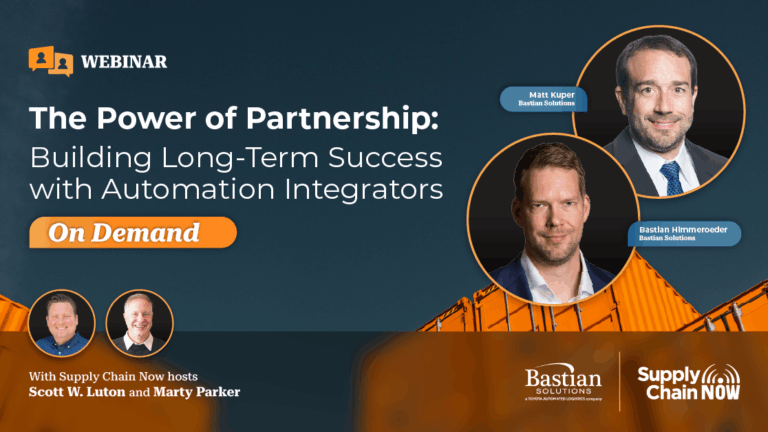
In a recent Supply Chain Now webinar, The Power of Supply Chain Partnerships, hosts Scott Luton and Marty Parker sat down with Matt Kuper and Bastian Himmeroeder from Bastian Solutions, a Toyota Automated Logistics company, for an in-depth conversation about how to unlock the true potential of automation through strong integrator relationships.

Here are a few key takeaways that stood out:

1. Strategic Partnerships Trump One-Off Projects

According to Bastian, the age of “one-and-done” automation projects is over. Today’s complexity demands long-term, strategic relationships between companies and their integrators—ones built on transparency, shared values, and a deep understanding of each other’s goals.

2. Culture Fit Matters as Much as Technology

Matt emphasized that cultural alignment is the first critical element in selecting an integrator. Shared values, open communication, and mutual respect ensure that the partnership thrives well beyond implementation.

3. Experience and Support Drive Success

Choosing a partner with the right industry experience and a commitment to aftercare and continuous improvement can make the difference between a system that simply works and one that evolves with your business. As Marty noted, “You get what you pay for—and aftercare is where that really shows.”

4. Plan for Quick Wins and Long-Term Growth

From retrofitting existing facilities to launching fully automated greenfield sites, Bastian Solutions shared how to balance measurable short-term gains with scalable long-term strategy—all without disrupting the customer experience.

5. Don’t Fear Healthy Debate

Perhaps the most refreshing insight? Great partnerships aren’t about constant agreement. True collaboration means challenging each other’s ideas to find better, smarter solutions.

Want to learn more?
Watch the full conversation for real-world examples of automation done right, including a case study with Polaris that tripled SKU capacity and boosted pick rates by over 50%.

Watch on demand: Register to view the webinar replay »
Related resource: Download Bastian’s Warehouse Operations Strategy Guide »

More Blogs
supply chain planning
Blogs
December 15, 2025

Uncovering Hidden Costs in Supply Chain Planning: Tom Moore of ProvisionAI on What Companies Miss

In today’s increasingly complex global supply chain landscape, Tom Moore keeps his message refreshingly straightforward: ProvisionAI helps large companies discover hidden costs and eliminate them. Organizations such as Procter & Gamble, Nestlé, and Unilever have leveraged the company’s technology to uncover and eliminate inefficiencies—particularly in transportation and warehousing—that traditional systems fail to detect. The outcome is significant and often delivers immediate savings. But Moore believes many of these problems stem from misunderstandings about the very technologies companies rely on.   Misnamed Systems & Misaligned Expectations Before the interview officially began, Moore reflected on the surprisingly inaccurate names assigned to modern supply chain technologies. ERP systems rarely plan resources across the enterprise, despite what their name suggests. Warehouse Management Systems, while certainly used in warehouses, don’t actually “manage” much at all. People behind keyboards still make most of the critical decisions. This disconnect in terminology shapes faulty expectations. Many organizations believe their planning systems will truly plan the supply chain, yet most tools merely react to demand signals. If ABC Company orders ten cases, the system automatically replenishes—without considering warehouse capacity, transportation availability, downstream implications, or cost-to-serve. Moore characterizes this as both an old problem and a new one, and it…
supply chain control tower technology
Blogs
December 15, 2025

Control Tower Technology: The Command Center for Modern Supply Chains

This post is written by our friends at e2open. E2open is the connected supply chain software platform that enables the world’s largest companies to transform the way they make, move, and sell goods and services. Moving as one.™ Learn More: www.e2open.com.   Global supply chains are under pressure like never before, and disruptions aren’t rare events anymore—they’re structural, constant, and often originate outside your four walls. A single weak link in your supplier network can ripple across production schedules, customer commitments, and brand reputation. The old playbook of reacting to occasional crises doesn’t cut it. To thrive in 2025 and beyond, companies need real-time visibility, predictive insights, and agile execution. That’s where supply chain control tower technology comes in.   What is a supply chain control tower, really? A control tower acts as the command center for your supply chain. It gathers and visualizes data, analyzes disruption impacts, and provides actionable recommendations before problems escalate. Advanced solutions can even automate responses to routine issues and enable cross-functional collaboration to ensure that decisions aren’t just well-informed, they’re executed across the supply chain as well.   Why control towers matter now Supply chain risk isn’t a passing cloud; it’s a thunderstorm that…