
Share:

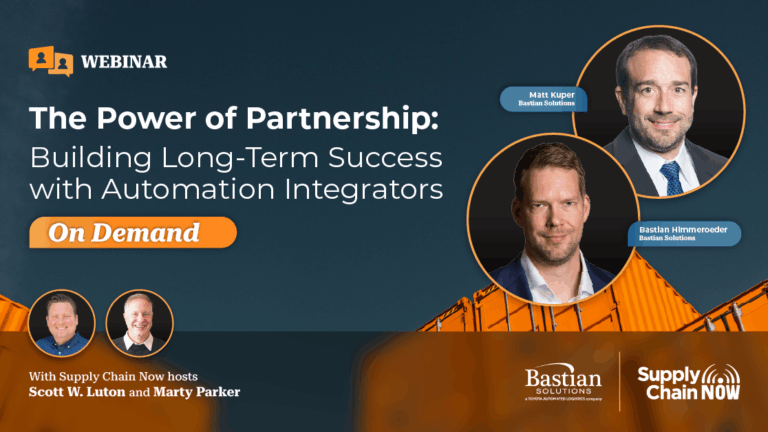
The Power of Partnership in Supply Chain Automation

Key Takeaways from the Supply Chain Now Webinar with Bastian Solutions

In today’s fast-changing world of logistics and manufacturing, one truth is clear: there’s no hiding from automation. Whether you’re a global enterprise or a growing regional player, success depends on choosing the right technology—and, just as importantly, the right partner.

In a recent Supply Chain Now webinar, The Power of Supply Chain Partnerships, hosts Scott Luton and Marty Parker sat down with Matt Kuper and Bastian Himmeroeder from Bastian Solutions, a Toyota Automated Logistics company, for an in-depth conversation about how to unlock the true potential of automation through strong integrator relationships.

Here are a few key takeaways that stood out:

1. Strategic Partnerships Trump One-Off Projects

According to Bastian, the age of “one-and-done” automation projects is over. Today’s complexity demands long-term, strategic relationships between companies and their integrators—ones built on transparency, shared values, and a deep understanding of each other’s goals.

2. Culture Fit Matters as Much as Technology

Matt emphasized that cultural alignment is the first critical element in selecting an integrator. Shared values, open communication, and mutual respect ensure that the partnership thrives well beyond implementation.

3. Experience and Support Drive Success

Choosing a partner with the right industry experience and a commitment to aftercare and continuous improvement can make the difference between a system that simply works and one that evolves with your business. As Marty noted, “You get what you pay for—and aftercare is where that really shows.”

4. Plan for Quick Wins and Long-Term Growth

From retrofitting existing facilities to launching fully automated greenfield sites, Bastian Solutions shared how to balance measurable short-term gains with scalable long-term strategy—all without disrupting the customer experience.

5. Don’t Fear Healthy Debate

Perhaps the most refreshing insight? Great partnerships aren’t about constant agreement. True collaboration means challenging each other’s ideas to find better, smarter solutions.

Want to learn more?
Watch the full conversation for real-world examples of automation done right, including a case study with Polaris that tripled SKU capacity and boosted pick rates by over 50%.

Watch on demand: Register to view the webinar replay »
Related resource: Download Bastian’s Warehouse Operations Strategy Guide »

More Blogs
Scope 3 Emissions
Blogs
April 15, 2025

Enabling Procurement Professions to Tackle Scope 3 Emissions

Special Guest Blog Post written by Memory Mathema   Tackling climate change is one of the defining challenges of our lifetime. Understanding the implications of decarbonization is imperative to eliminating the risks that come with taking a complacent approach. Our responsibility lies in understanding the impact of our operations and acknowledging the escalating urgency to transition to a carbon neutral future and reduce the environmental footprint of all business undertakings. This is not only right for individual organizations but for the good of the whole society. South Africa ranks 14th globally in carbon emissions and stands as Africa’s leading polluter. The nation’s energy intense economy highlights its crucial role in spearheading efforts to reduce the continent’s carbon footprint and achieve net zero goals. Outdated energy generation methods, particularly coal reliance for 80% of energy needs, overshadow the country’s vast potential in hydrogen, solar and wind power. Both public and private sectors are recognizing the need for sustainable alternatives and are transitioning towards greener energy sources, fostering a shift towards sustainable carbon neutral supply chains. Addressing Scope 3 emissions, which constitute a significant portion of global greenhouse gas emissions, is necessary to delivering carbon neutrality across operations. Organizations must entrench an…
parcel management software
Blogs
April 28, 2026

Parcel Management Software + TMS: The Shortcut to Lower Costs and Better Performance

This post is written by our friends at e2open. E2open is the connected supply chain software platform that enables the world’s largest companies to transform the way they make, move, and sell goods and services. Moving as one.™ Learn More: www.e2open.com.   Parcel used to be the lightweight cousin of freight: important, but not something that kept supply chain leaders up at night. Those days are long gone. Today, parcel volumes rival truckload execution in complexity, visibility requirements, and cost impact. For many enterprises, parcel management software now determines whether omnichannel promises are kept—or quietly broken—one late delivery at a time. The problem isn’t parcel itself, but where it lives. When parcel operates in a separate system from your transportation management system (TMS), costs creep up, execution gets messy, and performance suffers. Integrating parcel directly into TMS workflows turns shipping from a necessary evil into a strategic advantage.   Parcel management: from warehouse detail to board-level problem Parcel complexity exploded as e-commerce, ship-from-store, and direct-to-consumer models took center stage. More carriers, more service levels, more delivery promises—and far more returns—turned parcel shipping into a daily operational chess match. That complexity has consequences. Parcel spend now shows up on executive radar.…