[00:00:00] LeAnne Coulter: this market is all about risk, and it’s, it’s just not normal. The, the landscape has changed dramatically in really visible ways in recent months. So you’ve got expanded supply chain risk. It’s been growing for a while, but shippers really need to pay attention to their risk profile
[00:00:29] Scott W. Luton: Hey, good afternoon, good morning, good evening, wherever you are in this gorgeous world. Scott Luton here with you on Supply Chain Now. Welcome I’m really excited to kick off this new series called “The Problem Store.” And for it to make sense, let me share just a little bit of backdrop here today.
[00:00:45] Scott W Luton: So years ago, my oldest daughter, Brantley, would play this little recurring game. I think we’ve got an image here of, uh, Brantley and her fellow troublemaker, uh, Gracie, my two daughters here. So what Brantley would do is she’d pretend to be a consultant of sorts, and she would transform our playroom here at the home to something called The Problem Store, and she’d come up to me and Amanda and ask if there are some problems that we’d like her to solve for a fee, of course.
[00:01:12] Scott W Luton: Sometimes that fee could be paid in gummies, uh, some- sometimes it could be paid in other ways, but that name has always stuck with me. So today we open The Problem Store, where I’m envisioning a series of conversations where an incredible panel of experts tackle supply chain problems brought to them from our global audience, our SCN global fam.
[00:01:32] Scott W Luton: And of course, the series is gonna evolve, but our aim is for it to be a very practical, engaging, and helpful resource for busy professionals really across industry. Now, as you may know, we’ve got a deep stable of expert co-hosts here at Supply Chain Now, and they’re all gonna be leading different conversations via this series in the months to come.
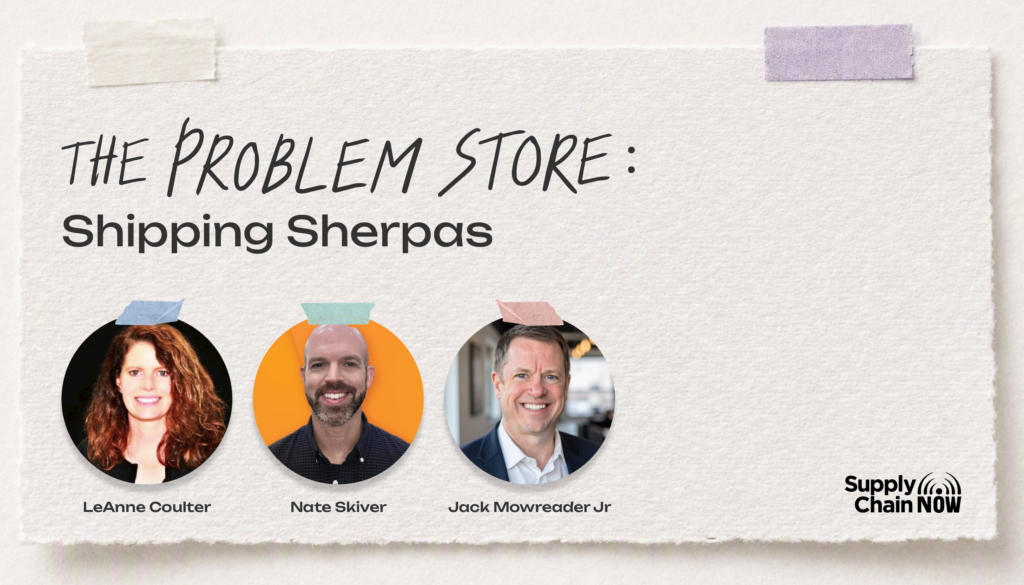
[00:01:48] Scott W Luton: But today, here at The Problem Store, we’re focused on all things shipping. And folks, let me tell you, we’ve got a trio of shipping sherpas to learn from.
[00:01:58] Scott W Luton: with all that as a backdrop, I wanna introduce our incredible panel, uh, starting with Jack Mowreader He brings more than 25 years of experience leading finance and operations, done some really big things in Final Mile and many other places. Jack has even served as a CFO five times throughout his career. He also spent six years in Amazon operations finance, uh, finance leadership, and he serves on an incredible new series here at Supply Chain Now called “The Collective,” led by the one and only Kim Reuter.
[00:02:26] Scott W Luton: So Jack is joined by LeAnne Coulter, a former executive with Penske Logistics and Schneider Logistics, where her expertise, strategic mindset, and execution ability, it moved mountains for customers and for revenue growth. She’s very active in industry. She leads Blue Wave Supply Chain. She also serves on a variety of boards and was recognized with the 2021 Women in Supply Chain Award.
[00:02:49] Scott W Luton: So LeAnne’s joining us as well. And Nate Skiver Uh, Nate spent tons of time, over 20 years or so, in parcel transportation, e-commerce, and really sharing helpful knowledge with others. Now get this, he built an $80 million parcel program from the ground up over about a six-year period. Man. He’s also led parcel transportation strategy for a $4 billion apparel retailer during part of his journey.
[00:03:15] Scott W Luton: So Ja- uh, Nate will be joining us as well. So as, as promised, folks, we’ve brought an incredible panel of been-there, done-that leaders here today, and the problem store is open for business. Let’s bring on Jack, LeAnne, and Nate Hey, LeAnne. Good morning. Good afternoon. How you doing?
[00:03:33] LeAnne Coulter: Great. How are you? Thanks for
[00:03:34] Scott W Luton: Wonderful. You bet. Great to have you here with us. And Nate, how are you doing, my friend?
[00:03:39] Nate Skiver: Doing well. I, uh, excited to be on here, Scott
[00:03:43] Scott W Luton: We are too. Uh, and Jack. Jack, how you doing, my friend?
[00:03:47] Jack Mowreader: Good morning. Doing great. Thank you
[00:03:49] Scott W Luton: So it is, uh, we’ve really been looking forward to this, LeAnne Nate, and Jack. And I tell you, the three of y’all get together, I think we can solve just about anything this, this world can throw at us. So again, we’re delighted to have you.
[00:04:00] Scott W Luton: But I want to start with this, LeAnne Nate, and Jack.
[00:04:03] Scott W Luton: So there’s a topic that comes around this time of year each and every year. It’s not, it’s not gonna be a full-blown fun warm-up question, but I got to get y’all’s yay or nay on this very divisive theme: pumpkin spice. Are you all in or all out? And Jack, your thoughts first
[00:04:24] Jack Mowreader: Well, being from the Seattle area, I’ve got to be all in. So you got to do one, you know, got to, got to get your pumpkin spice. Yeah.
[00:04:32] Scott W Luton: Okay. LeAnne he’s all in. How about you?
[00:04:36] LeAnne Coulter: Uh, I’m gonna play the hokey pokey. I got one foot in and one foot out.
[00:04:40] Scott W Luton: Okay.
[00:04:41] LeAnne Coulter: So, and it’s
[00:04:41] Scott W Luton: I’ma still
[00:04:42] LeAnne Coulter: degrees here today, so I don’t know. It doesn’t feel like fall yet.
[00:04:46] Scott W Luton: Man. Oh my gosh. Uh, well, I’m gonna steal that hokey pokey phraseology. That’s a good one. Uh, and Nate, uh, in or out? Do you care
[00:04:55] Nate Skiver: I don’t care that much because I’m not a coffee drinker, but, uh, generally I think I’m just going to be out. I’m not a big pumpkin much of anything fan, so I’ll just err on that side
[00:05:07] Scott W Luton: I’m kind of with you, Nate. And I’m not, I don’t have one foot, one out. I, I don’t, don’t care for pumpkin spice. I don’t love pumpkin pie. I know I’m, I’m, I’m odd like that. But, uh, Jack and LeAnne, y’all can have all that you want.
[00:05:20] Scott W Luton: today we’re gonna really break up Nate, LeAnne’s, and Jack’s expertise into four big segments: the macros, the setup, the operation, and the enablers. And LeAnne may have just had something to do with that framework. I love a good framework. But first, I want to do this. I wanna ask, uh, kind of an opening question to each of y’all.
[00:05:39] Scott W Luton: So, and Jack, I wanna start with you here. And when you look across this disruptive, rambunctious, you name it, shipping landscape right now,
[00:05:48] Scott W Luton: what’s the single biggest problem or maybe the overlooked problem that you think shippers gotta have on their radar? Jack?
[00:05:56] Jack Mowreader: Well, I don’t think you can have a decent conversation without talking about capacity and, you know, the shrinking capacity and how that’s gonna impact your business. And from a finance perspective, I’m always trying to figure out how, how’s that gonna hit my bottom line? Am I gonna, you know, is it gonna incur additional cost and, and risk to my network?
[00:06:13] Jack Mowreader: So
[00:06:14] Scott W Luton: excellent starting point. LeAnne what would you add to that?
[00:06:17] LeAnne Coulter: Uh, for me, this market is all about risk, and it’s, it’s just not normal. The, the landscape has changed dramatically in really visible ways in recent months. So you’ve got expanded supply chain risk. It’s been growing for a while, but shippers really need to pay attention to their risk profile
[00:06:35] Scott W Luton: Okay. Capacity, risk. And Nate, what would you add to the mix?
[00:06:39] Nate Skiver: I, I think specific to, to parcel, uh, it, it really has to do with the pace of change in the market. Um, parcel continues to evolve, change, I think more rapidly than it has perhaps ever. So you, you have more rate increases, more carriers enter- entering the market, carriers exiting the market. So you really have to, to stay on top of it.
[00:07:00] Nate Skiver: And I think if you do that, then you can really take advantage of some opportunities. And if you don’t, you are going to miss issues coming your way, whether it’s service or cost. So I would say staying on top of the, just the pace of change
[00:07:15] Scott W Luton: I’m with you. And if we don’t do that, kinda what you’re implying, uh, you know, we, we all have all these opportunities, I think, uh, at least in my journey, to either make our blind spot really be bigger or to be much smaller. And, and Nate and LeAnne and Jack by, uh, by not taking into account capacity and risk and this pace of change that Nate’s talking about, I think we’re unfortunately creating a bigger blind spot.
[00:07:39] Scott W Luton:
[00:07:39] Scott W Luton: So we’re gonna start to get into these four segments, uh, right? Got great framework. Uh, so tip of the hat to LeAnne here. So I wanna start with, well, a, a similar topic as this opening question we just posed to our, our panel, the macros. You know, before we talk about what shippers can control, let’s talk about all the things that we can’t.
[00:07:57] Scott W Luton: And LeAnne, I wanna start with you here on this two-part question. You know, how would you characterize the shipping market right now? And from where you sit, what external forces are really creating the most uncertainty for shippers?
[00:08:09] LeAnne Coulter: Yeah, there’s, there’s a lot out there right now. Um, you know, when I look at the transportation market, it is struggling mightily. And I was, I was thinking about, are we on the cusp of a crisis or really a painful transition? And I think it’s really in that painful transition space. But there’s a lot that’s changing that shippers really need to pay attention to.
[00:08:32] LeAnne Coulter: And to have a capacity-strained transportation market is highly unique, right? We’re coming out of a freight recession of three years. It’s been incredibly long, and the economics are brutal for carriers. So bankruptcies continue to climb, litigation costs. If a shipper isn’t paying attention to lawsuits and Supreme Court decisions that are coming out, um, their, their blind spot continues to increase.
[00:09:00] LeAnne Coulter: So all of these costs are being embedded inside of carrier operations, and small carriers, which make up the vast majority of providers that haul freight across the U.S., their costs are going up even more than the large carriers. So it’s all being baked in, so you’ve got economics that are changing and the floor is moving.
[00:09:24] LeAnne Coulter: So, you know, the rates that we’re looking at now, the capacity constraint, if demand starts to pick up, things are gonna get really interesting really fast
[00:09:34] Scott W Luton: Hmm. LeAnne what a great salvo. You know, have, have, has global supply chain been so interested in what the Supreme Court’s been up to in recent memory? I don’t remember the last time, so, uh, all right. So Nate, again, we’re talking about your take on the shipping market and those external forces creating the most uncertainty from where you sit.
[00:09:54] Scott W Luton: What do you, what, what’s, uh, what do you say, Nate?
[00:09:57] Nate Skiver: Well, I think in, in parcel it actually kind of depends on what you’re shipping. Uh, parcel, there’s just kind of a bit of a divergence in, in the market a little bit, and a lot of what gets attention, which it should, is e-commerce. So a lot of– That accounts for a lot of package volume. Uh, there are a lot of carriers, probably too many, that, that service that part of the market.
[00:10:20] Nate Skiver: But that’s good from a, a shipper standpoint. You, you have options. You have cost-effective options. You have carriers that can meet really specific needs, and that provides flexibility. So from that standpoint, I think e-commerce shippers are actually in a very good position to create value from, from delivery.
[00:10:43] Nate Skiver: On the kind of opposite side a little bit, if you’re shipping larger packages, you know, ones that are heavy, uh, maybe it requires special handling, you narrow down the, the number of carriers that can really effectively service that volume. It’s more than just UPS and FedEx, but those are the two primary ones, and they’ve been really focused on increasing, you know, yield, uh, co- uh, revenue per package and margin.
[00:11:09] Nate Skiver: And so you’ve got to be very, very on top of managing your costs tightly if you’re shipping, say, bigger, heavier packages. And so I think it’s just one of those things where if you’re not doing that, then again, kind of it’s a blind spot and you probably, uh, you know, have some, have some cost issues. But, um, if you are taking advantage of that, then y- you’re really able to kind of stay up on the market.
[00:11:37] Nate Skiver: Um, I think the other thing just from an external standpoint is, I mean, there’s some obvious ones, uh, don’t wanna go too broad, but, you know, it’s like geopolitical conflicts and tariffs. So from a parcel standpoint, really that’s increased fuel costs. Um, that is a, a, a massive expense burden for, for package shippers.
[00:11:58] Nate Skiver: And I think with that, you have fuel costs going up, you have rate increases coming along frequently from carriers. And so that’s really, I think, some of the, the biggest driver externally of, of uncertainty is just that cost volatility. And really, if you don’t see it coming, can’t do anything about it. And I think that’s a big
[00:12:18] Scott W Luton: Nope. And you’ll get hit by that train if you don’t see it coming. You know, the fuel’s so interesting. I was checking in on, on, on one of the fuel sites this morning, and diesel had come down just a smidge from the previous week. I want to say it was 6.38. It was like 6.50 last week. We’re seeing calls to release emergency, um, reserves, uh, uh, in other parts of the world.
[00:12:40] Scott W Luton: I tell you what, I’m, we’re h- I’m hoping we can get this diesel pricing in a headlock and, and, and, uh, get some control back. Uh, but Jack, we’re talking about how you would characterize the shipping market and some of the things creating uncertainty out there. What about from your view?
[00:12:54] Jack Mowreader: I mean, certainly, um, all great points from LeAnne and Nate. I, I think one of the things that underlies all of this, right, is the labor market. Um, I mean, obviously fuel. I mean, I just drove by, uh, uh, retail in the Seattle area is about 7.20 a gallon for diesel. I mean, that, um, but we’re also seeing, you know, pressures on labor force, um, CDL drivers, ’cause most, I mean, your freight’s gonna come and touch that, that piece, um, throughout the network.
[00:13:23] Jack Mowreader: And so, um, are we gonna, are we gonna see changes in the labor market, and are we getting our last mile delivery? Uh, are they being impacted as well with the labor market? And, and so I think those are, those are kind of the macro situations. And, and talking about those are things you ne- necessarily can’t control, but what you can control is, is we’ll talk a little bit more about relationships later in the program, but how are you posturing yourself to weather these storms and, and do you have the right partnerships that are, you know, they’re taking those things into consideration?
[00:13:56] Scott W Luton: Jack, straight call out. And you know, um, it’s interesting because some folks are more impacted than others, right? And for some folks, it might be a little bit more stable than other operations. And to your point, we’re gonna be talking with this incredible panel about things you gotta be doing right now for when things fall off the table even worse.
[00:14:14] Scott W Luton: And Nate and LeAnne isn’t it interesting, uh, y- Jack was just sharing his observational diesel. I guess depending on where you sit and what part of the country or the world you’re in, s- at 6.38 a gallon might be a good deal compared to the 7.20 out west where Jack is. Um, okay. So, uh, Nate, I’m gonna circle back to you here, you know, as we’re still in, uh, the macros segment here.
[00:14:37] Scott W Luton: So shipping costs, we know are much more about, um, much more than just about the base rate. You were kind of speaking to that in your, in your last response between the surcharges, accessorials, I can never say that, claims, frauds, theft. Theft, oh my gosh, freight theft. Service failures. Where are companies, in your view, taking on costs or risks that they really may not fully appreciate, or it might be in that blind spot we were talking about, Nate
[00:15:02] Nate Skiver: parcel and surcharges, so surcharges basically is, is the answer. And, and with parcel, uh, there are dozens of surcharges that can apply to a package. We’ve already talked about some of them.
[00:15:14] Nate Skiver: Fuel surcharge, that applies to the aggregate of all the other charges, by the way, so it’s kind of compounds. And it, it really is a, a part of the expense that is, it’s dynamic. It, it changes. There are criteria changes based on how large your package is, how much it weighs, where it’s going to. And so it really requires, I think, a couple of things to hopefully develop some internal expertise to actually understand what drives those surcharges, and then being able to negotiate contracts with carriers more effectively.
[00:15:55] Nate Skiver: But then also it’s something that it’s so complex and it moves honestly so quickly that engaging, having partners in place, whether it’s a, a parcel spend management, uh, provider or, or consulting, you know, partner to bring in other market expertise also and advise and, you know, serve as a, a thought partner to help you manage that expense.
[00:16:22] Nate Skiver: Uh, because it’s, it’s been something I’ve been in parcel for about 20 years, and I already mentioned the pace of change. It’s faster than it’s, it’s ever been. And the complexity of that pricing is not only more complex, but it keeps getting more so. And, and that just creates, uh, a lot of challenges for many companies who, if they don’t have the internal expertise or resources, uh, again, it’s an expense that grows significantly before you identify it
[00:16:55] Scott W Luton: Hmm. Yeah, compound interest is a lot m- lot more fun than compound pain, uh, right? When it comes to supply chain pain. All right, so Jack, weigh in there. We’re talking about cost risk that may be, uh, just off our radar, or at least maybe not fully visible
[00:17:09] Jack Mowreader: Well, I think Nate really nailed it. Um, there’s so many different components to what you actually pay, and I mean, there’s gonna be the tangible ones that you get billed for that you, you really want a solid audit process. Am I, am I getting– Do I understand my agreement? ‘Cause a lot of times, depending on who’s signing up your agreements, they may or may not understand all of the components of that.
[00:17:31] Jack Mowreader: So when you get those bills, making sure you’re breaking it down and doing it in real time status. I don’t know how many times I’ve gone back and, and, and all of a sudden it’s like, “Wow, I had no idea for the last six months I was paying this fee.” And it, it turns into a, a very difficult conversation, right?
[00:17:49] Jack Mowreader: And a lot of those are due to your own operations, too. So it’s communication internally. It’s saying, “Hey, what you just did cost us a bunch of money because, um, we’re getting charged this,” right? And, and I think that just having a good audit process, understanding what your agreement is, and then looking for ways to mitigate that with your, your shipper and, and having that conversation
[00:18:12] Scott W Luton: Well said. And we, we spent a bunch of time on our show yesterday really just making the great point you were just making. And hey, LeAnne wasn’t that spoken like a five-time CFO there from Jack? I loved Um, all right. So LeAnne when it comes to these costs and risks, what would you add to what Nate and Jack has shared with us?
[00:18:30] LeAnne Coulter: I think what’s interesting is, um, you know, we’ve got such a great parcel perspective, you’ve got the great finance perspective. And when you’re talking about transportation, it, it really becomes mode dependent. There’s so many differences across the modes, and expertise becomes really important. So I think within shipper organizations, understanding, um, how the modes that they use most frequently, what are the cost structures that their providers are operating under, what costs are important inside of their own organization, and how can they continue to review processes to really keep those surcharges and the accessorials under control is really important.
[00:19:14] LeAnne Coulter: Um, the other aspect of this when I think about companies taking on cost is with the current capacity constraint, there is this decision on do I, do I bring in and start up my own fleet? Do I expand my private fleet? That comes with a whole host of changes, like I talked about previously, from a risk perspective, from insurance and training and everything that carriers and brokers are having to think about now with this changing landscape, a shipper’s gonna have to make sure that they are accounting for all of those variables as well
[00:19:53] Scott W Luton: Mm. Uh, because, uh, yeah, I like how the three of y’all complement each other, and that was kind of some of our, our, our hope as we were designing this, this, uh, first installment. But you’re right, LeAnne, the, the, the mode, the structures, the priorities, the objectives. Uh, well said there.
[00:20:08] Scott W Luton: All right. So LeAnne, uh, Nate, and Jack, uh, we just kind of wrapped the macros, right? And I really appreciate y’all’s perspective there.
[00:20:15] Scott W Luton: Now we’re gonna move more into the setup.
[00:20:18] Scott W Luton: That’s right. So moving from the market to really the network itself. So, uh, Jack, I’m gonna start with you here. If resilience is the goal, and however you define resilience, every organization I think has may- maybe a different definition, what does good shipping network design look like today? And how should companies think about things like carrier mix, sourcing strategy, and while, all while maybe avoiding those single points of failure?
[00:20:43] Scott W Luton: Jack
[00:20:44] Jack Mowreader: Yeah, I think LeAnne really touched on this and I’ll, I’ll maybe drill into it a little bit more, but really it’s what are your objectives and, and are there other modes that can get you where you need to go? And you have maybe a primary and a secondary. I mean, good example, when I was in the truckload world, we’d, um, you know, we’d, we could use train cars and, and we could, we could augment our, our, uh, over-the-road fleet by using train.
[00:21:10] Jack Mowreader: Now it, it took a little longer, but, and there was, you know, challenges bringing the containers back and forth. But at the same time, um, just really knowing what your network really needs and having those conversations internally that says, “If I get it there two days later, is there a way to offset some of our total costs versus just the cost of shipping?”
[00:21:30] Jack Mowreader: So taking a look at that, that full supply chain and really understanding what you need and not paying for any more than you have to. And then what’s my next best option? And having that, that option available to kinda just pull off the shelf and, and that’s, that’s the kind of conversations you need to be having internally.
[00:21:49] Scott W Luton: And not just once a year or once a decade, right, Jack?
[00:21:53] Jack Mowreader: Yep. Be ready. Ha- you know, have your playbook on your arm, right? And, and be able to kind of audible if you need to. But, um, if, if you don’t have a place to shift, you’re gonna be in trouble.
[00:22:04] Scott W Luton: Yep. All right, LeAnne, what would you add? We’re talking about, uh, good shipping network design and avoiding those single points of failure. Your thoughts, LeAnne
[00:22:13] LeAnne Coulter: Yeah. When I think about network design, you, you have your physical structure in place, right? You’ve got your warehouses, distribution centers, manufacturing. Those don’t move very easily, and it takes a lot of CapEx to address that. What does provide resilience is your transportation network. Um, and I always think of that as like a rubber band.
[00:22:35] LeAnne Coulter: And I spent a lot of time in automotive, and boy, that rubber band gets stretched right to the end in that just in time. So, and that comes with trade-offs, right? And it, it really comes with a, a cost trade-off. So when thinking about transportation, I always look at what are your manufacturing, distribution, customer service policies, because those are, those are really going to define how your physical network functions and operates, and how much of that transportation rubber band you need to stretch in order to meet those objectives.
[00:23:12] LeAnne Coulter: And by doing that, like you, you really need to identify where do you have competing priorities, where are the KPIs in operations or manufacturing going head-to-head against inventory planning or material handling, um, or even your customer service policies, and how are you going to resolve those opposing forces to really design a network that meets the needs of your business
[00:23:41] Scott W Luton: Hmm. Leanna, I bet you’ve got some stories from automotive.
[00:23:44] Scott W Luton: That is a tough… Oh my gosh, that’s a tough industry. I, I, I dabbled in that indirectly, and I was like, “Hey, I’m good. I’m good.” Uh, all right. So Nate, uh, your thoughts on these topics we’re talking about when it comes to, uh, network design and all
[00:23:58] Nate Skiver: Well, I think with, with parcel it– this is gonna sound kind of obvious, but you have to design it with, with purpose and, and be intentional about it. And, and so what I, what I mean by that is actually establish goals, metrics for your program, whether it’s increasing delivery speed, uh, having a carrier in place to meet a specific, uh, or to support rather a specific volume segment, um, introducing, you know, carrier diversification to add flexibility or, or mitigate risk.
[00:24:33] Nate Skiver: You should define that a-and actually thoughtfully source the, the carriers and solutions that meet those needs. But what a lot of companies traditionally in the past have done with the parcel is kind of defaulting to the industry standard options like UPS or FedEx, uh, who are outstanding service providers, and they can do most everything pretty well, but they might not provide the, the optimal solution for all the specific needs you have.
[00:25:03] Nate Skiver: And to me, that’s not really a designed solution, it’s more of a, of a compromise. And I, I think it’s being very intentional with that design and then working from there around, uh, getting the providers in place that, that, that actually meet those needs. But back to the UPS and FedEx thing is that also is kind of a, a legacy strategy I think that is, is slowly fading away of working with, say, just one of those carriers.
[00:25:32] Nate Skiver: Uh, it’s easier. Uh, there, there’s not as much effort, uh, in-involved in, you know, a single provider, but I don’t know where else in an organization, say retail is my background, that you just put all your eggs in one basket and it, it– and everybody’s okay with that. Uh, but parcel has been kind of an exception historically where a lot of companies did that.
[00:25:55] Nate Skiver: But as I mentioned before, there’s so many options in the market now. Uh, there’s technology to optimize across, you know, delivery speed and cost to where you don’t really have an excuse to just work with a UPS or FedEx if they don’t meet your needs the way that they should. And so I think that’s where, um, diversification comes into play, particularly with parcel in, in really avoiding those single points of failure
[00:26:25] Scott W Luton: That’s great perspective. And, and we, we have so many options other than, you know, some of the primary players that you mentioned, uh, these days as well. Um, okay.
[00:26:34] Scott W Luton: this next question I wanna pose to y’all was partially inspired by a quick conversation and really a check-in I had with, uh, a gentleman named Tom. And Tom is in, uh, a retail space that is less impacted with what lot, lot of stuff we’re talking about here today. And, and he was like, “Scott, is there something I should be doing here in the better times in case, you know, the other shoe were to drop?”
[00:26:57] Scott W Luton: Right? So I, I wanna kind of go around the horn on this question here, because
[00:27:01] Scott W Luton: I wanna shift over to relationships. We all know how relationships power this industry. So if all of y’all can talk about the strength of shipper-carrier relationships, and then kind of to Tom’s question, you know, what should shippers be doing during the good times or the more stable times, or at least the least uncertain and the least unstable times maybe, to build those relationships to be stronger and more fruitful and productive when things are even more challenging.
[00:27:27] Scott W Luton: And LeAnne I wanna start with you. This, I know this is a big question, but let’s start with your perspective.
[00:27:31] LeAnne Coulter: Yeah. So if you start with the basic question, are relationships with your transportation providers important? Yes, they’re critical. Because with- without them, your customers won’t be satisfied, right? So it should not be transactionally based. I’m gonna go even more basic though, and talk a, a little bit about shipper of choice.
[00:27:55] LeAnne Coulter: So, and this gets into what you can do every day, rather, whether it’s good or bad times. But let’s just think about the driver experience. You think about your customer experience, you think about your associate experience. The driver is another one that interacts with your people, interacts with your facilities, and at many times is the face to your customers. And what I find still disturbing and disappointing is the number of facilities, organizations who deny drivers access to restrooms, temperature controlled spaces, water, coffee, things like that. So when we talk about relationships and what’s important, it really needs to even step back to these basics.
[00:28:48] LeAnne Coulter: Take a walk, see what it’s like. What is it like to be a driver coming into your facilities? So that, that’s one piece. Now, if I bring it up and you start to talk about strategic relationships, your carriers are in c- in interacting with so many different networks and companies, and they see so many different ways to solve problems, that they can be a wealth of information to you and the professionals within this space.
[00:29:18] LeAnne Coulter: And what I’ve seen work really well is shippers who are very focused on their core carrier groups, regardless of mode, across all modes. And then the ones who do it really well, they have carrier councils, and they engage at executive levels, and they really bring transportation into their business. They treat transportation strategy as supply chain strategy. And I think that’s just so critical. It’s a… And it’s such an easy thing to do, and you can do it in the good times, and it pays off dividends
[00:29:52] Scott W Luton: Hmm. You know, I wanna go back to your first point. Uh, uh, I really appreciate all your response, but the, the, your comments around drivers. It’s unbelievable t- unbelievable to me that the widespread mistreatment of one, uh, of it really any, any contributor to, to, to global business, but to such a critical big time workforce that makes what we do happen every single day.
[00:30:18] Scott W Luton: We’ve got to fix that as an industry, LeAnne I’m so glad you called it out. Um, all right, so Nate, we’re talking about relationships, and we’re also talking about what should, you know, if, if you’re not in the Armageddon of supply chain and things are a bit more stable and you’re kind of thinking, “Okay, what should I be doing?”
[00:30:34] Scott W Luton: Nate, some of your thoughts there.
[00:30:36] Nate Skiver: Well, I mean, I think in, to kind of echo a little bit of what LeAnne said, just on the, the strengthening of the relationship is bring your service providers, your carriers kind of into your business and, and help them understand it. Because I think, and that goes actually both directions, but, but in doing so, then th- they start to understand how, like, the, the criticality of what they do, uh, to support your business and your customers, and they become more invested in that.
[00:31:10] Nate Skiver: Um, and I think for just from a kind of managing or engaging within the relationship, e- engage, provide feedback, uh, when, when you don’t need something necessarily, when you’re not asking for, you know, another last minute trailer or something, but actually just, um, reaching out, providing feedback, can be constructive sometimes, but positive, you know, feedback as well, and acknowledging the value that they provide on a consistent basis.
[00:31:40] Nate Skiver: And again, not just being reactive, reaching out only when you need something. And I think just, and similar to, to what LeAnne said as well, is, is having a, a framework and a process for that. Actually just a regular meeting cadence, um, where it’s open, honest conversations, uh, as you go along. So if, if you do that, then when the issues do come, because they’re going to, um, it doesn’t have to be a, a, a massive escalation.
[00:32:12] Nate Skiver: There doesn’t have to be as much, you know, emotion involved, and you can almost handle it within that framework that you’ve already developed. And, uh, there’s just, I think really sets both parties up to succeed if, if you do it that way. And conversely, if you don’t, I, I really think there’s just, it just builds tension and, uh, you end up one side or both with compromised results
[00:32:39] Scott W Luton: You know, it’s, there, there’s a human element is the point you’re really driving home. You know, if, if one person picks the phone, you get a call only when things are bad. That’s the only time you ever hear. Naturally, who’s gonna always wanna take that call, even if they should and need to? I love the pro- the proactive investment of rapport and relationship, you name it, into, um, into the ecosystem.
[00:33:02] Scott W Luton: all right, so Jack, let’s finish this before we move into the operation. What would you add to what Nate and LeAnne have shared here?
[00:33:09] Jack Mowreader: Well, I, I think they both nailed it. I mean, part of this is just making sure that you really are in lockstep with whoever your strategic partners are, having those quarterly meetings, making sure you’re discussing things. And, I mean, one thing that, that I always like to do is tell me the risks that you’re managing within your business so you’re getting another layer down of that decision-making, not just who you’re picking and, and mitigating maybe a secondary carrier or sec- secondary shipping option, but how are they mitigating it?
[00:33:39] Jack Mowreader: And, and then also being able to ask them the question is, like, “How, how is it working for us? Am I a good partner in this situation? And what, what’s tough?” To, to kind of the point LeAnne said, “Do I make the driver sit on the street, um, or can they park in my lot overnight,” right? Um, “Do I make it hard if there’s a delay or they’re early to get into my dock?
[00:34:02] Jack Mowreader: Do I make them sit there for a long time? Are my people respecting them?” Right? All of these things, right? When you, when it comes down to it, it’s like, does that driver wanna take that load to your facility? And are you, are you an enabler? Are you, are you, um, you know somebody that’s like, “Hey, only if I have to am I gonna go to your, your place,” right?
[00:34:22] Jack Mowreader: And, and really understanding what that is and working internally to be the shipper of choice, uh, you know, you know, the customer of choice, right? And, and I mean, that goes a long ways, um, to do b- developing those relationships, and then y- that gives you leverage in the negotiation, right? It’s like, “Hey, I know that your guys aren’t being held and they can turn on that next load, so, um, I, I need a little h- favor here on the, on, on my, uh, negotiation.”
[00:34:49] Scott W Luton: Yep. Yeah, if you’re really, if you’re really putting action and results behind these labels like, uh, um, uh, c- um, uh, the customer label you just mentioned, a, uh, customer of choice, right? If that’s more than lip service, to your point, that’s, that’s business, uh, carriers wanna have, right? And it will add, uh, an extra dy- dynamic to the negotiating conversations.
[00:35:13] Scott W Luton: Great point. Um, okay, so
[00:35:16] Scott W Luton: we’re gonna transition over to the third segment, uh, the operation. And, uh, you know, after we, we’ve talked about the network, we’ve talked about the relationships, we’ve talked about the, the macro and some things outside of our control, uh, kind of a- a- a- across, uh, different, uh, channels of shipping.
[00:35:35] Scott W Luton: So Nate, what are some of the biggest mistakes you see companies making around process, uh, design, insourcing versus outsourcing, and really when it comes down to it, day-to-day shipping execution, Nate?
[00:35:50] Nate Skiver: Well, I think with parcel it’s, it’s a kind of a balance of, uh, deciding to take on the right amount of complexity. Um, and in, in doing so, it’s, it’s determining really kind of back to that, uh, network design of, of, of designing it with an intent, but then allocating the right resources. So whether that’s, you know, personnel, I’m a bit biased, but I, I feel like, you know, parcel kind of gets, even though it’s really important and within a lot of, especially on the retail side, within a lot of organizations as far as personnel, it’s usually pretty light.
[00:36:31] Nate Skiver: And I think so resourcing it appropriately because there can be a lot of value driven through the program. So that’s where I think, uh, at times there aren’t enough resources or the right resources because that can also be technology and external partners. And when that happens, uh, what I’ve seen is they’re not dedicating the right resources or enough resources because they’re actually avoiding the complexity.
[00:36:59] Scott W Luton: Right they’re, they’re keeping it simple, whether it’s keeping it to two carriers or, or, or three, whatever it is. And so that’s where I think it’s, it’s just being willing to dig in, determine what that complexity is and if it’s going to generate the amount of value that you need, and then resourcing it appropriately.
[00:37:19] Nate Skiver: Um, I think the other part of that though, is just from a, um, I don’t know, kind of balancing some of the different aspects of it is you, you have to determine what your priorities are. Right. and, and
[00:37:38] Scott W Luton: can’t be a priority.
[00:37:39] Nate Skiver: exactly. So determine cost, service, uh, customer experience, which one is the most important? Uh, what is it that is needed to hit the metrics hopefully that you’ve defined for, for that, uh, specific, uh, area?
[00:37:57] Nate Skiver: And then allocate those resources, measure the results, find gaps along the way, repeat the process
[00:38:05] Scott W Luton: Hmm. You know, I hate to use a cliché, but your perspective here just, you know, you gotta rip the Band-Aid off. I know that we’ve been doing certain things for years and years and years, and they work most of the time or… But, you know, we gotta be having these conversa- I think Jack put it, you gotta be, you know, taking your options and taking your questions into almost every conversation, especially when things are moving so fast and they’re evolving and innovating and, or, uh, just being disrupted so fast these days.
[00:38:37] Scott W Luton: Um, so Jack, what would you add to Nate’s perspective there, especially when it, you know, the mistakes companies are making, in some cases, those unforced errors to, to kind of borrow from the, our, our ten- our friends in tennis. Your thoughts, Jack
[00:38:52] Jack Mowreader: And, and we, we started kind of talking about this technology space, and I think that it’s really good to have, um, those goals and objectives on how you’re gonna interface with your partners, what information you’re gonna share, and making sure that it’s the right information, to Nate’s point. Is that gonna drive your KPI or are you just asking it just to ask?
[00:39:12] Jack Mowreader: Um, I’m, I’m thinking about exception reporting and making sure, especially maybe you have perishable goods, um, you need to know real time where they’re at and, and be able to react. I mean, that’s much different than something that’s a staple that, that, um, has a shelf life that, that, um, if it gets lost in, in the transition, you, you deal with it differently.
[00:39:32] Jack Mowreader: So really understanding your business, what’s really key to you, and so that you can make quicker, more timely decisions. And, uh, I’ll echo Nate’s, is that you have to, you have to resource that, um, so that you can react and in real time, um, if necessary, and, and make the right decisions. ‘Cause early decisions, um, you know, are, can, can save a lot of money, right?
[00:39:56] Jack Mowreader: Um, indecision or lack of visibility can really cost. Um, I mean, I remember, you know, we’re gonna be coming into peak season, especially perishables. I, I know that, um, you know, if the network gets pressed and you’re starting to see delays, I mean, that’s just, you know, throwaways and, and it’s a bad customer experience and it’s also, it’s very costly.
[00:40:17] Jack Mowreader: And so you, you wanna see those things early so that you can react and have those conversations.
[00:40:22] Scott W Luton: You know, to one of the points you were making, shipping socks is a, is a good bit different than shipping petunias. all right, so LeAnne, your thoughts on some of the mistakes that we’re making out there?
[00:40:31] LeAnne Coulter: I think this conversation around resource allocation is really important. Um, understanding if, if you’re going to insource, if you’re going to do functions internally, then are you willing to, as an organization, invest in the technology and invest in the people resources in order to do that exceptionally well?
[00:40:56] LeAnne Coulter: Because you need to be able to do it better than providers who are experts in this space, right? To really make it– If it’s going to be a core competency, then, then invest in it to be a core competency. And if it’s not, then vet providers and really understand what they can provide to your organization. I think the, the other thing, um, for me in this space is broken processes, broken process steps, right?
[00:41:23] LeAnne Coulter: Where you’re introducing like a transportation process into a distribution organization, and all of a sudden you’ve broken the transportation process that order to cash, and it doesn’t work anymore. And now all of a sudden you’re like at 25% cost leakage because you can’t trace anything any longer, and you don’t know where your risk is.
[00:41:44] LeAnne Coulter: So I, I always look at process. What’s the end-to-end? Where are there competing factions in place? And where are the KPIs really bumping heads with each other? And resolve those, because then that’s going to lead to improved service, and it makes your supply chain more resilient
[00:42:02] Scott W Luton: Hmm. Yeah, I’ll tell you that one of the, one of your comments you mentioned on not knowing where your risk is, that’s a bad day, that’s a bad week, that’s a bad year. And, you know, going back to that blind spot analogy we’re s- you know, sharing on the front end, uh, there are no shortage of organizations and, and supply chain leaders that are, that, uh, don’t have nearly as much risk visibility, I’ll call it, as that they should, and as, as we can in this era, in this incredible supply chain, the golden age of supply chain tech.
[00:42:31] Scott W Luton: Um, all right, so Jack, coming back,
[00:42:33] Scott W Luton: we’re gonna make one more question here around the, um, operation, and then we’re gonna move into the enablers. So we’re gonna have a fast and furious finish. You know, lots of trade-offs, Jack, lots of trade-offs we want, right? How would you advise leaders out there, uh, in terms of their ongoing efforts at balancing cost optimization, operational excellence, customer sat, and of course resilience and whatever that means to them, without optimizing one while costing, you know, at the expense of all the others?
[00:43:02] Scott W Luton: Your, your thoughts there, Jack
[00:43:04] Jack Mowreader: Yeah, a lot of that kind of just goes back to LeAnne hit those, right? It’s really understanding where those priorities are competing against each other and really having good solid, um, conversations around what’s your total cost of shipping, um, your soft and your hard costs, and, and really prioritizing what’s most important.
[00:43:27] Jack Mowreader: Is my customer experience important or am I– is my bottom do- you know, dollar, uh, most important? Because I think sometimes if you have lack of clarity internally, the– you’re at a lose-lose situation. You can’t win because, um, you, you just aren’t aligned internally. And so I would say go back to the drawing board, make sure your priorities are clear, and then just start layering in, um, those, those protections, right?
[00:43:52] Jack Mowreader: So if, if you need better service, maybe it’s a dedicated service provider or it’s, um, you know, there’s other things that you can do that build in the network to, to really protect your customer. Or if you’re just looking to, to cut costs, then maybe you’re farming it out and you’re taking some risks, um, because you’re, you’re, you know, you’re contracting out the lowest bidder.
[00:44:14] Jack Mowreader: So, um, just really getting alignment there
[00:44:17] Scott W Luton: And alignment across the organization. Sometimes we can kind of tee up our team to be motivated by different factors. Um, LeAnne, he, he mentioned, uh, you, you touched a little bit on this in your last response, but when it comes to balancing those trade-offs, your thoughts?
[00:44:30] LeAnne Coulter: So I, I think of it as a three-legged stool. You ever walk in, you sit down, you’re like, “Whoa.” So if one of those legs, they all need to be in balance, you’re gonna fall over. And this, the same thing happens here. I think Jack absolutely hit it. And are, are you a cost leader? Are you a premium shop? Are you a service leader?
[00:44:52] LeAnne Coulter: Because each one of those then determines how the other legs of the stool need to function. So if you’re gonna be focused on service, it’s going to cost you more in order to deliver that service. So those, those areas, those three legs need to be aligned
[00:45:08] Scott W Luton: Yep. And, uh, we’ve all probably sat, um, uh, as an analogy and maybe even in real life, uh, the La-Z-Boy just tips right on over, and it happens, uh, in our supply chains, too. Nate, your thoughts, these trade-offs, these, this, this, uh, uh, balance we’re trying to keep. Your thoughts, Nate
[00:45:27] Nate Skiver: I think the only thing I have to add, because I think the, the prioritization, uh, really defining what truly is im- the most important thing, I think, um, Jack and LeAnne hit that very, very well. I think building on that then, as you go along, measuring results against the metrics, KPIs you have in place. And when you identify some, some gaps, which usually that means you’re, you’re substandard on some metrics, but there could be you’re overperforming.
[00:46:00] Nate Skiver: If, if, uh, you have certain metrics on delivery speed or like in e-commerce, you know, on-time delivery, and you’re exceeding those metrics by 2% or 3%, you might have room to actually bring that down and save money. So, so it’s something that those metrics aren’t just set it and forget it. Uh, and, and actually, uh, along the way, they might evolve to where your priorities could change.
[00:46:30] Nate Skiver: Maybe not dramatically to say, uh, you, you go from something, you know, a company that’s highly focused on customer service and then pivot to we’re, we’re low cost first, but they, they might evolve a little bit to where you actually have to make some adjustments. And so you need some, some flexibility, not to completely flip the priority, but at least to identify when you have some opportunities to make some small adjustments that actually might provide some bottom line value
[00:47:00] Scott W Luton: Yep. And opportunities abound. Uh, even when we don’t think there’s opportunities and options out there, at least in my experience. Um, okay. We’re gonna jump into enablers, and then I got a hypothetical. We all love hypotheticals, right? But I got one I’m gonna throw at y’all, So enablers, right? Um, things that are helping us navigate successfully, uh, technology or otherwise. And it’s really interesting, LeAnne Nate, and Jack, I don’t think we’ve mentioned AI. We may have snuck it in one part so far. We’re gonna touch on that here in a second. But LeAnne at a, in a bigger sense, so w- what do you see that separates companies that really can intervene and kind of what Jack was talking about in real time, you know, catch the things in real time, address them in real time, versus, especially when things go wrong, versus those companies that catch the problem long after, uh, it’s happened or lo- long after, uh, they would’ve had more opportunities and more options.
[00:47:54] Scott W Luton: What do you see that separates those two scenarios, those two companies, LeAnne
[00:47:58] LeAnne Coulter: Yeah, I really see this in like a, a five-stage maturity model, um, that I work with customers on detect to decide. And what we’re talking about is really when you have a lot of signals coming in, you have visibility. So you have information coming in, but you don’t have the decision structure in place. And so everything looks like Groundhog Day, which doesn’t help anyone and it’s incredibly frustrating.
[00:48:28] LeAnne Coulter: So y- you know, the companies that do this really well, they’ve gone through escalation processes. They’ve identified their decision structure and the decision authority that goes along with it, and they follow it and they stick with it. Additionally from there, then they’re, they’re constantly pulling in five whys when issues do come up.
[00:48:48] LeAnne Coulter: Because they will, no matter how well you’re operating, something will happen. It’s just the nature of the beast. But it’s how quick do you learn from it? How quick do you adjust your operations and your decision-making model? Because the whole thing is around delivering decision speed and making that very systemic, that review of failures and adjusted, adjustment to your decision speed.
[00:49:14] LeAnne Coulter: That’s where I see companies really excelling
[00:49:17] Scott W Luton: Nate
[00:49:19] Nate Skiver: Well, I think to, to build on to what LeAnne said, and actually the, the framework is, is great because, uh, it, it might not work if you don’t have the people. And, and that’s what I, I think is, is, is really key to it. Uh, that framework then enables the, the personnel, if you have the right personnel with the subject matter exper- expertise to quickly interpret whether it’s the, the data, you have visibility to the issue, to quickly diagnose, understand, and then action it and not just, you know, identify it and kind of, you know, blindly walk through maybe whether it’s a process or, or kind of taking, uh, the information that you get at face value.
[00:50:09] Nate Skiver: And I, I think that’s where maybe there’s some opportunity sometimes is, is just not forgetting that, that human element. You, you do need people who know what they’re doing and who are, are able to think critically in those, uh, situations to then, you know, make the decision or if they’re informing others to make the decision.
[00:50:30] Nate Skiver: But, uh, the people aspect, I think is, is highly important as well
[00:50:34] Scott W Luton: Okay. So, uh, LeAnne and Nate, uh, amongst other things, Jack, they really pointed to the talent factor, uh, in this scenario, where you got some companies that, uh, can catch things real time in the moment and when they’ve got more options or maybe even get out ahead, as we were talking about proactively earlier, or, uh, those that just kind of react or observe or me-meander.
[00:51:00] Scott W Luton: That’s always the word that comes to my mind. Jack, your thoughts
[00:51:03] Jack Mowreader: Yeah, and I, I think this really ties back to your, your strategic partners, and I, I kind of lean on that. Even if you have a really small organization and you don’t have this big supply chain department, you can really outsource a lot of that expertise. I look for my suppliers, um, to be thought partners with me, and if they understand my business and I understand theirs, we can, we can do those things LeAnne talked about instead of escalating to me.
[00:51:30] Jack Mowreader: It’s like, “Hey, when this happens, why don’t you go through these actions before you even have to contact me? ‘Cause now you understand my intent, and we’ve had that discussion.” So this doesn’t have to, you know, pertain to large organizations that have huge departments. You can use that with a strategic partner, and they can, they can act on your behalf with your, your outcomes in mind, right?
[00:51:52] Jack Mowreader: So, um, I think, um, understanding that and having those, those really strong bonds will really enable, um, you especially, you know, when you come into a fourth quarter that gets really busy, um, you want all the minds synced up
[00:52:07] Scott W Luton: Mm. And you know, as some, some will say out there, visibility is not enough these days. I know we’re still looking for more visibility in, in different tiers and levels and in different parts of organizations, but we gotta have solutions and answers and, and, and, and recommendations. Um, okay.
[00:52:23] Scott W Luton:
[00:52:23] Scott W Luton: so when it comes to AI, right, I, I really, I know y’all are gonna keep it real here. I know y’all at least well enough to know you’re gonna, uh, uh, keep it real, keep it frank, and, uh, avoid the hype, ’cause there’s lots of hype out there. When it comes to the, what AI can do to really and genuinely, I have to say that slow, genuinely improve shipping decisions and operations here today, what, what are you most excited about, and where does that human judgment remain essential?
[00:52:52] Scott W Luton: And Nate, we’re gonna start with you here
[00:52:55] Nate Skiver: I think AI has massive value or I guess opportunity with, with reducing the, the time from analysis to action. And one of the biggest challenges with the parcel data is not just the, the speed with which you can complete an analysis, but actually being able to adjust it, to make adjustments to the inputs or requirements and then run scenarios.
[00:53:25] Nate Skiver: It’s, it’s not, uh, something that is, has really been there as a capability that’s widely available. Uh, AI is changing that. It can enable simulation, produce, produce much faster like iterations and allow you to make really impactful decisions like adding a carrier or increasing delivery speed, you know, cutting costs, uh, in far less time than, than traditional solutions, I think.
[00:53:54] Nate Skiver: So just that speed of, of making adjustments, you know, without sacrificing, sacrificing accuracy, um, that can produce real dollars in savings, uh, or maybe avoidance of cost. And I think that the human part of it, um, I mean, AI overall, I think you have to, it’s a trust but verify kind of, uh, approach. Parcel, that is definitely true, especially if you have personnel that don’t have, that they don’t have really deep parcel expertise.
[00:54:28] Nate Skiver: I know that’s really obvious, but, uh, of not taking it at face value, but in some way if you have a partner in place that has that expertise, leveraging resources there just to ensure before you take that information and run with it and make that decision, that it actually is, is accurate and, and you can use that and create the value, uh, that you intend to, uh, and not just, you know, kind of run, you know, a, a parcel contract through ChatGPT and then go negotiate it
[00:55:04] Scott W Luton: Uh, it– that goes on, I imagine, uh, quite a bit. Uh, uh, chat is, chat probably drives, and other platforms probably drive the world more than we, we wanna admit. Um, all right. So Jack, same question. AI, what excites you the most AI when it comes to, uh, all things shipping and the human factor? Where is that most important?
[00:55:24] Jack Mowreader: Well, I think there– it has a, a large, um, impact and opportunity depending on where you’re at, you have– you’re a small company, you’re a large company. I mean, one of the biggest pain points that I’ve seen is the whole invoicing process. How are you getting those invoices? How are you paying? How are you validating?
[00:55:42] Jack Mowreader: We talked about auditing all of our, um, accessorials and making sure that they’re all valid. That is a great use case for AI. You can train a model, you can set up inputs, you can do things like that because you’re talking about large data sets that take a lot of time to think through. And so, um, and, and I’m encouraging all those, uh, people in supply chain to think of your finance people and what they have to do to pay the bills and make sure that it’s accurate.
[00:56:11] Jack Mowreader: That’s a huge pain point, and this is a place where a lot of times the shippers can come with a solution or you can do something AI to make it easier for them. And then you have– the quicker you can get those invoices paid, the quicker you have, uh, you know, insights into your true shipping costs. If they’re sitting on somebody’s desk in an inbox for three weeks, you have zero visibility on what you’re actually paying.
[00:56:34] Jack Mowreader: So, um, that’s, uh, that’s where I would start
[00:56:37] Scott W Luton: LeAnne uh, you get the final word when it comes to AI and, and what you’re excited about most there, and where human judgment and, and the humans in general, uh, are, are still most important to be involved
[00:56:49] LeAnne Coulter: Yeah, I, I am excited about AI. I think it has some great application inside of operations. You think about data, it doubles every 24 or 12 hours, right? It’s, it’s insane. And humans are like this little bridge inside of organizations, and we’ve put a lot of value and time into ushering data from one place to another to analyze it, to put it back into something else, on and on and on.
[00:57:15] LeAnne Coulter: We all know it. We’ve all felt it. That– all of that contributes and to hidden work. Up to 60% of the time that people spend is not on things that are specific to their job description. To me, that’s, that’s, that’s where the opportunity lies. And it’s not a silver bullet. So human in the loop, I’ll go real quick into that space, is, is really important because I’ll go back to the relationships.
[00:57:43] LeAnne Coulter: You have relationships across your entire supply chain, and everybody has a vested interest in outcomes. So the human needs to stay in there, but the human does not need to take a look at every single alert that comes across. AI has a great opportunity to do that
[00:58:03] Scott W Luton: LeAnne, excellent comment. Uh, you know, I like to reference the, uh, the tidal wave of data you’re, you’re kind of speaking to, and it’s getting bigger and bigger. I think you said it’s doubling every, every so often. And we got to get better and better at, at, uh, identifying those little signals, sometimes big signals, that we got to be paying more attention to.
[00:58:24] Scott W Luton: Because if we’re just reacting to every single bit, man, all we’re doing is reacting, right? Excellent point, uh, LeAnne. All right. So, uh, Jack, Nate, and LeAnne, little,
[00:58:34] Scott W Luton: paint a little picture.
[00:58:35] Scott W Luton: So we got, uh, let’s call, um, Billy Bob. Billy Bob, right, runs the supply chain. He bee-bops into the supply chain store. He’s really got in a lot of pain, and he’s telling us, “Hey, my network costs way too much. There’s too much complexity, and I’m really worried that it’s just not gonna hold up when the big next disruption hits.”
[00:58:58] Scott W Luton: Okay, so there’s the f- there’s the scenario. LeAnne, as one of the shipping sherpas here today, what’s the first thing that you tell Billy Bob to do?
[00:59:07] LeAnne Coulter: Billy Bob, let’s go take a walk Let’s walk your process, let’s walk your facilities, and let’s watch what happens. Because watching is, is where you start to see the light in the gaps. And it’s in those dark spaces, that’s where your margin and service lives and breathes that you can capture
[00:59:32] Scott W Luton: That’s terrific advice. That’d be a great walk, uh, with LeAnne, uh, Billy Bob. All right, so Jack, what are you gonna s- challenge Billy Bob to do?
[00:59:41] Jack Mowreader: Actually, I was gonna take LeAnne’s stool. Um, which leg do you want to deal with first, right? I mean, ’cause there is, there– You can optimize the whole and, and settle all of those, but which, what’s your biggest problem? And, and when they say, “Well, network costs too much,” compared to what, right? Um, compared to a, you know, a mad customer, compared to your peers, compared to what?
[01:00:05] Jack Mowreader: And, and really trying to understand what that looks like. And, and I would say that to LeAnne’s point, when you walk, um, you know, they, they walk the process. Sometimes, um, requirements are layered on each other, and the first one doesn’t even matter anymore because it’s just out of time. And, and, and I think, I mean, I– she nailed it.
[01:00:24] Jack Mowreader: You’ve got to, you’ve got to end-to-end walk your process and question why does this, why is this constraint important to the organization?
[01:00:32] Scott W Luton: Jack, good stuff, you and LeAnne. All right, so Nate, what you gonna challenge Billy Bob to do?
[01:00:37] Nate Skiver: I think the first thing I would do is probably slide him a, a consulting agreement and ask him to, to, to sign on the dotted line. It sounds like he, he might need a little bit of help. Um, but, uh, like joking aside, I, I, uh, the, the prioritization, I mean, I know we’ve, we- that’s come up, but I mean, it’s important as, as Jack mentioned, those three things, like what is the, the biggest concern?
[01:01:04] Nate Skiver: Is it cost, the complexity, or the risk? And you can only choose one. And then breaking that down into, to smaller items, you know, smaller tasks or things to address. And in, in doing that, then you do need to actually determine how am I going to go about resolving this with what resources? And I think that’s, do you handle it internally 100%?
[01:01:29] Nate Skiver: Do you engage the right partners or is it a combination of both? And for most, it ends up being some, you know, the, the latter. And I think going through that process for the first, you know, big item, solve it. It’s a little harder than that, but do that and then move on to the next one
[01:01:49] Scott W Luton: Yeah. Gotta break it up. Gotta break it up. Uh, well, Nate and Jack and LeAnn, I think Billy Bob and any of the Billy, Billy Bob’s out there would be in good hands with the three of y’all. Um, so look forward to having y’all back. Really enjoyed y’all’s perspective here today. And I know it was, you know, to have a conversation and jam-pack, I made a mistake, too many questions in one hour.
[01:02:10] Scott W Luton: It’s tough to, uh, all of these are bigger conversations that require more time, but really appreciate y’all taking, uh, sharing your perspective and expertise, uh, here today on the Problem Store. So let’s do this. Let’s make sure folks know how to connect with each of y’all. I know you are staying very busy, creating a lot of value out there in industry.
[01:02:28] Scott W Luton: And I want to start with you, uh, Jack Mowreader Uh, how can folks connect with you, Jack?
[01:02:32] Jack Mowreader: Yeah, best way just LinkedIn with me through LinkedIn and I’d love to connect and if you have any questions just reach out
[01:02:39] Scott W Luton: LeAnne, uh, Coulter. Uh, LeAnne, great, really enjoyed, uh, the chat. I’d love to take a, a walk with you and learn and get, maybe get a, a supply chain degree or certification, but, uh, how can folks connect with you?
[01:02:51] LeAnne Coulter: Hey, connect with me on LinkedIn and, uh, there’s lots of information on our blog at insights.bluewavesupplychain.com. Excellent.And then Nate Skiver uh, I think I shared with you at pre-show, uh, enjoy your Substack.
[01:03:07] Scott W Luton: Uh, how often does that come out, Nate?
[01:03:09] Nate Skiver: Uh, it, it at times will, will be weekly, but, uh, it’s, it’s been a little bit less frequently, uh, You’ve been busy That, that is exactly the reason why. So, uh, but I do publish content on LinkedIn at least Monday through Friday, every day. Have been for over six years. A lot of it is focused on parcel, e-commerce, um, have a little bit of, uh, humor, uh, kind of sprinkled in there as well.
[01:03:36] Nate Skiver: Uh, have to have some fun with it. So follow me on LinkedIn, uh, you know, DM me. It’s the best way to, to, uh, engage
[01:03:42] Scott W Luton: Awesome.
[01:03:43] Scott W Luton: Nate Skiver thanks for being here, Nate.
[01:03:45] Nate Skiver: Thank you, Scott
[01:03:47] Scott W Luton: LeAnne Coulter, thanks so much for being here, LeAnne.
[01:03:49] LeAnne Coulter: Thank you
[01:03:51] Scott W Luton: And Jack Mowreader great to have you here today, and I look forward to the next edition of The Collective, my friend
[01:03:57] Jack Mowreader: Look forward to it, Scott.
[01:03:58] Scott W Luton: So folks, I hope you’ve enjoyed this conversation with LeAnne, Nate, and Jack as much as I have. Be sure to connect and follow our talented panel here today, and we challenge you, act on some of the brilliant perspective, very actionable perspective that our panel has shared here today. So we’re gonna be closing the pro- problem store up at this point in time, but hey, we’re gonna be opening again really soon ’cause we gotta serve the Billy Bob’s and many others out there.
[01:04:24] Scott W Luton: And with all that said, Scott Luton here on behalf of the Supply Chain Now team challenge you to do good, give forward, be the change that’s needed. We’ll see you next time right back here on Supply Chain Now. Thanks everybody.