October 7, 2026
AI in transportation

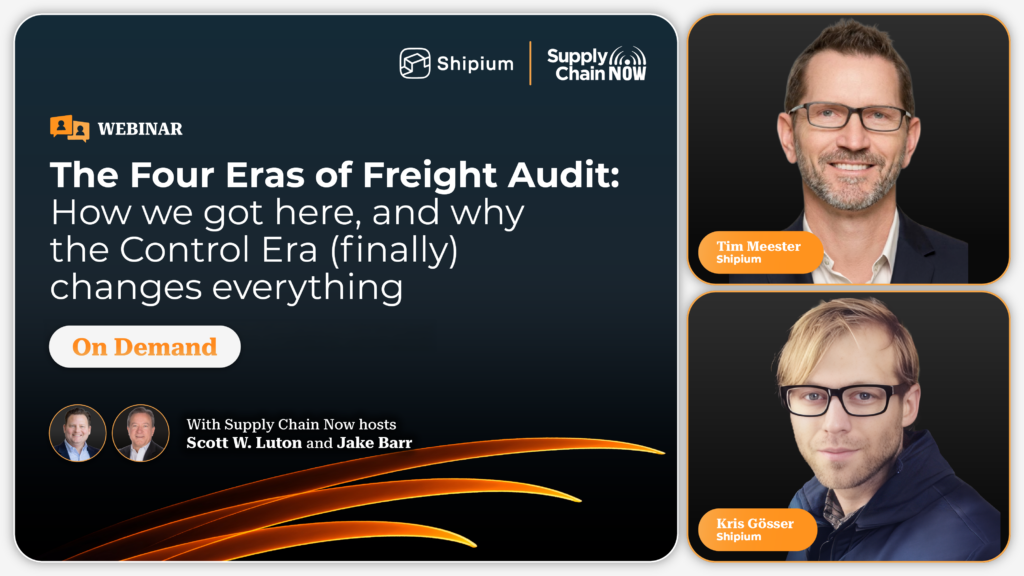
WEBINAR: The Four Eras of Freight Audit: How we got here, and why the Control Era (finally) changes everything

Share:

WEBINAR: The Four Eras of Freight Audit: How we got here, and why the Control Era (finally) changes everything

Freight audit and pay is like the diet industry. It’s a category that thrives precisely because it never resolves the underlying problem. For 120 years it has reinvented itself without ever fixing the shipment: the payment era, when banks matched invoices to posted rates; the audit era, when gain-share auditors got paid to find the same carrier errors month after month; and the data era, when those invoices became dashboards. Today’s AI audit startups are the last chapter of that story, not a new one.

We are now in the fourth era: the control era. Shipping AI makes it possible for a single platform to connect every upstream decision, from delivery promise to carrier selection to execution, evaluate the shipment in real time, and close the financial loop automatically. Only the provider that holds the shipment’s system of record can do this, which is why Shipium is pivotal to this era.

Join Scott Luton and Jake Barr alongside Shipium’s Kris Gösser and Tim Meester to learn how the four eras brought us here and how Always-On Audit connects the entire shipment lifecycle from promise to payment, mitigating discrepancies during execution rather than weeks after the invoice is reconciled.

Key takeaways

  • Why freight audit and pay has never fixed the underlying problem, and why the gain-share model depends on your errors recurring.
  • The four eras of freight audit (payment, audit, data, control) and how each was shaped by what the auditor could see, and when.
  • Why today’s AI audit startups are the final act of the data era: better ingestion and reporting, still weeks behind the shipment.
  • What defines the control era and why it requires the system of record for shipping data, not another after-the-fact tool.
  • How Always-On Audit connects promise to payment so discrepancies are caught during execution, and what that means for your carrier spend before peak.

More Webinars

Digital Transformation
play-button-webinar
webinar-person
Webinar
September 19, 2025

Real stories: Fast-tracking value, a pioneering digital transformation with impactful results.

Discover how Arxada, a specialty chemicals company, accelerated its planning transformation using OMP’s advanced platform and EY’s turnkey implementation approach. This session, hosted by Supply Chain Now’s Scott Luton and Jake Barr, highlights how focused execution, anchored in a strong business case, enabled rapid value realization across inventory, service levels, and planner efficiency. Learn what made the solution compelling to leadership and how collaborative delivery drove measurable impact. Join us and learn how to: Unlock Rapid Value – How a phased planning approach can deliver quick wins without the long timelines or high costs of traditional transformations. Build Planning Maturity – How to structure your transformation roadmap from foundational to advanced initiatives for step-by-step growth. Boost Performance with Integration – How unified, AI-driven planning tools improve service levels, optimize inventory, reduce costs, and enhance forecast accuracy. Simplify & Accelerate – How automation, scenario modeling, and industry-proven templates reduce complexity, lighten workloads, and speed deployment.
economy
play-button-webinar
webinar-person
Webinar
December 17, 2024

2025 Supply Chain Outlook: Preparing for Economic and Commercial Shifts

With economic changes on the horizon, the 2025 supply chain must be ready to adapt to commercial and economic trends that will shape—and sometimes steer—the industry. While certain disruptions are inevitable, businesses can still minimize vulnerabilities and seize opportunities with the right strategic approach. In this session, we’ll leverage insights from Enable’s State of Volume Rebates Survey to discuss how supply chain leaders can remain proactive rather than reactive in the year ahead. We’ll examine key commercial forces that are expected to influence supply chains, from evolving pricing and rebate management to strategic procurement practices that enhance resilience and drive growth. Attendees will leave with a practical toolbox to make their business less of a passenger and more of a driver in 2025.