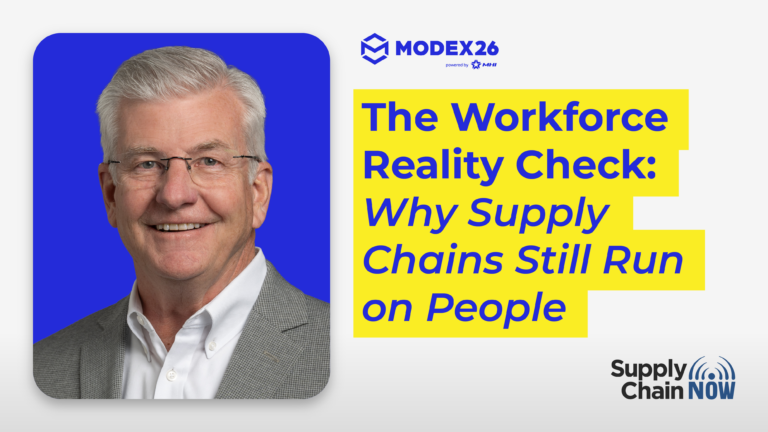
The Workforce Reality Check: Why Supply Chains Still Run on People
At the jampacked MODEX 2026 in Atlanta, Scott Luton sat down with Brian Devine, President & CEO of Ignite Industrial Professionals, for a grounded and timely conversation about one of the most pressing issues in global supply chain: the workforce.
While automation continues to dominate headlines, Devine makes one thing clear: people are still at the center of it all. And finding them is getting harder by the day.
“Fingerprints on Every Box”
Despite rapid advancements in robotics and automation, Devine emphasizes a fundamental truth that often gets overlooked.
“There’s still… fingerprints on boxes. Somebody’s putting their fingerprints on tons of boxes to move it to the next phase of the supply chain,” he explains.
Even in many highly automated environments, human labor remains essential. Devine shares an example of a cutting-edge facility where autonomous forklifts handle part of the process, but still rely on human operators to complete the job.
The takeaway? Automation is largely augmenting, rather than replacing, the workforce. And that makes the labor shortage even more critical to address.
A Shrinking Labor Pool
One of the most compelling parts of the discussion centers on simple supply-and-demand economics. The labor pool isn’t just tight. It’s shrinking.
Devine breaks it down: two generations ago, roughly 30 million workers were available for hands-on, industrial roles. Today, that number has dropped to around 15 million. Meanwhile, demand has surged as the economy, supply chains & consumer expectations have expanded.
“The supply of workers is shrinking,” Devine notes, pointing to fewer births and a wave of retirements as key drivers.
Compounding the issue, a larger percentage of today’s workforce has attended college – – and many have little interest in physically demanding warehouse or manufacturing jobs. The result is a widening gap between available talent and operational needs.
The Changing Social Contract
Beyond demographics, Devine highlights a deeper shift in how workers view employment.
“The social contract has changed,” he says, reflecting on how previous generations could expect long-term stability with a single employer.
Today, that expectation is gone. Layoffs, restructuring, and economic volatility have reshaped trust on both sides. Employees are less loyal – – and, as Devine points out, so are employers.
This shift has major implications for hiring and retention. Companies can no longer rely on outdated assumptions about workforce behavior. Instead, they must adapt to a more fluid, transactional labor market.
What Workers Actually Want
Through Ignite’s ongoing “Essential Employee Survey,” conducted in partnership with The Ohio State University’s Fisher College of Business, Devine and his team are gathering real-time insights from frontline workers. The survey is set to be released in mid-May 2026
One early finding stands out above the rest: compensation matters most.
“Pay rate, pay rate, pay rate… and keep the pizza. Workers don’t care about your culture if I can’t afford my car note,” Devine says bluntly.
It’s a powerful reminder that while perks and culture initiatives have their place, they cannot replace fair and competitive wages, especially for hourly workers trying to make ends meet.
The survey also reveals shifting preferences in work structure. A majority of respondents favor four 10-hour shifts over traditional five-day schedules, while very few prefer 12-hour shifts. These insights underscore the importance of aligning job design with worker expectations.
Rethinking Talent Strategies
To address these challenges, Ignite is helping to change how companies approach hiring.
Devine points out a critical flaw in traditional “temp-to-hire” models: “Nobody is leaving a full-time job for a temp-to-hire job.”
Instead, Ignite’s “Prime Hire” approach focuses on recruiting full-time talent directly, expanding access to higher-quality candidates who are already employed.
The company is also investing heavily in skill validation and training in their Testing and Training Centers. Candidates are tested in real-world scenarios to ensure they can perform the roles they claim to be qualified for. This reduces risk for employers, shortens onboarding learning curves and improves retention outcomes.
Tapping Into the “Hidden Workforce”
Perhaps most intriguing is Ignite’s push to engage workers who are currently on the sidelines.
With over 100 million Americans not actively participating in the workforce, Devine sees untapped potential, particularly among retirees and those seeking flexible, part-time opportunities.
To meet this need, Ignite developed its “Spark” app, which connects workers to short-term, project-based roles in warehouses and distribution centers. Think gig work, but purpose-built for supply chain operations.
This model allows companies to flex capacity while giving workers control over when and how they work.
Looking Ahead: Tight Labor, Rising Wages
When asked for a prediction, Devine doesn’t sugarcoat it.
“I think it’s going to be increasingly difficult to find enough workers,” he says.
As demand continues to outpace supply, wages will rise. At the same time, companies will increasingly adopt alternative labor models and technologies to bridge the gap.
Final Thought: People Still Power the Supply Chain
The conversation with Brian Devine is a timely reminder that even in a “golden age” of automation, the human element remains irreplaceable.
For supply chain leaders, a few of the key items to consider are:
- Invest in competitive pay
- Align work structures with employee preferences
- Embrace new talent models
And perhaps above all, listen to the workforce. It is largely irrelevant what the norms were in the 1980s or 1990s. We must build successful workforce models by meeting the talent where it is today. Because at the end of the day, no matter how advanced the technology becomes, supply chains still depend on people to keep the world moving.
Where to Learn More
Connect with Brian Devine on LinkedIn. Ignite Industrial Professionals is an industrial workforce provider. A bit like a staffing company, but instead of focusing solely on temporary workers for temporary assignments, Ignite also attracts full-time associates for full-time positions in the supply chain. Learn more here. You can also connect with Brian in person at the WERC Annual Conference, which takes place in Jacksonville, FL on May 17th-20th.
More Blogs
Blame Follows the Messenger