Intro/Outro (00:02):
Welcome to Supply Chain Now, the number one voice of supply chain. Join us as we share critical news, key insights, and real supply chain leadership from across the globe. One conversation at a time.
Kim Reuter (00:14):
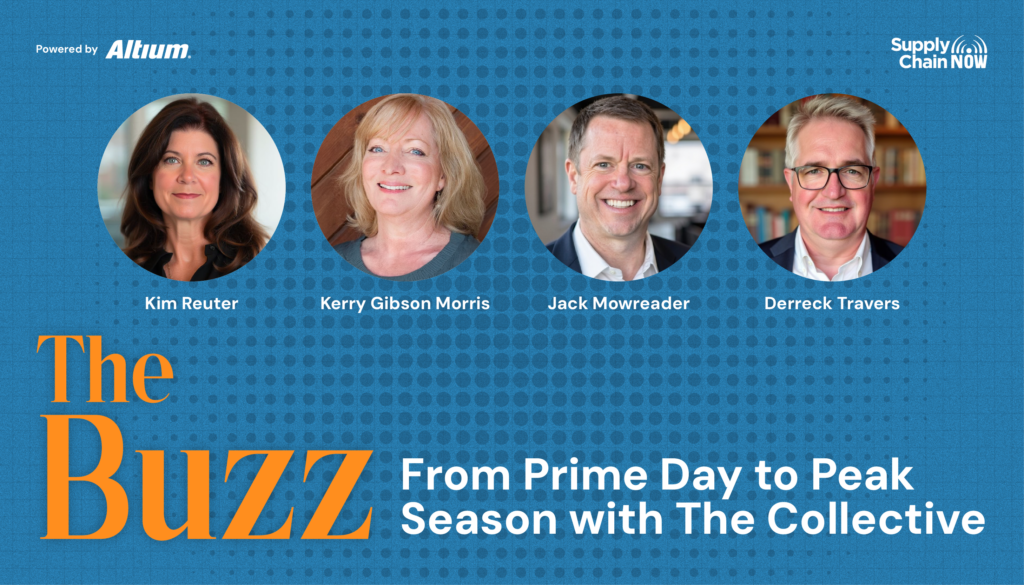
Good morning, good afternoon, good evening, wherever you may be. I am Kimberly Reuter and I am honored to be hosting The Buzz today along with my esteemed colleagues from The Collective. Welcome to today’s live stream. On today’s show, it’s The Buzz where every Monday at noon eastern time, we discuss a variety of news and developments from across the global supply chain and business. News that matters is what we like to call it. Today, the buzz is powered by our friends over at Altium, a powerful organization that is redefining electronic product creation in a software-defined world. To learn more, go check them out at altium.com. Big show, big topics, and big guests today. We’ll be touching on a variety of things. First up will be the results of Amazon Prime Days. Yep, we’re going to bring it to you here first. Also, we’ll be talking about the state of startups and what is on deck for Q4 and on your ready and are you ready? And we got a little surprise in there for you. So stay tuned, we’re going to cover all of that and a lot more. We’re also going to hear from our team at the Collective
(01:20):
And get their points of view from all of their years of e-commerce and supply chain. We got a big show ready for y’all, so get buckled up. We have an incredibly talented supply chain collective panel for everyone today. The group led the development of Amazon as you see it today, everything from the first private label product to Amazon’s first delivery. It all started here. Let’s meet the group before we get started. First up, Carrie Morris. God is the global sourcing.
(01:48):
She has sourced everything from teak furniture to insulated coffee mugs. Carrie built Amazon Private Label from scratch. I will also note that she fought for it, introducing the early brands Strathwood and Penzon and led the first Celebrity Chef Collab, world famous chef Tom Douglas. Welcome Carrie.
Kerry Gibson Morris (02:06):
Thank you, Kim.
Kim Reuter (02:07):
You’re welcome. Second, we have Jack Maureider, finance guru and army logistics veteran. Jack has built financial models and business plans across industries from everything from truckload carriers to solar panel construction. Jack laid the financial foundation for Amazon’s early import strategies and the Kiva Robotics integration. Welcome Jack. Next up we have Derek Travers. Everything last mile starts with Derek. Derek has built networks and programs from outbound to inbound and everything in between. Derek led the charge developing Amazon’s last mile delivery and returns program with a little dabble in product fraud. Welcome Derek. And last but not least, I’m your host, Kimberly Reuter. I’ll keep it short and sweet. If it shipped across the border, I’ve probably shipped it. I’ve done everything from creating eco terms to moving radiated monkey brains. If it shipped across the border and got stuck somewhere, I was probably involved. Thank you for joining us here at The Buzz.
(03:05):
All right, so let’s get into it. We got a lot of good stuff to talk about. So first of all, let’s do a little warmup question. It’s fall, so what is everyone’s favorite fall activity? Derek, we’re going to start with you.
Derreck Travers (03:18):
So I tend to spend a lot of my time over here in Idaho, probably in close proximity where I am. There’s probably about 2,000 miles of off-roading, ATV trailing and stuff like that. So it’s a lot of fun this time of year. You get to some parts of the state here that you can’t see unless you’re in an airplane and you get to look at it at least from the peaks of a mountain. So it’s pretty fun.
Kim Reuter (03:39):
Very cool. Awesome. Jack, how about you? What is your favorite fall activity?
Jack Mowreader (03:44):
Well, actually we got Halloween coming up and so we do a neighborhood get together in the yard and just get to see our neighbors that we don’t always see when it starts to get dark. So it’s kind of fun to just hang out and watch the kids go door to door. So we enjoyed that.
Kim Reuter (04:01):
That’s very cool. Carrie, I know you’ve got something special for fall.
Kerry Gibson Morris (04:05):
Oh, well, I love the fall leads, just the fall color. So anything that I can do that gets me closer. We took a Cascade loop drive last weekend to see the leaves changing.
Kim Reuter (04:17):
Oh, beautiful.
Kerry Gibson Morris (04:18):
I make flower arrangements with them. I gather them, press them, and yes, I rake them, but I just love the color change. It gets me excited.
Kim Reuter (04:28):
All about the fall. I love it. This time of year is baking season for me. I love to cook, and baking that is my stress reliever. So as soon as the temperatures start falling, the oven gets fired up and that’s where I spend a lot of my time. Great. I love the fall attitude everybody’s got. We got a great session coming up. Let’s go ahead and jump into it on the stories we have here on the buzz. And again, we are powered today by our friends over at Altium. So I don’t know if you knew, if you’re asleep, don’t have internet access, live in a cave somewhere, you may have missed it, but Amazon Prime was last week. Prime Days were last week. So how did Amazon do? They’ve been doing this twice a year for a couple of years now. Before we jump into, I did want to share a little history lesson on how Amazon Prime Day started.
(05:14):
Started a long time ago. I think we’re over a decade with Amazon Prime Days, but it originally started in October in an effort to clear out the warehouses for the incoming holiday inventory. So all things Amazon, I like to remind people this all the time, started with a purpose. It was never for a service. So that’s how Amazon Prime Day started and that has carried forward in our spring, our June Prime is for a similar reason for the summer peaks. So that’s where we started from. So how did Amazon do this year for 2006 Amazon Prime Days? We did almost $10 billion on sales in a two-day event. Mobile sales were up 12% year over year with five billion coming out of mobile. Discounts peaked around 20%. Personally, I feel like that’s a little low. I feel like I’ve seen better deals in the past, but considering our supply chain issues, maybe that was a little bit prohibitive.
(06:06):
Household spending was 114. Again, I feel like that was a little bit on the low side. Amazon did significantly outperform their competitors since it is their day. I would expect that to be happening. But the thing that really caught my eye is that most shoppers or about a third of shoppers stated that they did half of their holiday shopping during Prime Days. So I’m very curious to see how that is going to impact our actual holiday shopping. Now, most of us on this call today were actually at Amazon when Amazon Prime was born, if not very close. So I’m going to ask the team, what are your favorite memories about Amazon Prime in the early days and what are your thoughts on the performance that we saw today? Carrie, let’s start with you.
Kerry Gibson Morris (06:53):
Yes, I love that. So who doesn’t love frictionless shopping online? That’s what Prime does for all of us. And there’s so many great things that Prime shopping unlocks, customer loyalty, increase that shop basket, discover new categories, love all of that. But I will say what you said at the beginning, I was part of the inventory position problem being in merchandising, and we needed to find creative ways to clean house and make room for new, exciting, fresh product. And I will say that my team was actually involved probably a year and a half before Prime even officially launched, and that was testing merchandising sales offers that could help drive the purchase of the customer’s shopping basket, get more product into it, get it out of our warehouse. But it was challenging. We launched our first threshold free shipping models and we started to learn quick and fast what we could afford to do and what actually influenced the consumer but was the right margin balance.
(08:01):
So I was very margin centric, needed to make sure that we were protecting our profitability. And so we tested free shipping over 25, over 50, over 75. We even went to 150. 150 was profitable for Amazon. It did not motivate the shopper to come in and fill their basket, but all the time we were working through that. And so what I love about seeing Prime every year as a loyal Prime customer is I got to be a little tiny piece of that fabric early on, learning fast and figuring out how we actually bring profitability. And anytime you can be disruptive in the retail market and literally change the way consumers shop is just such a fascinating moment to be a part of.
Kim Reuter (08:51):
It was a super fascinating time. For those of you who were not there in the beginning, the original price for a Prime membership was $79, and that price did not change until 2014. And Amazon discontinued. Originally, Amazon Prime was only for free shipping and it was to offset the cost of free shipping. Jack, you may or may or not been involved in some of the financial modeling around how we figured out what that price should be, but that’s how it came about. And then Amazon just continued to add more and more to it. Prime Video became available in 2006. So Derek, what are your thoughts about how Amazon is doing in Prime, their performance this year and any fond memories from the early days?
Derreck Travers (09:35):
If I think back, at least from an operational perspective, Prime Day was more of a fire drill for the whole fulfillment process. We used to call them stress tests, but these got to be actual live stress tests with the benefit of not having a hard deadline that everything had to be delivered by the 24th of December. But now these rehearsals have kind of turned more into more of the whole network getting into practice right before or Black Friday or the peak events that take place and everything like that. Now what’s interesting though is that what Prime Day ended, what last Wednesday I think it was last Thursday, on some of my social feeds over the weekend, I started seeing other retailers promoting Black Friday already. It’s almost like this constant state of discounting. Now, what’s really interesting though is if you look at social comments out there about people’s opinions about Prime Day this year, I think there’s overall sense of appreciation for the assortment and what the discounts were.
(10:28):
But again, there was a lot of criticism about that the margins were over, or I shouldn’t say the margins, that the discounts were overpriced or over hyped coming up to the event. So I think a lot of people had big expectations. Thought I read somewhere that the average discount was only 20% someplace, whereas in the old days it was 50%.
Kim Reuter (10:50):
It was.
Derreck Travers (10:50):
So that’s one side of the equation. If I look at the other side of the equation, good for Amazon for keeping discipline on their discounting. We’ve all worked for different companies where maybe that wasn’t as strong and it really having really negative impacts for the companies. But it’s definitely with Prime Day, I think originally was always in June. Now that they have this other one in October, Peak has started and we’ll talk more about that here in a minute. I think the only other thing I would say is that what’s interesting is that with Peak, or I’m sorry, it’s interesting, and I don’t know if we’ll ever see the numbers, but actually how much space gets cleared out as a result. So I think Kimberly, you said something like, was it 10 million or $10 billion in sales?
Kim Reuter (11:31):
10 billion in sales in two days. Yeah.
Derreck Travers (11:33):
I’m not sure what that equates to in actual units and how much of that is direct fulfillment versus what’s happens that comes through an Amazon facility. But what I’m actually really curious to find out maybe one of these days, or it’d be interesting if they post it, but really how much spaces are truly free up.
Kim Reuter (11:49):
What do they actually work through?
Derreck Travers (11:50):
And then from an operational… And then are they actually cleaning up and putting all their hot moving ASINs in better strategic locations and less maybe the seasonal stuff stick in the back corner that nobody ever goes to. But probably the most important thing that everyone’s curious about for me is what was my Prime Day purchase? And I actually bought a heart covered book from Walter Isaacson. He did the biography on Elon Musk, and I got it for 76% off. So it’s a thick book. My plan is to cut the middle of it out so I can hide my passport in it.
Kim Reuter (12:20):
All right. Thanks, Derek. Jack, I saw you kind of chomping at the bit there. I think you were probably part of some of the early decisions on how do you make money on Prime?
Jack Mowreader (12:30):
Well, I wouldn’t say I was that close to the actual Prime membership fees and all of that because we had dedicated finance team that was doing that. But I remember, I’m going to even go back further to Super Saver Shipping. I mean, Carrie kind of alluded to it a little bit, right? That five to seven day threshold, it was $25 and it was $35. But I mean, those were back in the days. But I think that more memorable for me for Prime was around 2010 when I was working in third-party sellers and we really activated the FBA eligible for Prime button on the homepage and on the detail landing page, is that then you could see that it was sold by an FBA seller, but it was getting Prime treatment. And that was a big catalyst for the flywheel to really take off and really saw the explosion of third-party sellers and FBA just really took off.
(13:25):
So that’s kind of my biggest memory is really watching really the availability and the price competitiveness really take hold.
Kim Reuter (13:35):
Yeah, that was a good thing. Any thoughts on 2006 performance for Amazon?
Jack Mowreader (13:39):
It’s interesting if you rewind back to a previous show that we had, we were talking about AI and agentic purchasing, and one of the bullets that really came out to me was they doubled the amount of traffic through those channels and that a lot of people were setting predetermined price points. To Derek’s point is that, hey, if you’ve got a staple or something and you’re going to buy it anyway, let’s put a number to it and if it hits that number, let’s go ahead and buy it. And I thought that was pretty ingenious for people to do that, especially in the consumer world. And we know that that’s going to be some impact in the commercial side buying stuff and using AI, but really neat to see the consumers really taking hold of that.
Kim Reuter (14:24):
I agree. Fascinating. I appreciate everybody’s point of view back here on what’s going on with Amazon Prime and a little bit of a history lesson. Up next, we actually have something that’s even more interesting and a stat that kind of surprised me. So it turns out that VC failures are on the rise and everybody wants to know why. So 2026 saw an all-time high in VC-backed bankruptcy. In 2026, 2,345 VC-backed failures were reported, and that is a massive increase from just four years ago at 718. And 34% of those companies were funded during 2019 to 2021. Now, if you were at all paying attention to what was going on in 2019 and 2021, money was falling from the skies when it came to startup funding. Companies with little bit more than a napkin and a number were getting billion dollar checks left, right and center.
(15:26):
It was a pretty amazing experience. I think the only thing that people were able to explain as to why this happened was the huge increase in e-commerce business because obviously we can’t leave our home and just a lot of board investors who had money that they didn’t know what to do with. So today we’re going to jump into a little bit about why this happened. Now, our folks over at Foley have a nice little table that we’re going to share with you and shows you this increase that we’re seeing in bankruptcy. So some of these recent closures may ring a bell. Thorazio, if you guys remember that back from the COVID era, that was five billion to $2 billion value during the pandemic and shuddered with over a half a billion dollars in debt. 23andMe is another great example of a company that failed. Again, how many times can you take a DNA test?
(16:16):
It’s a one and done. They didn’t really think about that. Then tried to make money on selling people’s DNA information. And we hate to say it, but even our own Zulily made the list on startups that didn’t quite make it. Sorry, Carrie. So we have a lot of startup experience here from our collective here on the Supply Chain Now team. So let’s hear from the group. What is one thing that you think causes a startup to fail? Now keep in mind everybody out there, 80% of startups fail within the first two years. That stat might be even a little bit higher now, but last time I checked, it’s 80%. So Derek, tell us, what is your thought on why startups fail?
Derreck Travers (17:00):
Money hides broken unit economics, but when lending rates were zero, look, founders could buy gross forever, but when the cavalipit was repriced and the math came due, your good business can grow slowly and it’ll probably survive, but a bad business just grows really fast and very, very loud. I think the reality is for founders, they have to retain unwavering faith, but at the same time you have to be faced the brutal facts as to what actually is going on. And I think in a lot of cases here, just a lot of these were kind of hangovers from COVID and finally just got to the point to where they were no longer affordable. Now, I’ll just throw something out here a little bit counterintuitive, but I actually think these startups failing is actually healthy pruning. It actually is a sign that the market isn’t broken. Closures typically will recycle talent and they’ll also recycle capital.
(17:49):
And the founders who build something actually have a 22% chance of being more successful the second time around. So I think to me, this is just more of the process of what happens. I would guess that as far as the uptick this past year in failed startups, just more of a hangover from those that started out four or five years ago when COVID was going.
Kim Reuter (18:10):
So if you had to put one thing and say, okay, your one piece of advice to a startup company, what would it be?
Derreck Travers (18:17):
Look, you have to have unwavering faith. It’s going to work, but you have to be in tune with the customer and you got to face the brutal truth and act quickly on it.
Kim Reuter (18:25):
Carrie and Jack, would you add anything to Derek’s comment? And we’ll get your point of view too as well here in a minute.
Jack Mowreader (18:30):
I think the unwavering faith, it’s kind of one of those things. It’s a balance. To Derek’s point is you need to have confidence in it, but you have to know what you’re looking for and how to measure it and so you know if you’re doing a good job and you’re making progress or not. So I’ll elaborate a little bit more, but I think it’s really that balance that he was talking about.
Kerry Gibson Morris (18:49):
And entering into this with a long gain mindset is so important. If you’re looking for instant margin, if you’re looking for instant perfection, you’re going to really struggle to really ramp.
Kim Reuter (19:03):
Yeah, that’s a good point. And that may be the difference between two years and three years because it takes three years to make a profit and 80% of all startups fail in two years. I’m always curious about what’s the difference in that 12 months and maybe Derek has cracked it here. Carrie, what’s your point of view?
Derreck Travers (19:17):
Carrie’s comments are really smart there if you think about it. So again, in the theme of being ex-Amazon boys and stuff like that, Bezos is on record for saying that Amazon is willing to be misunderstood for a longer period of time, but they’re able to do that because they’re financing it themselves. The minute you have to go to the VC to get the money, all the expectations change and typically you’re managing a VC relationship versus the business.
Kim Reuter (19:42):
The actual business. That’s a really good point. Thanks Derek. Yep. So Kerry, what do you think? What are your thoughts on startups and what do you think is the number one thing that causes a failure?
Kerry Gibson Morris (19:51):
Building perfection, which I just shared briefly, but it’s so true. You think about the lessons you took away from Amazon. I just have ingrained in my head three years, fail fast for three years, then you’ll hit the trajectory that you need. And for me, it’s an example of where you’re going to invest and when you’re going to invest, whether it’s infrastructure, team, the systems that you’re driving. I had the opportunity to go to a startup after retiring from Amazon and they had the right model. They were making decisions on not making early investments. And the irony of it is we just talked about Amazon Prime. This startup group actually got an Amazon Prime account and this allowed them to not have to pay for shipping to their customer or inventory the warehouse or have a 3PL. It was brilliant. They put their investment in customer acquisition and marketing and they picked a lane and they beat that drum and stayed in that until they hit their critical threshold where they felt they could have that right base to begin to invest.
(21:02):
So I think there’s some real important lessons that I learned along the way and I really enjoyed getting to learn them.
Kim Reuter (21:10):
Thank you. Great. Jack or Derek, any comments on Carrie?
Jack Mowreader (21:16):
I just reinforced what Carrie was saying is that you can’t be everything to everybody. And so she talked about picking a lane and being the expert in that space. I think that’s a really good smart kind of a strategy for a startup and it’ll keep a lot more focused.
Kim Reuter (21:31):
So I’ve seen this a hundred times. They get a little bit of money and they’re going to solve the world’s problems and they don’t solve any problems because they’re everywhere. And then every time somebody mentions, “Oh, have you thought about?” They’re like, “Oh yeah, it’s the crazy squirrel. It’s just they’re chasing shiny objects.” And before you know it, the bank account is empty and the product shelf is also empty. So great points. Derek, what do you see here?
Derreck Travers (21:56):
I think that’s what Carrie just mentioned about the perfection piece actually really resonated with me. One of my idols was a former joint chief of staff, Colin Powell, and he had these principles, he had maybe 18 principles when he was on the speaking circuit that he would always speak to. And one of them actually was about that same idea. Sometimes you can’t have all the information you need to move forward, but you keep saying no until you get to about 60%. And then once you get to 60% of the information you think you need, then you start to dig into more and push and push and push. Once you get to 80, you go with your gut. Whereas, I mean, how many of us have worked with tech teams and the tech teams want something perfectly ironed out exactly how this is going to work?
(22:38):
And if you look at those software companies that are actually probably most successful, the ones that probably get to about 80% and then they push it out there and then they wait for the feedback from the customer.
Kim Reuter (22:50):
So yeah, I agree. And I think this is a principle that I think we all learned at Amazon, the concept of the MVP, to get it to 80% and then figure out the rest of it as we go. And I think that is definitely one of the things that allowed Amazon to move fast and it kept us from getting into, after I left Amazon, I went to go work for a luxury retailer. We’ll leave their actual name out of it, but they were very much still in the old waterfall model as we call it, which is horrendous. And that is we define it, we write it, we build it, and we don’t move until that ship is completely built and painted. And that was a terrible process. Whereas companies like Amazon are fast moving are more in agile environments where we’re deploying code, we’re giving incremental benefit to the market on a regular basis.
(23:37):
I think that is the thing that makes a big difference. Jack, what are your thoughts on what’s going on with startups and what’s the one thing that causes a failure?
Jack Mowreader (23:46):
One of the things I’ve observed, I was working with a middle mile startup here in the Seattle area, and I think that one of the things that I saw that happened in this
Intro/Outro (23:56):
Particular
Jack Mowreader (23:57):
One is that they just really underestimated the decision-making cycle. It’s a B2B situation and you can have the best solution and the customer may need it, but it’s going to take them a long time to sell it internally. It might take them a long time to implement it. There might be some integration issues. And so I think to tie in Carrie’s point as well is it has to be long-term, and I’ll tie in a little bit what Derek said too about VCs. If you’re living off VC money, you’ve got to be continually making progress because they’re going to want to exit that early stage or they might want to de-risk some of their money. And so you’re constantly selling yourself and they don’t have necessarily that long-term perspective all the time. And so you’re going to have to really understand what your end game is and make sure you have more than enough runway.
(24:49):
And from a finance perspective, I’m all about KPIs. We need to know what we’re measuring and how do you know if you’re making progress so that you can monitor those and you can adjust if you need to or just keep going. And I think to bring it also the Amazon experience into this, we witnessed a lot of failings at Amazon, and there’s a point in time where you just need to say, “You know what? It’s time to give up.” But it was a great place to see that in action. It was like, “You know what? We thought that was going to be really cool and it was a disaster.” I mean, no more cell phones, no more strategy. Yeah. But you need to be able to say, “Hey, it’s time to bow out. Let’s go.” And know when that is.
Kim Reuter (25:34):
And I think the other one that comes to mind too is Amazon’s had a couple rounds with grocery where we jumped in, jumped in, jumped in, jumped out, jumped in, jumped out. It seems like we’re kind of in the game for sure now with the wholesale purchase. But yeah, that was another one that had a lot of failure because grocery is a high risk business. So Carrie and Derek, Carrie, we’ll start with you. What did you hear from Jack and anything you want to add there?
Kerry Gibson Morris (25:57):
Oh, absolutely. First of all, when you’re talking about the VCs, both you and Derek, I just think golden handcuffs because I think we had the pleasure of working for a self-funded startup, all the difference in the world. So anybody who has a choice between which one, always go with the higher risk one, which is self-funded. I also, I love the bringing it back to Amazon because I’ll say that we all walked away with important lessons learned in our time there. Mine was so impactful to who I am as a leader today in the sense that I learned how to fail fast and I learned how to take calculated risks. And I know I show up as a leader and make people uncomfortable, but I’m in the long game. I understand that those two skill sets will actually get you through some of the toughest business decisions you need to make.
(26:53):
So I love you harkening back to just some great fundamentals.
Kim Reuter (26:58):
Derek, what are your thoughts here?
Derreck Travers (26:59):
I think it’s actually a shame that we don’t have more startups out there than we do today. Granted, there’s a high failure rate, but I actually think it’s really important for culture to have a high sense of risk. I would say responsible risk, not careless risk. If we had more startups going on in this country, I kind of can’t help to feel that it helps solve a lot of other problems that maybe people are dealing with right now. And I know I kind of called out VCs maybe in a little bit of a negative light earlier, but you actually provide a really good… A good VC can provide a really good service for a founder. Founder tends to be the dreamer and they need sometimes the discipline, kind of like what Jack was alluding to on managing KPIs or what I was talking about facing the brutal truth or the brutal facts.
(27:47):
A good VC can be a really good coach in helping develop those founders. And I think you look at some of the really successful startups in our lifetime, most of them probably credit some sort of a coach or a mentor, which typically is a VC that has helped guide them along.
Kim Reuter (28:04):
Yeah, that’s a good point. So from my perspective, I worked with a lot of startups in both the startups I built at Amazon and the startups I’ve worked with in my consulting business. And from what I see, the biggest issue I see with startups is not really understanding the problem. I see startups come and they have a great solution. We have this great tool, this great software, this great widget, this great whatever it is, and you’re like, wonderful, what problem does? And then there’s the big, well, it could solve this problem and it could solve this problem. Kind of back to your comment, Carrie, about all of a sudden it solves the world’s problems and we’re not really actually sure what it does. And why this is so dangerous and why I bring this up is that 90% of the time the VC doesn’t own.
(28:49):
They’re looking at projections, returns, sales, market growth, but they don’t really understand a lot of times with what the actual problem is or if there actually is a actual problem. Because if there is no problem in the market, you got nothing to sell. Carrie, what do you got to say about that?
Kerry Gibson Morris (29:09):
As to Jack and Derek’s point, I mean, I think we have a real good viewpoint of how you can become a startup and there’s different paths for everyone to take. But I also agree with you, you have to have the problem statement, you’ve got to ladder up to it. You have to check and adjust as you go, no question.
Kim Reuter (29:28):
Yeah, I agree on that one too. Yeah, because you do think you may know the problem, but as you learn, the problem changes and a lot of companies don’t pivot and that’s what leads them into the 80% sale. Jack, do you have anything you want to add there?
Jack Mowreader (29:41):
No, I think you guys wrapped it up. I like it.
Kim Reuter (29:43):
Awesome. Derek?
Derreck Travers (29:44):
It’s not easy being the leader, and that’s really what the founders are. They’re the leader. I can’t even express how much I admire anyone that’s willing to start their own business. It takes an incredible amount of guts. Most people aren’t willing to do it, but at the same time, I kind of reiterate what I said earlier. So important to have a really good coach to help you along. We’ve all been in situations where the only person talk in the room is the founder.
Kim Reuter (30:08):
Yeah.
Derreck Travers (30:09):
And the minute that starts, it’s the first sign that there are issues.
Kim Reuter (30:14):
Things are heading south. Great. Awesome. Great perspective, everybody. We’ve all worked with our fair share of successful and unsuccessful startups, so we know all about of it. Before we dive into our last topic today, I do want to put something on everyone’s radar. Altium Develop brings together advanced printed circuit board designs and secure cloud collaboration in one seamless experience. This powerful platform integrates everything from schematics and layout to simulation and analysis in one single environment. That’s actually pretty powerful, people. It is purpose-built for individual and small teams to design, share, and stay in sync from anywhere. Even better yet, Altium is offering free 30-day trial of Altium Developed so that you can give it a no strings attached test ride. Check out the link and comments to learn more, and also you go to altium.com. Now for our final topic for today’s buzz, it’s been a heavy lift I know, but hang in there because we got some important information coming up.
(31:15):
Q4 has happened like it does every year. I know. Sometimes it sneaks up on us. So what’s going on in the import market and what do we need to prepare for? Well, this year is a little bit interesting because they are calling it a pulled forward key. Actually, we are seeing, we believe that holiday peak already happened in July, August, September, with September logging a record 2.5 million TEU. Shippers moved early to beat looming tariff reviews, de minimis crackdowns and maritime pinch points. The Q4 run rate, monthly import projections for October through December are stabilizing in at the two million, 2.1 million TEU range. While this represents a sequential taper from the late summer rush, it is still up two to 3% year over year. West Coast preference, we still see people pushing everything through the West Coast as much as possible. This is mostly due to avoiding transit delays, global maritime choke points, and to minimize exposure to the East and Gulf Coast labor and rail congestion.
(32:23):
So guys, what are you seeing in the import market? What do you think people need to be worried about? And what are your thoughts on this pull forward peak? Carrie, let’s start with you.
Kerry Gibson Morris (32:33):
I would say that this isn’t something that you shouldn’t reserve for just this quarter. It should probably be best practice always, but buffer, buffer, buffer. Plan B and buffer. And I say that because while there might’ve been a pull forward and some of the heavy lifting has already happened, the impact that is being experienced with imports coming in is real and you have to anticipate as best as you can. I would say that some of the things that are top of mind are shipping delays, shipping rollovers, lack of capacity. Pretty normal in a fourth quarter window, but not when you think about a pull forward. Another area of disruption or fast learning is understanding a lot of the new regulatory compliance expectations with our custom border patrol. Have your paperwork right. Transparency is huge. And then just thinking about how you have a plan B.
(33:34):
And for me, it would be always pulsing your alternative markets. There’s always a trade-off, but if one particular region is experiencing pressure points, then do you flip into a different market, analyze your lead times, analyze your costs of goods, and try to back into it as best you can to mitigate some of the pressure points?
Kim Reuter (33:58):
Great, excellent advice, Carrie, because even though we saw this pull forward, we are still seeing delays with the carriers. We’re seeing cancellations, we’re seeing rollings, we’ve got congestion at the ports. We have all these new trucker regulations for the West Coast that are tying things up. So even though we saw a pull forward, we still do have some challenges for Q4. Derek, anything you want to add there to Carrie’s point?
Derreck Travers (34:20):
Yeah, I think some of the economic data that’s come out, even though we’re talking about how a lot of inventory’s been pushed forward earlier in the year as well as some of these promotional events that took place in September, if you look at retail sales year over year, it’s only up 4%. So I might suggest that there’s a lot of inventory still out there. So it’s going to be interesting to watch how large shippers, how they play this in the next month or two. I don’t know. I could see us maybe for the rest of the year, maybe imports lightening up because there’s already plenty of inventory for what the demand dictates out there.
Kim Reuter (34:56):
Okay, interesting. Jack, anything you want to add to Carrie’s point?
Jack Mowreader (34:58):
Yeah, it’s interesting. We talk about this pull forward and where the inventory is actually sitting. Is it still proximate to the ports and does it still need onward movement? Because I’ve been looking at the truckload figures, they’re holding pretty stable even with lower shipping volumes. And so that speaks to constrained networks. And so are you going to play the spot market or are you going to contract that volume? So I’ll follow on to Carrie’s advice, build those buffers. It’s like get your capacity locked in that you’re going to need and so you’re not scrambling on the spot market, stuff goes south. So I’m just looking forward and thinking about what my routes are, what do I need to secure and what timing I need to do that to make sure I built those right buffers in.
Kim Reuter (35:47):
Yeah. Okay. Carrie, anything you want to add to your point there before we see if Derek wants to add anything else?
Kerry Gibson Morris (35:53):
I was just thinking particularly when Derek’s talking about the softening in the next month or two and just the buildup of inventory, which is so fascinating to always see. Of course, my merchant instinct immediately says there’s going to be sales to be had everyone. Look, let that AI tool Ms. Zack talked about and let’s go shopping. But at the same time, I think one of the things that always, it shouldn’t be a surprise, but it seems to always be a surprise if you’re doing heavy importing out of China. Chinese New Year comes every year. And so there is a pull forward that happens there as well. So making sure –
Kim Reuter (36:31):
Yeah, there’s another one. Yeah, that’s true. You could have a double pull forward, which could be an interesting time. That’s a really good point, Carrie. Very good point. Derek, do you have anything you want to specific to importers and advice for importers?
Derreck Travers (36:44):
Yeah, so this has been a really interesting year for Lionhaul Trucking. This year rates actually, carriers or trucking companies have been in a four-year for recession specifically when it comes to rates. If you’re a transportation manager the last couple years, literally all you had to do is just show up and brag that you saved some more money because some desperate carrier reached out to you and undercut the current carrier you’re using. This year it’s gone the other way around, but it hasn’t necessarily gone because of the strength of the economy. There are some signals to suggest that that’s part of the case, but there’s been a massive number of drivers been taken out of the pool as regulatory agencies are getting more focused on driver safety ratings and records and such. Even with rates going up, it’s actually not really helpful for carriers right now because it’s being offset by the price of diesel fuel, which has gone up.
(37:32):
And then what’s interesting too is if you look at, and that has another indirect impact where if you look at intermodal lanes and stuff like that, they’re all at capacity right now. So those are full as well. So I guess the long and the short of it is I think shipping managers or transportation managers, I’m always looking at the long term in my relationships with my carriers. If you’re the kind of transportation carrier that’s going to try to take advantage of someone at this minute, you’re going to get taken advantage the next minute. And then the last thing I’ll just call out here, and this is kind of battle wounds from my time at Amazon, but everyone forgets about return season and that’s part of Peak as well. And I think with a lot of the talk right now about affordability and people maybe they’re a little bit tighter on their purchases and stuff, I’m not going to be surprised if in January the headline reads return rates are higher than normal.
Kim Reuter (38:21):
Buyer’s remorse. Yeah, that’s a really good point. Yep. Have it under the tree, but we’re going to have to return it because you can’t really keep it. Carrie, anything you want to add to Derek’s point? Because returns is a good point. We haven’t talked about that.
Kerry Gibson Morris (38:33):
Oh, that could be a whole topic in itself. Definitely a very interesting ecosystem. But no, really good insight. Always need to be thinking and looking around the corners, that’s for sure.
Kim Reuter (38:46):
All right, Jack, what do you have to say about all this?
Jack Mowreader (38:49):
I think you guys hit on some really good topics. I’m not sure I can expand too much on it. I mean, it’s about timing, it’s about relationships and just getting a good pulse. I mean, I’m really curious to see what’s going on with the de minimis impact. I mean, did they bring in container loads and what’s that going to do to the parcel network? So a lot of interesting thoughts around what that’s going to look like this peak, but I’m pretty excited about it.
Kim Reuter (39:16):
Yeah, it’s going to be good. And from my perspective, what I always tell importers is it’s pretty much just kind of a summary of what all you guys are saying. You have to have a plan B. Keep an eye on what’s going on. Don’t lock it in. You can’t set it and forget it. With all of this early pull through, that does not mean that ocean free rates are going to go down and then we’re going to see this big flex in the market. It’s still going to be sticky and we’re still going to have pain points. So don’t take your foot off the pedal even though you think you’re already done because I think there’s more to come off this one. All right, so that is the buzz today and we’re going to start wrapping things up. I want to encourage folks to check out our award-winning resource hub over at Supply Chain Now Resource Hub.
(39:59):
All of our recordings will be available to you there in addition to tons of other amazing information to help you now your supply chain every day become a better person and a better leader. Now we have a couple shows under our belt now with The Collective. This is a new podcast we’re doing here at Supply Chain Now. And I want to ask everybody, do you have any big moments or epiphanies you want to share that we’ve had from our previous shows? All right, I’ll start. So I think the coolest thing about bringing The Collective together is I have really appreciated hearing the points of view from Grizzled veterans, people who were actually there. We were in the trenches building it and making it happen. And that is a time that is no longer available. It’s past was a very unique experience. And I like to tell people that we were lucky enough to have a seat on the first bracket ship.
(40:54):
And so we get to report back on things that not everybody gets to see and being able to share that has been really exciting for me. So that is what my big takeaway from the collective has been so far.
Kerry Gibson Morris (41:05):
I would love to jump in because I have felt every time we’ve been able to come together that it’s a really important reminder that you can’t do it by yourself. You need to have amazing peers by your side. And it doesn’t matter if you’re in finance or logistics or importing or merchandise, a team is what makes it all come together and come to life. And this is just such a great reminder that while I have so many wild and crazy stories about Amazon, it was never me individually doing it. It was always with collective talent like this.
Kim Reuter (41:39):
Yeah, that’s a great point. Thanks, Carrie. That’s excellent. Derek or Jack, anything you want to share?
Derreck Travers (41:45):
I think we might be trendsetters. So that one podcast you did here a little while ago about AI doing your shopping for you, I kind of was maybe kind of dismissing it, but it seems like that’s all I ever hear now about nowadays. So I don’t know, maybe we’re more influential than we realize.
Kim Reuter (42:01):
All right. Let’s hope so. Invented agentik shopping, but we may have called it out first. Jack, anything you want to share?
Jack Mowreader (42:09):
Well, it’s similar to what Carrie said. I just love everybody’s insights and really makes me question how do I think about something and how do I approach it? And really gleaning that knowledge because there’s a lot of experience here and a lot of things within Amazon and outside of Amazon that have really formed our careers. And so it’s great to just get that collective brain power together and really talk about things that are important.
Kim Reuter (42:39):
Yeah, agree. That’s very cool. Anything else, Derek?
Derreck Travers (42:42):
I can’t wait for next month’s topic. Everyone should be sitting on the edge of their seats, getting ready to hear. It’s going to be awesome.
Kim Reuter (42:49):
Yep. Yes, we will be back next week. Topic to be determined, but it will be something about innovation and supply chain and e-commerce, I promise you. Before we sign off, let’s make sure people could get in touch with you. Derek, what is the best way for people to get in touch with you?
Derreck Travers (43:02):
Yeah, just go to LinkedIn. There you go. It says it’s spelled right here. Derek Travers, just look me up. I’m usually pretty good. I look at it twice a day and pretty responsive.
Kim Reuter (43:12):
Awesome.
Derreck Travers (43:12):
And I literally respond to everybody.
Kim Reuter (43:14):
There you go. If you’re lonely, you know where to go. Jack, what about you? How can we get in touch with you?
Jack Mowreader (43:19):
Yeah, same. Please just hit me up on LinkedIn. I’m there and I’d love to hear from you. And even if you have some thoughts on what we’re talking about or some ideas for the collective coming up, we’d love to hear your ideas and shoot us a note and let us know how we’re doing.
Kim Reuter (43:34):
Yeah, excellent. That’s a great point, Jack. Carrie, what about you?
Kerry Gibson Morris (43:37):
I am going to repeat and say LinkedIn, but I have to say shout out to recent interview candidates that I’ve had the pleasure of meeting. I’ve been actively interviewing for new roles and I’ve had several candidates come in and quote me from this podcast. So I’m feeling like good call on their part. They did their homework before they came in to talk to me, but also just such a great compliment.
Kim Reuter (44:05):
That’s very cool. I agree with it. If you want to get in touch with me, you can see me more here on Supply Chain Now. I’ll be having some upcoming appearances. You can always hit me up in LinkedIn. And if you are interested in being with us here on The Collective and having your business, our idea, our product featured and we can all discuss it, please get in touch. And also there’s availability with Supply Chain Now. So get in touch with us and we would love to have you. We want to give a big thanks to our friends over at Altium and of course a thanks to Amanda and Trisha behind the scenes because they’re the ones that really make it happen. And most importantly, thank you to our audience. Thank you, Jack, Carrie, and Derek for bringing it today. And as we leave you today, we want to leave you with this.
(44:51):
Go out there, do good, and leave it better than you found it. Thank you from Supply Chain Now.
Intro/Outro (44:59):
Join the Supply Chain Now community for more supply chain perspectives, news, and innovation. Check out supplychainnow.com. Subscribe to Supply Chain Now on YouTube and follow and listen to Supply Chain Now wherever you get your podcasts.