Intro/Outro (00:02):
Welcome to Supply Chain Now, the number one voice of supply chain. Join us as we share critical news, key insights, and real supply chain leadership from across the globe. One conversation at a time.
Scott Luton (00:14):
Hey, good morning, good afternoon, good evening. Wherever you may be, Scott Lewton and Allison Giddens here with you on Supply Chain Now. Welcome to today’s live stream. Allison, how you doing today?
Allison Giddens (00:25):
I’m good. Happy Monday.
Scott Luton (00:26):
Happy Monday. It’s been a busy start to the week in probably many circles. Has it been busy where you are, Allison?
Allison Giddens (00:34):
It has, rocking and rolling since. I’m not even going to tell you what time I got up because it’s embarrassingly late.
Scott Luton (00:39):
Well, at least we got some cool weather here in Metro Atlanta. Low 80s, I think. And we’re getting rain all week, Allison, is the projection. We’ll see if that delivers. Yes. Do
Allison Giddens (00:49):
You
Scott Luton (00:49):
Have a prediction to make four out of five days?
Allison Giddens (00:52):
Part of me wants it to rain, part of me doesn’t because I forget to water my plants outside.
Scott Luton (00:56):
You are a notorious plant killer. We know you Allison
Allison Giddens (00:59):
Giddens.
Scott Luton (01:00):
I am. I
(01:00):
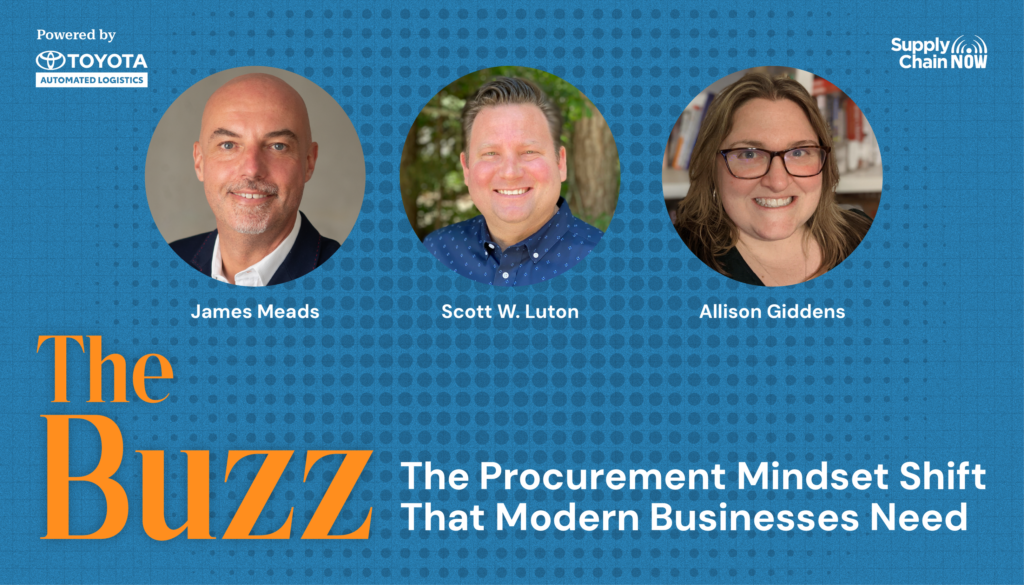
Am. Folks, as Trisha says, happy buzz day. Say hello, let us know where you’re tuned in from. We got a great show here on The Buzz where every Monday at 12 noon Eastern Time, we discuss a variety of news developments from across global supply chain and business. News that matters is what we like to call it. And folks, all month long in August, the buzz is powered by our friends at Toyota Automated Logistics, your global partner for integrated warehouse automation. To learn more, visit and bear with me here folks, toyota-automated-logistics.com. We’re also dropping a link right there in the chat. But Alison, we got to do that for folks that might be listening. They’re too busy working and they’re just listening to the conversation. We try to make it really easy for folks to connect, huh?
Allison Giddens (01:45):
I like that. I like, because you can visualize it too. When you just read that out, you can visualize the. Because my email address has a dash in it, so
Scott Luton (01:51):
You got to say
Allison Giddens (01:52):
The dash.
Scott Luton (01:53):
That’s right. You got to say the dash. But folks, big show teed up here today. We’re going to be talking about a variety of things, including big manufacturers, making some big moves to improve operations and performance. And there’s growing concerns about diesel prices and supply. More of the same folks. We’re going to dive into that. We’re also going to talk about some new procurement rules that Pentagon has implemented. Stay tuned. We cover all those things and a lot more and even better. It’s always a great show when Allison stops by, but we’ve got a great guest. James Meades with Entrepreneurial Procurement is with us here today. I’m looking forward to his insights and perspective. Allison should be a great show here today. I will. Are you ready to go, my friend?
Allison Giddens (02:34):
Let’s do this.
Scott Luton (02:35):
Let’s do it. So folks, Tricia is dropping that link. Thank you so much, Tricia, for all that you do, you and Amanda both. Trisha’s out to make your days easier. We’re dropping links right there in the chat, including the one to our friends at Toyota Automated Logistics. Let’s see here, we’re going to cover three things on the buzz here before our dear friend James joins us. And I want to start with the first one. We dropped a new edition of With That Said Over the Weekend. Tons of good stuff in here, right? And I’m going to share a couple of items because we really led off with news and views, I’ll call it. So I’m going to share a couple of these bullet points here. Up first, US consumer spending, which makes up about 70% of economic activity in the US. It rose considerably in second quarter 2026.
(03:21):
It was up 3.2% over the same timeframe last year. I guess that’s good news. We’re going to keep spending no matter what the economic waters are. We’re going to spend that money. Let’se, we also shared a survey from CIO Dive that gathered a perspective on 525 US professionals. And one of the nuggets they found, only 27% of the respondents characterized their AI governance programs as fully mature. And I bet 26% of those are lying, Alison. They’re lying. Maybe 1% out there that’s fully mature from a governance standpoint. And finally, we shared this nugget from a Gartner survey that showed 54% of supply chain executives said leadership turnover had moderately to completely disrupted supply chain performance over the last three years. Folks, recruit, develop, retain. We can’t forget about the retain part. Folks, beyond all those things, we had lots of helpful resources, including the complete guide to warehousing from Dr.
(04:17):
Mudasir Ahmed and the team over at SCM Dojo. But hey, Allison, not sure if you set aside an hour or so to dive into what that said over the weekend. Of course. I know you had a busy weekend. What’d you see in there?
Allison Giddens (04:29):
The whole spending going up, I think that was really, I know it was early on in the article or the newsletter, but I think that really kicked me because I had gone shopping with my mom for her birthday about a week or so ago. And I think we alone, we were the cause of that spending increase. So I think that that was probably the. No, but in all seriousness, you remember not too long ago when we were talking about companies holding onto cash?
James Meads (04:58):
Yes.
Allison Giddens (04:59):
So this is interesting that the spending is happening now. I don’t know if the spending is a result of borrowing and then spending new dollars or what, or spending the dollars that have been saved, but that’s interesting to watch. And I think a lot of it has to do with supply chains and manufacturing ramp up and people knowing that people need stuff.
Scott Luton (05:17):
That’s right. Allison, I agree. What I’d like to see, and maybe someone out there can help us out, I would love to see US consumer spending as it compares to other countries around the world, whether it’s for second quarter, whether it’s for last year, I’d love to map that out and look at the similarities and some of the contrasts. We’ll see. All right, let’s see here. Allison, I also want to point out one thing before we get to number two. This quote, it was James Baldwin’s birthday yesterday, and he is a famed civil rights activist, big time author. And I love this quote, his, “Not everything that is faced can be changed, but nothing can be changed until it is faced.” Alison, I find that to be a universal truth. Would you agree?
Allison Giddens (06:04):
Absolutely. This was very, it spoke to me as soon as you popped that up on the screen. I had something happen this morning that was going to be an uncomfortable start to a conversation, but until it was started, we can’t do anything about it. That’s right. So that’s it.
Scott Luton (06:17):
We got to deal in reality, right? Yep. We got to deal in reality. That’s how we get to the root cause and the bottom of things so we can overcome. All right, so let’s do this. On item number two, Allison, now you know, I think we talk about it every time you stop in. We love our acronyms in global supply chain. Love
James Meads (06:34):
Them.
Scott Luton (06:34):
As much as we love our coffee and our adult beverages. But perhaps the only other entity that loves acronyms even better, let’s see if you agree, is the US Department of Defense or War or whatever they’re calling it today. Now you write regularly on a variety of supply chain and what I’ll call supply chain and maybe regulatory topics in this space as your company works in this universe. Recently you were writing, got a little visual here to a couple snippets. You were writing about a DFARS rule, D-F-A-R-S, so an acronym. So Alison, if you would tell us what that is and some of your perspective here, including what other manufacturers that are maybe in this universe too, what they should know.
Allison Giddens (07:15):
Absolutely. So DFARS stands for Defense Federal Acquisition. It really doesn’t really matter what it stands for. If you are in manufacturing or really in services as well, you see a lot of different contractual clauses float into your contracts and your purchase orders. And essentially it’s like an onion with the peeling the layers back. You go, you look in the DFARS register and the supplemental information and you go through and you see what numbers match to what, and you see what it is that you’re contractually being required to do if you accept that contract. So there’s a big overhaul happening right now. So that’s kind of a side for the far overhaul. But meanwhile, in the attempt to try and get a lot of production ramped up and a lot of production brought back on shore here at the US, the US Department of Defense, they’re looking to change some requirements to secure circuit board acquisition requirements.
(08:08):
And so this particular one that you popped up, there are some security concerns that they want to make sure certain data related to these circuit boards are protected. However, the way that the rule is worded, the way that the proposal is worded, it implies that everything that goes around the circuit board, like the manufactured aluminum brackets and things like that, housings, implication, some people can read into it, say that that’s going to have to be protected just as much as the circuit board stuff. So at face value, you’re like, of course we should protect government data, of course. But when you really look at it and you realize, oh wait, so you’re telling me this aluminum bracket that might cost 60 bucks to make right now, now I have to protect it in the same way companies are protecting the electronics. So obviously that means my costs go up and my process has changed.
(08:58):
So what does that mean overall? So ultimately it’s just a call to manufacturers to know what it is that you’re being asked to do. And if you have an opinion with these things, push back. Put your words in writing and the government wants feedback. They don’t know what they don’t know.
(09:13):
So in this particular circumstance, if this kind of piqued your interest, they’re taking comments through the end of this month. So August 31st, 2026. So go look at it and go put your comments out there.
Scott Luton (09:23):
Now I’ll add to that, Alison, you laid that out very clear that anyone, no matter where they are in industry, I think could follow along and understand what you’re doing and why you’re getting involved. Now I’ll just point out folks, and again, I cherry-picked from Allison’s social following. She’s not lip service leadership. She’s jumping in. That’s a four-page letter, Alison.
James Meads (09:45):
I know.
Scott Luton (09:46):
Laying things out, things to look out for, some of the challenges, because they asked for comments and they’re getting them from this good manufacturing citizen. So Alison, good work. And I appreciate you unpacking that here. And folks, you got 27, 28 days to be heard. So I’m sure, Allison, if you had to point people DFARs, let’s see here, Defense Federal Acquisition Regulation Supplement. Yes. Man, that is official sounding.
Allison Giddens (10:11):
Oh, goodness.
Scott Luton (10:11):
It’s so interesting. I think we all know so many more acronyms and we know what it means. We don’t know what it means.
Allison Giddens (10:17):
Yes. If
Scott Luton (10:18):
That makes sense.
Allison Giddens (10:19):
Yep.
Scott Luton (10:19):
So Alison, they can follow you, I imagine, and go check out what you’ve shared on LinkedIn if they want to jump in the conversation. Is that right?
Allison Giddens (10:25):
Definitely, definitely. And I put the letter out there so that if you see something you like, steal it. Oh, nice. That’s the whole point is let’s share. I mean, it doesn’t do anybody any good to recreate the wheel. If I say something that you agree with, then copy paste and put it into your own letter with your name.
Scott Luton (10:39):
Love it. Good stuff. Good stuff. Donna says they don’t know what they don’t know. She’s quoting you there. That’s Donna Craichy. I gave your mom a different first name. Donna Craichy, the one and only. Great to see you. And that is perfectly said.
Allison Giddens (10:55):
One of the smartest people I know right there.
Scott Luton (10:57):
That’s right. Great to see you, Donna. And Robinson’s back with us. Hey, Robinson, let us know where you’re tuned in from. We know Donna is in the Atlanta area. Robinson, let us know where in this world you are tuned in from. All right, one more thing before we welcome in a great guest here today. I’m going to pop something on the screen. It’s going to hurt some eyes, Allison. It’s going to hurt some eyes because courtesy of our friends at ESPN. It’s the current standings of the National League East Division. Now, I want to just, before I ask you a question here, just clarify this for me from a data perspective. I see who’s in first place up here with a record of 67 and 45, almost a 600 winning percentage. But way down here, not the second team, not the third team, not the fourth team.
(11:41):
Who’s that team way down there in the basement? New
Allison Giddens (11:43):
York Mets. Yeah. See, I’ve got a lot of family that are Mets fans and as much you know what as we give each other, I feel for them because we’ve been there, right? We have. I mean, we’re not right now, and I’d like to point that out.
Scott Luton (11:58):
Hey, all in good fun. Mets fans, Nationals fans, Phish fans, really all in good fun. We’ve had our plenty of share of bad years. And sitting in first place in a division on August 3rd doesn’t get you mini trophies. So folks, all in good fun. All right, so let me ask you this though. It’s been an interesting baseball season. I’m not going to ask you about the trading deadline, but I am going to ask you this. This has been a really fun team to watch, the 2026 Atlanta Braves. I know you and Donna might be the biggest Braves fan ever. She’s in the chat there. I see her images from the ballpark all the time. What’s one thing about leadership that this year’s Braves team has taught you?
Allison Giddens (12:39):
I really like how there’s not just a single person that leads the team. And maybe that’s different behind the scenes, but it just seems to me like every game where we do great things, it seems like somebody is stepping up. Somebody different is stepping up. And I like the camaraderie. I like the fact that when, I think it was, I don’t even remember who it was, one of our guys had gotten a second base and he’s having a conversation with the other second basemen and they were laughing. I mean, you just tell ultimately they’re not taking themselves seriously. And maybe that’s more of the leadership lesson is don’t take yourself so seriously.
Scott Luton (13:12):
I think that’s a good practical one. And folks, as we like to say around here, sometimes you got to laugh to keep from crying on those tough days. Lean into your sense of humor because that will help you navigate through the more challenging times in your journey. But Alison, I’m with you. I don’t think the Braves take themselves too seriously. I think they’re always professional. And it is the point you’re making, a win by committee type of approach. And by the way, folks, I love Walt Weiss. I’ve been a fan of his since he was a shortstop for first, I guess it was the A’s. I think eventually he played with the Marlins later in his career, and I think he’s got a great baseball
Allison Giddens (13:48):
Line. That’s a good trivia that you remember there. That’s good. What did you have for breakfast three days ago? You don’t remember, Dave?
Scott Luton (13:54):
Sure, Kate. Oh man. All right, so Allison, good leadership observation there, and we’ll see how the season unfolds. A lot more baseball to be played. So with all that said, we have got a wonderful guest here on the buzz. Folks, James Meades has spent almost 20 years doing frontline procurement. He’s quite a guru. He’s seen the good and the bad and ugly, especially from a technology standpoint. James now advises supply chain leaders, especially procurement technology companies on how to bet much, much better way forward and optimize performance. He also hosts a show called The Procurement Software Podcast. He’s been busy. They’ve published well over 170 episodes since 2020. Please join me in welcoming James Meads, founder of Entrepreneurial Procurement. Hey, hey James, how are you doing today, my friend?
James Meads (14:45):
Scott, great to be on the show. Thank you for the introduction. Wow, that’s very grandstanding.
Scott Luton (14:51):
You’ve been busy. Allison, James has been busy, huh?
Allison Giddens (14:54):
Just about 100 Sonia, that’s a lot of episodes.
Scott Luton (14:56):
Man.
James Meads (14:57):
I didn’t realize it was that many interviews he said. I don’t count them that often.
Scott Luton (15:01):
And now you think if you’re like me, and once you start talking numbers, you can almost cycle through all the memories of each show, what number, what guess, what eureka moments. I mean, you’ve done great, great work and it’s great to finally have you on the bus. So James, I’m going to start with a patented fun warmup question with you and Allison. Okay? So today, August 3rd is many things. It is National Watermelon Day. Alison, I’ll ask you if you salt or no salt maybe later in the show. It’s British Columbia Day. It’s also Martha Stewart’s birthday. That’s right. The famed businesswoman, writer, and television personality was born on this day back in 1941 in Jersey City, New Jersey. So James, in honor of Martha Stewart, now you’re not one of her big followers, and that’s okay, but in honor of Martha Stewart, what do you like to do most?
(15:48):
Cooking, entertaining, or gardening? Well,
James Meads (15:51):
I’m going to have to exclude gardening because I don’t have a garden and I hate doing any manual labor. So it would have to be a mix of cooking and entertaining. I kind of think they’d both go together. So I love wine. So if I’m going to cook something, then I’m going to entertain with a good bottle of wine as well. Nice. Yeah, it
Scott Luton (16:06):
Would
James Meads (16:07):
Be both.
Scott Luton (16:08):
I like it. I like it. We may be second cousins. Allison, same question. Cooking, entertaining, or gardening. I know it’s not gardening for you either, right?
Allison Giddens (16:15):
Correct, because I kill everything, every plant. Yeah, I like to cook, but inevitably it drives me crazy because somebody else is standing in the kitchen and they’re standing in front of the one cabinet that I need. So I’m going to say probably entertaining.
Scott Luton (16:30):
I like it. I like it. And hey, as we were referencing earlier, in these divisive friction field times, isn’t it nice to get a bunch of friends and family over and just enjoy – That’s
Allison Giddens (16:41):
Right. Cooking, entertaining, or gardening? What do you
Scott Luton (16:44):
Think?
Allison Giddens (16:44):
Oh, for
Scott Luton (16:45):
Me?
Allison Giddens (16:45):
Yeah.
Scott Luton (16:46):
Well, let’s see. How would Amanda answer this question and how would I answer this question? So she does not like. Well, she likes my grilling. I’m okay there. She is a brilliant chef. Entertaining am I okay? I like to get outside. I’m not a gardener, James and Allison. I’ve given it the good college try numerous times enough to know that I do enjoy it. Allison, we have something in common. I’m not good at it. We’re still trying to grow tomatoes for the first time, and that’s been a disaster. But that’s been a disaster. But James and Allison, we got a lot of stuff to get to here today. And again, I appreciate y’all’s perspective. It’s good to entertain with people you love no matter what time of year it is. So let’s do this. We got three, three and a half big stories to get into here on the buzz powered by our friends at Toyota Automated Logistics.
(17:32):
And I want to start with a two-parter. There’s been no shortage of big companies announcing big supply chain transformation investments. Supply Chain Dive has been reporting on a couple of the latest endeavors, starting with GE Aerospace. In Q2, the company has been focused on a variety of improvements, including reducing production lead time for critical components by whopping 60%. That all has helped it boost a big increase in F-110, I’m going to call it, F-110 engine deliveries, which was up 50% in Q2 2026 year-over-year over the same time period last year. And one of the little trivia factoid, folks may not know that former Danaher CEO, Larry Culp, has been at the helm as CEO of GE Aerospace since 2018. Beyond this company, we’ve also seen General Motors also doing some big things as it invests in its supply chain resilience plan in really a number of different ways.
(18:29):
But check this out. It’s planning to spend an additional one to 1.5 billion, somewhere in there. Kind of a big range, right? One to $1.5 billion to own share more production to the US in 2027. GM is also expanding its relationship with Micron technology as it aims to protect access to key components such as memory chips. And folks, if y’all been tuned into the buzz, we tackled an interesting time in the memory chip and semiconductor market a few weeks back. So James, when you think about those things that GE Airspace and GM are doing, and you got your pulse on the market, what are you seeing? What sticks out to you?
James Meads (19:10):
Yeah, I mean, I’m an automotive guy by background, so I can kind of see where GM are coming from. I think just-in-time production that was always en vogue back in the day when I worked in automotive 20 years ago. It’s kind of dead now, isn’t it? If you look at the geopolitical situation and just look at the reality of where we are, there has to be a sensible compromise between how much inventory do you hold versus how lean is your supply chain and whether you spend time qualifying multiple sources to enable yourself to get out of a pickle if there’s a major unexpected black swan event, as we saw during COVID. And then when the Suez Canal was shot and now we’ve got the straight and full news, all of it. They seem to be coming thick and fast in ways that they never used to.
(19:53):
So I think that old playbook has kind of gone out of the window. And I think if I look, I mean, I don’t have a crystal ball, but I’m a bit of a geopolitics nerd more generally. And I just think where we’re going, it’s going to get worse before it gets better with inflation, supply chain risk, all of that stuff. I think it’s going to get worse before it gets better.
Scott Luton (20:11):
James, we were having the same conversation last week, and despite me being a practical optimist, I do agree with you. I think this year is going to be more challenging before it gets. It stabilized a little bit, which is great to see, but we’re just one event away from the whole world turning upside down again. So Allison, a lot of companies out there are looking for resilience or transformation. We’re just kind of picking a couple between General Motors and GE Aerospace. But what are your thoughts, Allison? What are you seeing?
Allison Giddens (20:39):
Yeah, I think James is dead on. I’m seeing the same. I’m encouraged to see news that lead times were trimmed. When a large, what we call prime says these types of things, my brain always goes to, okay, but who are GE Aerospace’s suppliers? Because the big primes aren’t necessarily all manufacturers, they’re assemblers. And so they’re bringing in products and they’re bringing in these things. So therefore their suppliers had to have had these successes in order for GE Aerospace to have that success. I see a lot of conversations happening to smaller companies asking them to consider things like expanding inventory and things like that. To James’s point, just in time, it ain’t going to cut it anymore. So cashflow I think is going to be very interesting, especially for small businesses for inventory, because there’s only so much stock a small business can manufacture, put on a shelf and let it sit until somebody needs it.
Scott Luton (21:33):
And inventory management’s cool again, based on some of the trends you and James both are speaking to. And as we’ve seen since I was in manufacturing industry where some of the big companies were getting a smaller company to own as much of the risk as they can, getting all the blood out of the turnip, so to speak. But the greater point you’re making, Allison, and I love, is there’s so much goodness in our supply chain ecosystem. And some of the best ideas can come from not only your customers, but also your suppliers. So good stuff. We’ll see how these efforts turn out despite some early returns. And folks, don’t take our word for it. Tricia is dropping a link to both of these stories right here in the chat. Also, hey Hamilton, good evening to you. Let us know what part of the world you’re in and give us your take on these topics we’re talking about.
(22:21):
Let’s see here. I told y’all three and a half stories, but I guess technically that was two. We got two more. I want to get into this next story that impacts everybody. If you think you’re immune to this because you don’t get diesel at the gas pump, you’re mistaken, my friend. You’re mistaken. We’re going to check in on what some are calling a diesel supply crunch that’s taking place right now. According to the Wall Street Journal, the ongoing conflict across the Middle East couldn’t hit us at a worst time really as we move into fall 2026 and what is typically a high demand time of year for diesel. Get this, the average on highway price of diesel in the US, it was $5.31 as of last week, I think last Monday, so a week ago, compared to $3.53 a gallon a year ago. Now, a variety of factors are creating a bit of a perfect storm as the article points to, all impacting overall access to supply and price.
(23:15):
Ukrainian attacks on Russian refineries, lower production at Chinese refineries, and of course, limited deliveries from Persian Gulf refineries. And because diesel is used across the business world, agriculture to heating, to of course transportation, it’s got massive ripple effects across global supply chain. It is a great indication of the butterfly effect might be a perfect example of that. So James, when you think of what some are calling the diesel supply crunch, and of course the increase in prices, your thoughts on what we’re going to see.
James Meads (23:47):
I think you hit the nail on the head, Scott. It’s a highly inflationary push because it’s used in so many other things beyond just car and truck transportation. As you alluded to, it’s used across agriculture. It’s used across when you think about delivery, it’s used across every supply chain. So from all of your consumer staples, it’s going to impact them. So if you get that and then you get the perfect storm of further raw material price inflation, the price of copper has gone up significantly over the past year, a bunch of others as well. If you’re going to see commodity price inflation, which I think overwhelmingly we are going to over the next three to five years, as money, as investor money comes out of things like AI and tech stocks, it has to go somewhere. And if all of these industry, oil and gas and commodities more specifically, more generally, they’ve not had the investment.
(24:37):
They’ve been sort of the redhead stepchildren of the investment world over the past 10 years. And because of that, there’s a lot of backlog in terms of investment to modernize those facilities and to bring them up to speed. So if there’s a capacity increase, then there’s going to be a lag because it takes a lot of time to get those facilities on stream. So I said I’m a bit of a geopolitics nerd. I listen to a lot of commodities, gold and silver type content and read a lot of that. And I think we are going to see a huge bull market in all commodities in the upcoming years.
Scott Luton (25:07):
James, I tell you, your crystal ball seems to be working well. Allison, your thoughts back to the diesel story.
Allison Giddens (25:14):
Yeah, that the diesel, it makes me think that come holiday shopping season, we’re going to start seeing really customers. I think demand is going to be well up there as we’ve seen from the spending increases over the past few quarters. But I think a lot of companies are going to start trying to figure out, to James’s point, it’s not as though you can just stand up infrastructure overnight. I think a lot of companies are going to try to figure out how to be more efficient in the back and forth, in the point A to point B. I don’t know if that means better packing of LTL. I don’t know what all that looks like, but I think efficiency is going to be key here.
Scott Luton (25:46):
I agree. And one other thing I was reading back to this article in the Wall Street Journal is they talked about the profit margins at the refineries. And it kind of reminded me of my food industry days way back when. Feels like a hundred years ago, but it was probably closer to 20. And as crude comes down, they’re projecting that refineries largely globally, not in just one market, two markets, they’re going to be protecting that margin. And you’re not going to see us crude. Hopefully if cooler heads can prevail, and hopefully we get even maybe a permanent deal of sorts that also allows for uninterrupted shipping through the Strade of Harmus. Even as crude oil comes down, the price of diesel is going to be more inflated as these refineries look to hang on to their profit margin to recover from a wide variety, many challenges.
(26:37):
So we’ll see. But James, do you take your crystal ball in all these conversations, my friend?
James Meads (26:42):
This is not investment advice, so don’t come and lynch me if I’m wrong.
Scott Luton (26:46):
Okay, fair enough. I’m glad you had that disclaimer. And by the way, Naranjan, great to see you here, my friend. Looks like you’re involved in a variety of sectors, including the railway rail industry. That’s an interesting one. Great to see here. All right, so the third story, before we dive deeper into some of the work James is doing, I want to go to this story, which I think is almost a perfect one to put in front of Allison and James. So Abigail Hunter over at Breaking Defense is reporting on new sourcing policies that the White House and the Pentagon is attempting to implement. Now, doesn’t that graphic? I can hear the Breaking Bad theme song in my ears right now, but check this out folks. And there’s a lot of moving pieces, so bear with me and we’ll see if I got it right from Alison and James.
(27:30):
So in a nutshell, for years that Pentagon has wanted to limit certain materials from certain countries making their way into US arms programs. Think critical minerals from China, Russia, North Korea, and Iran. And also for years, if a DOD supplier couldn’t find certain supplies anywhere else, it could still ask for a waiver from the restrictions and get what it needed. And that waiver from at least Abigail’s point of view seemed to be regularly granted. So let’s see, a couple weeks ago, the White House issued a new executive order that evidently cracks down on the usage of these waivers while also asking for a documented plan for resolving the supply issue down the road. So it’s not like a permanent waiver situation. The order also attempts to implement some degree of supply chain mapping and traceability for defense contractors. That is wonderful, frankly. Abigail pointed to, I think she mentioned 6% of prime contractors haven’t mapped out their whole ecosystem.
(28:29):
Welcome to the crowd. That happens a lot of places. Finally, a third major component of the order essentially is seeking to encourage more suppliers to source critical minerals from the domestic ecosystem that the US government is trying to invest in, stand up, and expand. So again, there’s a lot here. And Allison and James, that’s about as simple as I can make it. I hope I caught it accurately. James, react to this executive order and what it’s trying to accomplish.
James Meads (28:56):
So I’ve never worked in public sector procurement, and I don’t live in the US, so I’m not familiar with the intricacies of your public procurement policy. But I think one of the things that this highlights is that, especially coming on it from a procurement and supply chain tech perspective, material traceability software has become a lot better over the past few years. And that’s enabled companies to understand beyond just the tier one where their raw materials are coming from. And that, as the article shows, is opening up a lot of uncomfortable conversations if you realize that you’re dependent on a hostile state in this case, or in the wider private sector, if you’re dependent on a sole source for a raw material or for a purchase part. I think it’s good that we are shining a light on that and we’re figuring out that, hey, we’ve got a problem.
(29:47):
But then the next question is, okay, well, what’s the policy then around how do we go about fixing it? Is there going to be a budget to allow us to bring a second source on stream? Is there even a way that we can do it? I know a lot of rare earth, if I’m not mistaken, you pretty. Be much dependent on China to source them. So how does something as strategically important as the US DOD get around that? There’s no short-term solution as far as I can see. That’s
Scott Luton (30:10):
Right. And James, a great call out there. I don’t have the numbers in front of me, but China, of course, is corner to market in many ways, not just in the mining themselves, but also in the refining of those critical minerals. Allison though, your thoughts? Again, there’s lots of sensitivities here, I know, but your thoughts on this executive order and what it’s trying to get done.
Allison Giddens (30:29):
We can have a whole session just on this one. So there are a few things I think of big time red flags for me. So when I saw this EO come out, there were a lot of concerns because just like many other things in any administration, decisions are being made in a vacuum, but reality is not in a vacuum. So where we have requirements to better understand and better scope and better hone in our supply chain, especially domestically on defense related products, that makes a heck of a lot of sense. However, back to the diesel conversation, you can’t stand up infrastructure overnight. So in the meantime, while we are trying to work with a lot of large aluminum mills to try to get them online for aerospace grade materials and things that fit this need, meanwhile, what’s happening is we as defense contractors still have to find material for ramp-ups, for production ramp-ups that are happening right now.
(31:25):
So how we do that is we go to what they call DFARS compliant or DFARS qualifying countries. There’s a short list of friendly countries that we can get material from. Unfortunately, when you overlap a lot of the tariffs, they pretty much, it’s a one-to-one with said qualifying countries. So I hope that we’re not cutting off our nose despite our face with some of this. Other things to consider are that there are titanium, for example, titanium sponge. There’s only two people or two countries that make titanium sponge. Used to be three. We used to have a mill, I believe, in Utah or Nevada that would manufacture sponge, but we stopped supporting that as a country in 2020. And now the only two countries that make titanium sponge, you guessed it, are Russia and China.
James Meads (32:09):
Wow.
Allison Giddens (32:10):
So there’s a lot involved here I think that goes above and beyond simply onshoring material and the mapping of the supply chain, which would be good. But remember too, from a security standpoint, if anybody got their hands on a fully mapped supply chain, that would be devastating. That’s
Scott Luton (32:27):
A variety of great points, Allison. And I would just add one more thing, James and Allison. Topics like this, there’s all kinds of bedfellows, so to speak. You do one thing and you might accomplish what you’re after, but it brings other repercussions. And at the end of the day, in this case at least, since we’re talking about the US government, taxpayers and citizens and politicians, we got to pick what’s the least of the evils, I guess. What are you willing to stomach if you make progress here? And we’ll see how this all plays out. But I’ll tell you one thing. I’m very curious, James and Alison, I put some data a couple of weeks ago from a media publication called Simma Ford that really put a fine point on China’s position in particular when it comes to critical minerals. We’ve got some big choices that we’re going to have to make in the coming months and certainly the coming years.
(33:15):
And one of them, Alice, it goes to your example, my hunch. I don’t know that one plant you’re talking about in Utah or elsewhere, but my hunch is that it was probably regulated out of existence. And that’s a great example of some of the tough decisions we’re going to have to make. So we shall see. But James and Allison, I loved both of your takes on this executive order and we’ll see how it plays out. Folks, give us your take. I love that the title of The Devil was in the Wavers. We’ll see if that changes. All right, before we dive deeper into the mind of one James Meads, I want to share a quick resource right here for a second. Folks, Toyota Automated Logistics is your global partner for integrated warehouse automation. The company combines the talents of Bastion Solutions, Von Delande’s warehousing business, and ViaStore.
(34:05):
All under one brand as an integrated automation hub to deliver scalable systems, intelligent software, and life cycle services. Bringing together the latest supply chain technologies into one connected solution. Toyota Automated Logistics delivers a seamless journey from system design to delivery, empowering customers with a lasting competitive advantage. Learn more. Bear with me folks. Toyota-automated-logistics.com. And Trisha dropped the link. Thank you for that. All right, so James, we’ll dive deeper with you here on the buzz. In particular, I’m curious about something right out of the gate. So you’ve argued for years, if I’m not mistaken, back when you were actually doing the procurement work, I think for close to 20 years back in the day, that procurement needs to stop acting like a call center and start behaving like an entrepreneurial business partner. I feel like a parent saying those words. What’s the single biggest mindset shift that separates procurement organizations that lead the business from those that simply support it, James?
James Meads (35:04):
That’s a really good question. So I thought about this long and hard, and I think there are two key factors. So I think fundamentally procurement still has a bit of a Cinderella mindset that we often just make do, and we are often not brave enough to go to the CFO or to go to the CIO and really push and demand and make our case for investment. Part of that may have been that historically senior procurement people perhaps haven’t been the strongest communicators, the most charismatic people in the way that sales and marketing people often are. I think that’s part of the problem. But I think just the way that procurement often just rolls over and accepts that they’re not going to get investment, the grudging acceptance of having a very limited influence within the business. And if we don’t see our own self-worth and bravely push for that investment, then we’re just not going to get it.
(35:56):
So I think that if you talk about the one biggest mind shift, I would say it’s that if I spin that a little bit in terms of how does that then translate into a more behavioral shift in how procurement behaves on a day-to-day basis or the sort of people that I firmly believe we need to be hiring or promoting into senior leadership positions, I think we need to move away from being a very technocratic process-driven function. And as you said in the introduction, we need to have more of a business owner type mindset. I’m not saying you should go out and recruit startup founders into procurement. That’s probably not going to happen. But I think the way that we trade, if you look at procurement-related formal training, SIPs in the UK and in the Middle East and Africa and in Australia and New Zealand is a big one.
(36:41):
In the US, it’s ISM and APSM. I don’t see them teaching that. I see them teaching a lot of process. And I understand they have to cover both public and private sector, so they have to be all things to all people. So I get it, they’re preaching to quite a broad church. But I think if we don’t change that quickly and bring in curious minds that are willing to question the status quo, and if we don’t bring in builders who are really good at knocking up prototypes with AI and vibe coding and all that type of jazz that’s really driving innovation in some of these growth tech companies, I just think we’re at risk of losing the best people that we have in our profession because working for a startup is cooler. Working for a consulting firm pays more and is typically a little bit more, what’s the word?
(37:27):
You have a little bit more stature within a business if you go in as a consultant, whereas procurement practitioners often tend to be quite beaten down and downtrodden in the business because they just don’t get that reckoning. Nobody calls procurement and thanks them when everything goes right. But as soon as something goes wrong, same as if you work in logistics or supply chain, you’re the first one that’s on the hook for it. So I’m optimistic that, and I know we’re going to talk about AI in a little bit, but I’m optimistic that AI can help us get out of a lot of the day-to-day grunt work. But I think if we don’t have this more visionary mindset, we’ll struggle to be able to translate that into meaningful value for the business.
Scott Luton (38:03):
James, I know you could talk about this, and by extension we could talk about this for days on end, right? But one of the points you made, and Alison, I’ll see your take here as well, is it goes back to something we talk about all the time here. We got to stop as the rest of industry, stop acting like it’s 1982 and continue doing business as usual. In this case, James is talking about procurement as usual. Allison, what’d you hear there from James? I
Allison Giddens (38:29):
Know he said something like that he wasn’t asking for entrepreneurials to all get hired on as procurement. My though was, well, why not? Because he’s right. I think you really do need that thought. You have to have some sort of ownership mindset to plug into these roles. And yeah, no, he’s dead on. But
James Meads (38:47):
I think if we’re going to do that, Alison, I dont disagree with him and I’d love to get them in, but I think you would have to give that person that you are hiring in way more autonomy in terms of going around process and regulation to enable them to stay and make meaningful impact. You
Scott Luton (39:01):
Shared one other thing there, James. And what I heard as you were mentioning different organizations and whatnot, we all know industry associations and we all appreciate them from a networking standpoint, from a professional development to learning, you name it. However, most of them, if not all of them, at least those that offer certifications, they operate with a body of knowledge. And oftentimes, I’m not picking on any of them out there, but oftentimes the bodies of knowledge can be stagnant Because these associations can get so focused on growing membership and also protecting what the certifications test on and what that body of knowledge is because it takes a lot to get to a point where you’ve got one that’s worth a darn. It’s interesting because what I see there, James and Allison, is the same thing that I think to some degree makes professional associations really important is also the same thing that holds them back from Jane, to your point, James, kind of pushing the envelope and pushing the evolution of functional roles to what should come next.
(40:06):
James, do you see it similar to that?
James Meads (40:08):
Yeah, and I really hope that they can lead the way because I’m hearing that SIPS had a new CEO about a year and a half ago. He’s making the right noises. The challenge that he has is it’s a very broad church and it takes a long time to turn around the oil tanker.
Scott Luton (40:23):
Yes. Will
James Meads (40:24):
He have the gift of time to be able to do that or will world events and just how quickly everything is happening in terms of technological development just overtake how quickly he’s able to make that change? I don’t know. I wish him success. I think he’s making the right noises, but you need to go faster. We
Scott Luton (40:41):
Need to go faster. By the way, we’ve interviewed folks from SIPS. It’s a great organization. Folks, go check it out. Allison, really quick before I continue with James, really quick, you see a similar challenge with associations. We love them, but it’s like a double-edged sword sometimes, huh?
Allison Giddens (40:54):
Yes, I think too, because a lot of times they’ve got their own priorities understandable. I mean, that’s what they have to do, and they’re hearing from a lot of different people in membership. And again, sometimes only working in silos. And so it’s tough to see all the spokes that come in.
Scott Luton (41:08):
That’s right. The challenge is real, as they say. All right, so we’re going to talk AI for a minute, although we could talk hours. It’s an amazing time. The golden age of supply chain tech, or at least the goldenest age of supply chain tech maybe right now. Who knows what’s around the corner? Kind of exciting and scary at the same time. But James, in your conversations with procurement leaders around the world, I want to ask you a twofold question here. Number one, what’s one use case that you have found that’s really hit the mark and it’s delivering measurable value today? On the other side, what do you find maybe a use case that has been around maybe too long, is getting still more attention than it deserves? Maybe it’s so yesterday versus not today. James, what are a couple thoughts that come to your mind?
James Meads (41:51):
Yeah, I think the ones that are really driving value in terms of meaningfully reducing the amount of time that procurement leaders spend on non-value-added tasks, number one would be just simple automations to resolve very specific bottlenecks. So I don’t mean implementing a whole end-to-end procurement suite, but I mean if you can bring in a simple AI agent or a simple automation that removes a simple bottleneck, even if it’s something simple like extracting some data from an email and automatically populating that in an ERP system, saves a lot of time. Procurement leaders aren’t paid six-figure salaries to copy and paste stuff from email into an ERP system. The other one is a lot of the backend research and grunt work that goes around writing and devising requests for proposal, requests for quotation, especially for some of the bigger ticket items like CapEx or professional services. That would’ve typically been a day plus work in the past.
(42:49):
And now with AI, especially if you can create, for those of you that use Clawed, if you can create a Clawed skill for how you want it to write and the type of things that you want it to do, or even a Copilot agent for those of you that are restricted and can only use Microsoft in your organization, there are some pretty easy hacks that you can put together to really shorten the amount of time you need to take to write an RFP or to do some of the background research work for putting together procurement category strategies, which was always a big sort of grunt task in terms of putting all of that together. The amount of time that I spent making PowerPoint slides look pretty when I thought a well-paid admin assistant could do it a lot better than me and I could spend my time on something more value-added.
(43:29):
It’s shocking really how much time we spend on that type of thing. So I think AI can really free us from that. I think to the second part of the question, where is it maybe overstated? There’s definitely going to be a need ongoing to have a human in the loop for a lot of these decisions. So I don’t think you can just give AI the autonomy to go out and do what it pleases. I think the big challenge for leaders is to understand and get their heads around what are the limitations of AI and where do they need to have those humans without being too risk averse, but at the same time without letting the AI go off and do something that you don’t want it to do. The other one that I think is a bit buzzwordy is around the whole orchestration part. There are some great tools out there that do genuinely work in this space, but you can’t orchestrate broken processes and you can’t orchestrate poor data.
(44:16):
That’s just the reality. So if you are orchestrating a broken process or poor data, then you’re just speeding up and breaking something faster than would otherwise normally be done if you were doing it manually.
Scott Luton (44:26):
So one of the things I heard there from James’ thoughts, Alison, kind of like a common theme has come up a couple times on today’s show, is that balance. It’s that balance. One specific place that he mentioned that was allowing AI platforms to become more autonomous. But at what point, and I’m thinking just out loud, at what point should they be checking in with the humans? And at what point should humans intervene? What are we comfortable with? What are we uncomfortable with? That’s a fascinating topic really across sectors and across different businesses of how they’re leveraging AI. Allison, your thoughts.
Allison Giddens (44:58):
I agree that we don’t need to be implementing AI as businesses for the sake of implementing AI. Don’t make AI a solution looking for a problem. If you know of a problem and you know that there’s a fix to automate, then go that route. I see a lot of my peers jump on AI because it is the next cool thing. And you hate to see good money thrown after bad. Well,
Scott Luton (45:22):
And to your point, I think it was with that said, and I think we’d gotten the anecdote from the folks over at 0100, big fan, folks check out the signal. It comes out I think once every two weeks. Good stuff. They mentioned a healthcare executive that spent a hundred million dollars on an AI initiative without upfront defined RI, what it’s going to bring to business. And they basically were making the point, you can’t do that. And that kind of behavior can’t continue because that’s going to prevent so much meaningful gains being made by innovative technology these days. So anyway, go check that out and with that said. All right, so James, I want to get to your procurement tech map in just a second, but the one only, Kara Kozei is tuned in. I think he’s in Mexico this week. Kara says SIPS. We were talking about SIPS a minute ago.
(46:11):
SIPS is becoming an outdated credentialing body too focused on static frameworks, legacy exams, and institutional self-preservation while procurement is being reshaped by AI, geopolitics, risk, and value chain disruption. Kara, as always, brings the heat. Great to see you and looking forward to your next appearance with us. But James and Allison, James, I want to talk about this map here. And folks, we’re going to drop a link so you can get your own copy from James and the team of this procurement tech map for mid-market businesses 2026. I know you probably can’t see everything on the screen here, but I want to give you a flavor of what this looks like. So James, Trisha’s dropping a link, but if you would tell us, what are a couple things from all the data behind this massive map that you hope business leaders glean from this latest update?
James Meads (46:59):
Yeah, the reason why we originally did it almost three years ago when we published the first one was that all of the other analyst firms that are out there, when they publish any of their best of lists, all of them tended to be very much focused on enterprise. And I wanted to democratize access to all of the different providers that are out there because not everyone has the marketing budget of someone like SAP or Cooper. And just to be able to give people a synopsis of what’s out there beyond the big names. And one of the things that I would always stress is that there’s a bit of a fallacy out there that procurement and indeed supply chain technology is just focused on enterprise software. And there’s a lot of enterprise software out there, but there’s a very rich ecosystem of tools that are out there that also serves the mid-market as well as SMBs or as well as enterprise too.
(47:53):
Some will have different tiers, different packages, depending on how many users you have or the size of your business or the size of your spend. It’s really around understanding if you’re actually going out and sourcing software. Don’t just start looking at demos willy-nilly until you really understand what the problem is that you want to solve because any good salesperson will try and convince you that their solution will do it. No salesperson, well, very few are going to say, “No, we’re not a good fit,” unless you’ve done your homework beforehand. And this is why if you can use that map and the PDF version does have links that click through to their websites, you can get a much better picture of what’s out there before you then start booking demos or speaking to salespeople. I would ask for industry sector specific case studies because I do think that’s very relevant.
(48:42):
If you’re a life sciences company, then the solution that works in automotive might not necessarily work in your field. And the other thing in terms of what specifically happened since we did the last one, which was in November last year, since we published this one, there are a lot more tools coming out there, especially ones that are growing and maturing, that are focused on vertical solutions that are very niche category or industry sector specific around market intel, category intel, sourcing, and analytics to bring all of that data in one place. We’re starting to get to the position now that procurement actually has a fighting chance of being able to be just as well-informed as the salesperson that they’re sitting opposite in terms of data that they have going into a negotiation. I like
Scott Luton (49:29):
It. You’re helping to build a broader church, James. You’ve used that analogy a couple times in your elegant accent, James. I could listen to you read a phone book, my friend.
James Meads (49:38):
I want to say AI the way that you do with a Southern accent.
Scott Luton (49:41):
I don’t know if you do. Careful what you ask for. But hey, Alison, what I’m hearing there from James, and then we’re going to have a fast and furious finish right up against it, but is saving a ton of time, especially on the front end. Because as he says, don’t just willy-nilly go spend your precious hours on demos. Let’s start directionally with where we need to head. And I think that’s one of the ways I think folks use resources like this. What’d you hear there, Alice?
Allison Giddens (50:04):
Yes, I heard that. And I also heard the quest to get procurement just as much info as sales. And that’s invaluable. I mean, when you talk to somebody about potential partnering, you can tell when the procurement folks and the contract folks have the same knowledge as the sales and vice versa.
Scott Luton (50:21):
Good point. James, good stuff. Appreciate the work you and your team are doing. Trisha’s dropped a link. Folks, you can go get your own copy. And it’s not just a map, there’s some other information that’s going to be helpful. So go check that out, and I bet James would love to hear your feedback there. Hey, James, really quick, entrepreneurial procurement, entrepreneurial procurement. In a nutshell, what do y’all do there? We
James Meads (50:42):
Predominantly help procurement technology companies around sales and marketing enablement, content, product advisory, competitor analysis, but we also have some no-code apps that we built for small procurement teams that don’t have the budget to go out and buy some of the solutions that we have there on the tech map. So if you’re a procurement team of one or two and you want to have a simple app that can automate or that can digitize some of your existing manual processes, then we’d love to get your thoughts and comments if we can show you what we can do there too.
Scott Luton (51:14):
Outstanding democratizing access to technology success no matter what size company you’re in. Appreciate that, James. All right, so I wish I had another hour with both of y’all, James and Allison. Let’s make sure we can help continue the dialogue. And James, I want to start with you. What’s the easiest way folks can. We dropped linked for the procurement tech map, but beyond that, how can folks connect with you, James? Yeah, thanks,
James Meads (51:40):
Scott. The easiest place is just to connect with me on LinkedIn. If you’re in the procurement or supply chain space and you send me a connection request, then I’ll know it’s not spam and I’ll happily accept it. So yeah, just reach out there.
Scott Luton (51:50):
Outstanding. And Allison, as I wrap, I got a different question for you. Y’all know I’m a big fan of a powerful nonprofit called the Dave Craichy Foundation. And check this out. I grabbed this morning. Even Allison audited it before I shared it. They have helped over 2,500 children play the sports they love primarily by taking care of those expensive but pesky registration fees and Aldi’s athletic fees. Really quick, Allison, how can folks jump in to fight and support y’all? Definitely.
Allison Giddens (52:19):
Please check us out online at davecrachy.com. We’ll get you there. And yeah, we just appreciate the support and the shout out. You guys are wonderful.
Scott Luton (52:27):
Outstanding. What a great, great endeavor there. And beyond that, Allison, folks want to compare notes with anything you’ve shared here today, including back to DFARS, whatever the heck DFARS is. I already forgot about it, what it stands for. But how can folks do that, Alison? Same
Allison Giddens (52:41):
Thing, connect with me on LinkedIn, but throw a comment and reference supply chain now in order to be a guaranteed connect. Otherwise – Uncertainty,
Scott Luton (52:49):
More uncertainty. More uncertainty, folks. Hey, Trisha’s made it easy. She’s dropped Jane’s LinkedIn profile. Go check that out. We also dropped our procurement tech link earlier. Trisha dropped Allison’s link there. Again, they both would love for you to add a little note there about why and how you found them, so to speak. And we’re also including davecrachy.com, davecrachi.org. You’ll get there and check out a wonderful nonprofit that I’ve been thrilled to watch grow and continue to help so many folks. And I made a mistake there. It’s davecrachy.com. My bad, Allison. My bad. Oh,
James Meads (53:25):
Good.
Scott Luton (53:25):
Davecrachi.com. Go check it out. Well, big thanks everybody. I got to get one more comment in before we sign off here. Corai Coze, bring in the heat. Great topic. Procure tech is moving from hype into disillusionment as customers demand measurable returns. Through 2026, 2027, stronger platforms will attract capital while weaker vendors face consolidation, restructuring, or failure. I think his crystal ball is working pretty good too. James, you and him both have a great crystal ball. All right, big thanks. James Meades with Entrepreneurial Procurement. James, thanks for being here. Thank
James Meads (53:59):
You, Scott. Pleasure, and thanks for inviting me. You
Scott Luton (54:01):
Bet. My dear friend, wonderful co-host, Allison Giddens. Alison, great to have you here with us today. Great
Allison Giddens (54:06):
To talk and great to meet James. Big thanks
Scott Luton (54:08):
To our friends at Toyota Automated Logistics. Of course, big thanks to Ben and Trisha behind the scenes. Most importantly, big thanks to our global audience. Folks, you know what you got to do. Take one thing. Allison and James shared, do something with it, right? Deeds, not words. That’s how stuff gets done. With all that said, on behalf of the entire Supply Chain Now team, Scott Leon challenges you to do good, give forward, be the change that’s needed. And we’ll see you next time right back here on Supply Chain Now. Thanks, everybody.
Intro/Outro (54:32):
Join the Supply Chain Now community for more supply chain perspectives, news, and innovation. Check out supplychainnow.com. Subscribe to Supply Chain Now on YouTube, and follow and listen to Supply Chain Now wherever you get your podcasts.