Intro/Outro (00:02):
Welcome to Supply Chain Now, the number one voice of supply chain. Join us as we share critical news, key insights, and real supply chain leadership from across the globe. One conversation at a time.
Scott Luton (00:15):
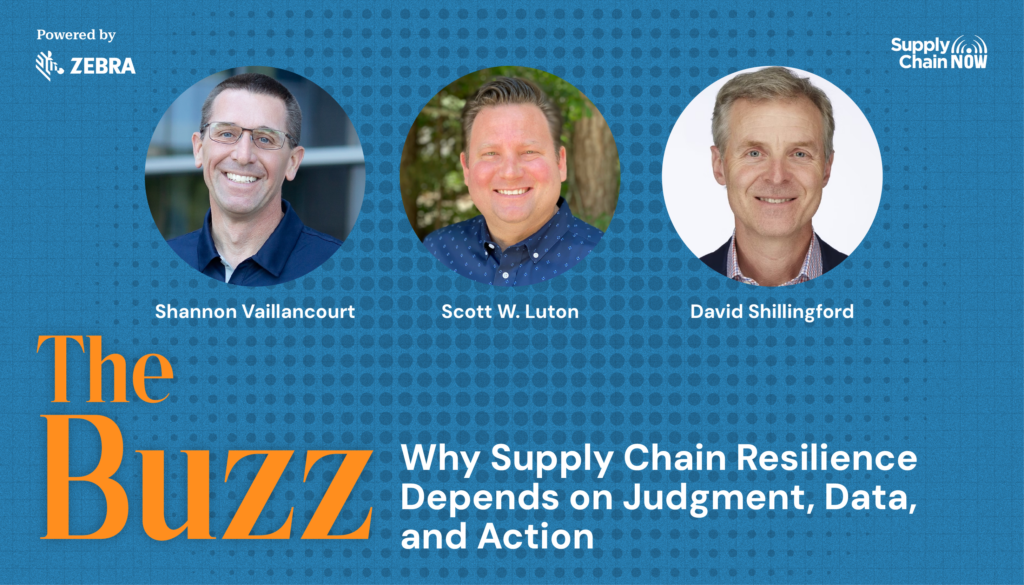
Hey, good morning, good afternoon, good evening, wherever you may be. Scott Luton and very special guest host, David Schilling with you here on Supply Chain Now. Welcome to today’s live stream. Hey, David, how you doing today?
David Shillingford (00:27):
Yeah, great. All good.
Scott Luton (00:28):
All good. And we got a bunch of folks. Alan Jock tuned in from Beautiful Canada. Great to see you, Alan. Looking forward to dinner next week, my friend. Trisha’s dropped a link to Zebra. Folks, go check that out, doing some cool things there. Larry Klein. LK is back with us from Southern Georgia. You know how hot he gets down in South Georgia, David?
David Shillingford (00:48):
Hotter than Connecticut.
Scott Luton (00:51):
That is an accurate answer. Ring a ding ding. That is an accurate answer. Helmut, great to see you, my friend. You’re back. It’s been too while. He says dream team, David. That’s how I praise, huh?
David Shillingford (01:00):
Well, we’ll take it.
Scott Luton (01:01):
We will take it, but great to see you. Helmut, look forward to your perspective on a variety of topics here today. And Jorg tuned in from, is that Hanau, Germany? Did I say that right, David, do you think?
David Shillingford (01:12):
That sounds right. Yeah, sounds good.
Scott Luton (01:14):
Jorg, correct my pronunciation. I think it’s Hanau, but please correct. And first time listener. Well, Horg, I look forward to your perspective on a variety of topics here today. And as T Squared says, who holds down the fort for us on YouTube, another Manic Monday with Murphy’s Law, bring on the nourishment. Hey, Tsquared, you know us well. Let’s get into it. David, there’s three things I want to hit before Shannon Valencourt joins us. We got a jam packed show here today. And I want to start really quick folks. We didn’t have a new edition of Wh That Said. Normally we cover that first, but go check out the last edition. We’ve got a lot of great feedback on the edition we released about a week and a half ago, and you’re not going to want to miss that. And you want to subscribe so you don’t miss any live programming.
(02:00):
So folks, go check that out. But David, where I want to start, the first of three things here today before Shannon joins us is the World Cup was a smashing success, I would say. The games, the moments, the logistics, all the visitors that ventured here to the US and evidently enjoyed the experience. I think we’ve got a ton and tons of new football fans, and I enjoyed your regular reporting and analysis, it seems like, of the World Cup experience, the business side, and a lot more. So David, if you would, give us a few supply chain inspired key takeaways from World Cup 2026. I’ll
David Shillingford (02:37):
Give you a couple. The first that I think is just a remarkable achievement was the turf at the stadiums that was grown all across the country at different farms, using different seats, different everything else, and was then rolled up and bought to the stadiums, installed, and the praise from the players was high and universal and throughout the tournament. So I think that was a logistical achievement and never been done before. So that’s number one. I think number two is maybe an indication courtesy of the Scottish fans that supply risk is often talked about, but sometimes demand spikes can be your biggest problem. Boston and the pubs in Boston found that out. It was great to watch people not just having a couple of beers, but also being funny and charming at the same time. And not just Boston, but throughout America. The way that the fans were welcomed by Americans in big cities and small towns was, I thought it was wonderful.
(03:32):
If you want to know America, don’t read the headlines, drive across the country.
Scott Luton (03:35):
I love those two takeaways and they generate two thoughts for me. Number one, starting with your last one. I’d love to know the last time that beer supply was a challenge in Boston. Someone out there needs to look that up for us. I bet it’s been a long time. And back on your first one, as we’re talking about basically grass supply chain, who would’ve though that we actually enjoyed, because I found it very interesting like you, to essentially watch grass grow and be supplied to stadiums around the states, huh?
David Shillingford (04:05):
Right. Yeah, I think the NFL players are now going to demand grass.
Scott Luton (04:09):
I think you’re right. I think you’re right. But folks, there’s a lot more. We’re going to touch on David’s regular observations, but I really enjoyed his regular World Cup observations. We’re going to drop a link to his LinkedIn account so you’ll be able to follow and/or connect with David later in the show. A couple of quick comments here. Let’s see here. Brett Marshall, the one only doing great things with Logi Sim ecosystem says two great men together tonight for a not to miss session. And Brett, y’all are too kind. You and Helmut. I’m blushing a bit, huh?
David Shillingford (04:38):
It’s late in Singapore.
Scott Luton (04:42):
And let’s see here. Ramdhani. Hope I’m saying that right. Great to meet you here today as well and be one of the team’s shout outs. Gotcha. Well, Ramdhani, I hope I’m saying your first name right. Let us know what part of the beautiful world you are tuned in from, and we look forward to your perspective. And Brett’s helmuts and Alan’s on the topics we’re talking about here today. All right, so David, we got a lot more to get to here today before Shannon joins us. I wanted to do number two. Folks, I just touched on this. David drops all kinds of though-provoking analysis, observations, and a whole bunch more on LinkedIn. This is one of his recent posts I took from his LinkedIn feed. And you can see a bunch of. Actually nine comments, David, I’m not sure what you were doing that day because that’s about a hundred below the average of the reaction you get to your posts.
(05:32):
So maybe that was an off day. Kidding aside, David, we want to ask, because I’ve met a bunch of great folks in the conversations that your LinkedIn posts create, and I’m curious, and this is not a fair question because I bet there’s way too many answers, but what’s been one of your favorite responses or pieces of feedback related to these almost daily shares of yours?
David Shillingford (05:52):
I’ll maybe be a little general here, but I love it when. Because I write about a lot of different topics. And to be clear, I’m not an expert in all of them. I’m more of a generalist. So I love it when somebody who knows way more about that topic than I do chimes in with, “Oh, hey, how about this?” And a comment. And sometimes they’re correct to me and that’s fine. That’s good. That’s important. It’s like people like Jason Miller and Lars Jensen, Tom Rafferty, who really sort of go deeper in a single topic and they can add so much to something that I got 3,000 characters to try and get a message across. So I love that when the experts weigh in.
Scott Luton (06:30):
I’m with you, David. I am with you. And I’m going to try not to talk out of both sides of my mouth here. I love the power of being a generalist because I kind of share that. I’m very kindred spirits with you there. And something like global supply chain, I think the industry is served well by the power of generalists that are out there. However, to your point, it’s also important to have folks that can deep dive and dive into a particular item or theme or challenge or sector. I think the industry has also served with the holistic balance of having both of those traits as we’re talking in generalities, I guess. But Dave, would you agree with that?
David Shillingford (07:04):
Yeah, you need both. You need both because I think it’s like the T-shirt. You got to have the horizontal and the vertical, and it applies to so many things in life. It’s obvious why we need experts, but I think the
Scott Luton (07:14):
Generalists,
David Shillingford (07:14):
Because we’re looking at so many different topics, we tend to be good at connecting dots across themes that either need connecting or maybe it’s not obvious that there’s a connection there and it’s fun to explore those things.
Scott Luton (07:26):
David, I’m with you. I’m with you because supply chain touches everything. And blessed are those that are able to connect the dots and get the rest of the industry to see those new connections, including those folks that will then dive deep into the connections. And we can unlock all sorts of eureka moments and innovations and more. Really quick, I tell you what, David, man, Eric says David is a goat. That’s the greatest of all time, folks. That’s what that acronym means on postings related to supply chain risk and resiliency. David, you’ve got quite a fan club, my friend. I didn’t know this.
David Shillingford (08:02):
It’s a very kind comment. I could list pretty quickly at least 10 people who would be above me in any kind of supply chain resiliency intelligence ranking. So thank you, but yeah.
Scott Luton (08:14):
Well, thank you for that, Eric. Look, great to have you here. Let us know what part of the world you are tuned in from. And by the way, Trisha dropped one of David’s posts, which we’re going to get David and Shannon to opine on in just a moment. And from that link, you’ll be able to follow or connect or react to other posts that David has shared. So good stuff. All right, so one more thing. Before we bring on Shannon, we’re about to dive into three big stories with Shannon and David, and then we’re going to dive into a whole bunch of shipping observations from especially Shannon, but Shannon and David as well. But first, we want to offer up some resources, folks. You know I love the practical resources we get from our friends over at EasyPost. Well, one of the latest is this ebook focused on the modern 3PL Carrier Playbook.
(08:57):
It’s a practical guide for 3PL operations leaders who need more carrier flexibility without more engineering, complexity, friction and headaches. So check it out via link we’re placing in the chat and let us know what you think. I’m delighted to have David and our special guest here on the buzz today. I’ve enjoyed learning from Shannon Vallencourt’s perspective, really for years. Ever since we sat down in Arizona, I bet back in 2018 or 2019, I think it was, you may know folks that he founded RateLinks back in 2002 where his team has been changing the game for shippers across the industry ever since. And on another note, due to his supply chain and technology expertise, Shannon’s been a member of the Forbes Technology Council since long before it was cool. I think seven, eight years ago. He tells it like it is, and we need more of that in global business.
(09:48):
Please join me and David in welcoming Shannon Valloncourt, founder and president of RateLinks. Hey, hey Shannon, how are you doing?
Shannon Vaillancourt (09:55):
I’m doing well. How are you doing? Are you cooling off from the heat?
Scott Luton (10:00):
I think so. And to let everybody in on that.
David Shillingford (10:02):
It’s the Monday theme.
Scott Luton (10:04):
That’s right. Today end, I’m just thankful that Shannon can hear us and see us and talk to us here. But on Friday I ventured out, me and my son ventured out to Phoenix, Arizona. And I noticed as I broke bread with Shannon for breakfast on Friday morning, that prediction, the weather forecast for Phoenix on Friday was 116. Is that right, Shannon?
Shannon Vaillancourt (10:24):
Yeah. Yeah, it was hot.
Scott Luton (10:26):
Oh my gosh. And folks, don’t buy all the way. Buy a little bit into the dry heat thing, but it is still very warm. All right, so really quick, I got a funwarmup question for y’all both. I want to connect. Eric is based in Charlottesville, Virginia. Beautiful part of the country, Eric. Looking forward to your take on some of the topics here today. All right, so Shannon and David, we got a fun warmup question because today, July 27th, I might scare some folks with this combination, but it’s National Scotch Day, it’s National Chicken Finger Day, and it’s National Creme Brulee Day. Sounds like a perfect lunch, huh? Dangerous lunch maybe. So that begs the question, at least in my mind, if it isn’t scotch chicken fingers and creme brulee, what is one of your favorite summertime meals when it is so daggum hot outside? And Shannon, I’m going to go to you.
(11:13):
What’s one of your favorite go-to cooler meals?
Shannon Vaillancourt (11:15):
I would say it’s probably sandwich. I would go with, I go with chicken salad sandwich. I’d like a salad, but right now, a little afraid. So I’m going to go with just regular chicken salad sandwich would be yummy.
Scott Luton (11:29):
That sounds great. As long as there’s no grapes in that chicken salad. I don’t want to hate grapes. No. No. And I think it’s a smart and prudent choice to go let us free right now, be on the safe side. But David, same question. When it’s hot outside, even as hot as Connecticut gets, I’m not sure how hot that is. What’s your go-to cool, cool lunch meal? I’m
David Shillingford (11:49):
Going to start with gazpacho and I’m going to finish with sorbet.
Scott Luton (11:52):
Oh man, that is a bit of a culinary masterpiece there, David. You got some culinary training in your background?
David Shillingford (11:59):
I don’t, but I’m surrounded by them in my house, which that’s good for everyone.
Scott Luton (12:05):
Is good for everybody. All right, so chicken salad sandwich, gazpacho, little sorbet. I love it. And if it was up to me, I’d say chili, but I always get vetoed by Amanda with that choice during the summer. It happens. All right, so folks, we got a lot to get into here today with David and Shannon. Shannon, great to have you back. And David, it’s been way too long since you were here with us last on the Buzz. So I’m going to dive into our first story here on The Buzz powered by our friends at Zebra Technologies. And folks, I hate to do it, but we’re going to talk about new tariffs. As various outlets, including Supply Chain Dive have reported. The White House rolled out new tariffs on over 80 countries last week. The tariffs range from 10% to 12.5%, and the administration claims to be using legal authority that allows it to target forced labor.
(12:54):
China, Mexico, and the EU are all among the countries or entities impacted by the Section 301 tariff, which kicked in last Friday, I believe. Now on one hand, I do love that forced labor is going to get a whole bunch more attention in this latest news cycle because that was kind of a big part of legal authority that the administration is leveraging. But on the other hand, and without seeing all the details, I’m not sure if this isn’t being used solely as a basis to apply tariffs to trading partners, which of course has been one of our administration’s favorite tools for sure. Shannon, either way, global supply chain, we’ve got to deal with it. Your thoughts, my friend.
Shannon Vaillancourt (13:33):
This is one of those tough subjects I think to talk about because it’s not really. I don’t feel like it’s a trading policy. I think it’s too political.
(13:43):
So it’s like I tend to not talk too much about it because of that. And it changes. It’s like as soon as you start getting it figured out, it’s going to change. Just wait a few days. I mean, it’s almost like the weather in the Midwest is how I feel like these days is how it’s been. It’s a challenge though. I’m definitely very empathetic to all the folks out there that have to deal with it. I think of all the years I’ve been doing this, I’ve never really had to be this aware of tariffs in my life. And I think that’s kind of what everybody’s feeling these days.
Scott Luton (14:15):
Shannon, that is a really big statement because you’ve been doing big things in the industry for quite some time, but it’s so accurate. And David, this is just a reality we’re in. And we always put politics aside. Trade policies happen to be inextricably, say that right, tied to whoever resides in the White House oftentimes. But it is what it is for our hardworking supply chain pros out there. David, your reaction.
David Shillingford (14:39):
Yeah, two things. I think on the tariff side of things, it adds more complexity and more uncertainty. And those are bad things for trade. They’re bad things for the economy. I think on the forced labor side, my concern here is, although as you say, it puts the topic in the spotlight, I think it puts it in the spotlight in the wrong way. This isn’t how to solve or go at forced labor. It’s an enormous problem. Numerous people and companies and organizations are doing fantastic work to root out what is a very, very big, very, very difficult problem. It’s very difficult for companies to do what they need to do about this. And unfortunately, this takes us in the wrong direction as far as the right way of approaching forced labor is concerned.
Scott Luton (15:24):
Very well said, David. I appreciate both of y’all’s perspectives. As I shared when I opened up this can of worms, I’m so tired of talking about tariffs, but it is a forced reality for our global supply chains right now, and it’s been that for quite some time. But Ava, to your point, and to my point, I want to take this opportunity to share one of my favorite nonprofits that is doing a lot of things that David mentioned because folks, you’d be surprised the modern-day slavery and forced labor and the numbers and just how massive of a travesty it is globally, including here in the States, believe it or not. Folks, I encourage you to check out the Slave-Free Alliance, which is part of, I think it’s fair to say, the Hope for Justice ecosystem, which I’m big fans of. And you can learn more at all the cool things they’re doing, wonderful things they’re doing, including being informed on this big topic at slavefreealliance.org.
(16:22):
On a much, much lighter note, very much, much lighter note. We got some summertime meal recommendations. Larry, my wife’s yummy pasta salad and her homemade peach ice cream. Oh my gosh, I could eat three gallons of the ice cream. E-squared says Turkey Club anyone with barbecue chops and a good 70 / 30. I bet that 70 / 30 is like tea to lemonade, like an Arnold Palmer, I bet is what he’s saying there, with either banana pudding or Watergate salad. Never had a Watergate salad, and it makes me think about some of the things that may be included in a Watergate salad, but I’m not going there either. Eastgreen, we’ll have to get the recipe from you, my friend. And back more on topic, Larry says, “Tariffs and supply chain issues have led to our family finding other ways to get what we need.” And I bet he’s not alone.
(17:11):
I bet a lot of us are in that same boat, my friend. Thankfully, I was probably speaking for Shannon and David here. Thankfully, we’re moving on from tariffs and I want to look at some new consumer data from our friends at Retail Brew because check this out folks. According to data from Bain & Company, unit sales for US grocery has dropped year over year for five straight months. February 2026 through June 2026. That’s the latest data here that was reported. Now they identify several factors, cuts in government benefit programs, increased gas prices, and GLP-1 usage, which is interesting that continued growing impact across so many different areas. Bain’s internal polling, Bain’s the one who put this data together, shows that 80% of US consumers say they are aiming to spend less each month overall with 28% say they’re targeting grocery budgets specifically. As a result, some retailers and manufacturers are finding ways to reduce prices.
(18:09):
That’s kind of the knee-jerk reaction. However, Kurt Grishell, hope I’m saying his last name right, he’s head of Banning Companies, America’s Retail Practice, and he’s who led the report that delivered this data. Kurt says the fix isn’t just about lowering prices. He says retailers in particular must offer, “A value story that shoppers believe in and come back for.” Steven Spielberg will be happy with that. But a really quick, a Monday morning analysis deep dive in the Luden household shows that grocery spending is off the charts and we’re conducting hearings later this week. So Shannon, I want to get your take on what I find to be this interesting data from the grocery aisle. Your thoughts.
Shannon Vaillancourt (18:50):
Yeah, when I read that, it was funny. I was talking with my wife about it and I brought up the GLP-1 stuff. If you are on a GLP-1, what you’re supposed to do is eat more protein and you should be getting more food at the grocery store and eating that way. So it is interesting that it’s down. I think it’s more on the price of gas and of course the food stamps and all that. I know that’s definitely an issue here with they’ve lost some funding on that side. And what’s interesting is I think some of that funding came from, I think, cigarettes. And now that people are vaping, they’ve lost tons of funding. It’s like the syntaxes, it’s like have to become more modern with the current sins, I guess, is what they have to do in order to maintain funding. But I wouldn’t blame the GLP-1 necessarily because I think you should be going and getting more food at the store and making more stuff at home instead of eating out.
(19:47):
So that was an interesting one.
Scott Luton (19:49):
It is. And somewhat related to your comments, I mean, for these numbers to overcome even inflationary forces is really interesting. David, what comes to your mind?
David Shillingford (20:00):
I’ll start by admitting I haven’t read the report, so that’s my defense if I say anything that’s nonsensical. The headline says unit sales. And I think that’s important because we’re not talking about how much people are spending. We’re talking, I think is what it says is are they buying literally volume-wise more or less? So maybe it’s GLP-1. I mean, price must be having an impact and maybe the optimist in me thinks maybe people are being more thoughtful about how much they buy in terms of how much food gets wasted because a lot gets wasted in the supply chain, but also an enormous amount gets wasted at home. So if people are really feeling the pressure on their pocketbooks, maybe they’re wasting less food at home. That’s my hope, but it’s got to have something to do with the economy.
Scott Luton (20:47):
Excellent comments. A great call out there. And David and Shannon, when I was reading the story, it reminded me of, and I might get some of this wrong folks, but we reported on this a week or two ago on supply chain dive where I think it was General Mills is transforming their supply chain ecosystem to better deal with higher volume of some of its cereals versus a lower volume that their system has been built with, I think for decades, if I recall that story correctly. So interesting, mixed signals. Shannon and David, there’s always mixed signals. Everything doesn’t hardly ever align all on the same side of the table, right?
Shannon Vaillancourt (21:23):
I mean the numbers can lie sometimes if you interpret them wrong. And that’s why, like David said, is it unit sales or is it cost? Because yeah, for us, what we look at, Scott, what you probably looked at is cost. Right, that’s right. And it’s like, so because of that cost, maybe your unit is down. And like David said, it’s probably because you’re going to make a meal last longer, keep more leftovers, finish the last very piece rather than go back and just buy three of everything like we used to.
David Shillingford (21:54):
I’ll add from a data standpoint that generally speaking in consumer analytics, the dollar value is recorded, measured pretty well. What’s in the basket, that’s much, much more difficult. So if I had time, I’d dig into where that data came from because hopefully it’s apples to apples, but it’s a grocery pun. You’re welcome.
Scott Luton (22:17):
I missed it. I missed it on the first. Let’s look at data and
David Shillingford (22:19):
Grocer.
Scott Luton (22:22):
I missed it on the first go around. He got me on the second go around. Thank you, David. And folks, we’re dropping a link. You can go dive into the data. I really appreciate Shannon and David’s perspective here because there’s lots of ways you can even look at, I think as Shannon alluded to, the same number. Folks, go check it out. And hey, we look forward to, I think in September we’re featuring a terrific supply chain leader from Bain. Maybe we’ll touch on this story. We’ll see. All right, let’s see here. Brett Marshall is commenting back I think more on the tariff conversation. Brett says, “Hey, putting tremendous pressure onto procurement and how critical a strategic procurement perspective is, but with strong cross-functional collaboration. That’s right, Brett, man, cross-functionality. It might be the skillset of 2026. I don’t know. And then LK, going back to this grocery story here, most of our produce,” he says, ” comes from our garden.
(23:12):
I am so jealous of this. LK, Shannon and David, I have tried about 17 different ways, mainly due to our outrageous grocery spending, to try to grow my own vegetables in the backyard.” Shannon, are you a good gardener? Because I failed miserably.
Shannon Vaillancourt (23:27):
I live in the desert.
Scott Luton (23:30):
And that brings me to David’s side project before we get this next news story. David, you’ve got a really big garden project right now, so you must be two green thumbs, huh?
David Shillingford (23:40):
No. My wife is the grower. She’s the green thumb. She has green thumbs for all of us. She has a floristry business. She has her grow stuff. I love building stuff. So she comes up with a diagram of something to grow things in and walls and fences and things, and I’m normally happy to build them. This weekend was a little different, but I’ll recover.
Scott Luton (24:01):
You will. And we’re going to get pictures of this project that’s probably the size of the PSMC foundry that I drove past. I think it was I-17. It’s a massive project David’s got going up in his neck of the woods. Stay tuned for the Full Story at 11, folks. All right, so next story is I want to touch on this interesting article that David really brought to the forefront in one of his LinkedIn updates. He shared a great article from my friend, Dr. Rodney Thomas and Alex Solace in Supply Chain Management Review. They wrote how the challenge to increasing supply chain resilience for organizations is not a data problem, it’s more of a judgment problem. We’re dropping a link to the full article because it really deserves a full read here. But I’m going to share four key takeaways from what they place at the top.
(24:48):
Four key executive takeaways. All right. So David and Shannon, bear with me one minute here because I’m going to quote this whole all four of them here. So I quote here, “Supply chain resilience is increasingly a leadership challenge, not a technology challenge. While AI, digital twins, visibility platforms, and control towers provide better data, competitive advantage comes from leaders who can interpret uncertainty, prioritize risks, and make sound decisions. Two, organizations should operationalize risk rather than simply document it. Companies that embed risk considerations into sourcing, procurement, inventory, and capacity planning build greater resilience than those treating risk management as a standalone compliance exercise. Three, structural flexibility matters as much as digital visibility. Strong supplier relationships, diversified sourcing, excess capacity, and network optionality cannot be created during a disruption. They must be developed long before a crisis occurs. And finally, the next generation of supply chain leaders will be defined by judgment.
(25:49):
As AI automates analysis, organizations should prioritize cross-functional development, systems thinking, problem framing, and decision-making skills over narrow functional specialization. End quote. Man, that’s a whole podcast series and those four things. David, since you were the first that I caught my eye of summarizing this and reacting to it on LinkedIn, give us your thoughts on this great article.
David Shillingford (26:13):
It is a great article. It’s well-written, it’s well argued, it’s clear, it’s concise. I recommend it to anyone, even those who don’t have their primary role as resilience in their organization. So I think two things. One, that last point about the supply chain leader of the future, I think that is applicable to almost any career and any function in any industry. So I think that’s a really important point. The other thing I’d say is that almost all the points you made ultimately come back to action. And a core theme that goes throughout the article is the difference between observing risk and actually doing something about it. Your organization does not become more resilient until you actually do something, until you take action. And that might be before a disruptive event, it might be after a disruptive event. Most of the time, what we see is action being taken after the event and maybe done well, it may be done badly.
(27:10):
But like the sort of iceberg metaphor, anyone who’s doing it well, most of what they’re doing was done before the event hit and it was enabled by visibility. It is judgment that is driving it and driving the action.
Scott Luton (27:23):
David, excellent astute analysis. And it is a great read. We’ve dropped a link to the full article right there in the chat. And Shannon, I want to get your take. Supply chain resilience can probably mean a bunch of different things to a bunch of different folks, but I like how they scoped out a core challenge amongst these really four core challenges, I guess I’ll call it. How would you react, Shannon?
Shannon Vaillancourt (27:44):
Well, I think it’s always, everyone talks about judgment and I feel like judgment is more about anticipation. I think the people who have good judgment can anticipate better than most. And I think that’s just understanding the material is how I look at it. The more experience you have in something or the more information you can get your hands on, the more you can anticipate what might happen, which is then going to drive your judgment call because all the judgment is, it’s a decision. I find it interesting that we call it judgment when that’s typically like an opinion.
(28:20):
It’s more subjective when this is kind of not subjective. It’s more objective based on some facts. That’s why I think the more facts that you can get in front of somebody and the more patterns that you can see, that’s where you can anticipate better what could happen. And then that’s how you can handle risk. As an engineer, you’re always taught to think about the failure. You don’t think about the good stuff. You always think about what could cause this to fail? And that’s the anticipation that you have. So I guess the more creative you can be there, the better you can handle the risk and plan for
Scott Luton (28:57):
It. Interesting take, Shannon. Really interesting take. David, I wish I could better communicate and know what engineers knew, but they never let me in those highfalutin engineering circles when I was in college. David, did they let you in?
David Shillingford (29:11):
They didn’t, no. I actually studied chemistry at university and I’m not sure I was led into that either.
Scott Luton (29:16):
Really? Man, I knew Shannon is a brilliant engineering mind. I didn’t know, David, that chemistry was your formal background. Learn something new here today, my friend. And both of y’all probably are much better at math than I am. I figured that going in though. All right. Brett says judgment or vision. That is an interesting question. And notice he said vision, not visibility, which of course has been forever. It seems like all the rage. Brett, that’s a great question. And I’ll turn it around and ask you, what do you think, Brett? Judgment or vision? Give us your take on how we can optimize our supply chain resilience. All right, Shannon and David, I got to lead the discussion there because we’ve got a lot more I want to dive into with Shannon. Isn’t it? But first, I want to offer up another resource for folks out there.
(30:04):
Every single second counts, as you all know, when you’re running a high throughput distribution center these days, operational headaches can cost you big time from false jams to package recirculation to especially miss those SLAs. Now all that’s just name a few. Our friends at Zebra Technologies are working hard to change the game with powerfully simple machine vision. Of course, powered by AI. Zebra makes machine vision easier to access, simpler to deploy, and infinitely scalable. Whether it’s streamlining dock door operations or speeding up park bench scanning or detecting conveyor jams, Zebra takes you from pilot to production with total confidence. Fix your toughest warehouse challenges today, not tomorrow, today. Zebra Technologies means vision made easy, powerfully, simple, and always scalable. Learn more, be the link that Trisha just dropped in the chat. David and Shannon, I’m looking forward to this next section here. I want to dive in deeper to some particular topics with our friend Shannon Valencourt.
(31:05):
And by the way, I should have called this out earlier. I appreciate Shannon and David’s sense of humor as we’re. Sometimes we got to laugh to keep from crying as we tackle all sorts of issues in global business. And to that end, Shannon, you and the Ratelinks team put out this meme a few weeks back that I think a lot of shippers out there is going to be able to relate to. I know I could back in the days forever ago when I was shipping stuff. I’m going to read these off for folks that may be listening. So I’m going to start with the first and up left-hand corner. Shippers are now using freight vibes for ETA. They just feel when shipments are getting close. Second one, hey, we got a new strategy. Ship parcel only, because Steve likes that button. I think we’ve all had Steve’s in our organizations before.
(31:47):
Number three, the perfect strategy to save on shipping. Pretend rate shopping doesn’t exist. And number four, and this was, as I shared with David and Shannon, I was watching Goodfellas come back from Arizona over the weekend. Shipment enters witness protection, no tracking, new identity, and the shipment’s living somewhere in Montana along with, was it Harry Hamlin? Was that the guy’s name from Goodfellas? Whatever. So Shannon, when you think of those four memes, which one is your favorite and why? And I’m going to pop these back up again.
Shannon Vaillancourt (32:16):
I’m going to go with the witness protection.
Scott Luton (32:19):
So
Shannon Vaillancourt (32:20):
Over the last two weeks, I’ve been working at home since I had back surgery, so I’ve been stuck at home working. And I had hopped on a call and my wife storms into my office and is yelling at me practically about a package that said it was delivered, but it wasn’t delivered at our house. There’s something I can do about it. And she’s like, “What do I do?” And this was the second time in two weeks that she had something go missing. And another one said it was supposed to be delivered between Monday and Thursday. And she even called the carrier and they’re like, “Well, it might show up Thursday, but if it doesn’t, let us know.” And then I guess she looked back on it on Friday and it said that they were doing an investigation. And she’s like, “What does that mean?” I’m like, “Nothing.
(33:10):
It means nothing.” I said, “It’s gone. I don’t know what to tell you. That thing is never coming back.” And yet sure enough, she had it re-shipped. So
Scott Luton (33:19):
Number four is your favorite one. Let me pop these back up. That’s
Shannon Vaillancourt (33:22):
The worst thing ever when it just disappears because you never hear from it again.
Scott Luton (33:27):
Yeah, it’s so true. And two quick points, Dave, before I come get your favorite one. Number one, we were talking with Lloyd Boyer and she was sharing data that you can be, even if you’re not incredibly fast, which of course we all value in this modern era, as long as consumers know where their stuff is, you’re going to be not always okay, but you’re going to be much better off. So don’t let your parcels enter wetness production programs. And number two, I got three texts when I said this, Harry Hamlin. Folks, I misspoke. It’s Henry Hill is what Goodfellas is all about. I think Harry Hamlin was on LA Law or something. So anyway, David, back to the memes, shipping memes. Which one’s your favorite and why?
David Shillingford (34:05):
I was going to go for four, but Shannon’s taken that. Our new house has three addresses. They’re all correct. And you can imagine where that is ending up. So I’m going to go for number two. And I think of memes like I think of The Office.
(34:17):
It’s the TV show. It’s ridiculous, but you can sort of relate to stuff that’s going on. Well, I was in a discussion with a CPG company the other day and we were talking about data analytics. And I said, “So what is the outcome you’re looking for?” And they said, “Well, actually, this is for an internal use because whenever something is maybe going to be late, the account team for that particular retailer is just like, yeah, let’s expedite it. Let’s go.” And we as the logistics group need data to say, “What are you doing? This is expensive. This is crazy.” And of course the account manager always wins because it’s like, wow, you want to upset company B? It’s like, all right, yeah, go and expedite it. So there’s a lot of that. It costs a lot of money.
Scott Luton (35:01):
Ton of that. A lot of Steve’s out there as the meme kind of points out. Well said there. And really quick, before I continue, we’re going to talk about bad data in just a second. Eric says, “Hey, I like Shannon’s point earlier about patterns. Recognizing patterns, sharing these patterns with others in your organization, and then acting to anticipate these patterns and what to do about these makes a ton of sense. Eric, I’m with you, but I’m not new to Shannon. All the sense Shannon makes when he joins us.” It goes back to these engineering circles. I wasn’t let in back as a college student. Shannon, you’ve said for years, because I’ve quoted you for years, that ad data, not all the times bad software, but bad data is often the real problem. Although as we were talking in the green room earlier, it certainly can be both and that happens regularly.
(35:48):
But has the explosion of AI made data quality even more important than say it was five years or so ago, Shannon?
Shannon Vaillancourt (35:55):
I don’t think it’s any more important than it’s ever been. I just think that because of AI, it’s making it faster for you to see how important it is. As long as I can remember, it’s always been about what’s the value of knowing? And the speed to getting the answer has always been, I guess, the holy grail. And that’s where I look at AI as only being a tool that now shows you how quickly maybe you have bad data. I mean, it’s no different than when you ask your best person. It’s like, take your best person in your organization around any particular topic and ask them a bad question. Guarantee you’re going to get a bad answer from that person. That’s no different than I think feeding incomplete or bad data into AI because that’s all that AI becomes pretty quickly. To me, AI just remembers everything that you feed it.
(36:46):
So if you feed it gaps and you feed it inconsistencies, that’s how it’s going to respond. It’s no different than a person. So that’s why I’ve had people get just downright angry with me over talking about AI and they’re like, “We can’t do AI. Our data’s bad. Going to make bad decisions.” And like, “Well, you’re already making them today because you’re using the same data to make your decisions, aren’t you?” And they’re just like, “No, it’s different.” It’s like, no, it isn’t.
Scott Luton (37:15):
Keeping it real. I told y’all folks, Shannon V keeps it real. David, your thoughts when it comes to data quality here in 2026 and beyond.
David Shillingford (37:23):
Yeah, no, I agree with Shannon. One lens to look at that through is the companies that are being successful with AI in their enterprises. And it’s not that they have better or different AI or know more about AI than the other companies. It’s that they have for years, in some cases, decades, been getting their arms around their data, setting up the processes correctly, understanding the why, getting the right people in the right seats. And those are all the things that determinants of success with AI. I think one thing that may be different is in the world of Agentic AI where we’re looking to automate things in a deeper sense where there is context to be understood to the extent that you want to fully automate something. And maybe the answer is you shouldn’t. You just take it 90% of the way and have a human in the loop or on the loop.
(38:16):
That’s I think where people are rightly concerned about data quality. And the answer isn’t fix your data quality, but long-term it is. But today the answer is think about what you can and can’t automate. And if you don’t need a dark warehouse to optimize your warehouse, what percentage is appropriate to be automating? Where does the machine stop and the humans start? So I think there’s a better conversation.
Scott Luton (38:43):
David, I wish we had a chance to have a full couple hour conversation around Shannon and your response to the last question. But your response gives me a great segue because you mentioned decision-making. What do we automate, what we don’t? And Shannon, I want to ask you, because you’re arguably in a very unique position to address this when it comes to day-to-day decision-making, especially in shipping logistics, what do you view as AI the best at owning and what is still best left in human hands, Shannon? I
Shannon Vaillancourt (39:12):
Think AI is best at taking out all the time, the time-wasting that happens. I still think a lot of decisions have to be left up to the human. I mean, most of the decisions that AI makes very well are the routine decisions where there’s not a lot of context required, but finding out and maybe pointing you in the right direction, that’s kind of how I think of the best use of AI. Point me in the right direction, get me there faster so that way I can now spend the time that I used to spend trying to find all this stuff and then come up with an answer. And then maybe that’s where AI could, if possible, run some scenarios for you. But I don’t know, we still watch too many movies, I think, and that’s where we’re thinking that that’s how it’s going to be.
(40:02):
And we’re a long, long ways away from that just because of the computing power that’s required to actually do that. It’s the understanding part that’s a challenge. Computers read things character by character. Whereas for us, we fill in a lot of blanks for the good and the bad.
Scott Luton (40:18):
Right, that’s right.
Shannon Vaillancourt (40:19):
I’ve read before, they say it’s great that you’ve got people in there, but you also got to remember that you got people in there because we do get tired and we do get hungry. And that’s what you got to worry about.
Scott Luton (40:30):
Let me write that down really quick because I’m going to steal that from you. People in there. All right, Shannon, it’s so true though. It’s so true. It’s a double-edged sword. And folks, y’all know if you’re watching or listening, I’m the biggest proponent. I love the human element, the beautiful human element that makes global supply chain happen. But that is such a great call out, Shannon. David, really quick as we come down the home stretch, respond to that same question I just posed to Shannon. What’s better automated or in the hands of AI and what’s better in human hands?
David Shillingford (40:57):
Yeah, I think supply chain risk management’s a good example of this where there’s an enormous amount of data, there’s an enormous amount of complexity. And to Shannon’s point, to the extent you can boil that down to insights that a human can then look at and make much more nuanced decisions around, that’s a good use of AI to say, let’s have humans focus their time on something that a computer really cannot do. And it’s important. I mean, you can look at the complexity of the decision, but you should also look at the importance and the permanence of the decision. If I’m deciding to change suppliers or the company of my supplier, then that’s clearly something that humans have got to be involved in. And you can work all the way back from that. Even at the shipment level, you have an exception. Is it a cargo theft?
(41:40):
Isn’t it? The computer can only take it so far. And that sort of triage and ultimately calling law enforcement, you don’t want a computer doing that. And anything where there’s a human on the other side of the equation, that’s where other humans should be involved. And please tell my bank that.
Scott Luton (41:58):
You know what? We do need a whole podcast series on the state of banking technology, but I’ll save that. We got Theo Lao joining us soon, and we’ve already had a chuckle about that. Hey, really quick, and I like your thoughts there, David, around what a gravity scale for the graveness of a typical challenge or topic or action. That’s a great call out. All right, so I want to pose a couple quick questions to Shannon here related to rate links. Now, Shannon, y’all work with hundreds, if not thousands of shippers around the world. We’ve talked about a lot of those going back for several years now. But another unfair question for you, what’s one of your favorite recent anecdotes related to those special relationships you have out across industry?
Shannon Vaillancourt (42:40):
Well, the other week, it was funny, we went live with a customer and I still get the biggest kick out of it. I guess whatever they did through our system used to be a lot harder to do. And as soon as he did it, he’s like, “Oh my God, that was F’ing easy.” And he didn’t shortcut the F part. And I was just like, “Wow, I did not expect I was going to hear that.” And it’s like we hear a lot of those old comments. And I think that’s what technology’s supposed to do, I think, is make things easier for the person to do. And again, it’s the mundane. Get rid of the mundane stuff. Don’t make it hard, make it simple, make it easy. And that’s the comments that I hear a lot. And then again, making it very easy for them to know what they should be looking at.
(43:27):
I think that’s also what the technology should be doing.
Scott Luton (43:31):
Yep. Well said. And I’ll tell you, you’re echoing what I hear from my three kids all the time. David, that is our vernacular is changing fast and I can’t keep up. David, would you agree with that?
David Shillingford (43:42):
Yep, absolutely. Yeah, I’m learning something new every day, and I hope that’ll always be the case.
Scott Luton (43:48):
Me too. Even if I’m using the wrong adjectives or nouns or adverbs or whatever all those things are. All right. And then a follow-up question, Shannon. I enjoyed, it’s been a couple years, I think I went in 2024. Insight Conference that y’all host each year. And you got the latest one, biggest and best one coming up October 13th and 14th right there. And by that time will be cooler Scottsdale, Arizona, hopefully. Man, if we’re still that hot in October, we’re doing something wrong. But really quick, Shannon, what’s one thing you’re looking forward to at Insight 2026?
Shannon Vaillancourt (44:18):
I always enjoy the conversations, talking with customers and just hearing about their challenges that they’re trying to work on and seeing how we can help. But that’s always the fun part for me is the conversations.
Scott Luton (44:30):
Yeah, I’m with you. And David, that echoes, I always see you in action. Last time, let’s see. We were at Manifest and then I think Gartner Symposium together. And every time I passed by you, David, and that’s a lot because I was doing lots of loops. You were engaged in what must have been a deep conversation with different folks. You’re taking all your eureka moments down. David, the power of those conversations, kind of what Shannon’s talking about. I mean, that’s my favorite part as well at any of these in-person events because for as much as I learn in the formal sit-downs, interviews and whatnot, it’s those unplanned sidebar conversations that you get to the real nitty-gritty. Would you agree?
David Shillingford (45:07):
I would 100%. And I think it’s a symptom of the presentations. It’s very, very difficult to put on a presentation that is at the right level for everyone in the room. It’s impossible. Whereas in a conversation, you can get right to the thing that is most important to that other person from which you will both learn something. Yeah, it’s fun meeting people and it’s great to do things in person. But I think in terms of information exchange, those are two very different things and one is clearly more valuable than the other.
Scott Luton (45:35):
Well said. Well said. Folks, if you want to learn more about in particular Ratelinks Insight 2026, go to ratelinks.com. And Trisha’s also dropped, I believe, the very specific link that will take you to that event. So check that out and be a part of those valuable conversations. And in a broader sense, speaking of Manifest, we’re going to be back there at Manifest in Vegas in 2027. That’s going to be here before we know it. So I’m sure David will as well. We’re looking forward to, let’s see, ProMat, Manifest, Gartner Symposium next year, and many, many others. And we look forward to seeing all y’all out there at those. Let’s see here. As we start to wrap here today, before I offer a few final resources, hey Jorg, hope you had a great time here on The Buzz Today. I would love, especially I think it was your first time, I would love to get your key takeaways from today’s conversation with David and Shannon.
(46:28):
I had a whole 17 pages of notes for sure. And Brett answered the call. Brett says judgment analysis based is here and now. Vision is how to be future-ready, tech, systems, process, and most importantly, people. Very eloquent. Very Shakespearean, Brett Marshall, including late at night as David called out earlier and is right. All right, before we wrap, make sure folks know how to connect with David and Shannon. I want to point people to our award-winning resource hub. You’re going to find great resources, growing resources like this white paper from our friends at Psycholabs. We are investing a ton in our resource hub library. I think written content is back. Maybe it never left, but sometimes I don’t want to watch it. I don’t want to listen to it. I just want to read it in my own time when I’ve got time. I don’t know if that resonates with either of y’all, but folks go check out our resource hub and you’ll enjoy a growing library there.
(47:24):
Shannon, how can folks connect with you and the Ratelinks team?
Shannon Vaillancourt (47:28):
I’d say probably just reach out on LinkedIn or go to our website, ratelinks.com, and click on contact us there. Be more than happy to have any conversations with folks out there. See how we can help them.
Scott Luton (47:41):
Outstanding. And Tricia’s dropped a link to that as well. It’s just real easy. She’s also dropped a link to Shannon’s LinkedIn so you can follow and connect there as well. And hey, take him up on that. You’ll enjoy those conversations with Shannon and David, I can assure you. And David, it begs the question, how can folks connect with you, my friend?
David Shillingford (47:59):
Yeah, find me at a conference. I go to a lot. Or LinkedIn is the easiest thing. I’m posting every day, so enjoy those interactions.
Scott Luton (48:07):
It is good stuff, folks. You know we’re very scrutinizing when it comes to the wide growing world of LinkedIn, but you got to find really good sources of information and dialogue. And I promise you, follow or connect with David and check out those daily. Usually morning AM Eastern Time is when he drops it. You’ll enjoy those, I can promise him. Okay, folks, I hate to park it there. Shannon Valencourt, president and founder at RateLinks. It was a pleasure to reconnect with you in person last week. Even better yet, great to have you back on the buzz. Thanks for being here.
Shannon Vaillancourt (48:38):
Thank you for having me. It was great seeing you and your son last Friday. It was great breakfast.
Scott Luton (48:43):
Man, I tell you. And as you observed, the pancakes or whatever they were at the restaurant had no chance. Ben destroyed this.
Shannon Vaillancourt (48:52):
We’re still trying to resupply here in Gottsdale. Geez, good thing your son was only here for a morning. I tell
Scott Luton (48:59):
You,
Shannon Vaillancourt (49:00):
That
Scott Luton (49:01):
Was
Shannon Vaillancourt (49:01):
Quite the event.
Scott Luton (49:02):
Ben is growing fast. I’ll tell you what. Keep your
Shannon Vaillancourt (49:04):
Fingers away from him. Holy cow.
Scott Luton (49:08):
Ed, David Shillingford, great to have you back here on The Buzz. I look forward to some future programming, but thanks for being here, my friend.
David Shillingford (49:16):
All right, good. Always a pleasure. Never a chore.
Scott Luton (49:18):
That’s right. Well, that’s a great way of putting it. That’s a T-shirt-ism that we can close on for sure. Big thanks to our friends at Zebra Technologies. Be sure to connect with them at zebra.com. Of course, big thanks to Amanda and Trisha. Behind the scenes, I should call out. I was just kidding about the grocery data. I got a really mean nasty gram, private nasty gram from Amanda earlier. Only kidding, only kidding, folks. But kidding aside, hey, everyone out there across our SEN Global Fam, hopefully you enjoyed today’s episode as much as I have. I’ll tell you, Shannon and David brought a lot of actionable perspective, and that leads me to your homework today. Take one thing from Shannon or David and put it into practice. Do something with it, right? Share it with your team, your organization. D’s not words, folks. And with that said, on behalf of the whole Supply Chain Now team, Scott Lewton challenge you to do good.
(50:06):
Give forward, be the change that’s needed, and we’ll see you next time right back here on Supply Chain Now. Thanks everybody.
Intro/Outro (50:13):
Join the Supply Chain Now community for more supply chain perspectives, news, and innovation. Check out supplychainnow.com. Subscribe to Supply Chain Now on YouTube, and follow and listen to Supply Chain Now wherever you get your podcasts.