Intro/Outro (00:02):
Welcome to Logistics with Purpose, presented by Vector Global Logistics in partnership with Supply Chain Now. We spotlight and celebrate organizations who are dedicated to creating a positive impact. Join us for this behind the scenes glimpse of the origin stories, change-making progress and future plans of organizations who are actively making a difference. Our goal isn’t just to entertain you, but to inspire you to go out and change the world. And now here’s today’s episode of Logistics with Purpose.
Enrique Alvarez (00:35):
Welcome, welcome, welcome to another episode of Logistics with Purpose. Logistics isn’t just about moving goods, but delivering impact. And I am very happy to be here with you. I’m your host, Enrique Alvarez, co-founder and managing director of Vector Global Logistics. And as always, I’m here with my super co-host, Christie Porter. How are you doing today, Christie?
Kristi Porter (00:57):
I’m really good. I am excited for this conversation. We met this guest at the Conscious Capitalism Summit back in October. We’re recording in May, so we’ve been anticipating this. I’ve seen his products in different places I’ve been, so I’m ready to have this conversation with him. Very. And he has a fantastic background that we’re going to get into as well, but I think it’s going to be a lot of fun. And I know you and I have been talking about looking forward to this episode.
Enrique Alvarez (01:23):
I agree. And it’s a very relevant thing, what they’re doing. It’s a problem that it’s affecting us all, and it’s getting more awareness day by day. So it’s very interesting and exciting to have him here.
Kristi Porter (01:34):
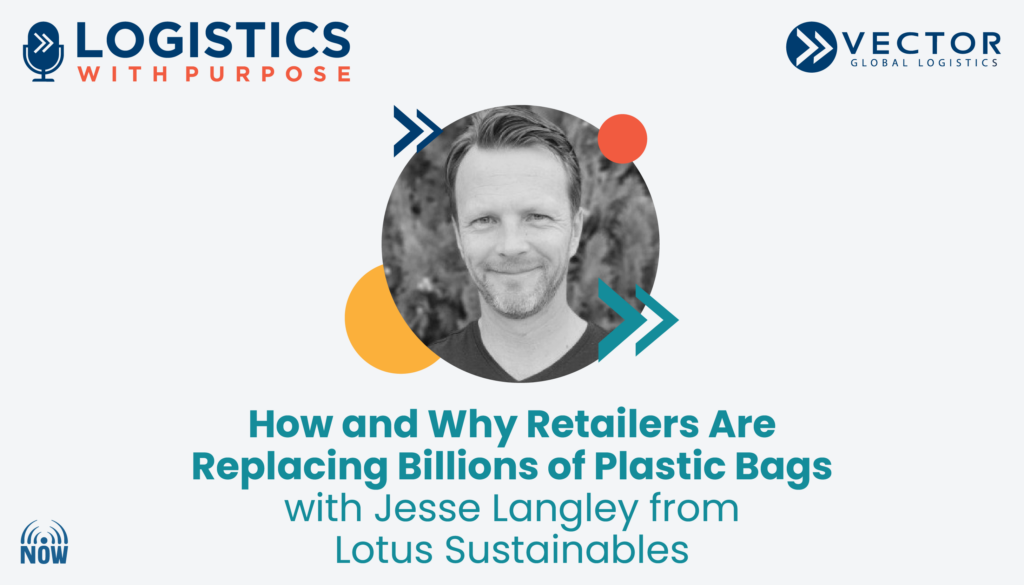
Yes. So without further ado, we are excited to introduce you to Jesse Langley, an entrepreneur with over 25 years of leadership experience across multiple industries at an international level, including startups, public, nonprofit, government. I’m not sure if there’s any other categories left. And current CEO at Lotus Sustainables with a purpose-driven spirit and mindset of evaluating elevating humanity through business. Jesse, it’s an honor to have you. Thank you so much. We’ve been really looking forward to talking with you.
Jesse Langley (02:05):
No, thank you. It’s great to be here. Appreciate that.
Enrique Alvarez (02:07):
It’s a pleasure to have you. We’ve talked a lot offline and when we met you, and of course what you’re doing is exciting, and I think our audience going to be very thrilled with the conversation we’ll have with you. So thanks again for giving us some time today from Costa Rica you said, right?
Intro/Outro (02:23):
Yes.
Enrique Alvarez (02:24):
Nice. Jesse, so if you had to choose one, innovation, regulation, or consumer behavior, which one will actually determine whether we solve the plastic crisis?
Jesse Langley (02:35):
That’s a great question. It’s kind of like picking your favorite hid type of question. I’m not sure. Reading
Enrique Alvarez (02:41):
Things both. We always have one though. There’s always one.
Jesse Langley (02:44):
Right, right. Really, ultimately, I think I would like it to be consumer behavior. I would love it for it to be consumer behavior because of the innovation in the space and the mindset has changed. That’s what I would like it to be. I think the reality is it’s probably legislation. It’s probably legislation ultimately that will then force everyone to be able to eliminate their single use plastic bag use. But ultimately it would be great if it was behavior change, which is very difficult to change. But I believe legislation would be it ultimately.
Kristi Porter (03:22):
I tend to agree with you there. Also, we’re recording May 12th. We just had the passing of Ted Turner who created Captain Planet and the Planeteers. So I consider myself a Planeteer. I worked at the Captain Planet Foundation and that was all about educating kids early on to change consumer behavior because kids often change an entire family’s behavior and a lot of those kids are grown up now. And so I see you as a continuation in that space. So thank you for everything that you’re doing. You’ve gone from serving in the US Navy to leading in the business world, very opposite ends of the spectrum, I feel like, but maybe you’ll tell me differently. So first of all, thank you for your service. And I’m curious, what lessons from those service days still guide the way you lead and make decisions today?
Jesse Langley (04:08):
I was super blessed to have the opportunity to be in the Navy. And as part of that, it’s a different environment obviously in the Navy. There’s a different level of connection with your team. Your team doesn’t just come in and clock in and clock out. You’re on missions together. That means you’re deployed for six months at a time. You’re living, you’re sleeping, you’re working with each other all the time. So as part of that, you develop a different relationship, a relationship that goes beyond a business or a work relationship. It gets into how are things at home? How to help navigate those aspects at home? And as an officer, there were many opportunities where I was working with my team to further dive into some problems that are happening in their personal life, either maybe financial or relationship or whatever it is. And so when you approach that environment from that team perspective and you come from that lens, which was really my most substantial initiation into leadership and management, it set a different arc for me and how I work and how our team evolves because at the end of the day, we’re all humans, we’re all beings.
(05:14):
We all have stuff going on after work hours and that’s real. And really trying to meet people where they are extremely important to me.
Kristi Porter (05:23):
Love that.
Enrique Alvarez (05:24):
Well, and after serving, does it feel a bit easier for you? You come, you did so many different things abroad and for the country and now you come into the business world. Is it at a very minor level even just easier to come and like, “Oh, this is a piece of cake. I’ve done more difficult things.”
Jesse Langley (05:41):
I wouldn’t say easier. I think each one has its differences and challenges. And the military, there’s certain protocols that are followed and they’re definitely followed. There’s definitely things that go a certain way and there’s no room around it. And then business, there aren’t necessarily as many of the guardrails that are set up. There isn’t that level of consistency. There isn’t that level of order. So you kind of look at it different ways. I see it as a perspective and a lens in which the opportunity to be part of, but I don’t know if it’s necessarily easier operating in the civilian world and the business environment.
Kristi Porter (06:20):
Are you able or a rule breaker now?
Jesse Langley (06:23):
I’ve always been a rule breaker even in the military. So that did what it was. I wouldn’t say necessarily a rule breaker, but I’m always looking to question where is really the line on things in a good way obviously. But I think it leads to innovation, that curiosity helps bring out those aspects.
Enrique Alvarez (06:44):
Well, and you’ve led a lot of different ventures throughout your career from environmental initiatives to climate action planning to food technology, consumer nutrition companies. So what drives that entrepreneurial spirit in you and how do you decide which one is a good idea? Because you’ve actually played in so many different industries. I would love to learn a little bit more about how do you think, well, this is the one that I’m going to dedicate time to. And how do you make those decisions?
Jesse Langley (07:10):
I think it boils down to how and where do I want to spend my time? What is the value that I want to create from my experience, from my education, from my network? How can I better support people on the planet? So it really, again, stems from curiosity and then stepping next into how can I be a contributor to an overall cause, effort, product, service that will ideally help move us forward and elevate humanity through business. Well,
Kristi Porter (07:40):
Outside of just being an entrepreneur, you’ve also advised a lot of mission-driven organizations such as Gravity Group, RISE, Costa Rica, and of course co-chair of Conscious Capitalism, San Diego, of which we’re huge fans as well. It sounds like you have a lot going on already. So what drives you to advising purpose-led companies? How do you help them translate big ideas into sustainability, real impact, measurable outcomes?
Jesse Langley (08:07):
It’s a great question. I think it starts with purpose, ensuring that there’s a inherent purpose around what we do at Conscious Capitalism most specifically and what we do at Lowe’s Sustainables and how that shows up. What is that purpose that we’re focused on and how do we really lean into that in a way that we can deliver an iterative process? So part of it is really ensuring that there’s a reality around that purpose, that it’s achievable to move through it. So those are really some of the key things that start, for me, the path forward is understanding first that purpose and understanding the metric of success and that iteration process.
Kristi Porter (08:49):
And what are some of the trends you’re seeing right now in talking to these different organizations? And of course you get to meet a lot of people through Conscious Capitalism, San Diego. What are some of the common themes and trends you’re hearing?
Jesse Langley (09:00):
So it’s a difficult time to be in business. There’s a lot of uncertainties. The struggle is real. As a business operator, you want to have as many known quantities as possible so that you can solve for it because you’re always going to have levels of variation and variables, but you want to have as many fixed as possible. And in today’s environment, those fixed numbers are becoming less and less. And so that’s really what I’m hearing in a lot of different kind of business circles. It’s just, hey, what are the rules? Once we know the rules, we’ll play the game. But without knowing the rules, it becomes very difficult to play the game.
Kristi Porter (09:37):
Yeah, that makes a lot of sense.
Enrique Alvarez (09:40):
Well, it’s always hard when you are constantly shifting. And I think what you mentioned about the rules changing quickly is something that we see very, very clearly in supply chains around the world and logistics in our industry because you see that being more regular than what we would like it to be. And there’s no clear sense of what the rules are anymore, which maybe that is what the rules will going to be going forward. So from your experience both in the military and then also your career as leading all these different organizations, what would be the one or two things that you can tell our audience to use quick suggestions as to how to handle this, what we believe is going to be the new norm, this variability, this constant change, this randomness in the world?
Jesse Langley (10:24):
Yeah, the opportunity to lead during uncertainty is definitely where we’re at. And I think it’s important. And you can look at the flip side of this. It’s not becoming comfortable. It’s making sure you’re always looking for innovation, making sure you’re always putting yourself in a seat where you’re not necessarily relying on this for it to happen, that you have a plan B, a C, and a D. So I think it just requires businesses in today’s environment to be that much more nimble, to be willing to problem solve on the spot, to open up a lens and keep more options open as we navigate what that may be. So I think it’s really how do you continue to do that even when things are feeling comfortable so that you’re looking for those opportunities? Because if you just sit back and hop on the ride, and if the ride’s a bumpy one and you’re not experienced enough to be able to know that it’s going to get bumpy and you better have some other ways to navigate it, then it can be a little challenging.
Enrique Alvarez (11:24):
Well, and what you’re saying is even taking it a step forward because you’re not only being comfortable with the bumpy ride, you’re looking for those bumps. You’re chasing the challenges basically and looking forward to them more proactively. Is that what you were saying?
Jesse Langley (11:38):
Exactly. That’s the opportunity. And I think that’s in times of consistency and times of uncertainty is that opportunity to know that it’s always an evolution. So why not get ahead of it instead of letting it happen to you?
Intro/Outro (11:53):
I like it.
Kristi Porter (11:54):
Yeah. Great lessons. Thank you. Well, you’ve told us a little bit about your military experience, but I’d like to step back even a bit further. Tell us a little bit about your background. Where did you grow up? What was your childhood like?
Jesse Langley (12:06):
Yeah, sure. I grew up in Mammoth Lakes, which is a ski resort in California near Yosemite. I was outside all the time exploring, getting lost, lots of adventure, be it winter or summer. So I was either out on a snowmobile or skiing in the back country or always out hiking or what have you. So I had a pretty amazing childhood. It was an opportunity for me to really be connected with nature, for me to do a lot of exploration. It really, I think, spurred my adventurous spirit and allowed me to really lean into it and establish those practices at an early age on my own or with a group of friends or what have you. But I had that opportunity to do some reps within that environment. And so it made me, I think, a little bit more comfortable as I stepped into out of the small town in the mountains into the real world, which is really no different.
(13:00):
You’re always up against some level of adventure. And so again, I think it was a really grounding experience for me. I’m super grateful for it.
Kristi Porter (13:07):
Yeah, sounds
Enrique Alvarez (13:08):
Beautiful. Wow. Yeah, it sounds amazing. And of course, connecting with nature is always important I think as human beings. But looking back, could you share one or two stories of your early years, something that maybe have shaped who you are now and what you’re currently doing?
Jesse Langley (13:25):
Yeah. So one opportunity I had was fairly quickly out of the military. I moved to the Fiji Islands and lived in Fiji for five years developing a sustainable resort. And in doing so, we had a very prety powerful team that we had all felt well educated, felt like we were resourced up. And we were working with the local Fijians on structuring a partnership. And it was an opportunity to really lean into to say, “Hey, this isn’t about me getting the best deal I can get. This is not because I would. ” We were more resourced and we could have easily taken advantage of. And it was really amazing to not be in that space and to recognize the long-term partnership with the Fijians and how can we structure something that is probably in their better interest than ours. We took the flip side of it because there was so much that was at stake for employment, use rights, land rights, these kind of components.
(14:30):
And that really having that opportunity to do the right thing at a fairly early age and being in an environment where it was set up and I was living with people that are some of the most amazing human beings on the planet and are so pure and natural and just gives you so much source of inspiration. And so having that in context with that environment and those people really helped sculpt me moving forward of how do we work together? How do we make sure our partners are winning? Because that’s how they stay our partners because if they’re not, that deal isn’t going to be there very long.
Enrique Alvarez (15:03):
Wow. So how do we work together? And it just reminded me of something that someone at the Champions Retreat earlier this month said about Japanese company that has been around for 300 years. And one of the questions they asked the CEO of this company is like, “So how do you keep relevant all those years?” And the number one thing that he attributed his success to was just taking care of the employees and suppliers. Their priority is making sure that their employees and suppliers are happy. And he stressed out the fact that he meant happy, not only getting by, not only having good salaries, but they were happy. And that was very powerful, which is to your point, working together. Thank you so much, Yessi. So tell us a little bit more about Lotus Sustainables. What is Lotus Sustainables? So we can give us a little more context around what you’re doing.
(15:50):
And then of course I’ll ask you another question about it because you’ve done an amazing job.
Jesse Langley (15:55):
Yeah. So Lotus Sustainables, our mission is to eliminate single use plastic bags. And we’ve been able to divert about six and a half billion plastic bags from landfills. And we do that by creating our own branded effort of reusable bags and different places that they can show up within grocery stores and retailers. And we also do that by being a sustainability solution advisor for many brands out there. So we work as a private label manufacturer, provide our knowledge, our supply chain, our stakeholders that we’ve developed those relationships with. And so basically any brand out there that has a reusable bag need and is interested in doing something with us, that’s how we help provide services as well. So that’s our main focus.
Enrique Alvarez (16:39):
Well, and you’ve been part of the journey for the past seven years, if I’m not mistaken, first as the chief operating officer, now as CEO. So since you started until today, what has been the biggest challenge you’ve seen in reducing the people’s dependence on single-use plastics?
Jesse Langley (16:56):
I have to pick one again, huh?
Enrique Alvarez (16:58):
Well, no. No, please pick more than one so that we can have a better understanding of the huge problem. Because you mentioned 6.5 billion single-use plastic bags that you have taken out of landfill, but there’s still so many more. It’s just a small amount, even though the number sounds incredibly big.
Jesse Langley (17:19):
Yes. Yeah, there are a lot of opposing forces for sure. I mean, we can start with big plastic. We can start back to the recycling symbol that was created that was created by big oil and that capacity as part of making us feel good that we’re actually recycling and the statistics around the percentage, single-digit percentage that actually gets recycled is startling. We also have just complacency. People feel comfortable with the behavior that we talked about. It’s difficult to change and that’s understandable. It is difficult to change our behaviors and such. Fortunately, we have a team at Lotus that works extremely hard as change makers to show up and make that change happen as effectively and as easily as possible. And that’s really how we believe that through our authentic relationships, how we show up as a B Corp, how we show up with our innovation and just continuing to that pursuit will continue to help make this problem be less and less.
Enrique Alvarez (18:26):
So you mentioned big plastic as one of the biggest challenges. And is that why we need more awareness? Is more education that’s needed? Because I guess consumers are not necessarily don’t know what the reality is when it comes to recycling. I mean, what is the many parts of the problem with a big plastic industry and lobbyist and people that just rely on plastics to be around?
Jesse Langley (18:53):
Yeah, Enrique, you’re right. Education is a key component because I think if everyone knows what’s happening and knows what the realities are, then it’s easier to make a more informed decision. And without that education or awareness, it becomes more difficult to do the thing that you believe is right. That’s a big component of it. I think it’s important that everyone has the opportunity to have not only the education, but a product that fits what their need is. And so that’s where we really come in with innovation and how can we continue to show up for consumers in a way that innovates and isn’t just an emotional change. I’m doing this for the planet, but it’s like, “Hey, this saves me time,” or, “This is really clever, and this makes life easier. This makes me more organized.” And those are other important aspects that we look at.
(19:45):
And of course, legislation as we’ve discussed is part of it because again, not everyone is maybe as engaged in the conversations that we are, and that’s okay. Everyone has their level of engagement and different topics, but really how do we see this as a movement that’s continuing and how can we continue to assist with our team as much as possible?
Kristi Porter (20:06):
You’ve mentioned innovation a few times. I’m curious what that, can you give us some examples of that or what that looks like to you, what your team is talking about around innovation? Because I don’t know that that’s a conversation we hear a lot when it comes to reducing plastic bags.
Jesse Langley (20:21):
Yeah, no, it’s probably not. But that’s again, an area that we love to show up. And in fact, our first flagship product that we launched called the Lotus Trolley Bag was exactly innovation. This is a bag of, we call it a system in essence almost. It’s four bags. It opens up in your shopping cart like an accordion. It’s got a cooler bag, another bag has egg and wine pockets. They’re all Velcro together. And then they’re kind of like a filing cabinet also so that you can organize what you put in which bag. It goes to what part of the pound troop pantry or what area. And then they all roll up really nice and tight like a yoga mat so they’re easily stored. They’re also easily washable. You take out the removable rods. And in fact, we have nine patents on this bag in four different regions around the world.
(21:10):
So again, I know they’re like, “Wait, you have a patent on a bag? That’s weird.” But that’s the type of innovation that we’ve had to defend around this space. So we are always looking to see how we can show up for the consumer in a way that again, saves them time, provides more organization, allows them to feel good about the decisions. We’re not into guilt tripping people into making the right decision. We want them to be led into that decision.
Enrique Alvarez (21:35):
Well, but I don’t really care about the guilt tripping as much. And sometimes we are lazy. We have to acknowledge the fact that we use plastic bags sometimes because we’re lazy and we should stop being lazy, especially when there’s companies like yours that actually are trying to make a difference and come up with products that are both practical and sustainable.
Kristi Porter (21:56):
And I love that you’re talking about innovation, but your solution is also a simple one in just the idea behind reducing single use plastic and making it more easy, efficient. I use a lot of recycled bags as well, but it sounds like I need a trolley bag because I hit my brakes too soon the other day and all my stuff’s filled into the floor. So I understand that as well. And then you also make it really easy for people by showing them. You use a lot of social media videos to show how simple and practical these products are in everyday life. So I feel like as entrepreneurs and any of the current or aspiring entrepreneurs who may be listening, it’s all about chasing the next big thing. It is about innovation. It is about what’s new and what’s next. But what Lotus has shown is that sometimes it isn’t really complex.
(22:49):
It is really just going back to see what’s working now and what’s in use now and how to make people’s lives better and easier. So what are some of those lessons that hold true for you?
Jesse Langley (22:59):
Yeah, Christie, I think it starts with solving a problem. And it’s usually best when it’s a problem in your own life so that you’re familiar with it, you’re your first customer and you’re solving it out of that level of need. And the founders of Lotus Sustainable, Jen and Farzan, we’re solving their same problem. They’re like, “Why are all these plastic bags in our houses? It’s ridiculous. How can we solve this problem? What can we do? ” And so when they set off on that journey in 2017 to do exactly that, this company’s continued to build on those principles is solving a problem and it can be as simple as that solve. And I would also say in addition to solving a problem, just start small and start an iterative process. What is it that we’re learning? Okay, adjust, move to a different direction or a different part of it, but it doesn’t need to be a complex black box.
(23:49):
It can be something very simple that you’re solving for.
Kristi Porter (23:52):
Yeah, it makes a lot of sense. You also have wonderful silicone containers. Those caught my attention for both hot and cold items. As someone who travels full-time, those sound like something very handy I need to look into as well. But how do you also balance real consumer needs with the bigger mission? You’re talking about solving problems for people going back to the basics, but there’s also a reality of running a business with a bigger mission. You have to make money, you have to employ people, and then you have to meet consumer needs and you have to figure out a way to do that. So what is that constant balance for you?
Jesse Langley (24:30):
Yeah, it is a constant balance. It’s how do you design and build products that are functional while being sustainable while operating in today’s business environment? Again, our team has a really good pulse on what’s happening in this space. There’s a lot of awareness as to what can be done, what can’t be done. We’re not afraid to say, nope, that can’t be done because we’d much rather come forward and deliver something that misses the mark. And so it really does become a balance in today’s environment and finding that happy medium between form and function. I wish there was a super secret sauce to share, but unfortunately there’s not. That’s where much of that has landed for our experience.
Enrique Alvarez (25:12):
Jesse, so we’re recording this conversation in May when B-Lab is celebrating the 20th anniversary and both Lotus Sustainables and Vector Global Logistics are proud, certified B corporations. So from your experience, what does it truly take for a company to leave up to the commitment of using business as force for good? I
Jesse Langley (25:32):
Think it really takes a holistic approach looking at everything. And I think when you look at everything, you’re looking at your stakeholders and that stakeholder orientation because as shared a little bit earlier of looking for the wins all the way through with everyone in the process, it’s also super important that we look at it from that perspective, that once you learn about B Corp standards and once you understand what it may entail, that allows you to show up for other stakeholders that maybe you weren’t aware that were part of the equation. And so really stakeholder orientation I see as the key component that gives you the awareness, the visibility to become more educated on it, and then ideally implement those policies to become a sort of way.
Enrique Alvarez (26:19):
Thank you. So what makes you proud and helps you go to work every day? Something that fuels you and helps you continue the amazing job that you and your team are doing?
Jesse Langley (26:28):
Honestly, it’s our team. Our team is amazing. Their commitment and perseverance to establishing relationships with our stakeholders, the time and effort they put into ensuring the products are made at a high level of quality and delivered effectively, especially into the uncertain times today and the different experiences that we’re seeing with shipping lines on freight or as you all are very well aware of, or domestic shipping and the costs that are associated there. And so really the team just shows up day in, day out on solving these problems. So ideally we can deliver high quality products to our customers on time.
Enrique Alvarez (27:11):
Well, and speaking a little bit about the supply chain, of course, yes, it’s been a rollercoaster ride with so many different things happening right now, the shipping side. Has the price of fuel or anything like that impacted? Could it be a positive impact now that you’re competing against products that might actually be more expensive these days? What do you see the current geopolitical situation impacting your business and how do you see that played out for the next couple of months?
Jesse Langley (27:40):
Yeah, that’s a great question after I polish my crystal ball to give you the answer.
Enrique Alvarez (27:45):
And no one will guess for sure.
Jesse Langley (27:48):
Yeah. It is interesting. I think it goes back to we were sharing earlier as well about the ability to be nimble and to recognize in these times of uncertainty is when we really have a time to accelerate through it. So we also work with our partners on these things. We’re looking for a long-term partnership. So how can we show up and navigate some of these maybe shorter term elements to ensure we’re there as a long-term partner? It’s extremely important to us. It’s important that we do recognize that the volatility in the markets does play a role. And so being very transparent and helping our partners understand those realities because the more that we understand how decisions are being made and why decisions are being made, we’re much more in tune with being part of those decisions and accepting them. So it really boils down to that level of devotion and persistence and how we are navigating today’s turmoil throughout the global shipping and domestic freight as well.
Enrique Alvarez (28:51):
Well, and a small part of you is cheering for plastic prices to go up, right? I mean, you’re like, yes, the more expensive a plastic bag could cost, the better it’ll be for people to realize maybe not using them is the better answer.
Jesse Langley (29:04):
It’s difficult to see how everything will really play out, especially in the global landscape. Hat we try to show up each and every day is to do the best that we can for our customers and our partners and all of our stakeholders.
Kristi Porter (29:18):
Yeah. And you mentioned earlier that you work with retailers and brands throughout both wholesale and private label to create the bags, everything from designing, sourcing, execution, but not only in US and North America, but across 14 different countries. So two questions on that. One, are you seeing more hopefully proactive approach to this rather than reactive? And then two, what does it really take to scale sustainable products throughout an entire retail supply chain?
Jesse Langley (29:48):
Yeah, it takes a lot of devotion and persistence. I’ll tell you that that’s for sure. In addition to that, we do see positive signs outside of just, let’s say, legislative changes And that includes not only consumer behavior that is continuing to see changes and wanting to be part of a solution, or again, wanting to find some functional uses as part of the different products that are out there. And then we’re also continuing to see corporations stepping up and seeing how they can solve this problem too. So we are working closely with many partners as they want to make a sustainable decision. And so sometimes if they don’t have all the information, they think they’re making the right decision but maybe aren’t. And so that is really our goal is how can we help show up as advisors as they are navigating through these different decisions across these different regions to scale something that really can have a true impact across the globe ultimately.
Enrique Alvarez (30:45):
So I’m curious, at least 14 countries, and you probably work with more countries than that, we have listeners from all over the world, so I was wondering if there’s any specific country that we can look into for inspiration or some countries that are doing something that’s better than others. How would you think about that? And could you give us more insight into which countries are probably a little bit ahead of the US right now?
Jesse Langley (31:09):
Yeah, so Europe has always been ahead of the US and sustainability. So we look to Europe, Australia has also been further ahead in this. Unfortunately, United States is pretty far behind in this, which means there’s a big gap there and a big opportunity for so many consumers and people to really become educated and aware of it. So again, we do do global business. A lot of our focus is because we do global business, learning from those global environments and taking those lessons home here to the US so that we can effectively put those into play and continue to support other regions where there might be a growing demand, be it Middle East or in Latin America, other areas where we can help support the cause.
Enrique Alvarez (31:53):
Any country in Latin America that might stand out?
Jesse Langley (31:56):
So we’re working with a few different countries right now. We haven’t gone to a full scale, but there’s definitely a few that we’re working with.
Enrique Alvarez (32:04):
Nice. Well, we’re looking forward to listening to the exciting news and of course for you and your company to continue growing in what it seems to me an incredible cost, and it’s something that we as humans need to get done. It’s not a nice thing to do. It’s just one of those things that, hey, we better do it before we kill ourselves with all the plastic. So thank you so much for sharing that.
Kristi Porter (32:26):
Yeah, thank you for this. I appreciate all your insights and sharing your expertise with us. And as we wrap things up, one of the questions we love to ask people, what does the phrase logistics with purpose mean to you?
Jesse Langley (32:39):
I think it means to me whatever you do within that space, have a higher focus on it. Really operate, have a level of awareness that sets up benefits for everyone. So with that, how does that purpose show up? And from my perspective is who are the different stakeholders attached to those logistics and how do you effectively make those winning partners?
Enrique Alvarez (33:03):
Thank you. So Jesse, how can our listeners connect with you and of course learn more about what Lotus Sustainables is doing?
Jesse Langley (33:10):
Yeah, so lotus-sustainables.com is our website. Can connect with me on LinkedIn. It can be found there on Jesse-Slangley and happy to have conversations and further work with those that are interested in making sustainable decisions.
Kristi Porter (33:25):
Thank you so much for your time. This was great. Loved learning more about the people behind the bags. So thank you for everything you’re doing there and to your team as well. And of course, thank you to our audience. If you’d like to learn more about how logistics can be a force for good and get expired by leaders creating a positive impact, people like Jesse, then please subscribe to Logistics with urpose on YouTube and your favorite platform. Stay tuned. We’ll see you again in two weeks with another terrific conversation. I