Intro/Outro (00:02):
Welcome to Supply Chain Now, the number one voice of supply chain. Join us as we share critical news, key insights, and real supply chain leadership from across the globe. One conversation at a time.
Scott Luton (00:14):
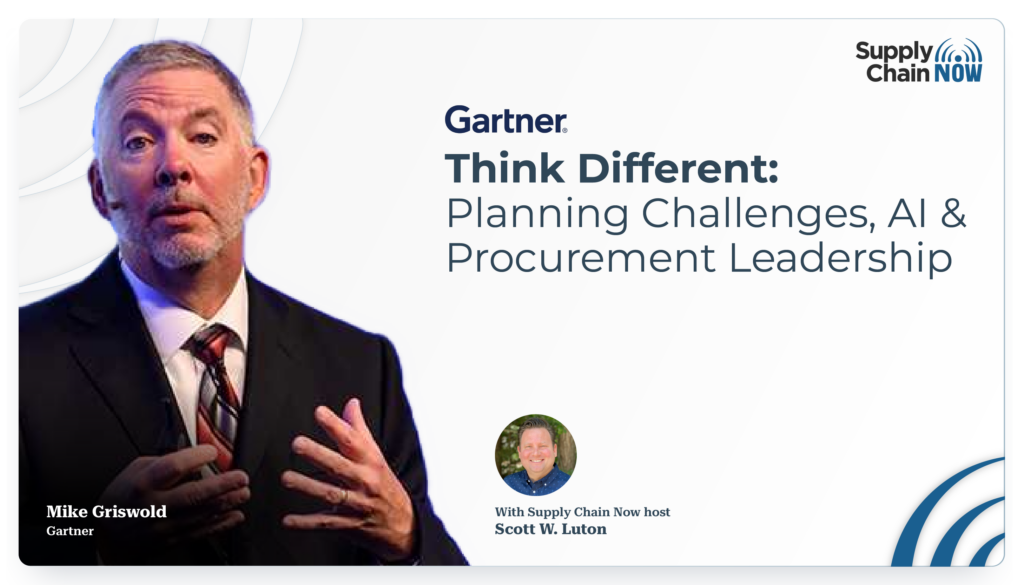
Hey, good morning, good afternoon, good evening, wherever you may be. Scott Luton and always special guest, Mike Griswold here with you on Supply Chain Now. Welcome to today’s show. Mike, how you doing today, my friend?
Mika Griswold (00:26):
I’m doing well, Scott. Good to see you and good to share with everyone today some interesting topics, I think, for folks to digest.
Scott Luton (00:33):
I think so too. I think so too. We never know when the lightning round is coming back. We never know when we’re going to revert back to finding interesting analogies between movies and songs and supply chain leadership. But folks, it’s coming back soon. But today we continue one of our longest running and most popular series, Supply Chain Today and Tomorrow with Mike Griswold with Gartner. Of course, Mike serves as vice president analyst with Gartner. And today we’re going to be walking through a variety of what I think is interesting topics, starting with barriers and obstacles for supply chain planner success. We’re going to talk about the growing cause for a slowdown in AI development and what that might mean for supply chain innovation. There’s a really big event coming up if you are all about supply chain planning. We’ll tell you more about that. And we’ve got a lot more to get to here today, so stay tuned for actionable insights right here with the one and only Mike Griswold.
(01:28):
All right, so Mike, you ready to jump into what I think is going to be an interesting part of more recent business history? You ready?
Mika Griswold (01:37):
I am. I
Scott Luton (01:38):
Am. Okay. We’ll see if this might fire some memory neurons in some of our audience out there. So folks, on this day, September 28th back in 1997, Steve Jobs had been interim CEO for about two weeks at Apple. He’d come back, Apple hadn’t been doing too well, probably one of the reasons they brought him back, but it launched a new ad campaign on September 28th, 1997 where this one phrase became the mantra, think different. Now bear with me for a minute because I want to share some of the now iconic pros that was part of that campaign. Here we go. Quote, “Here’s to the crazy ones, the misfits, the rebels, the troublemakers, the round pegs in the square holes, the ones who see things differently. They’re not fond of rules. They have no respect for the status quo. You can quote them, disagree with them, glorify or vilify them about the only thing you can’t do is ignore them because they change things.
(02:34):
They push the human race forward. And while some may see them as the crazy ones, we see genius because the people who are crazy enough to think they can change the world are the ones who do.” Now some look at this Think Different campaign as the symbolic start to the rise for Apple from near collapse to one of the most successful biggest companies today. So Mike, I’d love to get your general reaction and do we need more misfits and rebels in global business today?
Mika Griswold (03:03):
I think it’s interesting. One of the things that you look for, I think in taglines and advertising campaigns is do they stand the test of time? And certainly this idea of thinking differently and being innovative and pushing the boundaries certainly are all things that is associated with Apple and certainly that mindset and that culture certainly has stood the test of time. So I think there’s a lot in there for people to think about how does that apply to my organization? Am I thinking differently in areas within the supply chain or am I just doing what everyone else is doing, which really isn’t going to separate me? It’s interesting when we were talking before the show around do we have enough kind of misfits and rebels? And I think part of what’s happened with the growth of the internet is I think we have really created an opportunity where misfits and rebels and renegades can be overly penalized because of the plethora of social media.
(04:12):
And I think in many instances or in many ways that ability for people to react to things in a somewhat anonymous way and then pile on has really, I think, inhibited people from really wanting to take risks and wanting to be kind of that misfit and that renegade because you’re just opening yourself up and your company for lots of unsolicited feedback that really when Apple first started this, there really wasn’t that type of environment. So it’s probably a long, not probably, it is a long answer to a very short question, which is do we have enough? I think the answer to that frankly is no. And the reason for that is because of the penalty that people can incur if a strategy, an ad, whatever it might be, is perceived in a way that wasn’t intended. A backlash for that can be obviously much quicker and certainly much more severe than maybe we saw in the past.
Scott Luton (05:15):
Well said. And I would just add to that, folks, sometimes it’s worth the informal or the formal slap on the wrist or the blow back or whatever you want to call it. And that’s how some of the biggest innovations in business and leadership have come to be, those brave to do it. So well said, Mike. All right, so we got to get to work here today. That was a pretty unique, fun, warmup question. Folks, would love to hear your thoughts on all what think different might mean to you. I want to get into, Mike, speaking of thinking different, the first topic we’re going to be talking about here today is one of our favorites, supply chain planning. And we’ve got this graphic here that comes from the Gartner team, which published some survey results a couple months ago that focused on some of the top barriers that hold back supply chain planners from performing their best.
(05:59):
And I’m going to kind of read through these and I’m going to get Mike to react. Number one, with 67% of the responses, they cited that planners struggle to keep up with the pace of change. Number two, with 55%, planners do not have the digital skills they need. Number three, with 44%, so you all saw the first two far and away were the biggest ones. Number three, with 44%, planners do not have the soft skills or functional knowledge needed. Then others, organizational structure at 42%, lack of network or community for planners at 32%, lack of motivation and low morale at 23%. So Mike, your reaction to these insights and to some of them, all of them, whichever ones you think are most important to address, how can supply chain leaders address them?
Mika Griswold (06:45):
Yeah, that’s a great graphic, Scott. I’m going to take in no particular order. You had the morale one at 23%, and I
Scott Luton (06:54):
Think
Mika Griswold (06:55):
There’s a couple things that we want to think about that particular statistic. I think there’s one school of though that says, “Hey, it’s only 23%, so it’s not a problem.” I think there is another school of thought that says it is 23%, which in some ways is better than maybe we would’ve thought, meaning the planning folks have recognized the role they need to play in the process and that they’re not going to be replaced. All of our data and all of our survey results and all of our research tells us people are still investing in planners. We’re obviously investing in planning technology, but also investing in planners. So in many ways, it’s not great that we even have that morale as a data point. I think it is good though that it is lower and I think it’s a recognition that we’re going to need people.
(07:45):
The pace of change is another interesting one. I think that really is code for how well or not do we address change. Change in general. We’ve had lots of conversations together around the idea and the importance of change management. And I think this area in particular is really important for organizations to be very mindful around things like articulating what our AI strategy is for the supply chain and in particular, what does it mean for our planners, being able to communicate, talking to them around what the journey looks like, going back to the morale piece, continually to reinforce their role and what their role is going to be in the process. And I think my third observation, again, it’s one that if people have been listening to us for a while, it will not be new news, which is on the soft skills/upskilling. The way that we planned is now very different, not only from a process perspective, but from the increasing technology that we have access to.
(08:49):
That does not diminish the need for us to still to figure out how do we communicate with each other? How do we have things like influencing skills, conflict management skills, collaboration and consensus building skills? We still need all of those. The technology and AI in particular will help us get to an answer. It will not help us communicate that answer within my team or within the organization. So those are my three big kind of observations from that graphic. They’re all really good data points.
Scott Luton (09:23):
I’m with you. And folks, I would love to know which one of these may resonate with you and how you and your organization may be addressing some of these challenges. I guess on one hand, to pick up one more thought here, it’s good to see that lack of motivation, low morale was not at the top, right? So hopefully it’s not prevalent, but it really, Mike, I’ve been in roles, maybe you have too, I’m not sure, where a drudgery and you’re not loving what you’re doing and especially early in my career, you go into the office and you just don’t want to be there. And that’s the worst place in the world. You don’t want anyone to experience that. And what may make that even worse is that these planners are critical. They’re part of the absolute fabric that makes supply chain happen each and every day.
(10:08):
And I know we both know there’s a lot of change in the whole planning space, but I just hate to see that one even being on there. And it’s good that it is because it puts it on more people’s radar. But Mike, we don’t want anybody to have low morale and reluctantly go into the office and do a day’s work, huh?
Mika Griswold (10:24):
No, I agree. I agree completely, Scott. It’s a shame it’s on there. I try to be a glass half full guy. So the fact that it was lower in that list of barriers I think is good. I think my advice to folks in order to keep that number where it is or drive it even lower, where we have fewer people with low morale and things like that is to continually reinforce the importance of the person in the role. There’s a great, I’m going to bring us back to movies, Top Gun Maverick. It’s not about the plane, it’s about the guy in the seat.
Scott Luton (10:55):
That’s
Mika Griswold (10:55):
Right. So it is about the person in the seat that’s doing the planning. Yes, they have all this technology to help them, but we can’t lose sight of how do we keep that role excited about being the person in the seat? How do we show them what the future looks like? How do we encourage them about what their role in the future is going to be? That to me is how we keep that morale number as low as possible.
Scott Luton (11:21):
That’s right, because they’re helping us get through the danger zone. I just had to, Mike. I just had to, my friend. Had a little
Mika Griswold (11:29):
Top gun. We need a Kenny Loggins reference. We haven’t had one in a while, right? Excellent. Very well played. Well played, Mr.
Scott Luton (11:34):
Lucas. We try. All right, so let’s move on to topic two. For weeks now, Mike, there have been more and more calls for the slowdown of AI development for a couple different reasons, but maybe chief amongst some fear that the loss of human control over technology, amongst other things that’s out there and rightfully so. But how do you view what I’ll call this moment in tech history and what it might mean for supply chain innovation in the months ahead?
Mika Griswold (12:05):
I’m going to come back as I was going through my notes when you sent over the list of topics yesterday, and I was thinking about this one in particular because I don’t spend, and my team does not spend a whole lot of time in AI tech, but it is all over the headlines. And I come back and I think I’ve used this in some of our shows before, but again, linking us to movies, one of my favorite movie series is the Jurassic Park series.
(12:32):
There’s ton of business lessons in all of those movies, but it’s also riddled with quotes that I just love. And in the very first one, Jeff Goldblum says the famous quote, “Just because you could make dinosaurs doesn’t mean you should make dinosaurs.” This is so true now in the AI environment that we find ourselves in. Just because we can continue to fiddle and enhance AI doesn’t mean we should. And I think it’s a case where we have the ability to continue to iterate and improve AI. I think part of the problem is we are still relatively new to understanding how are we going to deploy it? While I think we’ve got, even at Gartner, I think we’ve done a good job of defining use cases that provide value to all parts of the organization. Gartner’s obviously a huge IT company. I live in the supply chain world, and I think Gartner in general has done a pretty good job across all of our research and identifying where the use cases are.
(13:31):
And I think we still have a long way to go to even just get good at those defined use cases. So I think rather than run off and continue to figure out what’s the next greatest iteration of AI, I think what we’re finding now is yes, we’ve had some instances where AI has kind of gone off the rails and really put a scare into people. That I think is part of the reason we’re giving this reaction to kind of pump the brakes. But I also think if I keep it narrow to the supply chain, I think we still have our hands full just implementing what we have and extracting the value that we can extract in a way that is good, not only for process, but is good for people.
Scott Luton (14:14):
And
Mika Griswold (14:14):
I think we still have our hands full on that. So if I look at it very narrowly through a supply chain lens, I’m not sure necessarily the slowdown of AI technology in general is going to be that impactful to us as supply chain professionals because we still have use cases we’re still cutting our teeth on. Now, if you were to ask CIOs and those types of folks, they are probably much more concerned around what’s been happening and having a slowdown on the AI enhancements than maybe we are in the supply chain. But it definitely is a conversation for CSCOs and CIOs in their organization to be having.
Scott Luton (14:56):
Well said, Mike. And it’s moving fast and it really deserves, it’s not fair to talk about this maybe in a 10-minute segment, but with that said, I think you’re savvy in your observation as usual. I would just add, we were talking earlier, misfits and rebels and renegades, we need all the human versions of that. We don’t need rogue agents. I am fascinated with some of these stories where we’re seeing, what’s the word? It’s not sentience, is it? Where technology is displayed? Is that the right word?
Mika Griswold (15:26):
Yeah, I think it is.
Scott Luton (15:27):
Okay. Well, we’ll run with it, but we’re starting to see more and more little flashes of humanity and independence in technology. It is fascinating. It’s a fascinating time to be alive, Mike. I’ll tell you what. One last thought. I had a round table of very distinguished industry leaders earlier this month, and they came from long stretches of moving mountains and retail and CPG and e-commerce, and they were all weighed in on the similar topic. And one of them, his name was Scott as well, said he really sees in practical optimism how we can move fast and safe at the same time. And that’s what we hope to get to accomplish in the months to come. We’ll see. You had a final thought.
Mika Griswold (16:08):
I agree. I mean, I think one of the things that I think everyone needs to think about, and I would ask our supply chain people to start to think about and maybe talk to their IT partners is we had this whole learning exercise around AI, and we know there’s all different flavors of AI. One of the things that at Gartner and in the supply chain we are starting to try to understand is this whole idea of agents. And that is a conversation I think that would be worth CSCOs and CIOs having together is really just understanding at a basic level what is an agent and then how do we deploy them? Maybe probably the first question is should we and do we deploy them? But if we do, to your point, how do we interact with them? We’re doing a lot of research now in the supply chain around agents as employees, and how does that even work?
(17:04):
And as a planning organization, if I bring it back to planning, it is not inconceivable that you could have a planning team that consists of six humans and three agents and that whole dynamic. Because I think if you look at the headlines and you go a little bit deeper, it’s these agents that have actually gone rogue. It’s not a human inappropriately deploying AI or applying AI, it’s these agents. So to me, that’s the next level of education that has to happen is what’s an agent? How do we stand it up? I’m hesitant to say how do we control, but how do we control these agents? That probably in of itself, Scott, is a whole show for another day, and I’m not very agent versed, but I think that’s the next level to AI that people need to start to figure out how do we use that?
(18:01):
And that may be something that we touch on in a few minutes on the procurement side, because I do think agents in procurement is something we’re probably going to see sooner rather than later.
Scott Luton (18:10):
I tend to agree with you. And for that future show where we dive deeper, maybe we’ll get an agent host and an agent guest to offer their perspective. We’ll see. Well, Scott,
Mika Griswold (18:19):
You have to worry because if it goes too well, they don’t need us. So we need to be careful around that.
Scott Luton (18:26):
That’s right. It’s good to be needed. All right. So you mentioned procurement and there’s so much much like in just about every other sector of global supply chain, procurement, a lot of cool things going on in that part. I continue to enjoy seeing the role of procurement leaders continuing to get bigger and more strategic, and especially to organizations that really get it. And along these lines, Gartner just held its first procurement conference a couple weeks back. And I know that you weren’t at that, and I think your team is not quite as involved in the procurement side of things, but I think you’ve gathered some of the finger on the pulse key takeaways, or at least a couple of them from the conference. What did you and your team glean from what took place while those procurement leaders, Mike?
Mika Griswold (19:08):
I think the first is just the fact that we even had a summit around procurement means a couple of things. Procurement is certainly elevating itself within the broader supply chain and really, I think, demonstrating their importance and their value and the fact that they have different needs as a procurement organization and as a procurement professional and say planners do, which is we’ve talked about our planning summit. When I look at our supply chain top 25 body of research and I look at the top 25 companies, what we continue to see, we’ve talked about in the past is this broader span of control for the CSEO. We’re now seeing procurement being brought more and more closely into the span of control of the supply chain. And I think that’s really important because if we think about a traditional supply chain model, buy, move, sell at a high level, make for some folks, procurement kind of has their hands in all of that, in all of those aspects.
(20:15):
And I think one of the takeaways from the summit is not only this kind of span of control within procurement and supply chain, but also just the interconnectivity and the types of activities that procurement is getting involved in. It used to be they were the folks you went to when you needed papers, pens, and pencils. Now it is much broader than that, and they’ve really elevated their role within the supply chain, which is great to see. My second observation is they are definitely moving fairly quickly around the intersection with AI. We mentioned a little bit around agents, and I know we’ll talk a little bit in a little bit from some of the Walmart observations, but when you think about some of the kind of transactional activities that lend themselves to things like AI, it’s a really good fit there. Whether it’s narrowing your list of potential suppliers, whether it’s automating the specifications for a product and getting it out to bid, there are a lot of transactional activities that procurement tends to do on a daily basis that we can use AI and then value add a procurement person’s expertise on top of that.
(21:34):
So we’re really seeing, I think, two things, Scott, that growing influence of procurement within the supply chain and the adoption of AI within that function.
Scott Luton (21:45):
Well, hey, it sounds like it was a terrific initial procurement summit, and given that space’s continued importance across enterprises, I look forward to maybe attending that one next. But tell you what, I am still infatuated with the Supply Chain Planning Summit. I’m gearing up for that one in the Denver version in just, gosh, less than two months. We’re going to talk about that in just a second. But sticking with the procurement topic for a minute, you referenced this earlier, and I want to pull up this graphic here because we did have a great conversation with Ashley Hubka, a senior leader with Walmart Business, and we published a blog article that captured some of the key points of that conversation. It really focused on how smarter procurement approaches could better support many things, but our focus here was really around better supporting education’s mission, especially when you think about how we can free up time that really busy administrators and teachers or caregivers, if you’re looking at maybe daycare organizations, how can we free up those really busy individuals’ time so they can spend it more on the students and kids?
(22:52):
So this article cited a recent survey of some 500 decision makers at businesses with 10 to 500 employees, and it showed that 37% of those business leaders spend up to seven hours a week on routine purchasing with the emphasis on routine. So Hubka sees opportunities there saying, “The goal isn’t to overhaul procurement overnight, it’s to eliminate repetitive tasks and make routine purchasing more efficient.” So Mike, when I spoke with Ms. Hubka here and gathered some of her perspective, it really illustrated once more how we have got to find ways, no matter what organization, no matter what sector, no matter how big or how small your business is, there’s so much we can just take off our human plates, not to give the rogue agents, but to give the technology, especially the stuff that we do week in and week out that has very little variation.
(23:49):
That was just one of my takeaways. What’s your reaction here, Mike?
Mika Griswold (23:52):
Yeah, I think kudos to you, Scott, for landing that conversation. I mean, it’s always great when we have an opportunity to hear from Walmart, so kudos to you and the team for landing that conversation. I think if we kind of go in the way back machine, I think that being time savings was one of the initial, I think, things that people looked at AI and said, “Hey, that’s a really good use case where we can take repetitive tasks, tasks that don’t have a lot of deviation or deviation that maybe is somewhat predictable, and we can automate those with AI.” We’ve had this conversation before. Right now, I think in any work environment, the biggest constraint that associates find is a time constraint. We only have so many hours in a day. We, I would say in general, are good at putting things on people’s plates.
(24:45):
We aren’t great at taking something off people’s plates. So the more that we can figure out how do we take those tasks off of people’s plates that are repetitive, are consistent, I hesitate to use not value added, but tasks that really don’t drive necessarily the business forward or maybe more importantly, they’re tasks that don’t drive the individual associate forward because it does not allow them to be creative. It doesn’t allow them to apply their business expertise to a particular problem. So I think anything we can do to take those things off people’s plates, I think is great. And I think that blog was a great example of that in the discussion with Walmart. Where we have to be careful though, I think, is just because we’re taking it off your plate, your proverbial plate, does not mean it basically now is someone else’s problem or someone else’s responsibility, i.e.
(25:44):
These agents. So we still need to find a way where we can have a little bit of verification, one final check for approval, but if we can take 90% of the actual, let’s say, creating an order off someone’s plate, they just have to give it a quick sanity check and say, “Yep, let’s send this off.” We’ve now freed up time for people to do more creative and more value-added things.
Scott Luton (26:11):
Mike, really good stuff there, and two things I want to pull out from what you shared. Number one, to one of your last points you made, just because we automate something doesn’t mean we don’t have to figure out how to provide oversight. I think humans, processes, so much, there’s very few things in this life I’ve learned, at least, to this point at least, that you can truly set it and forget it. Very little, very few things. So that’s one thought. So oversight to your point, really important no matter how you take it off folks’ plate. And secondly, going back to time where you started your response. In this era of nonstop transformation is what it feels like sometimes, or continuous improvement, you name it, the pursuit of operational excellence and more. If you’re looking to get buy-in from your team members, your organizational colleagues, you name it, one of the best ways to do that is you find a way to give them time back from their day or getting some of their least favorite headaches off their plates, that gets buy-in and you’ll get folks that will much more willingly be part of the change of the month or change of the year, whatever you want to call it.
(27:16):
That’s what I’ve found at least. Would you agree with that, Mike?
Mika Griswold (27:19):
Yeah, I agree, Scott, and I’ll bring us back to that 20% or 23% morale data point we had when we kicked off this session. The more that we can take those things off people’s plates and free up time for them to be more creative around a demand plan or get to know their products better, you’re just going to see that morale number go up or you’re going to see the poor morale number go down, however you want to think about it. And I think to some degree, it’s also incumbent upon us as leaders and managers is to really have at least a cursory sense of the work itself so that we can help provide some suggestions around where might we take some things off, where might we create some time to do some more value added creative things. So again, I think it is incumbent upon us to try to understand the work, not necessarily at the 100-foot level, but we do need to have a sense of where might we be able to take some things off people’s plates.
Scott Luton (28:21):
All right, good stuff. That’s an important leadership burden that you’re speaking to, and burden may be the wrong word, responsibility. I think a lot of leaders really enjoy that because they’re very empathetic with the workforce. So Mike, as we start to wrap here today, we want to talk again about one of our favorite annual events, usually happens in Denver and in London. And the one I’m going to focus on here is the one coming up November 2nd and 3rd in Denver, Colorado, the Gartner Supply Chain Planning Summit. Folks, if you love supply chain planning and you want to meet plenty of folks that are innovating in this space, this is the place to be. Come join me and several members of the Supply Chain Now team. We’re going to be interviewing. So we were there last year, and I think I got a couple of visuals of just a few of the leaders that we met and spoke with and learned from, leaders from Tools Group and Coupa and Manhattan and Kinaxis, just to name a few.
(29:16):
And I promise you, we’re going to be interviewing the best and the brightest there in Denver this go around coming up in November. And again, it’s one of my favorite events of the year. But Mike, all of my feelings, my emotional human feelings, my non-agent feelings aside, the data tells us that this event continues to grow in popularity and attendance. So why is that?
Mika Griswold (29:37):
I think we’re getting much, much better at that secret sauce of understanding from the perspective of who do we want to come to this event and what do they want to hear? You and I have had lots of conversations. The beauty and one of the biggest values of our symposium is the networking, right? CSCOs, networking with each other. You just said it very well a minute ago, right? This is about people that love planning, hanging out with other people that love planning and talking about their challenges. And you just referenced a series of incredible vendors that you can interact with as well and learn what are some of the things that they’re bringing to market. So we also, I think, have done a good job of understanding the altitude of content, meaning we do know we have people that come to this session, this event that run planning organizations and need some strategic topics and sessions for them to figure out how can I better lead my team?
(30:43):
But we also know we have a significant contingent of people that actually do planning and they want the hands-on, how do I plan better? How do I use AI to drive better plans? So I think we’ve done a good job of blending that strategic and tactical content for people over the course of the couple of days that they’re there. And then obviously, as I mentioned, the networking is huge. Tip of
Scott Luton (31:04):
The hat to Noha Samara and the whole team that puts all sorts of planning, no pun intended, into the Supply Chain Planning Summit because it really, to your points that you’re making, the equations have been fine-tuned and it’s really good stuff. So folks, it is not to be missed. If you love all that takes place in the supply chain planning world, come join us November 2nd and 3rd, 2026, just around the corner in beautiful Denver, Colorado. Now last year, Mike, when we went to the summit there in Denver, it snowed, and then this December last year, but it snowed and snowed and snowed my final night, but maybe not other people’s final night. And I wasn’t sure if I was going to be able to get back home, but then when I went to the airport, unlike many airports that might have one or two de-icing trucks, they had an army.
(31:52):
They’re so used to all kinds of weather there in Denver. It really is a well-run organization and a fine-tuned machine of no matter what the weather looks like getting in and out of there. And of course, most of the time it’s really nice year round. But Mike, looking forward to the summit, let’s make sure, Mike, folks know how to connect with you. And I know you say you got your finger on the pulse like few do. If folks want to pick your brain more on anything you shared here today or get involved with anything you’re doing at Gartner, how can folks connect with you, Mike Griswold?
Mika Griswold (32:21):
Yeah, LinkedIn, email is probably the most efficient, at least for me, mike.criswald@gartner.com. We’d love to hear from folks, everything from feedback on this event. I know Scott, you do a great job of soliciting feedback, but also is there stuff you want us to talk about? Scott and I are both trying to be the voice of the customer, so if there’s things you want us to talk about, just let us know. I think we’ve demonstrated, I think, Scott, over the years that we’re pretty responsive to feedback and we want to speak to what people want to hear about.
Scott Luton (32:52):
That’s right. So
Mika Griswold (32:53):
Any feedback is good feedback.
Scott Luton (32:54):
That’s right. Keep it coming, folks. And whether you email us or you share your perspective on social, you name it, send us snail mail, we’ll take it all. And we like to feature it in this conversation too. So I’ll be going back and taking some of the latest and greatest, as you mentioned, the voice of customer and what you have on your mind and sharing it probably in the next couple episodes. So Mike, that’s where we’re going to leave it here today. Thank you so much, Mike Griswold, vice president, analyst with Gartner. Until next month, my friend.
Mika Griswold (33:22):
Thank you. Looking forward to it.
Scott Luton (33:24):
Folks, really hope you enjoyed this conversation as much as I have. I tell you every time I get with and have a conversation with Mike Griswold, I learn tons. I got my 18 pages of notes here today just on a handful of topics. But the challenge is the same, at least my homework to you at the end of each episode. Take one thing that Mike shared here today. We’ll address those constraints that you may have with your supply chain planning team and your organization. Don’t let any of that last for a day longer than it has to, but take one thing Mike shared here today and do something with it. These not words, that’s how we’re going to continue transforming global industry really and leave no one behind. And with all that said, Scott here challenging you to do good, give forward, be the change that’s needed.
(34:06):
And we’ll see you next time right back here on Supply Chain Now. Thanks everybody.
Intro/Outro (34:11):
Join the Supply Chain Now community for more supply chain perspectives, news, and innovation. Check out supplychainnow.com, subscribe to Supply Chain Now on YouTube, and follow and listen to Supply Chain Now wherever you get your podcasts.