
This week has been packed with so many great stories! What was your favorite episode? Make sure you tune in next week for more great conversation, timely topics, and exceptional guests on Supply Chain Now!

This Week In Supply Chain Now: October 11th – 15th
Stay up to date on all the latest conversations, interviews, and episodes we released this week here at Supply Chain Now!
We kicked this week off with a special episode of Supply Chain Now featuring Mike Griswold. Scott, Kelly, and Mike discuss the key takeaways from the Gartner Supply Chain Symposium/Xpo 2021.
For Monday’s This Week In Business History, Kelly gives insight on two notable figures who have made some amazing strides in theoretical economic science research.
On Tuesday, we released an episode of Supply Chain Now with host Scott Luton. Scott had the opportunity to chat with Theodora Lau the Founder of Unconventional Ventures and Bradley Leimer the Co-Founder of Unconventional Ventures. They discuss some of the amazing points in their book titled “Beyond Good: How Technology Is Leading a Purpose-Driven Business Revolution.”
We also released an episode of Logistics With Purpose this week. Host Enrique and Monica talk with Dave Schweidenback the Founder and CEO of Pedals for Progress. Dave shares the story behind the logistics of shipping 4,800 bikes across 45 different countries.
For Thursday’s Supply Chain Now episode Scott interviews communications expert Monique Russell from Clear Communications, LLC. This conversation is all about effective communication and building thriving teams.
On Friday we released the Supply Chain Buzz with Scott and Greg featuring James Malley, the Co-Founder and CEO of Paccurate. The topics vary from the status of the United States Postal Service to the struggles working and living on containers.
And to wrap up the week, we released an Supply Chain is Boring Classic episode with host Chris Barnes. For part one of this two part series, Chris talks with Richard Sharpe the CEO of Competitive Insights LLC.
More Articles
logistics
Articles
November 2, 2021
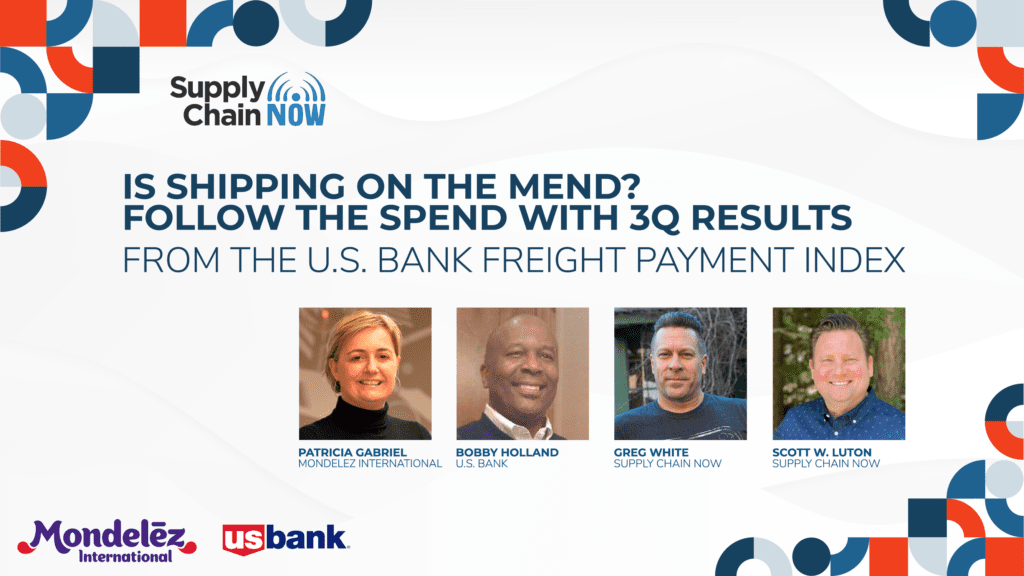
Is Shipping on the Mend? Follow the Spend with 3Q Results from the U.S. Bank Freight Payment Index
The U.S. Bank Freight Payment Index for 3Q 2021 has been released, and one thing remains clear: spend is up. More specifically, year over year, quarterly freight spend showed the second largest increase ever – rising 32.6% from 3Q 2020. What’s driving the dollars, and what can this increase tell us about the state of the supply chain across the country? Supply Chain Now co-hosts Scott Luton and Greg White recently sat down with Bobby Holland, Director, Freight Data Solutions at U.S. Bank, and Patricia Gabriel, Vice President US Customer Service & Logistics, at Mondelez International, to find out. Let’s review highlights from their discussion of the report – and take a look at what you need to consider moving forward. But first, what is the U.S. Bank Freight Payment Index? The U.S. Bank Freight Payment Index is a free report you can download each quarter to keep your finger on the pulse of freight shipping volumes and spend from both a national and regional perspective. The report uses actual transaction payment data, de-seasonalized and calendar adjusted for maximum comparability. How do I use it? When you’re asking the question, “What happened last quarter?” the U.S. Bank Freight Payment Index…

supply chain resiliency
Articles
September 26, 2024
Supply Chain Now’s Guide to Resilience in the Supply Chain
The resiliency of the supply chain has been tested time and time again — strained by weather-related events like hurricanes, global crises such as COVID-19, disasters like the Francis Scott Key Bridge collapse, and security breaches from cyberattacks. Supply chain resilience will continue to be tested. In fact, a major supply chain crisis could be just days away as the International Longshoremen’s Association (ILA) could stage a strike at ports all along the East and Gulf coasts of the United States as soon as Oct. 1. Beyond the Buzz: What is Supply Chain Resilience? “Supply chain resilience refers to the ability of a supply chain to prepare for unexpected events, adapt to disruptions, and recover quickly to restore its normal service levels,” Inbound Logistics said. “It’s not merely about preventing disruptions but being able to turn challenges into opportunities for growth and improvement.” Supply Chain Dive said because of events like COVID-19, the Panama drought, and Houthi attacks in the Red Sea, supply chain disruptions have become “part of the public’s consciousness and everyday nomenclature.” “The risk in our global economy is that supply chain disruptions are guaranteed to continue, but no forecast exists to tell us when or how…