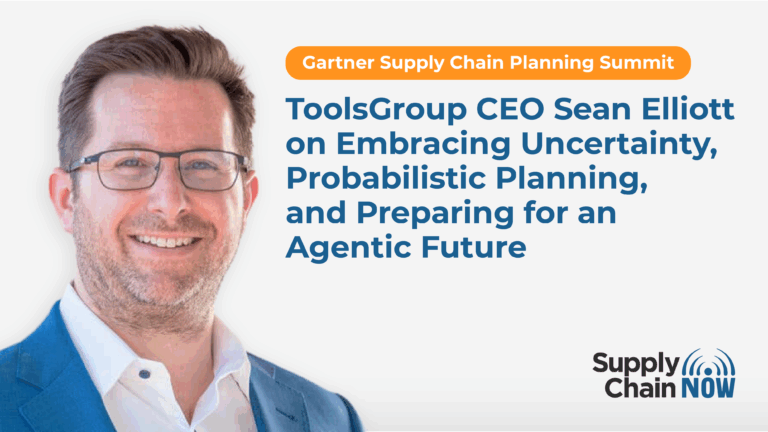

ToolsGroup CEO Sean Elliott on Embracing Uncertainty, Probabilistic Planning, and Preparing for an Agentic Future
At the Gartner Supply Chain Planning Summit in Denver, Scott Luton sat down with Sean Elliott, CEO of ToolsGroup, to discuss why uncertainty is no longer something supply chain leaders should fear—and how the right technology can turn volatility into advantage.
Elliott brings decades of experience across supply chain execution and planning, a background that shapes his pragmatic leadership philosophy. As he noted, bad plans can cripple even the best execution environments, just as poor execution can undermine well-crafted plans. ToolsGroup’s mission sits squarely at that intersection.
What Makes ToolsGroup Different
Elliott described ToolsGroup as one of the few truly probabilistic planning providers in the market. While many vendors claim probabilistic capabilities, most stop at probabilistic forecasting. ToolsGroup goes further by embedding probabilistic thinking across the full breadth of its planning technology.
The company’s belief is simple but powerful: uncertainty is not the enemy—it’s an asset. Rather than chasing forecast accuracy for its own sake, ToolsGroup focuses on business outcomes. What planning organizations really care about, Elliott argued, is having the right inventory in the right place at the right time to satisfy customers.
Customer satisfaction—driven by availability, pricing, and service—is the ultimate goal. Probabilistic planning enables organizations to position inventory intelligently in uncertain conditions, which is exactly where global supply chains find themselves today.
A Historic Era of Disruption
Elliott pointed to research from EY and McKinsey showing that large-scale macro disruptions have accelerated dramatically. A century ago, such disruptions occurred every five to ten years. Today, they happen three to five times per year—and that count doesn’t even include “logical” disruptions such as tariffs, regulatory changes, and pricing volatility.
Physical disruptions like canal blockages and pandemics are now compounded by dynamic trade policies and sourcing uncertainty. Together, these forces are reshaping how companies think about inventory, pricing, and risk.
For Elliott, this environment represents a defining moment for supply chain technology—and a clear validation of ToolsGroup’s approach.
Doubling Down on the Engines That Matter
When asked what excites him most as CEO, Elliott took a deliberately countercultural stance. While acknowledging the industry’s enthusiasm for agentic AI, he emphasized that strong engines must come before autonomous agents.
ToolsGroup is doubling down in two key areas:
First, the company is integrating both sides of the supply-demand equation. Most planning solutions focus almost exclusively on supply-side levers. ToolsGroup combines supply planning with demand-side capabilities—such as pricing, promotions, and markdown optimization—allowing organizations to manage demand and supply simultaneously.
Second, ToolsGroup is preparing thoughtfully for an agentic future. Elliott cautioned that automated agents powered by mediocre math will only deliver mediocre outcomes. The priority, he said, must be better recommendations, stronger explainability, and decision-centric workflows—so that when agents are fully empowered, they drive real, trusted value rather than noise.
How to Connect with ToolsGroup
Elliott encouraged supply chain leaders to connect with ToolsGroup through the company’s website, which is designed to quickly route organizations to meaningful, human-centered conversations. “We’re problem solvers,” he said. “We want to get you to the right discussion as fast as possible.” You can also follow Sean Elliott on LinkedIn: click here. To listen to the audio version of this interview with Scott W. Luton and Sean Elliott: click here.
As uncertainty continues to define global supply chains, ToolsGroup’s message is clear: embrace volatility, invest in stronger decision engines, and prepare now for the next generation of planning.
More Blogs
Building for Uncertainty: Stefan Groschupf on Reimagining Supply Chain AI at Manifest 2026