[00:00:00] Ben Gordon: there’s a lot of great technology, a lot of great talent, but in the end, there are very few great strategies. And the, the handful of companies and leaders that figure out, how do I think systematically about solving a problem and bundling it in a way that nobody else can do, those are the guys that win.
[00:00:18]
[00:00:31] Scott Luton: Hey, hey, good morning, good afternoon, good evening, wherever you may be. Scott Luton and Wiley Jones here with you on Supply Chain Now. Hey, Wiley, how you doing today?
[00:00:40] Wiley Jones: I am doing super well. Happy Friday, Scott
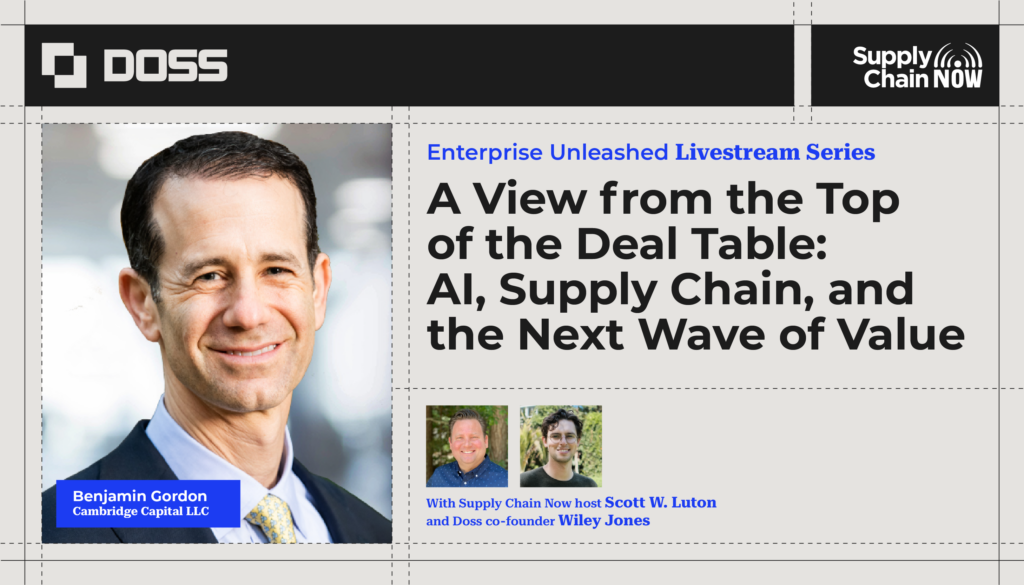
[00:00:43] Scott Luton: Happy Friday. And you know what? Happy and one of the best Fridays of the year because we’ve got a big show here today on Supply Chain Now as we continue a popular newer series for 2026, Enterprise Unleashed, powered by Wiley and all of our innovative friends at Doss. Itfocuses and really dials in on, real leadership conversations with individuals that have demonstrated a proven track record for truly unleashing the beast, the power of the enterprise, liberating their people, their operations, and their performance from old-fashioned technologies and approaches from the past, all driving innovation and change across industry.
[00:01:21] Wiley Jones:
[00:01:21] Scott Luton: With no further ado, wanna get to work and welcome in our featured guest here today. Folks, Benjamin Gordon is founder and managing partner of Cambridge Capital.
[00:01:30] Scott Luton: He draws regularly on career, building, advising, and investing in supply chain companies. Ben has led investments in outstanding firms like XPO, Grand Junction, Bring, LiftIt, and others. Prior to Cambridge Capital, Ben built BGSA Holdings into a global leader in M&A for the supply chain sector.
[00:01:50] Scott Luton: As CEO of BGSA, Ben led the firm’s efforts advising over, get this, over $2 billion worth of supply chain transactions. Prior to BGSA Holdings, Ben founded 3PLex, the internet solution enabling third-party logistics companies to automate their business.
[00:02:09] Scott Luton: It’s important to note that Ben is also an active civic leader who is committed to giving back to the community. For example, as founder and chairman of Gestra City, he boosted young adult volunteerism, expanding the organization to over 100,000 members in 20 locations. Dang. Ben also serves on a wide variety of boards and leadership committees.
[00:02:29] Scott Luton: Please join me in welcoming Ben Gordon, founder and managing partner of Cambridge Capital Hey, hey, Ben. How you doing, my friend?
[00:02:38] Ben Gordon: Outstanding, Scott. Great to see you and great to see Wily. Thank you.
[00:02:41] Scott Luton: Well, uh, Wiley, if I read word for word Ben’s entire background, we might not get out of here for six hours, so I kind of had to cherry-pick it a bit. But we’re, we’re pretty excited about today’s conversation, huh?
[00:02:51] Scott Luton: But let’s do this.
[00:02:53] Scott Luton: We got a lot to get to. And I wanna start with, you know, your family had a transportation business, uh, uh, earlier in your upbringing. So, uh, between that and, of course, your first startup, uh, three…
[00:03:03] Scott Luton: I’m probably saying this wrong. 3PLX is probably how you say it. 3PLX,
[00:03:06] Scott Luton: right,
[00:03:07] Ben Gordon: Yeah. You got it. Yeah
[00:03:08] Scott Luton: So supply chain runs really deep in your roots. Tell us more about
[00:03:11] Scott Luton: that.
[00:03:11] Ben Gordon: Well, listen, humble roots, right? Uh, my great-grandfather on one side came over steerage class on a boat from Russia when he was 15. And, uh, and then on, on the other side of my family, um… So that’s a form of transportation, uh, albeit, uh, pretty, pretty, uh, meager. And then on the other side, uh, my great-grandfather, actually great-great-grandfather, started a horse and buggy business in New York in 1903 called Morgenstern Express.
[00:03:38] Ben Gordon: And so, uh, and then his grandson, my grandfather, started a truck leasing company called AMI. Uh, and so then two generations later, there, there I was in ’99, uh, with the idea to start one of the first internet logistics companies, a SaaS TMS, which was 3PL. So, uh, you can trace that back many generations, and here we are
[00:04:01] Ben Gordon: today
[00:04:01] Scott Luton: Ben, that’s outstanding. And Wiley, uh, I’m already learning some new stuff about Ben Gordon and I thought I knew him. Uh, but The Roots have continued to deliver for industry, huh?
[00:04:10] Wiley Jones: Yeah. I mean, I think it’s, uh, what, uh, as you described the horse and buggy TMS of the 1903 timeframe. Um, they probably needed something pretty similar back then, but they didn’t have the means. So, uh, th- that’s, I mean, that’s awesome to see that through line.
[00:04:25] Scott Luton: It is, it is. Uh, and it reminds me of, uh, RD, uh, Desmook at, at Modex told me, uh, “Hey, we can’t, we can’t run the modern technology, uh, sup- supply chain technology race by taking a 1985 horse and buggy approach.” RD, I hope you’re tuned in here listening to Ben and Wiley. Uh, really quick, I’m gonna ask you about, uh, some of your work with, of course, BGSA and Cambridge.
[00:04:46] Scott Luton: But hey, Régine says, “The fastest old guy, that sounds like a perfect trophy title.” Love that. Uh, Osvaldo tuned in from Angola via LinkedIn. Great to see you. And Subhash says, “Hey, it’s been about 25 years since you first, uh, Subhash first met you.” Tell you what, blessed be. Eyes at mind. Ben, we’re gonna touch probably more on BGSA and Cambridge towards the end of today’s episode.
[00:05:08] Scott Luton: But first, especially for context, tell us more about your work with both BGSA Holdings and Cambridge Capital.
[00:05:15] Ben Gordon: They’re separate but related businesses. And the, principle is, if you’re a CEO building a great company, you might want advice on mergers, acquisitions, capital raise, or, uh, other, you know, transactional work. And that’s what BGSA does, okay? BGSA specializes in providing investment banking services for top CEOs in transportation, logistics, and the supply chain world, and has been doing so since 2002, okay?
[00:05:42] Ben Gordon: So nearly 25 years. If you want a capital partner for growth, you know, whether that’s to buy you out or to buy a component and then provide growth resources or to fund acquisitions, technology investments or otherwise, well, that’s Cambridge Capital. It’s a private equity firm. Cambridge is all about backing the best CEOs building the best businesses in supply chain.
[00:06:03] Ben Gordon: And we’ve been doing that since 2010. We’re early investors in XPO with Brad Jacobs in 2011, among others. And so really the principle is advisory side, principal side, all based on giving great CEOs the resources they need
[00:06:19] Ben Gordon: to succeed
[00:06:20] Scott Luton: Ben, that’s impressive. And, and, and really, uh, the longevity of it all, uh, is really impressive. You’ve seen a lot through those, uh, uh, different markets that represent those 25, 30 years. all right, so Wiley, uh, speaking of which, we’re gonna dive a little deeper into the unique position that Ben sits in.
[00:06:37] Scott Luton: Where are we going next, Wiley?
[00:06:38] Wiley Jones: I think the big thing that, especially having attended your conference a couple times now, that I love getting your point of view on is that you see so many different reference frames and slices of the industry as a capital allocator, as someone who’s helping and advise on both sides of transactions, someone who’s operated these companies, family lineage of operating these companies.
[00:07:01] Wiley Jones: What are the things that are top of mind for you, uh, across, you know, B2SA Holdings, Cambridge Capital? Like, what is happening in the market from a technology standpoint, but as well as where the operators are then focusing that technology? What are the big things that you’ve seen and observed that have really come to the forefront in recent, uh, you know, recent months?
[00:07:21] Ben Gordon: Wally, I think at least three things come to mind. Thefirst is macroeconomics, because we’re all part of this much bigger economic cycle. And so in the freight world We, we have just ended the longest, deepest, and worst freight recession in US history. It was a four-year recession. Freight rates on average dropped over 50%, particularly in truck dri– you know, drive-in truckload.
[00:07:45] Ben Gordon: Record bankruptcies on the trucking side, truck brokerage side, uh, and other collateral damage. Um, that meant that if you were a trucker, you went through pain, a truck broker, you went through pain. But also if you were a service provider to the industry, there were ripple effects from that as well. That freight recession is now over.
[00:08:01] Ben Gordon: We are now seeing rates skyrocket, uh, we’re seeing growth come back. Uh, the unit volume is not moving up as much as the pricing, but nevertheless, it’s clear that we’re in the next chapter. So I think topic number one is the volatility in the freight cycles, uh, and what that means for the entire ecosystem.
[00:08:20] Ben Gordon: Um, topic number two is technology. can’t read the newspaper or, uh, really anything without being aware of what’s happening in AI. Uh, but there are a few really big things happening in AI as it relates to supply chain. At our conference, for example, and Wylie, you know this because you were there, uh, we have the BGSA Supply Chain Shark Tank, which is a spotlight on innovation.
[00:08:40] Ben Gordon: We’ve been doing that for about eight years. This year, there were over 60 applicants. I think 52 of them were some flavor of AI, whether it was AI for workflow automation or, or some other, uh, component. Now, they’re not all gonna win.
[00:08:55] Ben Gordon: But the market need and opportunity for AI in supply chain is tremendous. And you could break that down into workflow automation, using AI to automate the sequence of steps that a truck broker, uh, or a freight forwarder or, or another transportation company goes through. There’s AI for pricing and analytics. Using AI to process massive data sets, $30, $40 billion of freight, to be able to make better analytical decisions.
[00:09:20] Ben Gordon: Um, and then third, there’s the opportunity to use AI to make sense of other bigger pools of data, including unstructured data, and that’s kind of a next frontier. So I think headline one, freight recession’s over. We’re now in the next chapter. Headline two, AI, and it really does change everything, and there are lots of huge winners.
[00:09:39] Ben Gordon: There are also, like, gonna be lots of huge losers because if you don’t know how to use these tools and your competitors do, you know, it, it’s inevitable that, that they’re gonna win and you’re gonna lose. In, in, in some respects, it is absolutely a highly competitive zero-sum game. And then I think the third big thing is M&A, okay?
[00:09:59] Ben Gordon: We’re seeing a lot of M&A activity right now, and that’s because I think companies are responding to the fact that their customers want more, better, different things. As an example, uh, BGSA, the investment bank, just sold a company called Idelic, which is really, uh, software that’s focused on driver safety and compliance.
[00:10:19] Ben Gordon: Um, and that is interesting in its own right. It’s probably more interesting today than it was a month ago because of the Supreme Court nine-zero ruling on, uh, on liability for, uh, brokers, which makes it that much more important to have a, a safety and compliance protocol. Um, but you know, that company was acquired by Descartes.
[00:10:38] Ben Gordon: And of course, Descartes, terrific company, public company, a $10 billion-plus business, and they are actively consolidating different parts of the supply chain software world, uh, as they look to automate more and more of the process. But similarly, you see other consolidators and other pockets of supply chain, e-com fulfillment, warehousing, truck brokerage, freight forwarding, et cetera.
[00:10:58] Ben Gordon: That’s awesome. Yeah, so mirroring that back, we have– we’re in the, the back half of the roaring ’20s now where we’re on the upswing out of our, great freight depression. there’s, workflow automation with AI that we’re seeing, unstructured data analysis across wide, you know, corpuses of data that has never been possible before.
[00:11:16] Wiley Jones: And then we’re seeing a bunch of consolidation from larger market players, but even in, you know, maybe places in mid-market where people are looking on the other side of the transaction.
[00:11:26] Scott Luton: Corpuses. That’s a great word, Wiley.
[00:11:29] Wiley Jones: So Wiley, I bet you’re curious to double-click on AI is my hunch
[00:11:33] Wiley Jones: Unfortunately, yes. So I think, um, the, the piece here that I’m most interested on this, Ben, is you have seen, again, as you, as you described, the transformative changes where technical innovation occurs, that came in the, the internet revolution, late ’90s when you were introducing 3PLX.
[00:11:52] Wiley Jones: Where are you seeing AI deliver the most practical value in the supply chain
[00:11:57] Ben Gordon: Great question.
[00:12:16] Ben Gordon: So I think the number one application is in workflow, and that’s because logistics, as you know, and as I’m sure everybody in the audience knows, is a complicated multi-step process, and there’s just a lot there. And whether it’s automating this, the sequence of steps that a truck broker goes through in the life of an order, uh, or what a carrier goes through or a shipper or anybody else in the supply chain process, there are a lot of steps.
[00:12:22] Ben Gordon: And if you could take out more steps and take out more costs, there are all kinds of benefits that could accrue to you. So here’s an example, Pallet is AI-powered workflow. Cambridge Capital invested in a company called Everest, a truck brokerage business, uh, great company, great people, does a great job, serves, large major brands.
[00:12:40] Ben Gordon: Um, went through the same pain and suffering that everybody in the truck brokerage world did over the course of this freight recession. In a world where you’ve got margin compression, on average, truck brokerage gross margins in 2021, and 2022 were close to 20%.
[00:12:55] Ben Gordon: By contrast, by 2025, those average margins for the industry had collapsed by 50% down to 10%.
[00:13:02] Ben Gordon: Amidst this massive margin compression, what do you do? You can’t just say, “Oh, I’m gonna do the same thing faster.” You’ve got to find ways to be materially different and better. Everest brought in Pallet. Pallet is using, uh, AI to really automate the entire process. And the idea is you map all the steps and you say, “Okay, if I’ve got 100 steps, can I automate half of them.
[00:13:24] Ben Gordon: And then for the other half, uh, can I use technology to allow the key people that do a great job be able to do more with less so that maybe with the same size team, you could do double the revenue or triple the revenue?
[00:13:37] Ben Gordon: and that is exactly what the Pallet technology is helping Everest to do.
[00:13:41] Ben Gordon: And so the net effect of that is, Everest wins because Everest can respond to the market dynamic and be able to still, succeed, uh, despite the, the market challenges that I’ve just described, uh, and be more efficient, and more effective. The Everest customers win because the customers gain the benefit from a team that can be more focused on service instead of doing commodity things that you could use technology to do better.
[00:14:06] Ben Gordon: Pallet wins because of course, Pallet is gaining revenue and a satisfied customer and all the ripple effects that flow from that. you know, in the end it is really, it’s a triple by virtue of that. And I think that’s a very good example.
[00:14:18] Ben Gordon: You can use AI to automate process and workflow in a manner that is transformative. you got to have a strategy for how can I use AI to take out process steps and be able to
[00:14:30] Ben Gordon: do more with less?
[00:14:31] Scott Luton: All right, so Wiley, we’ve got 3,427 more questions I want to pose to Ben while we got him. But quickly respond, Wiley, to that great case example, to Ben’s point, that triple winner. The team wins, the financials win, the ecosystem wins from, from an innovative approach.
[00:14:47] Wiley Jones: Yeah. I mean, that is I think the triple threat that we see any technical innovation that happens at the most foundational layer is it is net sum positive for almost everyone. You subtract out the pain and suffering and you grow revenue.
[00:15:02] Wiley Jones: One kind of like immediate super quick, question back to Ben on this is, this is a fundamental thing that management teams will ask me a lot is do they see most benefits from workflow automation in the team being able to grow revenue as a result of doing more with less?
[00:15:22] Wiley Jones: Or are they more focused on saying, “How can we improve margin by taking the thing that we’re already doing and, and use less energy, effort, people, time, et cetera to do it?” Where do you see most of the benefit, especially in the world of logistics
[00:15:35] Wiley Jones: Where do they see most of that coming from?
[00:15:37] Ben Gordon: The answer is both. but in particular, if you are a company that’s growing and successful, and maybe you are gonna grow 20% this year, maybe with AI you could do a better job, maybe you could grow 30%, 40%, and maybe you could do so without having to add cost. So if you could use the same team but be able to produce more, great, you win, everybody wins.
[00:16:00] Ben Gordon: Now,In the beginning of my career, I was a strategy consultant, There was a book that, we had published nearly 30 years ago, titled, “You Can’t Shrink Your Way to Greatness.” It’s as true now as it was then. You can’t shrink your way to greatness. So can you use AI to take out some cost? Yes. And does that mean that if you’re running a company, you ought to be able to do it to improve your margin?
[00:16:19] Ben Gordon: Yes. But you can’t shrink your way to greatness. It’s got to be a tool for being able to grow. Uh, and I think smart, successful companies, and certainly, would put Everest in that camp, are, are using it as a
[00:16:29] Ben Gordon: tool for growth as well
[00:16:30] Scott Luton: Still true, except for semiconductors.
[00:16:33] Wiley Jones: I was a– I, I literally had those wor- exact words in my head, Scott. I was like, “Well, chips,” but yeah
[00:16:40] Scott Luton: Other than that, it’s universal. I love it. What a great T-shirtism. uh, you can’t shrink yourself to great– uh, shrink your way to greatness.
[00:16:47] Scott Luton: I want to ask you this,
[00:16:48] Scott Luton: How much of enterprise value today comes down to leadership quality and operational discipline versus pure technological differentiation?
[00:16:58] Ben Gordon: Well, I think it has to start with leadership. I mean, it, it’s interesting. I, I remember when, um, you think about some of the great technology companies that have been built along the way. So, here’s a good vintage reference. There was a company called Lotus, uh, pioneer in making the spreadsheets, you know, Lotus 1-2-3, and before there was Excel, there was Lotus.
[00:17:17] Ben Gordon: and in the end, uh, Lotus sold, uh, in the late ’90s, and somebody asked Bill Gates about it and said, “Lotus isn’t a strategy, it’s just a product.” the reason why that was such a great line then, and, and it resonates now as I think about your question is, Bill Gates had a strategy, right? Lotus had a product, which was okay, the spreadsheet.
[00:17:39] Ben Gordon: But Bill Gates figured out, I could bundle these different capabilities together. I could have, uh, Microsoft Word, Microsoft Excel, Internet Explorer. Of course, that bundle gave him a competitive advantage so powerful that in the end, the, court system had to break it up. But it just shows the difference between a product and a strategy.
[00:17:58] Ben Gordon: So to me, the answer is, it’s leadership, and that leadership starts with a clear point of view. and this is so important in supply chain right now because when you think about all the competition,for example, the AI workflow example and the 50 plus applicants to the BJSA Supply Chain Shark Tank.
[00:18:15] Ben Gordon: Okay, there’s a lot of great technology, a lot of great talent, but in the end, there are very few great strategies. And the, the handful of companies that… and, and leaders that figure out, how do I think systematically about solving a problem and bundling it in a way that nobody else can do, those are the guys that win.
[00:18:34] Ben Gordon: Um, and if you look at, for example, the giants of value creation and supply chain, WiseTech, for example. WiseTech got started, uh, because Richard White figured out how to map a really complex workflow, which was for global freight forwarding, and how to automate it using software. And there were people doing different things, but nobody said, “I’m gonna automate everything end-to-end in the, in the freight forwarding arena,” and then made a string of acquisitions to fill in the gaps.
[00:19:01] Ben Gordon: So to me, that starts with leadership, with vision, and with the desire to do something that nobody else
[00:19:07] Ben Gordon: could do it the same way.
[00:19:08] Scott Luton: Outstanding. Okay, I’m, while I’m gonna go one more question, then I’m gonna circle back and get your conversation. And who knows, Lexus, Lotus, what’s coming next? Maybe formerly L- Llamasoft. Who knows where we’re going next?
[00:19:19] Scott Luton: What operational characteristics consistently show up?
[00:19:22] Scott Luton: I mean, you’ve got a incredible track record here. You’ve seen the companies built to win and to scale, and some that have tried and, and haven’t. But what are some of the common threads in terms of operational characteristics that show up in those companies that do scale successfully?
[00:19:36] Ben Gordon: I’m gonna go to the godfather of supply chain value, value growth, uh, and that’s Brad Jacobs. Brad Jacobs came to our conference just like Wiley in 2010, Brad Jacobs had been a very successful guy by then, but he hadn’t done something in our sector.
[00:19:51] Ben Gordon: He’d built United Waste and United Rentals, and he came up to me and he said, “You don’t know me, but I built four companies from nothing to over a billion, and my next one’s gonna be in logistics. Everybody said I, I gotta come to this conference and I gotta meet you, and so what do I need to know?”
[00:20:06] Ben Gordon: It was sort of the like, you know, explain the Bible while I stand on one foot. Uh, but we had a great conversation, and the takeaway was focus on large, growing, fragmented markets. Truck brokerage was a great place to start. Famously, Brad went and bought Express One.
[00:20:20] Ben Gordon: That $70 million value company would grow to become a $20 billion value company within a decade. The acquisitions were only a part of it. The operational excellence, as you’re alluding to now, uh, was equally important.
[00:20:34] Ben Gordon: One of the things that, Brad did, was crowdsourcing agendas for meetings after you buy a company.
[00:20:40] Ben Gordon: He’s got 10,000 new employees. What happens? Well, a lot of times, your typical CEO comes in and says, “I’m gonna give you, you know, my vision and, you know, give you the speech, give you the talk, and try to get you fired up and let’s go.” Okay. Brad had a different approach, which is, “I wanna know what everybody cares about, and I also want them to feel listened to.”
[00:20:59] Ben Gordon: He’d have somebody send an email to the entire company and say, “Tell me the issues that are on your mind.” So he’s got a list. Then there would be a second email that said, “Now I want you to force rank these and tell me which ones matter the most to you.” So he has crowdsourced an agenda that becomes the basis for that meeting, for that conversation.
[00:21:18] Ben Gordon: That in and of itself is valuable because it means he’s getting better ideas, he’s listening to people on the front lines, uh, and he’s focusing on what they care about. But then there’s a second advantage, and that is, you know, we’re all human. We like to feel listened to. We’re more engaged, we’re more excited, we work harder, and we perform better when we know that we’re working with someone and for someone that listens to us, values us, and cares about us.
[00:21:41] Ben Gordon: So, you know, you not only get to better ideas, but you get a more engaged workforce. And so that’s just one very specific example of how operational excellence can come from something that w- when you, when you hear it, you probably think, “Gee, that sounds obvious. Of course I would do that.” Um, but most companies don’t do that.
[00:22:01] Ben Gordon: And you could take that same approach to all aspects of running the business
[00:22:04] Scott Luton: Excellent. Ben, uh, we could be here all day talking, I think, on your last response.
[00:22:09] Scott Luton: Wiley, you were talking about this specific address in the green room and, and how what Brad shared and what Ben’s describing, you think about, like, once a day or once a week.
[00:22:20] Scott Luton: And it touches on, Wiley, one big time common thread through all four of the conversations here of Enterprise Unleashed: culture, the power of intentional culture. But respond to what you heard there from Ben
[00:22:32] Wiley Jones: Yeah. There, there were probably three to four sentences that Brad, you know, uh, verbalized in that discussion with you that I think about on a weekly basis. But the thing you just touched on that was the most interesting part of his discussion with you in that fireside was that he went from this metaphysical, you know, really big picture, 10x your ambition, 10x your goals discussion.
[00:23:01] Wiley Jones: The CEO comes into a company they buy and they get everybody fired up. He went from that and then he bottomed out into the tactics instantly. His ability to switch from the strategic high level into tactical rigor and excellence like on, like he was flipping a switch. And he was like, “Here is exactly how I will collect information from the team members.
[00:23:21] Wiley Jones: Here’s exactly how we will validate which people actually fit into the new culture we’re trying to build. Here’s the toxic parts of the culture that we need to systematically carve out. Here is how I go in and find all that.” Here, you know, it was like, it was like watching a maestro and I was like, “Oh, this is different.”
[00:23:38] Wiley Jones: There’s like something special here where you watch someone operate at such a high wavelength and then they drop down into this like very deep rigorous operational frame. And, uh, like that really clicked for me was like this is, this is what excellence looks like when you observe it like a couple times and you see people like, you know, Brad or the way they think and the way that they operate.
[00:24:01] Wiley Jones: I was like, “Oh, okay. This is why you get,” as you said, “the $70 million, you know, company grow to $20 billion.” And he does it not once, but he does it like four times.
[00:24:11] Scott Luton: Mm-hmm. It is remarkable. Maybe we get Brad next on Enterprise Unleashed. Brad and Ben and Wally. Oh my gosh, I’ll get a Diet Coke and popcorn and watch. Uh, all right.
[00:24:27] Scott Luton: So Ben, I got a two-part question as we kind of wrap up this enterprise value segment in the conversation. Sonumber one, we’re in this interesting time. Volatile market doesn’t do it justice, but I’m gonna go with that descriptor right now, In volatile markets in general, what’s the most important trait? You know, profitability, resilience, adaptability, experience? So that’s the first question.
[00:24:41] Scott Luton: And then secondly, regardless of what market we’re in, the more predictable, the more volatile, whatever descriptors you want to use, what’s one of the biggest mistakes you’ve seen founders and leadership teams make when trying to Ben, what you say?
[00:24:54] Ben Gordon: All right. Well, let’s start with your first question. So in, in volatile markets, what’s the thing that matters most? You’ve got to have one thing that you’re great at that people can count on you for. So, I mean, I’ll give you an example. Greenscreens, AI-powered predictive pricing for trucking.
[00:25:07] Ben Gordon: So when I first met Felix, who is the real founder, put in years and millions of dollars of his own money uh, and time and effort, you know, getting the business started, creating a terrific technology team.
[00:25:18] Ben Gordon: But they were doing at least six different things at once, including a digital truck brokerage capability, sort of a Convoy-like business, and a series of, of other products. One of my mentors who, I’ve always found super, uh, super helpful likes to say, “Simplify, focus, execute.”
[00:25:37] Ben Gordon: This business was doing too many things. You got to simplify. What’s the one thing that mattered the most? In the case of Greenscreens, what they had that was special above and beyond… I mean, there were other digital brokers and in the end, I think we all learned that digital brokerage as a business model, uh, is a tough business to really turn into something great,
[00:25:55] Ben Gordon: but having one master database with more pricing data than anybody and the ability to use AI to detect patterns and ultimately to be able to tell you on a real-time basis what should it cost to ship a truckload of freight from LA to Miami right now, how is that likely to be different on Monday at 10:00 a.m.
[00:26:14] Ben Gordon: or Tuesday at 4:00 p.m., and Factoring into account everything, you know, whether it’s trade patterns or weather issues or, carrier networks or, or anything else. Having one huge dataset and one powerful set of algorithms that in the end everybody uses, that was a really valuable thing. So when we looked at all the different areas, to me, the question was, “Well, what’s the one thing that we could do better than anybody else?”
[00:26:38] Ben Gordon: Um, and it was that. And with all the volatility in the freight markets over the 2020 to 2025 timeframe, the reason Greenscreens succeeded was because they were doing that one thing really well.
[00:26:49] Ben Gordon: Now, Greenscreens had competitors
[00:26:51] Ben Gordon: but nobody was doing the one thing that Greenscreens was focused on 100%. That gave Greenscreens an advantage in its market, that allowed Greenscreens to succeed. And then, and then of course, you know, the third part, execute.
[00:27:04] Ben Gordon: Well, one thing that we figured out was, you lose companies when implementations take too long. By the way, you also lose money when they take too long because usually they don’t want to pay you. Whether your contract allows you to bill them or not, nobody wants to pay you before the system is on. So we looked at the question of how long does it take from when you sign the contract with a customer to when they’re 100% operating, and how do we squeeze that down as much as possible?
[00:27:32] Ben Gordon: And if you could take 90 days to 60 to 30 to 10 days, you get paid faster. your customer’s happier. there’s less risk of you’re using your own time more efficiently. There’s this great flywheel. So in the end, simplify, focus, execute. And in times of volatility like right now, those principles are, are more
[00:27:50] Ben Gordon: valuable than ever
[00:27:51] Scott Luton: You know what, what’s old is new again. You know, there’s these timeless principles, I think, regardless of markets, uh, Ben, and one of them is certainly the, um, focus is so undervalued across industry, and it’s very powerful as, as Ben just shared. Uh, okay. So Wiley, we got so much more to get to with Ben.
[00:28:10] Scott Luton: Uh, I’m gonna pass the baton to you, Wiley. I bet you wanna comment on what you heard there from Ben. Go right ahead. But we will also wanna get into the current investment landscape and share Ben’s perspective with our, our SC&Global fam
[00:28:21] Wiley Jones: Two sides of this coin. I’ll, I’ll make a nice segue out of it. Focus, focus, focus. simplify and then focus. I, I love that.
[00:28:30] Wiley Jones: when you’re thinking about that exact same kind of focus in the investment landscape, where are you focusing?
[00:28:36] Wiley Jones: Because as you said, there are 60 companies that come through the BGSA Shark Tank, and there will be consolidation among them. There will be winners that emerge, but more importantly, there are ideas that are more correct than others. So where do you feel like you wanna be spending your time and focusing, and where do you think that the investment landscape should be focusing with respect to where new technology companies are, uh, pushing value into the supply
[00:29:00] Ben Gordon: At Cambridge Capital, we invest in tech companies. We also invest in services companies. So on the tech side, we want companies that are solving a real problem, that have real proof points of success and, and that are winners.
[00:29:11] Ben Gordon: How do you know that? Well, you know that not just because the technology’s good, but because, uh, there’s customer adoption. So I always want to see customer case studies. I’d love to see, you know, some major companies where you’re able to demonstrate, “Here’s what they did before, here’s what their options were, here’s why they chose you, and here’s what the results were.”
[00:29:32] Ben Gordon: And if those results are really compelling, and as a result, they not only are doing more with you, but they’re also a, a, you know, great source of recommendations, fantastic. second thing that, that to us is important is there’s got to be some kind of a moat. Most companies are product companies, not real strategies, and that makes it hard. but a company that could build some kind of a moat.
[00:29:54] Ben Gordon: What was interesting about Greenscreens was the opportunity to use data to create a moat, ’cause the more data you had, the more value in your AI-powered predictive pricing, uh, and then in turn made you, you know, more and more indispensable to the customer. Well, similarly, if you could figure out how there’s something you could bundle so that the combination of things you give your customer is something that makes you indispensable, all, all the better.
[00:30:17] Ben Gordon: But there’s got to be some kind of a moat. Um, and then third is, uh, uh, tailwinds, right? Like, I mean, w- we don’t want to find the, the, the next, you know, the, the best version of a buggy whip company, right? We want to find the company that’s doing something that we know the market wants more of. And so maybe that’s, uh, you know, technology for the hyperscalers as they’re ramping up, or for healthcare and medical logistics, or some other area where you know there’s a large growing problem, uh, that, that is a catalyst for continued growth.
[00:30:50] Ben Gordon: Um, and then I think, you know, fourth is the people, which is, um… And this is one of those things that it- it’s easy to say and it, and it’s hard to know. But you, you want leaders, but you also want leaders that know how to pivot, how to adapt, you know, that could be, you know, focused and maybe stubborn where they need to, um, ruthless about prioritizing that simplify, focus, execute mantra, but that are also good listeners.
[00:31:15] Ben Gordon: I mean, Scott, you, you asked a question earlier, which we, we, we didn’t end up getting to, about, you know, the biggest mistakes that founders make. To me, the biggest mistake is, um, believing your own bullshit, okay? And that’s because every founder… You think about how hard it is when you start a company, okay?
[00:31:34] Ben Gordon: You have to simultaneously convince customers you’ve got a great technology. Convince engineers to be able to build something that you think the customers are going to want, but it’s not there yet. Convince the investors that you have something that’s great, uh, that, that merits funding. Convince employees, customers, and others that you have enough capital and enough resources to make it happen.
[00:31:56] Ben Gordon: And all those things have to happen at once, and they can’t possibly all be completely true at once i- in the beginning of a company journey. They just can’t, right? So, so founders have to figure out how to, how to scrounge by and, and accomplish all those things simultaneously, and it’s kind of impossible to do.
[00:32:16] Ben Gordon: so you got to have that scrappiness and that drive. But then you also have to know, don’t believe your own bullshit because listen, I mean, Steve Jobs had what they called the reality distortion field, where he would tell you something that wasn’t true, but he would say it in a way that it was almost like he would will it into being.
[00:32:33] Ben Gordon: You know, as, uh, as the kids say, manifest it, right? So, so, uh, but, but that’s fine, you know, and when you’re Steve Jobs and you’re, you’re, you’re, you’re using the reality distortion field to win customers or recruit people or, or, you know, change direction, fine. But you got to be able to know, you know, when you look in the mirror, is this really 100% true or not?
[00:32:57] Ben Gordon: You got to have data and an honest, candid self-assessment to know what’s working and what isn’t, and then be willing to change or adapt. Because what you think is right is rarely going to be 100% right. As you learn more, you find out more, and you got to be able to, uh, a- adapt, right? And, and so, you know, as, as the facts change, does your mind change or not?
[00:33:20] Ben Gordon: Um, so, so really, I mean, those are four critical things that we look for on the tech side. Now, on the services side, we look for all those things too, but a services company is less about having great pure play technology, and it’s more about having a great solution for customers. But, but all that should show up in, and this brings me to the last point, um, the financial side, which is the unit economics have to be compelling and make sense.
[00:33:45] Ben Gordon: For software companies, you know, we… or, or AI now, you know, we look at companies that are generally, you know, uh, five to 30 million of revenue. And for services companies, you know, it’s more like five to 30 million of EBITDA. Um, but in both cases, big enough to prove that you’ve got something that works, uh, and, and the ability to deploy resources to scale up
[00:34:06] Wiley Jones: Yeah. One, um, one, one comment on the thing you’re describing and then kind of a, a follow-up quick question on that. The, the thing you said about the reality distortion field I think is especially interesting. Um, the job of leaders a lot of times is to hold two conflicting ideas in their head at the same time.
[00:34:24] Wiley Jones: You have to be extremely high conviction in your ideas because, well, you know, if you’re not, then people will tell you no 100 times, and you’ll actually d- get discouraged when you actually can’t do that as a person who is gonna get told no a lot, especially in the early parts of the journey. On the other end of the, uh, spectrum, you have to be able to recognize when the thing that you’re going down is this globally not optimal path.
[00:34:49] Wiley Jones: And it’s what you described as, you know, being able to look in the mirror and say, “Are our unit economics gonna be bust forever? You know, yes, we’ll get to, you know, five, 10, $20 million of revenue, but am I actually just digging myself a, a bigger hole?” And those are the things I think are, is, yeah, as, as you look at quality of leadership, I’m sure that’s something that you all are thinking about and I think about a lot for our own company.
[00:35:11] Wiley Jones: The, the question kind of as like the follow-up on this is, where is capital becoming more skeptical? There, there’s an ability now for us to l- you know, lose that simplification and that focus because it feels like so much is now possible. What is the stuff that you’re seeing as you’re evaluating opportunities on the services and the technology side where you’re like, “Seems great, sounds great, but we’re actually not sure”?
[00:35:39] Ben Gordon:
[00:35:39] Ben Gordon: Well, it’s a great question because, uh, on the one hand, uh, capital markets can be fickle. Uh, on the other hand, as Warren Buffett says, in the short run, markets are a, a voting mechanism, but in the long run they’re a weighting mechanism, right? Meaning the short run popularity could go up and down, but in the long run scales, you know, ultimately, you know, bear themselves out.
[00:35:59] Ben Gordon: Look, right now, I think tremendous level of volatility. Just look at the public markets. Today there was a publicly traded company, uh, that announced that they had figured out how to use AI to, um, massively transform and automate logistics. And all the publicly traded logistics companies tanked. CH Robinson dropped 15% that day, uh, which was, I don’t know, like a billion dollars of value destroyed.
[00:36:24] Ben Gordon: Um, except that the company that made this announcement was a microcap company. I think their value was like 9 or 10 million, and until recently they had been a karaoke machine maker. Okay? So like this was not a credible thing, right? I mean, no more credible than if, if I came out and declared that I had come up with a cure for cancer.
[00:36:43] Ben Gordon: It’d be like, who the hell is Ben Gordon to become the, uh, the cure for cancer guy, And in the end, you know, the markets figured it out you know, water finds its level. uh, but I think just it highlights that there’s a, there’s a lot of panic, fear, uncertainty, and, and anxiety about what’s happening with AI.
[00:36:59] Ben Gordon: One consequence of that is investors are a lot more cautious about businesses that they think could be destroyed by AI. Um,
[00:37:09] Ben Gordon: so you know, that means that look, uh, uh legacy software companies doing something that’s simple to replicate and expensive, and that maybe Claude comes out with a, a tool tomorrow that, you know, or skill that, that, that automates that, you know, boom, you know, you could be gone.
[00:37:27] Ben Gordon: This is the reason why in the public markets, uh, over the last six, seven months, you know, what they call the SaaSpocalypse has happened, and SaaS companies that might have been trading at 20 times revenue, you know, have, have come down a lot. Um, now is all that justified? No. It turns out that some of these things, enterprise software is probably the hardest thing to replicate.
[00:37:48] Ben Gordon: You, you are probably not gonna replace SAP or Oracle or, or Descartes, uh, or WiseTech just like that because Claude comes out with a tool or skill. Um, on the other hand, something that’s more simple or practical like, uh, I, I mean, uh, uh, some consumer-facing simple piece of software, uh, you know, and maybe, you know, workflow or, or CRM or, or, or other- otherwise, different story.
[00:38:15] Ben Gordon: Okay? But I think there’s, there’s a lot of capital market retrenchment around software that they think could be replaced by AI. The other thing that’s, I think, worth noting is the Amazon effect. So for instance, when Amazon announced that they were expanding their supply chain capabilities to go after e-commerce fulfillment, um, in the immediate term, you know, market prices for e-com fulfillment companies, you know, came down, right?
[00:38:41] Ben Gordon: Companies like GXO and others. Then people went back and looked at it more closely and said, “Okay, well, what Amazon is really gonna do is not the same thing as what a GXO does.” Right? I mean, Amazon will provide a high scale, low cost, simple fulfillment service, and if you fit what’s in that box, yeah, that’s gonna be something they will probably do faster, cheaper, and better over time than anybody, um, you know, as they’ve done with Amazon Web Services and, and Amazon Prime and others.
[00:39:10] Ben Gordon: But if you’re doing something that’s more differentiated, more specialized, uh, that requires more service, different story. So I think capital markets kinda, it’s like shoot first, ask questions later, right? I mean, so there, there’s kinda broad overreaction in, in some of these categories. Um, but in, in, in the end, if you’re doing something that’s complex or differentiated or service intensive, there’s still a
[00:39:33] Ben Gordon: tremendous need for that
[00:39:34] Wiley Jones: Yep. Yeah, makes a ton of sense. I, I think the, the degree to which I think, kind of reading back, the degree to which I would say capital allocators over the long run are thinking about differentiation seems to be at an all-time high
[00:39:54] Ben Gordon: Yeah, I think that’s right
[00:39:56] Scott Luton: So, uh, as we start to come down the home stretch here, Wiley and Ben. Ben, I hope your crystal ball is working well. Mine’s been broken, as I say, for years, but I bet yours… Wiley, my hunch is Ben’s has been pretty good for years. Uh, but when you think about, let’s call it five years from now, or if you want to change the timeframe, you can do what you want, Ben.
[00:40:16] Scott Luton: Three years, 10 years, you name it. What do you think is gonna define the companies that win and scale versus those companies that don’t? And some of them are gonna disappear like, uh, Blockbuster or many others that come to mind. Ben, your thoughts
[00:40:31] Ben Gordon: Well, I think the, the number one answer is companies that are really good at focusing on the one big thing. You know, simplify, focus, and execute. So Greenscreens was great at that one thing, but the reason why it made sense to sell Greenscreens to Triumph was because it was a point solution.
[00:40:47] Ben Gordon: And so you basically had to say, “All right. We’re either gonna go invest another couple hundred million and build out everything that the target customer, a truck broker, wants and needs, including capacity management and a whole host of other things, or sell to or merge with someone that, that has those capabilities so that the customer’s got everything.”
[00:41:06] Ben Gordon: Number one is those that do a great job of simplify, focus, execute. Number two, those that are honest and look themselves in the mirror and understand, what do, what do I really need to do to be indispensable?
[00:41:18] Ben Gordon: and if you can’t get there in a clear path, then sell, merge, or, or find another way to, A, unlock value for your shareholders, and B, make sure that the business becomes part of something that’s much more, uh, sticky, valuable, and indispensable. So I think that’s kind of the big thing.
[00:41:35] Ben Gordon: The other thing that I would say is, Be close to the customer and, and listen and pivot.
[00:41:40] Ben Gordon: Find ways to do more, do better. I’ll give you an example. We, Cambridge Capital invested in a company called Moresby, and Moresby does long tail procurement spend management.
[00:41:50] Ben Gordon: The founders were McKinsey guys who were providing procurement services to these Fortune 500 companies. We’ll help you buy cheaper or we’ll help you renegotiate with your existing, uh, you know, sourcing partners.
[00:42:02] Ben Gordon: And they realized that instead of doing that as a service, as McKinsey consultants, they could build software and do that in a more recurring and scalable fashion for, for these Fortune 500 companies. So they built this company, Moresby, uh, did a great job powering giants like US Foods, FedEx, and a host of others.
[00:42:23] Ben Gordon: We came in, bought a majority stake, uh, combined it with another company called STAT that does another, form of, of spend management and, and fee reduction. What STAT does is they help large brands reduce the OTIF, on time and in full fees, that these brands pay to Walmart and other retailers.
[00:42:39] Ben Gordon: Walmart charges over two billion a year in OTIF fees, so it’s a big deal, big problem. STAT built software and, and solutions to be able to help these brands do post-audit recovery and can save tens of millions, uh, by, by doing so. But the idea, the insight was put those pieces together, okay? So you’ve got OTIF and kind of post-audit recovery and long tail procurement, you know, spend management, and you could give the office of the CFO the ability to provide a holistic way to take down cost, use AI to make better decisions, better analytics, um, and because you’re bundling more capabilities, you’re now stickier, you’re now more valuable, you’re now more indispensable to these, uh, CFOs of Fortune 500 companies.
[00:43:29] Ben Gordon: And so to me, I think that’s an example of the kind of strategic move that, uh, I think sets you up for success
[00:43:36] Ben Gordon:
[00:43:36] Scott Luton: Outstanding.
[00:43:39] Scott Luton: So as we start to wrap here, uh, a couple more questions for… And Ben and, and Wiley, I knew that this was gonna be a jam up master class.
[00:43:47] Scott Luton: Um, all right. So you’ve already offered at least seven chapters of your next book in advice for, uh, venture leaders and, and founders and, and startups out there. But if you, uh, if you had to pick one piece of advice, and I, I better know what you’re gonna say here, we’ll see.
[00:44:04] Scott Luton: If you had to pick one piece of final advice to speak to and share with that group, what would that be, Ben?
[00:44:10] Scott Luton:
[00:44:10] Ben Gordon: So it depends on who you are, right? If you’re a CEO of a company and you’re running a business and supply chain and you’re figuring out, what do I do amidst this ecosystem, all the volatility, you know, where do I go? I think number one is outside in, okay? Think about what’s happening outside you in the market that you could bring in in order to help inform your strategy.
[00:44:32] Ben Gordon: I think, you know, if you’re convinced that what you have is great and better than anybody else and you don’t have to listen to or look at the market, you know, you’re, you’re gonna have a harder time. So start with outside in. Um, it’s so important to be a voracious reader, consumer of information, whether it’s about your direct competitors, your indirect competitors or the, you know, the, the ecosystem as a whole.
[00:44:54] Ben Gordon: And by the way, it’s never been easier to find out. I mean, you know, one of the things that I do that, you know, we as a firm do with, with, uh, with AI, I mean, I We run regular reports on not just what’s happening with our eight portfolio companies at Cambridge Capital, but also their competitors and, and those that are kind of, you know, more indirect.
[00:45:13] Ben Gordon: So you know who else is raising capital, who else has made big announcements, who else is, you know, engaged in an M&A transaction, you know, who, who else has done something newsworthy or noteworthy. And that’s important because the, the– there are– there’s more insight and more to learn based on what’s outside your four walls than inside.
[00:45:34] Ben Gordon: So I think, like, to me, that’s number one. Um, number two is, uh, be willing to make bold decisions. Uh, you know what I mean? The, the saying wh- what got you here won’t get you there. it might be that the things that you did that made you successful, uh, were vital, but it might also be that we’re in a different market.
[00:45:53] Ben Gordon: I mean, I, I would, uh, I, I don’t think it’s, uh, hyperbole to say that, AI creates more opportunity, more volatility, more risk, and, you know, more of everything than, than ever before. I mean, the, the, the thing that everybody in Silicon Valley’s been talking about for the last couple of years are tiny teams, and there was a kind of a parlor game and an ongoing bet.
[00:46:13] Ben Gordon: Who would be the first one-man billion-dollar company? Um, and by the way, it looks like the, the winner was a guy that was profiled in The New York Times last month. One employee, two years, built a $1.8 billion revenue company. It’s a marketplace for, for GLP-1s. And, uh, so you gotta think, “Well, hell, if that’s possible, what else is possible?”
[00:46:35] Ben Gordon: Um, and, and so think big. Recognize that what got you here won’t get you there. Understand that if you were building a GLP-1 marketplace and you’re competing against this guy, uh, you know, figure out how could you do more with less. How could you massively automate as much as you can? How could you be more nimble?
[00:46:53] Ben Gordon: How could you, you know, take out big chunks of cost, or how could you use AI to do things that nobody thought was, was possible before? And if you’re not willing to do some things that might look bold, risky, and scary, it’s probably a good time to say, “Sell.” Uh, you know what I mean? Frankly, the market– public markets are at all-time highs, and, uh, it’s– You could argue that people always remember selectively when was the greatest time to sell.
[00:47:20] Ben Gordon: You know, 2021 multiples might have been higher than any time in human history. But it’s a robust market right now, so now’s a great time to be a seller, uh, or to do a recapitalization, and, and I would, would urge anybody that’s, that’s an owner, you know, or CEO or leader to be thinking about that
[00:47:39] Scott Luton: Hmm. So Ben, I’m gonna come to you next. I’m gonna pitch you on my fax machine spare part marketplace idea. We’ll talk after the show. Does that sound like a plan, Ben?
[00:47:48] Ben Gordon: I, I hear fax machines are
[00:47:49] Ben Gordon: coming back
[00:47:50] Scott Luton: Okay. Just like– Hey, just like vinyl albums, who knows? Who saw that coming? Uh, Ben, excellent advice. Been there, done that. Very practical advice. And that, and that one person billion dollar company, that is fascinating. I’m gonna go check that out. Uh, a GLP-1 marketplace. Uh, all right. So, Wiley, I’m gonna come back to you for your patent key takeaway in just a second, but I wanna, uh, uh, ask Ben just two more questions.
[00:48:13] Scott Luton: We got the final advice. Uh, Ben touched on the new and exciting stuff going on at Cambridge Capital already. Also wanna ask you about, uh, Ben, your latest big deal at BGSA. We were talking about pre-show. Tell us more, Ben
[00:48:27] Ben Gordon: Well, sure. So, so a couple things. Number one, uh, you know, BJSA has worked on over 50 transactions in the supply chain arena. Uh, we were engaged by a company called Idelic, which is a leader in SaaS, uh, solutions for driver safety and compliance. And so if you’re a trucking company or a private fleet or anybody else that cares about driver safety and compliance, this is a big deal.
[00:48:51] Ben Gordon: kind of like the green screens example, doing one thing great, being focused, very valuable, but at the end of the day, a point solution that belongs in a broader suite of solutions for someone that cares about, uh, compliance or safety or, or other adjacencies. And so, um, ran a process, uh, evaluated multiple options, talked to lots of buyers.
[00:49:12] Ben Gordon: In the end, the right buyer was Descartes. And the reason Descartes was the winner, uh, number one, large public company with the, the resources, but also number two, uh, already doing a, a variety of things, you know, whether TMS, safety, compliance or, or otherwise that add value to the same customers. So, you know, if you’re doing five things for a customer and you could add the sixth thing, it’s a lot easier to add that, okay?
[00:49:37] Ben Gordon: And, and, and it’s a huge, cross-selling advantage. And, you know, I’m, I, I’m optimistic that Descartes’ going to be able to create a lot of value with that and, you know, looking forward to, uh, you know, to the next, uh, you know, couple years in, in their next chapter. So and I think that’s exciting. Uh, and then meanwhile, and I can’t name names, uh, yet, but BJSA is also engaged for the sale of a, a high-growth e-commerce fulfillment company.
[00:50:02] Ben Gordon: Great business, founded six years ago. Uh, it’s on track to do 6 million-plus of EBITDA this year, growing at over 50%. and it comes down to, you know, an entrepreneur-led business, uh, with good technology, lean processes, great job focusing on customers, particularly, uh, consumer brands, um, you know, mid-sized consumer brands in, in a market that’s consolidating.
[00:50:26] Ben Gordon: So that’s attractive to l- larger e-com fulfillment companies. It’s also attractive to other mid-sized companies that want to become national in scope. So you, you add a few locations and a few capabilities and make it happen. And it’s also appealing to private equity firms that are excited about sponsoring consolidation.
[00:50:43] Ben Gordon: So, uh, there are a lot of other things happening at, at BGSA and, and, uh, and I’ll mention one other, which is also working with a pretty interesting company in the realm of, uh, it’s TMS adjacent software. Basically, they help global freight forwarders, uh, with, uh, pricing, quoting, RFPs, RFQs, kind of top of the funnel.
[00:51:03] Ben Gordon: So if you’re a freight forwarder and you want to be able to grow, you got to be able to do a better job in those top of the funnel activities. What’s great about that is they add value for those customers. They’re not just, you know, taking out process cost, uh, but back to you can’t shrink your rate of greatness.
[00:51:19] Ben Gordon: They’re a tool for growth for these freight forwarders, and they serve, um, seven– Like they, they say seven, 75% of the top 10. I’m not sure how that math works. I think it’s because they’re using like half of one company, but many of the top 10 freight forwarders are, are working with them. So a lot of interesting, exciting things at BGSA
[00:51:39] Scott Luton: Uh, all right, couple thoughts. First off, we’re gonna drop, uh, links to both Cambridge Capital and BGSA right there in the chat. Go check it out, folks. I bet Ben welcomes your, uh, your industry, uh, conversations. Who knows other opportunities. Secondly, all math questions go to Wiley, Ben. Uh, so if that group wants to double-check their math, all that goes to Wiley Jones.
[00:51:59] Scott Luton: Uh, all right, so Wiley, uh, Ben has shared a lot here, and we’re starting to wrap here. Um, there’s a couple, couple final things I want to get to. Number one, you’re patented. This is gonna be tough. You get the toughest question, Wiley, ’cause Ben has shared, I’ve got about, I don’t know, 17 pages of notes here.
[00:52:15] Scott Luton: What is your favorite takeaway from what the Ben Gordon has shared with us here today, Wiley?
[00:52:19] Wiley Jones: That’s really hard. Does anyone remember having to defrag their, uh, hard drives back in the day? I feel like that’s what I’m doing to my brain right now. Um, no, I mean, I think the, it’s the Yogi Berra-is- Berra-ism. Um, you got to keep the main thing the main thing, right? Make sure the main thing’s the main thing.
[00:52:37] Wiley Jones: Um, so my main thing for today’s main thing is the main thing. And I would describe that you also have to take what Ben des- uh, you know, pointed out into account, which is you need to be integrating what’s happening outside, pulling ideas from the market, pulling ideas from what your competitors are doing, pulling ideas from your own team, and consistently scrutinizing, “Am I correct?
[00:53:02] Wiley Jones: And are the things I truly believe about our main thing true?” Executing with relentless focus. Um, and then also understanding what game you want to play. And I think the point Ben made around, um, you know, it- it’s a great time to sell the business. It’s a g- markets are at an all-time high. Think about your positioning, where you stand in the market.
[00:53:26] Wiley Jones: Is this a great time for me to actually take the people who have been competitors to me for the last number of bouts and actually turn them into partners? Um, I think that’s something that actually even in our business we’ve thought a lot about, where we actually changed the way that we positioned our product, and it helped massively accelerate growth for us by taking a product line that we had, stopping selling it, and instead going to our competitor and saying, “We will now sell your product with you.”
[00:53:52] Wiley Jones: Um, and, uh, like really understanding what game you want to play and how you integrate that into making the main thing the main thing.
[00:53:59] Scott Luton: Wiley. And that t-shirtism, simplify, focus, execute. Love that from Ben Gordon. And I enjoyed, uh, obviously, uh, Wiley enjoyed your color commentary throughout. Uh, all right. So Ben Gordon, Cambridge Capital, uh, BGSA. How can folks track you down, Ben?
[00:54:19] Ben Gordon: Well, pretty easy to reach. Uh, you know, you can go to the bgsa.com or cambridgecapital.com sites, and you can email me, ben@ either of those, ben@bgsa.com or ben@cambridgecapital.com. You can also go to LinkedIn. I’m BenGordon18. It’s my handle and, uh, easy to find there. Or you can go to Twitter and BenjaminHGordon is my handle there.
[00:54:41] Ben Gordon: And, and, uh, I can’t promise, uh, uh, you know, com- complete answers to everything, but, uh, do my best to be responsive and accessible. And in particular, if you’ve got something that’s a good fit for us, uh, definitely please, please reach out for BGSA. really it’s, you know, great companies that are looking for mergers, acquisitions, raising capital, recapitalizations, or otherwise generally, you know, five to 100 million of EBITDA or five to 100 million of, of, of, of ARR for software.
[00:55:12] Ben Gordon: And then on the Cambridge Capital side, uh, similar size range, uh, but you know, a business that’s got tailwinds, technology or service leadership, a moat, um, and looking for a partner for growth or recapitalization or otherwise. So, if you have ideas, love to hear them and love to be responsive.
[00:55:32] Scott Luton: Outstanding. Outstanding, Ben. We’re gonna drop those links. Reminds me of the movie, Everywhere All Things All at Once. I think that was an Oscar winner at some point. That’s Ben Gordon, uh, in a nutshell.
[00:55:43] Scott Luton: all right. So Wiley, let’s make sure folks know how to connect with you and, uh, Team Doss, who is the ERP evolved. You, uh, have had an incredible 2026. I know you invite folks out there to go learn more at doss.com, and you can take a demo.
[00:55:59] Scott Luton: Uh, don’t take our word for it. Uh, Wiley, how would you suggest folks connect with you and the team?
[00:56:04] Wiley Jones: Yeah. Come through exactly like Ben said. Go to doss.com, D-O-S-S.com. Send us a note. Um, we’re all pretty active on LinkedIn. You can find me on LinkedIn, Wiley Jones. Um, send me– You know, connect, send me a note. Um, we, we love hearing from folks, especially as what Ben was describing, where companies are thinking about that next generation of workflow automation.
[00:56:29] Wiley Jones: They’re thinking about the next generation system of record. They maybe don’t want to continue to invest in, uh, you know, to put it in Ben’s terms, a green screen, uh, that maybe they might be running on from, uh, you know, way back in the horse and buggy era. Um, and a lot of that actually does look like, uh, for our business, is helping transform the really sticky enterprise software that maybe they feel stuck in.
[00:56:53] Wiley Jones: So, um, we spend a lot of time on that, and it’s– it– I, I have to say it is the single most fun thing that I hear on a weekly basis is, “Yeah, we have this mainframe running somewhere. How do we shut it off?” Um, and that’s a, that’s always a fun conversation.
[00:57:09] Scott Luton: I bet. I bet it is. Uh, folks, reach out to wiley@doss.com. Again, book a demo.
[00:57:16] Scott Luton: Uh, all right, so we’re gonna wrap here, but I got three resources I wanna share. Uh, starting with, you know, Ben talked about the value of outside-in thinking, and whenever I hear that phraseology, uh, Laura Cecere is one of the first names that come to my mind. And on June 23rd, we’re gonna be featuring Supply Chains to Admire, listing the winners, and sharing her new platform called Ask Laura.
[00:57:39] Scott Luton: So come join us on 12 noon, at 12 noon on June 23rd. And then after that, come join Wiley and the crew for a Fireside Chat focused on the Retail Entry Playbook: Navigating Operational Fundamentals. You’re not gonna wanna miss that. Uh, and then finally, make sure you circle on your calendar. Circle this date, June 30th, ’cause Wiley and the team are bringing Je- uh, Jindra Zitek.
[00:58:03] Scott Luton: I hope I got that right. He’s a partner and head of scale at Stripes. He’s also a board member in a variety of organizations. He was former CSCO at, uh, HelloFresh, but he spent a ton of time in both operations and technology across global supply chain. Join us at 12 noon on June 30th. I bet Jindra, I bet he’ll be almost as good as Ben.
[00:58:23] Scott Luton: Uh, and of course, I’m kidding. I’m kidding. But Ben, Ben brought it. I’m sure Ji- uh, Jindra will as well. Uh, all right, we gotta get out of here, folks. What a great, uh, hour and some change well spent with, uh, Ben Gordon, the one and only, with Cambridge Capital. Ben, thank you so much for being here, my friend
[00:58:40] Ben Gordon: My pleasure and great to be with
[00:58:41] Ben Gordon: you
[00:58:42] Scott Luton: And joining Ben and I today, of course, Wiley Jones and the Doss team. Wiley, always a pleasure. Thanks for being here
[00:58:49] Wiley Jones: Thanks Scott and Ben. This was a blast
[00:58:52] Scott Luton: It is. I tell you, the hits keep on coming with this series. Uh, big thanks to Wiley, Ashan, and the whole Doss team for partnering with us on Enterprise Unleashed. Uh, Amanda and Tricia behind the scenes, and Joshua, thanks so much. Appreciate all your work. Uh, big thanks to our global audience out there. Come join us on June 30th at 12 noon.
[00:59:09] Scott Luton: And whatever you do, Ben and Wiley both brought very actionable, proven perspective. Now it’s in your hands, and you got a choice to make. What are you gonna do with it, right? Deeds not words, folks. Go take one thing you heard there from Ben and Wiley, do something with it, share it with your team. Action above anything else.
[00:59:28] Scott Luton: Do one thing with it. And with all of that said, on behalf of the whole Supply Chain Now team, Scott Luton challenging you, do, do good, give forward, be the change that’s needed. And we’ll see you next time right back here on Supply Chain Now. Thanks, everybody
Join the Supply Chain Now community. For more supply chain perspectives, news and innovation, check out supplychainnow.com. Subscribe to Supply Chain Now on YouTube and follow and listen to Supply Chain Now wherever you get your podcasts.