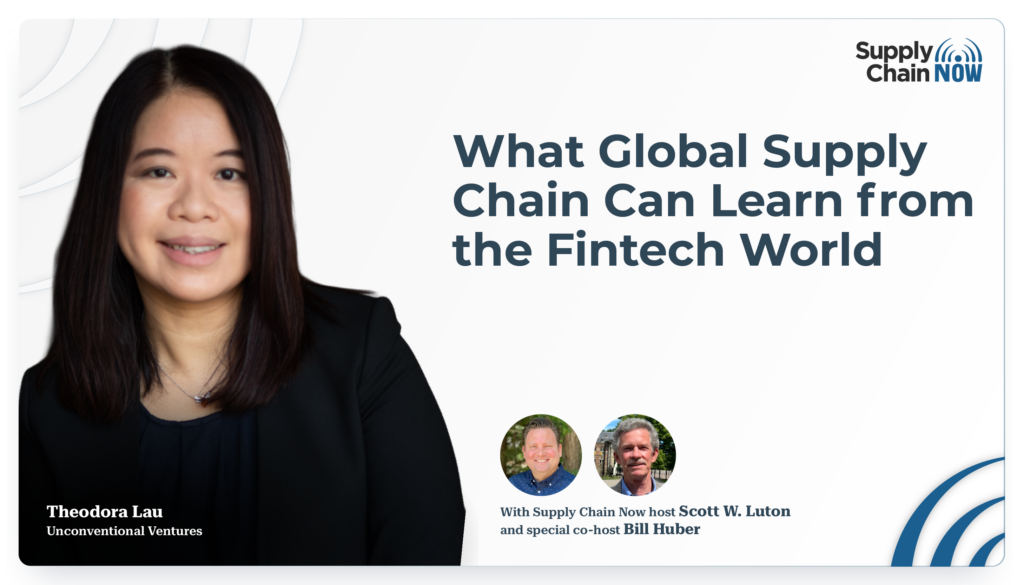
[00:00:00] Theodora Lau: underneath it all is the amount of data. Massive, massive amount of data that’s in, in your phone, in these devices inside of you. I would love to see the next evolution of that is to have some ways to bring all of these data together in a sphere that I can control, is permissioned, and I can say who is interacting with me can have access to this and can do this for me.
[00:00:41] Scott Luton: Hey, good morning, good afternoon, good evening, wherever you may be. Scott Luton and special guest co-host Bill Huber with you here on Supply Chain Now. Welcome to today’s show. Bill, how you doing today?
[00:00:52] Bill Huber: Doing great, Scott. It’s so good to be back with you and, uh, see you and have the opportunity to, uh, collaborate with Theo today
[00:01:00] Scott Luton: mesmo, my friend. I’m really been looking forward to this one. And, uh, Bill, I can’t wait to learn from you and our guest because folks, we got a great show teed up. We’re gonna be talking about all sorts of topics, I think in a, many unique topics here on Supply Chain Now. You know, from what s- global supply chain might learn from the world of fintech to key attributes of those organizations truly moving li- mountains with AI, to the opportunity that fintech innovation poses to supply chain organizations.
[00:01:29] Scott Luton: All that and much, much more. Stay tuned for a fascinating discussion. And Bill, I’m delighted you could stop by and join us again. It’s been too long. I think it’s important that our audience knows though, Bill, you and I were touring the Port of Rotterdam last time I think we were together in person, right?
[00:01:45] Bill Huber: Right. That’s right. Very great, uh, tour with Kenzo from Modus from the, uh, from the Rotterdam, uh, Port Center
[00:01:53] Scott Luton: That’s right. That was an incredible, incredible, uh, almost a full day spent, and I really appreciate your facilitation there. But for our audience, folks, y’all might remember Bill from some earlier shows, uh, but I wanna remind you of his significant background in the C-suite in global supply chain, especially as a CFO, and I look forward to his insights here today.
[00:02:13] Scott Luton: So Bill, it begs the question, are you ready to go, my friend?
[00:02:16] Bill Huber: I am, Scott. It’s, uh, like I say, great to be back together with you, and what a perfect time. I mean, the intersection of everything happening with technology and, you know, be it in finance, be it in, uh, supply chain, be it in general operations, uh, I think we’ll have an exciting day to talk
[00:02:35] Scott Luton: I, I completely agree. So folks, stick around for a great conversation. It’s gonna offer up tons of actual insights by the truckload. Now, as if Bill Huber is not enough, I got another repeat guest and industry dynamo joining us here today as our featured guest. So our guest today is Theodora Lau, founder of Unconventional Ventures and a leading voice at really the intersection of AI, fintech, innovation, and inclusion.
[00:03:02] Scott Luton: In fact, American Banker has named Theo one of the top 20 most influential women in fintech. So Theo is a sought-after speaker, writer, and advisor who works with startups, financial institutions, and business leaders to explore how emerging technology can create meaningful impact for both organizations and people.
[00:03:22] Scott Luton: That’s the most important part, latter part, people. She’s a three-time author, including her latest book, “Banking on Artificial Intelligence.” She’s also the, the host of the popular One Vision podcast. Go check it out wherever you get your podcasts. But regardless, throughout her work, Theo brings an important perspective to the, especially to the AI conversation, not simply what technology can do, but how we can use it responsibly, inclusively, and for good.
[00:03:49] Scott Luton: So I wanna welcome in Theo Lau with Unconventional Ventures. Theo, how you doing today?
[00:03:55] Theodora Lau: Good. Thank you. Thank you for having me again. Nice to see you and nice to meet you, Bill
[00:04:01] Bill Huber: Nice to meet you too
[00:04:03] Scott Luton: Well, you know, I was tickled when we started talking about this, this, uh, your latest appearance here, ’cause it’s been too long for you as well, Theo. And I was thinking about, okay, what, who would be an interesting co-host for this conversation? And then Bill was available, and we got Theo and Bill, two of my favorite people.
[00:04:18] Scott Luton: So let’s dive in. So I wanna start, folks, with the fun warmer question, right? Let’s get to know Theo and Bill a bit better. And Theo, we were talking pre-show, and we found something in common, which oftentimes humans will do when they take the time to, to, uh, you know, peel back layers of the onion. We got more in common than we think.
[00:04:39] Scott Luton: And we found out that not only you and Bill are fellow Legos fans, but Theo, you were started to share kinda how the Legos experience has changed over the years. So tell us more about that
[00:04:52] Theodora Lau: It has indeed. So my fascination, my fascination with, with Lego bricks, um, started when I was young, back when they had the space, the moon sat where with the rockets, the moon station. Um, I remember it was distinctly gray and blue color scheme. And back then, Lego was Lego. Boys and girls play with it. It was Lego.
[00:05:15] Theodora Lau: Fast-forward to, um, you know, let’s say 15-ish years ago when I had my first child and then my second one, I realized, wait a minute, now there are pink Legos and blue Legos. There’s this distinction, which I don’t quite understand, but that’s besides the point. The price point. The price point of the Lego, I would say the audience of who they’re targeting has changed because now you have the little Duplo set, you have the, you know, little sets for the kids.
[00:05:42] Theodora Lau: But majority of the market, if you walk into a Lego store, are these big sets, 200, 300, 400 plus. They’re not for kids, they’re for adults. So, you know, it begs the question, all right, I mean, it’s interesting, but, you know, are, are we taking some of the fun out from children, from childhood, from creativity?
[00:06:04] Scott Luton: That is a great question that we’re gonna have to devote an entire podcast episode to. I think one other thing about LEGO is, before I move over to Bill, Theo, is its foray into the content world and the LEGO movies and just how that’s become a vibrant, uh, component of the LEGO engine, huh?
[00:06:23] Theodora Lau: Mm-hmm. Oh yeah. I mean, the things that they’ve been able to do. So if you ask me if I were to have a dream job, my dream job would be to work for Lego. I wanna go inside, right, and see how they’re thinking about themes, how they create these different products, w- what tools do they use, and, and et cetera, et cetera.
[00:06:42] Theodora Lau: I really wanna know
[00:06:43] Scott Luton: All right. So, uh, LEGO friends out there, we want to bring y’all onto the show so we can talk about supply chain and a whole bunch more that helps power the LEGO experience. Now, Bill, I think you were going to add, before we get to your official fundamental
[00:06:56] Bill Huber: yeah, yeah.
[00:06:56] Scott Luton: To what we’re hearing there from Le- Theo
[00:06:58] Bill Huber: I mean, and again, Theo’s exactly right, and I’ve had the great pleasure of actually having a conference on Billund, the little island that, uh, the Christiansen family, the Danish family had started Lego on. And, uh, so it, it’s quite amazing just to be there. but, uh, to the point about Lego, I think, you know, a lot of things are getting more, uh, personal also in, for example, my university from the Netherlands actually had a industrious student who went out and got the rights to have a little Lego castle done of the university.
[00:07:35] Bill Huber: And it’s Nyenrode Business University in, uh, Breukelen, uh, Breukelen, New York. It’s named after Breukelen. I could spend hours just talking about New Amsterdam, but we won’t. Anyway, uh, the point is, Lego is really getting to, you know, the idea of personalizing things, and I think, uh, Theo had also said that her own high school has, uh, you know, a Lego model.
[00:08:01] Bill Huber: So it’s quite interesting. Very
[00:08:03] Scott Luton: It is. All right, so really quick. We, we, we could nerd out for a couple hours, Theo and Bill, and Lego. Really quick, Bill, you’ve got big news personally. Uh, what’s the latest with the
[00:08:14] Bill Huber: Yeah. Yeah. Well, both of my children had, uh, sort of moved and settled in New York City and, um, both doing extremely well, but we’re very proud to be Opa and Oma for the first time in, uh, July. My daughter had her first baby boy. And so, yeah, um, Felix and, uh, we go up, you know. Of course, we went up that day he was born, just went up immediately, spent a week there, and we’ll go up again, uh, in about two weeks.
[00:08:44] Bill Huber: So, you know, getting up, my, my wife already went back to help, uh, the family. they went to Chicago for a wedding, took the four-week-old baby with them, so Oma went with them, too. But, um, yeah, yeah, they’re, uh, bringing up a real city boy.
[00:09:01] Scott Luton: Uh, that’s awesome. Well, congratulations to the whole family. And again, I can’t tell y’all how, how, uh, really pleased and tickled I am to have Theo and Bill here today on the show. So, Theo, we got a lot of questions for you, and I cannot wait to hear your takes on, on each of these here today. And I wanna start, and I was sharing a little bit about, uh, Bill’s background earlier, but you have got an incredible background as well.
[00:09:27] Scott Luton: And I really wanna start with getting you to share a couple of the key roles that you’ve held in your professional journey, that in particular, they’ve impacted your worldview and your trajectory forward. Tell us more about that, Theo.
[00:09:41] Theodora Lau: I… Thank you for that. I, I like to tell people I didn’t come from banking. I was not born a banker, so don’t hold that against me. But, um, so I spent about 20 years in, in telecom, uh, building things, tearing systems down, building new systems. A lot of work on the infrastructure layers, um, looking at data sets across different systems.
[00:10:02] Theodora Lau: How do we create, um, a unified, um, layer, if you will, where, you know, different, different applications can tap from and build out the customer experience from there on. So that, I would say, influenced a lot of my thinking because there’s a lot of similarity if you look at, you know, telecom versus banking.
[00:10:25] Theodora Lau: You know, they’re both regulated industries. Both has been around forever. Um, there are a lot of legacy systems you need to think about. There’s a lot of constraints that we need to also think about, um, when we talk right now, and I know later on we’re gonna talk about data fragmentation. It was a question and challenge 20-some years ago, and it’s still a challenge right now.
[00:10:47] Theodora Lau: So, you know, I, I draw a lot of parallels from that. but then from there on, I also spent 10 years, looking at financial services and fintech innovation. And what prompted that was my journey right after telecom. I took a role in innovation at a, um, nonprofit, an NGO in, in the US looking squarely at how do we help people live better life as we get older.
[00:11:15] Theodora Lau: And, um, so I learned a lot, uh, from that. I, I think I got a much better appreciation of how we can influence people’s lives with technology and the role that money plays into it, and that was, um, what prompted me to do everything that I’ve been doing for the last decade.
[00:11:34] Scott Luton: Hmm.
[00:11:34] Theodora Lau: Mm-hmm.
[00:11:35] Scott Luton: Theo, there’s so many questions I’ve got just on that unique background of yours. But Bill, uh, from 20 years in telecom to at least 10 years driving innovation in the nonprofit space and, and further exploring how humanity, humanity at all stages can apply technology in a real beneficial, positive way.
[00:11:55] Scott Luton: A pretty in- in-intriguing, unique background. What, what’d you hear there, Bill?
[00:11:59] Bill Huber: Yeah, I, uh, again, what I liked the most was where, uh, Theo said how it impacts people’s lives. Because I think that’s where technology, uh, for all the right reasons, helps companies be more efficient, you know, economic, uh, take disparate systems and meld them together, have always the one truth so that you have clear data sets.
[00:12:24] Bill Huber: But more importantly, it’s how that data is then being used to really, be it consumer-facing or, you know, customer as in within your supply chain. But, uh, it’s that, you know, making people’s lives better, which can be done even just through a more efficient way of ultimately getting a product to your front door
[00:12:46] Scott Luton: Yeah. Well said, Bill. And Thao, one, one little quick follow-up before I move on to the next one, e- especially given all of your time in, uh, leadership and driving change and improvement in telecommunications. You know, you think about the dial tone. Now, some folks watching or listening, they may have never experienced a dial tone moment, so to speak, because so many homes don’t have, you know, traditional phones anymore.
[00:13:11] Scott Luton: But I’ll tell you, from like a reliability, a consistency, and it, it eventually gave way to how all of us that lived through, you know, those decades where it was very common to have a landline in every home, how often did you pick up that receiver and not hear the dial tone, right? We took, we assumed it was always there.
[00:13:32] Scott Luton: It was incredibly reliable. And Thao, do you ever think about, especially given your time in the industry, do you think about what else we wish could be as reliable as dial tone?
[00:13:42] Theodora Lau: Oh, you, you have a great point. I, I don’t think, you know, we just took it for granted, right? You’re home, you pick up the handset. I think the only, the only gripe I would have is Before we had, uh, the ability to actually have call waiting or, you know, you would call someone and all you hear is a busy tone, busy tone.
[00:14:01] Theodora Lau: You’re like, “Really?” Um, and then, you know, they, they created, they invented, invented call waiting where you hear… You can actually jump onto the other line. So, that was like, wow, that was earth-shattering for
[00:14:12] Scott Luton: It was. You’re so true
[00:14:15] Theodora Lau: But, but, but you know, you know what, though? I think, I think that those times, what we didn’t appreciate was we were willing to take time. We… Life was slower. It’s not always about instant gratification. It’s not about… Like, I always tell kids, like, you know, back when I was watching TV, remember, like, I had to sit in front of the TV set. That, that was before recording, right? So, you have to, like, find the time with the TV Guide. You have to sit in front of it, wait patiently for the one time slot your program comes on, and then have to wait another week, God forbid, for the second episode.
[00:14:57] Theodora Lau: But now, kids are like, just, they’re scrolling, scrolling, scrolling, stream, stream, stream. It, it, it’s, it’s, it’s nonstop.
[00:15:03] Scott Luton: it is interesting to think about because so many things have advanced since, since then. But Bill, Theo’s really pulling at my heartstrings thinking of what it was like in the ’80s and ’90s growing up as a kid. Uh, we may have had it better then. I don’t know, Bill, your thoughts?
[00:15:19] Bill Huber: Oh, you know, better in the sense of perhaps less dependence on the technology today. Example, very quickly, I got a new iPhone yesterday. I mean, sit them next to each other, everything transfers. But then I go to my banking app, I go to my Amex app, I go to my other app. You got to re-set up all the face ID, you know.
[00:15:45] Bill Huber: Uh, it’s just like, I wanted this to happen right away. So yes, it was simpler back then when, you know, y- you didn’t have these dependencies. Think about it. If we lose our cellphone today, if it drops in the water, it’s he- it’s, it’s absolute, you know, almost the end of the day
[00:16:06] Theodora Lau: I will die.
[00:16:07] Bill Huber: back, back then, I lost a bicycle.
[00:16:09] Bill Huber: You know, you walk home, you tell Dad, “I, my bicycle’s gone. I don’t know. I don’t think I parked it somewhere else, but I lost my bike.” You know? Okay, you got a new bike. But it… You lose a phone today, everything. Oh, everything’s there. I mean, I can’t get on Delta Airlines without my iPhone, you know?
[00:16:28] Scott Luton: Well, you know, one, one last thing you said there. Uh, I, I could dwell on both y’all’s responses, but Theo, I loved what you were kind of implying is that we were perfectly okay back in the day that you’re describing, right? I was a kid in the ’80s and ’90s. We missed things. We missed some calls because we didn’t have call waiting.
[00:16:46] Scott Luton: We missed some shows because largely the VCR and figuring out how to program it was rocket science, and that was okay. And, you know, nowadays, what both of y’all are kind of talking about is, man, we’ve got to be in constant consumption mode of everything, and we got everything at our fingertips. You know, not sure if we’re better or not, but we’re not gonna solve that today.
[00:17:09] Scott Luton: But Theo, I want to move on ’cause I want to, I want to dive a little deeper into your worldview that you were starting to share with us, right? Starting with your background and, and, and some of what we were reminiscing about. So you’ve spent a lot of time studying, researching, but also driving change and adding your leadership voice at the intersection of fintech, AI, gender equity, um, uh, inclusion, and a whole bunch more.
[00:17:35] Scott Luton: Big intersection. And so when you look at the global business landscape right now, I’m curious, this is not a fair question because there’s a longer list of things, but if you were to pick one development that’s got your attention, but it doesn’t have enough attention from, you know, business leaders and the movers and shakers out there, what comes to mind, Theo?
[00:17:56] Theodora Lau: Ooh. A lot. The long– The list is long, but I would say most on topic and, and what I’ve been obsessed with the last year is the topic of trust. Trust in the sense of when, when we see certain technology or we use certain technology, do we trust it or does trust drive adoption? So I’ll, I’ll give you an example.
[00:18:23] Theodora Lau: I think since last, I wanted to say since at least a year and a half ago, there have been a few reports have come out that track how people from different demographics, different countries are using technology. Do they trust the use of AI in their daily lives? Do they trust the use of AI in businesses?
[00:18:45] Theodora Lau: And what’s been fascinating to watch is countries in Asia, for example, Indonesia and China, or in LATAM or in Brazil, the degree of trust in AI is like in the 60-some percent, in the 70-some percent. Whereas when you zoom over and look at the United States, it’s in the 30-some percent. It, it’s like half, right?
[00:19:12] Theodora Lau: And when I first came across a report like that, I’m like, “Wow, that, this was interesting.” And then different reports have been produced since then, for the last year and a half I’ve been tracking, produced by different companies, uh, in, you know, from different countries, and they all track similarly, is that trust in AI is much higher in certain countries versus the US.
[00:19:36] Theodora Lau: US is almost like you see, you know, if you look at the headlines, right? You see people opposing the, um, data centers. People don’t want AI to be used in schools. People don’t want AI to be used in, in businesses. There’s almost this resentment, if you will, um, or is that fear, right? That leads to the lack of trust.
[00:19:57] Theodora Lau: And so that topic, I, I think it’s important to talk about, not to be dismissed, because that drives what is going to happen not just in the business world, but also in society.
[00:20:07] Scott Luton: Yep. Theo, Bill, that, that is a, um, that needs its own series,
[00:20:13] Bill Huber: It does
[00:20:14] Scott Luton: to explore that. What, what’s your reaction to that, Bill?
[00:20:17] Bill Huber: Well, uh, again, I think it’s fascinating as we identify AI adoption, uh, around the world. But it’s not even just AI. Let’s just go back 10 years. It’s the technology adoption of, you know, online banking and all of the, uh, you know, the European Union, of course, has GDPR, and all of the data, personal information is so protected that it actually drives a higher trust, but actually lower adoption sometimes.
[00:20:50] Bill Huber: Um, you know, I could talk about my family over there, you know, who don’t even use the typical, um, SparkCard. What is that? Uh, like a Kroger or a Publix, um,
[00:21:02] Scott Luton: Like a bonus card or
[00:21:03] Bill Huber: bonus card. Exactly. The bonus cards. Because they don’t want their data tracked. And I’m like: Are you kidding? I get 20% off the next time I buy one because I use the card.
[00:21:12] Bill Huber: So of course, I use it all the time. But the point is, the different adoption levels to me are also a relationship to where countries are with governance around new technology. So it’s back to GDPR, very strong governance. Um, today, uh, the AI Act in Europe actually is mandating that boards come out in their, you know, in their guide- in their annual reports and literally state that they have full trust in the validity of what AI is being used for.
[00:21:52] Bill Huber: And so this is where I think, and again, you’re right, I’d love to have another conversation with Thao just on this, that in the US, we seem to be wanting to push things out very quickly. We also have very, very competitive landscape with between the hyperscalers and, you know, the, the platforms. And then, you know, it, it is back to a matter of trust.
[00:22:15] Bill Huber: If it’s not your entire in-house platform, how reliant is the AI decision drivers for the decision-makers? Because the decision-makers still have to be the humans, the executives, the managers, and yet they’re depending on this, you know, very integrated network of, you know, where does the data reside? What model is actually being used?
[00:22:42] Bill Huber: Is… Are they in control of what other competitive data is going into that model? And so I think it’s, it, it reduces the trust, to Thao’s point
[00:22:53] Scott Luton: Well, so let me pick up on that. And I think Bill just gave us a podcast, Theo. Uh, I want to pick up on that. So Theo, you think, I’m glad he, he, he brought the regulatory measures that we’re seeing in other parts of the world, ’cause there’s all sorts of takes on that. Theo, do you think that if we… And, and there are certain states that are developing a, uh, AI regulatory measures, right?
[00:23:15] Scott Luton: But we, we still, I don’t think we’ve really seen a, um, a, a nationwide, um, uh, leg- set of legislation get passed. Do you think– H- how does that factor into, you think, the trust levels or the fear levels, depending on how you look at it, um, across the world when it comes to AI, you think?
[00:23:32] Theodora Lau: Ooh, that, that’s a multi, multi, multi-layer answer. couple of things, right? You’re absolutely correct. There are different states that are coming up with their own regulation. It’s a result of because of a lot of lack of federal oversight, right? So we don’t really have on a federal level says, you know, “Here’s what you can do, cannot do, and here’s who’s going to be held accountable or not.”
[00:23:55] Theodora Lau: And because of the lack of that, different states are coming up with their own regulation, which I, and I don’t. Um, I like that there is something, but then the problem is now you’re creating a cheesecloth with a bunch of different versions and variations of regulations. If you think about from a, um, provider perspective, it’s really hard to, you know, figure out what exactly can I provide and what is going to get me into trouble.
[00:24:22] Theodora Lau: And so that increases the burden on compliance perspective. That is not ideal. Um, I do think that part of the challenges that we see right now in the United States specifically on pushing back on AI is multi things. One is we keep seeing on the, on the headline news, you know, every other day some big tech CEO come out and say, “Well, you know, AI’s gonna take over the world.
[00:24:48] Theodora Lau: Well, this is gonna be doomed, this is gonna be bad, and this is why you should only trust me.” I think a lot of that is self-serving because a lot of these companies are coming up with their own IPO. So of course, you know, there’s a little bit of an undercurrent to exactly what they’re saying, why they’re saying.
[00:25:03] Theodora Lau: But if you are, as a consumer, if you are as a small business owner, you’re sitting there, this is all you can see is this is bad, this is bad, this is bad, this is bad. And by the way, they keep laying off people and there’s no safety net to catch the people, then of course we’re gonna feel freaked out. I mean, this is normal human reaction.
[00:25:23] Theodora Lau: Um, if you have a sort of a, a, a framework built to your point in the EU AI Act or some sort of accountability that know, A, there is a social, social safety nets that will catch you. You won’t just get laid off for no reason. Um, there are programs to retrain, to help you, to support you, and by the way, we are going to hold the bad actors accountable.
[00:25:47] Theodora Lau: I think that will go a long way in fostering trust.
[00:25:50] Scott Luton: I heard a lot of pragmatism, if I said that right, Thea. A lot, I heard a lot of practicality in your response there. And, uh, Bill, quick reaction before I move forward with Thea, quick reaction to what she’s describing there
[00:26:03] Bill Huber: I, I totally agree. Everything she said, it is really about having solutions that are, A, to your word, pragmatic. But, you know, I, I still reflect on back in the days when we were taking all these disparate systems and bringing them together in one and really implementing the best technology, we were also facing redundancies.
[00:26:26] Bill Huber: But what we did is we took people and did retraining. We made people, you know, more business partners than they were the old, you know, pencil pushers. And, uh, you know, no disrespect whatsoever to all the roles that people played. I think this is what’s gonna happen again going forward, but it’s very early.
[00:26:47] Bill Huber: And to Theo’s point, it is, you know, one, uh, threat message after the other, whether it’s, you know, uh, uh, Anthropic that’s gone out and found out that its own,
[00:27:04] Scott Luton: Right
[00:27:04] Bill Huber: you know, AI has done something quite devious, and yet they caught it. Well, what have they not caught? There’s the, there’s the question.
[00:27:11] Scott Luton: That, and that opened, that, that’s, uh, that’s good old Pandora’s box, uh, for this podcast conversation here today. There’s so much, so, so many off-ramps we could take. Uh, but Theo and Bill, man. Uh, so let’s do this. Theo, I’m gonna continue on and ask this next, next question because when you look outside, you know, banking and fintech, or even telecommunications where you spent so much time, and you look at industries such as manufacturing, where Bill spent a bunch of his time, I, I did as well, uh, logistics, global supply chain, which, which the way I use that term is it’s very inclusive and holistic of all these other sectors, right?
[00:27:49] Scott Luton: Everything is a supply chain. But what do you, what innova- innovative lessons do you think that these industries, supply chain, manufacturing, the like, could steal, in a good way, uh, from fintech, whether they’re good lessons or bad lessons? Your thoughts, Theo
[00:28:04] Theodora Lau: I, I think I’m going to, um, borrow some of the thoughts that Bill just said, is about, you know, building systems, the silos, and all of that, right? Uh, in the last, you know, few years, we’ve seen a lot of movement around open API, around open banking, making sure that we can find ways to get data across each other, to share it, to be interoperable.
[00:28:28] Theodora Lau: Um, I think that was, that was a great thing. It’s a beautiful thing. I know that, you know, in the US, 1033 is, is real- right, quite, quite right there yet. But in a lot of places, right, open banking is a thing, and it keeps evolving into open finance, open data, giving consumers more control of the data, giving them more ways of using the data, giving the FIs and the fintechs more ways to work together.
[00:28:51] Theodora Lau: And I think that regulation is, is, is good because it gives you access to things that you own, and it gives parties an ability to create and innovate and create solutions that will work for people. So that, that is a great, great thing. Um, knowing how to bring data standards together instead of, you know, um, doing point solutions, doing the very painful, boring bits, I call it, um, the hard work of, of having a, um, a shared structured dataset that, that is standard.
[00:29:28] Theodora Lau: That was a good thing also. So those are things I think, um, is good learning and good things that I love about our industry. Um, the not so good . The, the not so good things is, um, just how you can use data and, and draw insights and figure out how you can create better solutions for people. You can use it to also exploit people, right?
[00:29:55] Theodora Lau: The, the likes of buy now, pay later, for example. You know, one hand you can call it, you know, giving frictionless credit to people who otherwise don’t have it. The other side of is I’m looking at my teenagers, like, just, just easier for them to get things without thinking if it’s actually something they should get, if it’s something that’s affordable.
[00:30:15] Theodora Lau: Um, so innovation, yes. But innovation on the intent, um, I think that, that’s sometimes we need a little bit of reflecting on who exactly are we helping. Are we helping our own bottom line? Are we actually doing good for consumers?
[00:30:32] Scott Luton: Yes. All right, Bill, I can’t wait to hear your reaction to the good and the bad that Theo just shared there
[00:30:38] Bill Huber: Well, a-again, I think it’s, um, clear that there have been technology advances in other industries and the slower to adopt and, and manufacturing because it’s so, you know, human intense. I mean, it’s truly labor intense in so many ways. Uh, it’s been slower to move. But what we’ve seen is, again, say the back office, that’s where things really evolve first.
[00:31:05] Bill Huber: And then, you know, the marketing side, the consumer side also, you know, using, uh, agentic for just so many things, whether it’s, you know, uh, consumer ads no longer are really using an individual that had to be paid, but they’re using a, um, you know, AI-generated, uh, individual. And, and that’s okay. I mean, that’s fine.
[00:31:28] Bill Huber: but what I see is happening now more rapidly, and again, I retired a few years ago, but I… it was already happening. I know it’s still happening in manufacturing, that you really have a lot more of the autonomous robot capabilities. And that actually brings in a safety feature that so many big corporation manufacturers had the biggest problem with in the past, and that was all of the, um, you know, the, the claims for, uh, workman’s comp.
[00:31:58] Bill Huber: I
[00:31:58] Scott Luton: Mm.
[00:31:59] Bill Huber: You know, your autonomous robot screwing something in a million times a day never, never gets that arthritic, you know, problem that has to be, uh, you know, five years on workers’ comp. I mean, it’s just… Sorry, but those are bottom-line things. But it is actually still, you know, humanistic in that you’re able to save people from those problems.
[00:32:26] Bill Huber: And, and again, I think, you know, we’ll see how things work out. But I do think cross-training is going to become an industry of itself, in itself. You know, really getting people better trained to be able to do things that previously were all just so very human labor-intensive
[00:32:49] Scott Luton: Hmm. You know, uh, uh, I wanna piggyback a bit on what Bill is sharing, and Tye, and go back to the good side of what you were sharing, especially as it relates to open or, or, um, you said open banking, but I kind of was hearing you kind of s- uh, touch on mobile banking as well, and of course, the, the data standards.
[00:33:08] Scott Luton: Uh, because I think global supply chain, especially as we continue to try to find new ways of applying modern technology, we’re gonna draw heavily on what the banking world… Despite Bill’s, he was talking about earlier as he got a new iPhone, and then he had all those updates. Still, on the whole though, I think the ability we have, especially in certain places in the globe, t-to do everything and then some m-m-, uh, mobile banking-wise, I think there’s tons and tons of applications for supply chain there.
[00:33:39] Scott Luton: And from a data standardization and, and protocol creation, I’ll call it, uh, standpoint, I think we’ve got a lot more work to do, uh, especially to get past the, the point systems I think both of y’all referenced, uh, so that we can optimize the interoperability. And not necessarily to take more and more humans out, although in every industrial revolution, and we know jobs are lost, jobs are created, but to get more platforms, apps, bots, you name it, being able to communicate with each other.
[00:34:12] Scott Luton: I mean, imagine that. Humans have a hard time communicating with each other. Well, machines, machines are, are displaying some, some traits of their creators perhaps. Uh, but Tye, react really quick to what me and Bill shared, and then I’m gonna move on to, uh, more AI
[00:34:28] Theodora Lau: Yeah. A, um, think about the world that we had before we had the iPhone, right? So before we had the iPhone, when you actually had to, um, I, I still remember this vividly. I had spent a lot of time in, in Manhattan, um, on projects and Friday afternoon trying to get a ride to the airport. Oh my God. And especially when it rains, me trying to get on the street and get a car, yes, five foot, that never worked.
[00:35:00] Theodora Lau: It was painful, right? So with iPhone, then came the new industries, right? Came the, the, the, uh, ride hailing industries. That was, oh my God, amazing, right? You can just get a ride. You don’t have to stand in the rain to try to get f**ked down a taxi cab who yell at you because no one wants to go to JFK on a Friday afternoon.
[00:35:23] Theodora Lau: That, it was life-changing. It was amazing. And along with that, um, you know, Scott, you mentioned m- mobile banking, being able to pay people as you go wherever you are, being able to get allowances to the kids, being able to split a bill, being able to pay a bill when you’re on the road remembering, “Oh, rats, you know, my Amex bill is due.”
[00:35:42] Theodora Lau: All of these things is amazing and it’s great, and underlying underneath it all is the amount of data. Massive, massive amount of data that’s in, in your phone, in these devices inside of you. I would love to see the next evolution of that is to have some ways to bring all of these data together in a sphere that I can control, is permissioned, and I can say who is interacting with me can have access to this and can do this for me.
[00:36:14] Theodora Lau: Instead of now all of these app companies, they’re all taking, I don’t know, whatever it is that they wanna do with my data and to what it is they wanna do, right? Um, there was a recent, I believe, a court hearing that talked about how Uber is actively monitoring the, um, battery level of your phones, knowing that if you deplete it to like a really, really low level, chances are they can price gouge you and raise your price because you need a ride.
[00:36:45] Theodora Lau: Things like that. Like, I would love for the data to work for me, not for the, you know, service provider
[00:36:53] Scott Luton: That’s a great example. I mean, think of hurricane season, which, you know, uh, we’ve fortunately, knock on wood, it’s been, um, milder, at least in the, in, in, uh, the US. Think of all the talk every time Bill and, and Theo gener- the price of generators or bottled water and, and a lot of the gouging, um, um, um, allegations.
[00:37:14] Scott Luton: Theo, you’re talking about something very, very similar. In times of need, does the price go up? Does the price go down? Are people taking advantage?
[00:37:20] Theodora Lau: Mm-hmm
[00:37:21] Scott Luton: So many things to, to, uh, take into consideration in terms of what we can expect, especially as consumers, as we move deeper and deeper into the technology era.
[00:37:30] Scott Luton: All right, so for the sake of time, Bill and Theo, y’all are making my brains work too hard, both of y’all. Um, so let’s do this. Let’s talk a little more AI, because AI is key, is we’re being bombarded, uh, both personally, uh, as business leaders, from solution providers, you name it. Uh, Lara Cesari joined me, um, uh, here recently, and what she loves to do when then, whenever anyone asks her about AI, she asks the person to define what you mean by AI, and I thought that was a really good, um, step to take.
[00:38:05] Scott Luton: But let me ask you this. Theo, from your purview and your work and, um, uh, how you got your finger on the pulse, what is one thing that separates those organizations that genuine, truly are transforming with AI, moving mountains, versus those that are just adding AI, I’ll call it, as yet one more initiative?
[00:38:27] Scott Luton: What’s, what, what separates the two?
[00:38:29] Theodora Lau: I think the ones that, um the ones that, that’s more performative is a bad word. Bolting on, I think, I think is the more eloquent way of saying it. Uh, is you don’t look at the, the, the ones that, that just bolted on, is you keep the process, whatever it is. Things are broken, the data might not be perfect, and you slap AI on it and hoping that things will move faster.
[00:38:52] Theodora Lau: And then you step back three months later and wonder why things didn’t change. Um, those types is, you know, if you… I always tell people, if you automate something that’s broken, you are just automating the bad things faster. You’re not fixing anything. Um, right? So the ones that actually make it work, that can make it work, is look at how things are supposed to be.
[00:39:14] Theodora Lau: Fix your process. Bring the data together. Bring the people together, the culture, e- et cetera. Everything that you need to make that work. And then look at what is my outcome? What, w- what am, what am I trying to do, right? And then use technology, apply on it, and, and make it better. That, that’s where I see genuine change.
[00:39:34] Theodora Lau: Um, the one thing I always laugh is, you know, like how couple of months ago people were saying, “Well, you know, we gotta measure how people are using AI in terms of how many tokens they’re using. If they’re using more tokens, then they must be doing the real work.” What happen after when the bill comes? Oops, that might not be the best way of doing it.
[00:39:53] Theodora Lau: So there you have it
[00:39:54] Scott Luton: So Bill, react to that. One of the things I heard there is outcomes first and a targeted application, making sure we’re using the right tools, uh, with the right problem. But what’d you hear? And your thoughts, Bill
[00:40:06] Bill Huber: Well, A, Theo is spot on. You know, you can’t, uh, automate a bad process. You have to literally do the fit-gap analysis. You’ve got to figure out, uh, what is it that you want as the end state. So I’m gonna go all the way back to, you know, within AI, it’s every AI project has to truly have an anticipated outcome, return on investment.
[00:40:34] Bill Huber: What is it? If they just throw money at a problem, they’re not gonna get the return because they’ve never really set forward what it is they want to have as a return. And I think one of the key things today, and I read a lot about it, I have a, a very good colleague, uh, from the university in the Netherlands who’s written quite a bit about both the AI governance and the AI boardroom and the AI war room, but it’s truly about understanding, are you making a company AI-ready before you’re actually making the executive decision ready?
[00:41:12] Bill Huber: And so I sort of alluded to it earlier, but the point is, you know, AI shouldn’t be that end-all be-all, it’s made a decision, let’s go do it. It still is judgment on the, you know, the operators, the people who truly know and run the business, um, you know, in any vertical. And so I think, you know, a-again, to Theo’s point, you just, you can’t it and it’s going to be the end-all be-all solution
[00:41:45] Scott Luton: Yep. You know, Bill and Theo, I, uh, enjoyed a recent, uh, webinar conversation with some folks from DataRobot, and one of the points that they had made was as we evaluate where humans need to stay involved, uh, in processes and what we can, uh, truly make autonomous, uh, and I was trying… I, I’m not remember all the, uh, their short list of, of characteristics, but one of them is if it’s not reversible, we might wanna keep humans in the loop.
[00:42:16] Scott Luton: Uh, but anyway, so Theo, um, we’ve been talking a little bit today about the, some of the differences between some of these industries and sectors, but, you know, there is one… There’s, there’s a lot in common really, if you think of banking and supply chain and, and these various, uh, sub-sectors, is that legacy technology and fragmented or bad data, it is a universal problem almost no matter what industry you’re in.
[00:42:47] Scott Luton: So I wanna ask you this. This goes, kind of touches on some of the things that you and Bill both touched on in your last response. Can AI really overcome, especially all that fragmented data? Can we do good things with bad data, or are, do you find companies are truly underestimating the foundational, the hard work they still gotta do to get the biggest return out of this golden age of technology that we’re in?
[00:43:13] Theodora Lau: I would differentiate between bad data and fragmented data. So fragmented data doesn’t al- is, isn’t always bad, but bad data is, is bad. AI can’t fix your bad data. Um, you have to do the hard work. Uh, fragmented data, on the other hand, AI can help with that. It can help orchestrate, you know, different data, you know, unstructured mess, if you will.
[00:43:35] Theodora Lau: You know, you have things as in emails, you have things in PDF formats, you have things in text, you have every- everywhere. It’s like a spaghetti, and you can bring that together. So AI can do the orchestration part. Um, I, I think there is also the, the other part that, that’s challenging, and I think it’s, it’s across all industry, right?
[00:43:53] Theodora Lau: In banking, we have the core. In banks, they can have one core provider, they can have multiple core providers. Getting that data from all of the partners that you cannot control, that part is hard. And, and that AI can help, but it’s more than a AI problem. Um, and, and I, and I fear that we are continuing to work, walk in that direction, and AI or not.
[00:44:19] Theodora Lau: Um, you know, a, a great example recently in the last, um, half year, we’ve seen three major banking core providers all coming out with their own announcements says, “Oh, you know, we’re gonna be providing AI capabilities to, to our, um, credit unions and, and community banks that are banking with us.” Then the question become, okay, so if each one of these core provider have some sort of AI capability and you’re a downstream taking all of that, A, you are still, at the end of the day, at the mercy of that core provider providing you the capability.
[00:44:56] Theodora Lau: And B, now it adds a whole bunch of question exactly what are these capabilities and who are these different providers providing and how we can bring them back together. AI can’t fix that. Um, so I, I think at the end of the day, it’s a fundamental infrastructure problem. You still need to sit down and do the hard work, draw the spaghetti out, and figure out exactly what is the right way to do it
[00:45:18] Scott Luton: Well said, and you made me hungry with a little spaghetti reference at the end. All right. So Bill,
[00:45:24] Bill Huber: that time
[00:45:25] Scott Luton: I tend to agree with, with, uh, Theo, um, and then she makes a great distinction between fragmented and bad data as well. What, what’d you hear, your response, Bill?
[00:45:34] Bill Huber: And again, I think it was at the very end where we– Theo really was saying, you know, it’s about the organization. It’s the ecosystem. You know? Where is the data residing? Uh, back to my point earlier, if you have multiple, uh, platforms where the data is and you own the model, you still have to understand how to trust the data coming together into your, you know, internal systems from this larger ecosystem.
[00:46:06] Bill Huber: And I think that’s where it’s very interesting that the EU, uh, AI Act has literally mandated that the boards will be able to certify that they trust that outcome. And, and i-it’s all back to, you know, where’s the decision being made? But, um, the last thing in the world we wanna see is suddenly a lot of, you know, huge corporate litigation, uh, you know, consumer fraud cases and other things because the data was to the very first point of Theo’s comments, bad data, and they relied on it
[00:46:39] Scott Luton: Man, um, really quick aside, we, we, we’ve spent a lot of, a lot of, um, a big theme today has been about data. Did y’all see the recent news? Now, by the time this podcast gets published, it might be, be a couple months back, but I think it was Google that outbid others on buying all the data, the whole enchilada, from a now-defunct airline.
[00:47:05] Scott Luton: And I think the airline was, was about a $6 billion organization, and, and Google had, had acquired all the data, the workflows, you name it. Have you seen this, Theo?
[00:47:14] Theodora Lau: Yeah.
[00:47:15] Bill Huber: I missed it.
[00:47:17] Theodora Lau: I missed that
[00:47:18] Scott Luton: Well, uh, well, in that case, we’ll, we’ll, uh,
[00:47:21] Bill Huber: in the akin, akin times, and I don’t, I don’t catch the akin times
[00:47:26] Scott Luton: in that case, we’ll analyze it on the next podcast, but it’s fascinating. Y’all, y’all gotta check that out. Um, all right. So for the sake of time, Theo, let’s talk about, uh, some of these projects that you have been, uh, driving and that, uh, you’ve got a lot of folks that have enjoyed your now three published books and, of course, the podcast that we re-referenced earlier.
[00:47:50] Scott Luton: I wanna start with the, the three books, right, Theo? The latest one, uh, was, I think I, I, I shared it earlier. It is “Banking on Artificial Intelligence,” and I’ve made it through the first couple chapters, Theo. I’m, I’m, I’ve gotta take it slow because, you know, I’m, I’m a little bit slow on the uptake, as a, a dear friend used to say.
[00:48:11] Scott Luton: But let me ask you this: Since your very first book, right, um, has there been a development in industry that, uh, especially related to technology, that has caused you to reconsider one of your core beliefs?
[00:48:30] Theodora Lau: that’s a… It’s a tough one. I think I, I, I flip back and forth on a, on a couple of things. Um, so one is, one is what we touched on earlier in the beginning is around adoption and trust, um, and alongside with that, friction and control. So it, it’s, it is super interesting when you look at all of the different fintech apps that’s, you know, been made available in the last decade, um, the different capabilities that banks have extended to users.
[00:49:01] Theodora Lau: And now, you know, with the Frontier AI labs, you know, giving, you know, the ChatGPTs of the world, the Claude, the Perplexity, and all of those things, and consumers actually having access to those tools. And for the first time, they can play with it. They can see what happens to it and the outcome. Um, I, I think that was fascinating.
[00:49:19] Theodora Lau: For the longest time, I always thought, you know, consumers, they want, um, more control of things, which I think is still true for the most part. But the more… I see more and more of these tools, I think what we need and want more is, is less friction. Um, not no friction. Some friction is good. Um, but having less friction, the ability to, to not just control who can have access to our data, but to be able to delegate the things that is…
[00:49:54] Theodora Lau: We don’t wanna do. For example, you know, keep going to, um, the grocery store and refilling the same thing every other week that I know we always have to get. Um, those decisions that, that is mundane, I would like for some- something, someone to, to do that for me. Um, but at the same time, I still want control.
[00:50:14] Theodora Lau: So I wouldn’t say it’s completely changing what I am thinking or reverting what I’m thinking, but it is getting me deeper into what, um, the layers of onion, if you will.
[00:50:26] Scott Luton: Mm. And that’s a Vidalia onion. Uh, the, the best onion out there right here, found here right in Georgia. Uh, kidding aside, the, um, one, one of the points she made there, Bill, that, um, I think is really important is not eliminating all friction, not eliminating all tension. Folks, we can’t drive improvement and transformation and, and, uh, change how work is done, uh, for the, for the better without little bit of the right friction and tension and, and, um, and heartburn, right?
[00:50:58] Scott Luton: That’s a really important point you made there, Thao. But Bill, uh, when you think of as she was kind of reflecting on, uh, her core beliefs and reflecting on, you know, as times have continued to change, uh, your thoughts, Bill
[00:51:12] Bill Huber: Well, again, I think, um, to your point, you know, friction’s really important because it’s the world of debate that, you know, really makes a corporation also, you know, and a family, frankly, you know, have better outcomes perhaps in that they’ve thought through problems. Um, a-as far as, you know, I go back to the adoption and trust being so important because we’re now literally facing a, I mean, a technology that, uh, 20 years ago, I mean, yes, you had some sort of automation going on, but never this idea that this, you know, AI agentic can really write script.
[00:51:56] Bill Huber: That you’ve got these, uh, avatars that, I mean, today on Squawk Box it was great to see. I don’t know if you watch it, but Becky Quick and, you know, um, they literally had an avatar of her. And I mean, they trained it in no time to speak exactly like her, to know the names of her co-hosts, to know when they started with, you know, CNBC.
[00:52:19] Bill Huber: And I mean, it’s just, it’s just the data’s out there. And so, you know, somebody asked a question to the avatars, literally that AI agent in a, a nanosecond found the data.
[00:52:29] Bill Huber: to me, that’s where it comes down to, uh, the adoption and trust also in, you know, having to have a bit of, uh, professional skepticism in everything we hear, see, and do.
[00:52:43] Bill Huber: And if it, you know, if I get a how many emails do we get a day, guys, or text messages that say, um, “Your bill’s unpaid.” I never, I never bought from you guys, you know? So just
[00:52:55] Scott Luton: And who is this?
[00:52:57] Bill Huber: And block the sender. Block the sender. But
[00:53:00] Scott Luton: you know, it is a, I tell you, what you just, a couple things you just shared there reminds me once again for the millionth time how exciting of a time it is right now to be living at this moment, right, on the blue marble. But at the same time, time, how, how equally as terrifying it can be, right?
[00:53:19] Scott Luton: The wrong message to the wrong text, uh, wrong response to the wrong text, uh, no telling what, you know, the wrong click, the path it leads you down to. Uh, the, um, when you’re going back to the content of the show and how we’re able to create, um, you know, lean on technology to create content and perspectives and opinions and conversations that, uh, can inform or misinform folks.
[00:53:43] Scott Luton: It really is a, uh, an interesting time. All right. So Theo, we’re not gonna let you get off just by talking about your books, which by the way, I’ve got, I think I’ve got all three of them, uh, on my, on my bookshelf, and I think you’ve autographed at least one of them, Theo. I gotta get you on the other two. Um, let’s talk about your podcast.
[00:54:02] Scott Luton: You’ve had countless conversations on the “One Vision” podcast. What is one conversation that you’ve had that has fundamentally, fundamentally changed the way you think about technology or leadership?
[00:54:16] Theodora Lau: Um, oof. Scott, you ask really, uh, hard questions. Um, so I would say one One huge one, and I’ll tell you why it was important. Um, it was, it was an episode that I had with, um, three of, three of my industry friends on the show. We were doing a mid-year recap. Um, and it was Tiffany from eMarketer, it was, um, Julie Munn from Finovate, and, um, Jennifer from, um, JD Powers.
[00:54:52] Theodora Lau: And why that particular show was, was important was because Jennifer White, she came to the show and, and she shared a number, and that number was 53%. As according to JD Power back then, couple months ago, um, one of their surveys, 53% of consumers have used at least one of the, um, AI tools that’s, uh, generally available to ask a financial question.
[00:55:21] Theodora Lau: That stat was important because for, you know, ever since ChatGPT came out, you know, back a few years ago, we were joking, you know, “Oh yeah, you know, this is silly. You can create a, you know, a, a, a picture of yourself, you know, with three hands and, you know, like an anime version of you.” People use it to, um, write emails, marketing campaigns, and, you know, and, and that has since evolved.
[00:55:47] Theodora Lau: But we always thought for the longest time, the area where consumers go ask financial questions, right? You know, “What can I do with, with, you know, the money that I have? How can I, um, you know, reduce my exposure? How can I improve credit score?” Those things we always thought that’s the Holy Grail. That’s…
[00:56:07] Theodora Lau: You always go to your banker, you go to a finance site, or you go ask your close friends, right? But now consumers are apparently going to these tools that don’t have context on their financial outcome, their wellbeing, who they bank with, et cetera. They just ask and they take the answers. And that, that was…
[00:56:30] Theodora Lau: It, to me, it was shocking on multiple level. One is, wow, if only they know where some of these, quote-unquote, “answers” are sourced from. A lot of this from Reddit. Would you go to Reddit and ask a finance question? I won’t. Um, but they dress it up and wrap it up and make it look s- so plausible and so professional, and consumers grav- gravitate to it.
[00:56:54] Theodora Lau: And so the question then become, why do they use these tools? Why don’t they go to the channels that, you know, should be more believable? Um, and B, what does that mean to us in the industry? Are we get- getting a little bit further from consumers? Are we losing the insights of, you know, their lives and what they’re thinking about, what they wanna do?
[00:57:16] Theodora Lau: And more importantly, how should we respond?
[00:57:19] Scott Luton: Hmm. All right, Bill, um, your thoughts
[00:57:24] Bill Huber: Yeah. Lot to unpack there, but I’ll summarize it in those few words, very famous in our day and age, trust and verify. And quite seriously, um, I’ll just use the example of ChatGPT when I was, you know, still working and I thought, “Okay, I’m gonna test how to really use this.” And I asked questions about my own company’s, you know, business, business results. The trash it threw out was unbelievable. And, you know, so it, it taught me very early, you know, wow, this is, this is scary. ‘Cause if I had used that in a board presentation and been caught, you know, with, “Where did this data come from?” “Oh, I just asked ChatGPT.” I probably wouldn’t have stayed much longer. But, um, you know, the thing is, you, you don’t do that.
[00:58:15] Bill Huber: You, you know… A-again, I am probably a novice in comparison to Theo in my use of, you know, ChatGPT, Claude, um, you know, um, but I just don’t need it as much anymore. But of course, I do all the things that, uh, Theo had mentioned. You know, as you get on there and you’re looking up what’s the best, you know, you know, back brace to use if you got a back problem or something.
[00:58:45] Bill Huber: Man, the data it spits out is unbelievable
[00:58:48] Scott Luton: It, Bill, it is. And the point, one of the points y’all both are making that is timeless, but we still, as many of us humans refuse to, um, to practice context is so important. It’s so important. You don’t go to the doctor and you think you’ve got high blood pressure and, uh, the doctor is, um, I don’t know, taking your temperature or giving you an eye chart, right?
[00:59:14] Scott Luton: They di- they, they do a blood test, they learn your whole family history. They do all the holistic, uh, medical, um, evaluation, right? Uh, in that context, that might be a terrible example because I didn’t make it through medical school, but y’all know what I mean. Um, folks, we gotta go, we gotta do the pros. We gotta, um, we gotta make sure, especially these big decisions, oh my gosh, that, that, uh, we’re evaluating them holistically and by using the right criteria.
[00:59:46] Scott Luton: Uh, and of course, with those, uh, trusted pros, Theo, that you mentioned many of them. Um, but hey, humans have been making mistakes with technology for millennium, and we’ll continue to do so. Um, but let’s, b- but you know, Theo, kidding aside, I appreciate voices like yours that are trusted voices that continue to give guidance via written form, social, podcasts, you name it, and of course, all of the work that you do.
[01:00:11] Scott Luton: I wanna make sure folks know how to connect with you, Theo. What’s the, w- how would you suggest they do?
[01:00:17] Theodora Lau: Thank you, first of all, Scott. Always a pleasure to talk to you. Um, they can find me easiest is on LinkedIn. I’m always all, always there all the time, so look me up, Theodora Lau. Um, or on Ven- OneVision podcast. It’s on YouTube and Apple and Spotify, wherever you listen to podcasts
[01:00:34] Scott Luton: Outstanding. And I want to say, I might get this wrong, correct me if I’m wrong, of course, but, uh, your popular newsletter, uh, The Financial Pros. Do I have that right?
[01:00:44] Theodora Lau: Fintech pros,
[01:00:45] Scott Luton: Fintech Pros. I was cl- that close.
[01:00:47] Theodora Lau: It was close
[01:00:48] Scott Luton: Um, outstanding. Well, Theo, always a pleasure. And Bill, really quick, I’m gonna, I’m gonna get your golden takeaway in one second.
[01:00:56] Scott Luton: That’s a, that’s gonna be maybe the toughest question of the day. But how can folks connect with you, Bill Huber?
[01:01:01] Bill Huber: Best way to reach me is through LinkedIn as well, and it’s simply Bill Huber Atlanta. There’s a lot of Bill Hubers out there. I’m not the great artist, I’m not the former linebacker, um, but, uh, yeah. Oh, yeah
[01:01:16] Scott Luton: I’m gonna have to go find, I’m gonna have to ask Chat to, to give me a rundown on all the Bill Hubers out there. Um, but Bill, all that aside, I tell you, we have learned, I, I always feel so much smarter after spending really a conversation with both of y’all. And Theo has given us so much to think about, uh, in this incredible time at 2026, uh, with all the, the progress, but all the regression in some cases that we’re seeing.
[01:01:42] Scott Luton: Um, what is your favorite takeaway from this conversation we’ve had with Theo?
[01:01:48] Bill Huber: Uh, you know, it, it just comes down to the simple, uh, need for governance around AI, and whether it’s a federal or at a state or, you know, maybe some way we end up with a, a regulatory body that’s outside of any of those, but actually industry-centric. And, um, I think that’s what’s going to, again, build the trust, the adoption, remove the fear.
[01:02:19] Bill Huber: But without a really strong governance, um, it’s a challenge
[01:02:24] Scott Luton: Yeah, no doubt. Maybe a, a, it’s not perfectly what you’re suggesting, but a, a digital twin of the United Nations maybe with a little more industry involved. Who knows? Maybe something like that. Um, but nevertheless, I tell you, this could have easily been a six-hour podcast and I had to fight the urge, Theo and Bill, to c- to, to stay focused ’cause I really enjoyed y’all’s perspectives.
[01:02:48] Scott Luton: Uh, but we’re gonna have to leave it here for now. I wanna thank you both starting with, uh, Theodora Lau with Unconventional Ventures and the One Vision podcast. Make sure you go check out her books. Who knows? I’m not gonna let any cats out of the bag, but is there a fourth book around the corner, Theo?
[01:03:04] Scott Luton: Okay. I, I, I figured. I figured. But Theo, thanks for being here, my friend
[01:03:09] Theodora Lau: Thank you so much for having me
[01:03:10] Scott Luton: You bet. Keep doing, uh, fighting the good fight. And Bill Huber, always a pleasure to collaborate with you. I, I tell you, I think, Theo, I think Bill killed it as his first co-host gig here at Supply Chain Now. Do you think, you agree with me, Theo?
[01:03:25] Theodora Lau: That’s amazing. Yes. And we should do this again. When
[01:03:28] Bill Huber: Thoroughly enjoyed it. Absolutely.
[01:03:31] Scott Luton: Bill,
[01:03:31] Bill Huber: More to come, Scott. Thank you to all of the Supply Chain Now team
[01:03:36] Scott Luton: You got it. folks, to our SC and global fam, I hope you enjoyed this conversation. As I promised, this is a, this was a more of a unique conversation than all the ones that are so focused on global supply chain, and I thought it was a, a, a timely and a highly relevant and a consequential conversation. So hope you enjoyed it.
[01:03:53] Scott Luton: But you know the homework. You gotta take one thing you heard here from Theo and Bill. They shared a ton of actual perspective that hopefully makes you think, but also hopefully makes you take action. Share it, do something with it. Deeds not words. That’s how we’re gonna keep transforming the globe and leave no one behind.
[01:04:09] Scott Luton: And with that said, on behalf of the entire team here at Supply Chain Now, Scott Luton challenging you do good, give forward, be the change that’s needed, and we’ll see you next time right back here on Supply Chain Now. Thanks everybody.