[00:00:00] Lora Cecere: There is the belief that if we optimize functional outcomes on cost, that we will lower operating margin, and that is not true. What happens is when we focus on reducing functional cost, we throw the supply chain out of balance because it’s a complex nonlinear system.
[00:00:19] Wael Abdelmalek: a private large language model is a general model, but it’s been put inside a room, a closed room only with, Lora’s content and expertise. So it has nothing else to reference but that, which means that it’s high level of accuracy when it comes to responding
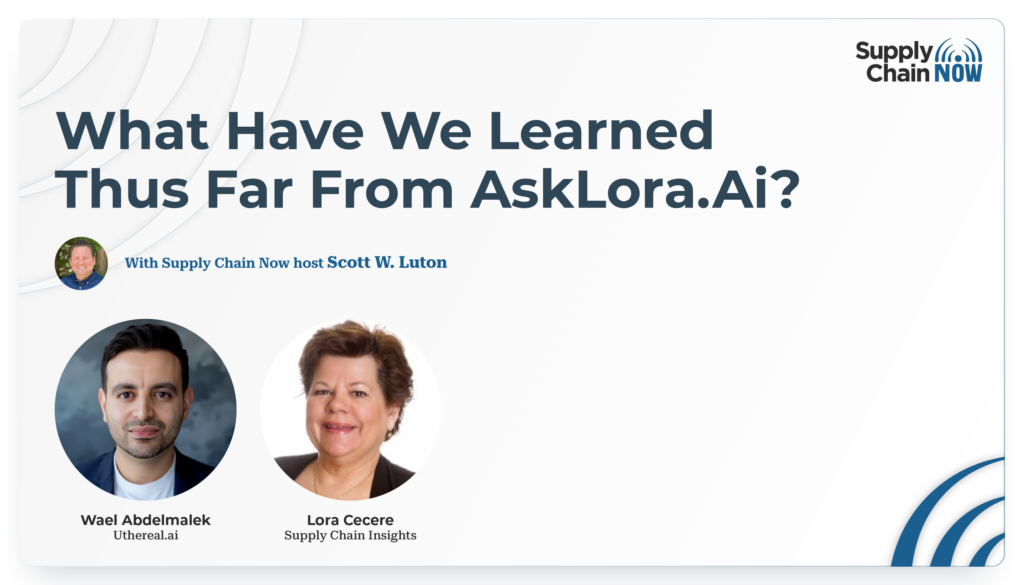
[00:00:52] Scott W. Luton: Hey, good morning, good afternoon, good evening, wherever you may be. Scott Luton and very special guest hosts Lora Cecere and Wael Abdelmalek with you here on Supply Chain Now. Welcome to today’s live stream. Lora, good afternoon. How you doing today, my friend?
[00:01:09] Lora Cecere: Hey, it’s morning here. I’m in Chicago.
[00:01:11] Lora Cecere: It’s great to be with you, Scott.
[00:01:13] Scott W. Luton: Outstanding. It’s great to have a, a, a sequel to a great show in June. And Wael, great to have you back, my friend.
[00:01:20] Wael Abdelmalek: Thank you very much. Uh, enjoyed last time very much. I’m so happy to be here again.
[00:01:25] Scott W. Luton: Well, we got a lot to get into here today, folks. Big show here. W- whenever we have Lora and Wael, it’s a big show here on Supply Chain Now.
[00:01:32] Scott W. Luton: We’re gonna be discussing all sorts of stuff. In particular, we’re gonna be sharing the latest learnings and gleanings, actionable gleanings, from Ask Lora, and all the research and all the build-out that they’ve been doing, including how supply chain leaders and organizations are leveraging this AI-enabled dynamic benchmarking platform.
[00:01:50] Scott W. Luton: So Lora, as I referenced, we last got together a couple, three months ago or so, but I bet it feels like 25 years ago now. Is that right?
[00:02:00] Lora Cecere: It’s like, where does time go? Summer is over and, you know, here we are. You know, and Wael and I launched
[00:02:07] Lora Cecere: this in June, and it was a big scramble to get it, and it’s like, wow, it’s September.
[00:02:13] Lora Cecere: Oh, my.
[00:02:15] Scott W. Luton: It really is. Uh, e- every day feels like a a, a week or maybe a month these days.
[00:02:20] Scott W. Luton: and Wael, uh, since then, I know you’ve continued to do, uh, the big things in industry. Are you ready to dive in to a big show, another big show here today?
[00:02:31] Wael Abdelmalek: Of course. Of course. We have quite a
[00:02:33] Wael Abdelmalek: lot of good, good updates since last time, so
[00:02:35] Wael Abdelmalek: yeah, looking forward. Can’t wait.
[00:02:37] Scott W. Luton: All right. Well, I look forward to learning from you both.
[00:02:40] Scott W. Luton: You may agree, you may disagree, and that’s okay because as Lora and Wael know, we’re here to help continue to foment a constructive dialogue. And Lora, I think I’ve got that right. I think that’s where kindred spirits there. Would you add anything to that invocation?
[00:02:56] Lora Cecere: No, I think that, you know, constructive dialogue and debate is really healthy.
[00:03:01] Lora Cecere: I mean, supply chains were defined in
[00:03:04] Lora Cecere: 1982. It’s still a very young field, and we’re still learning. And anybody that thinks we have best practices, right, I think we have emerging practices. And what’s so exciting is what those processes could be with, uh, really embracing forms
[00:03:21] Lora Cecere: of tech.
[00:03:22] Scott W. Luton: Yes. Well said, Lora. And Wael, I know I’ve shared this with Lora, she was just talking about best practices, emerging practices. Um, we had one of our attendees from the June session call out something that Lora shared last time we were together, Wael, i- in that, um, we don’t necessarily have best practices. We have, in some cases, most cases, historic practices. Would you agree with that, Wael?
[00:03:47] Wael Abdelmalek: Yeah, of course. I mean, uh, uh, history kind of, uh, rhymes at times, right? Repeats itself. And so we have… This is, this is definitely true. And, uh, yeah, I mean, obviously this is why building with expertise like Lora is very, very important.
[00:04:04] Scott W. Luton: I’m
[00:04:04] Wael Abdelmalek: with you. Because you’re trying to, to, to
[00:04:06] Wael Abdelmalek: capture obviously, uh, expert, expert views and
[00:04:10] Wael Abdelmalek: trends, uh, global trends, try to read between the lines, uh, with what’s happening in the industry.
[00:04:16] Wael Abdelmalek: It’s, it’s very important to be a good listener.
[00:04:19] Scott W. Luton: I’m with you. and and as that particular, uh, T-shirt-ism suggests, just because we’ve been doing it a long time doesn’t mean it’s the best thing to do.
[00:04:27] Scott W. Luton: Uh, all right, so Lora and Wael, before we get into the, the uh, the no-fluff zone, as, as it always is when Lora’s with
[00:04:35] Scott W. Luton: us in particular-
[00:04:35] Scott W. Luton: I wanna have a little fun.
[00:04:38] Scott W. Luton: I wanna have a little fun. And folks, this question’s for y’all too. So today’s many things.
[00:04:43] Scott W. Luton: It’s
[00:04:43] Scott W. Luton: World Coconut Day. Not for me. I’m not gonna… I hate coconut, except for my mom’s coconut pie. Uh, National Blueberry Popsicle Day.
[00:04:52] Scott W. Luton: Okay. It’s Spalding-
[00:04:54] Lora Cecere: There’s a day for everything.
[00:04:56] Scott W. Luton: There’s a day for everything. It’s Spalding Baseball Day. Love baseball, love my Atlanta Braves. Yes. And then it is National Live Fearless Day. So this is interesting. I’m gonna take that last one, and I wanna get both of y’all to weigh in, starting with Wael. What, when you think of your journey to this point,
[00:05:13] Scott W. Luton: when you think of a decision or a venture or even, uh, an amusement ride at a park or something, what’s one moment in your journey you look back and you’re like, “Man, I sure was fearless in that moment”? Wael, what comes to mind?
[00:05:27] Wael Abdelmalek: Um, yeah, I can, I can, I can tell you something. We were talking about this. So, uh, having, having a really, uh, great job, great team, uh, working for one of the bigger companies, one of the biggest companies own- in the world, and then making the decisions like, “I’m gonna leave all that and build my own.”
[00:05:48] Scott W. Luton: That’s a good example. That’s a great example, Wael.
[00:05:50] Wael Abdelmalek: Exactly. Exactly. Like, having, like, so much, you know, security and all of that, but, like, I’m gonna give all of, all of that away, and you know what? I’m gonna throw myself into the unknown. But I gotta say, it’s probably one of the best decision I’ve ever made, so yeah.
[00:06:04] Scott W. Luton: Uh, that’s outstanding, and I’m so glad, uh, entrepreneurs, like all three of us here and so many more out there- … made that big leap. Uh, all right. So Lora, uh, you and I have reflected at various times in our journey. I’m dying to know which one comes to your mind
[00:06:23] Lora Cecere: Well, I learned how to kayak and whitewater raft, uh, about 15 years ago.
[00:06:30] Lora Cecere: Wow. And, um, actually helped some guides up the Gauley River in West Virginia, which is class five, class six. And, um, I almost died in an undercut rock. Wow. Uh, but it was really wonderful. Um, and um, I was glad I volunteered to do it, and I, you
[00:06:53] Lora Cecere: know, I wouldn’t go back and undo it, but, you know, seeing those last bubbles of last air come from your lungs and just hope that the Lord’s gonna pop you up under this u- undercut rock was very, very, um, insightful to me.
[00:07:12] Scott W. Luton: Oh my gosh, Lora, I bet that moment is as vivid today as it was that day. Oh
[00:07:18] Lora Cecere: my. Oh my. I mean, you could see the bubbles,
[00:07:21] Lora Cecere: and the bubbles started getting smaller, and the lungs started, you know, coming inward. And I’m like, closed my eyes and just said a prayer, and
[00:07:31] Lora Cecere: somewhere God brought me up.
[00:07:34] Scott W. Luton: Well, uh, I tell you
[00:07:35] Scott W. Luton: what, um, uh, I got lots of thoughts right now.
[00:07:38] Scott W. Luton: Not to turn it into a church service, but, uh-
[00:07:41] Lora Cecere: Yeah … I’ll
[00:07:41] Scott W. Luton: say I’m thankful the good Lord was with you on that journey and all of our journeys as we get through those ch- challenging times, and of course, today’s challenging times. And of course, global supply chain, there’s no shortage there.
[00:07:52] Scott W. Luton: But Lora, to level set, right? Uh, when it comes to Supply Chains to Admire, give us in a s- in a nutshell, the history of Supply Chains to Admire, and why do you do this work?
[00:08:04] Lora Cecere: Well, why I do the work I ask myself every year, because it takes a long time to do it. And I used to work at a company called AMR Research, and at AMR we developed the AMR Top 25, which became the Gartner Top 25.
[00:08:20] Lora Cecere: And I remember sitting at the conference table when it was being discussed, and I’m like You know, the AMR Top 25 was based 50% on input from supply chain professionals and analysts like myself. And I’m asked the question, which I think is still pertinent, of does any individual really have the insight to grade all supply chains around the world?
[00:08:47] Lora Cecere: And I don’t think that’s true. And I think the public domain information about what makes a good supply chain is very jaded by people that do a lot of public outreach about their supply chains. So I did some work with Arizona State University when I left AMR, when Gartner bought them, and we looked at which metrics together could drive value.
[00:09:15] Lora Cecere: And I was working on a book at the time, and Keith Harrison, who had led the Procter & Gamble supply group for many years, said, “Lori, you need to figure out what is value.” So I worked first with Statisticians, statist- statis… I can’t say that word. People that were really good in statistics and ran the department.
[00:09:36] Lora Cecere: Uh, and we developed linear optimization models, and then I did recent work with Georgia Tech, which validated those models, which said that if you focus on the metrics that matter, which are growth, operating margin, inventory turns, and return on capital employed, you can predict market cap per employee, which I think is really cool.
[00:10:00] Lora Cecere: And we back casted and we tested the models, and most people aren’t managing their supply chains with that kind of cross-functional balanced scorecard. So then what we did was we looked at which companies were top performing based upon that set of metrics. And what I found really interesting, Scott, and what I think is so pivotal in this whole dialogue, is the concept of industry potential.
[00:10:29] Lora Cecere: So as I did this, I looked at each of the industry segments, and I was able to look at what the pattern was at the intersection of operating margin and inventory turns, and also growth and return on capital employed. And my observation was that those patterns were going backward. Mm. Yeah. And every company’s driving continuous improvement programs, uh, with three assumptions that are false.
[00:10:55] Lora Cecere: One, that, you know, there’s unlimited potential, we can just drive continuous improvement. Two, that we’re not really looking at the feasible plan on setting our targets because we’re not in alignment of those industry averages. And three, the degree in which we were going backward, and that the large corporations were actually having less success than the small regional players, that we weren’t able to get economy of scale.
[00:11:25] Scott W. Luton: Hmm.
[00:11:25] Lora Cecere: And I found all of that to be really fascinating. Now I’m a geeky kind of gal and I love supply chains, but I thought that was really relevant. The other thing that I think is really relevant is that the companies on the AMR Top 25, which became the Gartner Top 25, are actually underperforming, and we don’t have a good reference of what is top performing supply chains So when ChatGPT came along, I started asking it questions about what defines the best supply chains, and I got horrible, horrible information that the best supply chain was the most efficient, and that if I deployed lots of ERP, I would have a great supply chain and references to the AMR Top 25 and the Gartner Top 25.
[00:12:15] Lora Cecere: And I’m like, “This is just not okay.” But these are not top performing supply chains. If you believe that supply chain should drive value versus the traditional belief is that functional efficiency or lower cost by function drives a good supply chain. So that’s why I continue to do it, is to help people with reasonable benchmarks, help them with industry averages, and help them to be able to look at which companies are outperforming
[00:12:51] Scott W. Luton: So Wael, that was a big
[00:12:53] Scott W. Luton: why. But one of the, what I heard, if I’m hearing Lora correctly, uh, one of the big themes there is there’s all kinds of things in labels. We love putting labels and ribbons and badges on all kinds of things. However, they’re not
[00:13:07] Lora Cecere: al- And lists. Uh,
[00:13:07] Scott W. Luton: Scott, how
[00:13:08] Lora Cecere: many lists do we have in the market, right?
[00:13:10] Scott W. Luton: Oh, b- and Amanda in particular, she loves a good list.
[00:13:13] Scott W. Luton: But Wael, what you hear there that really… And, and of course going back to what, one of the things she first said, metrics that matter, ’cause we can metric ourself to death these days, but all, they’re not all created equal. Wael, what’d you hear there and Lora’s why?
[00:13:28] Wael Abdelmalek: So I, I, I obviously completely agree. I mean, I think it’s, what’s more important is, is that the data that is being used to do research is, is data that is verified and it’s not generic.
[00:13:40] Wael Abdelmalek: And I guess this is the problem with quite a lot of these, uh, let’s say generic AIs that just give you a very, very basic answer. Uh, without the expert validation of the data, without the expert validation, uh, of, of, or the expert opinion, a lot of these kind of lists type, uh, like, uh, like advice boards are very, very generic and they don’t really give any benefit.
[00:14:05] Wael Abdelmalek: So once, when we released Ask Lora, we found that a lot of the
[00:14:09] Wael Abdelmalek: people actually asking a lot of questions about the benchmark, and they really, really want to get the data and they value the data because it’s very, very relevant, and it’s also been verified.
[00:14:18] Wael Abdelmalek: So, uh, that’s one of the things that we’re actually seeing when people are using Ask Lora today.
[00:14:24] Scott W. Luton: And we’re gonna dive more into that,
[00:14:25] Scott W. Luton: okay, so Lora, and not to be redundant, but, and not to double-click on stuff, to use a, what cool thing the kids say these days, but you’ve been you’ve been, studying supply chain performance so many years. What is the data telling you today that you still believe in your bones that most supply chain leaders are still getting wrong?
[00:14:47] Lora Cecere: Well, in my old bones, I see that there is the belief that if we optimize functional outcomes on cost, that we will lower operating margin, and that is not true. What happens is when we focus on reducing functional cost, we throw the supply chain out of balance because it’s a complex nonlinear system. So yes, we may reduce transportation costs, but we do not reduce overall cost.
[00:15:17] Lora Cecere: Mm-hmm. And it doesn’t translate to margin. The second thing that I see people getting wrong is the belief that they can just set targets without having an understanding of what’s possible and feasible in an industry, or understanding that industry trend. And that industry trend is so important to setting reasonable targets and to understand what is possible for performance.
[00:15:45] Lora Cecere: But the other thing I found fascinating, Scott, was really the fact that our performance is declining. And if you think about the frog analogy in hot water, supply chains have absorbed a lot of variability. You know, there’s a lot of offhand talk about VUCA and variability and volatility, and a lot of that drives me nuts because people don’t actually measure it.
[00:16:11] Lora Cecere: But, you know, we’re sort of like that frog in water where we’ve absorbed a lot of volatility and variability, and people believe they can just put their foot on the gas and drive supply chain performance without realizing what’s feasible. And I think that’s really an important concept that ground us in these industry patterns, and to understand what is feasible, but also to step back and to say, “We measure way too many things, and those measurements drive bad performance, uh, because our functional metrics will throw us out of balance.”
[00:16:53] Lora Cecere: And we need to ground ourselves organizationally across source, make, deliver, sell on common metrics. And third, there’s an awful lot of metric information out there that’s just bad. Mm. Like, a lot of times people will say, “Well, what is customer service?” There is no good industry measurement of customer service.
[00:17:14] Lora Cecere: Or ESG, I can’t find any really good data on ESG. I think customer service and, uh, environmental impact are really important, but this benchmarking is based upon publicly available information through white charts that is based upon breaking down into the industry sectors. And that sounds easy, but that’s not.
[00:17:39] Lora Cecere: And what we have done is really worked on a 10-year view, because
[00:17:45] Lora Cecere: it takes supply chains at least four or five years to really drive improvement, and that’s the basis of the benchmarking.
[00:17:54] Scott W. Luton: Uh, Lora, there’s a lot there we could dive into, but I wanna get to, um, uh, y- a lot of your gleaning since just in the last couple months with Ask Lora.
[00:18:02] Scott W. Luton: Uh, but really quick, one quick follow-up before we level set on Ask Lora. Uh, when it comes to performance, I wanna make sure I’m, I’m tracking with you. Do you feel that a lot of supply chain leaders or organization leaders may be fooling themselves a bit with, uh, with some of the goal set, goals they set, or, or how they stack up in their sector, or even in a broader sense in global supply chain? And even though they may be, uh, uh, uh, surpassing their goals, the goals maybe should be much higher? I- is, is
[00:18:36] Scott W. Luton: that kind of what one of the things you’re sharing?
[00:18:39] Lora Cecere: All of that is true. I, you know, we are not being disciplined enough about the metrics we choose,
[00:18:47] Lora Cecere: what’s possible, and how long it’s gonna take us to get
[00:18:51] Lora Cecere: there. Big organizations are like big ships. It takes a long time to really drive that performance, and a lot of consultants are not well-grounded in what is possible and what is feasible.
[00:19:05] Scott W. Luton: Yep. All right.
[00:19:07] Scott W. Luton: first, Lora, let’s level set. Lora and YL own AskLora.ai. Let’s make sure folks know what it is, if this is the first time they’ve heard it here today.
[00:19:16] Scott W. Luton: Uh, Lora, I’ll get you to weigh in first, and then we’ll get YL to, uh, add his thoughts as well. Lora, what is
[00:19:22] Lora Cecere: it?
[00:19:22] Lora Cecere: It’s a large language model that I think of in two areas. One, it’s got 10 years of the research that I’ve done, the quantitative research, the qualitative research, and all of the writing that I’ve done, which is now into a large language model which allows discovery.
[00:19:41] Lora Cecere: But it’s complemented by, uh, 10 years of benchmark data from YCharts, which is organized by industry sector, to allow people to look at the patterns on the orbit charts and build their own orbit charts. If you have read my research, you know what an orbit chart is, to look at industry potential. And it, um, combines the benchmark data with the research I’ve done to make it easy for people to do things like upload a strategy document and get feedback, or to update a PowerPoint, uh, for a big meeting that they’re doing, or look at the feasibility of the metrics that they’re selecting.
[00:20:21] Lora Cecere: Those kind of questions.
[00:20:23] Scott W. Luton: All right. And YL, what else would you add to what folks should know just about what AskLora.ai is?
[00:20:32] Wael Abdelmalek: So it’s, uh, how do I say? It’s Lora’s brain in a nutshell. And, um, it’s … Yeah, exactly. It’s exactly that. And it’s, uh, really grounded into the good data and research that Lora put together.
[00:20:46] Wael Abdelmalek: Um, but it has the capability to get data from the outside if it wants to, but really, its main source of information or its main intelligence comes from the research and, uh, and, and the work that Lora’s been doing, and also data that has been validated and reviewed
[00:21:00] Wael Abdelmalek: also by Lora.
[00:21:02] Scott W. Luton: Excellent. Uh, I like that, Lora’s brain.
[00:21:04] Scott W. Luton: I need Lora’s brain regularly. So we’ll, uh, we’ll dive into that.
[00:21:09] Scott W. Luton: All right, so, uh, Wael, a lot of us heard, you know, of course, LLM, large language model. I think a lot of us have started to wrap our head around what that is, but when it comes to what a private large language model is, what is that, number one, And number two, what inspired you to partner with Lora?
[00:21:30] Wael Abdelmalek: Sure. So a private large language model is a general model, but it’s been put inside a room, a closed room only with, with Lora’s content and expertise. So it has nothing else to reference but that, which means that it’s high level of accuracy when it comes to responding to, to, to, to that type of in- information.
[00:21:52] Wael Abdelmalek: Unlike ChatGPT that can, can, can give you generic information just to make you happy, uh, a private LLM doesn’t do that. That behavior is not there. So this is in a much, uh, this is in a kind of very high level what, what would be a private LLM is that it has access to certain data sets, and it has certain instructions.
[00:22:10] Wael Abdelmalek: And when it doesn’t know something, it says, “I don’t know.” Doesn’t make it up. So it doesn’t hallucinate e- uh, either. So there’s quite a lot of control and guardrails, we call them guardrails, that has been put around that, uh, a- around that model. And why we, um, why we part- why we partner with Lora is, is, is really our thesis at Ethereal that, um, most valuable knowledge in any industry usually sits within a handful of experts.
[00:22:36] Wael Abdelmalek: And those experts, you can only kind of get in a, in a room with them one at a time. And we really wanted… Uh, Lora was, like, the clearest, uh, use case in supply chain. There’s, she’s independent, the data-driven, um, published, uh, research, uh, validated, uh, data, reviewed data, peer-reviewed data. So it was the perfect, uh, the perfect partnership for us.
[00:23:01] Scott W. Luton: Hmm. Outstanding. Okay. So Lora, I wanna ask you,
[00:23:05] Scott W. Luton: um, the data elements in this private large language model that, uh, we’re referencing here called Ask Lora, uh, speak to that and just how much data is in there, Lora?
[00:23:20] Lora Cecere: I… All public companies that are manufacturers and distributors around the world on public markets. So that may sound simple, but a company like Unilever reports in 24 different markets with different currencies, so it’s synchronized and harmonized data through YCharts. Now, you might say, “Well, why don’t we just use YChart as just an upload?”
[00:23:45] Lora Cecere: Because we give it industry sector and industry sector analysis. And building those industry sectors was tough because SIC codes and NAICS codes aren’t sufficient. Uh, what we did was we built based upon our knowledge what we thought an industry sector was, and then we interviewed companies. Like, I called Schneider Electric and said, “Would you consider this a good peer group?”
[00:24:10] Lora Cecere: Or Procter & Gamble, “Would you consider this a good peer group?” And so we built those peer groups in 2013, and we have refined them over the period of
[00:24:19] Lora Cecere: time.
[00:24:20] Scott W. Luton: all right. So I think one thing that folks will be curious about, especially folks that are newer maybe to LLMs, is how is an LLM different than a website in its usability? Wael, would you address that first, and then we get, might get Lora also to supplement that
[00:24:36] Wael Abdelmalek: Sure. So, uh, if you’re looking for data, uh, on a website, you probably have to search for it.
[00:24:43] Wael Abdelmalek: You, you have to filter through to get to the, to the answer, to get to the fact that you need that is most relevant to what you’re looking for. A large language model has done that job for you by learning everything on that website. And when you ask a question, it goes down to the nitty-gritty and actually head-on answer that question and becomes very, very specific.
[00:25:00] Wael Abdelmalek: So it saves you the journey of searching for information, and it gives it out to you, uh, outright. Uh- There is a, there is a downside though, because when you’re searching a website, there’s high transparency. When you’re looking at the data, you know where it came from, you know, like, what, who wrote this file perhaps.
[00:25:18] Wael Abdelmalek: When you have large languages answering your question, it’s more like, “Trust me, I, I know what I’m talking about.” But there’s no… You can’t validate it. You don’t know where did you get this information from. You can’t get that answer, uh, uh, uh, a lot of the time. But that’s, this is why large language models today started to add links to where they’re getting information from, just to get people to kind of trust the source a bit more.
[00:25:39] Scott W. Luton: Hmm. And we all know trust, it goes without saying, is so critically important. Lora, what would you add to that in terms of LLMs versus websites?
[00:25:48] Lora Cecere: It allows you to have a conversation. So I… You ask the first question and maybe you’re not as smart when you ask the second or third question, and it allows you to have a conversation evolve and, you know, YL is bringing in, uh, you know, information of companies from the outside, so it allows the combination of my research and outside in- information.
[00:26:16] Lora Cecere: Uh, the other thing is the benchmarking model has questions that I’ve used in my quantitative research for 10 years around organizational alignment, you know, satisfaction of technology, ability to get to data, really key questions. And it allows you to compare the answers of your company to top performing companies on the process, organization and technology questions, and then combine it with the financial data, because I don’t know any other place in the world you can get that on an ongoing basis.
[00:26:53] Scott W. Luton: Hmm. All right, so I want to ask you this. “Why use Ask Lora when there’s so much data in Claude and ChatGPT?”
[00:27:03] Lora Cecere: It’s because the information in ChatGPT and Claude really represents the conventional paradigm of supply chain, of efficient supply chains are the best supply chains, functional optimization drives performance, invest in ERP and integrated end-to-end solutions, and magic happens.
[00:27:26] Lora Cecere: And that is not true. Uh, and our conventional beliefs about supply chain need to be challenged, our conventional paradigms. Because they’re insufficient for what is happening in this world of variability. For example, we match demand and supply volumes. We don’t align demand and supply cycles. We’re not really looking at demand streams.
[00:27:51] Lora Cecere: We’re not looking at the feasibility of inventory, of because safety stock’s only about 15% of inventory now. We’re not managing form and function of inventory. So I found that in the conventional LLMs that we were not able to really get what I think is the right answer to derive improvement value.
[00:28:18] Scott W. Luton: Okay.
[00:28:19] Scott W. Luton: Makes sense to me. Wael, anything else to add before we get into, you know, some of the, some of the ways organizations are, uh, using Ask Lora? Anything else to add to that, Wael?
[00:28:29] Wael Abdelmalek: Uh, well I guess it’s, it’s the difference between maybe a Chevy Nova and a Porsche, right? So
[00:28:34] Wael Abdelmalek: one has a lot more, uh, substance. Uh, there’s, there’s quite a lot of care has been taken in putting together all the parts, and the other one, uh, you know, a
[00:28:43] Wael Abdelmalek: bit more for the general use. You know what I mean? So it’s that… N- no offense if, if you’re a fan of
[00:28:48] Wael Abdelmalek: any, any, any Chevy Novas out there, but, uh that would be my answer.
[00:28:53] Scott W. Luton: It’s all about purpose and being- … customized and the focus and, and of course the data set, right? Is what I’m gathering. Yeah. And I’m certainly by no means an LLM expert.
[00:29:04] Scott W. Luton: All right, so let’s get into how folks are using Ask Lora thus far. Um, it’s exci- as exciting as it is, it probably is to see, especially for the two of y’all, to see how things have evolved to this point.
[00:29:17] Scott W. Luton: Gosh, just wait til as we get into next year, right? So Wael, uh, I want to start with you. I know we got a couple videos we’re gonna play in a second. Um, how do you see folks already using Ask Lora?
[00:29:28] Wael Abdelmalek: So since we spoke last time, it’s been used about 1,200 times, which is, uh, pretty, pretty, uh, pretty impressive.
[00:29:36] Wael Abdelmalek: People have been, uh, using, uh, Ask Lora to do various things. Um, I would say obviously the benchmarking has been a big element of the usage. People have been, uh, running benchmarks, testing, really getting answers. But the people that have been using the chat feature and, and to get feedback from Ask Lora have been using it mainly to almost as a peer to review some of the documents.
[00:29:58] Wael Abdelmalek: People have been uploading their strategy document and trying to get an update on it. Uh, people have been kind of using it as a, as a, “I prepared this presentation. I’m about to go to my boss. Tell me if, if I got everything right.” This kind of, uh, this kind of usage. And so it’s not just Q&A. Uh, it seems that the users are experts in their field, and they really want that trusted peer to s- to, to throw out, to kind of exchange ideas with.
[00:30:23] Scott W. Luton: So let’s, let’s show, I think we’ve got a video of, uh, a user uploading. And, uh, what, what are we seeing here, Wael?
[00:30:30] Wael Abdelmalek: So this is a strategy document that has been pr- prepared by, by, by, by a user about, like, a specific areas of sh- of supply chain. And they, and instead of asking question one by one, they want the feedback on the entire strategy document.
[00:30:43] Wael Abdelmalek: And that’s exactly what Ask Lora is doing. So Ask Lora now is breaking that strategy document into small pieces and is giving them feedback on each piece, on the thinking, on the methodology, on where Ask Lora agrees with their approach and where it, it, it does not agree and why. So instead of getting an, uh, uh, almost like a, an answer, they get an entire report feedback on that strategy document, and that’s a feature that we put, put there, and I think the users have been quite pleased with it.
[00:31:10] Wael Abdelmalek: And also, if Ask Lora doesn’t agree with you, we tell you why. So we can send you back to the research, and then you can read why we, why we think this could be different, why you could consider this in a different way. And also, we are allowing you to download that and actually kind of use it as a, as a, as a delivery document as well.
[00:31:30] Wael Abdelmalek: So that’s one of really cool features we’ve added recently.
[00:31:33] Scott W. Luton: Okay. And Lora, w- when it comes, uh, um, I think you’re gonna t- touch more on the benchmarking. How else are you seeing companies use Ask Lora?
[00:31:44] Lora Cecere: Well, it’s to really combine the questions around organizational process and technology maturity with the financial data, you know, in a simple exercise, and then to be able to have a dialogue
[00:31:59] Scott W. Luton: Lora, what are we seeing here?
[00:32:02] Lora Cecere: We’re seeing the benchmarking side of this, which really starts with the demographic data, gets your information, allows you to compare to a peer group, allows you to compare to a period of time. Uh, you’re able to see your responses at the end to the Gartner Top 25 or the Supply Chains to Admire, to be able to look at process organizational and technology maturity.
[00:32:28] Lora Cecere: You’re also getting people’s satisfaction with technology. Are they an early adopter or a late adopter culturally, to be able to look at the comparison. And then to be able to build the report based upon, you know, what you want to do in the metrics and, uh, you know, be able to run it. And people will be surprised how quickly you can actually get the data.
[00:32:56] Lora Cecere: And again, this is process, organization, and technology. These are the quantitative questions that I’ve asked in my research for the last 10 years. So the model is bumping up against those research answers, and it’s being refreshed for the new data that’s coming in that’s characterized by supply chain performance, either the Gartner Top 25 or the Supply Chains to Admire.
[00:33:24] Lora Cecere: And then you’re gonna get a report which is going to give you information about the companies, your maturity, and your relative maturity to the companies you picked, and your ability to think about supply chains more holistically as you think and refine your processes and your workflows. And it’s just quick as that.
[00:33:50] Lora Cecere: And you can do it multiple times, so you can change your peer group, you can change your timeframe, you can change your answers and see a little bit of difference. You can get your orbit charts and look at your performance over time to the peer group. And at the end, you get an analysis of the river demand work, which is what are your rocks and obstacles and barriers to
[00:34:14] Lora Cecere: performance.
[00:34:15] Scott W. Luton: Okay. All right. I think that really hopefully helps gives folks a, um, a, picture of how organizations and leaders are using Ask Lora. I’m gonna sneak a question here, “Hey, what are the integration requirements and governance for AskLora.com?”
[00:34:30] Scott W. Luton: All right, so Lora, you’re laughing. Uh, what comes to mind
[00:34:34] Lora Cecere: Well, first of all, there are some private companies that aren’t gonna have their data in the system. So, you know, we’ve thought about governance and guide rails for, you know, uploading private information or embedding Ask Lora into a supply chain center of excellence, right?
[00:34:52] Lora Cecere: And I like Wael’s approach. His approach is how do we say yes versus how do we say no? And I’m impressed both how quickly Wael can respond and how effective he is on a
[00:35:06] Lora Cecere: cost basis. So I think for all of those individual, and it’s not nearly as costly as, you know, Claude
[00:35:14] Scott W. Luton: So Wael
[00:35:14] Scott W. Luton: how would you address governance and and the like? Your thoughts.
[00:35:18] Wael Abdelmalek: So yeah, for sure. So he asked two things around integration and governance.
[00:35:21] Wael Abdelmalek: So I would say the governance, uh, we don’t use your data to train large language models. So we, we, we don’t, we don’t do that. So the data that you put in, in, in Ask Lora kind of stays in Ask Lora, and it’s not shared with anybody else. It’s only accessible to you. And if you choose to kind of delete your account, everything goes.
[00:35:41] Wael Abdelmalek: Because we, we try not to… Because we don’t train on your data, we don’t really need to spend more money on that, if you see what I mean. Uh, so that’s, that’s from kind of guardrails and governance. From integration perspective, you can use Ask Lora from AskLora.ai, or you can actually use it as an integration directly within your enterprise application through API access.
[00:36:04] Wael Abdelmalek: Uh, which means that you don’t, you can, if you build something and you would like to get Ask Lora insights into your own enterprise application, you can integrate directly, uh, with Ask Lora, which is also very, very, uh,
[00:36:15] Wael Abdelmalek: good. And
[00:36:15] Wael Abdelmalek: what’s good about Ask Lora for Enterprise, that Ask Lora for Enterprise doesn’t charge customer by user, because it knows Enterprise has so many users.
[00:36:23] Wael Abdelmalek: It only charges them per usage, which means that we don’t care how many people use
[00:36:27] Wael Abdelmalek: it, uh, as long as you, as long as you have that usage code. So it’s, it’s more, much more cost-effective compared to a user-based
[00:36:35] Wael Abdelmalek: license.
[00:36:36] Scott W. Luton: Outstanding. And we’re gonna– folks, we’re gonna touch on the tiers before we get out of here today, so stay tuned.
[00:36:41] Scott W. Luton: let’s, let’s talk ab- think about since y’all joined us in June, some of the latest updates, some of the feedback, some of your, uh, own eureka moments. And Lora, I wanna start with you. Since June in particular, what comes top of mind for you?
[00:36:54] Lora Cecere: Well, we uploaded all the public information for all manufacturers and distributors.
[00:36:59] Lora Cecere: So we started with just the Supply Chains to Admire database of 420 companies to really be able to broaden that, and that brought a lot of insight, Scott
[00:37:11] Scott W. Luton: So Wael, uh, that, that was one of her learnings since June. what would you add to that?
[00:37:18] Wael Abdelmalek: I would say it, it, it broadens… It did broaden also the, the, the usage requirement for Ask Lora.
[00:37:25] Wael Abdelmalek: People want to create, um, slide decks, uh, immediately from, fr- from Ask Lora. They want to upload something and get, like, a, a, a really, a high-level
[00:37:36] Wael Abdelmalek: feedback. Um, they want to do more with Ask Lora. We’re now thinking of integrating, obviously adding more data, adding voice. Uh, so we… I can see from user requirements or the user asking us to do stuff, they, they, they want more features, which is, which is, has been very interesting.
[00:37:53] Scott W. Luton: Okay. That’s probably a good sign. Um, Lora, anything else stick out in terms of gleanings, especially in the last few months?
[00:38:01] Lora Cecere: Well, I’ve had a number of companies that are doing events that want to look at the maturity of the audience, and, uh, maybe they’re doing a business dinner or they’re doing an event and they want to have something that’s personal.
[00:38:14] Lora Cecere: So we can do a custom link for that. And, uh, I’ve also been using it in education. So I taught a class on demand cycles, and, you know, how do we think about the redefinition of demand? And people used Ask Lora, and they had a good time with it. So I think it’s also a great application for education. I was talking to the University of Arkansas about that the other day.
[00:38:42] Scott W. Luton: all right, so Wael, I want to ask you, um, you know, s- especially in the last few months, some of your own, uh, gleanings, eureka moments, uh, you name it, comes to mind, Wael
[00:38:54] Wael Abdelmalek: I think, uh, the technology definitely is moving really, really fast, and, um, it’s been quite fascinating actually watching the innovations in the space. And also, but at the same time, watching, uh, a little bit of confusion because as it moves fast, there’s, there’s quite a lot of confusion.
[00:39:13] Wael Abdelmalek: What do we need to do?
[00:39:14] Lora Cecere: Right.
[00:39:14] Wael Abdelmalek: So it’s been definitely, I would say, it’s been definitely very exciting to be building in that space.
[00:39:20] Wael Abdelmalek: Um, uh, like, I think if you’re trying to build something today, you need, you need to, you need a little bit of clarity, but also you need a little bit of also,
[00:39:29] Wael Abdelmalek: like, focus to be able to build something successful.
[00:39:32] Wael Abdelmalek: So, uh, I guess this is, this is the, this is the thing I’ve been, I’ve been looking at the market and actually
[00:39:37] Wael Abdelmalek: noticing very closely.
[00:39:39] Scott W. Luton: And Lora, I’m gonna get you to speak ’cause, you know, we talk often about the velocity of this modern age. It really is, in, in some days mind-boggling. And it does create, you know, especially for those that, uh, are still learning and they’re, and are feeding from that proverbial fire hose, it can create lots of, uh, heartburn and uncertainty and anxiety and other things.
[00:39:58] Scott W. Luton: Uh, speak to what Wael just shared there, Lora, his, his learnings.
[00:40:03] Lora Cecere: I was so proud the other day when somebody sent me the output of Ask Lora. They had done a strategy document and they sent it to me and they said, “So useful.” And, you know, here I am, I have done almost 700 blog posts. I’ve written eBooks almost every year.
[00:40:24] Lora Cecere: I’ve got podcasts, I’ve got videos. I forget what I’ve written, right? And it’s hard to take that all together and put it together, but I read his output and I was pretty proud. I thought it was pretty good. And, you know, his ability to have a dialogue and argue with Lora, I
[00:40:43] Lora Cecere: thought was really fascinating because he didn’t buy
[00:40:47] Lora Cecere: all of the research.
[00:40:49] Lora Cecere: And so he had, you know, a debate with Lora about a concept, and I was like, Ask Lora held up really well. I was pretty proud. I called Wael and said, “I had a
[00:41:01] Lora Cecere: proud moment.”
[00:41:03] Scott W. Luton: All right. So, so, um, y’all always lean in to, uh, the questions. I’m gonna sneak one more in
[00:41:09] Scott W. Luton: here,
[00:41:10] Scott W. Luton: “I’ve seen a lot of benchmarking tests that highlight what is wrong, but how does Ask Lora help elevate companies in their supply chain maturity levels? Also, when there are industry specific issues, how does Ask Lora assist with supply chains in different industries and with international involvement?”
[00:41:27] Scott W. Luton: Uh, Lora, I know that might deserve a, a separate conversation, but any initial thoughts you wanna offer up,
[00:41:32] Lora Cecere: Well, first of all, we’re dividing the information by industry sector, and the, uh, research it’s referencing for things like organizational maturity and the ability to get to data is based upon the re- industry sector.
[00:41:47] Lora Cecere: But also we’re bringing in, uh, information from the public domain about the competitors. So you can look at, you know, number of employees, number of distribution centers, number of manufacturing sites, anything that’s publicly available around digital transformation so that you can do your own assessment.
[00:42:09] Lora Cecere: Um, and that has never really been available for conversations. So then you can ask conversations about, you know, what you see and you can, you know, have debates like I talked about this client did. And I’ve never seen the ability to do that as, you know, and get it quickly. So I remember doing benchmarking when I was at AMR, and it would take us six to seven weeks and the data wasn’t current.
[00:42:40] Lora Cecere: Right. Uh, and it was costly. You know, it was, you know, $90,000. And I look at, you know, what happens in the score benchmarking, right? And I look at the price tag of that
[00:42:51] Lora Cecere: and
[00:42:51] Lora Cecere: the time that it takes, and yes, they’re different metrics, but this is really looking at publicly available data in an industry sector format that ties to the quantitative research based upon characteristics to be able to
[00:43:09] Lora Cecere: combine that together.
[00:43:11] Scott W. Luton: Okay. So l- let’s go ahead and we’re gonna talk about both of y’all’s vision in a second for how you continue to see organization supply chain leaders use Ask Lora. But given, uh, you were referencing how we used to do things, Lora, and the f- and six to eight weeks, lots of- Yep … very expensive, let’s talk about the different tiers so folks understand how they can, you know, plug in to Ask Lora, including the free, the free tier.
[00:43:36] Scott W. Luton: Tell us more there, Lora
[00:43:39] Lora Cecere: Well, we wanted to make it a low price point, uh, but we also wanted to make it very usable. So Wael, why don’t you talk about the tiers that we’re launching in September? Uh, we have, up to this point we’ve had a lot of free access, but we’re getting ready to formalize those tiers.
[00:43:59] Lora Cecere: So Wael, you wanna go through that?
[00:44:02] Wael Abdelmalek: Absolutely. So we’re gonna have a, a, um, a user t- a user type subscription and an enterprise type subscription. So if I, if I, if I address the user first, so we would have a, a low entry level, uh, tier for maybe $50 or so, and then this would allow you to use Ask Lora and then run the benchmarking for a certain number of times.
[00:44:25] Wael Abdelmalek: And then you can buy more quota. This is $50 a month. And then you can buy more quota to, to run it even more. And that’s kind of the entry level for the user, and it kind of goes up. If you want more usage, you buy, you buy, buy the usage. For the enterprise, we also will be, uh, starting from a slightly higher enterprise, uh, subscription.
[00:44:45] Wael Abdelmalek: It’s gonna be based on the usage, obviously it’s gonna be tiered, but also there will be almost like a white labeling option as well, where you can use Ask Lora inside your application and, and, and you can actually kind of have ad- ad- additional maybe, additional content also. So, and that will be available also for the enterprise.
[00:45:05] Lora Cecere: this is a different thing. You know, research has always been behind the firewall, and you pay thousands of dollars for the research, and maybe it’s a article, but, you know, this is kind of a new venture, and we appreciate your partnership and support of it.
[00:45:20] Scott W. Luton: Well, I, I appreciate that. You know, we… I was about to say this before we showed that second
[00:45:24] Scott W. Luton: video, and I know this sounds maybe obvious, it might sound cheesy, but what- however we find, we gotta find a way to have different conversations and dialogue these days. That’s where we are. And, and looking back and trying to, uh, take old or traditional solutions and apply them to some of these new challenges, it’s not gonna work- Right on, on so many different levels. So I, I appreciate. Gl- great to have y’all back here. So let’s do this, Lora and W.L., ’cause we wanna continue to give examples and, and from y’all’s mind, um, help to, to, to share with the market and the industry how folks can use Ask Lora, e- especially as it continues to develop and evolve.
[00:46:03] Scott W. Luton: So Lora, when it comes to your vision of how you see these hardworking supply chain professionals and their organizations use Ask Lora, what else would you want to share that we haven’t hit on already?
[00:46:15] Lora Cecere: So if you look at a user persona, if you’re a manufacturer or distributor, and you’ve got to do a document for a strat day for your team, put your document in, get reasonable benchmarks, and look at the feasibility of your strategy.
[00:46:32] Lora Cecere: If you’re a supply chain center of excellence and you want to be able to spread this information and insight across your organization, consider a white label into your portals or your center of excellence knowledge centers. If you’re a technologist and you wanna look at, you know, the current state of maturity of the organization and perhaps get ready for a successful project in terms of what’s reasonable in terms of an output or the maturity of the team, I think it’s a great way to get started.
[00:47:06] Lora Cecere: If you’re, uh, working on an event, uh, or a consultant, I think it’s also a great way to have a different conversation.
[00:47:15] Scott W. Luton: Okay. Lots of possibilities. Uh, W.L., w- in terms of your vision, what would you add to what Lora has shared?
[00:47:22] Wael Abdelmalek: Um, I am very much enjoying my seat in the builder, in the builder seat of this, of AskLora.com.
[00:47:30] Wael Abdelmalek: And, uh, my biggest, uh, kind of like materialization of the vision is that Ask Lora becomes like one of those pillars of,
[00:47:38] Wael Abdelmalek: uh, of, of, you
[00:47:40] Wael Abdelmalek: know, AI advisory apps and, and supply chain. And I would love to, I would love to be part of that journey. So that’s, that’s really my vision.
[00:47:49] Scott W. Luton: You’re gonna need a Porsche for that journey, Wael. Yeah. You’re definitely gonna need a Porsche for that journey. a red one.
[00:47:55] Wael Abdelmalek: Any color is fine. That’s
[00:47:56] Scott W. Luton: right. Uh, all right, let’s do this.
[00:47:59] Scott W. Luton: What kind of prompts, uh, and, and experience or interface experience should folks expect? Wael?
[00:48:05] Wael Abdelmalek: Uh, really Ask Lora’s built to, to… as an, as an advisor, so you don’t need to say, “Act as my advisor.”
[00:48:12] Wael Abdelmalek: It, it knows it, it will have to do that for you. So, uh, so y- you don’t need to kind of really just explain the problem that you’re having and ask for references and, or upload something to get an opinion on. Uh, this is like a model focused on that. It doesn’t need you to s- to try to convince it it’s an advisor.
[00:48:31] Wael Abdelmalek: It already knows that.
[00:48:33] Lora Cecere: Excellent. And
[00:48:35] Lora Cecere: Lora
[00:48:35] Lora Cecere: favorite questions is, you know, tell me what this strategy document means if I were in kindergarten, or, you know, how would I explain this to my mother? Or I… You know, what do you think is the weakness? What do you think is the strength? Uh, you
[00:48:50] Lora Cecere: know, how do you see this actually evolving five years from now?
[00:48:55] Lora Cecere: So you have a conversation, and, uh, I think that’s really important, of what are the pluses and minuses, where do you agree, disagree, to Wael’s point on his video.
[00:49:08] Scott W. Luton: All right. Good stuff. I’m gonna sneak one more in, and I’ll pose this to you, Lora. “Is using operational KPIs and financial performance metrics in the supply chain while understanding the true cause and effect relationships, is all that still a key challenge in driving explanatory analysis and critical thinking?”
[00:49:31] Lora Cecere: Absolutely. Our focus on functional optimization and particularly functional cost sub optimizes supply chain. And I would encourage people to basically push that functional metric into a digital twin and then look at the research I did with Georgia Tech around the linear regression on market cap per employee, and look at the difference for your in- organization on value realization to be able to look at a balanced scorecard,
[00:50:07] Lora Cecere: uh, versus functional metrics, and you’ll be shocked at the potential that’s being lost.
[00:50:13] Scott W. Luton: beyond Ask Lora, Lora, I wanna make sure you mentioned all, you know, the podcast, the blog, everything that you’re involved in, the keynotes. How can folks connect with you, Lora? What’s the easiest way?
[00:50:24] Lora Cecere: The easiest way?
[00:50:25] Lora Cecere: is through LinkedIn. I answer every email or inbox that I get from LinkedIn, and that’s the easiest way.
[00:50:33] Scott W. Luton: Okay. Really? Every single one, Lora? Now that, I’m impressed by that.
[00:50:37] Lora Cecere: I do. I do, unless it’s somebody that wants to sell me something.
[00:50:41] Lora Cecere: I, but, uh, you know,
[00:50:42] Lora Cecere: I, I really appreciate the 350,000 followers I have, and I really appreciate all the people that have filled out all my surveys all these years. I… It was a great gift, and this is part of my goal to give back.
[00:50:59] Scott W. Luton: Outstanding.
[00:51:00] Scott W. Luton: same question for you, Wael. You and the, and the, and the team on the move at U- Etheereal.
[00:51:06] Scott W. Luton: I think I got that right. Did I get that right?
[00:51:08] Wael Abdelmalek: Yes.
[00:51:08] Scott W. Luton: Okay. How can folks connect with you, Wael?
[00:51:11] Wael Abdelmalek: Uh, LinkedIn is the, is the best also for, f- uh, for, for us, or drop by ethereal.ai and, uh, ask a question there or get in touch with us by filling the form there if you have a question.
[00:51:23] Wael Abdelmalek: But I would say also LinkedIn.
[00:51:25] Wael Abdelmalek: it’s very, very good exchange.
[00:51:27] Scott W. Luton: Okay. Hopefully. We’ve got your, uh, LinkedIn right there as well, along with, uh, Lora’s. And,
[00:51:34] Scott W. Luton: uh,
[00:51:35] Scott W. Luton: we look forward to getting folks’ feedback on AskLora.ai. What a great session. Thank you. Man, I really appreciate. Uh, Lora Cecere, thanks for being here as always, my friend Uh, and Wael, Abdelmalek, great to have you here with us once again.
[00:51:51] Scott W. Luton: We look forward to having y’all back. We’ll do an update maybe in a few months, and, uh, we’ll see what the latest and greatest is from the incredible journey y’all are on. So thanks. Thanks, Wael, for being here. Pleasure.
[00:52:02] Wael Abdelmalek: Thank you very much for inviting
[00:52:03] Wael Abdelmalek: us.
[00:52:04] Scott W. Luton: Hey, folks, one more plug before we get out of here.
[00:52:06] Scott W. Luton: You know, we, we’re also, we’re very passionate about sharing resources, including how we can keep conversations, just like this one on your radar, right?
[00:52:14] Scott W. Luton: So to that end, if you haven’t registered yet
[00:52:17] Scott W. Luton: and subscribed yet to our With That Said almost weekly newsletter, Lora and Wael, we gotta bake in a little, little insurance policy there, ’cause some weeks it’s tough to get to a newsletter. Go check out With That Said,
[00:52:28] Scott W. Luton: So on behalf of Lora and Wael, folks, hope you enjoyed the session here today. Take one thing you heard, you know your homework. Take one thing you heard here from Wael or Lora. Hey, go check out, give, uh, the Porsche that is AskLora.ai. Take it out for a spin. Report back. Let us know what you think. But whatever you do, on behalf of the whole Supply Chain Now team, Scott Luton challenging you to do good, give forward, be, be the change that’s needed out there in the world, folks.
[00:52:54] Scott W. Luton: And with that said, we’ll see you next time right back here on Supply Chain Now. Thanks, everybody.