Intro/Outro (00:02):
Welcome to Logistics With Purpose, presented by Vector Global Logistics in partnership with Supply Chain Now. We spotlight and celebrate organizations who are dedicated to creating a positive impact. Join us for this behind the scenes glimpse of the origin stories, change making progress and future plans of organizations who are actively making a difference. Our goal isn’t just to entertain you, but to inspire you to go out and change the world. And now here’s today’s episode of Logistics with Purpose.
Enrique Alvarez (00:35):
Welcome, welcome. My name’s Enrique Alvarez. I’m with Logistics With Purpose and we have an excellent show today and logistics is just not only about moving goods but really about delivering impact. I think today’s Sasha episode is going to be incredibly impactful. I’m very happy to be here with my co-host, Christie. Christie, how are you doing today?
Kristi Porter (00:57):
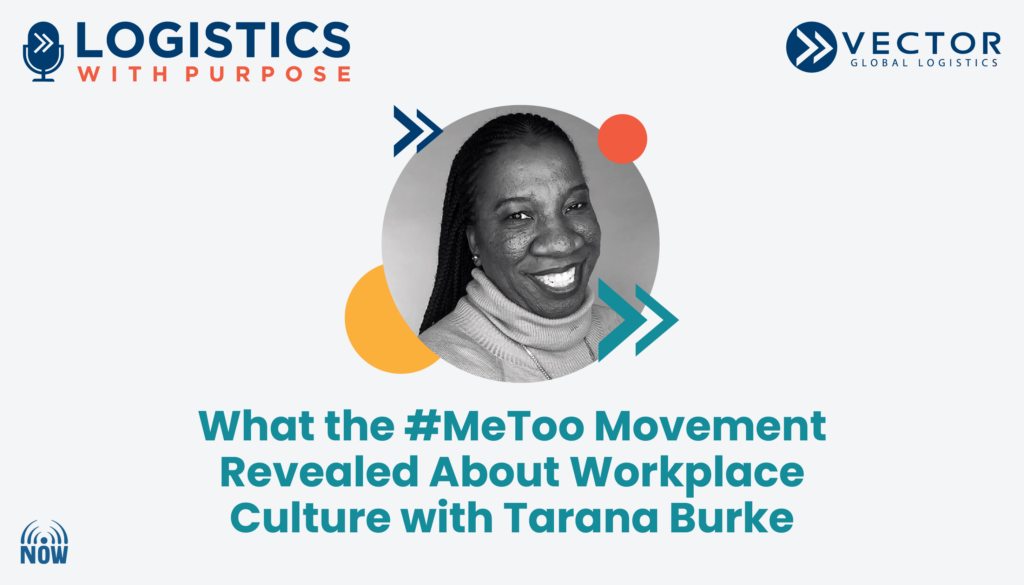
I’m excited about today’s guest. We’ll not really need an introduction, but we’re going to give her one. She’s done incredible work for decades. Some of us only learned about her work in 2017 when the MeToo hashtag went viral, but she has been hard at work since 2006. And so this is a vital conversation no matter what area of the company you’re in, what role you’re in, just showing up on a daily basis. There’s something you can learn from our guest today and we are delighted to have her. So without further ado, I’d love to introduce Terana Burke to the show. She changed global conversations around the world. So Tarana Burke is an activist, an advocate, a founder, and the chief vision officer of the Me Too Movement, a movement centered on empathy, survivor support, healing and accountability. And she’s also the co-founder of Me Too Internationals.
(01:47):
Again, we all have seen the hashtag. We have heard of her work at some point and there needs to be just a lot more conversations around this topic. And I think it’s probably not something that people think of necessarily when they think of supply chain, but it shows up in every organization. And so we’re here to bring this conversation to you today and really excited. So Tarana, thank you so much for being here.
Tarana Burke (02:10):
Thank you for having me. And I actually really appreciate that you would have this conversation in your line of work because I think that it is a necessary conversation and no matter where you are on the supply chain.
Enrique Alvarez (02:20):
Well, it’s absolutely necessary in every single industry. And of course, supply chain companies are very global in nature. I mean, we’re shipping things from all over the world and this is, again, a problem that unfortunately is global as well. I am delighted to have you here. We’re going to have a very serious, interesting conversation with you for something that is still a problem and it shouldn’t be in our society. And so we’re really all trying to help raise awareness and of course trying to end sexual and gender bias violence. Something that I read while I was getting ready for our conversation, Tadana, and I think you said it at some point, you said that sexual violence is a community problem and therefore it deserves a community response. And so that’s so powerful because usually we just don’t talk enough about this. We don’t talk enough about this at our house.
(03:08):
We don’t talk about this at work.
Tarana Burke (03:09):
It’s one of the issues that I say it’s sort of bastardized, right? It’s because it’s individualized so much. When people hear about sexual harassment or any form of sexual violence, they tend to think about normally to individuals or the person who caused harm, the person who was harmed and sort of isolate them to whether there’s services for the person who was harmed and accountability for the person who caused harm. But we take ourselves out of it. Most people take themselves out of the conversation like, well, even if you are sympathetic to it, it’s like, well, I hope that person gets what they need and I hope that person gets what they deserve and we feel disconnected from it. And I think we have to think about this type of violence the same way we think about any other type of violence, right? Absolutely. If there was a person who was shot, for instance, for God forbid, I think people feel more connected to that.
(04:03):
They think, I want to be safe in this community, in this workplace, whatever, or we can’t live in a society that has this kind of violence. People on a baseline have that sort of reaction and we should have that same reaction when we hear about sexual and gender-based violence because we all play a role.
Enrique Alvarez (04:22):
Absolutely. And now we’re ready buckle up, I guess, audience, because we’re going to have a conversation about this very open and candid. Tarana, I read that nearly one in three women in the US have experienced sexual abuse or harassment in their lifetime. One in three, long before the world knew the Me Too movement, you were already hearing this firsthand stories from young girls in Salama, Alabama, many without support, resources or safe spaces. In your journey, when did you realize this was a problem? Take us back when you just first started and realized that this was something that not only was a problem, but it was something that you were going to dedicate your life to try to solve.
Tarana Burke (05:01):
Yeah. I mean, as a survivor myself, I grew up thinking about it as my problem, not a community problem, not something that happened to other girls and boys. I thought of it as just a personal shame like most survivors do. When I started working with young people and not about this work, not about sexual violence at all, it was about leadership development. I was very committed to the idea of developing young leaders the way I had been. I’d come out of a youth leadership program. And when I shifted my focus to just focusing on the girls in the program, inevitably these stories started to come about. You build trust with young people, you create safe spaces for them and they felt comfortable enough to disclose this kind of traumas they had experienced or were currently experiencing. It was then my first notion of this and how big the problem was, was how many young people whose lives this had touched like me.
(05:59):
And I remember a friend and I, we used to do this work together and we would do these workshops and some of the first workshops we would say, “Just write me to on a piece of paper or tell us one or two things that you got from the workshop.” So that everybody would be writing something and nobody would feel called out for writing Me Too. And we got back to our hotel room and we dumped out all of the little folder sticky notes and it was a class of like 75 kids and it was just one after another after another after another saying Me Too. I think about that day often because the gravity of reading and each time, I don’t know who wrote what, but I do know the faces that I had just seen in that room. And these are kids, these were like middle school and high school kids.
(06:48):
And I thought, “My God, how are we going to deal with this? How do we even address this? ” That was probably my earliest notion. Very early on after I started Me Too, we were focused on young people, but we took it to the internet because it was sort of the dawn of social media and MySpace was the order of the day then, right? We’ll remember those MySpace days and we really just created a MySpace page just to have presence on the internet. It was just like this new cool thing to do was to be on the internet and made a MySpace page and then adults, because we didn’t specify this is not for… We just sort of talked about the work and then adult women came, there’s early virality, it’s probably the earliest
(07:34):
We had, I want to say hundreds of women who kept over periods of time kept coming into our inbox saying, “Oh my God, me too. Thank you for starting this. ” And we were like, “Holy heck, this is everywhere.” It was kind of naive if you think about it because it was three of us working on it then and all three of us were survivors. So it’s like the likelihood that there is just millions more of us is… And so it’s been like that. I have not since I started this, I’ve not gone in a room, done a talk where more than half the room couldn’t say me too.
Kristi Porter (08:07):
That’s staggering and remarkable all at the same time. Remember it reminds me of, I’ve been called for jury duty exactly once and it’s supposed to be a cross section of people throughout your community and your county. And the case was a domestic violence case and there were probably 200, they start with 200 and they continue to whittle down to 12 in an alternate, I think it is. It was very, again, kind of that word staggering to me because they had an extremely hard time finding people who could be objective because they had been affected in some way, whether it was a friend, a family member, themselves, but had to call in more alternates. And this was just a random supposed cross section of my community, 200 people. But it was just you’re standing up hearing story after story of people who’d been affected in this way.
(08:57):
It was very similar to your work as well.
Tarana Burke (09:00):
Sobering.
Kristi Porter (09:00):
Yes. Bring is a great word. Well, one of the things that I think Me Too in 2017 exposed globally, you’d clearly been at this for over a decade prior, but then it just was like wildfire and everywhere. And so you were able to expose how harmful the harmful behavior survives within systems where people feel afraid to speak up because it’s based on shame and silence basically. And in high pressure industries like logistics and supply chain, you’re often working around speed and hierarchy and performance. A lot of male dominated cultures, very traditional industries. So I’m curious from your perspective, how do you think silence can become normalized? And I know we kind of referenced supply chain, but of course as we’ve already heard kind of affects everyone, but how does that silence become normalized in a way that ultimately harms people and culture?
Tarana Burke (09:53):
Yeah, I think very easily, very easily. When I think of when I was reading about the work on supply chain and I looked at even those three words, speed, hierarchy and high performance, right? Each of those in their own way can create a culture of silence when people are moving really quickly and things have to move really quickly. And I think this mirrors culture where you feel like you don’t have time to disrupt the flow of things with your problems. I could very easily see a culture where a woman or a person who has been harassed is like, well, weighing the weight of what happened to them against the speed that they have to have and knowing what interrupting that process can do that could easily, unless somebody in leadership says, “This is not as important.” The speed of getting this thing out and moving efficiently with our product is not as important as the human beings.
(10:46):
And a lot of times when I speak in corporate spaces or in workplaces, the thing I talk about is humanity, that you have to really tap into the humanity of every person that works for you. And even if it’s just about high performance, people want their humanity acknowledged and knowing that we are different kinds of human beings. And so there’s no not to make it unequivalent a woman is a type of human being and a man is another type of human being and our humanity is reflected differently in the world. And so there has to be somebody in leadership who says that it’s not okay to be silent. We respect you as a human being and we want you to come to work with your full humanity or else then the speed will extend high performance. Those two areas will absolutely create a culture of silence.
(11:36):
Women come into a lot of these jobs already kind of behind the eight ball, right? There’s an expectation that they’re going to be slower, that they’re going to be more emotional, that they’re going to be les organized, all of these sort of stereotypes that we hear. And so then that creates a culture where that woman then wants to overperform to prove that I belong here, I can work just as well, just as fast, just as high performing. All of those kinds of things create the space for secrecy and for silence. And again, it takes leadership being really intentional about creating the kind of culture that says that’s not okay here, that we want you to, again, be your full human self here and that includes vulnerability.
Enrique Alvarez (12:22):
Absolutely. And we’ve talked a lot about culture in this podcast and we’re both very avid supporters of being open and inclusive. And so when you say culture is important and leadership is important, I think that hopefully people realize that if they do want to maximize returns and profits, having an open culture is key. So it’s not something that you’re doing because you’re a nice person, which you should. Which you should, but if you want –
Tarana Burke (12:49):
Yeah. But even if we sometimes are trying to – If you want to raise the delusion, right?
Enrique Alvarez (12:54):
You’re one of those bosses that values profit over everything else, you have to realize that purpose and culture and humanity is the only path to maximizing your profits. If you don’t treat people like human beings and give them the respect they need, then they will probably never, ever perform to where you want or would like them to perform. People can
Tarana Burke (13:17):
Push past their own sort of inclination. So even if you wanted to, at some point that silence and that secrecy and that shame is going to show up in another way and it’s probably going to show up in low performance because as much as you want to kind of push past your feelings, if you are… Listen, the thing that particularly around workplaces that I try to stress all the time is that most people, what we’ve seen in the news and what we’ve seen on television about we have like law and order where a case is solved in an hour, right? It’s very neatly tied up. It’s quick. Or we have these extraordinary cases of the Weinsteins and the Didies or whoever that happen to show up in court. The average person has to work and worship and live and exist, be educated in the same places they will harm.
(14:08):
Most people don’t have the option to quit their job, to leave their church, to leave their home, to drop out of school. Those things may happen, but then it sets them on a whole other path. And so knowing that they will resist that path and stay in the places they were harmed. If we operate with that sensibility, those of us who are in leadership and even in peer relationships, we know that you’re surrounded by people who are holding that hurt and holding that harm. That is a way to tap into and understand people’s humanity that we need to operate as if these people are coming here with certain vulnerabilities and certain harm they might’ve experienced here. So our job is to make it the most safe and the most inviting and the most humane places that we can.
Kristi Porter (14:52):
Well, reminds me of a couple weeks ago I was at a conference and one of the speakers said what doesn’t get talked about gets acted out, which can apply to so many different things. And I thought that was wonderful. And before we move on, I want to ask you about, you mentioned peers. So we’re starting to talk about hierarchy and leadership, but a lot of work happens at the peer level, the grassroots level. So as far as coworkers helping create cultures where people feel protected, believed, supported, instead of isolated, what are some of your, I guess, marching orders for those at that peer level who may not feel that they have a lot of say if they’re not in leadership, but at the same time, they’ll be the ones who know this person face-to-face as well.
Tarana Burke (15:35):
Sure. I have this concept that I call scalable courage that many people don’t come into situations with all the courage they need to move one way or the other, but that’s where your community around you, which in workplace would be your coworkers and your peers can help you scale that courage. It is very difficult for many people to do things by themselves outside of community. But I mean, we spend more time with the people at work than we do with our families. And so even if it’s not like, oh, this is the kind of workplace where we’re all friends and getting along and family, but you still have colleagues and you have relationships that are important and it’s important that in those relationships that there’s some safety. And so I think that the thing that you can do as a colleague is try to create that kind of safety, which is again, culture.
(16:25):
It leads to this idea of the hierarchy, the leadership can say a lot of things and we often do. We say, this is how we operate in this place and we believe in this and we believe in that, but it has to show up in HR. It has to show up in who you hire and how you hire and then it has to show up in what happens after the people are hired. I also talk a lot workplaces about that process. If there’s a person in your job who is a known harasser, let’s just sort of entry level violence is a known harasser, I’m always like, well, what happened? What did they see when they showed up to make them feel comfortable to operate that way in that place? That’s an HR problem. And so an HR is not often high leadership, but sort of mid-level management, if you will.
(17:17):
There are all kinds of safety nets that we can put in from the mid-level management place to the coworker and colleague place to create a culture of safety to say, “I want to lend you some courage so that she can not be silent.” And we do that by operating a way to let our colleagues know that it’s okay. I’m not trying to cross boundaries. I’m not saying everybody should bear everybody’s therapist, but there are lots of ways that you can cue to your coworkers that these things are intolerable. Oftentimes for the men, I run into so many men who are like, “Hey, I don’t do that. I’m not that guy. I would never harass a woman. I would never touch somebody inappropriately.” But if you are silent when you see it happening, if you are even a little bit compliant with like you tee he at the joke or you whatever, all of that contributes to an unsafe workplace.
(18:14):
So there are lots of ways that your colleagues can show up for you.
Enrique Alvarez (18:18):
No, it’s something that it’s, as you said, it’s the serveside community response. It’s everyone’s problem. It’s not just the person committing it. It’s not only the person receiving it, it’s everyone’s problem and everyone should be very aware and participate. And I would say at least in our industry, supply chain and logistics, it is something that happens for sure. And it’s something that destroys the culture of the companies. And
Tarana Burke (18:41):
It’s not just men. I want to add to that too, because I feel like we often talk about the men changing their behavior, but when a woman experiences some type of sexual violence, nine times out of 10, the very first person she’s going to rely on or go to is another woman. And this happened, I say this to college students all the time, if somebody comes to you and your first response to them as a woman, woman to woman is, “What were you wearing? What did you do? Why were you there questioning them?” Or we’ve seen this before where there’s the men who laugh at the rude jokes or the inappropriate things and there are the women who say things like, “Oh, I heard that she sleeps around or I heard that who keep up rumors that we can practice patriarchy and misogyny too. So women also have to do some self-examination about the kind of culture we create.
(19:34):
Does this signal safety for the other women around me? “
Enrique Alvarez (19:37):
Well, and then the company has to act quickly and swiftly about this, right? Because at the end of the day, it’s like everything else that going back to performance and going back to having a healthy culture, I think that if you have a rotten apple, it will very, very quickly spoil the whole culture. So as leader or middle management or even director, you need to recognize the problem and then take action very quickly. You don’t have to let it sit for long. And especially things like this, you have to be very decisive. And I think that’s one of the things we’ve talked about this in this show before. It’s one of the things that I think managers and people in leadership positions probably it’s a hard thing to do, but you have to let people go and fire people quickly, otherwise they’ll ruin the culture.
Tarana Burke (20:20):
Got to fail fast. It is a thing I’ve been saying for years. I got it from one of a mentor of mine. It’s much better to fail fast. You see the thing. Absolutely. You pull it out and even if it’s not firing a person, sometimes it’s just addressing it. We tend to get really quiet about things that are uncomfortable. If you are in middle management or if you’re a peer, there’s also a way to create a culture that’s not about silence, experience the harm, but if you witnessed it or if you have any kind of awareness, you got to come forward and say, “Listen, we need to talk about this. I saw a thing, it’s not okay and if it escalates, it’s only going to get worse.” Somebody needs to have a conversation. Let’s just get it out, talk about it. It doesn’t always have to result in maybe a person getting fired, but it can absolutely result in a shift in culture.
Enrique Alvarez (21:09):
Absolutely. Well, one thing that I wanted to ask you is what are the warning signs at a workplace at a school or a community? Because some of these organizations may appear healthy in the surface, but people inside might not actually feel protected or supported. In your experience, what are some of those warning signs that people should be paying attention so they can actually do pay attention to things like that?
Tarana Burke (21:34):
I would say anytime I come into a place, workplace, school, whatever, and there’s just not a spirit of transparency, like a culture of transparency, that worries me. Not about this. It could be about anything. If it’s like, we shouldn’t talk about this because it’s going to make our department look bad, or we shouldn’t deal with this because there should be a culture of transparency across the board so that when it comes to something more serious, there’s an understanding that we, it’s kind of what I was saying before, that we kind of dig it out immediately. I run an organization. We definitely operate in a way that’s like, I’ve had employees who say that thing I brought together, it made me uncomfortable the way you responded to that. And I just wanted to flag it. It’s not a big deal, but I did want to flag that.
(22:21):
I was just not comfortable. And we took a picture recently on a trip. One of my staff members was just, the way the picture came out, she looked strange to say, right? We’ve all been there. Yeah. Yeah, it did look a litle strange because she was the only person sitting on the floor and everybody else was cowering over her. So it felt a little strange, but the rest of us loved the picture. It was like this kind of artsy thing we were trying to do and she tapped our CEO and she said, “I really don’t like that picture. It made me uncomfortable.” I felt subservient and I’m sitting on the floor or whatever. And we said, “No problem. We’ll just scrap the picture.” It’s not a thing. But she was really kind of like, “I know everybody was so excited at the moment, so I didn’t want to say anything when I saw it because everybody loved it, but I don’t love it.
(23:11):
” And happy for that because I know we’ve created this culture of transparency and openness in our organization that allows people, even when they feel a little uncomfortable to say, “I just got to push through and say that. ” So it’s a red flag for me when it’s too perfect because there’s always challenges just by the nature of the way the world works and businesses work, there’s always challenges. I definitely think when there’s whisper networks, that’s another red flag and it kind of feeds into the same thing where there’s coming to a place. Say that again?
Enrique Alvarez (23:44):
Tell us a little more about the example because I don’t know if I got it from – We call them kind of like –
Tarana Burke (23:50):
Yeah,
Enrique Alvarez (23:50):
Whisper networks. How do you describe that?
Tarana Burke (23:53):
I bet you women, you know what I’m talking about, don’t you, Christie? Yep.
Enrique Alvarez (23:56):
I’m clueless.
Tarana Burke (23:57):
I’m sorry. No, no, only because I think women experience it more often than men. When you come into a workplace and people are like, “Hey, you’re new here, but listen, Bob in accounting, he’s really handsy, so just know that. So hold that. So as you’re moving through the workplace, you’re careful.” And while they are helpful so that we can be safe and keep away from situations that would cause us harm in the long run, it’s really problematic because you’re not addressing the problem. This is just a
Enrique Alvarez (24:30):
Bandaid. Everyone knows that it’s happening.
Tarana Burke (24:32):
Everyone knows it’s a thing, but nobody is addressing it publicly and it’s like a really, you create these… Women have survived off of whisper networks for decades, but ultimately that means somebody had to be harmed. Several of somebodies had to be harmed in order to get that information. And at no point was it dealt with. We just kind of felt like that person’s too powerful or nothing’s going to happen or whatever. All of that is a red flag inside of a workplace, for sure.
Kristi Porter (25:00):
Well, I want to step back for a second. I love talking about what you’re doing now, but it all came from someplace. And I want to talk about that too. You were in the Bronx and Selma, of course, also well known for the civil rights movement and the magnitude of events that happened there. But at one point you were just a young woman doing community work and listening to people who felt unheard. So where did that sense of empathy and responsibility come from?
Tarana Burke (25:27):
It was what people showed me. I didn’t have the language of like, I’m a survivor or… I didn’t even call myself a victim. It was just like my reality. This is a thing that happened in my life and it’s what I hold as my secret. I didn’t identify as anything in particular, but it’s kind of like what the person said, what’s not talked about shows up
(25:50):
Exactly and is acted out. I have to remember that. And I definitely had behavior through my teen years and young adult years that now as I reflect back was a direct reflection of the trauma I experienced. And so I met a group of women, several different things happened, but one was this group of women who first gave me language. And when I described what happened, and I said, I was just creeping up to like, well, I was a victim of, and they were like, no, you’re a survivor. You came through that challenge, you’re here, you’re able to talk about it. It was so much empathy.
(26:28):
It wasn’t a bunch of like, “Oh, I’m so sorry that happened to you. ” It was like, “We get it. We’ve been there, we understand and you’re okay.” The people who showed that to me, and that’s why I coined the phrase empowermental empathy because there was just so much untapped power inside of me that was awakened once I received that kind of empathy. I felt empowered. I felt empowered to speak. I felt empowered to exist in my body in a particular way. I can be seen, I can be heard. That did it for me. And I was like, “Oh, I need to spread this everywhere. I need to take this back and let the people know there’s power in being…” Me too wasn’t created as so much as a call out as it was an invitation. It was an invitation to other survivors to say, “I see you.
(27:21):
I know you. I am you. ” And it was a level of empathy inside of that that really sparked and resonated with people. And so yeah, it really came from that and then a desire to just not have another young person experience what I had experienced. I would think what could somebody have told me at 12 or 14 that could have changed the trajectory of my life and that’s who I want to be.
Enrique Alvarez (27:46):
Oh, that’s very powerful and something that’s very brave and all the survivors share for sure. I like the empowerment through empathy. It’s a very, very great way of putting it and it’s very eloquent as well. So thank you so much for sharing that a lile bit of your experience with us. Back then, do you remember or can share with us a moment or maybe a particular person that kind of inspired you or influenced you more than anything? And you mentioned a litle bit about that just now, but is there a particular mentor or someone that you say, “Hey, this person inspired me and influenced me to the point that you led and advocate the way you do now?”
Tarana Burke (28:24):
Yeah, for sure. I grew up in a youth leadership program that’s called the 21st Century Youth Leadership Movement. It was founded by veterans of the Civil Rights Movement and the Labor Movement and all those radical 60s movements and they wanted to help create space for young people of the 21st century to carry on that work. Those men and women in that program, the elders is what we call them, completely inspired me. It was founded by a woman named Fire Rose Terray who is still alive and in Selma right now, still fiery and working. There’s another woman, one of my elders who just passed, Joanne Bland, she was 11 years old during the Selma Montgomery March. She was on the Edmund Pettus Bridge on Bloody Sunday. And so grew up with a really, really incredible story of achievement and understanding the power of movement and really leaning into that.
(29:18):
Those women, there’s some men in that group too, they have been pouring into me now 40 years. The fact that I can still call on many of them to say, “Hey, I don’t understand what’s happening. Can you help me? ” Or, “I feel like I’m not doing enough,” or whatever the feelings are that I have, and they give me great guidance even now, but they were very inspirational in knowing I knew that this needed to be not just a program but a movement. What I was seeing in Selma and the scale that I was seeing in Selma said to me, “This movements move people. ” That’s the whole point. They
(29:53):
Move ideas, they move people, and we needed to have a new way of approaching this as an… Issue. It was more than just like, let me give a speech about it, or let me take a group of girls. It was like, no, something has to happen. Something dramatic has to happen. We can’t live like this. Selma has at the time had one middle school and my program was in that middle school. So when I have all of these girls in the middle school, to me, this is all the children of Selma who are being impacted like that. And so you take that and you multiply that exponentially when Me Too goes viral. The biggest lesson I got at that moment was the very same things that my girls needed in our program. It’s exactly what these women across the internet and people across the internet were asking for.
(30:43):
They need to be heard, they need to be seen, they need to be believed. And I think we found a really quick and bold way to do that.
Enrique Alvarez (30:51):
Did you ever think it was going to go that big, that quickly?
Tarana Burke (30:56):
No, no. It’s amazing.
Enrique Alvarez (30:59):
It just went out. Yeah.
Tarana Burke (31:01):
It was interesting is when I first started Me Too and I used to sit in my living room and write letters to people like Oprah and say, “I have this thing that I think would be really great.” The biggest aspiration I had is I wanted Me Too to be the rainbow flag or whatever for the LGBTQ community. I wanted it to represent something that said, “Hey, if you see a Me Too sticker on a car or on a window, this is a safe space for survivors. This is a place that’s accepting of and understands what it is to be a survivor.” I thought it could be like… And it has become that to some degree. That was my biggest aspiration though. I couldn’t imagine that we could have a sustained global conversation about sexual and gender-based violence. Now personally, I realize that we just don’t dream big enough.
(31:49):
We really don’t. When you have the seeds for something, whatever the idea is, whatever the thing is. I saw a quote the other day, it’s right here. My friend actually gave me this quote and she said, “The sky is not the limit, it’s the view.”
(32:04):
I said, “Wow, that is good. I have to write that one down.”
Enrique Alvarez (32:08):
I am doing that right now.
Tarana Burke (32:09):
It’s so good because I do believe that this is a solvable issue. I believe that if we are only dreaming about awareness like, “Oh, this is a big enough that everybody’s aware,” that we’re not dreaming big enough. We have to go further and figure out how we solve this issue.
Enrique Alvarez (32:25):
You were writing to opera though. A part of you thought that this was possible, or at least you actually aimed high enough to write those letters, right?
Tarana Burke (32:37):
I did. When I look now at the list of people who I’ve
Enrique Alvarez (32:40):
Reached to and I was like – Did you respond to the first one or?
Tarana Burke (32:42):
No. You said did she respond? No, actually nobody ever responded. And now, well, I also was like – I’ve been in response now. This the early days of the internet, so I was just Googling some random… I probably went to her receptionist in the studio or something. But many of the women on the list who I use, I would use Oprah, use Gabrielle Union, Aya Angelou, anybody who talked publicly about experiencing sexual violence, I would just take their story and I would bring it to my kids and I’d say, “Look, this is possible for you. Your life doesn’t have to be defined by this thing because look at Oprah.” But it worked.
Kristi Porter (33:21):
Of course, now as we’ve discussed, your organization, you’ve talked to people all over the world, you’ve reached dozens of countries through your work. So I have a couple of questions about that. So in working toward the next generation no longer having to carry the burden of surviving abuse, but we’ve talked about workplace culture, but there’s also geography culture. So I’m curious how you see your movement being lived out in other areas of the world and how it’s either posing opportunities or challenges.
Tarana Burke (33:50):
So we have a global network. One of the things that’s been really interesting for me to see as this has gotten bigger and my voice and position has gotten bigger in the world is how much the US operates as if we’re not on the globe. And so I spend a lot of time in global spaces saying, “This is happening in America. This happening all over our country.” And in fact, there are places that you can… I can go down and post statistics in Jackson, Mississippi that would look like a country in Latin America or Africa or somewhere in Asia because the rate of sexual violence, sexual and gender-based violence that’s happening is on par. And so in our global network, our driving question is what can we do together that we can’t do a part? Because we are not going to solve this problem, and I do actually believe it’s solvable, but we won’t get to solutions until we figure out how to work together, how to learn from each other.
(34:48):
There are places across the globe that are actually attacking this problem and have all kinds of support. There are statistics where they have cut the rate of SGBV down by 50% in three years. I mean, there’s amazing work being done. That work has to be resourced and then it has to be scaled. Our work is a lot of movement building. We have more than a hundred organizations in our global network. We also have a US network. Our US network is the Survivor Justice Network, and it’s organizations here in the US who are working on this. And here, because of our political system works differently, are trying to organize survivors as a constituency. There are like 52 million survivors across the US. Imagine if we were a voting block.
(35:34):
It’s the same way politicians have to speak to unions when they come out and say, “We promise to do so – and-so for the workers,” or they speak to moms or they speak to domestic workers. They should be speaking to survivors and saying, “This is how we intend to keep your community safe. This is how we intend to enforce these laws that already exist to make sure that there’s accountability. This is how we intend to make sure there are resources for the people who experience this harm. There’s nobody to hold. And also, this is how we intend to operate in our jobs. We don’t hold our leadership to a standard, and we’ve seen this across the media now, to a standard that says, if you are going to be my leader, if you’re going to represent my district, my state, my whatever, that I expect you to operate in a very particular way with these values are a thing.
Enrique Alvarez (36:24):
So
Tarana Burke (36:24):
That’s the work that we do. We really want to help shift the narrative. But across the globe we are saying, we have a voice in this. We have to come up with joint solutions and we’re ready to work with you to do that.
Kristi Porter (36:38):
What countries are doing well?
Enrique Alvarez (36:39):
It was just mask.
Tarana Burke (36:41):
Listen, that statistic I gave you just now is from Uganda. Wow. It was a program that the UN – Women in Country. Yeah. Yeah. Oh, to institute there. So they have some really progressive things happening across the continent, across the African continent. There’s a group of folks in Asia. I’m trying to think of, I don’t want to say the wrong country. I want to say Korea, but I’m not sure. But there are some really great examples in Latin America. There’s some really great examples acros Africa. There are community programs though, or maybe led by a city or a municipality. And that’s really what it takes. We don’t see a lot of that here in our country where the city itself, the municipality leans in. I also think workplaces and colleges become examples of this. When you have huge, like Amazon, for instance, a huge company like that, what they do internally around addressing these issues gets to be replicated.
(37:40):
They become a standard. And so there’s a lot of ways that we try to talk to, this is why I like doing things like this podcast. We need to talk to everywhere this exists and the fact is it exists everywhere to say there’s possibility, there’s ways for you to adress it. There’s ways for you to be an example and be a leader and show other people that this can be done. We can solve sexual and gender-based violence and we should talk about it as if it’s solvable.
Enrique Alvarez (38:05):
Absolutely.
Tarana Burke (38:06):
Most of us think of it as a foregon conclusion. It’s like this is just the way of life. His is the thing that happens. We get some services, you get over it. That doesn’t have to be true.
Enrique Alvarez (38:16):
Well, and supply chain touches everything we do from the mug that I’m holding, the book that I’m writing on, the computer that we’re using. Supply chain is a really, really good way to start and enact change and positively impact on the world in many, many different ways. So thank you once again for being here because – I love it. Our industry needs this as much as any other industry out there. So we’re very humbled and proud that you accepted our invitation. What keeps you grounded? What has helped you stay grounded and committed to this purpose? Because with all this unbelievable success that you had, it must be hard sometimes to prioritize what you need to do.
Tarana Burke (38:54):
That group of elders that I talked about earlier, it’s certainly helped to keep me grounded. They don’t see all the red carpets and the magazine covers. They’re like, “You are still little Tarana. And you need to show up well and represent us well.” Same with my family. I have the same group of friends that I’ve always had and they’ve been my soft place to land. And I’ve worked with so many young people throughout the years that are now adults or young adults. I feel accountable to people. And I think that goes a long way in helping you feel grounded. I have to show up in my integrity and in the values that I have said because somebody’s going to say, “Didn’t you say that this is who you were? Why are you acting like that? ” I mean, I don’t want that. I want to be…
(39:43):
I did a speech recently and my mom was there. I got an award and I said, “Making you proud is my ministry.” It is what I feel most compelled to do. The people who’ve poured into me for the last 50 plus years, we owe them something. I owe them something. And so that absolutely keeps me grounded and focused. I’m here for the work and the work it’ll show.
Enrique Alvarez (40:08):
So what’s your mom’s name? And she must be very proud of you, I’m sure.
Tarana Burke (40:11):
Yeah, her name is Anne and she’s amazing. And if it’s not my daughter that’s my plus one, it’s my mom because my husband is always like, “Go ahead. I know you want to take your mom.” Yeah, I love them.
Kristi Porter (40:26):
That’s amazing. There’s so many aspects of our conversation, been around the anti-human trafficking world and modern slavery world for about 20 years. And so a lot of it is very reminiscent of the conversation we’re having today. And along those lines, we talked about early on it was awareness. Now you’ve sort of pivoted to healing. And so you have initiatives like the Survivor Sanctuary and the idea is to heal on purpose. And so you create these intentional spaces where people can begin to heal no matter where in the journey they are because it isn’t… Again, I go back to what doesn’t get talked about gets acted out. Somewhere it’s going to show up in their lives if it’s not dealt with. So I am curious, let’s look at a what if situation. What would change if organizations were proactive in approaching people and culture and leadership with that same level of intentional care versus reacting only during moments of crisis?
Tarana Burke (41:17):
I mean, you mentioned it Enrique earlier. This is in businesses and from a business perspective, I guess, if people were to respond in that way, we’d see a whole different world of productivity. We’d see people who actually felt more passionate or at least more connected to their work. And I think that happens inside of organizations as well. When I talk about this work, I very often talk about humanity because what sexual and gender-based violence does is rob us of our humanity. And so all the ways that we respond, all the ways that we show up, whether it’s individually, as a community, as an organization or a business, all of that is to give back to the humanity that we’ve lost. And so we would see a shift in how people show up, not just for work, but in life. You’d have a different culture, but also it then creates another piece that it creates understanding just how grave the issue is.
(42:16):
And so we don’t think about sexual and gender-based violence the way we think about, say, murder. And I used to use this example when I would say kids on college campuses will say, “Yeah, I know that guy. I mean, I’ve heard three or four times just that he’s messed with some women, but it’s not really a thing.” If somebody say, “Well, I heard he killed three or four people, but I don’t think he’s a serial killer.”
Intro/Outro (42:44):
It’s
Tarana Burke (42:44):
The same thing when you rob somebody of their humanity. I mean, obviously dying is dying. It’s final. But robbing somebody of their humanity is right up there because it’s like we are the walking wounded. You walk around now with a piece of you missing. And there are other ways to lose your humanity. And those of us who have been in those situations understand that gaping hole that it leaves. So to your point, when organizations and companies and anybody who has power really behaves differently and responds differently, it sends a signal about the gravity of the issue and that shifts everything. It starts to help shift the culture, shift the way we behave. All of that is important. It’s actually vital that people with power show up in that way.
Enrique Alvarez (43:35):
So that’s a good segue to the question I had for you. Or leaders that are listening to us and to this episode today and anytime that they’re listening to this, what would be one step or one piece of advice that you would give to them and industries like ours, logistics, your supply chain that they can do, they can take right now to build safer, more supportive and more accountable workspaces? What would be that one first step?
Tarana Burke (44:00):
I think you can never discount values. I think that there’s a lot of lip service, if you will, paid to the idea of values. But I’ll give an example. I was with this CEO once in this event and he was very proud because he said to me, “Oh, Tarani, you would love since Me Too has happened, I’ve just been hiring all kind of women and it’s kind of like binders full of woman.” He was just like, “I have women and I’m just hiring them and I’m pushing them into these positions, whatever.” And I said, “What kind of women?” And he said, “Well, what do you mean?” I said, “What are you saying to these women when you hire them? Are these women who value the safety of other women? Because it doesn’t matter if you hire a woman for a position, if she’s the kind of woman who gatekeeps, or if she’s the kind of woman who wants to be one of the boys or who practices misogyny in her own way, just hiring women is not the answer.
(44:59):
Having a set of values that everybody, however they identify across the gender spectrum, that everybody knows you have to adhere to. And the main reason they know that you have to adhere to that is because the leadership operates and knows about. So I said, I was like, listen, what’s important to you? What is important to you about having women in leadership positions? What is important to you for your company? Who is your company in the world? That’s the place that you start. What is it that you value most? You should value the contributions that women bring. And if you value that, that means you create safe spaces. You should value the contribution that any person, however they identify, LGBTQ people, Black people, disabled people, whatever the marginalization is, our humanity matters and our humanity shows up differently. So the very first thing I tell people to do is examine your values.
(45:52):
And do the values that you say that you want to uphold in this space reflect a culture of safety that are going to lead to a culture of safety for all the people in your staff? I think when you try to start with this is the rule and this is the policy, blah, blah, blah, none of that’s going to matter if people are like, this is not people here that this is not a value for the folks here. People need to see it.
Kristi Porter (46:17):
Yeah, thank you. This has been an extraordinary conversation and I’m delighted to get it out into the world soon. As we start wrapping up and before we get to CTAs and calls to action for our non-marketing, I just wanted to ask something that I hadn’t thought to ask until just now, but I love, again, in the anti-trafficking world, I ask people this a lot. It is hard work. It is emotionally draining work. What makes you happy? What brings you joy? What helps you to keep going?
Tarana Burke (46:50):
I love this work. I really do. And I meet so many people. I mean really all the time, whether I’m meeting them in the airport or going to the grocery store or at events, I meet people who talk about how important the work is to them, that their ability to disclose to their family or whatever changed their life or their job changed the policy or whatever that thing is. I really am motivated by that. I have a great support system. I have a great husband. I have a great kid and friends who are there when I just… I am not together all the time. I have to tell survivors all the time who are like, “Oh, I can’t wait till I’m healed like you. ” And I’m like, “No, I’m still healing.” So I don’t have to be afraid of that. I’m not afraid of the vulnerability.
(47:40):
I’m not afraid to say, “I don’t know. It’s too much,” whatever. And when I do say those things, I have really great people around me who are like, “Cool, let’s figure out how to help you. ” Community is everything to me. It really is. The people I surround myself with, it just means a lot because you can’t do this work and then come home to a miserable existence or to have friends who are self-centered. It’s impossible.
Kristi Porter (48:06):
Thank you. Well, how can people get in touch with you? We’ve opened up a great conversation today, maybe some new information for people, some old information, continued information, but how can people get in touch with you and learn more about the Me Too movement?
Tarana Burke (48:21):
Well, we are all over social media and I think we’re the same on everywhere. It’s Me Too MVMT. So that’s a little acronym for movement or shorthand, excuse me. So definitely follow us on social, sign up for our newsletter. We have a great newsletter from the desk of that keeps people abreast of what’s happening both in our global work and in our local US work. You can follow me on social. My page is not as exciting, but I do tend to post a lot about where I’ve been and what’s happening and try to keep people tuned what’s moving in the movement. So those are great ways.
Kristi Porter (48:57):
Thank you. And then very importantly, if somebody needs help, they’re looking for support for themselves, they’ve been affected, know somebody who’s been affected, a family member, a friend, where can they go to get help?
Tarana Burke (49:09):
So outside of the National Hotlines, which there are national hotlines both for domestic violence, intimate partner violence, and sexual violence, on our website we have a healing resource library that has more than a thousand resources and a filtering system so that you can filter by your zip code, but you can also filter by lots of demographic identities. And so that’s one way. And then also Survivor Sanctuary, you mentioned earlier. It’s a great resource for folks who are maybe not immediately in crisis because they just experienced the harm, but we often get triggered watching a movie or a family member will call or something will happen and Survivor Sanctuary allows you to craft your own healing journey. You can pick and choose by topic area what you want to do, five-minute, 10-minute, 25-minute lessons. So I often advise people to check it out because it’s really beautiful.
Kristi Porter (49:59):
Fantastic. Thank you. Yeah.
Tarana Burke (50:00):
Thank you.
Enrique Alvarez (50:02):
Thank you so much. This has been a masterclas in many, many different levels and it’s been not only interesting and really inspiring, but it’s needed. I think these type of conversations are needed. We don’t have them often enough, so we’re very proud and happy that you actually agreed to be here today. And for everyone listening to this episode and for everyone in logistics and supply chain, which is a lot of people around the whole world in every corner of the world, just pay attention to this. Pay attention to this issue because as Tarana was saying, we can resolve it. We can eradicate if we work together. And it’s something that it’s in our power and in our control to do. And so I would very, very much like to see everyone that is in our industry pay attention and do something about it. Tarana, once again, for everyone to this episode, if you would like to learn more about how logistics can be a force for good and get inspired by leaders creating a possible impact like Tarana here and her organization and her amazing team, please remember to subscribe to the Logistics with Purpose Podcast on YouTube or any of your favorite platforms.
(51:12):
And of course, follow us on our social media as well. Our handle is at logistics with purpose. Thank you so much. Stay tuned. Thank you.
Tarana Burke (51:20):
Next
Enrique Alvarez (51:20):
Time. Thank you.
Tarana Burke (51:21):
Thank you so much.