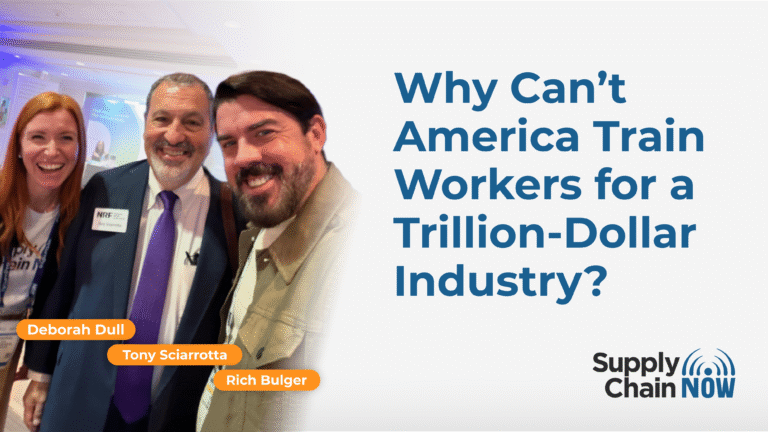
Why Can’t America Train Workers for a Trillion-Dollar Industry?
Inside the reverse logistics education gap and the economic blind spot keeping it invisible
Special Guest Blog Post written by Deborah Dull
Tony Sciarrotta has been asking the same question at industry conferences for years. As the Senior Director of Circularity and Reverse Logistics at the National Retail Federation, he knows what answer he’s going to get. But he keeps asking anyway.
“Anybody in here go to school for returns management, reverse logistics, circularity? Any degrees in those fields the room?”
It’s rare that anyone raises their hand.
“That’s what’s wrong with our industry,” Sciarrotta told me at NRF Rev this January, the first conference under NRF’s new reverse logistics banner. “We still need to fix it.”
The Numbers That Should Make Headlines
Here’s what makes reverse logistics so fascinating: the scale is staggering, but the infrastructure to support it needs to be stronger. According to the National Retail Federation, American retailers processed approximately $890 billion in returns in 2024 which is roughly 17% of all retail sales – and it’s higher for ecommerce.
But that number almost certainly understates reality.
“We have a fragmented industry,” Sciarrotta explained. “Where are all those returns going? It has to be touched, refurbished, repaired, recycled. We can’t find it, and the government data doesn’t exist.”
The $890 billion figure captures what retailers report. It doesn’t capture industrial returns, B2B flows, warranty replacements, or the vast secondary markets where returned goods eventually land. When accounting for the full ecosystem of processors, refurbishers, resellers, recyclers, and liquidators who handle these goods the economic activity likely exceeds a trillion dollars annually.
And almost none of it is tracked holistically. We’re talking about an economic flow roughly the size of Switzerland’s GDP, operating largely in the shadows.
The Industry Everyone Pretends Doesn’t Exist
Why has reverse logistics remained invisible for so long? The answer lies in how companies have historically viewed returns: as a cost to minimize, a problem to hide, and increasingly, a problem to offshore.
For decades, the economics of processing returns in the United States has been too high to reuse or resell that item. When a $50 product comes back, the cost to inspect, repackage, and resell it can easily exceed the item’s recoverable value. The math often makes landfilling look rational. So that’s what often happens: returns get written off, shipped to liquidators at pennies on the dollar, or simply thrown away.
“Almost a third of the retail economy flows through reverse, and there’s no education on how to do it,” said Rich Bulger, founder of All Things Circular and a former Verizon executive who ran a $300 million reverse logistics operation. The reason is simple: if you treat something as pure waste, you don’t build systems to optimize it. You certainly don’t train people to manage it professionally.
This mindset, and the realities of unit economics, has led many companies to push returns processing offshore. Operations in Mexico and other lower-cost countries handle what American facilities find too expensive to touch. It’s been an economically rational choice, but it’s also meant that the expertise, jobs, and infrastructure have developed elsewhere.
Why This Moment Is Different
Two forces are converging to drag reverse logistics out of the shadows.
The first is supply chain resilience. The past five years have delivered a crash course in the risks of material dependence on other countries. As companies and policymakers push for greater domestic manufacturing capacity, an obvious question emerges: why are we importing raw materials when millions of products (full of recoverable components, materials, and value) flow back through our economy every year?
The second is practicality. Landfilling billions of dollars in usable products has become increasingly untenable – reputationally, regulatorially, and economically. Companies that once buried their returns problems are now under pressure to demonstrate circular practices. The conference floor at NRF Rev was packed with solution providers promising to help retailers recover value from what they once discarded.
Reverse logistics isn’t just about processing returns anymore. It’s about recapturing materials, extending product life, and building circular supply chains that reduce dependence on imports. The products American consumers return represent a domestic source of materials that currently gets squandered.
The Textbook Problem
But here’s the catch: you can’t build an industry on workers who learned by accident.
Bulger has documented this gap extensively. At conferences and workshops across the country, he asks professionals how they learned to do their jobs. Did they take a formal course? Shadow someone? Get thrown into the deep end?
“Do you know how many people have said they’ve taken a formal course on reverse logistics?” he asked me. “Two.”
When Bulger pursued his own graduate education in supply chain, he discovered the textbook was written in 1999. “I got Cs in my assignments because I was writing about concepts that aren’t in the book. The book said all returns are bad. But in the circular economy, returns are part of the flow of goods. You want to match products from customer one to customer two.”
He wrote his own book, Going Circular, partly out of frustration that existing curriculum didn’t reflect operational reality.
An Industry Built by Accident
Nobody in this industry planned to be here. That’s one of the recurring themes in every conversation I had at NRF Rev.
Stephen Beard, Vice President of Sales for Services & Solutions at Flex, started his career at UPS and spent fifteen years in parcel and supply chain before gravitating toward reverse logistics. “John Lennon said that life is what happens to you when you’re busy making other plans,” he told me. “It may not shock anybody to learn that when I was a kid in grammar school, I did not imagine my future as a logistician.”
Sciarrotta’s origin story is even more direct. “I was a happy-go-lucky sales guy, winning awards at companies like Sony and Philips. One day I was called into the senior offices at Philips, and I was told: we have a returns problem. We need somebody to fix it. You’ve been picked.”
He didn’t know anything about returns. “It was just a number on my P&L every month.” But that was 1998, and when he went looking for learning resources, he found almost nothing.
“Since most don’t choose this profession, we end up falling into it and falling in love with it,” Sciarrotta reflected. “If you fall in love with it, you won’t leave it, because you know you make a difference.”
The Opportunity No One Knows About
David Watson, Managing Director of RL People, a recruitment firm specializing in reverse logistics and circularity talent, sees the disconnect between the need for talent and the supply of talent every day. “Kids coming out of high school and college, they don’t know circularity exists,” he told me. “No one does, unless they’re involved in this space. So how do we make it genuinely mainstream?”
His prescription: “We need to shout as loudly as possible that you can pursue a career in circularity that pays a good wage, allows you to genuinely change the world, and enjoy an abundance of variety. No two days are the same.”
Marcus Shen, CEO of B-Stock, a technology platform that helps retailers optimize their returns inventory, points to an underappreciated reality: “The margins in this business are potentially better than the original brand and retailer business.” The opportunity goes beyond processing returns and into building businesses around recovering their value.
Technology as Trainer
One reason for optimism: technology is making expertise more accessible.
The reverse logistics industry has historically required years of accumulated knowledge. Experienced operators carry mental databases of product conditions, disposition paths, and value recovery strategies. When they leave, that knowledge walks out the door.
But that’s changing. Jamin Nieri, Chief Operating Officer at Trove, a recommerce platform for luxury brands, described how software is transforming training timelines. “One of the issues for returns processors is that if I lose a member of my team that has been inspecting items for years, I’m actually losing all the knowledge I have.” Image-driven inspection software now guides operators through complex assessments. “An operator can be up and running and very productive in a couple of weeks, rather than three months.”
This doesn’t eliminate the need for training, but it changes what training needs to accomplish. Someone with basic mechanical aptitude and problem-solving skills can now be guided through sophisticated processes by AI-powered tools. The barrier to entry is lower. But workers still need foundational knowledge: how supply chains work, how to assess product condition, how disposition decisions affect value recovery.
“Large language models allow returns operations to run these algorithms to tackle a high level of complexity,” adds Toby Connock, Director of Customer Solutions at Pentatonic. “The biggest opportunity is reframing returns. Processing returns is not only a cost – it’s a way of getting new commerce again and again.”
What Would Actually Fix This
Standing in the exhibition hall at NRF Rev, surrounded by solution providers and retailers and logistics operators all working on pieces of this puzzle, I kept thinking about those two raised hands. Two people, out of hundreds, who had any formal training for work they’ve dedicated their careers to.
The industry has matured. The technology has arrived. The economic and environmental pressures are mounting. What’s missing is the connective tissue that turns an accidental profession into a real career path.
That means building what doesn’t currently exist:
- Industry-recognized certifications. Other logistics disciplines have them. Reverse logistics needs credentials that signal competence to employers and give workers portable proof of their skills.
- Curriculum that reflects reality. Bulger has set himself a goal: get 100 colleges to adopt reverse logistics courses. “It’s the most complicated part of supply chain, in my opinion,” he said. “And it’s where all the interesting problems are.” Community colleges, vocational programs, and university supply chain departments need curriculum that specifically addresses reverse flows, disposition economics, and circular value creation.
- Employer investment in training pipelines. The companies that process returns have the most to gain from a trained workforce. Partnerships with community colleges, apprenticeship programs, and incumbent worker training could build the talent base the industry needs. But individual companies have been reluctant to invest in training workers who might leave for competitors. Industry-wide coordination could solve this collective action problem.
- Better data, finally. You can’t professionalize an industry you can’t measure. Government statistical agencies need to track reverse logistics flows the way they track other economic activity.
Watson’s advice for the industry is simpler than any of this: “Everyone needs to shout a little bit louder. There’s so much good happening, and I see it every day. But we don’t share it loudly enough.”
He’s right. But shouting only works if someone is building something worth shouting about. A trillion-dollar industry is hiding in plain sight, processing the products Americans send back by the billions, recovering value that would otherwise be lost, and offering work that’s hands-on, varied, and increasingly well-paid.
The industry exists. The jobs exist. The workers who could fill them exist.
What’s missing is the system that connects them, and the recognition that building that system isn’t charity. It’s economic common sense.
Where to Learn More
Connect with Deborah Dull on LinkedIn and visit Trillium Digital Services’ website to learn more about the digital advisory and execution work they provide. We also invite you to learn more about the Circular Supply Chain Network, which Deborah Dull founded to pull leaders together in order to create a better future. Stay tuned to Supply Chain Now programming, where Deborah serves as one of our popular co-hosts regularly.
More Blogs
5 Leading Supply Chain Recruiting & Executive Search Firms