[00:00:00] Zubin Appoo: we weren’t focusing on the manufacturers, the buyers, the importers we were focusing on the parties that helped move the goods, the customs brokers that lodged the customs entries with the Australian government to pay the right duties. The
[00:00:26] Scott W. Luton: Hey, good morning, good afternoon, good evening, wherever you may be. Scott Luton. And he’s back, folks. Wiley Jones. The Wiley Jones here with you on supply chain.
[00:00:35] Scott W. Luton: Now Wiley. How you doing today?
[00:00:37] Wiley Jones: I am doing super well, energizing day, feeling great. How about you?
[00:00:42] Scott W. Luton: the same. I’ve had a great week. I think you’ve had a better week, but you know what, uh, we might touch on that towards the latter part of today’s show, but, uh, great to see you as always. You know, we’ve got a hit on our hands, Wiley.
[00:00:54] Scott W. Luton: A bit of a hit on our hands. We continue today, a popular new series for 2026. It’s not even new anymore. This is our third episode. So we gotta take the new, uh, label off Enterprise Unleashed, powered by Wiley Jones and the Doss team, all of our friends at Doss.
[00:01:10] Scott W. Luton: You’re gonna hear stories and perspective from innovative individuals that have led transformative change, all that was gonna help you drive real targeted outcomes driven change in your own organization today. Folks, we’ve got a big time leader joining us on the show, so stay tuned for an informative, actionable conversation.
[00:01:29] Scott W. Luton: Wiley big show here today.
[00:01:30] Scott W. Luton: Are you ready to go?
[00:01:31] Wiley Jones: Oh, I’m ready to rock. I’m fired up. This is one I was really looking forward to. I look forward to all of them, but I woke up this morning, pretty fired up.
[00:01:38] Scott W. Luton: You jumped out of bed, you’re saying? Is that right?
[00:01:40] Wiley Jones: did. Yes. I was excited for this.
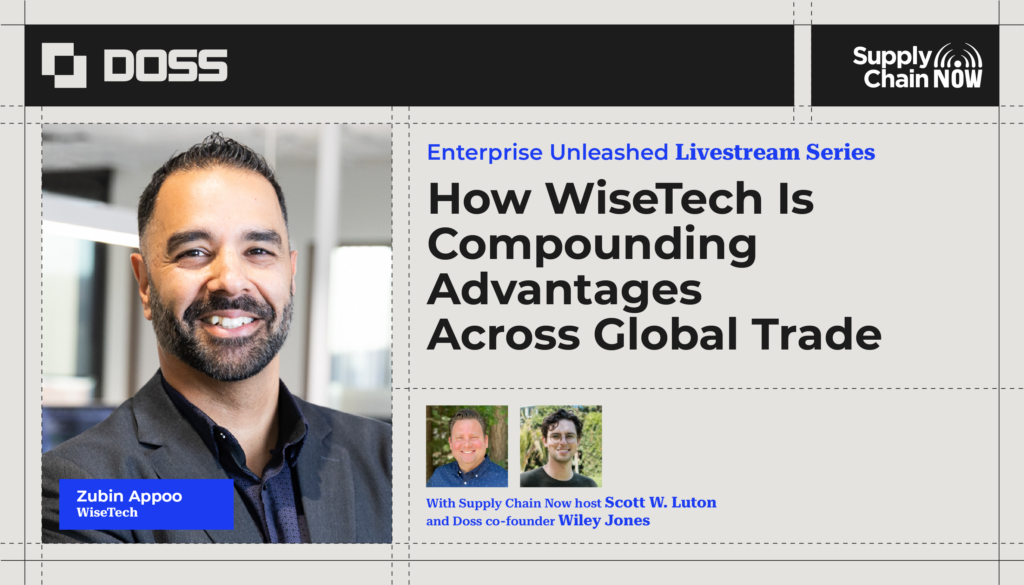
[00:01:43] Scott W. Luton: Well, again, appreciate the cloud approach here and appreciate what you and the Doss team are doing moving at a hundred miles an hour. So let’s get to work, and I wanna welcome in our featured guest here today on Enterprise Unleashed. Zubin Appoo is the Chief Executive Officer for WiseTech Global, the world’s largest logistics supply chain and global trade technology company.
[00:02:04] Scott W. Luton: In fact, here’s what did you know? WiseTech Global is Australia’s largest a SX listed technology firm. It’s like the, uh, Australian version of the New York Stock Exchange, right? WiseTech Solutions connect every layer and player in the supply chain ecosystem to optimize the movement of goods around the world.
[00:02:24] Scott W. Luton: A proven technology leader, Zubin, has nearly 25 years of experience. We broke our 20 year rule. We never break our 20 year rule Wiley. We had to, had to do it here. Zubin brings. About 25 years experience in software development leadership in commercializing market disrupting products. He spent close to 15 years at WiseTech from 2004 to 2018 where he had a foundational role in the rapid growth of the company, helping to shape wise tech’s growth strategy.
[00:02:53] Scott W. Luton: Zubin then held various executive leadership roles, including Chief Technology Officer at Inloop and many, many others. And then Wiley, he rejoined WiseTech in 2025 as Chief of staff and Deputy Chief Innovation Officer before assuming the role of CEO in July, 2025. So please join me in welcoming Zubin Appoo, CEO of WiseTech Global.
[00:03:15] Scott W. Luton: Hey, hey Zubin. How are you doing today?
[00:03:18] Zubin Appoo: Good. It’s great to be here and thanks for that fantastic intro.
[00:03:22] Scott W. Luton: Hey, you know, Wiley, as we promised, you know, we could have been here for 15 minutes introducing Zubin based on what he is done in this journey. But we tried to, which we did pretty good so far, didn’t we? Wiley,
[00:03:32] Wiley Jones: that is maybe the best intro that I’ve ever heard you do, and now it, I think it’s actually a little, it’s a little easy. Wise Tech is such an awesome company. Zubin’s background is so incredible, but the line of. Why is tech connecting every layer and player? I was like, I’m gonna take that.
[00:03:47] Scott W. Luton: That was brilliant. I love that.I wish I could say those were my own words, but I may have stole that from somewhere along the line. And Zubin and Wiley, if I’ve done anything, y’all know, we keep it real with our audience around here. But if we’ve done anything, we’ve introduced guests and, uh, Zubin, is wonderful to have you here.
[00:04:03] Scott W. Luton: Appreciate your time. So let’s do this. Zubin and Wiley. Fun warmup question. April 7th, right? Today when we’re dropping this, uh, episode, it’s both World Health Day, which is wonderful, and then here in the States it’s National Beer Day. So I’m not sure but that tells me that beer is a key ingredient for healthy living.
[00:04:25] Scott W. Luton: Maybe that’s not how it was meant to be, I don’t know. But on that note, Zubin, I’m gonna ask you with this fun warmup question. What’s one of your favorite beers or springtime beverages? Your thoughts?
[00:04:35] Zubin Appoo: Look, my favorite beer would have to be the Irish Kilkenny, and luckily I’ll be in Dublin next Thursday, so I’m looking forward to having a couple of nice kil Kens there.
[00:04:45] Scott W. Luton: Oh, man, that sounds delicious. And what do you eat those with? Uh, Zubin.
[00:04:50] Zubin Appoo: it’s the beer that matters. It’s not the food, it’s only the beer that matters.
[00:04:54] Scott W. Luton: Oh.
[00:04:55] Zubin Appoo: in Sydney, Australia, it’s really quite difficult to get a so I am very.
[00:05:00] Scott W. Luton: Well, we’re gonna work on that global supply chain and we’re gonna make that happen. Make that easier. Maybe we’ll see. Wiley Zubin, as we knew, fits right in. How about you? Your favorite beer or beverage?
[00:05:10] Wiley Jones: Well, in tandem with the Health Day. I’ve cut back on the beer quite a lot in the last couple of years. But the favorite historically was, uh, a shout out to my fellow Midwesterners, the Wisconsin New GLADiS spotted Cow. If you’re
[00:05:27] Wiley Jones: familiar, it’s a regional beer and people, listeners from the Midwest and the United States will know what I’m talking about.
[00:05:33] Wiley Jones: If you’ve had it, it’s the best.
[00:05:35] Scott W. Luton: Okay, man, that does sound like a regional beer. Sounds delicious too. I tell you, I’m not gonna be as cool as either one of those choices. I, I like a good anchor steam, which is, not necessarily regional. It’s a, it’s a bigger brand, but I gotta tell you, I drink more beer when I’m playing beer, golf, pour a very poor game of beer, golf, uh, on the golf course.
[00:05:53] Scott W. Luton: But if I’m home barbecuing, I like chardonnay. I like the light wines. don’t take my cool points, uh, for admitting that here today. So Zubin and Wiley. Zubin, I see you smiling. You’re not gonna take my cool points. Are you
[00:06:06] Zubin Appoo: Do that,
[00:06:08] Wiley Jones: Hey Scott. you get cool points galore. Anchor steam is actually, I think the brewery is not, too far from where I’m sitting right now. It’s,
[00:06:16] Scott W. Luton: really?
[00:06:17] Wiley Jones: Yeah.
[00:06:18] Scott W. Luton: Okay, we’ll make a road trip. That is a delicious beer. I’ve enjoyed it since, uh, long well back in college. okay. We got a lot of stuff get to here today on Enterprise Unleashed and Zubin. We’re gonna follow up, that fun warmup question by diving a little bit deeper into your background. We shared a little bit, a little bit of that.
[00:06:35] Scott W. Luton: We’d be here all day, I think, talking about all the twists and turns of your incredible journey. But let’s level sit a little bit more because, you know, our worldviews are constantly shaped right. With every role we take, every leadership role we take. And I’m really curious, prior to your current role, what were a couple roles that did do just that it really shaped your worldview.
[00:06:57] Zubin Appoo: Look, it’s a great question, and as you said in the intro, I actually spent 15 years at WiseTech in the past. The company was much smaller back then. I joined when the company had about 40 staff in Sydney,
[00:07:07] Zubin Appoo: Australia. weren’t even called WiseTech back then and we were a very different company. and I spent 15 years at Wise Tech building product development and really understanding the supply chain and logistics, in depth. And then I left in 2018 when the company was about a thousand staff and I spent a lot of the seven years out of we Tech in social purpose businesses. I worked in ed tech businesses, health tech businesses, aged care businesses, both as CTO and CEO and those, seven years out and the 15 years in We Tech in my prior time at We Tech. Really gave me this sort of, contrasting view and different skills in how to lead different types of organizations, how to motivate people, how to solve some of the most complex problems and the most meaningful problems in the world. And then coming back to Wise Tech, uh, nearly a year ago now, and bringing those complimentary skills, bringing that diverse experience. And of course the history of being at We Tech and building disruptive technology, puts me in sort of a great position to lead this fantastic organization.
[00:08:10] Scott W. Luton: a lot of that resonates with me. The inside outside approach, you get kind of the best of both worlds. Um, lemme get one more follow up question to you then. I’m gonna get Wiley to chime in here. as CEO of a global technology company that’s doing really big things that really cross the world, what are a couple of components of your job as CEO that you love most?
[00:08:29] Zubin Appoo: Look, I think there’s a couple I would call out. The first is having influence over how 7,000 people experience the organization having influence over how they build disruptive technology and solve problems that others shy away from. that’s pretty powerful. then when you think about the products and services that we actually deliver software for, logistics and software for trade. Many people would see that, hopefully not your listeners, but many people would see that it’s quite a boring industry, yet it’s probably the most important industry in the world. It’s also one of the oldest industries in the world. You think about how you order something on Amazon and it turns up the next day.
[00:09:07] Zubin Appoo: You think about how you order something on eBay and it turns up quickly. That sort of movement of goods, we take that for granted, just like we take electricity for granted, water for granted, and other infrastructure for granted. We take logistics for granted, but it is such a complex industry, such an important industry.
[00:09:24] Zubin Appoo: And in fact, for me and for many of our staff, incredibly exciting.
[00:09:28] Scott W. Luton: Hmm. Zubin, if I had a beer, I’d crack it open and I would toast exactly what you just shared. and I’m only halfway kidding because Wiley. One part of his response there, you know, the globe takes so much for, for granted, including the ability and the supply chain workforce and all the technology that allows us to enjoy these modern conveniences that all of us as consumers do.
[00:09:50] Scott W. Luton: Right. Uh, but Wiley, what resonated with you based on what Zubin has shared about his role and, what he loves about his role?
[00:09:56] Wiley Jones: the second part is we’re about at, about at the size as a company, uh, at Doss as what you described when you joined WiseTech. we’re at that stage where we’re 40, 50, 60 people, and I say, still the same thing that you’re saying today. And so that, that to me is exciting.
[00:10:12] Wiley Jones: Is that. Even after decades of working on this problem, there are still ways to go apply disruptive technology to innovate on something that people take for granted. the fact that someone expects now every single company to have the same, uh, SLAs and service levels of an Amazon, um, how do we make it so that every company in the world can deliver a world-class supply chain?
[00:10:37] Wiley Jones: these are the things that I think are most exciting to me right now is that we have an opportunity to continue to push that frontier. And, you know, businesses like WiseTech who have been doing it for decades are still attacking these problems. That, that just makes me really excited.
[00:10:52] Scott W. Luton: I love that. Uh, sounds poetic to my ears. but very true. Wiley, where are we going next with Zubin Appoo, here.
[00:10:59] Wiley Jones: So Zoomin, I think one thing that. kind of the before and after that. I would love to get your point of view on is that the intro Scott gave was fantastic around the WiseTech, you know, connecting all the layers and the players in the global value chain. how do you describe what WiseTech does for the world and for the supply chain?
[00:11:18] Wiley Jones: And like we can make it practical and talk about the pragmatic and literally what it does, especially for people who are less familiar with the services and offerings for the company. then the last, clarifier I’ll put in there is, is what did that look like as it changed over time from day one to where you are today?
[00:11:36] Wiley Jones: you saw that journey. And so I think that’s what’s, so that’s the really unique perspective to hear is, is like the supply chain matured so much during your time, in your tenure there. how is it today and where did it come from?
[00:11:49] Zubin Appoo: it’s a fantastic story really when you look at our history. We’ve been around for about 32 years now, and in those three decades, plus we have solved some of the most complex problems in logistics, ferociously to steal your word. And we started very Australian focused and, and a little bit of New Zealand and then into Singapore, but we really focused initially on. Freight forwarding and customs
[00:12:12] Zubin Appoo: brokerage. And just so people understand, what that means is we’re focusing on the people that facilitate the movement of goods. for 32 years, we weren’t focusing on the manufacturers, the buyers, the importers we were focusing on the parties that helped move the goods, the customs brokers that lodged the customs entries with the Australian government to pay the right duties. The freight forwarders that helped a small importer or a small exporter move goods from A to B. The warehouse that stored the goods whilst they were going through quarantine or whilst they were going through customs hold the land transport. So the trucking companies or the drayage operators that would drive a container from the port to the importer or exporter. So these are the middle parts of the supply chain. If you think about the supply chain with manufacturing at one end and consumption or retailers at the other end. Our focus has always been the logistics operators in the middle, what we call the logistics service providers. And for 30 years we have expanded that moat. Expanded across the entire world. We now have solutions in countries that support 80% of manufactured world trade. We have connections to 140 different shipping lines, 400 different airlines, customs authorities, government departments, biosecurity, quarantine across the world. That’s quite powerful. And then just because we never get bored and we don’t like to sit still.
[00:13:33] Zubin Appoo: Last year we acquired a very large, US listed of company called e2open. And they focus actually on the ends of the supply chain where we didn’t really have depth. And that is the manufacturers, the importers, the exporters, the distributors, companies like Dell, companies like Nvidia, companies like L’Oreal. So now what that means for us is we have connections and we have solutions across the entire supply chain in a way that no other company in the world has. And we don’t do that as separate solutions. We don’t have a forwarding solution, a custom solution, a warehousing solution. We have a single global operating system that integrates all of that data.
[00:14:11] Zubin Appoo: It provides financials, it provides master data, it provides ai, provides analysis, it provides insights across the whole supply chain. Because as you would know, many companies these days don’t just operate in silos. Many companies do forwarding and brokerage. Maybe they deal with shipping lines directly as well.
[00:14:30] Zubin Appoo: So this is a, a company that has constantly thought about how can we do more? How can we spread our tentacles into larger parts or further parts of the supply chain, and solve some of the most fundamental problems in those areas.
[00:14:45] Wiley Jones: that is exactly the answer I was looking to hear. that is also my, you know, outside view of the company is precisely what we described. And, starting with a kernel of truth and insight around how messy the middle is and harmonizing that, and then continuing to grow outward from there, from the earliest places in the value chain, in the life cycle of a product all the way to the place of consumption. kind of then shifting gears and getting into that next point of discussion is that What do you view as the really large opportunities as a business that is a nervous system from that start to finish and has that entire view, what are some of the really massive opportunities that you as a company are thinking about as an infrastructure business that are very different that, you know, from maybe just the typical enterprise?
[00:15:29] Wiley Jones: So especially you worked at some previous, in the intermediate time when you weren’t at, WiseTech, these companies probably didn’t have the scope and scale of, systems as what WiseTech has. How do you view the difference of opportunity between companies in that position versus infrastructure companies like WiseTech?
[00:15:46] Zubin Appoo: The way you described it is spot on, right? Like we really are a digital infrastructure company. We are like electricity, we are like the grid, we are like the water supply or the internet supply. We aren’t typically seen that way, but that’s really what are if WiseTech or CargoWise our main product wasn’t operating. not like a freight forwarder or a customs broker has an alternate paper-based approach or a different system they can use. CargoWise becomes the operating system for these businesses. So the opportunity here for us is to do more and to do it better and to do it faster. Now, you think about what’s happening with global trade across the globe, right?
[00:16:24] Zubin Appoo: You think about the tariffs that are changing regularly. You look at what’s happening, right now in the Middle East and and Iran, where the Strait of Hormuz is closed and might open shortly. But you think about what impact that has on shipments, on the supply of medicine, on the supply of food, on the supply of other types of materials and stocks. facilitate that movement and we provide the tooling or the. intelligence for our customers to make smart decisions. We give them the options of looking at what does the closure of the Strait of Hormuz look like for them? What does it do to shipping line ETAs and transit times, and what are the alternate routes they can take? We give trucking operators or drainage operators the chance to look at what does increasing fuel prices do? Do they need to pass a fuel and a temporary fuel levy onto their customers, or do they need to route differently or do they need to consolidate differently? So I’d say the opportunity here is because the supply chain is becoming increasingly complex, that’s a chance for us to shine and to show even more value. And then of course, there’s artificial intelligence and what large language models have done to the world, and us leveraging those large language models means we can do what we’ve done for 32 years in a much deeper and faster way.
[00:17:38] Wiley Jones: the specific part you’re calling out around having access to the root data and the records for what’s occurring. Then up connecting that up to the intelligence, and then now using language models to access that intelligence in a new way. That hierarchy is really, really, really powerful. any points on that? Scott? Anything calling out of any initial reactions?
[00:18:00] Scott W. Luton: well, my initial reaction is what’s old is new again, in so many ways. You know, how can we empower the, incredibly talented human factor that makes global supply chain happen each and every day to make faster, better, more confident decisions using powerful tools like a CargoWise or, or wherever you get your, your help from
[00:18:19] Scott W. Luton: Being able to predict, proactively figure out what the best options are as you’re looking to solve problems and protect margin and, and ultimately delight your customers. You know, the ability that we’re gaining as an industry, uh, in part power by the, what y’all’s organizations are doing, but better and better to understand on a Monday what your Friday’s gonna look like.
[00:18:41] Scott W. Luton: for long is gonna be understanding on a Monday, what your Monday from 60 days from now or maybe 160 days from now is gonna look like, right? and on top of helping the beautiful human factor make better decisions more and more in many cases. Been able even to eliminate so many decisions from having to be made.
[00:19:02] Scott W. Luton: Because we’ve talked about this here, Wiley. I think on the last show maybe, or on one of the shows we did, I talk about a lot. It’s not necessarily in my experience, that one or two really big decisions per day For a lot of times when I was in supply chain and, and certainly now as an entrepreneur, it is like the multitude of constant decisions you’ve got to make minute by minute.
[00:19:24] Scott W. Luton: when we can make time slow down and we can eliminate some of those decisions and focus our unique superpowers of our human brains on where human superpowers, can bring a lot more value. That’s what I’m hearing certainly Zubin talking about here today. And that’s clearly WiseTech.
[00:19:42] Scott W. Luton: Global has evolved quite a bit from where they set out 32 years ago.
[00:19:46] Wiley Jones: One thing I’m very curious about is, um, WiseTech I think has been known for a pretty, I dunno if I would say differentiated, but, um, a unique strategy around acquisition and being able to go in and find these unique. Differentiated pockets of subject matter expertise and then bringing that into the company, especially regionally and then now systematizing that in, platforms like CargoWise, how has your organization thinking about systematizing this intelligence as well, working with large language models to take knowledge of customs and brokerage practices in various regions and integrating that into the platform. How are you thinking about that in this next generation of technology?
[00:20:31] Zubin Appoo: You’re right in that one of our core strategies, as I was mentioning earlier, it really is to put our tentacles and our intelligence and our. You know, our ability to solve complex problems into every sort of part of logistics and now trade. Now that we have e2open as well. So the full supply chain. yes, we have acquired many companies, nearly 60 companies over the last, decade or so across different parts of the supply chain. That includes acquiring regional knowledge specifically for customs authorities or customs filings in different countries. Now, we don’t do that because we are acquiring the technology or the product that’s interesting to us.
[00:21:09] Zubin Appoo: But we’re a software developer. We’re a product company. We know how to build product, we know how to build really quite, innovative technology. What we are acquiring is exactly what you said. We’re acquiring domain knowledge, we’re acquiring expertise. We’re acquiring people who know what Belgium customs looks like
[00:21:25] Zubin Appoo: because that’s what they’ve lived and breathed for, you know, the last 15 years. So we’re acquiring that talent. Also we’re acquiring the intelligence as you put it, or the data that underpins those systems and what we can do with ai, when we take all of that data and we take the domain expertise that the people we acquire have, but also our own people have, we can build some of the most powerful systems in the world. Especially now when you apply the large language models on top, data becomes king, right? Data becomes key to everything we’re doing. The only way we can make intelligent decisions here is by applying that LLM layer to that data.
[00:22:03] Zubin Appoo: The only way we can do that well is by taking all that human expertise and human capital that we have in the business and using that to, you know, orchestrate how that data is then turned into actual intelligence until we’ve had LLMs in the world. Converting data into insights or into intelligence has been quite difficult and has always been quite surface level. It’s never been powerful enough, but we have data for 32 years across now, the entire supply chain across 80% of the world’s economies. What we can do with that data and what insights we can produce for supply chain participants, but also for governments, also for financial bodies, it’s quite a powerful proposition here. We’ve invested quite heavily over the last year or so into large language models. All of our team use large language models either to enhance their software development skills, their analytical skills, their customer service facing skills. And what we’re seeing is that data that we’ve collected makes our job, much more powerful, makes what we can do much more powerful.
[00:23:06] Wiley Jones: that translates exactly to the way that we’ve seen, our customers using all of these products. But really just everything that we’re hearing Where subject matter expertise and context collected over long periods of time can be fused together and arbitrated through these language models. the end result. It almost feels like magic,
[00:23:27] Zubin Appoo: It’s also a, a massive opportunity here for our customers, right? When we take the data that we’ve got and we take the power of these very large LLM model companies that are doing amazing things, all around the world, and you couple them together. The ability for us to give solutions to our customers is just accelerated
[00:23:47] Zubin Appoo: and amplified, and we can deliver more powerful solutions. For 32 years, our job has been to make the supply chain more efficient and to make the supply chain more compliant, as in to help forwarders and custom brokers file the correct duties and taxes and quarantine requirements and so on. That hasn’t changed. AI doesn’t change that, what AI does for us, it means we can do that, in a more accelerated and amplified way. We can do that more. We can do that more powerfully. We can do that faster. We can deliver solutions in a way that previously would’ve taken a year. We can now deliver those solutions in months.
[00:24:21] Scott W. Luton: the scale and the velocity of global business and certainly global supply chain. We’ve got to be able to move at the velocity, in a quality manner that you’re describing Zubin, right? We don’t have the luxury, you know, think about it, the old days when I first started, well, it depends on everyone’s definition.
[00:24:36] Scott W. Luton: In the old days, uh, for, for me it was, uh, 2002 when I started in manufacture, right? We had faxed orders, you know, sometimes, getting back to customers and took a couple of days. That’s a luxury now. I mean, now it needs to be, you know, almost instantaneous in many ways. And we’re making those fast, high stakes decisions, at a scale maybe, that industry hasn’t seen up until this point.
[00:25:03] Scott W. Luton: So we’ve gotta have all those things you, you both have mentioned here. I wanna ask you something. And you’ve spoken to this already, Zubin, but I’m gonna, I’m gonna sharpen the tip on the proverbial pencil here. when we talk about what it takes to successfully operationalize AI at big time portfolio scale, right?
[00:25:21] Scott W. Luton: And big time is a highly scientific term. don’t ask me to quantify it, but Zubin, how do you think about, and again, you’ve spoken a little bit to this, but how do you think about embedding AI into core workflows rather than layering it in on the top? And kinda a second part is why is AI on top rarely the answer for really deep logistics operations.
[00:25:42] Zubin Appoo: Great question, and, and I think you’ve answered it well. Uh, my strong view here is that. AI cannot be a layer on top of an existing system. AI has to be fundamental to how we build product and how we deliver value to the industry. if you think about AI as just a new slice of technology, you’re gonna miss the mark.
[00:26:03] Zubin Appoo: You’re not gonna get to where the industry needs to be. CargoWise, uh, next, which is the name of our product, has had workflow embedded into that platform for many years, both in the current iteration and in the earlier version called CargoWise One. And when I say workflow, what I mean is. That our system provides standard operating procedures, SOPs for freight forwarders, for brokers, for warehouse operators, for land transport operators, for shipping lines to configure what they see as their SOP and then follow that SOP.
[00:26:33] Zubin Appoo: Of course there are exceptions, of course, there are automations and edge cases that happen and our workflow engine forks off and, and deals with those edge cases or helps our customers deal with those edge cases. When you add AI into that level of cargo, Aztec into that sort of fundamental architecture layer of our platform, and you say rather than there being 18 tasks on this SOP and 18 tasks done by humans, 16 of them can now be done by AI agents, an agent that knows how to ingest a document, an agent that knows how to read an invoice, an agent that knows how to go back to the importer or exporter and say, you forgot to upload this document, or I need a clearer version, or you haven’t signed this document. Or an agent that says. said you’re shipping steel bars. What are they made from? Because we need to know that for customs classification, when we build these very narrow agents that know how to replicate individual parts of the supply chain, our software and our product becomes infinitely more powerful. When you stick AI on top of a product, and there are many companies that build generic AI layers or automation layers, what those products can do is interesting and it’s powerful, but all they can really do is automate user interfaces. They can automate keystrokes, they can create data much more rapidly than a human can. They can click on things they can navigate, but they can’t access the underlying data they can’t operate at the business logic or at the architecture layer that we can, because we own the source code and we’re building CargoWise next ourselves. So I think the, the fundamental lesson here for anyone is that when you are adding AI to a product, you cannot think of it as an add-on.
[00:28:11] Zubin Appoo: You have to think of it as reimagining your entire solution to the market. And how do you become AI first or AI led rather than AI assisted or AI
[00:28:21] Zubin Appoo: last.
[00:28:22] Scott W. Luton: this analogy may not be accurate. Zubin and Wiley, and I’ll defer to both of you, smart technologists, but AI is not a calculator. It’s essentially the math.
[00:28:33] Zubin Appoo: it’s an interesting analogy. It is, it is a whole new way of doing math might be a way of thinking about it, right? It’s a whole new way of solving problems that no one has been able to do before. If you asked anyone three years ago about where they thought AI would be, no one would’ve predicted it is where it is
[00:28:48] Zubin Appoo: today. for that same reason, it’s impossible for any of us to predict where it will be in six months. And I think that’s incredibly exciting. I think the, the pace of change here and the way it is changing, not just the supply chain, but technology, but education, every single sort of industry in the world, maybe except physical labor industries, it’s, a scary thing for many people.
[00:29:10] Zubin Appoo: And I understand it’s gonna disrupt many people, but it’s also incredibly exciting in what it means for how we deliver powerful solutions across all sectors.
[00:29:20] Scott W. Luton: Yeah. Uh, and new math is better than new Coke. Uh, let’s just level set there, right? Wiley, really quick, I’m about to take the conversation to, you know, deploying ai, that global platform, global enterprise versus single company. Next with Zubin, your quick comment. So on what we were just talking about.
[00:29:36] Wiley Jones: the thing that you’re talking about, zoom, and it’s funny, this is, these are completely, um, tangential, topics. Nothing that normally has to do with this, this show and these conversations, but I had this conversation with our own team for our own development, our product exactly the same way, which is that we have to challenge a lot of the fundamental assumptions that have been made about how you build products, how you deliver solutions to customers, because we’ve kind of created, I say we as in the world is now to kind of created this new form of computing and it’s this soft and fuzzy computing where you don’t need hard, deterministic computable answers, you know, traditionally computable answers. Instead, LLMs can have. Judgment that they apply to just, you know, what normally would be human level decision making, and it’s exactly what you said is, you know, the ability to go in and, triage documents that come back in. I don’t think anyone 10 years ago would’ve ever said that that would’ve been possible anytime soon. So, that’s been one thing that’s been really, that’s stuck out to our, our team is, is what fundamental assumptions do we need to challenge as a technology community When we think about delivering solutions for the supply chain, what rocks should we go back and turn over that
[00:30:46] Wiley Jones: people have left for a while because we thought the problems couldn’t be solved. And then your point around AI on top, the way our team talks about this is someone says, you know, we’re AI native, it’d be like someone saying, uh, you know, oh, I’m a native speaker. And they, they pull out their phone and start speaking Spanish and to Google Translate or speaking, you know, to Google Translate.
[00:31:04] Wiley Jones: And they go, oh yeah, I, I can say that and, you know, I can speak Chinese. And then Google Translate reads it back that that’s the difference. It’s the difference between internally and understanding and having a product that internally is able to deliver a, you know, an intelligent solution versus shipping it off to some other place, grabbing a little bit of intelligence and pulling it back.
[00:31:23] Scott W. Luton: excellent commentary there, Wiley. maybe that’s my next tip. I’ve tried and tried and tried to learn Spanish and maybe I’m not leaning on technology enough. Wiley and Zubin, we’ll cover that maybe next episode, see if I’ve made any gains. But Zubin, getting back to what we’re talking about while we got you here, I’m really curious about your take here.
[00:31:42] Scott W. Luton: when you’re talking about deploying AI at a global platform scale, global Enterprises versus a single company, what changes Zubin? And if you would, uh, second part of this question is how acquisitions and like the big one, you, talking about, you made last year with e2open, I think it was last year.
[00:32:01] Scott W. Luton: how all that strengthens your ability to deliver more and more AI driven successful outcomes. Your thoughts, Zubin.
[00:32:08] Zubin Appoo: Yeah, I would actually take it a step back. I would say it’s not really about AI here, it’s about problem solving. And AI is the current and the most, uh, incredible tool in at least our lifetimes that help us, uh, solve problems. But the art really here is to solve the most complex problems in the industry and to solve them. Deeply to pick the problems that others shy away from, to be very, cognizant that customers will express their solution to you, but we as product designers, we as product innovators, it is our job to take what 10 customers say to us and understand the theme there, understand what is the actual underlying problem that they’re asking for. Customers will often say, you know, I need you to build a report that does x or, I need a red button here that when I click it, it does y. That’s actually not their job. That’s our job. The customer’s job is to move freight or to, uh, execute logistics. And customers typically will struggle to articulate the actual problem.
[00:33:10] Zubin Appoo: They’ll solve it in their head and give us the solution. for some years in our earlier years, we listened to customers deeply we did exactly what the customer asked. We realized that that ends up solving the problem for one customer and then causing a new problem for customer B.
[00:33:25] Zubin Appoo: for 25 plus years now what we have done is ask why multiple times.
[00:33:31] Zubin Appoo: You know, we really dig deep through our product management expertise to understand what is the actual fundamental root problem that the customer or the industry is trying to solve. And if customer A has that problem, it probably means the industry has that problem. And we see our role there as, as sort of, people who uphold. the industry needs to solve is a very important role, and we spend a lot of time digging deep and understanding those problems. the same thing applies with ai. We can throw AI into the product everywhere and say that we’re AI native or say that we’re an AI native solution. That’s not what’s going to make us win or solve the industry problems. What’s gonna work very well is to work closely with industry, to work closely with our partners and with our customers’ customers to understand what are the real pain points here, and to spend the right amount of time to solve those pain points deeply. When you look at, e2open, what that does for us and our other acquisitions. It gives us more domain expertise, so more people who are industry experts. It gives us more data in terms of the different parts of the supply chain that we weren’t operating in, and it means we can use the skill we’ve built over 30 years, our systems thinking approach, our theory of constraints, principles that come into everything we do in how we solve problems to solve bigger problems, and to solve them much more deeply than we could ever before.
[00:34:52] Scott W. Luton: we’ve talked about this a lot. when this AI centric, ’cause as Zubin called it, it’s probably the most powerful tool we’ll see in our lifetimes, right?
[00:35:00] Scott W. Luton: And it’s kinda a scary thought, especially when, who knows that the scale of innovation, you know, five years from now or whopping five years from now, right? But all of us are like, okay, how can I solve that with ai? How can I solve that with ai? But I love Zubin’s answer, right? Let’s focus in on the problem.
[00:35:17] Scott W. Luton: and I can’t remember that quote who said it, but a problem, uh, well-defined as a problem, half solved. And, you know, as silly as it may sound Wiley in this, in 2026, yes, we’ve got solutions that don’t require ai, right? And they work great. we’ve got a lot of solutions that do involve AI and they work great too.
[00:35:36] Scott W. Luton: But Wiley, your, your quick here.
[00:35:38] Wiley Jones: the problem well defined, problem half solved. what you’re describing, Zubin, is the same way that we do product development. And it’s almost like you’re verbatim saying the words that I say to our team, which is, you need to listen deeply to your customers and be very skeptical of the things that they’re saying, not because you think that they’re. Telling you something that isn’t true, but because you need to paint it against a broader context that they don’t, they’re not aware of, that integrating the context of customer A, B, and C and therefore what does it mean for customers D through Z. and therefore what does it mean for the people we don’t serve in the broader market?
[00:36:15] Wiley Jones: And then the base assumption of is everyone doing this wrong? Because we haven’t actually been able to use a new technology to introduce something completely novel. to the earlier point of Scott mentioning around fax machines, we could have used a lot of technology to innovate on fax machines, and I think everyone’s glad that we haven’t. and so recognizing when to engage in optimization, when to disengage and challenge the assumptions, that’s I think the big lesson I’m hearing. And it, it just sounds like, you know, not to be trite about it, but it sounds like just world class product management
[00:36:49] Wiley Jones: is really the answer. The best way to deliver great AI solutions is the same way to deliver great solutions, has been for the last number of decades, just is gonna require a lot of discipline.
[00:37:00] Scott W. Luton: Zubin, your quick comments response to that before I ask you this next question about centralized teams.
[00:37:06] Zubin Appoo: Look, absolutely agree. it is wrong to think of AI as some newfangled thing that you have to put into your product so you can tick a box on your website. AI means we can solve the problems that need solving more deeply, faster, and possibly solve problems that we couldn’t solve before. There are some problems that weren’t solvable, but they are now solvable because of ai. I would never talk about AI as a new offering that YEC is doing. YEC has for three decades solved efficiency and solved risk. AI means we can do that far greater than we ever could before.
[00:37:40] Scott W. Luton: Outstanding. That’s exciting, exciting time. It’s a great time to be in global supply chain. It’s amazing. It’s tough to keep up, quite frankly. I’m trying to keep it with two of y’all here today. It’s tough enough.
[00:37:49] Scott W. Luton: Really quick, Zubin, I wish we had a couple more hours here today. I, I find you, you and Wiley’s, uh, perspective. Fascinating, but quick thoughts on the role that centralized AI or data teams play in a business like yours versus,
[00:38:03] Scott W. Luton: deployed teams. Uh, your thoughts, Zubin.
[00:38:05] Zubin Appoo: Yeah, look, there are multiple ways to think about this. My view is that AI is a skill that every single person needs to have. This is why humans are so important in this new AI led world. You need humans in the loop to, to verify, to train, to feedback information, to provide that sort of feedback loop. I’m not an advocate of having a centralized AI team.
[00:38:25] Zubin Appoo: I’m an advocate of saying, you give the AI tools, the AI models, the AI governance frameworks, the guardrails to every single person, whether they’re a software developer, a product manager, a CEO a head of communications, every single person needs to be thinking about how do they augment to their skills, or how do they accelerate their output by using AI and particularly using LLMs. Now you do need, teams that manage the different models and decide which models are the ones that you’ll make available. But my strong view at this very still early stage of large language models is you need teams to experiment. You need people to have access to all of the models because they’re leapfrogging each other every four hours in some cases. And the best bottle today is the worst bottle tomorrow.
[00:39:11] Scott W. Luton: Man. Uh, all right. So Wiley, that’ll provoke a few thoughts out there. Where are we going next? Uh, here with Zubin?
[00:39:19] Wiley Jones: I, I think that, a good segue from this is the experimentation point you made. When we think about experimentation, and the customers that we see, there are a lot of hard problems that are desperately and want of acceleration or improvements in efficiency. The larger the surface of the organization, the more of these they can go work on. How do you think about seeding these experiments inside of a massive global company That, let’s be honest, any one of the experiments that you could potentially be running the bottom of your list is probably really interesting. How are you thinking about that as a leader when there is so much you could do, but you have to focus?
[00:40:02] Zubin Appoo: Probably three things I’ll say there. The first is that we’ve had this unofficial mantra. used to be stuck in the office when I first started in 2004, and it said, reward success, reward failure, punish in action. I’ve used that for my entire career, and I’ve said that to every single team and every single, part of the business that I’ve led. I think you have to build a culture where teams are given the freedom to experiment within guardrails and within a time boxed environment, but to experiment and to try things, and to be allowed to fail and not punished, in fact, rewarded for trying. That’s how you innovate. If you expect teams to be perfect every single time, they won’t ever take a risk.
[00:40:43] Zubin Appoo: They won’t ever take a gamble and they’re never going to innovate. That’s part one. The second part is what AI has done and what LLMs have done. And I, I read the quote the other day. It said, if the time to build is now quicker than the time to plan. Why plan? I’m not suggesting you don’t
[00:40:59] Zubin Appoo: plan at all, but with AI you can experiment on things that previously would’ve taken six months to get to a point where you could make a decision.
[00:41:07] Zubin Appoo: You can now do that in days or sometimes even hours. So if you can experiment that rapidly, it gives us more ability to try these things and to decide are these the right paths forward? Are these the the problems that we really want to solve? And the last slice of that is. We are a, sort of a leader in understanding the problems that the industry face.
[00:41:28] Zubin Appoo: So yes, we have a long, you know, menu list of problems to solve, but we also have, because of our deep domain expertise, we have a good understanding of the value. Each of those problems or each of those solutions will deliver to market so we can prioritize based on that value and based on what I call big rocks.
[00:41:45] Zubin Appoo: We’ve got a roadmap for the next couple of years. We know what the big rocks are that the industry needs solving and what we feel we need to solve, and we’ll execute on that strategy as we have for 32 years of our history.
[00:41:56] Wiley Jones: That’s amazing. We say, what are the big boulders we need to move ourselves for our customers? You know, it’s like if we have that big list of boulders, we know pretty clearly what we wanna focus on. that’s brilliant. One thing that you called out the way that experimentation and planning go hand in hand. And if the time to discuss the experiment is longer than the experiment, maybe let’s run the experiment. I think the point you brought up earlier in the discussion is the capabilities of these systems.
[00:42:25] Wiley Jones: Um, We should be reevaluating how they function every, let’s call it, six to 12 months. If we’re re-underwriting those capabilities and we actually can see that those experiments, what maybe would’ve been really hard to run today, we think it’s actually gonna be really easy to run in six months or vice versa. the ability to consider that and and constantly be reevaluating, uh, I think is gonna be really, really important. something that we’ve seen
[00:42:55] Wiley Jones: boulders six months ago are no longer boulders, but they’re smaller pebbles now.
[00:42:59] Scott W. Luton: That’s right.
[00:43:00] Wiley Jones: So Zubin, I think the thing that I’m really interested in hearing more about is, especially at a really large company where the. Business itself can be viewed as almost this, you know, machine and factory of producing solutions for customers. There’s a component of applying your own resources to making your own machine run better, and especially using technology to do this. And then there’s another piece which is building the solutions for the customers themselves. How do you think about resourcing, making yourself and making the organization better? Resourcing specifically solution A and solution B for customer A and customer B. And sometimes, you know, what is it the cleanest you cook mentality?
[00:43:42] Wiley Jones: And can we do a little bit of both here and there? How do you think about that and you know, is it boulder by Boulder or uh, or is it more periods of time? What’s, what’s your broader view?
[00:43:52] Zubin Appoo: It is really both of those things. It is, focusing on growth of the business, and we do that by delivering incredible value to our customers, and it’s focusing on efficiency inside the business. And you’re right, AI and LLMs give us opportunities that simply were not present, even three or four months ago. I don’t really think about it as two separate things though. I think about it as doing both at the same time. When we are building solutions for customers, how can we do that more efficiently when we’re building a new product? How can we embed LLMs and AI into our processes, but also into the product so that we can build it in a quarter of the time with higher quality and release it to market and innovate and get feedback in a much tighter feedback loop. If you, if you try and separate the two, if you try and say. This half of the business focuses on efficiency and this half focuses on growth or on customer value proposition. You end up in this kind of weird conflict in my mind, and I’ve seen that happen in other businesses. I strongly feel it’s just like when someone’s learning ai, you can’t ask someone, go and spend your Monday and Tuesday to go and learn AI and your Wednesday, Thursday, Friday, do your normal job and produce value for customers.
[00:45:02] Zubin Appoo: It’s, do your job, but figure out how to embed AI into your job at every single step, and you will end up accelerating yourself significantly. And, you know, winning
[00:45:12] Scott W. Luton: Zubin. I love that.
[00:45:14] Scott W. Luton: As I mentioned, I wish we had a couple more hours with you and Wiley, uh, ’cause you, you both are unleashing the enterprise here in this conversation and with what you do day in and day out. But that means we’re gonna have to have you back Zubin. But I got a couple of final questions before we wrap here today.
[00:45:30] Scott W. Luton: And then we’re gonna get Wiley’s favorite parts from Zubin’s, perspective here today. I know I’ve got, I’ve got a couple of Ernie early winners that I’ve written down in my 18 pages of notes here. But Zubin, a couple final questions for you. Number one, what would be your final advice for those supply chain leaders and the teams and the operators out there, out organizations around the world that are starting or leading AI transformation today?
[00:45:55] Scott W. Luton: Based on all that you’ve learned, what would be your actionable advice here today?
[00:46:00] Zubin Appoo: Look, my advice would be that it is, incorrect to still be skeptical or cynical about the value that LMS are going to bring to the world and the value they are bringing to every single industry. Companies, individuals, kids, through school, you all have to lean in heavily into this world. This is the biggest transformation, at least of, you know, my lifetime so far.
[00:46:23] Zubin Appoo: And I think possibly our lifetimes at all. It’s something we have to lean into. It’s something we have to think about, how it changes businesses, how it changes the, the way we’ve done things for a hundred years. This is the chance to reimagine those workflows, and it has to be in a way where we become AI first or AI led, not just use it to write your emails better or do a bit of research.
[00:46:47] Scott W. Luton: So I gotta ask you, with that in mind, that great piece of advice in mind over your left hand shoulder, I think that’s your left hand shoulder. You’ve got either nieces, nephews, or maybe it’s your children. are any of those gonna be fellow transformational leaders that, really make a big impact on industry?
[00:47:05] Zubin Appoo: Look, it’s a great question. That’s that picture on my left. There is my son who is now 17 and going through his final year of high school. but my second son, uh, Ryland, he’s 15, he actually spent a week at WiseTech last week doing what we call work experience here, where in year 10 they spend a week and he is fascinated by software development. I think software development has changed entirely because of ai, but that doesn’t diminish the importance of that skill. Knowing how to innovate, knowing how to disrupt, how to build solutions that really disrupt whatever industry he ends up working in. Innovation, that’s a really critical skill, and AI doesn’t displace that.
[00:47:44] Zubin Appoo: AI enhances that or accelerates that, so hopefully he will be.
[00:47:48] Scott W. Luton: I’m thinking very practically optimistically that he may already be one, uh, a transformational leader. Hey, really quick.
[00:47:55] Scott W. Luton: How can folks connect with you and the WiseTech team and all that you are doing and, and changing and leading?
[00:48:03] Scott W. Luton: How can folks do that?
[00:48:04] Zubin Appoo: Uh, look, www.wisetechglobal.com is our website. Also, www.cargowise.com is our website for our main product, etwoopen.com. We’ll show you our trade products and of course, your listeners always happy to be connected directly on LinkedIn and have these sort of fascinating conversations about ai, about technology and what’s happening, uh, in the supply chain.
[00:48:26] Scott W. Luton: Really appreciate that. I tell you, Zubin, uh, I’d be here all day if I told you some of my favorite parts of what you and Wiley have shared, but Wiley mine. Again, arguable, but reward success, reward failure, punish in action. That really speaks to me, and I can feel that in my bones, but Wiley, you get a tough one.
[00:48:45] Scott W. Luton: You get a tough question. What is your favorite key takeaway from all that Zubin Oo shared with us here today?
[00:48:52] Wiley Jones: I think that there’s a clear winner on this one, which is that here you have Zubin who is basically seen from start to finish the build of the most important infrastructure company in all of logistics.
[00:49:08] Wiley Jones: And he is saying that more important than any other thing he’s ever worked on.
[00:49:13] Wiley Jones: Technology wise, we are seeing the most important transformation is yet to come. That is really, I don’t wanna say crazy, that’s big. What that makes me think is that there’s even more opportunity than there’s ever been before, and so it’s exciting. I’m optimistic
[00:49:30] Wiley Jones: it’s really easy to be pessimistic right now whenever you see certain things in the news and I think there’s not enough optimism and what is of what is yet to come.
[00:49:41] Scott W. Luton: and you’re right, there’s a lot of, there’s a lot of anxiety, there’s a lot of, um, friction out there based on where we are as a world today. But you look, deal deeper, there’s always good news if you take the time to go looking. And it, it really is amazing the innovation we’re seeing, uh, between people and technology across global business today and that this conversation has been full of that.
[00:50:01] Scott W. Luton: So I really appreciate that. Um, alright. Before we thank everybody and get outta here. Zubin, uh, you gotta come to this side of the table because we gotta ask Wiley about some big news he had this week. Uh, so Zubin, you’re an honorary co-host now. Okay? So Wiley Jones,
[00:50:17] Scott W. Luton: what’s the big news at dos?
[00:50:19] Wiley Jones: So, yeah, we announced a big fundraise that we had. we did the fundraise back in the fall, and we’ve really used it to push into, I would say, a broader set of solutions for our existing customers, growing our team, being able to expand our offerings. we’re still in the early days of what Zubin was talking about, you know, the, the early stage of when he was working at WiseTech.
[00:50:41] Wiley Jones: You know, hopefully 20 years from now, we can, I can be saying a lot of the same things about Doss providing infrastructure, but into, you know, more of the ERP category.
[00:50:51] Scott W. Luton: Exciting times and, and Zubin, you remember ’cause you were telling us about it. You remember those critical moments, 20 some odd years ago is about. I have that about right bin.
[00:51:02] Zubin Appoo: Correct. That’s about right. I mean, I, I remember the, the very early days of, uh WiseTech, we were called EDI back then. But the, the experimentation, the innovation, the culture of solving some of the most complex problems in the world, that’s led us to our success. And those are the same fundamental, cultural traits that we have today.
[00:51:23] Scott W. Luton: Ooh. Love that. Okay, we’re gonna have to have Zubin Appoo back with us here today, but I wanna thank Zubin Appoo, CEO, with WiseTech Global Folks. You can learn more@wisetechglobal.com. Uh, Zubin, thank you so much for joining us here today.
[00:51:38] Zubin Appoo: Pleasure. It was fantastic to be here and great to talk to you and to your listeners.
[00:51:42] Scott W. Luton: You bet we’re gonna have you back. Uh, we gotta go through your agent, your rock and roll agent. You’re in demand, Zub Appoo uh, also big thanks as always to Wiley Jones and the Doss team on the Move Wiley. You got a bunch of big fans here, you know, uh, and we celebrate with you on the news and the continued movement y’all make as a team.
[00:51:58] Scott W. Luton: Folks, you can learn more@doss.com. But Wiley, thanks so much.
[00:52:02] Wiley Jones: Of course, thanks for me on Scott.
[00:52:04] Scott W. Luton: You bet. and folks stick around Enterprise unleashed. Uh, we got lots, lots more to come as we get deeper into the 2026. Of course, big thanks to our global audience. Y’all keep the feedback coming. Feedback is a blessing. Even on those tough days, feedback’s still a blessing.
[00:52:20] Scott W. Luton: you’re our, our North star that God’s all that we do here. So y’all keep it up. Uh, but you know, at the same time. You got homework today and Zubin and Wiley brought it. Lots of actual perspective, lots of leadership lessons, lots of technology lessons, lots of, uh, what I’ll call, interesting perspective on, on how they view industry and where we are and where we’re headed.
[00:52:42] Scott W. Luton: You gotta take one thing that you are here today from Zubin or Wiley, share it with your team. Do something with it. Deeds, words, right? That’s how we’re gonna continue to fuel global transformation and leave no one behind. Exciting times ahead. So with all that said, on behalf of Wiley and the Doss team, on, on behalf of the Supply Chain Now team, Scott Luton, challenging
[00:53:01] Scott W. Luton: You do good, give forward, be the change that’s needed, and we’ll see next time right back here at Supply Chain Now. Thanks everybody.