
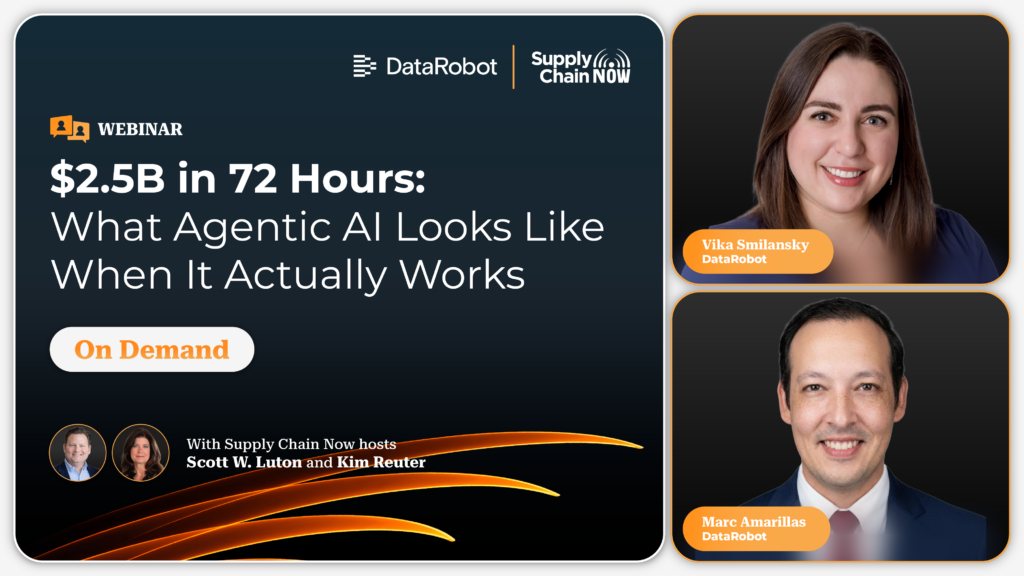

WEBINAR: $2.5B in 72 Hours: What Agentic AI Looks Like When It Actually Works
95% of enterprise agentic AI pilots never deliver ROI (MIT, 2025). The gap isn’t ambition — it’s the jump from a model that works in a sandbox to an agent trusted to act on the plant floor, inside the systems your team already runs on.
This session, with host Scott Luton and featured guests Vika Smilansky and Marc Amarillas with DataRobot, breaks down what that jump actually takes, and what it looks like solved, with agents orchestrated across the value chain, not in isolated silos:
– Supply chain: multi-tier supplier risk and tariff exposure caught before a single-source failure becomes a line-down event
– Plant operations: bottlenecks and downtime caught before they hit the shift report
– Aftermarket: warranty leakage and reactive dispatch turned back into retained margin
We’ll ground our conversation in real use cases, including a tariff signal that put $2.5B in revenue at risk, resolved in 72 hours instead of weeks, with a human signing off at every step.
Not a pilot. Not a dashboard. A production-grade agent workforce — connecting planning, operations, and service to move manufacturers from reactive to proactive.
Webinar Key Takeaways:
- Understand why 95% of agentic AI pilots fail — and the specific infrastructure, governance, and integration requirements that separate production-grade agents from stalled experiments.
- See what an agent workforce looks like across the manufacturing value chain — from supply chain and plant operations to aftermarket services, with concrete examples of what agents actually do at each stage.
- Learn how to move from reactive to proactive across planning, procurement, and operations — with agents that catch multi-tier supplier risk, tariff exposure, and equipment issues before they become line-down events.
- Walk through a real production scenario — how a manufacturing agent workforce, integrated with SAP and powered by NVIDIA, turned a $2.5B supply chain crisis into a 72-hour recovery, with human sign-off at every step.
- Take away a framework for evaluating agentic AI in your own operation — including the governance and integration questions to ask before your next pilot becomes another statistic.
More Webinars

Uncertain Times Fueling Supply Chain Innovations
