
February 9, 2026
AI

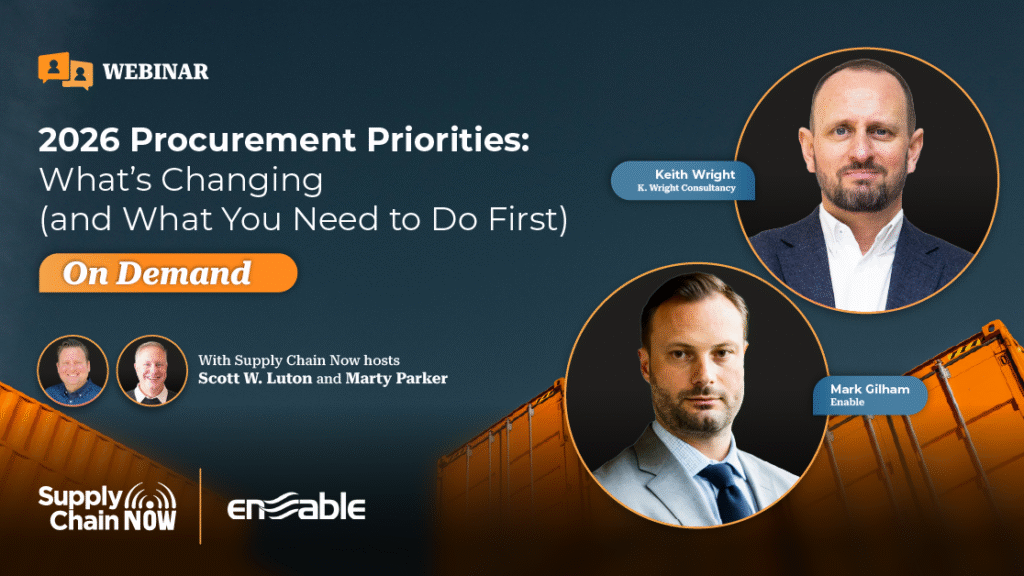
WEBINAR: 2026 Procurement Priorities: What’s Changing (and What You Need to Do First)

Share:

WEBINAR: 2026 Procurement Priorities: What’s Changing (and What You Need to Do First)

Procurement teams already shoulder immense pressure to deliver margin, resilience, and stronger supplier partnerships — and 2026 is only going to heighten those expectations. Fortunately, teams already have a powerful, often under-looked resource at their disposal: rebates.

In this webinar, Supply Chain Now hosts Scott Luton and Marty Parker welcome rebate and procurement experts Mark Gilham from Enable and Keith Wright from K. Wright Consultancy to help you understand how rebates, incentive programs, and joint business planning can create alignment, unlock hidden value, and make your supplier relationships far more strategic.

They will reveal what most procurement teams don’t know about rebates, the full spectrum of incentive programs available, and how these programs can transform suppliers and buyers into a unified go-to-market force.

Join us to learn how organizations are leveraging AI to overcome traditional rebate management barriers, empowering suppliers to offer richer incentives — and giving procurement unprecedented visibility to ensure no money is left on the table.

More Webinars

ERP
play-button-webinar
webinar-person
Webinar
October 17, 2023

A Match Made in Heaven – Your ERP and Inventory Planning Software
ERPs are pivotal in streamlining operations; however, not all ERP solutions provide adequate inventory optimization functionality. SMBs need functionality that provides inventory visibility, automated processes to reduce excess stock and avoid stockouts, precise forecasting capabilities, and predictive analytics to minimize supply and demand risks. Customizing your ERP can lead to expensive challenges in the long term, especially when performing automatic upgrades. Consider using best-in-breed inventory solutions from Independent Software Vendors (ISVs) to enhance ERP functionality without unnecessary complexity, ensuring long-term adaptability and efficiency To balance inventory and costs, businesses need to understand what tools are fit for purpose to help achieve inventory optimization, financial success, and market competitiveness.   From this discussion, the audience will have a better understanding of: – The functionality of ERPs – How to assess if ERPs deliver on inventory goals and capabilities – Identify missing gaps for better inventory planning and optimization – What key features to prioritize when selecting an inventory add-on solution – Rearview vs front window when it comes to forecasting and risk in your ERP – How to measure ROI – how best-of-breed solutions like Netstock show ROI when integrated with an ERP        
Cyndi Lago
play-button-webinar
webinar-person
Webinar
March 18, 2021

New Market, New Mindset

Retail’s new rules have altered the face of fulfillment forever – and modernizing your DC from warehouse to awarehouse is Rule 1. For years, many companies have treated fulfillment as largely a “backroom” function. Enter the COVID-19 pandemic – and its attendant global shutdowns and quarantines – and a company’s ability to keep its products flowing to buyers is in the spotlight. Supply chain leaders now must determine for their companies what “normal” looks like, and guide their executives and Boards to support new decisions and investments based on changing conditions. Whether defining a “new” normal…a “better” normal…a “safer” normal…a “riskier” normal…a “more flexible” normal, or whatever adjective fits best, supply chain leaders need new evaluation and decision frameworks to shape their fulfillment operation investments. Join Jeff Cashman, a 30-plus-year supply chain veteran, as he and Cyndi Lago, Vice President at Capgemini, a global leader in consulting, digital transformation, technology and engineering services, explore various considerations, dilemmas and options facing Chief Supply Chain Officers as they move into what has traditionally been “peak” fulfillment season and – more importantly – what 2021 is likely to have in store.