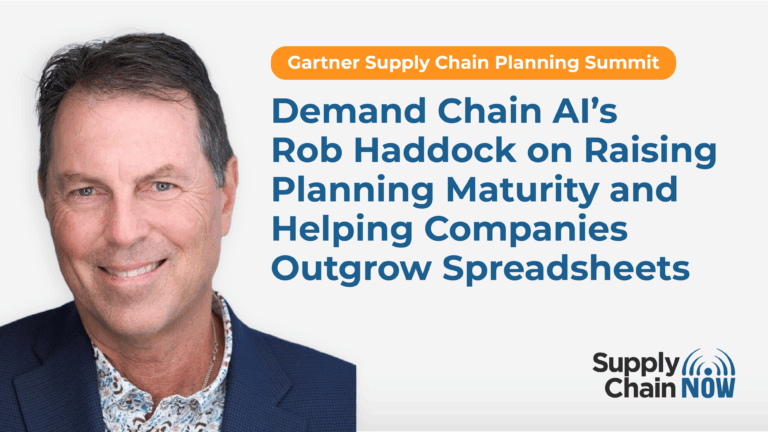

Demand Chain AI’s Rob Haddock on Raising Planning Maturity and Helping Companies Outgrow Spreadsheets
At the Gartner Supply Chain Planning Summit in Denver, Scott Luton caught up with Rob Haddock, a seasoned supply chain practitioner and advisor with Demand Chain AI, to discuss the persistent planning challenges organizations face—and why maturity, discipline, and optimization still matter more than buzzwords.
Demand Chain AI blends consulting services with advanced supply chain technologies, focusing on optimization across trade promotion management, demand sensing, supply planning, and detailed production scheduling. Haddock’s role centers on helping organizations strengthen business processes—particularly sales and operations planning (S&OP), performance reporting, and the practical application of technology to improve execution on both the demand and supply sides.
A Practitioner’s Perspective on Planning Gaps
Haddock’s perspective is shaped by decades spent inside large, sophisticated supply chain organizations. Early in his career, he worked within an iconic, global beverage company where advanced planning environments were already in place—though, in hindsight, he admits those tools were sometimes underutilized.
Today, Haddock spends much of his time working with small and mid-sized organizations that haven’t been as fortunate. In many of these environments, planning maturity is still low, foundational practices are missing, and—unsurprisingly—Excel remains the primary planning tool.
“Basic business practices that have been around since the 1990s are often nowhere to be seen,” Haddock noted. The issue isn’t a lack of potential. Rather, it’s a lack of structure, consistency, and change management.
Successful planning, he emphasized, requires a balance of:
- Sound processes
- The right enabling technology
- Daily discipline and accountability
Without all three, even the best tools fail to deliver value.
From Painful Lessons to Proven Best Practices
Haddock sees a significant opportunity to help organizations accelerate their maturity—both in the mid-market and among larger enterprises looking to refine existing capabilities. Demand Chain AI’s team brings countless decades of experience from large CPG and manufacturing environments, allowing them to guide clients away from common pitfalls.
Rather than forcing one-size-fits-all solutions, Demand Chain AI focuses on:
- Assessing where organizations are today
- Identifying realistic paths to higher maturity
- Introducing optimization tools that improve trade promotion effectiveness
- Enhancing demand sensing to reflect the latest forecast signals
- Modernizing production scheduling and execution
As Haddock put it, “If you’re still sending schedules to your production floor using Excel, we should really talk.”
Helping Companies Grow the Right Way
For Haddock, the mission is simple: help organizations run better today so they can grow tomorrow. Especially for small and mid-sized companies with ambitions to scale, improved planning discipline, waste reduction, and smarter optimization can be the difference between stalled growth and sustainable success.
Demand Chain AI works with growth-oriented companies to remove inefficiencies, strengthen decision-making, and build planning capabilities that scale with the business.
How to Connect
Haddock encourages leaders to connect with him on LinkedIn, where he remains active and accessible. He also shared his enthusiasm for his role as incoming board chair at CSCMP, reinforcing his commitment to advancing the profession and supporting both today’s practitioners and tomorrow’s supply chain leaders. You can also learn more about Demand Chain AI vis their company website.
We invite you to listen to the full audio version of this interview with Scott W. Luton and Rob Haddock: click here.
More Blogs
How the Delivery Experience Is Not a ‘One Size Fits All’