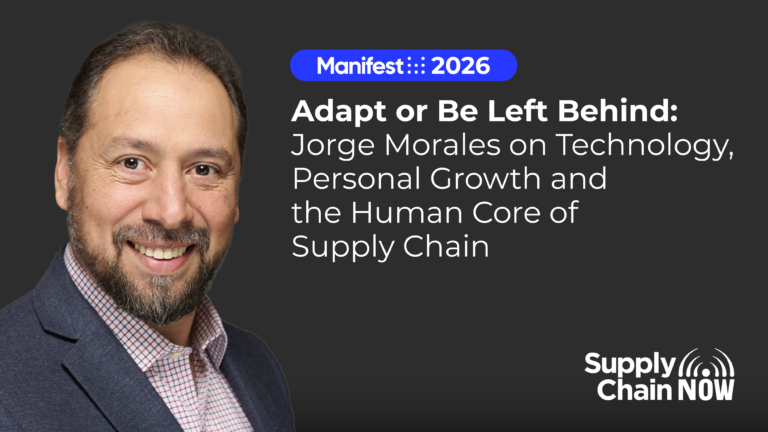
Adapt or Be Left Behind: Jorge Morales on Technology, Personal Growth and the Human Core of Supply Chain
At Manifest 2026, Scott Luton spent time with his friend, Jorge Morales, Global Chief Operating Officer of the International Supply Chain Education Alliance (ISCEA), for a conversation that centered not on hype, but on growth.
ISCEA is a global certification body serving supply chain professionals around the world. But as Morales put it, “We’re in the knowledge business; but most of all, we’re in the personal growth business.”
Through certifications, membership programs, advisory boards, and global events, ISCEA empowers professionals to stay current, expand their networks, and advance their careers. In a volatile era, that mission has never been more relevant.
Beyond the AI Hype Cycle
When asked about dominant themes from 2025 to 2026, Morales pointed to a shift in how the industry views technology.
“Last year we were still in the bubble of the hype of AI,” he said. Many professionals feared being replaced or assumed AI would solve everything overnight. That perspective has matured.
“Technology by itself is not what determines your level of success,” Morales explained. “Understanding the basics, knowing how things work; THAT is key.”
AI and data tools remain critical across procurement, logistics, manufacturing, planning and more. But success depends on how organizations harness them, not simply whether they deploy them.
Technology supports processes. It doesn’t regularly replace judgment.
Forecast Error and the Limits of Prediction
Morales offered a practical example: demand forecasting. AI has been embedded in demand planning for years, and yet forecast accuracy remains imperfect. But perhaps that’s the wrong metric.
“We cannot see the future,” Morales said. “Forecast error may remain the same.”
The value of technology lies not in eliminating uncertainty but in illuminating the drivers behind it; helping teams understand which factors truly matter and which do not. That insight allows organizations to execute better even when forecasts aren’t perfect.
And execution, not prediction, is where competitive advantage lives.
Volatility Is the New Constant
If there’s one defining challenge of 2026, Morales believes it’s volatility.
“Most assumptions that we thought were immutable: they’re not,” he noted.
Trade policies shift. Geopolitics evolve. Climate events disrupt. Consumer behavior changes quickly. But Morales doesn’t see 2026 as necessarily tougher than 2025.
“It’s tough if you are fixed on the way you were doing things before,” he said. “If you let go and embrace change…it becomes fun.”
The difference lies in mindset. Organizations clinging to old playbooks feel pressure. Those willing to adapt unlock creativity.
Education as a Strategic Advantage
So how does ISCEA help its global community navigate disruption? Morales outlined two primary levers: events and education.
ISCEA hosts major gatherings such as the Sustainable Supply Chain Pledge and the Supply Chain Technology Conference (SCTech), providing global professionals access to emerging trends, peer insight, and evolving best practices.
But perhaps more critical is how ISCEA continuously updates its certification programs.
The Certified Supply Chain Technology Professional (CSCTP) program was refreshed in early 2026 to incorporate both core enterprise technologies, such as ERP, WMS, TMS, and emerging technologies like AI and data science.
Other certifications are evolving as well:
- Certified Forecasting & Demand Planning (CFDP)
- Certified Professional in Sourcing and Procurement (CPSP)
Procurement training now incorporates reshoring and nearshoring alongside traditional offshoring strategies, reflecting today’s geopolitical reality.
“The important thing is that you are doing something,” Morales emphasized. Staying current. Staying connected. Staying engaged. Adaptation isn’t passive.
Start Inside, Then Apply Technology
One of Morales’ most compelling insights at Manifest 2026 came from a simple truth: before chasing AI, look inward.
“What’s that constraint, that problem, that if you solve it, you gain a competitive edge?”, he asked.
Technology must be tied to a specific need. Organizations that adopt AI without clarity risk disappointment. Those that identify their bottleneck first can apply AI surgically. And win.
It’s not about the tool. It’s about the problem.
The Human Core Remains
While AI anxiety persists, Morales aligns with a broader optimism: technological revolutions create opportunity for those willing to learn.
“The human factor remains the central piece,” he said.
Tribal knowledge. Critical thinking. Adaptability. Culture. These cannot be automated away. In fact, in a world of accelerating technology, they become more valuable.
As Darwin observed: it’s not the strongest who survive, but the most adaptable.
And in 2026, adaptability begins with education. For Morales and ISCEA, the mission is clear: empower professionals to evolve with the industry, not be overtaken by it.
Where to Learn More
Connect with Jorge Morales on LinkedIn here. We invite you to learn more about ISCEA via its website: https://www.iscea.org/. And while the SCN team enjoys a variety of ISCEA programming, we invite you to check out SC Tech, in particular: https://www.sctechshow.com/
More Blogs
Anything is Possible: Josh Gruenstein on AI Workers, Throughput Pressure, and the Next Revenue Lever in Supply Chain