Supply Chains That Bend, Not Break
This post is written in partnership with Reuters Events: Supply Chain. Reuters Events connects the world’s most senior supply chain leaders through conferences, research, and digital content. Learn more: events.reutersevents.com/supply-chain/usa
When decisions cannot keep pace with change
There is a moment most planning leaders recognise right now: A tariff announcement lands. A carrier pulls capacity. Demand accelerates faster than the forecast adjusts. The decision window compresses, and by the time there is confidence in the data, the cost of delay is already building.
These pressures across supply chains are not new. What has changed is the speed at which conditions move underneath a decision, often faster than organisations are set up to respond.
Customer expectations do not flex when supply does not. The cost of a wrong call, whether inventory in the wrong market, capacity committed too early, or service levels slipping before anyone flags them, compounds quickly.
Most organisations have responded by investing. Better tools. More data. AI pilots. Network reviews.
The core problem persists: decisions are still being made without full confidence. Planning and execution do not align when conditions change.
In many cases, the issue is not disruption itself. It is how long organisations take to decide what to do about it. At this level, hesitation is expensive. It is also where performance starts to diverge.
Why investment is not delivering results
What is becoming clearer is that the answer does not start with more technology. It starts with whether planning and execution still align when conditions change. Whether teams can act on data quickly enough to move inventory, adjust capacity, or protect service levels before cost builds.
Trusted information. Alignment between planning and execution. Clear ownership of decisions.
That foundation allows AI and automation to deliver.
Without it, organisations are not transforming performance. They are accelerating a system that breaks under pressure instead of bending with it.
Where decisions get tested before they are committed
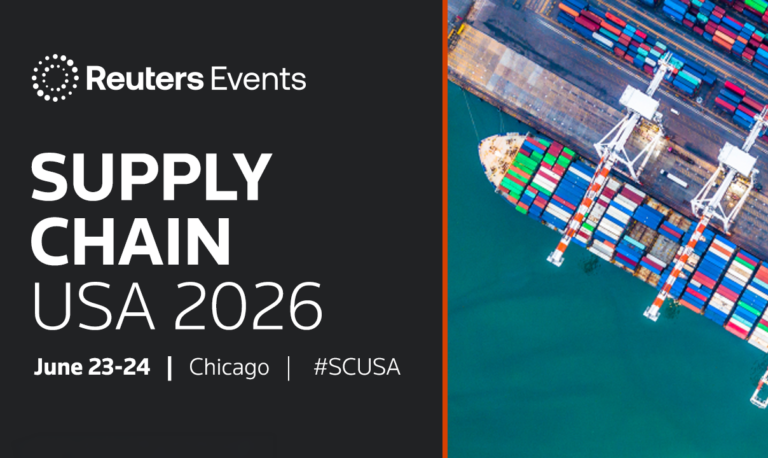
This is the gap Reuters Events: Supply Chain USA 2026 (23–24 June, Chicago) is designed to address.
The focus is not on sharing best practice. It is on testing real decisions against peers working under the same pressures before committing budget, resource, or structural change internally.
Four areas consistently sit at the centre of those trade offs:
- Design for disruption: where the network needs flexibility, and where it should stay fixed
- Focus on the customer: how to balance service and cost when visibility is incomplete
- Innovate at scale: which AI investments deliver measurable ROI and which do not scale
- Partner for performance: where supplier and logistics dependencies introduce risk
What matters is using these themes to test real decisions against live operating examples and peer experience before committing internally.
Direct access to how these decisions actually play out
Each session at #SCUSA is built around a real operating case study, followed by discussion and time to engage directly with the speaker.
That means hearing how decisions played out in practice, then questioning the leaders behind them to understand what worked, what failed, and what this means for your own operation.
One example is a live case study from Nike’s supply chain leadership, focused on demand driven by global events like the 2026 World Cup. Planning cycles compress, demand spikes quickly, and there is no margin for delay. The discussion shows what happens when forecasts fail, what gets prioritised under pressure, and what that means for where to lock decisions early in your own network and where to maintain flexibility.
A second case study brings together supply chain and AI transformation leadership at AT&T. The focus is not that AI delivers ROI, but where that return actually comes from, what had to change operationally to achieve it, and what did not scale. That directly informs where further investment is justified and where it is likely to fall short.
In logistics, the focus turns to autonomous freight. At Waabi, the discussion centres on where autonomy improves predictability in live networks today, where it introduces risk, and what must change across partner ecosystems before adoption becomes viable. This helps leaders assess whether autonomous capacity should be factored into near term planning decisions.
Across each case, the outcome is clear: understanding how similar decisions performed in reality, and using that to decide where to invest, what to change, and what to avoid once back in the business.
Interpreting the signals shaping your supply chain
A second layer sits outside the organisation: understanding which external developments should trigger immediate change in sourcing, planning, or network design.
Tariffs, trade realignment, and regulatory pressure are continuously reshaping supply chains. The challenge is not seeing these changes. It is knowing how to respond to them.
The Reuters Editors’ Briefings provide that perspective. These are journalists tracking global trade, tariffs, and geopolitical shifts in real time under the Reuters Trust Principles.
They focus on the specific signals that change decisions:
- Which shifts are structural and require immediate action
- How governments and trading partners are responding in practice
- Which developments should inform short term actions versus long term commitments
For leaders making forward commitments, this determines whether decisions are made too early, too late, or in the wrong direction.
How decisions get made in practice
Sessions move quickly into specific decisions, where approaches worked, where they failed, and what changed as a result. You leave with a clear understanding of which KPIs were used, how ROI was measured, and what can be applied directly within your own operations. Participants are working through similar constraints, which allows assumptions to be challenged directly. Conversations extend beyond sessions, where detail becomes practical and comparable.
Across more than 18 hours of networking, the dynamic shifts from sharing ideas to working through decisions with peers operating at the same level of complexity.
The result is simpler: avoiding decisions that look correct in theory but do not hold once implemented.
Move faster with greater confidence
The challenge is not understanding the problem. It is deciding what to do next and acting with enough confidence to move.
In most organisations, decisions are tested internally against the same assumptions that created the uncertainty in the first place.
Reuters Events: Supply Chain USA 2026 provides the opportunity to step outside that loop, test decisions against peers who have already made them, and move faster on priorities that typically stall internally.
If the priority is to accelerate investment, reduce execution risk, and make decisions that hold under pressure, this is where those decisions get made faster.
- Explore the full agenda to see where your next decisions can be tested: https://events.reutersevents.com/supply-chain/usa/agenda
- Register now to secure your place: https://events.reutersevents.com/supply-chain/usa/register
- Use code SCN200 to save $200 on your pass.
For more information, contact the Senior Conference Producer: abigail.blackwell@thomsonreuters.com
More Blogs

Critical Mass: Inside the Coalition Building America’s Circular Supply Chain