[00:00:00] Chris Caplice: one of the interesting things, if you look at December 2024 and December 2025, they looked identical in the markets. But as we came into 2025, the tariffs hit, and that kinda cratered the market. but what happened in 26 now, would’ve happened in ’25 without those tariffs. because if you look at the general cycles, they happen this way. As prices go up, more capacity comes in, gets over-capacitated, and, you know, the cycle moves.
[00:00:38] Scott W. Luton: Hey, hey, good morning, good afternoon, good evening, wherever you may
[00:00:42] Scott W. Luton: be. Scott Luton and Supply Chain Hall of Famer, Jake Barr here with you on Supply Chain Now. Welcome to today’s live stream. Hey Jake, how we doing today?
[00:00:50] Jake Barr: I am hot and heavy just like freight rates are
[00:00:53] Scott W. Luton: And just like the rest of the world is right now. Man, this heat wave’s been something. But folks, we got a great show teed
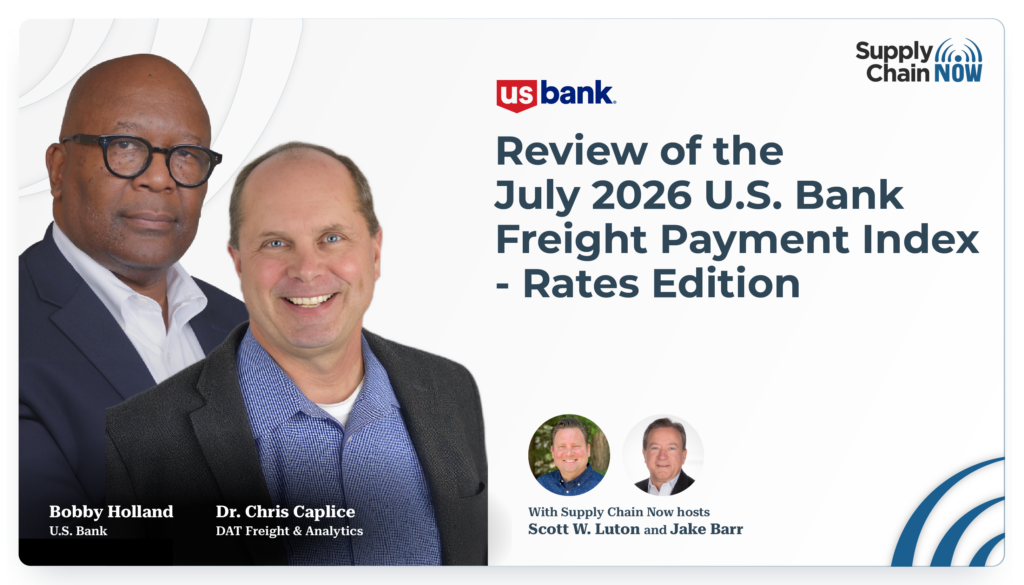
[00:00:59] Scott W. Luton: up, folks. We’re going to dive into the third installment of the U.S. Bank Freight
[00:01:03] Scott W. Luton: Payment Index Rates Edition. And as Jake just mentioned, hey, we all know the Freight Payment Index has been around for years, but at the beginning of 2026, U.S.
[00:01:13] Scott W. Luton: Bank partnered with DAT Freight Analytics to produce a supplementary report called the Rates Edition. It provides a unique market perspective into a variety of data and helpful info, dry van spot rates, contract rates, fuel average, cost per mile rates, along with important economic context and perspective.
[00:01:34] Scott W. Luton: Now, why is this important? Well, Jake, this resource is a joint project, again, delivered to the market by these two data powerhouses, U.S. Bank, which processes, processes more than $46 billion in freight payments annually, and DAT Freight Analytics, who has an incredible database of more than one trillion in freight market transactions.
[00:01:58] Scott W. Luton: So Jake, what does this mean? The Rates Edition, along with the conversation, is gonna help supply chain professionals better understand what’s going on in the freight market, and better yet, what they can do to better navigate the months to come. Jake, should be a great
[00:02:11] Scott W. Luton: conversation. Is
[00:02:12] Jake Barr: Absolutely. We’re talking about the godfathers of freight here
[00:02:15] Scott W. Luton: all right. So Jake,
[00:02:16] Scott W. Luton: with no further ado, let’s bring in the Godfathers of Freight, Bobby Holland,
[00:02:22] Scott W. Luton: Director of Freight Business Analytics at
[00:02:23] Scott W. Luton: U.S.
[00:02:23] Scott W. Luton: Bank, and Dr. Chris Caplice, Chief Scientist with DAT Freight
[00:02:28] Scott W. Luton: and Analytics. hey, Bobby. Great to have you back. How you doing?
[00:02:32] Bobby Holland: I am doing well.
[00:02:34] Scott W. Luton: One, do you like your new title that
[00:02:36] Scott W. Luton: Jake,
[00:02:36] Scott W. Luton: uh, bestowed upon you and
[00:02:38] Jake Barr: The Godfather’s afraid
[00:02:40] Bobby Holland: It’s a, it’s a scary one to live up to,
[00:02:41] Bobby Holland: but I’ll do my best
[00:02:43] Scott W. Luton: And Chris Caplice, Dr. Chris Caplice, great to have you here. How you doing?
[00:02:48] Chris Caplice: Doing all right. Glad to be here
[00:02:50] Scott W. Luton: Well, it’s great to have y’all both back here. We got a lot of stuff to get to, but we’ll start with a little fun warm-up question, Chris, Bobby, and Jake. So to– and, and we’re gonna base this on some business history ’cause I’m a bit of a history nerd.
[00:03:01] Scott W. Luton: So on today’s date, July 14th, way back in 1906, Tom Carvel was born in Athens, Greece. He’d later immigrate to the United States, borrow $15 from his future wife, Agnes, and he’d use
[00:03:15] Scott W. Luton: that to start the famous Carvel Ice Cream Company. The rest is history. Carvel has some 373 locations today,
[00:03:24] Scott W. Luton: and
[00:03:24] Scott W. Luton: of course, I’m truncating that incredible story.
[00:03:26] Scott W. Luton: But, you know, one of my go-tos of beating the heat is
[00:03:29] Scott W. Luton: ice cream. Chris, I wanna ask you, what
[00:03:31] Scott W. Luton: is your best practice to beating,
[00:03:34] Scott W. Luton: for beating the heat?
[00:03:35] Chris Caplice: Uh, leave town. I mean, get, get to where it’s cooler. But I like ice cream too. I mean, uh, black raspberry
[00:03:41] Chris Caplice: ice cream is, is the best, or salted caramel.
[00:03:44] Scott W. Luton: Okay. All right. Folks, we want to hear your flavors if you’re an ice cream fan out there. Uh, Bobby, same question. Is it ice cream? How, how do you beat the heat?
[00:03:53] Bobby Holland: ice. Lots of ice, but ice cream will work too. Um, I’m a, I’m a vanilla guy. I’ll put stuff on it, but I’m a, van- I’m a vanilla
[00:04:00] Bobby Holland: guy
[00:04:01] Scott W. Luton: And Bob, you shared pre-show with us that you put, uh, was it, uh, pecans or, um, spinach
[00:04:07] Bobby Holland: peanuts
[00:04:08] Scott W. Luton: on vanilla ice cream. That’s new for me. I have to give it a try. Um,
[00:04:12] Bobby Holland: half of a Sunday
[00:04:13] Scott W. Luton: okay. All right. So Jake, we got ice cream recommendations from Chris and Bobby. Your take for beating the heat?
[00:04:21] Jake Barr: Uh, well, I’ll jump in. I’ll say ice cream as well, and strawberry. But given the fact that Chris made the foray into black raspberry chip, you know, I’m going to say everybody knows the best ice cream is Graeter’s. Why? Because Oprah ended up resulting in two new
[00:04:40] Jake Barr: factories being built after she put it at the top of her list
[00:04:44] Scott W. Luton: Okay
[00:04:44] Chris Caplice: the thing is every town up here in New England has the best ice cream. There’s so many local shops. It’s like breweries up here. So every town has the best. So there’s good ice cream everywhere
[00:04:54] Scott W. Luton: All right. We’re gonna have to have a, a ice cream, uh, investigative, uh, podcast series. We’ll see.
[00:05:00] Scott W. Luton: all right, so we’re gonna level set here. We got a lot to get to here today. And Chris, again, great to have you back. You set the markets ablaze with your last appearance here at Supply Chain Now.
[00:05:09] Scott W. Luton: Let’s level set for the three people out there
[00:05:11] Scott W. Luton: that may not know, you know, what you do and
[00:05:14] Scott W. Luton: what DAT Freight Analytics does. Would you shed light on both, please?
[00:05:18] Chris Caplice: Yeah, sure. My name is Scott– Chris Caplice, Chief
[00:05:20] Chris Caplice: Scientist of– at, uh, DAT Freight Analytics. I was part of an acquisition from a company called Chainalytics back in twenty twenty, brought over the shipper side of benchmarking. and essentially, DAT is the market, leading, uh, Freight Analytics, uh, platform, um, serving shippers, carriers, brokers.
[00:05:38] Chris Caplice: We lead the market in far as broker solutions. we help, Um, brokers match, identify loads, benchmark their rates, pretty much all in one. On the shipper side, we’ve been doing this for a number of years at Chainalytics prior, but we help shippers, carriers, and, brokers make better decisions, make the market more, efficient
[00:05:54] Scott W. Luton: Hmm. I like it. Making those better decisions. Critical, critical here today. Uh, Chris, thanks for being back with us. And by the way, Tricia agrees with you,
[00:06:03] Scott W. Luton: greatest– Actually, it wasn’t Chris,
[00:06:05] Scott W. Luton: it was Jake that rec- highly recommended graders. Okay. All
[00:06:09] Scott W. Luton: right. All right, so Bobby, you’re no stranger to our Supply Chain Now Global fam.
[00:06:15] Scott W. Luton: Uh, we’ve been collaborating for years to help inform supply chain leaders of what’s going
[00:06:18] Scott W. Luton: on in the domestic freight markets and
[00:06:20] Scott W. Luton: more. But for folks new, first time maybe here today, tell us about the U.S.
[00:06:25] Scott W. Luton: Bank Freight Payment Index, please
[00:06:27] Bobby Holland: Well, the Freight Payment Index Rates Edition is a new publication. It is a two-page, easy-to-read publication. It– what we’re trying to do with it is to make freight rate movement easier to understand and more useful in real customer decisions. So we have this two-page document. It shows rolling six-month and year-over-year views of contract, spot, and fuel rates.
[00:06:52] Bobby Holland: And then the commentary kind of connects those rates and the rate movements to broader market conditions. and we wanted it to be a connect– a connection point between our quarterly regular freight payment
[00:07:04] Bobby Holland: index document.
[00:07:06] Scott W. Luton: And, and Jake, picking back up on
[00:07:08] Scott W. Luton: what Bobby shared there, you know, you’re no stranger, been working in the industry for over 30 years, supply chain hall of famer. Uh, tell us about the value of resources like this
[00:07:17] Jake Barr: Hey, you can never have enough data, especially productive data, data that’s actually been vetted thoroughly and can help you with providing you the ability to think about the implications of which way the market’s heading. Because ultimately, you’ve got to be able to serve the market, whether you’re a shipper, how you provide service as a transportation agent, and you’ve got to be able to do that in an efficient way, right?
[00:07:43] Jake Barr: ‘Cause you’re not running charities. You, you’re running live operating businesses. And so you’ve got to be able to understand, do I need to invest in more equipment? Yes or no? If so, where, right? How do I think about that? If you’re on the shipper side, you’ve got to say, “Hey, how do I make sure that I’m not eroding my margins and causing me to actually have to lift prices in an inflationary period, right?
[00:08:06] Jake Barr: When I don’t need to.”
[00:08:08] Scott W. Luton: Hmm. All right. So we could dive right into the report, but I got a couple more things I wanna unpack, uh, ’cause these are great resources for folks. And Chris, I tell you, I, we, I think we both enjoy, the, the world enjoys, uh, Dr. Jason Miller’s perspective on the market. Uh, you had him on your, uh, great podcast here recently, Freight Vine.
[00:08:28] Scott W. Luton: Folks, go find that. And I wanna pose this to you ’cause one of the questions I think you and him both spoke to was this one. It’s kind of a two-parter. Is the truckload market finally turning, or are we just watching a freed, a, a feeding frenzy fueled by AI
[00:08:43] Scott W. Luton: hype? Share a couple co- observations there, Chris
[00:08:47] Chris Caplice: yeah, it’s, it’s a kind of a mix of the two. So the thing about the market turning, the only surprise is that people are surprised. I mean, the market, this is what it does. We’re a supply and demand industry. We have such a long tail of small providers that come in and out of the market, so we’re gonna constantly cycle.
[00:09:04] Chris Caplice: And, uh, one of the interesting things, if you look at December 2024 and December 2025, they looked identical in the markets. But as we came into 2025, the tariffs hit, and that kinda cratered the market. Um, but what happened in ’25, uh, in, in ’26 now, would’ve happened in ’25 without those tariffs. Uh, because if you look at the general
[00:09:25] Chris Caplice: cycles, they, they happen this way.
[00:09:27] Chris Caplice: As prices go up,
[00:09:28] Chris Caplice: more capacity comes in, gets over-capacitated, and, you know, the cycle moves. What makes this one different, this cycle, it’s more, um, capacity-driven. Usually it’s demand-driven. You think of the pandemic and in, uh, Q3 of
[00:09:41] Chris Caplice: 2020 when everyone was buying a bunch of stuff, that really drove demand.
[00:09:46] Chris Caplice: Here it’s more capacity. We’ve seen a
[00:09:48] Chris Caplice: lot of capacity driven out of the market, mainly drivers, and we can
[00:09:51] Chris Caplice: talk about that, um, the different things that have done. And so this is really a capacity-driven cycle, um, but it’s having all the same effects. Um, whenever supply and demand is out of sync, it’s either gonna be a tightening market or a loosening market.
[00:10:04] Chris Caplice: We’re, we’re tightening, have been since December 2025
[00:10:08] Chris Caplice: the reason why capacity is, is tighter, ’cause drivers have been driven
[00:10:11] Chris Caplice: out, but the demand is relatively stable except
[00:10:15] Chris Caplice: in data center build-out. And, and you, we think data center build-out, and there’s a really great article by, uh, um, The Wall Street Journal recently that talked about the, you know, the impact on freight, on air freight, and that’s really big.
[00:10:27] Chris Caplice: Liz Walker’s wr- walked throughout that. But then also you look at flatbed, you consider that makes sense. But a lot of dry van carriers are, there’s a lot of stuff that goes into these centers, and that’s really propping up the demand side. Um, but the real thing that’s driving this cycle and tightening the rates is capacity
[00:10:45] Scott W. Luton: You know what? I saw that same article. In fact, we reported on over the weekend, the one in Wall Street Journal and how the data center boom, AI investment boom is really, uh, uh, uh, doing crazy things with the air freight market in particular. Jake, he called you out. You agree or disagree with Dr. Chris Caplice?
[00:11:03] Jake Barr: Chris has more titles than I have, you know, time to talk through. All Right
[00:11:08] Jake Barr: So, but I, actually fully agree with him on this. Absolutely. A- and I’ll, I’ll point to a data point that I actually think Chris probably has detailed stats on. The percentage of rejects, the percentage of rejects in today’s market is incredibly high.
[00:11:31] Jake Barr: So that is also another telltale factor of capacity. The carriers are in control. We’ve swung to the point where the carriers are in control, and they are saying, “No, no, no. I’m not going and flooding the market with additional equipment. I’m actually going to take advantage here, and I’m going to be choiceful about what loads I take and at what price
[00:11:57] Scott W. Luton: I got a two-part question to ask the whole panel. And, uh, actually, you know, Bobby, I wanna lead with you here, if that works. I’ma, I’ma bring up the, um, Rates Edition here and some of the key metrics that you’ll find, folks will find at the very top of, um, each of these editions. And so the two-part question here.
[00:12:15] Scott W. Luton: What’s changed the most in the freight market since the very first Rates Edition, which again, was only six months and some change ago. It feels like 60 years ago, though. And what’s one thing that stands out the most in this latest release? So Bobby, I know you’re chomping at the bit. Your thoughts on those questions.
[00:12:33] Bobby Holland: So what’s changed in the marketplace, uh, since then? I th- I agree with the comments before that this has become, a pricing power move, uh, or market for carriers. Um, again, the, the rates have gone up, uh, as Jake put it and as Chris put it But we haven’t had– The prices have gone up, the, uh, capacity has gone down, and again, it just points to whatever.
[00:12:59] Bobby Holland: I can’t really add a lot more. The carriers are in control right now, uh, until that changes, um, for all the reasons that we’ve discussed, exits. Uh, there’s a lot of, you know, legal impacts that have affected drivers and causing shortages. Uh, so there’s a lot of, of pressure in, in that regard, and that’s changed, not to mention gas prices.
[00:13:20] Bobby Holland: So you kinda see all of these things working in tandem to, to drive the prices up. But it’s not, uh, it’s not,
[00:13:28] Bobby Holland: demand-led, definitely not, as we’ve all agreed
[00:13:30] Scott W. Luton: Yep. And we’ll touch on those diesel prices here momentarily. Uh, Chris, same two questions. What’s changed the most since January, and one thing that
[00:13:38] Scott W. Luton: sticks out?
[00:13:39] Chris Caplice: I, I think it’s, uh, the big thing is the trends continued. So in, uh, like I said, December 2025, You know we saw everything going up. We’re saying, “Okay, is something gonna happen?” Because a lot of transportation executives at shippers have been caught crying wolf for the last three years. “This year it’s gonna tighten up.
[00:13:56] Chris Caplice: This year it’s gonna tighten up,” and this year
[00:13:57] Chris Caplice: it finally did. And so we saw it
[00:13:59] Chris Caplice: hold through Q1, Q2, and it, it, it continued on. We didn’t know if it would crater
[00:14:04] Chris Caplice: back down again if volumes had
[00:14:06] Chris Caplice: decreased. So I think we’ve seen it
[00:14:08] Chris Caplice: continue and kind of ramp up and pick up its speed a little bit. But a- any of us who’ve been in this market long enough,
[00:14:15] Chris Caplice: you know where it’s heading.
[00:14:16] Chris Caplice: Uh, you look at, uh, what spot rates do, dynamic
[00:14:19] Chris Caplice: rates do, and that’s con- usually about a six-month to nine-month lead what
[00:14:22] Chris Caplice: contract rates do. Uh, you, you look over year-over-year.
[00:14:25] Chris Caplice: So there are a lot of signals to what Jake said earlier. There’s so
[00:14:28] Chris Caplice: much data out there. And the two big things, it’s not just more data, it’s better data.
[00:14:34] Chris Caplice: We
[00:14:34] Chris Caplice: have– We’re better than we were in
[00:14:35] Chris Caplice: the ’90s. Oh my God, that was,
[00:14:36] Chris Caplice: that was horrible. But then it’s also better
[00:14:39] Chris Caplice: distributed. It’s not just like some analysts have this data. Every shipper, every carrier, every
[00:14:44] Chris Caplice: broker has access to this. Carriers, owner-operators have The market on
[00:14:47] Chris Caplice: their smartphone. So we have so
[00:14:49] Chris Caplice: much more access to this data, I think we’re able to
[00:14:52] Chris Caplice: respond to it much faster. And so we’re, we’re
[00:14:55] Chris Caplice: reacting to that. And so I’m I’m seeing that happening more and more. But one of the quick thing about something Jake said, the
[00:15:00] Chris Caplice: rejects. I agree with that, but that is kind of an older framework for the way that uh, ship transportation’s being procured, especially truckload. It used to be everything gets in the bid, goes in the routing guide, and then you have
[00:15:13] Chris Caplice: rejects and failures there. We’re seeing a larger and larger percentage of, loads goes direct to spot. Spot is strategic. so we’re seeing about
[00:15:20] Chris Caplice: 20% of the volume going that way. So just looking at rejects misses a big section of the market. So what we do at
[00:15:27] Chris Caplice: DAT, we look at the dynamic rate. If a rate hasn’t appeared for a certain amount of time,
[00:15:31] Chris Caplice: it’s dynamic. Whether you call it spot, call
[00:15:34] Chris Caplice: it a failure, whatever, it’s not a contracted rate. And you’re exactly right. that is going
[00:15:38] Chris Caplice: through the, roof now, but a lot of it is not just rejects, it’s just the shippers are better at handling this,
[00:15:45] Chris Caplice: this freight that’s random And not regularly scheduled
[00:15:47] Scott W. Luton: Okay. All right. And Jake, before I get your comments, I just want to point out, Chris bemoaned how bad things were in the ’90s, but hey, the music was pretty good, Chris. The music was pretty good in the 1990s. All right. So Jake, weigh in on those two questions. What’s changed the most since the first of the year And one thing that stands out
[00:16:04] Jake Barr: I never had a CEO or CFO ask me about my musical taste doing that. They asked me what, what was I spending and what was I spending it on, and where, where were the pain points, right? So I I, again, I wanna echo what Chris said because he, he’s right on The spot piece, If you look at that at the moment, is also through the roof.
[00:16:25] Jake Barr: And I, and I, I believe that is also a testament to the analytics and the AI capability. Folks are using the available information and trying to leverage it quickly in acquiring support, freight rate support against needs, right? So it, it’s, um, I, I describe it as, you know, we, we might’ve been in a squirrel cage running around for a loose peanut in the squirrel, in the cage in the ’90s.
[00:17:00] Jake Barr: We’re
[00:17:00] Jake Barr: on hyperdrive, okay?
[00:17:02] Chris Caplice: Yeah. If you look at dry van, I’m just looking at some numbers right now for DAT, just popping it up. We’re about 24% dynamic or
[00:17:08] Chris Caplice: spot. That’s not all just rejects. That’s the non-reoccurring rates. Look at it that
[00:17:13] Chris Caplice: way.
[00:17:14] Chris Caplice: That’s about 10%,
[00:17:15] Chris Caplice: 10 points higher than typically it was about a
[00:17:17] Chris Caplice: year, year and a half ago. So yeah, it’s, it’s higher.
[00:17:20] Chris Caplice: And flatbed’s
[00:17:21] Chris Caplice: even crazier. Flatbed is, gosh, I’m seeing it peaking at, uh, almost 50% in our,
[00:17:27] Jake Barr: I think flatbed
[00:17:28] Jake Barr: is going to go double that, Chris,
[00:17:30] Jake Barr: in the, in the, coming. And the reason I say that is there’s such a limit right now on the capa- Look, flatbeds were
[00:17:38] Jake Barr: and have always been a valuable piece
[00:17:41] Jake Barr: of a network design. But the reality is no one and no party ever created the amount of capacity in flatbed to be able to move components to build these data centers at the rate at which we’re trying to put them up
[00:17:54] Bobby Holland: Yeah, I think that’s what makes it, uh, a standout is the fact that it moves so quickly. The speed of the move in spot rates relative to what the volume was doing and, you know, you guys have helped identify some of the reasons why that moved so fast. Um, and, but I also agree too that, you know, because of the data, customers are, are paying more attention to all these factors and, and, and fine-tuning their, their strategies to
[00:18:19] Bobby Holland: deal with the current state of the market and, and how fast it’s moving
[00:18:23] Chris Caplice: Yeah, but the one thing that’s constant though, CFOs are still stymied why, uh, contracts are breaking. I thought a contract was a contract. Why are they asking for their rates to come up? It’s like it, it does the same as it ever was
[00:18:35] Scott W. Luton: Same as ever was. We got a lot more to get into, a lot more to get into this edition. But I wanna, I wanna work in this perspective, uh, from Alex Terry, who serves as director of transportation with Veritiv, a leading provider of packaging, print, and facility solutions. Alex was quoted in the rates edition saying, quote, “Freight volumes may appear stable, but costs are telling a different story.
[00:18:57] Scott W. Luton: As contract rates catch up to spot pricing, shippers face growing exposure to higher transportation spend.” End quote.
[00:19:05] Jake Barr: let’s quote a Rocky movie with Clubber Lang. If you’re a shipper, I predict pain, okay? Pain over the coming months, okay?
[00:19:15] Scott W. Luton: That’s one of my favorite moments in that whole series, uh, Jake. Uh, Chris. I want to ask you though, so The Rates Edition, uh, this edition installment of the Rates Edition covers market activity through about the end of May, right. 2026. So
[00:19:29] Scott W. Luton: in particular, Chris, in the last few
[00:19:30] Scott W. Luton: weeks, your observations of what we’ve seen
[00:19:33] Chris Caplice: Yeah, more of the same. The, The,
[00:19:35] Chris Caplice: trends continue. So the qui- real question at the end of May was, would it continue
[00:19:39] Chris Caplice: or is it a blip? The produce season, is that gonna take it off or is that gonna fade
[00:19:43] Chris Caplice: away? and the answer is, it’s continuing. Um, and So we’ve seen rates continue to rise, um, and, uh,
[00:19:50] Chris Caplice: exactly to the point, the spot rates really jumped up, but contract
[00:19:53] Chris Caplice: rates are starting to follow now. Something we always look at here at DAT is the new rate
[00:19:58] Chris Caplice: differential, looking at rates coming in for contract versus the rates
[00:20:01] Chris Caplice: that
[00:20:01] Chris Caplice: are leaving, and look at that. and right now, that’s, uh, right around
[00:20:06] Chris Caplice: 13% for dry van, which means that you can expect on
[00:20:09] Chris Caplice: average, right, your new rates if you were on a bid, about 10 to 12% higher.
[00:20:14] Chris Caplice: That’s, that’s huge.
[00:20:15] Chris Caplice: It hasn’t been that high since, uh,
[00:20:19] Chris Caplice: 2021.
[00:20:20] Chris Caplice: So it’s a big, it’s a big jump right now. But we have to remember, it, was flat for about three
[00:20:25] Chris Caplice: years, let’s say. So one, what we, were
[00:20:27] Chris Caplice: talking about before the show, you
[00:20:29] Chris Caplice: know, uh, where I s- how I stand depends on where I sit, right? So this is the best of
[00:20:34] Chris Caplice: times for brokers and carriers, just like for shippers, the last three years were awesome.
[00:20:39] Chris Caplice: So it’s, you know, it, it depends. It’s the same coin, different sides
[00:20:42] Scott W. Luton: Same coin, different sides. Uh, Jake, I know you wanna get a comment in here, maybe you too, Bobby, really quick on what we’ve seen in the last few weeks. Jake
[00:20:51] Scott W. Luton: Pain,
[00:20:51] Jake Barr: Go Bobby. Go Bobby. It’s suicidal to make a comment at this point
[00:20:56] Bobby Holland: Yeah, no, I I mean, I mean, it’s basically The conclusion we’ve all come to, which is that, you know, shippers need to stress test their budgets. They need to basically review their operations. They need to look at their contracts and spot rates carefully, and basically make sure that whatever strategy they have fits this market instead of trying to hope that, you know, what they’re doing is gonna get them through this They have to, they have to
[00:21:17] Bobby Holland: adjust, and it, an indication sounds like they are
[00:21:20] Scott W. Luton: All right. So I want to– Speaking of recent marketing, market activity, the US Energy Information Administration just this morning published the latest regional and national data on several things, But including the US on-highway diesel prices. Now, check this out. It’s no– Probably surprises no one out there.
[00:21:38] Scott W. Luton: If you look at the price changes from two years ago, one year ago, one week ago, every single price is up except one. Somehow, the New England market has managed to lower on-highway diesel prices this week from last week. I’m assuming, Chris, you’ve got some
[00:21:54] Scott W. Luton: magic sauce you’re putting on up there on the New England market,
[00:21:57] Scott W. Luton: Chris, huh?
[00:21:58] Chris Caplice: No, it’s still, you know, 40 cents a, a gallon higher than average. I mean, it’s just a, just dropped a little bit, three cents. I mean, negative .031. I, I wouldn’t write home about that. We’re still way above, above average
[00:22:12] Chris Caplice: market. We’re not California, thank God,
[00:22:15] Chris Caplice: But we’re, we’re getting there
[00:22:17] Scott W. Luton: All right. So folks, y- you’re, we’re gonna double down on some of the themes you’ve already heard from Chris and Bobby and Jake. uh, we’re gonna put a finer point on some of these things, as well as get into a few other key takeaways from the rates edition but yeah, at a broad level, right, As we get into true signals, uh, and really focus on a data-based reality, That’s important, right?
[00:22:37] Scott W. Luton: No unicorns and, and, uh, dragons, all that stuff. Reality. So at a broad level, one of y’all touched on this, but Chris, I’m gonna circle back to you. The report suggests pricing is moving ahead of demand. What does that actually mean, and why is this cycle unfolding differently?
[00:22:54] Chris Caplice: Well, I don’t, I don’t think it’s unfolding
[00:22:56] Chris Caplice: differently. I mean, it’s, it’s moving in the same direction.
[00:22:58] Chris Caplice: It’s a cycle. And the question is, cycles can start one of two ways. Either
[00:23:02] Chris Caplice: demand goes up and it exceeds available capacity, or capacity is removed and that isn’t, isn’t enough for
[00:23:08] Chris Caplice: existing demand. And we’re seeing that
[00:23:10] Chris Caplice: second one.
[00:23:11] Chris Caplice: Uh, previous three cycles we’ve seen
[00:23:12] Chris Caplice: before this were really demand-driven for the most part, but they also had some capacity issues. When the ELD mandate came down, that removed some capacity. Some hour service rules, that removed some. But this was the big one. And the reason why it took three years to really happen, so much capacity came into the market during the pandemic, and it was, a lot of it was dumb capacity, but a lot of it stayed.
[00:23:33] Chris Caplice: And so it took a long time for that to come out. And without the… I think the real thing was what Bobby was talking about earlier, that some of the driver regulations, English, English language proficiency, um, a lot of the CDL mills finally, um, being closed, thank God, um, because they were just flooding the market with unsafe drivers.
[00:23:53] Chris Caplice: I think that this is all good for the industry. Um, we’ll see what some other things are having, Uh, the effect it’s gonna have, like the recent Supreme Court hearing, the Montgomery case, what effect that’ll have to filter through. But I think at the end of the day, whether demand goes up or capacity goes down, those two are the levers.
[00:24:10] Chris Caplice: It’s, you’re gonna see the cycle, and this is what we’re seeing now. Spot above contract rates. But once spot gets a certain level above contract rates, more capacity’s gonna come in and it’ll start going down. It, it’s a constantly yo-yoing market
[00:24:22] Scott W. Luton: Okay. Bobby, uh, speaking the YoYo Market, uh, your thoughts?
[00:24:27] Bobby Holland: My thoughts, I agree. with, with Chris. The market is made up of a lot of complex variables and people making decisions on how to deal with those variables. And as we’ve talked about, you know, with the new regulations that have come out, say within the last year, uh, that adds more variables that weren’t necessarily in the market or, or changed the, the, the dynamic of the market.
[00:24:49] Bobby Holland: But basically we’ve got, you know, millions of people making decisions on how to best cope with this on both sides of the, the fence. And
[00:24:56] Bobby Holland: so to Chris’s point, to Dr. Chris’s point, it’s a cycle, but some of the differences in the things that people are making decisions about and having to deal with can affect the smoothness of
[00:25:08] Bobby Holland: that cycle.
[00:25:09] Bobby Holland: And that’s what I believe we’re seeing now
[00:25:11] Chris Caplice: Th- that’s a great point
[00:25:13] Chris Caplice: Bobby, ’cause I think It’s not like there’s a central
[00:25:15] Chris Caplice: poobah of truckload out there controlling capacity and demand and
[00:25:18] Chris Caplice: turning levers. But this is
[00:25:20] Chris Caplice: different from like LTL. There’s fewer
[00:25:22] Chris Caplice: of them. And so it’s a very different
[00:25:24] Chris Caplice: markets for that. But for– I love
[00:25:26] Chris Caplice: the idea that you said, Bobby, is that it’s a bunch of individuals responding to market pressures, whether it’s incentives to get in or
[00:25:32] Chris Caplice: incentives to get out.
[00:25:33] Chris Caplice: That’s what really drives this cycle. And as the as the market gets tighter, it’s gonna bring capacity in
[00:25:39] Scott W. Luton: Hmm All right. Jake, I know you want to comment here.
[00:25:41] Jake Barr: Yeah, Chris uh, and I’m glad you brought that up because I, I actually have seen in a few of my clients where they’ve been trying to use LTL carriers as a pressure relief valve trigger for offsets. They’re going, “Wait, I can’t afford that, but I got it, But I’ve got freight, I’ve got to move. So I’m looking at alternates.”
[00:26:00] Jake Barr: And all I’m seeing from that is it’s, as you said, there’s fewer players now, and as such, it’s actually driving
[00:26:07] Jake Barr: the rates up there as well
[00:26:09] Chris Caplice: Yeah, they’re, they’re a little more insulated, um, because I mean, with Yellow leaving a lot of, so a lot of
[00:26:16] Chris Caplice: extra capacity kind of got spread out
[00:26:18] Chris Caplice: there. But, uh, yeah, they, they move– They’re slightly different markets.
[00:26:21] Chris Caplice: Yeah.
[00:26:21] Scott W. Luton: Chris, I wanna pick up there. It’s a great segue because I think it’s important for our, for our audience or at least segments of it to, to really understand The different pricing mechanisms be- behind
[00:26:32] Scott W. Luton: LTL and truckload
[00:26:34] Scott W. Luton: Would you shed some light on that,
[00:26:35] Scott W. Luton: Chris?
[00:26:36] Chris Caplice: Yeah. I mean, uh, Jake has bought more truckload and LTL than I have ever seen, so I’ll let him correct me when I’m wrong. But the way I like to think about it is there’s two types of transportation modes. There’s taxis and buses. Uh, L– truckload is taxis. You gotta go pick up, drop a load off, find another load.
[00:26:53] Chris Caplice: So economies of scope, you want to reduce your empty miles. LTL is a bus, right? You’re gonna– You do the same moves, and so it’s all economies of scale. That’s why there’s 200,000 plus truckload carriers, ’cause you’re– there’s economies of scope, not really scale there. And for LTL, there’s maybe 100 that matter, 150 that matter.
[00:27:11] Chris Caplice: And so you’re seeing the pricing very different for that. And so be– you don’t see as many cycles as dramatic as you do in truckload for LTL. ‘Cause it’s usually negotiated annually. You might have two to three carriers, um, ’cause they wanna sweep
[00:27:25] Chris Caplice: the docks. So the economics are dramatically different
[00:27:28] Chris Caplice: between truckload and LTL. But now Jake can
[00:27:31] Chris Caplice: correct me and tell me where I’m wrong
[00:27:32] Scott W. Luton: All right,
[00:27:33] Jake Barr: he did it. He did it. You’re describing the difference between a, a Greyhound bus schedule where I’m waiting and loading it up and
[00:27:40] Jake Barr: filling it up because I’m gonna make that run and I’m gonna go from point A to point B, but I’m only gonna make that run on, on Wednesdays
[00:27:48] Scott W. Luton: All
[00:27:48] Scott W. Luton: right. So again, I know we’ve touched on a couple of key takeaways already, but I want to double dip on a couple of these. Little ice cream analogy and maybe a little bit of pun intended there. uh, three core trends were identified in this report. I want to call these out and get all our panel here to speak to them again if they haven’t already. Uh, number one is pricing power shifting back to the carriers even without that stronger freight demand that we
[00:28:15] Scott W. Luton: referenced. Chris, weigh in on that.
[00:28:17] Chris Caplice: Yeah. Yes.
[00:28:19] Chris Caplice: Uh, absolutely. And the metric that I want to see that I haven’t seen anyone do is, uh, the, the percentage of who calls who, right? In this tight market, it’s shippers calling carriers and brokers. But about a year ago, it was brokers and carriers calling shippers. So I’m always want to see who’s doing the calling, and that tells you where the pressure is
[00:28:36] Scott W. Luton: who pickups, uh, picks up the phone first? Uh, Bobby, weigh in there
[00:28:41] Bobby Holland: I agree. I agree. Nothing more to add
[00:28:43] Scott W. Luton: Okay, I concur.
[00:28:44] Chris Caplice: we are agreeing
[00:28:45] Chris Caplice: way too much. We need to start talking about politics or
[00:28:47] Chris Caplice: religion or something to get, get, some more excitement in here
[00:28:50] Bobby Holland: All
[00:28:51] Bobby Holland: the stuff I have to stay away
[00:28:52] Bobby Holland: from. Yay.
[00:28:52] Scott W. Luton: Hey, I tell you what, uh, uh, it’s a rodeo in here with y’all three. All right, so Jake, um, your thoughts on the pri- on who’s got the power
[00:29:01] Jake Barr: The carriers did. Hell yes. I mean, it’s sw- we have swung. Chris, has accurately called that out, and the rates are showing it, right? and the reality is, if we were in a situation where the demand, the, the marketplace demand was higher, maybe we’d have a different discussion, but we’re not, okay? With inflation and the co- the…
[00:29:26] Jake Barr: Look, w- we’re hunkered down, and right now you’re in the, you’re in the bomb shelter trying to figure out, “Where am I going, to make the money as a shipper work?” because right now with the rate structure, it’s not working
[00:29:41] Scott W. Luton: All right, so I’m gonna fish for some disagreement here. I’m gonna stick with you here, Jake, uh, on this, uh, core trend, core topic identified here. Number two, are spot rates leading a broader market resu- reset, and what must shippers understand about this cycle? Jake, tell us.
[00:30:01] Jake Barr: Well, let’s start with the fact are spot rates going higher? Yes. Um, uh, what shippers need to understand with that is they’re going to have to get?
[00:30:13] Jake Barr: far more creative with other logistical and transportation options if they’re trying to find a way to cut costs, because it’s not gonna come from the base rate package and the base contracted lanes that you have set up.
[00:30:27] Jake Barr: You’re going to have to look and say, “What needs to be true for me to create an environment where I have more closed loop, uh, environments, where I have more dedicated freight where I can put it off?” Because that actually then matches up with what the carriers wanna do, which is to maximize the use of the available scarce capacity
[00:30:50] Scott W. Luton: All right. Bobby, weigh in there what shippers must understand about this cycle
[00:30:56] Bobby Holland: Well, historically, improvements in spot pricing tend to precede, you know, changes in contract rates. and I think we’ve already touched on that a, a few times in the conversation. Um, but as capacity tightens and spot rates continue to improve, uh, contract ra- contract negotiation should balance out as well. and that’ll reduce some of the leverage, and we kinda again indicated that. It’ll reduce some of the leverages
[00:31:26] Bobby Holland: that, um, shippers have, have more recently, uh, enjoyed. They’re gonna have to meet them where they
[00:31:27] Bobby Holland: meet them
[00:31:27] Scott W. Luton: Okay. and Chris, uh, you heard what Jake and Bobby shared. Do you agree with that? You concur
[00:31:33] Scott W. Luton: with that? Disagree? Your thoughts
[00:31:35] Chris Caplice: Yeah, I think, um, a-
[00:31:37] Chris Caplice: as opposed to the ’90s, I think, shippers are much more sophisticated, um, in that they understand that
[00:31:42] Chris Caplice: there’s, uh, a lane is not a lane is not a lane. And so what they’re seeing now is they’re
[00:31:46] Chris Caplice: looking at the portfolio. And so what you go is dedicated. If I can move it dedicated in a
[00:31:51] Chris Caplice: market like this, that’s the best.
[00:31:52] Chris Caplice: And carriers like that.
[00:31:53] Chris Caplice: too, ’cause it’s, it’s higher utilization if you have lanes for that. And then you have the contract rates, the one-ways, and those are getting beaten right now. But then there’s the dynamic, and dynamic’s usually 15 to 20% of your volume, maybe. Probably 50% of your lanes, but a very small percentage of your volume.
[00:32:09] Chris Caplice: And that’s the one that’s, that’s the canary in the coal mine. That’s what we’re seeing now. And so when you’re doing your budgeting, the more you put to dedicated,
[00:32:16] Chris Caplice: you can, you can budget for
[00:32:17] Chris Caplice: that. Contract, you can kind of budget for that, but your routing guide is not a budget. You might think it
[00:32:22] Chris Caplice: is. But then for the dynamic, you just have to think about the two variables.
[00:32:26] Chris Caplice: How often will I have to use it, and what’s the range that it’ll go to? And so that’s kinda your slush fund. And I would treat that
[00:32:32] Chris Caplice: dynamic rate that you’re gonna have, everyone has it, like a fuel surcharge. Treat it that way where, you know, you’re subject to the whims of the f- of the market
[00:32:40] Chris Caplice: for pricing. You’re subject to the whims of the market for
[00:32:43] Chris Caplice: that piece of it, But it’s not your whole budget. It’s a piece of your budget
[00:32:47] Scott W. Luton: Uh, all right so Chris, I’m gonna stick with you here for this third element, uh, that really, um, uh, came from this edition, the rates edition. Are you seeing carriers display discipline and prioritization
[00:32:59] Scott W. Luton: when it comes to profit versus
[00:33:01] Scott W. Luton: volume? Your thoughts, Chris.
[00:33:02] Chris Caplice: It’s, it’s a mix, right, Every carrier, it
[00:33:05] Chris Caplice: depends on the carrier and depends on the relationship with the shipper. Um, so if you’ve got a core you’re a carrier and you’ve
[00:33:10] Chris Caplice: got a core customer and the shipper, you’re gonna treat them differently than the transactional one who only comes in when they need some
[00:33:16] Chris Caplice: volume.
[00:33:17] Chris Caplice: So, I think it really depends on the relationship. We’ve done a lot of projects up here at MIT looking at the relationships between shippers and carriers, shippers and brokers
[00:33:25] Chris Caplice: and all that, and the question we had was, are
[00:33:28] Chris Caplice: they, um, elephants or are they goldfish? In other words, do they remember when the market
[00:33:32] Chris Caplice: was soft and how they were treated and they treat to change the way they do it?
[00:33:36] Chris Caplice: Or do they, are they goldfish? They don’t remember
[00:33:38] Chris Caplice: anything and everything’s new. And what we found is generally brokers and
[00:33:42] Chris Caplice: carriers are goldfish. They’ll behave as they can. They’ll find the market for that Shippers tend to be more elephant-ish. They remember when a carrier
[00:33:50] Chris Caplice: let them down. and but that’s All mainly based off of buyer-seller Relationships If you’re selling, you don’t have the luxury to pick Your customers a lot of time As a buyer, you kinda do
[00:34:01] Scott W. Luton: I like that elephants and goldfish
[00:34:03] Scott W. Luton: analogy. It makes so much sense to me. Uh, but what do you think in terms
[00:34:07] Chris Caplice: And carriers don’t believe It Carriers never believe it, but I
[00:34:10] Chris Caplice: can show it in the data
[00:34:12] Scott W. Luton: I, I believe that.
[00:34:13] Jake Barr: And ele- and elephants love squashing goldfish every chance they get
[00:34:17] Chris Caplice: They do. They do
[00:34:19] Scott W. Luton: All right. So Bob, you were talking carriers maybe, uh, displaying discipline and prioritization when it comes to profit versus volume. Your thoughts, Bobby?
[00:34:27] Bobby Holland: I think earlier in the conversation we mentioned rejection rates. Uh, I think that shows that carriers are willing to prioritize their profitability over the just pumping out the volumes and the fact that they’re willing to, to wait or move towards higher rates, uh, in order to keep their profitability.
[00:34:45] Bobby Holland: Um, I think that’s what’s helping the rates to, to continue to rise and driving them towards some equalization with contract
[00:34:51] Bobby Holland: rates.
[00:34:52] Scott W. Luton: I concur, I
[00:34:53] Bobby Holland: yeah, they’re looking for sustainable returns rather
[00:34:55] Bobby Holland: than just give me all the volume I
[00:34:57] Bobby Holland: can get and I’ll, I’ll work with it
[00:34:58] Scott W. Luton: Hmm. And Jake, your thoughts on all the above?
[00:35:04] Jake Barr: Chri- Chris nailed it.
[00:35:06] Jake Barr: There’s, two camps, right? Um, are they focused more on
[00:35:12] Jake Barr: profitability than they have been in the past? Absolutely. I’m like, are you kidding? You gotta be insane not
[00:35:18] Jake Barr: to, right? You’ve had three
[00:35:20] Jake Barr: years where you’ve been at the
[00:35:25] Jake Barr: altar and had people turning you away for trying to get a rate increase when you really needed
[00:35:30] Jake Barr: it to manage your
[00:35:32] Jake Barr: profitability, right?
[00:35:34] Jake Barr: Now you’re– the pendulum has turned, but you’re gonna
[00:35:37] Jake Barr: judic- judiciously do that. For your longstanding business
[00:35:42] Jake Barr: partners, you’re gonna behave differently. Are you gonna Go
[00:35:45] Jake Barr: in with rate increases? Absolutely, right? Because they’re warranted, quite frankly. The– Are– But you’re going to, I’m gonna say, extract more pounds of flesh on those who occasionally show up and ring you and need help to cover their freight, but haven’t been
[00:36:08] Jake Barr: a longtime partner with you, right?
[00:36:12] Scott W. Luton:
[00:36:12] Chris Caplice: Yeah. I mean, every carrier, you’re trying to maximize long-term profitability, not short-term, unless you, have a really cash flow issue, Right
[00:36:18] Chris Caplice: And that’s another story. But long-term, so the relationships matter. We always say, you know, every single thing’s going digital. That’s true. Relationships matter at times like this.
[00:36:28] Chris Caplice: And, uh, we’re seeing how that, how that works out. But it, it– every shipper doesn’t treat every carrier the same and vice versa
[00:36:34] Scott W. Luton: Hmm
[00:36:35] Bobby Holland: Everybody’s trying to manage to
[00:36:36] Bobby Holland: their view of the variables and make the best decisions they can
[00:36:39] Chris Caplice: Yep, yep
[00:36:40] Scott W. Luton: All right, so
[00:36:41] Jake Barr: and Scott, we’re, we’re in a world of a new never normal where we’re not sure administratively and, and politically exactly what additional shoe’s gonna fall. So I’m trying to make sure that I’m making hedged bets on how I manage my customers and how I manage those that
[00:37:04] Jake Barr: still need my support
[00:37:06] Chris Caplice: A-agree 100%. I– The one thing I’d
[00:37:08] Chris Caplice: like to say though, um, we’re, we’re always in
[00:37:10] Chris Caplice: unprecedented times. I can’t think of a time in the last 100 years where the time it was–
[00:37:15] Chris Caplice: our s-situation wasn’t unprecedented.
[00:37:18] Chris Caplice: We’re always precedented. There’s always crises and uncertainties. Only looking backwards it
[00:37:22] Chris Caplice: looks like it was the good old days.
[00:37:24] Chris Caplice: Uh, 70s stagflation
[00:37:25] Chris Caplice: was not the good old days
[00:37:26] Scott W. Luton: These, we’ve got a sign hanging on our, uh, at our
[00:37:29] Scott W. Luton: home, uh, that, that says, “Hey, these are the good old days that we’re living
[00:37:34] Scott W. Luton: in right
[00:37:34] Scott W. Luton: now.” Um, but that’s a great perspective,
[00:37:37] Scott W. Luton: and I’m trying to figure out uh, Jake, am I an elephant or a goldfish? I am not sure, Jake.
[00:37:43] Scott W. Luton: Goldfish.
[00:37:43] Scott W. Luton: Okay, good. There’s probably benefits a- and disadvantages
[00:37:47] Scott W. Luton: to each.
[00:37:47] Scott W. Luton: But anyway, um, all right, so
[00:37:48] Scott W. Luton: folks, in– as we come down the home stretch, we’re gonna
[00:37:51] Scott W. Luton: get some actions, prescriptive actions supply chain leaders
[00:37:55] Scott W. Luton: gotta take given these data-driven insights we’ve delivered already.
[00:37:58] Scott W. Luton: And we’re gonna get Jake and Chris to weigh in,
[00:38:02] Scott W. Luton: break out their crystal ball, and let us know what we can expect.
[00:38:05] Scott W. Luton: So get ready with both. Um, all right, so Chris, circling back to you. Um, in light of all, everything we’ve discussed to this point,
[00:38:13] Scott W. Luton: and we’ve already mentioned a
[00:38:14] Scott W. Luton: couple things, Bobby, Jake, and you have
[00:38:16] Scott W. Luton: already mentioned a couple things that shippers should be thinking about, but specifically, how should shippers be rethinking budgets
[00:38:22] Scott W. Luton: and
[00:38:22] Scott W. Luton: forecasts right now, Chris?
[00:38:24] Chris Caplice: Yeah. So I think the big thing is segmenting your network. and if you push as much as you can into the steady, the bonds of, of freight transportation, the dedicated. If you can do dedicated where it’s relatively high volume, fairly consistent, and somewhat balanced, look for that, and carriers will love that.
[00:38:40] Chris Caplice: They always look for that as well. That’s why I was just talking with, uh, had an interview with Jim Filter, the new CEO at Schneider, and they’re now 70% of their truckload is dedicated versus over the road. and that’s flipped over the last 10 years. So go that way. The contract rates, you’ve negotiated those, and you look at those.
[00:38:58] Chris Caplice: And what some shippers are doing now is you pre-assign. You give your incumbents and say, “You know what? I know the rates are gonna go up. If I increase you X, you know, will you stay?” And, and you kinda keep them out of the bid for that and kinda secure it up. And then the dynamic stuff, that’s what I was talking about before.
[00:39:13] Chris Caplice: That’s the stuff you cannot control. You might think you can control it, but you don’t. And So just budget that accordingly as a variable that you cannot control, and just put bounds on it as far as much you. use and what you think the market’s gonna do
[00:39:26] Scott W. Luton: Mm. It’s like a panel of Chris, Bobby, and Jake. You think you control the panel, but you don’t control the panel at all. Uh, all right, Jake, get you to weigh in what shippers should be thinking, budgets and forecasts, and then B- Bobby may have a comment as well.
[00:39:39] Scott W. Luton: Jake?
[00:39:39] Jake Barr: Oh, I, I hammer down on the segmentation element again. Uh, it is the smartest move that a shipper has available to them at the moment in, in these times and what we’re facing. And quite frankly, if you use the amount of data that we talked about that’s available to you today, it– you can actually flip that pendulum a bit.
[00:40:01] Jake Barr: I, I, I work with a lot of clients, and I’m gonna tell you, many of them are under-mature when it comes to actually doing what Chris said, which is base mechanics of, “Hey, how many c- of these things can I flip into more dedicated moves?” That’s just being smart, okay? But
[00:40:22] Jake Barr: it takes you doing the work to be able to understand the dynamics of how the data
[00:40:29] Jake Barr: lays out, how the shipments and the order profiles lay out.
[00:40:32] Jake Barr: And I hate to say it, most of those
[00:40:34] Jake Barr: clients where I find they’re not
[00:40:37] Jake Barr: the ones that
[00:40:38] Jake Barr: have been using advanced analytics or AI to help do that
[00:40:40] Scott W. Luton: Hmm. All right, Bobby, comments on budgets, forecasts,
[00:40:44] Scott W. Luton: and shippers?
[00:40:46] Bobby Holland: Well, again, I think a lot of it has to do with the data You know, they can ask themselves questions. You know, are they adjusting their pricing to account for increased shipping spend? Um, how do the rates compare with current averages, and what analytics do they have or wish they had in order to
[00:41:01] Bobby Holland: manage their risks?
[00:41:02] Bobby Holland: So we already talked about there’s a lot of data out there, but, you know, how do you corral it in? How do you organize it? How do you interrogate it to make sure that it’s giving you the right, information and the right signals? uh, that’s part of the reason why we put the rates edition out there, is kind of to help focus some of that using, you know, the incredible data we get from BATE. you know, that’s what it’s about is, is, is, is analyzing, basically putting their thinking caps on and trying to make the best planning. It’s a, a planning conversation, not just a, a, a rates negotiation. It’s about planning your operations so that you have more stability through whatever’s going on
[00:41:42] Bobby Holland: outside
[00:41:43] Scott W. Luton: All right, uh, let’s talk about signals. Chris, signals that shippers should be watching most closely right now and in the weeks
[00:41:50] Scott W. Luton: ahead
[00:41:51] Chris Caplice: Um, fuel always, um, look at that. Um, but it depends on your industry. And so d- If I was just talking with someone from, uh, INA, uh, I- IANA rather for intermodal. and so what’s interesting and what’s been happening there is, uh, international, um, intermodal has been down imports, but domestic is up. So on, on a whole it’s kinda even, but it’s shifting, right?
[00:42:14] Chris Caplice: So, so the split between international and domestic is kind of bouncing back and forth. So depending on your industry, there’s different things you wanna follow. But fuel is one, and then look at the, uh, spot premium ratio to me is the next big one, ’cause that tells you kind of the momentum that the market’s moving.
[00:42:29] Chris Caplice: Um, but there’s, uh, as we talked about earlier, there’s so much data out there, and it’s usually the challenge is y- you get overwhelmed with the data. So I’d pick one or two things to track and just track them over time and see how they work for you. Every shipper’s a little different. Every shipper’s a little bit of a snowflake, and they’re affected by different things
[00:42:48] Scott W. Luton: Hmm. Jake, what particular signal are you suggesting to shippers
[00:42:52] Scott W. Luton: out there?
[00:42:52] Jake Barr: Well, I’m always looking at the ra- rate and fuel index, right? So I’m looking at the fuel swings because that’s a, a large scale component. But when, when we’re in a market like this where we’ve got, I’ll call it, uh, we’re at the edge of what I’ll call an under-investment in capacity. Chris outlined earlier, “Hey, wait a minute.
[00:43:12] Jake Barr: We had a bunch of players that came into the market at, you know, at the front end of the pandemic who really shouldn’t have been there to begin with, and it’s taken a while to bleed all that off,” right? Well, we’re at a, a point where we do need some added capacity to start coming back on. But I believe looking at that is really important right now because I think it’s gonna give you an indication of how long our transportation partners out there?
[00:43:42] Jake Barr: are going to wait before they begin adding to the la- how much capacity
[00:43:49] Jake Barr: they have
[00:43:50] Scott W. Luton: Okay. The tidal wave of data that’s out there, Bobby, what’s a signal or two you’d really suggest shippers pay attention to?
[00:44:00] Bobby Holland: Um, I agree with Chris. Um, I also, you know, it’s self-promotion, uh, the Freight Payment Index and the Rates Edition. Again, we are using an added date, uh, DAT data to both of those precisely to add that extra bit of, of data and information kind of distilled out obviously through US Bank perspective. But as, you know, $46 billion in payments, uh, data to back it up, and it’s based on what we’ve actually processed,
[00:44:29] Bobby Holland: not conjecture, uh, those are the signals I’d pay attention to
[00:44:33] Scott W. Luton: Outstanding, Bob. And
[00:44:34] Scott W. Luton: folks, the US Bank
[00:44:36] Scott W. Luton: Freight Payment Index and the Rates
[00:44:38] Scott W. Luton: Edition is free. You’re gonna enjoy. My favorite part, especially on the, the Standard Edition, is the regional
[00:44:44] Scott W. Luton: breakdowns and in particular, uh, the
[00:44:47] Scott W. Luton: economic, um, information and perspective that’s included along with the, the rates and data itself.
[00:44:52] Scott W. Luton: So go check it out. Um, all
[00:44:53] Scott W. Luton: right. So Chris and Bobby and Jake, all three of y’all have prescribed all sorts of actions that shippers should take to stay ahead of these continued rising cost pressures, pressures on a variety of fronts.
[00:45:05] Scott W. Luton: Is there one thing though,
[00:45:06] Scott W. Luton: Chris, that you don’t feel like we have–
[00:45:09] Scott W. Luton: one prescribed action you don’t think we’ve recommended yet
[00:45:12] Scott W. Luton: that you would
[00:45:12] Scott W. Luton: like to add?
[00:45:14] Chris Caplice: I think we kind of hit, hit them all. I think the, the big thing is, like Jake and, and Bobby’s been saying, is first know what you. got, right? Do The segmentation analysis. But like I said, know– Because different industries have very different profiles. If you’re in paper and pulp, uh, you know you’re gonna be paying below market ’cause it’s a low commodity.
[00:45:32] Chris Caplice: If you’re on retail, you’re gonna be paying above the average. You, you just are ’cause your timeliness matters more to you. So I think it depends, again, how you face this market depends on your industry, how– your value of product, your, your importance of being on time, and that’ll dictate how you wanna procure things.
[00:45:50] Chris Caplice: So I think, one, segment, know what you gotta buy, know what you gotta manage. And two, manage those relationships and manage the right relationships in the right way. It’s all about managing that portfolio
[00:46:00] Scott W. Luton: All right. Uh, Jake, what would you add? Anything we missed on prescribed actions and
[00:46:05] Scott W. Luton: recommendations?
[00:46:05] Jake Barr: I– It’s a beautiful time to be a supply chain leader because this is a period where you actually truly earn your pay. You know, look, you’ve had the benefit of the last one to two years where you’re actually in a, “Hey, I’m gonna extract my pound of flesh.” Well, guess what? It’s flipped the other way. Well, now you gotta put your thinking beanie on, actually go to work and say, “What needs to be true for me to actually flip this again back to my favor?”
[00:46:32] Jake Barr: And that takes creativity. Chris talked about an element. Look, the entire supply chain runs on a time element. It, it fundamentally does every single day. You actually get to determine part of why it runs on the time element it does. What I mean by that is, hey, I’ve got a relationship with key partners, and I’ve agreed to response time of eight hours, twelve hours, twenty-four hours, thirty-six, fill in the blank, right?
[00:46:59] Jake Barr: I have the ability to go back and say, “Well, wait a minute. It’s costing me X if I wanna maintain that.
[00:47:06] Jake Barr: Okay, if I wanted to move it to Y, what would I need to
[00:47:09] Jake Barr: change about the balance and the way that we, we service the lane?” All those things. Those things, they seem
[00:47:17] Jake Barr: like, well, they wouldn’t make a tangible benefit.
[00:47:19] Jake Barr: They make a huge benefit. They’ll unlock a lot of ability for you to go back and switch volume that wasn’t previously dedicated into dedicated if, in
[00:47:29] Jake Barr: fact, you play with the time interval
[00:47:32] Scott W. Luton: All right. And Bobby, uh,
[00:47:35] Scott W. Luton: prescribed actions for shippers out there as we continue to navigate. Uh, uh, as Chris mentioned, it’s not unprecedented. It’s always precedent, I think is what he said.
[00:47:46] Scott W. Luton: Uh, anything we missed there, Bobby?
[00:47:48] Bobby Holland: No, I think they covered it pretty well. Planning and strategy, uh, being willing to adjust your plan, being willing to adjust your strategy and not just, you know, one size fits all, I’m gonna power through. Uh, the ones that are more successful at, at, at navigating this are the ones that, that have that flexibility and are willing to put the, the time in to really get down and figure out the, the course corrections that they
[00:48:11] Bobby Holland: need rather than just straight ahead and we’ll get through it
[00:48:15] Chris Caplice: But one other thing, let me add
[00:48:16] Chris Caplice: in one thing, And this is the beautiful thing that this, uh, the the data that we put out there does. the question that every transportation executive needs to persuade their CFO, their chief purchasing off, whatever, is, you know, prices are going up. Is it me or is it the market?
[00:48:31] Chris Caplice: And by using these indices, you can identify whether it is you or the market, ’cause the market might be going up 10, 15%, and you can now go, and say, “If I’m only going up 5%,” that’s showing your relation to the market. Truckload is So strange in that you have to compare to the existing market where you are.
[00:48:48] Chris Caplice: No one sets the prices. There’s no market maker out there. It’s constantly flowing along, so you have to compare yourself to where the market is now. But that, helps you. The indices that we provide helps you say, “Oh, it’s me,” or, “It’s the market,” and helps you determine if you’re above market or below market…
[00:49:06] Scott W. Luton: And, uh, are we expecting a central Poobah any point in
[00:49:10] Scott W. Luton: time, Chris? Or should there be one? Never.
[00:49:12] Chris Caplice: Doesn’t work. Doesn’t work. Maybe you’ve heard centralized
[00:49:15] Chris Caplice: economies tend to not do well
[00:49:17] Jake Barr: No.
[00:49:18] Scott W. Luton: Hey, we’re finding some disagreement now. All right. Uh, all right, so folks, if you’ve been tuned in to this series going back six, seven years, you know that Bobby Holland, while he ha- he can predict
[00:49:29] Scott W. Luton: the future like none other, he’s unable to share that because he is with a financial institution on this show.
[00:49:36] Scott W. Luton: So all the pressure falls then on Chris and Jake. And Chris, uh, actually Jake, I’m gonna start with you here. So I’m not gonna couch it any certain way, but if you think of the next, let’s call it next quarter, next two quarters,
[00:49:50] Scott W. Luton: what do you believe? What’s your bold prognostication for
[00:49:53] Jake Barr: I’m gonna be very blunt. If you’re a shipper in the next– for the next quarter, you should expect pain, okay? And the amount of pain is based on whether you’ve rolled up your sleeves and gotten to work, because the only way you– Again, the pendulum has flipped, guys. I’m sorry. That, that piece that you were enjoying
[00:50:13] Jake Barr: is over.
[00:50:15] Jake Barr: So have you been spent sitting back drinking coffee, or have you actually
[00:50:20] Jake Barr: been engaged
[00:50:22] Scott W. Luton: All right. So folks, hopefully you haven’t been s- leaned back drinking coffee, eating ice cream, but doing something with, uh, these relatively stable times, ’cause
[00:50:30] Scott W. Luton: as Jake’s prescribing, you got
[00:50:31] Scott W. Luton: some pain to come. Chris,
[00:50:33] Chris Caplice: L-l-let’s go back a little
[00:50:35] Chris Caplice: bit. It’s been three years. I was Just looking at the data, And it was mid-2022 that the, the new rate differential, remember that’s the, what expect from running a bid, was negative for three years. In other words, you’re gonna save money every time you run a bid, right?
[00:50:48] Chris Caplice: And That’s only changed as of Q4 of, of the the past year, 2025. So it’s changing So you gotta understand, most transportation executives have been accused of crying wolf for three years. Freight’s gonna go up, market’s gonna tighten. and it didn’t, it didn’t, it didn’t, and now it did. Um, and so here’s what I’m predicting.
[00:51:06] Chris Caplice: Um, Q2, Q3 2027 is when the market’s gonna flip back again. Not that it’s gonna become really loose. It’s gonna when spot goes below contract. And I’m saying that because I like to look at that spot premium ratio. How much is the spot rate over the contract rate? And over the last three cycles, it usually peaks around 30%. And then there’s enough incentive, it brings capacity in to meet the demand that’s there, whether it’s a demand-driven cycle or capacity reduction-driven cycle. So I think, uh, right now we’re roughly at around 23, 24% in dry van. Got a little room to go, but it’s gonna start pulling in capacity. It will, and then it takes a while for that. to go. So I think this cycle, if it.” started in December ’25, we’re looking about 18 months for it to do a half cycle, right? And that, that’s my prediction
[00:51:54] Jake Barr: Yeah.
[00:51:54] Jake Barr: And I, I agree with what Chris has said, but I think there’s gonna be some exception
[00:52:00] Jake Barr: to that, especially in certain segments of transport, for i- industry vertical segments. I think we’d all agree it’s Katie bar the door right now when it comes to flatbed to be able to get components to large scale infrastructure projects.
[00:52:19] Jake Barr: And there’s going to be an increase in capacity earlier than that on that. But it’s just economically viable to do it right now, right? So
[00:52:29] Jake Barr: special cost. It’s not the base. I agree with Chri- Chris
[00:52:33] Jake Barr: on the base of when it’s gonna turn
[00:52:36] Chris Caplice: But the, the interesting thing is the data center build-out, that could crash. There could be– There’s a lot… No one’s making money right now. No one’s making any money except flatbed carriers,
[00:52:47] Chris Caplice:
[00:52:47] Scott W. Luton: I, got two thoughts. Uh, number one, Jake, I’m not sure who Katie is, but folks bar the, Katie needs to bar the door. And number two, Chris, we’re gonna bring you next time with a whiteboard. I bet you and a whiteboard are a deadly combination, Chris
[00:53:01] Chris Caplice: You know, you know I love my
[00:53:03] Scott W. Luton: Let’s do it next time. Um, all right. So as we start to wrap here, Chris, Jake, and Bobby.
[00:53:09] Scott W. Luton: Bobby, I wanna start with making sure folks know how to connect, how to access, how to download their own copy of the U.S. Bank Freight Payment Index. Folks, uh, can subs- uh, can subscribe to it at
[00:53:20] Scott W. Luton: that. It’s real easy. Bobby, what would your advice be there?
[00:53:24] Bobby Holland: Just go to freight.usbank.com and sign up, and you can also get the regular Freight Payment Index if you don’t already receive
[00:53:31] Bobby Holland: it, And they show up in your,
[00:53:33] Bobby Holland: uh, inbox
[00:53:34] Scott W. Luton: All right. Just that easy. And folks, we have dropped a link. Tricia’s been busy. We got a link right there. You want to click away
[00:53:41] Scott W. Luton: from, um, becoming a subscriber. Um, all right, Chris, two-part question for you as we start to wrap. Number one, how can folks connect with you and the DAT Freight Analytics team?
[00:53:51] Scott W. Luton: And number two, you got to give us
[00:53:53] Scott W. Luton: coming attractions. What’s coming up next on your podcast, Freight Vine?
[00:53:57] Chris Caplice: sure. Yeah, so you can always find me. There’s not that many Chris Caplice’s out there. Just Google me, uh, you know, at DAT or at MIT. I’m, I’m pretty easy to find. Um, yeah, we just finished a conversation that dropped last week with Jim Filter. He’s the fifth CEO of Schneider. Uh, been a longtime career, uh, employee at Schneider, and really insightful on how he’s looking at things. And so that was a great conversation. That’s out there now. Next week, uh, I have a conversation with Andre Mendoza Pena, who is the prime writer of the Kearney CSCMP State of Logistics. Um, and they do this every year, and, uh, Andre’s great. So we talk about how things are changing and gives an idea of why things have changed and what to look at going forward.
[00:54:39] Chris Caplice: And then at the next one I have after that Is with the chief economist at, uh, IANA, the Intermodal Association North America. That’s Andrew Seibold. And we talk about how that market’s changing, ’cause there is some rebounding coming on in intermodal. Whenever fuel goes up, right, everyone becomes green and you, you start shifting to intermodal.
[00:54:57] Chris Caplice: So we’re seeing more of that. So a lot of interesting stuff on, uh, Freight Find podcast
[00:55:01] Scott W. Luton: And a new episode drops, uh, Every week. Is that right, Chris?
[00:55:04] Chris Caplice: week. Every
[00:55:05] Chris Caplice: other
[00:55:05] Chris Caplice: week.
[00:55:06] Scott W. Luton: And
[00:55:06] Chris Caplice: Don’t make, “No, I can’t do weekly. Can’t do it.” Every other week’s Plenty
[00:55:10] Jake Barr: It’s Eels whiteboard
[00:55:11] Jake Barr: time
[00:55:12] Scott W. Luton: Jake, you get perhaps the toughest question of the whole hour. If you had to boil it down to one key takeaway here today from what we heard from you and Chris and Bobby, what would that be?
[00:55:23] Jake Barr: We’re sailing stormy waters for another couple of quarters if you’re on the shipper side. And it’s just truth and reality. Chris laid it out for you. Bobby’s, you know, uh, his data proves it. Look, you’ve taken advantage of, if you’re a shipper, you’ve taken advantage of smooth sailing for a couple of years and pocketed that money.
[00:55:46] Jake Barr: The question is: Have you been productively reinvesting it?
[00:55:50] Scott W. Luton: Hmm. All right. I like it. Hope, hope there’s no regrets. I hope there’s no regrets out there, folks. Um, Jake, good stuff. I wanna thank, uh, the whole panel here today. What a great lively conversation. Hard to wrangle. Hard to wrangle th- this trio of godfathers of freight. Uh, Bobby Holland, director of freight business analytics at US Bank.
[00:56:09] Scott W. Luton: Bobby, always a pleasure. Great to see you here today
[00:56:13] Jake Barr: Bobby,
[00:56:14] Bobby Holland: well. Thank you
[00:56:15] Jake Barr: I I, just, every time I look at the freight index, though, I see red, right? And, and you’re using beautiful blue colors on it, but when I see it, as Chris knows, I’m looking at it seeing red, right?
[00:56:27] Scott W. Luton: I’ll st- Hey, don’t challenge. Who knows what, what’s gonna come out next in the next edition? We shall see. Um, and by the way, thank you, Paul. Appreciate that, Paul Bingham. Well done today. Thank you to the whole panel. I agree with you, Paul. We had qui- we had our hands full with perspective here today. Uh, Dr.
[00:56:44] Scott W. Luton: Chris Caplice, chief scientist with DAT Freight Analytics, host of Freight Vine. Chris, always a pleasure. I learned a lot from you here today
[00:56:51] Chris Caplice: Great. Always fun. Anytime
[00:56:53] Scott W. Luton: Big thanks, Jake Barr. Jake, the one and only, uh, the John Wayne of global supply chain. Jake, thanks
[00:57:00] Scott W. Luton: for being here
[00:57:01] Jake Barr: Having fun as always
[00:57:03] Scott W. Luton: That’s right.
[00:57:04] Chris Caplice: So for The Godfathers, are you Fredo?
[00:57:08] Scott W. Luton: save that debate. That’s, that’s gonna be a debate. That’ll be the debate, Chris.
[00:57:12] Scott W. Luton: Uh, also big thanks to Amanda, Tricia, and Dan, our adjunct producer out there. Big thanks to all the behind scenes production making it all happen. Uh, most importantly, folks, thank y’all for tuning in. Um, want to k- you know, keep your feedback coming.
[00:57:28] Scott W. Luton: Feedback is a blessing. We love it, we thrive on it, and you’re why we do everything we do. Uh, make sure you download the U.S. Bank Freight Payment Index, including the most recent rates edition. But most importantly, take one very actionable insight that we got here from Chris or Bobby or Jake and do something with it, right?
[00:57:45] Scott W. Luton: Deeds not words. You know how it goes. That’s how we’re gonna transform this industry. And with all that said, Scott Luton here challenging all of you, do good, give forward, be the change that’s needed. We’ll see you next time right back here on Supply Chain Now. Thanks everybody.