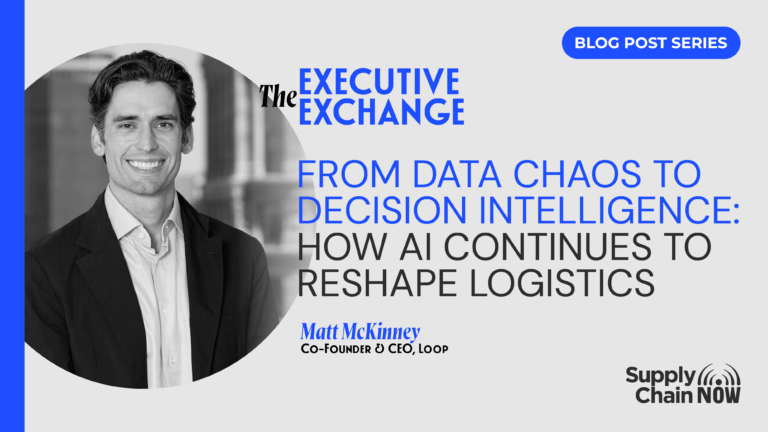
From Data Chaos To Decision Intelligence: How AI Continues To Reshape Logistics
Supply chain organizations have never lacked data. What they have often lacked is the ability to connect it, normalize it, trust it, and turn it into better decisions.
That was one of the central themes in a recent conversation between Scott Luton and Matt McKinney, Co-Founder and CEO of Loop. Drawing on his experience helping build Uber Freight and now leading a logistics technology company, McKinney offered a clear-eyed view of where AI is already creating value, as well as why the data foundation still matters more than the model itself.
The Real Problem Is Not Data Volume
McKinney traces Loop’s origins back to a recurring problem he and his co-founder (Shaosu Liu) saw at Uber Freight: rapid growth on the revenue side paired with a back office still dependent on people manually reconciling invoices, contracts, proofs of delivery, and surcharges. The bigger realization was that this was not unique to Uber.
“The thing people miss is that the value isn’t in the quantity of data, it’s in the utility of it,” McKinney explained. “Most companies have plenty of data. What they don’t have is data that connects.”
That disconnect is especially painful in logistics, where data is scattered across PDFs, emails, spreadsheets, phone calls, carrier systems, customer systems, and legacy platforms.
Even seemingly simple inconsistencies, such as different spellings of an address or different names for the same carrier fee, can prevent systems from recognizing that two records refer to the same thing.
Why Verticalized AI Matters
McKinney believes AI is the first technology capable of solving many of these normalization problems at scale. But he draws an important distinction between general-purpose AI and logistics-specific intelligence.
“A general-purpose model can read a document,” he said. “It doesn’t know what a bill of lading is, why a pickup date has to precede a delivery date, or that those two fee names are the same charge.”
That is why McKinney sees verticalized AI as critical. The technology must understand the terminology, business rules, relationships, and workflows of supply chain – – not simply process words on a page. Once that domain context is applied, raw information can become a unified data foundation capable of supporting automation, analytics, and increasingly autonomous workflows.
Freight Audit Was the Doorway
Loop began with freight audit and payment because it is one of the most data-intensive and error-prone areas in logistics. The opportunity was immediate: structure the data correctly, then automate the process to generate transportation savings and reduce manual work. But freight audit was never intended to be the final destination.
Once customers had trustworthy, structured information, McKinney says they began applying it to procurement, contract compliance, decision intelligence, and network planning.
The lesson is an important one for supply chain leaders: solving a foundational data problem can unlock opportunities far beyond the original use case.
Where AI Is Already Delivering Value
For McKinney, some of the most practical AI opportunities today are hiding in the back office.He estimates that a significant portion of supply chain operational information remains trapped in offline and unstructured formats. Once AI can extract and structure that information, organizations can automate processes that historically required extensive manual review.
The payoff can include carrier disputes resolved in minutes instead of weeks, automated audits, and finance teams closing the books using actual costs rather than estimates. That kind of practical value matters even more as shippers face tariffs, sourcing changes, geopolitical instability, margin pressure and more.
Trust Has to Come Before Autonomy
Even when the technology works, organizations may hesitate to allow AI agents to make consequential decisions. McKinney believes the answer is transparency and sequencing.
“Trust comes from sequencing, giving teams visibility into accurate, validated data before asking them to hand over autonomy,” he explained.
Unlike legacy black-box systems, well-designed AI should allow users to see which documents were read, which rules were applied, and why a decision was made. That visibility can turn AI adoption from a mandate into something employees actively want.
Modernization Starts with the Foundation
For companies modernizing their logistics technology stack, McKinney’s advice is straightforward: resist the urge to begin with flashy features.
“Get the data foundation right first – – validated, audited, normalized – – before you try to layer automation or AI on top of it.”
That sequencing may become one of the defining differences between organizations that scale AI successfully and those that remain stuck in pilot mode.
The Future Moves Continuously
Looking ahead, McKinney believes the biggest surprise may not be that AI makes better decisions, but rather how quickly those decisions begin happening. Network decisions that once occurred quarterly, supported by last month’s data, could increasingly happen continuously.
The result is a fundamentally different way of managing logistics: less rearview mirror, more real-time intelligence. For supply chain leaders, the opportunity is enormous. But the path starts somewhere decidedly less glamorous than AI hype.
It starts with getting the data right.
Where to Learn More
Learn more about Loop, including its recent $95M Series C, via its company website: https://www.loop.com/ . We also invite you to tune in to a past Supply Chain Now episode, where Matt joins Scott and a few industry leaders to talk about digital transformation across global supply chain: click here.
More Blogs
Five Questions I Wished People Asked Me About Public Sector Supply Chains