[00:00:00] Jorge Bayona: What I like about what’s going on right now in Latin America is I think the… we are evolving into a more long-term relations.
[00:00:09] Jorge Bayona: We’re stopping to be so short-term mindset, which used to be characteristic of the region, but it’s also characteristic of every emerging market. It’s just a matter of evolving, learning, and maturing, and I think that’s happening. I mean, a lot of the stories
[00:00:37] Scott W. Luton: Hey, good morning, good afternoon, good evening, wherever you may be.
[00:00:41] Scott W. Luton: Scott Luton and the one and only Scott DeGroot with you here on Supply Chain Now. Welcome to today’s show. Scott, AKA The Professor, how are you doing, my friend?
[00:00:51] Scott DeGroot: Well, I am outstanding. We have an amazing weekend of college football and the supply chain world is exciting as always, so I’m, I’m excited
[00:01:00] Scott W. Luton: I am too. I am too. And an excellent conversation teed up here today, folks. I’m really looking forward to it. We’re diving into one savvy supply chain leader’s perspective as we discuss really a variety of topics. We’re especially gonna be focusing on Latin American markets, uh, and that overall incredible innovative supply chain ecosystem today.
[00:01:20] Scott W. Luton: We’re gonna be discussing some of the particular dynamics impacting supply chains and opportunities across that beautiful specific part of the world. We’re gonna be offering up some very specific observations on market intel, only handful of countries, but also, uh, some tips that you can apply in general as well.
[00:01:39] Scott W. Luton: And, and we’re also gonna be speaking to the capabilities that you gotta be looking for in supply chain partners as you expand into Latin America. All of that here today on this episode of Supply Chain Now. And Scott, given your supply chain leadership track record, including decades at one leading global CPG manufacturer, I can’t wait to get your take on today’s discussion.
[00:02:02] Scott W. Luton: Are you ready to go?
[00:02:03] Scott DeGroot: I, I am ready to go. It’s an amazing part of the world and I’m excited to, uh, talk about it today
[00:02:09] Scott W. Luton: I, I’m looking forward to learning from you and our guests here today. So folks, stick around for a great conversation. It’s gonna offer up tons of actual insights by the railcar load. New mode in there, railcar load. Okay, so wanna welcome in, uh, this special guest we’ve been talking about joining me and Scott here today.
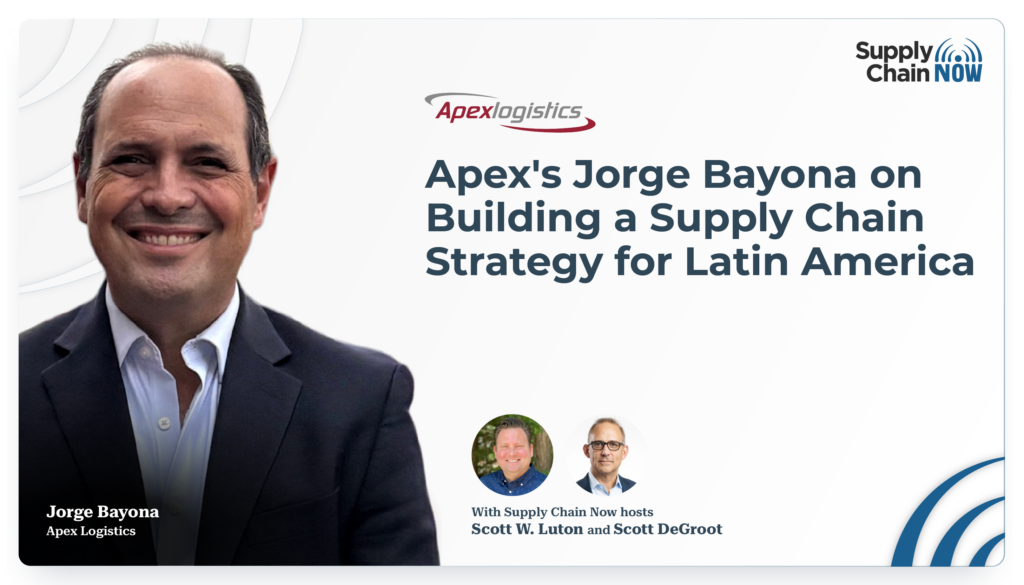
[00:02:26] Scott W. Luton: Jorge Biona is a vice president for Latin America with AB- APEX Logistics International. Now, as you’re gonna see here today, he is a dynamic global logistics leader who built his career in leadership positions at Deutsche Post and DHL. He also led the expansion of FEMSA Group’s logistics division, Solistica.
[00:02:47] Scott W. Luton: Now, at APEX, Jorge is growing and leading teams to drive high performance outcomes as the company continues and rapidly expands into new markets. So let’s welcome in Jorge Biona with APEX Logistics International. Jorge, how you doing, my friend?
[00:03:05] Jorge Bayona: Fantastic. Very happy to be here today, Scott
[00:03:08] Scott W. Luton: well, you know, me and Scott DeGroot have done our homework, and, and you’re always a pretty happy guy. Is that right, Jorge?
[00:03:15] Jorge Bayona: Absolutely. We got to keep the passion. We’re Latins
[00:03:20] Scott DeGroot: Indeed
[00:03:21] Scott W. Luton: uh, that’s a great, uh, kickoff for today’s episode. And before we get into all of your and Scott DeGroot’s supply chain expertise, a little fun warm-up question here. I hear that you were born in a really special place, an island, uh, in a certain part of the world. Tell us more about that, Jorge
[00:03:39] Jorge Bayona: Oh, yeah. I was born in the ’70s in a little tiny island named San Andres. It’s a small, tiny island with a huge reef. It’s actually named as part of the Sea of the Seven Colors by the UNESCO. And most of the people don’t really know it is, like, one of the largest reef in the world. It’s so tiny you can… The airport goes when, from one side to the next side of the island completely.
[00:04:06] Scott W. Luton: Wow.
[00:04:07] Jorge Bayona: So it is… And it’s in Colombia. Most people in Central America and some of the Latin America region will know the, the island, but it’s a really tiny island. Very proud. However, I was bor- born there but raised in Bogotá, in the capital of Colombia
[00:04:21] Scott W. Luton: Okay. Uh, quick follow-up before I get Scott, uh, DeGroot to react. Uh, speaking of your upbringing, I hear your grandparents were big inspirations, much like my own upbringing. My grandparents inspired me greatly and still motivate me to this day. Tell us about, um, I think one of them, uh, there was some army service, there was some entrepreneurialship.
[00:04:43] Scott W. Luton: Tell us about that, Jorge
[00:04:44] Jorge Bayona: Oh, yeah. So let me start with my grandmother, because she was very ha- far ahead of, of her time. She was actually the first woman in Colombia who owns a gas station for the Texas Petroleum Company. It wasn’t by choice. Unfortunately, my grandfather passed away when sh- uh, he was very young. But instead of kind of going to the back, she took the lead, she took the entrepreneurial on her hands, and having seven kids, she choose to run a gas station on the ’70s.
[00:05:17] Jorge Bayona: She was a pretty woman, but very strong and a determined person. So absolutely great example and way ahead of her time. On the other hand, that was the mother of my mother. On the other hand, the father of my father was a general. He was actually the commander-in-chief of the Colombian forces back in the ’50, ’40s, end of ’40s, beginning of the 15th, right before the only dictatorship we have in the last dec- uh, century in Colombia.
[00:05:51] Jorge Bayona: So he, he put in our family a lot of discipline. He put on, on, uh, coordination, how to deal with multiple situation, adversity. So as you can said, we got anchors, and I’m a very family person, so the anchors of my family on both ends were very strong, and I’m very proud of them and everybody out in the family
[00:06:13] Scott W. Luton: As you should be. Uh, those are one, and, and then there’s so much more there. I wish we could dedicate the whole story to those, uh, uh, the whole episode to those incredible stories that still inspire you today. But Scott DeGroot, I tell you, what an incredible way to start the show. Uh, from breaking barriers with, with his grandmother being the first woman to, you know, be a gas station entrepreneur in, in some tough circumstances to, uh, you know, his grandfather who hit the highest echelons of service to any country out there, which is being a general in the Army.
[00:06:45] Scott W. Luton: What’d you hear there, Scott?
[00:06:46] Scott DeGroot: Well, an amazing story of resilience and, uh, you know, overcoming and, uh, finding a better, a path, uh, to growth. And, you know, I think that’s what Jorge, we’re gonna be talking about a little bit more today with Apex. And I, I will tell you, uh, during my own personal or business travels, Colombia, what a beautiful country.
[00:07:04] Scott DeGroot: A lot of people don’t re- Colombians of course will know, but a lot of, uh, people outside of Latin America will not know. Colombia is naturally on both oceans, right? And so it has this great benefit and, um, I’m very interested in hearing more about, um, Jorge and his work
[00:07:19] Scott W. Luton: Me and you both. Uh, all right, so next show, Jorge, me and you and Scott are getting together in beautiful Colombia, and, uh, we’re gonna, we’re gonna see all of what you described already in the first opening minutes. Um, is that a deal, Jorge? Does that sound
[00:07:32] Jorge Bayona: Deal. Next one, live from Bogotá.
[00:07:35] Scott W. Luton: Yes. All right. So let’s do this. Uh, we’ve, we’ve really enjoyed, uh, having a variety of leaders from Apex Logistics International join us here on “Supply Chain Now.”
[00:07:45] Scott W. Luton: Each one of them have brought something different to the table. Really have enjoyed those conversations. Um, let’s level set on that, though. If you would tell us a little bit, little bit more about yourself professionally, Jorge, and what Apex Logistics International does in a nutshell.
[00:07:59] Jorge Bayona: Beautiful. So I’m gonna go in two steps. First is a little bit about my career. The second part will be more into the Apex portion. So because they’re very different stories, right? Uh, and very good ones both, by the way. So the, the first one, um, I was part of a big company, an American company named Archer-Daniels-Midland.
[00:08:19] Jorge Bayona: I don’t know if you probably remember ADM. Uh, I was in charge of developing their non-traditional grains, kind of human consumption grains into Latin America. And thanks to them, I got the opportunity to study in the University of Illinois on a specialized program for international managers on how to behave or manage within multinational companies.
[00:08:42] Jorge Bayona: And because of, uh… At, at that moment, I have nothing to do with logistics. And then when I finished my studies, my graduate studies in the University of Illi- Illinois, adversity hits and September 11 happens. So I had to went back after I was ready to move to exciting Decatur, Illinois. Can you imagine?
[00:09:01] Scott DeGroot: Hm.
[00:09:02] Jorge Bayona: I had to move back to Bogotá unemployed and go back to start from scratch.
[00:09:08] Jorge Bayona: And somebody from a company named Dansus invited me to be a key account manager, uh, locally in Bogota. And that’s wh- how I end up in Dansus and the logistics for the very first time in a tiny opportunity there. And then the, uh, Deutsche Post bought Dansus, they bought DHL, they bought Excel, they bought a lot– They went through a lot of acquisitions.
[00:09:32] Jorge Bayona: And during those years, because I spent seventeen, almost eighteen years in the Deutsche Post Group, starting in Bogota as a key account manager, moving to, uh, throughout the ladder into regional roles, global roles, I call it. I was like the co-pilot all the way to global, and then I- they send me back to Colombia as a pilot and all the way back, uh, to global.
[00:09:55] Jorge Bayona: And my last role, I mean, I run, um, huge accounts globally. Uh, DeGroot, you’re probably familiar. I used to run HP logistics for DHL globally, which is probably their largest customer, one of their largest customers. Um, and then my last role in DHL was running the Latin America, uh, like, corporate accounts, which was a group of hundred accounts for the Deutsche Post commercially.
[00:10:22] Jorge Bayona: Uh, that was a fantastic thing. I got great partners, great friends, great competitors today leading the organizations. Part of my teams currently lead, uh, competition, so it’s a great, fantastic thing. One thing that happened to me in that time and I think is relevant to share is I, I’m a kind of a weird Latin guy, uh, DeGroot.
[00:10:42] Jorge Bayona: You probably see this because I’ve been coming in and out of the region, but I, I always come back. So I believe in– I, I learned English in Canada. That’s already weird, but I learned English there. Then I went to the University of Illinois and came back. Then I, I move into the US, got global roles, and ca- came back to Latin America even though I stay in Miami.
[00:11:08] Jorge Bayona: But Miami’s kind of Latin America anyway. Right. So, um, after that, I move into a big group, a Latin group. Uh, I don’t know if you’re familiar with them. It’s the FEMSA group, F-E-M-S-A group. Uh, these guys are, these guys are massive. I mean, these guys got 400,000 employees just in Latin America. These guys are huge.
[00:11:29] Jorge Bayona: And they got a logistic spinoff, uh, uh, called Solística, and this was my first entrepreneurial effort. We built the l- second, third-largest 3PL in the region, which was then sold to a Mexican company named Tracción. And that’s right the time I have to, uh, take a, take a time off required because of the sale of the company.
[00:11:53] Jorge Bayona: So I stay on the, on the side for a year. I went back to school. I went to MIT, did some graduate schools, entrepreneurial schools, executive, things like that. And then, um, two years and a half ago, uh, ABX, uh, I, I, I was in conversation with them, so I joined to develop Latin America. So that’s my previous premier- professional life.
[00:12:17] Scott W. Luton: Jorge, really quick, before you, before you tell us about Apex in a nutshell, uh, I got to come back to a couple things there, Scott, and I loved his comment, so many of his comments about his story, but he always comes back. He, he ventures the world. He’s in all kinds of, you know, business ventures and growth opportunities, but he always comes back to Colombia and, and really to the whole region, and that is, uh, you know, that, there’s something human about that.
[00:12:42] Scott W. Luton: I think home always calls us back. Uh, but Scott, what’d you hear there on just his personal journey?
[00:12:48] Scott DeGroot: Yeah. Again, a, a very– I agree, and this idea that you really have roots, you know, where, where, where your home is, and you know that we, we can be global citizens and care for the entire world. At the same time, we always have a special place in our hearts for our native lands, and, um, certainly Jorge has shown us about that, and he’s also, you know, quite honestly, I’m impressed.
[00:13:12] Scott DeGroot: Congratulations, Jorge, on quite a robu- robust and broad career, and I’m, I’m sure you’re excited about what you’re about to do or are doing now with Apex
[00:13:22] Scott W. Luton: And that’s a great segue, Scott DeGroot. Thank you for that. So Jorge, uh, for the handful of folks that may not have heard of Apex Logistics International out there, tell us in a nutshell, uh, what the company does.
[00:13:34] Jorge Bayona: Very good. So on, on APEX, APEX Logistics is, is, um, an organization that was born in, in China, uh, with roots in Asia and mostly focused on Asia into the US for many, many years. It comes through a lot of growing, a fast-growing. I think the entrepreneurship of the leaders of the organization and the founders is exceptional.
[00:13:59] Jorge Bayona: But in– Not to go into many details, but just the fact that APEX has started in Tony and Elsie and many others that were part of that group, that start from the bottom of the organizations. It started in DHL, for example, and how they moved and create their own company to make this multi-billion company.
[00:14:20] Jorge Bayona: It’s very, very exciting, right? Um, for this particular moment on APEX, as we continue to grow in air freight of being one of the largest ones in the world, ocean freight, we have more, more capacity, same as 3PL. I think the most important thing, at least from my perspective from Latin America, is how we’re moving from a peer-to-peer Asia to US into Asia to Americas.
[00:14:44] Jorge Bayona: Imagine the value proposition for the market, even if Latin America is not as big. I mean, let’s be honest, Latin America will never be more than ten, fifteen percent of any of these multi-billion companies. But imagine saying, “I’m China to US compared to I’m Asia to Americas.” How much more attractive the company is in a process where APEX continue to be a private company.
[00:15:09] Jorge Bayona: That is not gonna be the end story for the long run, and this is just me saying, I’m not saying anything different. But for the long run, and I’ve been on growing organizations, this is fantastic. Now, Latin America started for APEX about ten years ago when we opened our first office in Mexico. However, it was very, um, small and not focused, uh, um, effort.
[00:15:35] Jorge Bayona: So with my arrival and with inviting me to the organization, it was a much more aggressive bet. It was a much more aggressive investment from Elsie, which is the CEO in Americas. She invited me to that, and that was really what makes me come. I, I was like, “Well, this is like starting from zero. I don’t know.”
[00:15:55] Jorge Bayona: And contrary to that, that was that make it excited. Oh, so I can do this, everything from scratch. I’m gonna have full empowerment from the founders and the board and everybody. And they say, “Yes, you can do whatever you want. Just deliver results,” because that’s exactly how this works. And, um, so that’s the way we did it.
[00:16:15] Jorge Bayona: And, um, well, in APEX today, we have grown significantly. We got– cover eighteen countries in less than f- Two years that we started, two years and a half. Uh, we got a footprint. We have done the acquisition of one company, and we are growing rapidly. So the plan is loving
[00:16:37] Scott W. Luton: Scott, I wish I could, uh, whatever Jorge eats for breakfast, I’m gonna steal that from him because he is chomping at the bit, growing left and right. And, uh, it, it’s really exciting to hear him, uh, talk about the, all the opportunities out there. Um, and Scott, there is no shortage. I, I, I enjoyed Jorge’s remarks around, you know, the difference re- difference, um, different regions and, and the intro relationships and what that’s posed.
[00:17:03] Scott W. Luton: Of course, we’ve seen, uh, uh, not just Mexico, but really across Latin America, all sorts of new relationships, new supply chain nodes, um, new partnerships, uh, found. And of course, all of that requires logistics and supply chain wherewithal. But what’d you hear there, Scott, from Jorge?
[00:17:20] Scott DeGroot: Yeah, I, I thought– I’m very excited, uh, for what he describes, and you, you just have a natural energy about you, Jorge. And, um, I– Who wouldn’t love trying to create something from scratch with the support of LC and the senior leadership of, of a rapidly growing country? And, and I think it kind of speaks to the growing power and importance in global trade and in supply chains and company operations of, of Latin America as a region.
[00:17:45] Scott DeGroot: You know, it has, um, over time grown, but maybe not as fast as it ha– could have. But now I think what Jorge is pointing out, the huge opportunity, especially as international trade relations continue to change almost by the moment. Sowhat I hear is Jorge and APEX looking forward to taking advantage of, um, a great opportunity
[00:18:06] Scott W. Luton: I’m with you. Now, you made a great, a, a interesting comment, and it actually, you must have been reading my mind because it’s what I wanna pose to Jorge next. Because, you know, given Jorge, given your, uh, your role and your background and the journey, of course, what Apex, uh, is doing, 18 countries in, in less than two years, that’s incredible.
[00:18:26] Scott W. Luton: What are a couple of your favorite aspects of the, what I’ll call the supply chain community and ecosystem across Latin America, Jorge?
[00:18:34] Scott W. Luton: I think it varies, right? And the, the first thing that I like at last, a lot, is the fact that people continue to said, “Oh, we’re so special. We’re so different.” In reality, it’s not that different. We’re just an emerging market. We’re just complex. And whoever is able to deal with and wants to deal with the complexity is not only, is not only well-positioned to grow, is well-positioned to remain and be successful.
[00:19:08] Jorge Bayona: And that has been, like, the secret sauce. So what I like about what’s going on right now in Latin America is I think the… Even though we continue to be, once again, very Latin, it’s not necessarily the most mature and the most relaxed and German guys, very straightforward, um, we, we are evolving into a more long-term relations.
[00:19:29] Jorge Bayona: We’re stopping to be so short-term mindset, which used to be characteristic of the region, but it’s also characteristic of every emerging market. It’s just a matter of evolving, learning, and maturing, and I think that’s happening. I mean, a lot of the stories that are happening right now in Latin America just happened centuries ago in Europe or in Greece or in whatever.
[00:19:52] Jorge Bayona: We’re just younger generation that are learning and educating differently. So I love the fact that the level is raising, the bar is raising, and even though it’s not the same way everywhere, as you were mentioning before, Scott, about Brazil or Mexico, which was, is kind of like the easy ones that everybody goes because it’s so big.
[00:20:15] Jorge Bayona: By the way, it’s very difficult to get in those markets, so
[00:20:18] Scott DeGroot: Yes
[00:20:19] Jorge Bayona: not necessarily you need to go and run for those if you’re not prepared. So that’s what I like. I mean, there is many, many things I like. I like in almost everything in my region, and much more things to love that not to, but the most, the thing that I love the most is the fact that we’re evolving rapidly and we’re shortening the gap with the most mature markets
[00:20:39] Scott W. Luton: Alright. So Jorge, uh, lots of great comments there and I love, we can’t– It’s very difficult to talk about Latin America as if it’s all one place, one culture, uh, the same market, the same skill sets, the same businesses. That’s a great call-out. And in fact, folks, in a few minutes, we’re gonna go through country by country of some of those, um, uh, special places that make up Latin America and get some of Jorge’s perspective there.
[00:21:04] Scott W. Luton: So, but Jor- uh, Scott, before I pose to Jorge some of the factors influencing opportunities across the region, what did you hear there about some of his favorite parts of doing business across Latin America?
[00:21:17] Scott DeGroot: Well, I, I, number one, I appreciate what he com- he commented about the dynamic nature of the region, and again, the sort of distinguishing factors underneath it. And, and I think he’s also getting at an important point about the, um, the consumer is becoming more advanced and more technology-driven, and so is the infrastructure.
[00:21:39] Scott DeGroot: And we start thinking about the infrastructure around cities like São Paulo or, um, Santiago or Bogotá, and we know that these infrastructures are now being im- substantially improving outside of the cities, you know? And in that area, commerce and trade starts to f- flow more smoothly, and I think it, it speaks to the great opportunity for companies to take advantage of this market, not only to sell, but also to, um, you know, buy products from.
[00:22:09] Scott W. Luton: Yes. It speaks to all that, and it’s also, it’s growing those opportunities, right? And that’s, Jorge, I’m really curious, and this could be a three-hour response, this next question’s not fair at all. So just at the top of your list, when you think of national economics and, uh, policies and, uh, politics frankly, uh, impacting supply chains, including opening up some of those opportunities that Scott’s talking about for American businesses or, or businesses elsewhere in the globe that can, um, uh, seize those opportunities and navigate the landscape, w- what do you, what factors would you put on your short list there, Jorge?
[00:22:47] Jorge Bayona: Well, I- I’ll try to go really fast, but I mean, the, these trends, I think, uh, one that is undeniable is we’re close to the US, which is a major market, right? So that’s, that’s, uh, that’s a trend that sometimes is well, uh, utilized. I think Mexico is a clear example where the proximity is being very used and the, uh, everything related to near shoring, all this is very, uh, developed.
[00:23:14] Jorge Bayona: Uh, but in other countries, maybe not. I mean, Brazil doesn’t do that much with US. Uh, the South doesn’t do that much with US. But it’s still really, uh, that’s a trend. The other one is there is abundant food, energy, and minerals in Latin America, and that’s gonna come out from the region to the globe. Just to put it in perspective, and this is just to give you, uh, uh, relevance, uh, the, the balance of trade between China and Latin America, between China and the US is usually unbalanced, right?
[00:23:46] Jorge Bayona: But even with the US, it’s kind of balancing value. With the Latin America countries, it’s extremely unbalanced. However, and this is just my thought, this is not an economic, so, I’m not an economist. Sorry. Right? But, um, it’s so easy for China to balance the balance of trade with a country like Colombia.
[00:24:06] Jorge Bayona: It’s just, “Hey, buy lemons.” it’s gonna be swap immediately, just with the 0.0001% of the consumption alignments of China. So it’s easy for the governments to fix it. It’s impossible for the government to fix US. And that’s what I meant. Now, if you go for the big ones, Mexico, Brazil, it’s gonna be harder.
[00:24:28] Jorge Bayona: Every other country is very simple. Perfect example, Chile. Chile is very balanced because China buys copper and fruits and salmon, so it’s balanced. Easy. So that’s a major strength of the region. It’s easier to balance with the big powers, be it US, be it China, you choose, or Europe, right? Opportunities.
[00:24:51] Jorge Bayona: Well, there’s a lot of opportunity politically about advancing, uh, the healthcare, the thr- the political energy transitions that we’re having, for example, in Colombia. So we have gone from the left to the right in most of the region, and Mexico and Brazil remained on kind of more socialism. The other ones is more capital- capitalism, and Brazil is going in a couple of months into a presidential election, so it’s, it’s so many countries we’re always gonna have something there, but that’s an opportunity.
[00:25:23] Jorge Bayona: It also it’s a threat, but it’s a huge opportunity depending on what you’re talking, and this is very, very important. When, when I go through the country by country, I’ll talk a little bit about that. Now, uh, and the other huge opportunity there is most of the region does not produce a lot of value-add products.
[00:25:42] Jorge Bayona: I mean, if you go to automotive, if you go to electronics, only Brazil and Mexico has a strong productions. Everybody else buys these value-add products and sends back food, goods, and raw materials. So it’s a huge opportunity to try to balance their supply chains. Um, weakness, well, infrastructure. You mentioned it before, uh, Scott, the group.
[00:26:08] Jorge Bayona: Uh, it… There is a huge, uh, uh, lag in infrastructure, especially in the not-so-big countries, uh, not to mention Central America or the, uh, medium-sized customers. Um, the education is uneven, uh, the fiscal, uh, that’s weakness. And, uh, threats, well, I think the most evident one is this whole political situation we got between the big powers in the regions across the globe, but that’s not specific to us.
[00:26:34] Jorge Bayona: It’s just we’re just more exposed because we’re smaller.
[00:26:38] Scott W. Luton: Hmm. All right, Scott, we just got a, uh, quite a walkthrough. He says he’s not an economist, but I, I, I’m not sure if I’m gonna believe him there. Uh, Jorge walked through some really good, good stuff. And of course, the EU seems to be playing a bigger, bigger role, uh, in growing its trade. Of course, there was a big agreement there, I think, uh, I think it was signed earlier this year.
[00:26:59] Scott W. Luton: Uh, but Scott, as, you know, we asked Jorge to kinda identify a short list of some of these big factors shaping relationships and opportunities. What’d you hear?
[00:27:07] Scott DeGroot: Yeah, I, I, what I, what I heard was that, you know, the, um, the world needs to see Latin America in a new light, right? And see Latin America, especially as shift, things shift in the, um, in that, um, Asia and, um, the, the Asian sort of trading balance. You know, the, if I think about, um, we talked about Chile, but talk about Peru, we could talk about Ecuador, we could talk about so many countries where there’s so m- there’s such great opportunity.
[00:27:36] Scott DeGroot: And it, yes, historically people have looked for raw materials, minerals, and copper and foodstuffs. Uh, but there’s opportunity for, you know, rapidly developing countries and for, you know, becoming more and more educated labor force. And I, I just think it’s, um, it’s exciting what Jorge is describing because it’s, there’s a lot of positive runway, as we say
[00:27:59] Scott W. Luton: Yes. And you know, one other thing comes to my mind, especially as I s- uh, as I want to pose this question about some of the mistakes that, that leaders and organizations make that enter this region. Um, you gotta have someone like Jorge that, uh, knows how to read, you know, knows the ins and outs of, uh, whether it’s countries or regions, or knows some of the trends or some of the small trends.
[00:28:25] Scott W. Luton: Um, I guess everything but economics, which w- which is what Jorge said. But Jorge, hey, I’m, I’m a fellow kindred spirit. I’m anything but an economist as well, and I think you’ve got that, uh, better than I do in terms of, uh, your appreciation and knowledge. But you gotta have a Jorge. And, and that leads me, Jorge, to ask you this question: What do you see some of the most common mistakes that businesses and business leaders make as they look to move into and, and take advantage of some of these opportunities across Latin America?
[00:28:55] Scott W. Luton: I think it might sound easy answer, but it’s actually a really hard to act on it, right? The answer is kind of, um, is slogan. So we are victims of the average of the average. So people will always go to, “Oh, the region should grow, I don’t know, 3%, 5%.”
[00:29:14] Jorge Bayona: Kind of like, how much is US gonna grow? Now this percent, and people said that, okay, that’s your fact, and because the region as a whole seems the size of a full country, then they measure the region by that number. And that number, or that mistake, replicates in country by country. So that number is not true for Latin America, but that number is not true for Brazil, is not true for Mexico, is not true for Colombia.
[00:29:41] Jorge Bayona: You actually need to drill down, double-click, triple-click in order to understand where you’re true. Uh, and I’ll divide this in the right to play and the right to win, which are completely different scenarios. You first need to get the right to play in the region. I mean, and, and I’m gonna be absolutely honest, I can have a nice beautiful plane like that one, and for co- for that I think, “Oh, I got the right to play.”
[00:30:08] Jorge Bayona: No, you need to understand that everybody can buy a plane. Why you are different? Why you’re coming? That’s your right to play. And then, and you were mention it, uh, i- it’s not a Jorge. You need a complete team who understand the rules and the details of every specific region. And some people will call it local heroes, some people will love, uh, uh, knowing a, a strategic talent, you name it.
[00:30:33] Jorge Bayona: But at the end of the day, nobody will walk into the region without the trust. People will not vibe from you. I don’t care where the decision is taken. If the decision is taken in Hong Kong, in Switzerland, in Germany, whatever. If the local guy in T- Tegucigalpa, in Guatema- in Guatemala or whatever, don’t said, “I trust those guys to manage my cargo here in this city”, you will not get the business.
[00:31:02] Jorge Bayona: So the right to play and the right to win are completely different. So I think that’s the biggest mistake that everybody does, and not everybody, that most people does. And that’s why you continue to see the exact same players being successful, and that’s why you see so many local heroes in the region
[00:31:19] Scott W. Luton: Scott, that makes a ton of sense to me, uh, on, on a variety of levels because to, to, to, to be able to, you know, trust is such so important. It’s the global currency of global supply chains and global business, and there’s so many different elements that goes into the recipe of trust. And, and Jorge’s hit on a bunch of them, right?
[00:31:40] Scott W. Luton: but what’d you hear there, uh, from Scott in terms of some of these mistakes that time and time again organizations make?
[00:31:45] Scott DeGroot: I just, in my own experience and some of the, some of this experience I still have, you know, the, the m- marks on my back. Y- I mean, what Jorge is talking about is you, you have to ma- commit to the time of building trust. And, you know, that requires time, it requires, um, sincere and authentic effort. It requires local knowledge and experience.
[00:32:09] Scott DeGroot: Um, and you know, I, what he, he said something resonate. You make some decision maker in Geneva or in London or in New York make some decision. But, um, that’s not really relevant until you, you’re someone on the ground, as he said, that, that can be trusted. And, and don’t think that you can just walk in with a contract and you can start doing business.
[00:32:30] Scott DeGroot: I think it requires, you know, a substantial amount of knowledge and, and time investment
[00:32:35] Scott W. Luton: That’s right
[00:32:36] Jorge Bayona: and, and Scott the other thing, it actually works the exact same way the other way around. So in, in a way, what I’ve been doing in my previous company, in the three m- I, I have worked only for three company that you saw. In the three companies, I become the connection also for the Latin player to trust the origin, to trust the headquarters.
[00:33:01] Jorge Bayona: Because they feel not, uh, understood. So, “Oh, these guys don’t even understand, uh, what our reality is.” And in theory, it’s not that they don’t understand, it’s they don’t have the time. That’s why they have people like us
[00:33:14] Scott W. Luton: That’s right. Uh, we’re moving fast. Uh, the, the pace of global velocity we talk about all the time, and how can we speed up, what I’m hearing kind of these knowledge cycles so we can get to the point where we’ve got trust and, and eventually we’ve got the opportunity to do business and grow business.
[00:33:31] Scott W. Luton: all right, so Jorge, I’m really curious. We’re gonna– this second half of the interview, we’re gonna learn from you here, and I think you’ve got so much to, uh, share with our audience, uh, really no matter where they do business and where– no matter where they are, but particularly for folks looking to do more business and seize opportunities across Latin America.
[00:33:48] Scott W. Luton: So how can companies leverage a smart, uh, Latin American strategy to make better moves, savvier moves in today’s market and avoid any of those other regional obstacles, Jorge?
[00:34:03] Jorge Bayona: Well, there’s gonna be four main landscapes, right? There’s gonna be market demand. There’s gonna be a competitive landscape economic landscape and, uh, politically, politically and regulatory, right? So market demand, that’s kind of the easy one. People will know that is finished goods coming in and perishables coming out.
[00:34:27] Jorge Bayona: And if you can find where your niche is or where your strengths are, your right to play and your right to win is, then you’re gonna be fine. that’s probably where most of the people stop, right? And maybe the politically, political one because it’s in all the news and depending on the flavor of the moment or the algorithm you are into, you will think it’s going one way or the other, right?
[00:34:49] Jorge Bayona: So those two are kind of self-explicit, right? But the regulatory is a little bit, uh, different, which is part of the political one. So you really need to understand the local, local things. Things as simple as if you go into Mexico, your broker is a natural person, and he can only play in X, Y airports. And if you go and buy a customs broker company and the guy dies, there he goes your company. But those kind of things are important. Or if you go into Colombia, by law, the airline needs to move the cargo from the airport to the warehouse. Those things, little details, and I’m not pointing out any specific, I’m just trying to make an example.
[00:35:29] Scott W. Luton: Right
[00:35:30] Jorge Bayona: those are market demand and political and regulatory.
[00:35:33] Jorge Bayona: And then the other two are very, very important and pe- most people don’t pay attention. The competitive landscape. This is not a rich region. People will be very price sensitive. So if you wanna be in the right to win, even if you find a niche, depending on the market, you will have completely different behaviors.
[00:35:53] Jorge Bayona: So for example, Brazilians will take forever to close a deal with you, but once they go into the deal with you, they will stay with you.
[00:36:02] Scott DeGroot: Mm.
[00:36:02] Jorge Bayona: So you need– If you rush the deal, you lose. In Colombia, it’s very similar. You need to build up the trust. It’s a little bit faster, and it… but if you don’t get to the price point, you’re out.
[00:36:15] Jorge Bayona: But it’s not because, uh, Colombians are cheap. It’s just the market is extremely demanding in margins. So if you are not competitive in price, you’re out of the market, you don’t have a business. Chile is much faster. Chile is very first world. They’re very pragmatic. They write the book. Uh, they do re- appreciate the relation, but it’s more go into the deals and things like that.
[00:36:38] Jorge Bayona: So competitive-wise, if you go to by the book, oh, just go for the big biz, uh, get the big business, b-get the high, uh, profit and forget the others. Ah, the market is not that big. And or, or put all your, uh, uh, service center in, I don’t know, Bangalore or China or Colombia, whatever, and manage it from there.
[00:37:01] Jorge Bayona: You will fail immediately You, you, you can do some of that, but not at that edge. And then of course, the economic, uh, landscape. Because again, not because I got inflation, not because I got interest rates, exchange rate and credit ability, etc., etc. Uh, I mean, there are countries where it doesn’t really matter how much they pay on logistics.
[00:37:23] Jorge Bayona: What it matters how much they charge you in taxes. Perfect example is e-commerce. If the e-commerce get taxed, forget it. It’s not gonna fly. It doesn’t matter how many fancy planes you have, right? So I think those are– Trying to answer your question, but that was a hard one
[00:37:41] Scott W. Luton: I’m asking some not, some unfair questions today, Jorge, but only because I know you’ve been there and done it, uh, and you’re such a great resource for supply chain leaders and business leaders looking to, to, to find a better path. Uh, Scott DeGroot. Now he just, I, I love a good matrix, and he gave us basically a, a, a proven matrix, right?
[00:38:01] Scott W. Luton: And I try to keep fast and furious notes, but I got market demand, the competitive landscape, the economic landscape, and the political, including the regulatory landscape. And if you heard Jorge say, most organizations stop just after considering the market demand. But Jorge just gave us a hol- more holistic, uh, uh, framework.
[00:38:22] Scott W. Luton: What’d you hear there, Scott?
[00:38:23] Scott DeGroot: I heard that you need to know what you’re doing before you really just, start. You know, sometimes they say you learn by doing. Maybe that’s best, but in this case, you better have someone who knows what they’re doing. In my own experience, I’ve learned a lot about the Brazilian tax structure and the fact that, um, you know, it’s very, very localized.
[00:38:43] Scott DeGroot: Like, uh, we should put a distribution center where the people are. Oh, well, the tax you’ll pay will be subs- There’s– It’s a different mindset, so you need the local expertise a- at the granular level. And, and I think that’s what a good operation requires. And, and I think Jorge is pointing that out to us both and to our audience that, um, you need to get, you need to get into the local understanding of rules, regulations, and taxes
[00:39:09] Scott W. Luton: That’s right. Local heroes is one of the phrases that, that Jorge had used earlier. Um, all right. So Jorge, you’ve already kinda, um, shared, some thoughts on opportunities, risks, and strengths, and weaknesses, uh, and there’s plenty more.
[00:39:26] Scott W. Luton: But I got a question for you, Jorge, as you might suspect. How can these supply chain leaders identify each of those? Those you’ve touched on, those you hadn’t, but how, how do you, how do you advise folks to, to determine what all those things are for their organization?
[00:39:43] Jorge Bayona: Well, I will focus in two, maybe three things, right?
[00:39:48] Scott W. Luton: Okay
[00:39:49] Jorge Bayona: Uh, the very first one is you need to have a plan and stick to it. Yeah, I mean, it… One, one of the things that we see continuously in the region is people that comes with a plan, sometimes with a big name behind one of the big consultants, sometimes, uh, just a white paper done in a conference room, whatever it is.
[00:40:12] Jorge Bayona: Uh, some are better sometimes in the whiteboard, some are better in the big b- in the big firms. But then, I don’t know, uh, an election a bad year or a bad quarter, and they switch the strategy completely. If you are trying to penetrate a region with the complexity and the know-hows that require the right to play and the right to win, you need to give time to evolve and earn the, the right to be there and, and do it, and that takes time.
[00:40:44] Jorge Bayona: in current world, getting time is difficult, but giving time is harder. As a leaders, we keep to try pushing, “Oh, no, you need to do it in six months or in a year. Come on.” You’re trying to go into a full region that it took you 20 years to develop the company. So that- that’s the number one, right?
[00:41:04] Jorge Bayona: The, the number two is your talent, your talent, your talent. You need reliable, committed executives and operators. It’s not just the leader. It’s all the way to the bottom. Whoever is facing the final delivery or whoever is dealing with the broker or with the customs authorities. I mean, your people. in the previous company I was before with Solistica, during COVID, uh, we learned this, uh, that at 5:00 PM our busi- biggest asset goes to home Right?
[00:41:38] Jorge Bayona: Everybody goes home at the end of the day, and we need to make sure they come back. And guess what? Our industry is not that fashion anymore. It’s really hard to convince people to come and work in a hot weather in the middle of a port, uh, just driving a little truck, uh, which in se- many of our countries don’t even have AC, right?
[00:42:03] Jorge Bayona: So it’s really hard to convince them come here instead of just, film themself and make a TikTok, right? So, so that’s the second one. And, and the last one is make sure you partner or work with a company, if it’s a big enterprise, medium enterprise, whatever it is, that is a good fit with what you’re trying to do, which is exactly, uh, what we’ve been trying to do with ABX, right?
[00:42:30] Jorge Bayona: W- who is the right partner is not who’s the biggest one or wh- where is that we can really, um, instead of, uh, if we go, for example, in an inorganic service or buying a company, not how do I put together and then remove the fat? It’s how do we complement each other. So compli- complementarity, I think, is much more important than many things
[00:42:54] Scott W. Luton: Hmm. Okay. So Scott, we got another framework from Jorge, and I love frameworks. Now let me see. I think I tried to, uh, try to play up the alliterative, if I said that word right. They all start with a, the right, the same constant. So we got time, the time factor, the talent factor, the targeted factor, right?
[00:43:15] Scott W. Luton: They gotta know what the focus, the objective, and be aligned there, and not to worry about the TikTok factor is what Jorge said. I, I’m adding that fourth one, I think. But Scott, we asked him how to identify, you know, some of the things we gotta know as we, as we look to go into a new region, especially Latin America, new business opportunities, risks, and, and, and whatnot.
[00:43:34] Scott W. Luton: That framework sounds good to me.
[00:43:35] Scott DeGroot: Yeah, no, very good. And what Jorge has talked about, uh, which I think our audience will resonate with, is this idea that, you know, you have to have some consistency of purpose. This is not something that you do, um, and then want something to have you back out too easily. Number two, you have to have talent, and talent is, uh, Scott, Jorge, don’t we talk about talent so much?
[00:43:55] Scott DeGroot: You know, and you can’t just, um, find just anybody to do this work. People– It’s difficult work at times, so the right kind of talent. And then, you know, I like to think about the cultural fit is always the secret sauce. You know, you partner with the right people, that fits with the culture that you want to create.
[00:44:11] Scott DeGroot: And so very powerful, words from Jorge.
[00:44:14] Scott W. Luton: And you know, I’m, I, I may be a bit biased, uh, because we get to rub elbows with people like Jorge, but it seems like Apex takes the talent, uh, portion of that very seriously. Um, and, and that of course is refreshing, especially in this day and age where I think the three of us know and so many out there listening or watching know how important that is.
[00:44:34] Scott W. Luton: But, you know, that, that’s not uni- that’s not completely universal, sadly. Um, all right. So Jorge, man, we got a whole bunch of tough questions for you, but you’re the person, you’re, you’re, you’re, you’re, you’re, you’re the guy with all the answers. So why is it important? We touched on this on the front end.
[00:44:51] Scott W. Luton: Why is it so important to evaluate country by country and, and the individual, um, components there as we, uh, are considering logistics needs and business opportunities and goals, all that? I know we can’t go through all the countries ’cause we don’t have that time, but I bet for folks that wanna connect with Jorge, he can do that.
[00:45:13] Scott W. Luton: Give us some initial thoughts there, Jorge
[00:45:15] Jorge Bayona: Okay. Yeah, so I’m gonna try to step on probably what I think are the most critical ones or the ones that we– people can take the most out of it, right? So I’m gonna start first with the natural gateways to the region. So because we know this is not a region that produce themself everything, so everything is in and out, the gateways are the entry point or the exit point of the region.
[00:45:43] Jorge Bayona: And the natural hub on air, of course, is Miami. The natural hub on ocean is Panama And the natural hub that used to be a natural hub when things were produced in Mexico for other locations than US was Mexico. So I’m gonna talk about an alternative gateway on Mexico. So first of all, for me, Miami is just an expensive city of Latin America.
[00:46:12] Jorge Bayona: It’s really not US, right? It– And it’s not because a lot of power is there, it’s just an– Latins loves to come here to Miami, number one. A lot of, uh, headquarters used to be here and continue to be here. A lot of finance happen here. And the air freight flows through Miami. So from the world to Miami, from Miami to Latin America, is the largest hub and the largest capacity in and out.
[00:46:42] Jorge Bayona: So that’s an easy one. So Miami always need to be taken in consideration when you think about air freight Latin America. The second one, of course, is Panama, not only because of the canal, because everybody’s always thinking of the canal, Panama Canal, and the whole thing, and the weather ladder is low, so it’s gonna be…
[00:47:02] Jorge Bayona: Let’s put it in perspective. Most of the cargo that goes into Panama don’t cross the canal. Goes into Panama, get unloaded, and then it can be redistributed to the rest of the region. So in the past, that type of cargo was coming into LA, that cargo was coming into Mexico, and then going into Latin America.
[00:47:21] Jorge Bayona: Today, it goes to Panama. So, uh, we call this the Why Panama Effect. Well, it’s easy. You can come in with big ship into Panama and then redistribute to the rest of the region, even by truck to Central America, by air into countries like Colombia because it’s so close, it’s almost the same price to fly to Bogotá than going d- by ocean, or continue into a different type of solution.
[00:47:44] Jorge Bayona: So those are three gateway, natural gateways. Very important to know the details. Panama is kind of like a Singapore, so fiscal rules, expats don’t pay taxes. I love that. Uh, things like that. You wanna attract talent and big bosses to move to Latin America? Bring them to Panama, no taxes, things like that.
[00:48:03] Jorge Bayona: Once again, it’s not only about explaining Latin America, it’s how to enam– to get your executives in love with the region.
[00:48:10] Scott W. Luton: Right
[00:48:12] Jorge Bayona: Then you got, uh, things are, uh, Chile is easy, is first world in Latin America. Everything is so nice and shiny, everything works, people is super polite, they got stations.
[00:48:25] Jorge Bayona: They are first world. I don’t know why it’s not there classified. Then the other two easy ones, Mexico and Brazil as the big monsters. Those, each of those is the same size as the rest of the region. So in reality, even though I divide the region in four clusters, is Mexico, Panama, and the backbone. Right?
[00:48:47] Jorge Bayona: And the backbone is the same size as the other two.
[00:48:50] Scott DeGroot: Mm-hmm
[00:48:51] Jorge Bayona: Uh, roughly. It’s not 33, 33, 33. It might be 35, 35, 30, whatever, right? And then the backbone is divided in Central America. Central America, it’s a lot of countries, which if you have the right partner, you can deal with that kind of like in the US. You can actually move throughout the countries easy if you have the right partner.
[00:49:12] Jorge Bayona: ‘Cause they got their own treats and everything. You can move by truck. So as long as you got your security cover, you don’t wanna go with a full truck of $1 million cellphones in Central America,
[00:49:24] Scott DeGroot: Mm-hmm. Mm-hmm.
[00:49:25] Jorge Bayona: Then you’re gonna be fine. And you can get a lot of value and a lot of profit. Now, its profit percentage is not gonna be huge because it’s a small market.
[00:49:33] Jorge Bayona: You need to know that. You can– You’re not gonna get rich. However, the big supply chain guys in Central America are super rich, so you can make a lot of money as an individual or as a company. Then the, on the South America, I think, uh, well, Peru, uh, it’s ups and downs. They got a lot of mining. They have a lot of, uh, uh, perishables.
[00:49:54] Jorge Bayona: They consume a lot of electronics. They change president every year for the last five years. So it… The, the president has been, taken out for the last four years every year. So it becomes so normal that it doesn’t affect the economy anymore. People don’t care. Oh, we got a new president.
[00:50:13] Jorge Bayona: Who cares? Let’s continue. Things like that, that’s very weird, right? And last but not least, I’m gonna talk about Colombia, but I’m not gonna talk about Colombia alone. So Colombia is going through a lot of changes, a lot, a, a big regime change. Uh, it, it’s too early to know how big, how good or bad it’s gonna be.
[00:50:32] Jorge Bayona: Uh, I’m the one that thinks it’s really good what’s going on. But I think the most important thing happening is Venezuela is coming back into the market. Venezuela was completely out. And let’s not forget, Venezuela was the com- biggest commercial partner of Colombia twenty years ago, even larger than US.
[00:50:53] Jorge Bayona: So if Venezuela reacts twenty percent, Colombia is gonna grow like never before.
[00:51:01] Scott W. Luton: Wow
[00:51:02] Jorge Bayona: So I think we are in front of a very high dynamic in the north of South America with Colombia and Venezuela. We’re gonna continue to see Brazil and Mexico growing like, uh, bigger countries. Uh, we’re gonna continue to see Miami being the natural hub, and maybe Mexico trying to get some relevance as a hub back, because now the nearshoring is so evident with US that now it is starting to look nice for South America. Why do I need to go through Miami every single time? regulatory doesn’t allow, just for the record, for the moment. Okay. And, and last but not least, Argentina, which is coming for the last couple of years after being completely out of the market. And just with one example, the Vaca Muerta, which is, uh, one of the largest oil or petroleum, uh, um, locations.
[00:51:57] Jorge Bayona: I don’t know how to say that in English. I’m sorry. Only that particular one, i- it can represent a 10% growth for Argentina, just that deal. So I think a lot of good things is, are going on in the region, but this is a perfect sample from what I said before. If you’re in the, in that section, you can grow 100%, but if you don’t touch that particular deal, if you grow 5%, it’s fantastic
[00:52:22] Scott W. Luton: you know, Scott, as, um, I’m gonna get you to react after I pose this next question to Jorge. But Jorge, I thank you for visually, in my mind, as you were walking us through the countries and the regions, I was traveling with you. now a lot of folks, my geographic prowess is not world-class, but you make it really easy to follow you from country to country.
[00:52:44] Scott W. Luton: And I like, I really like your, uh, practical optimism for maybe the, the very next chapter ahead. But all of that that you shared, all the different factors, uh, the nuances, uh, of course, the opportunities to drive revenue and profit and build a team, a talented team, and a whole bunch more, it begs this next question, Jorge.
[00:53:07] Scott W. Luton: What capabilities should companies look for in a logistics and a supply chain partner as they’re looking to expand in, into Latin America? Your thoughts
[00:53:17] Jorge Bayona: Uh, the very first answer is pretty easy. They need to work with Apex as number one. Come on. But no, but, uh, realistically, uh, the, the very first thing that the, uh, people and companies or partners needs to look, if they’re go- if they’re coming for the very first time into the region, the answer might be completely different that if they’re already in the, in the region, right?
[00:53:43] Jorge Bayona: So, but all of them will be, they need a partner, not a provider, and the partner not as, “Oh, come on, we’re a partner, and we have a nice PowerPoint.” No. A partner that is in the same strategic point as they are today. Let me illustrate that point. One of the largest companies in Latin America that has been in the process of being attacked by the big e-commerce companies, right?
[00:54:14] Jorge Bayona: Has, trying to figure out how to grow in the international portion. We are in the process on how to grow in the Latin American market. Imagine that partnership, right? We need how to grow in Latin America. They need to know how to work that internationally. If we join efforts, that’s a magic strategy. I think that’s the type of align strategic that customers and providers need to be looking for.
[00:54:44] Jorge Bayona: If they continue to go into the rise of procurement with, I’m sure Scott is very familiar in the college, ’cause I hear it from every single supply chain, uh, presentation or every on- university. In supply chain, procurement destroy the partnership completely. But they didn’t do it intentionally because they’re not stupid.
[00:55:03] Jorge Bayona: They’re actually very smart people, but they are doing their job. And we have to do as leaderships and customers, they need to be able to re- revise, remove the competitiveness and pricing structures are very important, but the strategy and the fit for complementary, as I mentioned before, is way more important.
[00:55:24] Jorge Bayona: So, uh, yes, uh, and, and also make sure you’re playing with somebody that is not there for the moment or for the peak or for the niche, right? If you got somebody that is fully embedded, that got skin in the game, you want that guy. And, and by the way, that’s the kind of customers we want. We don’t want everybody.
[00:55:48] Jorge Bayona: And, and it’s sometimes it’s so much harder to say no than say yes.
[00:55:52] Scott DeGroot: Mm-hmm
[00:55:54] Jorge Bayona: These huge companies, these massive companies that has so much volume that they can make your life super easy and pay for your salaries, but don’t make money for the company. And at a, at, at a senior level, as, uh, entrepreneurs, we need to make sure our stakeholders make money.
[00:56:13] Jorge Bayona: Otherwise, everybody lose
[00:56:17] Scott W. Luton: And that’s, that is not good. Just make sure we’re all on the same page. That is not good. Um, all right, so let’s do this. Uh, Scott, we’ve covered a lot of ground, especially on the last couple questions with Jorge. Um, I wanna get you to react to what some of the suggestions he just gave us in terms of what supply chain lead- what company, business leaders should be looking for in logistics and supply chain partner for doing business in Latin America.
[00:56:43] Scott W. Luton: And then I’m gonna come back after we make sure folks know how to connect with Jorge and get your patent and key takeaway, okay? So firstly, he gave us, he went country by country a minute ago, gave us some, some interesting dynamics to keep, keep abreast, and then he shared some, some advice for what, uh, other than APEX, some other advice for what business leaders should look for in a provider.
[00:57:05] Scott W. Luton: Your thoughts, Scott
[00:57:07] Scott DeGroot: Well, I’m, uh, rather than just re-articulating the dynamic nature of what is a really big region, um, let me just say, I, I am very curious, anxious to learn how, um, the reemergence of a stable and progressive Venezuela will mean to the positive nature of the relationship with Colombia and the northern sort of Andes countries.
[00:57:32] Scott DeGroot: I mean, that- that’s amazing opportunity. Second, I think, uh, Jorge is reminding us of some of the basic elements of a really sound and robust supply chain strategy, which is, you know, you need to do business with partners that you can trust and that you have a shared, uh, mutual interest in success if you’re gonna do innovation or those kind of things.
[00:57:53] Scott DeGroot: Um, it can’t just be tactically, tactically about price. It has to be about total value to the end consumer and to the business. And so I think Jorge’s reminding us of that. And I think that’s vitally important because some people are under so much pressure to get margin up and price down, uh, that they forget sometimes that they’re making risky bets that they shouldn’t make.
[00:58:15] Scott DeGroot: Quality always wins
[00:58:18] Scott W. Luton: Yeah, Scott, uh, uh, two quick thoughts based on what you just shared. Uh, you mentioned pricing. I think pricing strategy and then, and then rapid pricing execution is also a challenge. And gosh, I bet Jorge’s got a, a, a… We could bring him back and talk for another hour about that amongst these specific markets, right?
[00:58:38] Scott W. Luton: So many organizations I see, not, not so much in, you know, this space we’re talking about, but in general, uh, pricing challenges and, and being way too slow to price based on how, uh, factors and, and how the landscape is changing so quickly. and then the other point I was gonna mention before we, we make sure folks want to connect with Jorge.
[00:58:59] Scott W. Luton: Scott, going back to what you shared on the front end, uh, there sounds like there’s a story there on your efforts earlier in your career to set up that, that, uh, distribution center in Brazil, Scott. There’s a lot more to that story, it sounds like. We’re gonna have to have you back, and we’ll dive
[00:59:13] Scott DeGroot: about it someday. Mm-hmm. We have distribution centers in Brazil, but a new one… Anyway, another story another time.
[00:59:20] Scott W. Luton: All right. We’re gonna come back on that. Maybe we’ll bring Jorge and, and the rest of the gang. All right. So Jorge, uh, I’m really, you know, clearly you are a fountain of knowledge. Uh, and, and you know, it’s not just what you know, it’s what you’ve done, which we’ve established on the front end of today’s episode.
[00:59:37] Scott W. Luton: Uh, if folks want to reach out to you and your team and, you know, uh, collaborate so they can take advantage of some of the incredible opportunities, not just across Latin America, but in general, how can folks track you down, Jorge?
[00:59:51] Jorge Bayona: Well, there’s multiple ways to come to me. Always on LinkedIn, uh, you can find me, uh, and you can see from scratch a lot of what’s been done. That’s an easy one. I check in regular basis there because I get approached by a lot of people. Strongly recommendation, don’t just send an invite because sometimes the invites are spams.
[01:00:12] Jorge Bayona: So send a note, “Hey, I s- we saw you on this,” and then I- I’ll know we’re talking about Scott and this, uh, particular podcast, and we take it from there. Uh, of course, by email. We’re gonna be sharing out my email and contacts on ABX, uh, later in the process. Uh, I, I … Did I get right, Scott? You’re gonna share this with the people right a- after?
[01:00:34] Scott W. Luton: Jorge, if you are so bold, it’s up to you. If you’re so bold to share your email address on this show, by all means, my friend. That way folks that are listening or watching, they got it
[01:00:45] Jorge Bayona: easy. jorge.bayona@apexglove.com. Bring it on. I’m more than happy, uh, I’m more than happy. If you wanna have a smart, intelligent, constructive conversation, I will always entertain it. I’m always looking forward to have a good, interesting interaction with people across the globe
[01:01:07] Scott W. Luton: Alright. I believe that. Uh, an hour spent with you is a, a well, a great hour invested, and I really enjoy your perspective and, and your story. Uh, you know, and we’ll have to have you back, talk about, um, your grandmother and grandfather again too. I loved how we started there. Um, okay. So folks, make sure you connect with Jorge Bayona, uh, and the Apex team on the move.
[01:01:29] Scott W. Luton: Uh, and also Jorge fearlessly shared his email. Check it out. Uh, let him know that you heard him here on Supply Chain Now and what you enjoyed. Uh, and Scott, I tell you, the professor, you’ve got a, a tough question. You might have the toughest question of the whole interview because Jorge shared a lot of, uh, practical, uh, expert advice with us and insights with us.
[01:01:51] Scott W. Luton: What is your favorite takeaway here today, Scott?
[01:01:55] Scott DeGroot: Yeah, I, I think it’s, it has to be this, that, um, the, the region, uh, of Latin America, so just Mexico all the way down, uh, all the way to Chile and Argentina, all the way. It’s a very dynamic place. It’s a place that’s growing in, um, impact and capability, and we need to have really good partners to be able to take advantage of that growth and to help that growth happen.
[01:02:22] Scott DeGroot: And I think it’s a very exciting place to be, and you have to have trusted partners to do business there. And I think that’s the way to go
[01:02:29] Scott W. Luton: I’m with you. Uh, we gotta have supply chain sherpas just like Jorge, Biona, and Apex. So I gotta leave it there. Jorge, it has been a pleasure to get to know you and to learn from your perspective here today. I m- uh, I mean, uh, sounds like it’s a very exciting chapter, next chapter in your journey, and we look forward to having you back soon and get an update.
[01:02:50] Scott W. Luton: But thanks for being here, Jorge
[01:02:52] Jorge Bayona: Well, thank you very much for having me. It’s very, very excited to be here and have the chance to share with you our last journey, which is moving from a startup to a scale-up, which hopefully is what we are gonna end up in the very short term
[01:03:06] Scott W. Luton: Uh, y’all, I’ve got a lot of confidence in you based on the wealth of, uh, of leadership dynamos y’all have got on the team and, and I’ve had a chance to meet. I got a lot of confidence. So thanks for being here, Jorge. Uh, Scott DeGroot, always a pleasure. Really enjoyed your perspective today. We’re gonna get more of that story on a future show that you’re touched on, but really enjoyed your, uh, uh, color commentary on our, on our chat with Jorge
[01:03:30] Scott DeGroot: Thank you very much, Scott and Jorge
[01:03:33] Scott W. Luton: All right. So to our Supply Chain Now global fam, I hope you enjoyed today’s conversation as much as I have. Um, I tell you, uh, I’ve got about, uh, 27 pages of notes here today, I think, after talking with Jorge and Scott. But you’ve got homework. Take one thing. Jorge ga- Jorge and Scott both gave us tons of really actionable insights, right?
[01:03:52] Scott W. Luton: And I love how we centered so much of our conversation around trust and we’re, and finding trusted partners, right? Um, your homework’s you gotta take one thing. All right. You heard here from Jorge, put it into practice, do something with it. Deeds not words, that’s how we’re gonna con- not only keep transforming global supply chain, but seizing the opportunities that are out there.
[01:04:14] Scott W. Luton: So with all that said, on behalf of the Supply Chain Now team, Scott Luton challenging you do good, give forward, be the change that’s needed. We’ll see you next time right back here on Supply Chain Now. Thanks everybody.