[00:00:00] David Sobie: If you give online shoppers the choice, they overwhelmingly prefer to return products in person. six months after launching the Return to Rack program, over seventy percent of HauteLook’s returns were going back into Nordstrom Rack stores,
[00:00:12] David Sobie: it was great for HauteLook, It was solving a real pain point for shoppers. But it also was driving an incredible amount of foot traffic into Nordstrom Rack stores,
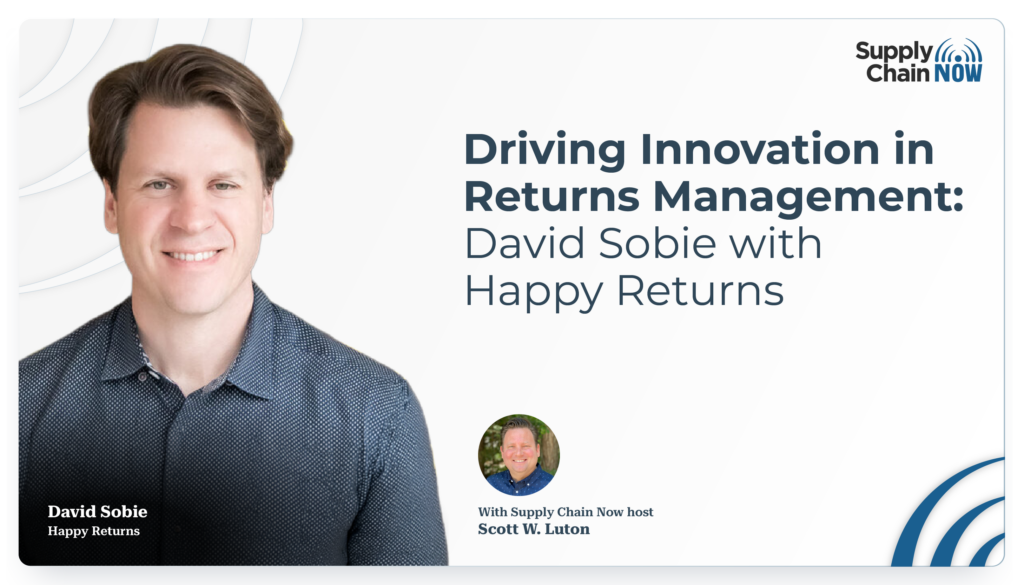
[00:00:34] Scott W. Luton: Hey, good morning, good afternoon, good evening, wherever you may be. Scott Luton with you here on Supply Chain Now. Welcome to today’s show. Folks, on today’s show, we’re delighted to have a pioneer in supply chain join us here today, especially from a returns management and reverse logistics standpoint. We’re gonna be taking a look at how one innovative company that provides end-to-end return solutions for online retailers and shoppers, well, how it continues to expand across the US.
[00:01:02] Scott W. Luton: We’re gonna touch on a variety of things, and one of my favorite topics, including some of the key trends impacting the reverse and return space. We’re gonna talk about the rise of returns fraud and what the future of returns may look like. All this and much, much more. So folks, stick around for a great conversation that’s gonna offer up tons of actionable insights by the truckload.
[00:01:24] Scott W. Luton: So I, I wanna welcome in our terrific guest joining us here today. David Sobie has quite a successful track record, especially in online retail. He’s built businesses in enterprise software, logistics, supply chain, and e-commerce at top-tier tech companies like eBay and Free Markets. And in 2015, David co-founded an intriguing business called Happy Returns, which looked to transform the customer experience, especially from a returns standpoint.
[00:01:53] Scott W. Luton: Now, Happy Returns has enjoyed a successful growth journey, and it eventually would be acquired by PayPal and now UPS. David continues to lead the company as CEO while also serving as an advisor and board member to other intriguing organizations. Please join me in welcoming David Sobie, Co-Founder and CEO of Happy Returns.
[00:02:12] Scott W. Luton: David, how you doing today?
[00:02:14] David Sobie: Ah, well, thanks Scott
[00:02:15] Scott W. Luton: It is wonderful to finally meet you. You know, uh, you may not know it, but I’ve been tracking you and the Happy Returns, uh, team for quite some time, and it’s great to finally meet you here today
[00:02:25] David Sobie: Good to meet you, sir
[00:02:26] Scott W. Luton: So let me ask you this.
[00:02:27] Scott W. Luton: Before we get into all things reverse and returns and, and find out some really cool expansion plans you’re in the middle of at Happy Returns, I want to start with a little fun warm-up question. And you know, we like to talk food, music, and sports, and kids. Uh, but one thing that kind of came to the forefront in the pre-show is you just are, uh, coming off a great experience in Vegas where you took in a pretty longtime popular band at Sphere.
[00:02:56] Scott W. Luton: Tell us about it.
[00:02:57] David Sobie: Yeah, so a couple weekends back, I was lucky enough to catch Phish. Uh, they did a, a nine-show residence at the Sphere over three weekends. I caught the, the final weekend, um, so shows seven, eight, and nine. And, um, man, if you haven’t been to the Sphere yet, I, I could not recommend it more. Um, it is a very, very unique, uh, music experience.
[00:03:20] David Sobie: The, uh, just the, the power of the visuals in that arena make it unlike anything that, uh, that I’ve seen. And, um, yeah, it was, uh… I had a great, great time, you know, with a lot of good friends, but, the sound quality is incredible. The visual quality is, is amazing. Um, really, really kind of a different animal, uh, than maybe what you’re used to a live, uh, live concert being.
[00:03:40] David Sobie: So highly, highly recommend it
[00:03:42] Scott W. Luton: David, that’s what I’ve heard. I’ve heard a lot, and, and as, uh, we were talking kind of pre-show, I’ve, I’ve seen and read various takes on the business model behind the Sphere, but, you know, I’ve heard so many great, um, attendee experiences, so I’m gonna have to take you on the show. really quick, one last thing before we get into your, your professional journey.
[00:04:01] Scott W. Luton: You’re a big-time Lakers fan. think LA is home while you’re on the road right now, big-time Lakers fan. And, uh, of course, spending time with your kids I know is atop your list. Um, what’s one of your favorite, uh, things to do with your kids there, David?
[00:04:16] David Sobie: Oh, that’s a great question. So we live in LA. Uh, we live near the water, so, you know, the beach is probably, uh, you know, one consistent experience that, uh, you know, it’s hard to– Everyone enjoys the beach, right? It’s hard to, uh, to have a bad time when you’re at the beach
[00:04:31] Scott W. Luton: Um, with you, especially with kids, man, especially with kids. Uh, well, it’s great to get to know you. Uh, we got a lot to get to here today. Uh, appreciate you joining us here on Supply Chain Now.
[00:04:41] Scott W. Luton: And I wanna, I wanna first offer some context to folks, right? And level set a bit on your professional background.
[00:04:47] Scott W. Luton: Um, you’ve had quite a journey, and you still got lots more chapters to go. It’s amazing what you’re doing right now at Happy Returns. But long before all the modern glory, I’ll call it, uh, and long before your current role at Happy Returns, can you share a couple of, you know, leadership roles that really shaped your worldview, David?
[00:05:06] David Sobie: Yeah, I think the, the first one, and, and I’m gonna date myself with this, but, um, in the late ’90s, sort of first dot-com boom, I worked for a company called Free Markets, uh, which pioneered the use of kind of B2B, uh, reverse auctions. it was a company based in Pittsburgh, which is, uh, what made it sort of a unique experience.
[00:05:27] David Sobie: but I would say a lot of my career is– was shaped by the experience I had there, being part of a growth company. that was really where I got, you know, a taste of what an entrepreneurial experience could be like. I think much of my career has been sort of chasing that, trying to recreate that.
[00:05:44] David Sobie: Um, learned a ton about culture and the importance of culture in building a company. Um, a lot of what we kinda have as a performance culture at Happy Returns is, is probably modeled on that experience at Free Markets. and it was kind of the full, you know, the full monty, right? We, we, we, we were a dot-com darling.
[00:06:02] David Sobie: Uh, we went public in, in December 1999, kind of at the, at the very peak of the, uh, of the market. and so got to sort of ride it up and then also ride it back down, when the NASDAQ bubble burst in March of 2000, um, and we were all still locked up at the IPO. But awesome experience.
[00:06:19] David Sobie: Um, actually fall, uh, we had our, our 30-year reunion, for Free Markets, which, uh, was pretty amazing to kinda reconnect with all the folks that I went through that experience with.
[00:06:29] Scott W. Luton: Really quick, on the culture side, I, I got– I loved your, um, I mean, number one, it sounds like an exciting chapter, you know, highs, uh, and then lows, but, but the, uh, it sounds like the camaraderie of w– at Free Returns you experienced. I mean, how many companies do you hear getting together for reunions like y’all are doing?
[00:06:49] Scott W. Luton: Thirty-year reunion. That’s awesome. and the cultural takeaways. I love hearing how those lessons you learned, those critical lessons you learned in what’s a special time for industry, you know, are still baked into and lingering between your ears and baked into, uh, the team and the organization and the culture at Happy Returns years and years later.
[00:07:08] Scott W. Luton: That sounds like you had some, uh, powerful eureka moments.
[00:07:11] David Sobie: Yeah, for sure. I think, um, as a young person, an impressionable person, um, you know, at a time when I was excited to work hard, um, and, you know, to be part of a culture where that was really rewarded, it was very much a performance culture. You know, we were all there to, you know, yes, we were there to have fun, but we were there to work hard, and we were there to accomplish something.
[00:07:31] David Sobie: And, um, and I think it, you know, very much modeled kind of our, our feeling at, at, at Happy Returns where, you know, when you find talent, it is your job to keep them engaged. It is your job to keep those people, to give them opportunities to grow. Um, sometimes, you know, responsibility maybe beyond what, you know, their age or their, their experience set might suggest.
[00:07:52] David Sobie: and, and so I think that that, you know, having, having those opportunities presented to me, uh, you know, is very much kind of the way that we’ve modeled the career paths of, of some of the folks at, at, at Happy Returns.
[00:08:02] Scott W. Luton: David, love it. I know there’s plenty of other, uh, roles and positions that you held, uh, that I’m sure shaped how you, uh, view industry and view the world and view business. But is there another one that comes to mind that you could share with us?
[00:08:15] David Sobie: Yeah, I think, um, it’s kind of where the Happy Returns story starts. Um, and that was that I was an SVP of marketing, uh, for a flash sale retailer in Los Angeles called, uh, Hautelook. And I don’t know if you all remember, uh, flash sale as a, a format, but these were kind of limited time sales of designer apparel and footwear, uh, highly discounted prices, right?
[00:08:39] David Sobie: So you, you joined for free by providing an email, and then each day there was an announcement of what, uh, what brands were going to be on sale. And, you know, it was kind of inventory was there until it was gone, so there was a strong call to action. Um, and it was a sort of pioneer in online off-price, which at the time, so this is kind of 2009, 2010, um, you know, was, was still, uh, new.
[00:09:06] David Sobie: You know, most, most online retail was full price, and this was discount. And if you know the Hautelook story, um, we, you know, we ended up getting acquired by Nordstrom. Nordstrom had, you know, Nordstrom stores and nordstrom.com for full-line retail. They had Nordstrom Rack for, you know, physical discount retail, but they didn’t have a nordstromrack.com.
[00:09:30] David Sobie: And so Hautelook became the nucleus of what eventually became, you know, nordstromrack.com, which today is a, a multi-billion dollar, uh, business line for, for Nordstrom. And the Happy Returns story actually starts there. that’s where I met the co-founder, Mark Eller. I was leading marketing.
[00:09:48] David Sobie: Mark was leading the mobile development team. And one of the projects that we worked on after the acquisition was letting Hautelook shoppers buy online, because we were an online-only business. Um, so you could buy from, from Hautelook and return products to Nordstrom Rack stores. And the insights that we gained working on that program, um, were, were really the, the instrumental insights that led to founding the company.
[00:10:13] David Sobie: you know, in really simple terms, if you give online shoppers the choice, you know, print a label, box it up, mail it back, or bring the item in for an in-store return experience, uh, they overwhelmingly prefer to return products in person. And, you know, Mark and I were shocked that, you know, six months after launching the Return to Rack program, um, over seventy percent of HauteLook’s returns were going back into Nordstrom Rack stores, even though most of our, our customers had no idea that we were part of Nordstrom.
[00:10:43] David Sobie: And, you know, what was really remarkable was that it was great for HauteLook, right? You know, it was a differentiator compared to all the other flash sale sites out there. It was solving a real pain point for shoppers. Uh, but it also was driving an incredible amount of foot traffic into Nordstrom Rack stores, right?
[00:10:59] David Sobie: And you can imagine if you’re a Nordstrom Rack sales associate, you know, and I come in returning a pair of jeans, natural question, “Hey, David, why are you returning those jeans?” You know, “They didn’t fit.” “Okay, great. Let’s get your HauteLook return taken care of, and then maybe we can walk over to the denim section and put you in a pair of jeans that do fit,” right?
[00:11:15] David Sobie: So it, it was phenomenal customer acquisition, uh, play for Nordstrom Rack. And when Mark and I started Happy Returns, you know, we thought, gosh, you know, we can recreate this case study that we just had a front row seat to. we probably know more about this problem than anyone in the world at this point because, you know, we had spent some time working on it.
[00:11:34] David Sobie: And so when we went out to pitch, you know, the initial idea for Happy Returns, it was, you know, we enable buy online, return to store for retailers without stores. And, you know, this was kind of the beginning of the direct consumer wave of e-commerce. Um, you know, we knew there were gonna be a lot more HauteLook type businesses out there, you know, digitally native without stores, and that we could provide that sort of buy online, return in-store experience for all of those businesses.
[00:12:00] Scott W. Luton: you’re already kind of sharing some of the what prompted you to start Happy Returns and some of your why there. But really quick, you’re describing, you know, we all love our acronyms in this space and BORIS, you know, buy online, return in store. And if I’m not mistaken, really quick before I double down on how you started Happy Returns, y’all had a great report come out with our friends at the National Retail Federation, and I was looking through that earlier.
[00:12:22] Scott W. Luton: It’s called … Folks, go, y’all go check it out. Chockfull of good stuff. The 2025 Retail Returns Landscape. Should’ve had another cup of coffee. Um, and one of the things that, that the data shares is that BORIS, you know, buy online, return in store, is still a fast-growing preferred option for a lot of consumers out there, uh, David.
[00:12:44] Scott W. Luton: You’re, you’re still seeing that, right?
[00:12:46] David Sobie: Yeah. And, and so in our case, it’s, you know, returning, buying online, returning in a store, but it’s a store where the experience is of Happy Returns, right? So it’s a third-party network of locations. Um, and yeah, that, what that report basically kinda highlights is that this has become the preferred way that online shoppers want to return products, right?
[00:13:07] David Sobie: Don’t make me print a label, right? No, no one has a printer anymore, um, especially those of us that work from home. I mean, my printer never has toner in it, right? Um, don’t make me print a label. please don’t make me box something up. You know, we, we joke in our office that that tape is a four-letter word.
[00:13:23] David Sobie: Um, and, and most importantly, you know, if you talk to online shoppers, they say, “Please don’t make me wait to get my money back,” right? And, and returns by mail You know, the process typically was, hey, print a label, box it up, drop it off, and then go check your credit card statement for the next two to three weeks hoping to see that refund issued.
[00:13:41] David Sobie: you know, we started Happy Returns with this idea of we can eliminate all of that return friction for shoppers. And by doing so, we can actually reward the merchants that, that make it easy, right? And it’s a little bit of a counterintuitive point in our business. You know, we, we used to hear things from retailers like, “Gosh, you know, do I really wanna make it easy for my shoppers to return?”
[00:14:02] David Sobie: And yet, if you think about the places that you shop, and I, and I’m speaking for myself here, but it’s the, it’s the, the merchants that return– that remove friction, that make it easy for me to buy, make it easy for me to return, that’s where loyalty is really built. Um, and I’d say that,we were ahead of the curve in understanding just how important that touchpoint is in the journey with a shopper, right?
[00:14:22] David Sobie: It’s, it’s kind of, you know, hey, they bought something, it didn’t work out for whatever the reason. That’s really an important opportunity to either build loyalty or to lose a customer, right? And, and that report that you highlight, you know, talks about I think it’s something like, you know, eighty-plus percent of people that have a bad return experience will never shop with that merchant again, right?
[00:14:44] David Sobie: You know, on the flip side, if you can turn it into, to something happy, right, something delightful, um, that’s really where you, you earn loyalty.
[00:14:52] David Sobie: and the reality is, you know, and this is again kind of a counterintuitive point, but you know, the best customers of any brand that sells online, you know, they buy the most from you, but they also return the most, right?
[00:15:03] David Sobie: You know, it’s kinda like, you know, shots on goal in a hockey game, right? It’s, it’s, you know, they have the most opportunity for, for something to not work out. they’re more likely if they’re loyal to you to try. You know, let’s say you, you know, you expand your assortment into something new, they’re more likely to try it.
[00:15:17] David Sobie: and the reality of buying, you know, we, we work mostly in soft goods, you know, things like apparel, uh, footwear, accessories. You know, the reality is those are, those are highly penetrated categories online, but they have really endemic return challenges, um, especially when you’re trying something on, you know, without, without…
[00:15:32] David Sobie: Or I’m sorry, when you’re buying something and can’t yet try it on, right? And so something like footwear, a lot of times people will buy multiple sizes, you know, or, or in apparel sometimes, you know, multiple colors. Uh, maybe I’m buying it from my phone. I can’t really see, you know, is it, is it black? Is it, is it charcoal gray?
[00:15:47] David Sobie: Is it heather gray? You know, maybe I’ll buy all three to try them on at, at home and figure out which one I like the most. and so yeah, it’s, it’s really, you know, I, I would say that we, you know, we started the company really thinking about solving the consumer pain point. Um, you know, what we found is that, man, returns are challenging for merchants as well.
[00:16:05] David Sobie: Um, they’re expensive. You know, you, you probably couldn’t design a more inefficient, um, and costly, uh, process than, than single item shipments back through the mail. we quickly realized that, you know, Happy Returns could not only solve pain for shoppers but could also solve, solve a lot of pain for merchants through, you know, some of the, some of the things that we do to aggregate items before we, we send them back.
[00:16:25] Scott W. Luton: David, fascinating stuff. Uh, it really is. And you know, um, I think in the bigger sense, I think we can have our cake and eat it too. I’ve seen a lot of leading retailers, um, number one, on one side do a great job making it frictionless for customers to return stuff. But then on the other side, doing their best to educate, inform, and, uh, help the customer make a more, make a better buying decision.
[00:16:49] Scott W. Luton: So hopefully we see less of the bracketing, which you’re referencing, uh, that, you know, is still prevalent across industry. Uh, and I tell you what, if we can make the customer happy and delighted when they return stuff, but also make them happy and delighted that more of their orders hit the mark, I think we, we’ll be making progress.
[00:17:08] Scott W. Luton: Um, so David, so we’re gonna, and we’re gonna talk about the Happy Returns expansion because y- y’all have entered a, a really exciting new chapter, so we’re gonna come back to that. And when you think of the why for starting Happy Returns, you really laid out a compelling, uh, part of your story there.
[00:17:25] Scott W. Luton: You mentioned counterintuitive a couple times, but man, looking back, it makes so much sense, David. I wish I thought of it 20, 30 years ago, my friend
[00:17:37] David Sobie: Thanks. Yeah, it’s, pretty neat that a lot of the initial insights that Mark and I had, um, you know, are still relevant today. Um, you know, I’d say as our journey, you know, I mean, this is our 11th year in business. Um, you know, as you mentioned in your introduction, you know, we at, we had times an independent company and, you know, were then acquired by PayPal, so went through that experience one time and then, you know, had the opportunity to sell the company a second time.
[00:18:01] David Sobie: and, and, you know, found, I think, uh, the right long-term home at, you know, at UPS. a lot of the core ideas have stayed the same, but where, where I think there’s excitement is really that the scale has just grown. Um, and, you know, logistics is a business that gets far more interesting with scale.
[00:18:17] David Sobie: and I would say that the problems change as well, right? You know, if, if there’s something that’s slightly inefficient, you know, it’s, it’s one thing if you’re doing it a couple of times a month. But when you start doing it millions of times a month, millions of times a week, you know, even small inefficiencies, uh, you know, can, can cause major issues.
[00:18:36] David Sobie: it’s sort of the reinvention of our network, the reinvention of our return hubs, you know, the reinvention of the journey, uh, you know, through our, you know, reverse logistics network, with scale, that’s really, you know, what, what, where I find joy today is, is just being able to operate at, at sort of enterprise scale.
[00:18:52] David Sobie: Um, and being part of UPS is, I mean, it’s just the resources we have, the expertise we have, uh, it’s just awesome.
[00:18:58] Scott W. Luton: Well, I’ll tell you, and, and more, more on that, uh, current chapter in just a moment. Um, you know, you describe a lot of what I think, uh, of the reverse logistics and returns management space. You know, we’ve been covering this space for, about eight, nine years. Uh, and a big tip of the hat to my dear friend Tony Sciarrotta, who’s helped, uh, with our, uh, continued learning and, and professional development here.
[00:19:20] Scott W. Luton: You know what? As a practitioner, I was in the manufacturing space more than anything else in all of my, uh, my supply chain experience. So I’ve learned a lot in the last eight or nine years. Uh, and, you know, over that time period, it’s been really cool to see more technology and startups and investment, you know, enter this space.
[00:19:38] Scott W. Luton: Um, but when you think of a short list of key trends that are impacting returns here in 2026, now in your 11th year, um, uh, leading Happy Returns, but also you’ve been in, you’ve been in this space longer than just those 11 years. Um, what are a couple key trends that, that are atop your list right now that, that supply chain leaders need to be aware of?
[00:20:00] David Sobie: Yeah. I’d say that, that speed, you know, speed and return is probably really top of mind. why is that? I think that, you know, returns are essentially inventory that, you know, can’t be resold until it’s back on the shelf. And I think that, you know, merchants are understanding, you know, especially in some of the, the categories we work in where, you know, it’s, it’s not uncommon to see return rates, you know, thirty, forty percent in apparel and footwear.
[00:20:27] David Sobie: all that inventory is, is basically dead stock until you can get it back on the shelf. And so I’d say that, you know, a real focus on speed is sort of one trend. Um, and then I think, you know, people have, have written about this quite a bit, this sort of, um, you know, question of are we at the end of the era of free returns?
[00:20:45] David Sobie: Um, you know, many, many more merchants… I think in our latest survey it was like north of seventy percent now have some form of fees associated with returns. You know, why is that? It, it’s trying to introduce a bit of friction maybe upstream, you know, as, as you talked about in, in the, you know, asking shoppers to think about, you know, what they’re buying and know that, hey, there’s a real cost here for the merchant if you, if you end up returning it.
[00:21:09] David Sobie: And I think what, the really savvy, uh, merchants are doing are, sort of imposing return fees that drive, uh, the behavior they want, right? And, and the example I always use here is, they may say, “Hey, if you want to return this to your original payment method, uh, I’m gonna charge a restocking fee.
[00:21:26] David Sobie: But if you’re willing to exchange that item, I’ll waive that,” right? And so maybe instead of buying two sizes, you know, you buy the one that you think is gonna work well, and we’ll make it easy for you if you want to exchange. You know, how do we do that? Well, we partner with a company like Happy Returns to make it easy to drop the item off.
[00:21:42] David Sobie: And, when your item is dropped off, that’s what will trigger exchange back. We’ll waive the fees to try to incent the right type of behavior, right? Or we see sometimes people saying, you know, “I’ll charge you a fee if you want your money back. But if you’re willing to take it in the form of store credit, I might actually even add to your, your total.”
[00:21:58] David Sobie: Right? So it’s, you know, this, the hundred dollar, you know, shirt that you bought, I’ll give you $110 if you take it in store credit, uh, rather than, you know, taking, uh, you know, a fee from you if you want it back to the original payment method, right? And, and, and so what is that? That’s a merchant thoughtfully using kinda carrot and stick in their return policy in order to try to drive the behavior that they want from their shoppers.
[00:22:20] Scott W. Luton: I like it. Uh, I really like it. I tell you, it’s, it’s a fascinating time. Uh, we talk regularly of, as a consumer, you know, if you look at the last 20 years, look at– heck, look at the last 10 years, the options and the, uh, variety, and I mean, it’s just an amazing time. It’s just an amazing time. And then to get what you need, you, you mentioned speed at the top of your list, one of the trends, to get it going and coming, you know, same day, next day, it’s just an amazing time.
[00:22:49] Scott W. Luton: And it’s– the engine behind it all is equally as amazing.
[00:22:53] Scott W. Luton: But I wanna talk about one trend in particular, uh, and get your take on one rising trend. You know, as I mentioned pre-show, I was in a room in Dallas, Texas last year, a couple years ago maybe. Last year, I think it was. Anyway, it had the biggest collection of retail leaders and retail returns leaders in this room that I’ve ever been around, right?
[00:23:14] Scott W. Luton: And we both know that the returns, when you think of returns as a functional space, that’s one area the industry’s gotta get better at, you know, creating more, uh, reverse logistics VPs and directors. We still have a lot of, lot of, uh, room to go there. the brain trust in this room was, was, uh, staggering.
[00:23:32] Scott W. Luton: And I spent about two days with this group, and the number one thing that all these retails, these retail leaders and returns leaders spoke about, the number one topic far and away was returns fraud, right? Because it’s a challenge that continues, and it’s not just a friendly, the friendly fraud, as some folks refer to it.
[00:23:51] Scott W. Luton: There’s more organized crime getting into, um, uh, the fraud game. So share a few of your observations, if you would, around the continued rise of returns fraud.
[00:24:01] David Sobie: Yeah. So I agree with you. It is definitely probably the number one concern of the merchants that we work with. you mentioned the study that we published with the NRF. Um, you know, a couple of stats from that, that study I think are just, just staggering. So, so one was just the, the share of, of returns that merchants believe are fraudulent.
[00:24:21] David Sobie: Um, in, in our reporting, and this is through kind of merchant surveys, you know, nine percent, right? Almost one in ten returns are what merchants are estimating. if you think about that, That’s a lot of, a lot of potential loss that the merchant has to eat. we also survey shoppers in that study.
[00:24:38] David Sobie: one of the, the, you know, really kind of mind-boggling stats was, was, you know, forty-five percent of the shoppers that we surveyed admitted to bending the truth sometimes when it came to returns. so almost half overall. And, and then if you actually, you know, took a look at it by age bracket, um, you know, this, this trend was even more pronounced in younger shoppers, right?
[00:24:59] David Sobie: So, so Gen Z, that, that, that statistic climbed to sixty-six percent of Gen Z respondents admitted to bending the rules. And when you think about Gen Z, I mean, these are folks that have grown up with online shopping, right? I’m, I’m more of a, of a Gen Xer. but for the Gen Z, you know… And so to them, you know, fraud is just, you know, you know, it’s just part of shopping, right?
[00:25:22] David Sobie: And you mentioned the rise of, organized crime rings. I mean, this, this is something that, whether it’s true criminals or just, you know, folks that are, looking, to take advantage of a weakness. What’s remarkable to us is how if you look for it, you know, in Reddit threads, in Discord threads, um, you know, you can find places where, people are, are gathering online, where they’re, sharing what they have found, you know, weaknesses in, in some retailers’, uh, return processes and opportunities to defraud the, retailers.
[00:25:50] David Sobie: Like, the moment a weakness is identified, uh, you know, it’s out there on social media. it ends up getting, you know, utilized. And it’s kind of a little bit of a game of Whac-A-Mole for the merchants. and I would say, you know, one of real vulnerabilities is, you know, it’s not just returns by mail, it’s returns by mail coupled with refund at the time of carrier scan or refund at the time that a package arrives back to the warehouse rather than actually inspecting the item at the time of drop-off or inspecting the item at the warehouse, right?
[00:26:21] David Sobie: And why is that, why is that, you know, sort of th-this weak point? Well, it’s because what ends up happening is people will return empty boxes, right? Or, there’s a, something called fake tracking ID fraud where, you know, someone will, you know, print the return label that the merchant gives them.
[00:26:37] David Sobie: Um, they might alter the address Slap that label on an empty envelope and mail it off. and then as it’s going through the carrier’s network, it’s getting scanned. Uh, and so at that point then they’ll start calling customer service saying, “Well look, I can see that it’s been received, and I can see that made its way back, but I haven’t gotten my refund yet.
[00:26:56] David Sobie: You know, you need to issue me my refund.” And what does the customer service person do? They assume that it’s lost somewhere at the warehouse, so, you know, I think that, um, the idea that, merchants are, are facing more fraud just because of consumer behavior as well as the, the sort of organized fraud, um, is very real, right?
[00:27:13] David Sobie: And I know your next question’s gonna be, well, you know, what do you do about it? Um, you know, it’s really this sort of balance of, you know, great customer experience. You know, what do shoppers want? They want returns that are, that are free, that are easy, and that are fast. you know what merchants want, they need confidence in order to issue those refunds.
[00:27:30] David Sobie: so in our case, you know, this means dropping items off in person. You know where a store associate can actually verify that the item that’s being returned is actually the item that was purchased. You know, we do that through things like barcode scans, um, or asking the store associate to pick, you know, an image of the item out from a series of images, a little bit like a captcha, right?
[00:27:50] David Sobie: And, and why are we doing that? Well, we’re doing it so that the merchant can with confidence know it’s okay to issue David his refund, right? combine that with now, you know, advancements in, uh, risk profiling and risk scoring each return transaction. this is something where, you know, we used to have 100% of items that got dropped off at Happy Returns would get an instant refund.
[00:28:12] David Sobie: Now what we’re doing is we’re actually looking at, uh, you know, the, the– basically coming up with a fraud score or a risk score for each one of those returns transactions and deciding that the high-risk items, we’ll wait until we can get that item back in one of our facilities, actually take a look at it and, and confirm, both with the human eye and using artificial intelligence.
[00:28:33] David Sobie: You know, is this actually the item that was purchased, right? Taking, Taking pictures, comparing those pictures to images on the merchant’s website, and then using AI to really like study and confirm that, yes, you know, the item that, David is returning is actually the, you know, the item that he purchased from this specific brand.
[00:28:50] Scott W. Luton: when we think of the organized crime component of overall returns fraud, just like they’re using the latest and greatest technology, I see a lot of the countermeasures, and you’re describing a few. Retailers will continue to invest this really cool technology that’s proliferating out now that’s gonna be able to, uh, x-ray is probably not the right word, but between using AI and other technology really scan even the packages that look like they’re in their original, um, you know, manufacturing, you know, plastic wrap and all that stuff. You know, the associates are in place, um, are in a spot where they can really, you know, make certain determinations. We c- we gotta put them in a better position too. We gotta educate them and equip them with a, with, um, innovative technology to, handle the right, those conversations at the point of returns.
[00:29:41] Scott W. Luton: So it really is, um, it’s a fascinating, you know, like, like in every sector, every industry, um, you know, you got bad actors. This is a fascinating particular battle to continue to watch. Uh, and, you know, all the cr- organized crime aside, David, just going back to the, the, um, survey data points you shared on what we’ll call, I hate saying friendly fraud, but you know, I’m not sure a better name to put that.
[00:30:08] Scott W. Luton: Um, you know, consumers bending the truth. We gotta, we gotta figure out a, a good countermeasure there too.
[00:30:16] David Sobie: I think what we’re gonna see is we’re gonna see, and maybe I’m jumping ahead to kinda, you know, crystal ball stuff. But, the same kind of personalization that we experience on the buying side, um, I think we’re gonna see on, on the return side, right? And it could be based on, you know, your, your past, uh, behavior as a shopper.
[00:30:34] David Sobie: You know, it could be based on value of the transaction. It could be based on characteristics of the actual return, right? we look at this in our risk scoring, things like, you know, when did you start the return relative to when you received the item, right? and all of those various data points about our history, uh, will go into, you know, the methods that are offered to you to how much scrutiny is given to the item as it comes back, uh, and ultimately when your refund is issued
[00:31:03] Scott W. Luton: And you know, uh, we are jumping ahead to crystal ball, but just like, uh, we all have a credit score, uh, you know, we’ll probably more and more all have a, a consumer score or a return score, um, as, you know, we look to, to, um, enable consumers to take full advantage of their behaviors. You know, uh, whether in terms of some of the deals you mentioned much earlier in your response or to mitigate some of the behaviors retailers don’t want to see as much.
[00:31:31] Scott W. Luton: So it’s, it’s again, fascinating space and, and, uh, I’m gonna keep my finger on the pulse and watch what y’all do at Happy Returns as we continue to navigate, you and all the retailers navigate this, um, this really interesting time.
[00:31:44] Scott W. Luton: Speaking of interesting times, uh, Happy Returns, you got big news. In fact, this is what hit my radar.
[00:31:50] Scott W. Luton: I think I was reading, uh, news of y’all’s expansion in The Wall Street Journal. Um, and I’d love for you to tell us kind of in a nutshell about this big exciting expansion that’s taking place, David
[00:32:02] David Sobie: Yeah.so the, the news that you read about in the journal was that we are expanding the drop-off network, um, from 8,000 locations, uh, to 10,000 locations. Um, and so, you know, today 8,000 locations are composed of, uh, The UPS Store, which has about 5,400 locations, um, Staples, which has about 1,000, um, and Ulta Beauty, which has, I think, 1,400 drop-off points.
[00:32:26] David Sobie: Um, those are all part of our network today. Uh, the expansion announcement was really about adding 2,000 additional locations. And, and we do this, uh, through our, you know, our partnership with, with UPS. Um, UPS has what are called, uh, ASOs, and that acronym stands for Authorized Shipping Outlets. Uh, so these are companies like Package Hub, or annex brands, um, you know, uh, Postal Annex, that are, you know, shipping local.
[00:32:53] David Sobie: Typically, these are local businesses, that offer shipping services. And so we’re adding about 2,000 of those to our network. why is this important? Well, it’s important because, you know, more locations means that we are closer to where shoppers are. it means that we’re expanding the percentage of shoppers that live near a Happy Returns location.
[00:33:14] David Sobie: we know that, you know, what do shoppers want? And I mentioned that they want returns that are kind of free, fast, and easy. Um, this kind of speaks to the easy part, right? More locations means more convenience, uh, for those shoppers. and we’re excited because it’s, it’s, you know, in, in the logistics business, you’re sort of balancing, ultimately, uh, you know, part, part of how we get economies of scale is by aggregating items in the same box for shipment.
[00:33:38] David Sobie: and, and so, you know, full boxes is important for our unit economics, right? You know, we wanna– instead of shipping, you know, 20 boxes with one item in it, we wanna ship one box with 20 items in it, um, to, in order to, to take advantage of sort of the, the shipping cost curve. and so expanding, you know, we, we wouldn’t be able to add, you know, 20% more locations if we didn’t have significant return volumes.
[00:34:02] David Sobie: And so it’s sort of a– this is a natural, next step in our growth path. and that’s really, I would say, you know, the success over the last couple years being part of UPS, where we’ve added, you know, some real household names, uh, that, that use Happy Returns service. Uh, so companies like The Gap, uh, companies like Shein, uh, Temu, uh, Skims, Spanx.
[00:34:23] David Sobie: You know, these are all Happy Returns customers now. And, you know, those are businesses that are, are large and scaled and as a result, have large return volumes. Um, and so being able to add 2,000 new locations to the network, um, is, is part and parcel of the growth that we’ve seen in return volumes by adding new customers.
[00:34:40] Scott W. Luton: Exciting times. And that list of companies you just rattled off, all those new customers, um, my daughter would think you’re the coolest person in the world, David. My oldest daughter. Uh, I’m still learn- I’m still learning the cool places to shop for her. Uh, all right. Well, congratulations to you and the Happy Returns team.
[00:34:59] Scott W. Luton: This is a really cool, uh, chapter and, and a fascinating space, and, and we’ll have to have you back and, and talk more trends, uh, far beyond fraud. Some more, some more, um, fun to talk about, uh, trends taking place in this, uh, uh, special part of the global retail world. Um, all right.
[00:35:16] Scott W. Luton: I got a couple of questions for you here, and one thing I wanna particularly ask you.
[00:35:20] Scott W. Luton: You know, we have supply chain leaders tuned in. They’re listening to us, right? In the traditional podcast sense, or they’re watching us on YouTube perhaps.there’s still a lot … When we think about some of the most mature aspects of global supply chain in terms of performance or functional areas, you know, the return science and reverse logistics science is newer, and it hasn’t gotten the attention that so much of the forward side of our global, uh, industry has gotten.
[00:35:48] Scott W. Luton: So naturally, we got, we got lots of, um, lots of improvement opportunities. So for the supply chain leaders out there that are listening to this conversation right now, uh, that are grappling and struggling with reverse logistics and returns management, you have a couple of, uh, pieces of advice, uh, for them, David?
[00:36:05] David Sobie: So I’d say that, you know, the first piece is to kind of give the people what they want. Um, you know, I think what shoppers want are returns that, as I said, are free, fast, and easy. Um, you know, depending on the category you’re in, um, you know, the idea of box-free returns to a third-party network make a lot of sense.
[00:36:22] David Sobie: Um, you know, there’s sort of two big ecosystems, uh, with Happy Returns being one of themwhere that service is available.the second is really this need to sort of protect yourself from fraud. and that can take many different forms. You know, we talked about things like risk scoring, about, you know, kind of secondary audits.
[00:36:38] David Sobie: You know, there’s a service that we introduced last fall called, uh, Return Vision, you know, that sort of combines the idea of risk scoring and secondary auditing of, of, you know, of items that are coming back, delaying refunds in some instances to ensure that, you know, fraud can be identified at the source.
[00:36:55] David Sobie: Um, and then the last, you know, kind of big trend is, is really the thoughtful application of return fees, right? So I talked about, you know, how many more merchants, you know, again, in our survey, I think the number’s north of 70% now have some form of return fee. Um, but you know, for, for those that are considering return fees, I would say, you know, one size doesn’t fit all necessarily.
[00:37:16] David Sobie: Um, and I think you wanna be really thoughtful about, uh, how you apply fees and, you know, if you have the data and the modeling to do it, you know, identifying which customers or which transactions, um, have fees, and then trying to be thoughtful about what behavior you’re trying to, uh, you know, incent or prevent, um, you know, by the application, uh, or waiving of those fees, I think is, is really important, right?
[00:37:39] David Sobie: You know, your, your best customers, you know, don’t introduce friction there. Um, you know, but those where you’re, you’re most exposed, um, or perhaps where there’s, you know, been, been fraud in the past or, you know, tho-those, uh, specific customers that you know, have had, instances of fraud, you know, that, that’s I think where you want to introduce friction.
[00:37:56] David Sobie: And so I think it’s, you know, it’s really trying to balance that, you know, getting shoppers exactly what they want with not exposing, you know, your business to, you know, to material amounts of fraud.
[00:38:06] Scott W. Luton: I think those are three great tips. Uh, and I love, uh, the last one about being judicious before you rush to, um, you know, that, um, across the board policy. Really, we have tremendous opportunities, especially in the, in the modern age where technology and, and treasure troves of data and analytics are at our fingertips.
[00:38:25] Scott W. Luton: Let’s use them, right? And let’s, um, let’s build a, a smarter nuanced strategy. Uh, and then going back to your first one, David, I know you’re a music fan, obviously a big Phish fan. Are you a fan of 10,000 Maniacs? Do you remember Natalie
[00:38:38] David Sobie: do. Yeah, sure. Of course. Yeah
[00:38:41] Scott W. Luton: So your first tip reminded me of one of my favorite songs that they released when I was in high school called, Give Them What They Want” was a refrain.
[00:38:48] Scott W. Luton: I can’t remember the name of the title, but that’s your tip. That’s the first tip, give them what they want. We’re in a great position here in the golden age of, of supply chain tech, returns tech, reverse tech, to really give the consumers what they want to delight and, and, you know, blow their socks off while protecting the business and, and being smart and managing, um, a, a smart and profitable business.
[00:39:11] Scott W. Luton: Um, okay, so let’s do this. You’ve already touched on the crystal ball, right? But I’m gonna double dip here, um, because when you think of the future of returns and what they may, that, that, that might look like, what else do you see? I mean, you’ve been in this space longer than a lot of folks and with a lot more success than a lot of folks.
[00:39:28] Scott W. Luton: What else do you see in the next couple years?
[00:39:30] David Sobie: yeah, one area that we’re pretty excited about, I, I think there’s two areas. one is sort of, uh, you know, if you kind of look at where growth is, a lot of growth is coming from, uh, some of the Chinese e-commerce players. we’re excited about that space. we’re excited about, about partnering with those companies.
[00:39:47] David Sobie: there’s a desire to truly have, a modern return experience. And, and so I think that’s a, that’s a growth area. Um, you know, another is this sort of personalization aspect that I mentioned. You know, like for years, personalization in e-commerce was about, uh, recommendations.
[00:40:03] David Sobie: You know, you know, you bought peanut butter, so now I’m gonna, I’m gonna recommend jelly, um, to you. but I think the personalization is coming to post-purchase as well, right? And that could be things like, you know, what shipment method or, or speed of shipment. It could be things like, you know, as we talked about, what types of return methods are available to you.
[00:40:21] David Sobie: It could be, uh, when refunds are issued for you. And, and again, I think that’s going to be really dependent on you as a consumer, um, you know, and, and the data that’s being collected on your behavior. Uh, you know, you talked about the idea of almost like a credit score. I think that’s gonna be, you know, i-increasingly, you know, a, a good model to, to think about in terms of the, the post-purchase experience that shoppers have.
[00:40:44] David Sobie: and I, and I think that’s exciting ’cause it’s, it’s, um, you know, I think it’s appropriate, and I think it makes sense from a merchant standpoint. maybe it doesn’t make sense to have the same return process for every one of your shoppers.
[00:40:54] Scott W. Luton: Yeah, I, I agree with you. And if we can encourage the right behaviors, you know, I think that provides a lot more options and, benefits for the 80% out there, you know? So it’ll be fascinating to watch. I think your crystal ball seems to be pretty finely tuned, and we’ll have to have you back, and we’ll examine, um, uh, the next couple years.
[00:41:14] Scott W. Luton: We’ll examine the, the growth chapter that Happy Returns is in, and we’ll keep our finger on the pulse of this fascinating aspect of global business and global supply chain. Um, all right. So David, uh, final question for you, the billion-dollar question. If folks wanna connect with you or if they wanna learn more or do business with Happy Returns, you name it, what’s the easiest way for them to, to learn more?
[00:41:37] David Sobie: Yeah. So I would say, you know, to learn more is probably happyreturns.com. Um, you know, or, or to follow Happy Returns on LinkedIn. Um, you know, we, we use that a lot to publish updates on the business. if you spend time there, you can download the research report that you and I have talked quite a bit about.
[00:41:54] David Sobie: there’s all kinds of case studies about the way that we work with different, um, merchants, that can be really useful, you know, especially, uh, if, you know, if it’s a brand that’s, uh, trying to understand kind of how to apply, uh, solutions like ours. Um, me personally, LinkedIn is a great way. I do read and respond to LinkedIn requests.
[00:42:11] David Sobie: my one ask would just be, uh, explain to me why you’re reaching out. Don’t make me click through to your profile and try to figure out what I’m supposed to do with it. Uh, you know, I’m much more likely to respond if someone says, “Hey, you know, I’d like to learn more about something,” or, uh, you know, “Hey, listened to you on a, on a podcast, uh, and I found it really, you know, really exciting.”
[00:42:29] David Sobie: that kind of personalization goes a long way in, in kind of cutting through the clutter,
[00:42:32] Scott W. Luton: I like it. I like it. Be targeted, be judicious. And hey, say you heard David Sobi right here on Supply Chain Now. That might get his attention. We shall see. But also, uh, he mentioned Happy Returns on LinkedIn. That’s where I found some really cool stuff, including, I think that’s how I, I backtracked to, uh, this great, uh, piece of research that I wanna, uh, mention again.
[00:42:53] Scott W. Luton: It is a joint, uh, a project between the National Retail Federation and Happy Returns. I think it came out last year, but it’s chock-full of stuff that’s relevant to where we are today, and it’s the “2025 Retail Returns Landscape.” So folks, check it out and let us know what you think. what a great conversation.
[00:43:10] Scott W. Luton: David Sobie, Co-Founder, CEO at Happy Returns. David, thank you so much for being here today.
[00:43:16] David Sobie: Thank you, Scott. This was fun. I enjoyed it
[00:43:19] Scott W. Luton: Well, next time we’ll double dip on, uh, the music side. We’ll, we’ll explore some other ways that we– other music analogies we can find in returns in global supply chain. But hey, kidding aside, hey, I appreciate the innovation that you and your team continue to bring to global supply chain. We look forward to having you back again soon, David.
[00:43:35] David Sobie: Thanks, Scott.
[00:43:36] Scott W. Luton: All right. So to our Supply Chain Now global fam, hope you enjoyed this conversation as much as I have. I, I nerded out a bit. I find this space fascinating, I really do. And maybe one of the reasons why is because we’re all consumers, right? And, and a lot of the behaviors that David and I both spoke about, um, you know, they, they resonate, right?
[00:43:54] Scott W. Luton: Because again, we all– these are things we all do. And so watching innovation in this space is really fascinating. But beyond all of that, you got homework. Y’all know the homework, uh, right? It’s the same homework every episode. You gotta take one thing. Of all the good stuff that David shared here today, take one thing, do something with it, share it with your team, share it with a colleague.
[00:44:13] Scott W. Luton: Uh, deeds not words, that’s how we’re gonna continue to transform global supply chain and not leave anyone behind. With all that said, Scott Luton challenge each of our listeners out there, do good, give forward, be the change that’s needed, and we’ll see you next time right back here on Supply Chain Now.
[00:44:28] Scott W. Luton: Thanks everybody.