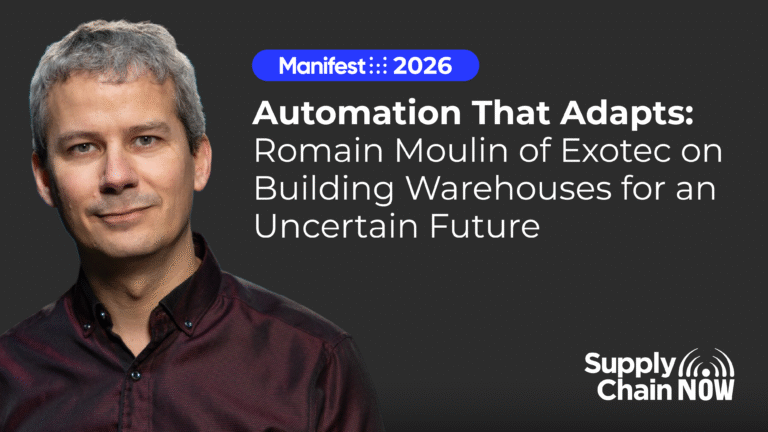
Automation That Adapts: Romain Moulin of Exotec on Building Warehouses for an Uncertain Future
Uncertainty Is the New Baseline
At Manifest 2026, Scott Luton spoke with Romain Moulin, CEO and co-founder of Exotec, to discuss how warehouse automation is evolving in an era defined by volatility.
“The big trend of last year was uncertainty,” Romain said, reflecting on 2025’s tariffs, economic tensions, and shifting trade dynamics. “Anything that would be done needed to deal with uncertainty.”
Rather than waiting for stability, companies are designing operations that assume change is constant. “Anything that is going on now must be projects that are able to reorganize themselves,” he explained. Warehouses must be robust, agile and flexible as to whatever the next disruption brings.
From Conveyors to Configurable Robotics
Exotec is known for inventing 3D warehouse robots (Skypods) that move across the floor and climb racks up to 14 meters (46 feet) to retrieve totes and deliver them to operators.
But beyond the visual wow factor, the real transformation is simplification. “The time of bespoke complex warehouses tailored to a very specific need is over,” Romain said. Customers are moving toward more generic, adaptable warehouses.
Exotec replaces hardware complexity with intelligent software. “We don’t program the solution,” he noted. “We let the software find the best optimal solution by using mathematical optimization or AI.”
The result is flexibility. A facility shifting from B2C to B2B operations can maintain performance without a physical overhaul. Scaling up or down becomes a software decision rather than a structural rebuild.
Standard Building Blocks, Tailored Outcomes
While every customer has different needs, Exotec’s strategy relies on standardized components. “The challenge and the beauty of what we do is solving very different needs with as much standard solution as possible,” Romain explained.
By assembling standard building blocks with minimal customization, companies gain both reliability and resilience. That approach reduces risk and improves the system’s ability to withstand future change.
Empowering the Workforce
Beyond efficiency gains, warehouse automation is increasingly about people.
“They can’t find the people to do the job,” Romain said of labor shortages across Europe, North America, and Japan. Manual picking roles that require walking 10 miles a day can drive high turnover.
Automation changes that equation. Robots handle the travel while workers focus on picking and value-added tasks. Humans supported by robots can move at 5x speed when compared to humans working alone, he said, while also improving ergonomics and job satisfaction.
Survey data reinforces the point. Workers overwhelmingly prefer automated warehouses. “If they have to choose between automated and non-automated,” the talent will choose an automated facility, Romain shared. During peak periods like Black Friday, the preference becomes even stronger.
In manual environments, performance improvements often mean pushing workers harder. In automated environments, optimization focuses on software and hardware, rather than human strain. As Romain put it, the goal is “to put the machine at the service of the workers and not the opposite.”
Designing for the Long Game
Today’s warehouse investments must withstand unpredictable demand shifts, channel changes, and geopolitical disruption. Adaptability is no longer optional.
For Exotec and its customers, the future belongs to systems that scale up, scale down, and reorganize without starting from scratch. In a world where uncertainty is permanent, automation that adapts may be the ultimate competitive advantage.
Where to Learn More
Connect with Romain Moulin with Exotec here on LinkedIn. Be sure to checkout Exotec’s recent report on their survey entitled: “Warehouse Worker Sentiment: Understanding the Impact of Automation on Retention and Satisfaction”: click here. And you can learn more via the company website: https://www.exotec.com/
More Blogs
Top Microsoft Dynamics 365 Partners for Distribution and Supply Chain Management