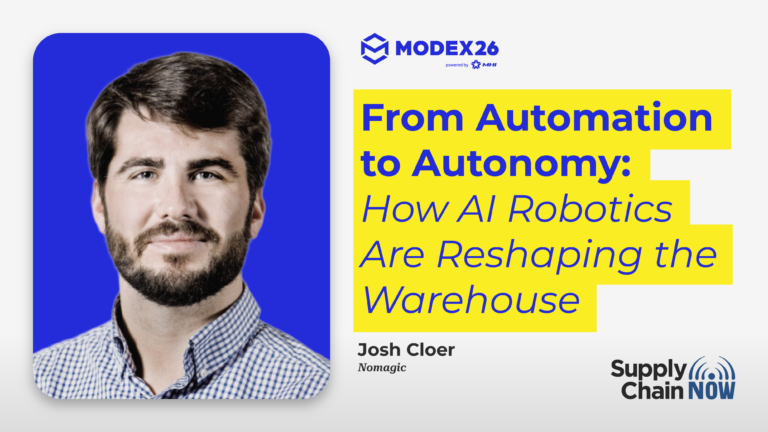
From Automation to Autonomy: How AI Robotics Are Reshaping the Warehouse
At MODEX 2026 in Atlanta, Scott Luton sat down with Josh Cloer, General Manager, North America for Nomagic, to discuss the next phase of warehouse robotics and the growing role of AI-driven automation inside modern fulfillment operations.
While transportation costs and economic uncertainty continue to pressure supply chains globally, Cloer sees a major opportunity emerging inside the four walls of the warehouse.
The Next Wave of Warehouse Investment
According to Cloer, many organizations spent the last decade investing heavily in core warehouse infrastructure: automated storage systems, shuttles, and tote-moving technologies. Now, the focus is shifting toward connecting and expanding those systems.
“What they’re moving forward with now is doing the rest of their warehouse,” Cloer explains.
That includes: automated forklifts, robotic picking systems, mobile robots and AI-driven item handling.
At the same time, smaller operators that may not have justified large-scale automation investments in the past are increasingly turning to more flexible robotic solutions. This evolution reflects a broader industry trend: warehouse automation is no longer reserved only for massive enterprises. More scalable and adaptable technologies are opening the door for a wider range of operators.
A Different Approach to Robotics
One of the most interesting parts of the conversation centers on Nomagic’s operating philosophy. Cloer believes one of the reasons robotics adoption has sometimes struggled is because vendors focused too heavily on project completion rather than operational outcomes.
“AI robotics has been around for some time… and a lot of people have struggled with adopting this technology,” he says.
Too often, companies deliver a robot, pass an acceptance test, and leave operators to manage the system themselves. Nomagic takes a different approach.
“We’re really doing robots as a service,” Cloer explains.
That means maintaining ongoing operational involvement, providing continuous support, and keeping humans actively in the loop. Rather than treating robotics as a one-time deployment, the company views automation as a long-term operational partnership.
Perhaps the most eye-catching detail? Nomagic operates with a 16-second response time when issues arise. That level of responsiveness highlights how critical uptime and operational continuity have become in today’s fulfillment environments.
AI at the Core of Fulfillment Robotics
At its foundation, Nomagic is focused on one of the hardest problems in warehouse automation: item manipulation.
The company’s robotic systems handle tasks like:
- Picking items from totes
- Inducting products into containers
- Packing items into shipping boxes
- Managing piece-level fulfillment workflows
But according to Cloer, the real differentiator isn’t the robotic arm itself. But rather, it’s the AI layer behind it.
“We’re really focused on the vision, the motion planning, the AI layer that makes this solution work,” he says.
That intelligence allows robots to operate in less structured environments and adapt to changing warehouse conditions more effectively than traditional systems.
Breaking New Ground with the Shoebox Picker
One of Nomagic’s newest innovations is already generating significant attention: a robotic shoebox picker capable of handling unstructured shoeboxes with clamshell or hinged lids. According to Cloer, it’s the first system of its kind able to reliably pick unstrapped shoeboxes from totes and place them accurately in downstream workflows.
The application may sound niche at first glance, but it highlights a major challenge in warehouse robotics: handling irregular, unstable, or semi-open packaging formats that humans manage intuitively but robots traditionally struggle with.
Expanding Into North America
Another major milestone for Nomagic is its formal expansion into the North American market. Founded in Warsaw, Poland, the company spent years building traction across Europe before launching operations in Atlanta to support U.S. growth.
“We know that people do their warehouses differently in North America than they do in Europe,” Cloer notes.
That localized approach includes building engineering, sales, and support capabilities directly in the region to adapt solutions to North American operational requirements.
The Future: AI Will Drive the Entire Robot
Looking ahead, Cloer predicts a major shift in how warehouse robotics systems operate. Today, many robotic deployments still rely heavily on deterministic programming with AI assisting around the edges. But over the next few years, he expects far more autonomous decision-making.
“We will see a big transfer over to these Vision-Language-Action models,” he predicts.
In this future state, AI systems won’t simply assist the robot – – they’ll also actively interpret goals, evaluate conditions in real time, and autonomously drive task execution.
Final Takeaway: The Warehouse Continues to Become Intelligent
The conversation with Josh Cloer highlights how warehouse automation is evolving beyond isolated robotics deployments into fully intelligent operational ecosystems. Success will increasingly depend not just on installing automation, but on integrating AI, operational support, and real-time adaptability into everyday workflows.
At MODEX 2026, one thing became clear: the future warehouse won’t just be automated. It will be increasingly autonomous.
Where to Learn More
Connect with Josh Cloer on LinkedIn. Nomagic engineers Physical AI systems that automate the flow of goods through warehouses, driving increases in speed, accuracy and throughput for scalable and consistent business growth. Learn more: https://nomagic.ai/
More Blogs

Breaking Down Silos and Gaining Speed: Manhattan Associates on Unifying Planning and Execution