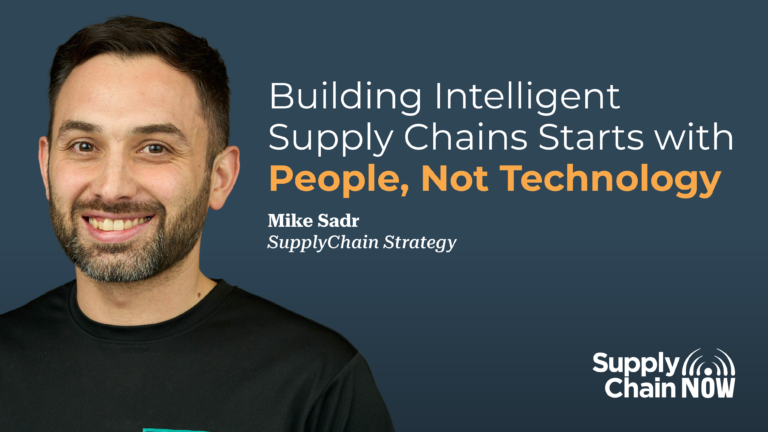
Building Intelligent Supply Chains Starts with People, Not Technology
Artificial intelligence, automation, and advanced analytics are reshaping global supply chains. But amid all the excitement surrounding emerging technologies, one critical ingredient continues to separate successful transformation from expensive experimentation: people.
That was a central theme of a recent Supply Chain Now conversation between host Scott W. Luton and Mike Sadr, Chief Revenue & Strategy Officer at SupplyChain Strategy.
Drawing on insights from SupplyChain Strategy’s Intelligent Supply Chain Champions Index and accompanying Playbook, Sadr shared perspectives on leadership, scaling innovation, building resilience, and learning from the people driving meaningful change across the industry.
Celebrating the Leaders Behind Supply Chain Innovation
The Intelligent Supply Chain Champions initiative was created to recognize professionals making a tangible difference across global supply chains while sharing lessons others can apply.
The peer-nominated Champions Index celebrates 193 outstanding leaders from across the Americas, Europe, the Middle East and Africa, and Asia-Pacific. While the Playbook invites ten of those senior supply chain professionals to discuss real-world challenges and opportunities.
According to Sadr, one leadership capability stands above the rest: connecting people, technology, and business priorities.
“There’s understandably a huge amount of attention on AI and automation, but the leaders we featured made it clear that successful transformation requires much more than adopting new technology.”
It’s an important distinction. Technology alone doesn’t transform an organization. People do, particularly when they’re equipped with the right tools, supported by leadership, and aligned around clear business objectives.
AI Should Empower People, Not Sideline Them
As organizations accelerate AI adoption, questions surrounding workforce implications have become increasingly important. Sadr emphasized that operational expertise and human judgment remain essential.
“Technology can provide better information, improve visibility and take some of the pressure off teams by automating repetitive tasks. But it doesn’t replace the experience, judgement and understanding that people bring to the business.”
Successful organizations involve frontline employees in transformation, listen to their experiences, and invest in developing new capabilities.
They also communicate why changes are happening and how employees will benefit.
As Sadr explained, “It’s not about taking people out of the equation, but giving them the tools and information to do their jobs more effectively.”
Escaping Pilot Purgatory
Another challenge facing supply chain organizations is moving promising technology pilots into enterprise-wide operations. Sadr pointed to the importance of clear objectives, measurable outcomes, reliable data, and cross-functional ownership.
“A pilot can demonstrate that a technology works, but that’s quite different from proving it can deliver value across a much larger organization.”
Too often, companies introduce technology without fully addressing the operational problems they’re trying to solve. Successful scaling requires more than technical validation. It demands organizational commitment and a sustainable approach to change.
“The difference is between treating a pilot as an experiment and treating transformation as a long-term business priority,” Sadr noted.
Building Resilience in a World of Constant Disruption
Disruption is no longer an occasional interruption. It’s a defining feature of today’s supply chain environment. The Intelligent Supply Chain Playbook explores five critical areas: end-to-end visibility, intelligent decision-making, resilience, cross-functional collaboration, and leadership and culture.
Sadr emphasized preparation over reaction, including stronger supplier relationships, better risk visibility, and greater operational flexibility.
“There’s also a recognition that you can’t anticipate every disruption. But with the right information, relationships and processes in place, you can make more informed decisions and respond with greater confidence.”
Importantly, he encouraged leaders to look beyond their own industries for inspiration.
“Sometimes a different perspective can challenge the way you’ve always done something or give you an idea you might not otherwise have considered.”
Expanding the Champions Programme in 2027
Building on the success of the inaugural program, SupplyChain Strategy is expanding its Champions initiatives in 2027. Alongside Intelligent Supply Chain Champions Vol. 2, two new programs are being introduced: Sustainable Supply Chain Champions, with nominations now open to recognize individuals driving meaningful sustainability improvements within their organizations and supply networks, and Logistics Excellence Champions, which will launch later in 2027.
Ultimately, the conversation reinforced a message that deserves more attention across the global supply chain industry: innovation isn’t simply about adopting the latest technology. It’s about celebrating talented people, learning from their experiences and creating the conditions for meaningful, lasting improvement.
Where to Learn More
To learn more about the program, explore the Intelligent Supply Chain Champions Index and register to access the accompanying Playbook, featuring insights from ten senior supply chain leaders.
For more industry insights, interviews and updates on upcoming Champions programs, follow SupplyChain Strategy on LinkedIn. You can also connect with Mike Sadr directly.
More Blogs
Investing at the Seams: Rachel Holt of Construct Capital on AI, Visibility, and the Race to Transform Foundational Industries