Intro/Outro (00:02):
Welcome to Supply Chain Now, the number one voice of supply chain. Join us as we share critical news, key insights, and real supply chain leadership from across the globe. One conversation at a time.
Scott Luton (00:14):
Good morning, good afternoon, good evening, wherever you may be. Scott Luton, Scott DeGroot here with you on Supply Chain now. Welcome to today’s live stream. Scott, how you doing today, my friend?
Scott DeGroot (00:23):
I’m doing very well, Mr. Lewton, thank you. I hope you are as well.
Scott Luton (00:27):
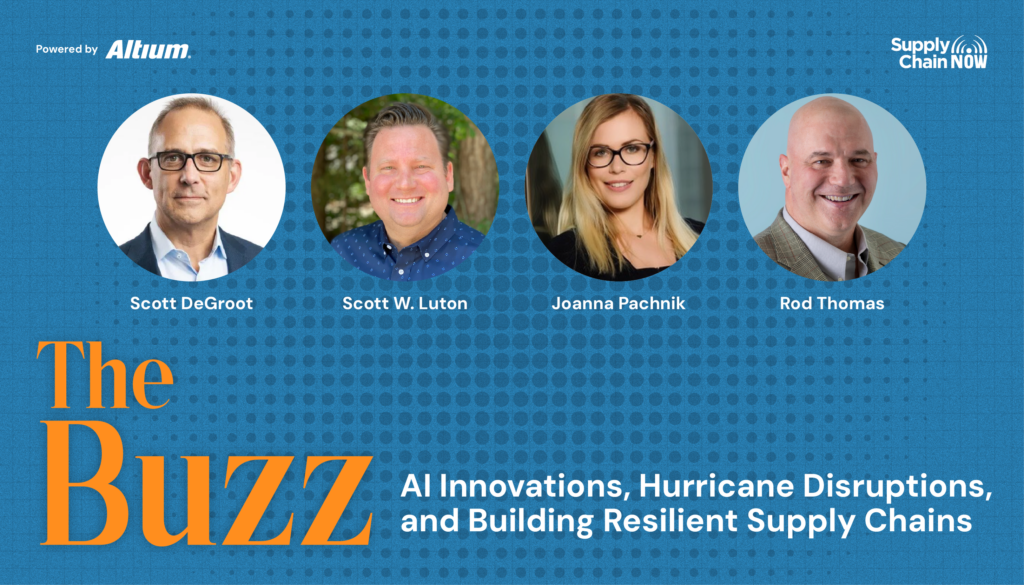
I am. I am. And folks, it’s the buzz. Every Monday at 12 noon Eastern time, we discuss a variety of news developments from across global supply chain and business. News that matters is what we like to call it. And folks, all month long in October, the buzz is powered by our friends at Altium who are doing some really cool things out in the industry. It’s a powerful organization redefining electronic product creation in a software defined world. You can learn more at altium.com. Okay, Scott, we’ve got a big show here today. We’re going to be talking about supply chain talent. We’ll be talking about the ongoing impact of Hurricane Asias. We’re going to get an update on where the USMCA renewal process stands. We’re going to be talking about why so many tech projects fail and don’t scale across the enterprise, all that much, much more.
(01:11):
And as Scott knows, we’ve enjoyed the pre-show sessions of both our wonderful guests. Dr. Rod Thomas is back with us. Joanna Potchnick is here with us today, so stay tuned for great conversations. Scott DeGroot, are you ready, AKA the professor? Are you ready to go today?
Scott DeGroot (01:28):
I am ready. Great topics and great guests, Scott. So I’m ready to learn something new every time.
Scott Luton (01:33):
I’m with you. I am with you. So we got a great edition of The Buzz and thank you, Tricia, already having dropped the link to our friends at Altium. And as Trisha challenges y’all, happy Buzz Day. Let us know where you’re tuned in from. We’d love to connect the dots. Certainly Supply Chain’s the greatest global sport for sure. All right, really quick, before we bring on our first guest here on The Buzz here today, I want to just call out really quick, we published the 192nd edition, I think, of our almost weekly newsletter with that said, published over the weekend. And I got to tell you, our whole Supply Chain Now team celebrated being named the number one Supply Chain podcast on a really solid list of 85 shows from around the world. So big thanks to our friends at Feedspot. We also featured a terrific edition of Marty’s Corner, which is always focused on actionable leadership strategies.
(02:22):
So check that out and let us know what you think. All right, Scott the group, I want to welcome in our first guest here today on the Buzz. Dr. Rod Thomas is an associate professor of supply chain management at the University of Arkansas’s Sam M. Walton College of Business. Now, before entering academia, he held leadership roles at Michelin, IBM and Lowe’s, and he also serves as a co-editor in chief at the Journal of Business Logistics. We’ve enjoyed publishing some of the great content here on Supply Chain now. So I want to welcome in Dr. Rod Thomas. Hey Rod, how you doing today, my friend?
Dr. Rod Thomas (02:57):
Hey, how are you?
Scott Luton (02:59):
Wonderful. Rod, whether it is an industry as a practitioner or in leading academic institutions, you rubbed elbows and worked with some of the top supply chain talent in the industry for quite some time. And of course, I think we called this out, you research and publish leading perspective for organizational and supply chain leaders to consider out there. So based on where we are here in 2026, I’d love to gain three tips from you when it comes to managing or even optimizing our engagement top supply chain talent. What three tips come to mind, Rod?
Dr. Rod Thomas (03:30):
Yeah, the first one, companies need to develop robust internship experiences. The better your internship program is, the more those students learn from you. They give them real projects. Don’t just have them make coffee and make copies, but give them real projects, real experience. They’re going to come back to campus and they’re going to share those experiences. They’re not shy about talking to their peers about what worked really well or what didn’t, what companies you want to work for and which ones you don’t. So if you develop a real robust internship program, they’re going to send your message of you’re a good company to work for more than any recruiter ever could. The other good thing you get out of it is you get a deeper recruiting pool next cycle. If they say good things about your company and the experience they had, everybody’s going to want to come work for you.
(04:15):
And the flip side is you get better hires out of it, meaning it’s not a 30-minute interview where all you’re really assessing is did somebody talk for 30 minutes well? You got three months with them and you see what they’re good at, what they’re not, are they a good fit or not? So that would be tip number
Scott Luton (04:29):
One.
Dr. Rod Thomas (04:30):
Tip number two is closely related. Pick your university partners wisely. Spend as much time on that supplier selection decision as you would any other. It’s the most important supplier you’ll ever have because it’s the human capital that’s going to come into your company. There are a ton of great supply chain programs out there, but they’re all a little different. They all have strengths and weaknesses. They all have things they focus on. Figure out what fits your company and your needs. And I would say the same thing about their student bases. Not all colleges have the same student populations. There are differences. Figure out which kids fit your culture and your environment more than any other. So those are the two I would say to get you the next generation of supply chain talent.
Scott Luton (05:09):
So Rod, hang on. Let me make sure. I was a C student, so let me make sure I was paying attention here. So let’s not mail it in on the internship program. Let’s not treat those like it’s 1982 was the first one. And then the second one, that’s a great tip because not only do we have limited resources and investing into our university partners, but they also bring all sorts of different things to the table. So am I tracking with you on the first two, Rod?
Dr. Rod Thomas (05:35):
Yeah, absolutely.
Scott Luton (05:36):
Great. And Scott, I’m going to get the third one and then I’m going to come back and get your thoughts on Rod three tips. So what’s number three, Rod?
Dr. Rod Thomas (05:42):
Number three, once you got them interested, once you have them and they’ve come to start working for you, realize you’re going to have to help them transition. The way they’ve been socialized, things that made them successful in school or maybe in their social circles aren’t always the same things that’ll make them most successful in a work environment. For example, think about our educational system. From little on up, every new hire you get went through a system that was highly structured. When we’re in elementary school, they tell you, here’s when you can go to recess, here’s when you’re going to study ABCs, here’s when you’re going to do whatever tasks that day. As they go further along, they give them rubrics and they say, here’s exactly what you have to do to get a C. Here’s exactly what you have to do to get a B.
(06:22):
Here’s what you have to do to get an A. Everything is really structured. Well, the reality is once you get out there in the work environment, not every problem we face is structured, especially in supply chain. I guarantee Scott’s done this before with a recent hire. Hey, get on a plane, go to this city, go out in this manufacturing facility or this operating environment, spend a week there and tell me what’s going on. And a lot of the new hires, they’re going to lock up because it’s not very clear. We need to help them transition of it’s okay if you don’t know exactly what to do, but roll up your sleeves and go figure it out. It’s okay to make a learning mistake. It’s okay to have an initial hypothesis that’s wrong, but then iterate and learn from it. That’s a transition they all have to make.
(07:02):
And again, think about it’s not their generation, it’s the way school taught them and trained them for the last 15 years. You’re going to have to push them to go make mistakes, roll up their sleeves, figure it out, be entrepreneurial. And sometimes we don’t even know as a manager what the answer is. We want you to go figure it out and that’s a mindset transition. They can all make it, but you’re going to have to help them make it.
Scott Luton (07:25):
Rod, I tell you what, if we had the next hour, I bet we could get 300 of these from you and they’re so valuable. Scott, the three that Rod shared, optimize and be serious about your internship programs, pick your partners wisely, and we got to help with transition and be okay with their approaches that they’ve been trained for the last 15 years. Scott, what’d you hear?
Scott DeGroot (07:43):
Yeah, no, I think Rod is right on the money, so thank you very much for sharing that. I completely agree. Some of you know I also work with a University of Tennessee big supply chain program and I think he’s right on. And the thing I would add is the students, even when they’re in their internships, they can do a lot of good things. And so let’s make full use of their time, give them the full experience, drive on the full width of the road as they say, and then give them the opportunity to shine once you bring them into your company because they can make a serious difference.
Scott Luton (08:13):
Well said, Scott. And folks, as Rod mentioned, if your interns are making coffee and making copies, you’re doing it wrong. And folks, if you’re an intern listening and you’re in that type of internship, set a meeting and professionally, but directly challenge them to help you, what would help your career in that internship, right? Rod, outstanding stuff. Scott, appreciate your perspective. Really quick, T-Squared, who holds down the workforce up in Baltimore and on YouTube says internships and structure critical for basic understanding, but what’s outside the circle is going for order to chaos, constant learning curve for all. That last line, I filled that one in my bones. I’m always on a learning curve, I feel. All right, Rod, before you go, I am delighted to be co-authoring a book with you that’s going to be published next year called The Readiness Rules. It’s going to be a very actionable read for folks out there, and I think you just kind of got a flavor of it from Rod Thomas here today.
(09:07):
Rod, your thoughts on what we’re going to be launching next year.
Dr. Rod Thomas (09:10):
Can’t wait. I’m excited. This is 20 years of working with students, employers, alumni. It’s all the tips and tricks of things that we normally don’t teach you in school that every manager wishes you knew. So when I said we want students to go figure it out, that’s one of the very first readiness rules we have. We call it FIO. Every one of our rules has an acronym so that it’ll resonate with them and they can remember it. We want a day. They’re not meant to be very long. They’re short, they’re direct, they tie industry examples and they’re really meant to create awareness for these students transitioning into managerial roles. I think it’ll be a big help for anybody, any new hire. I think it’ll be a language for hiring managers to give feedback in a way that maybe they weren’t able to do before. You could say, “Hey, you need to FIO a little bit more, or you need to show a little more gas, or you need to show a little less PETA,” or whatever the acronym is of the day that we’re on.
(10:01):
It’s a great start for them.
Scott Luton (10:03):
I agree. And folks, Rod is dropping some acronyms there. We’re going to explain more in a future show, but Rod also didn’t realize just how low his co-author’s reading comprehension was. So Rod’s really had to bring me along. Big burden on Dr. Rod Thomas there. But folks, kidding aside, go check out the Readiness Rules. We’ve got a landing page. We’re dropping a link in the chat so you can get all the alerts for publishing information, notifications, including where you get your copy. So go check that out. And Dr. Rod Thomas, my last question for you is how can folks connect with you, Rod?
Dr. Rod Thomas (10:36):
I’m on LinkedIn, Rod Thomas, or you can go to the University of Arkansas. I’m in the Walton College of Business in the supply chain management department. You could track me down either of those ways. Happy to chat anytime.
Scott Luton (10:47):
Outstanding. Dr. Rod Thomas, big thanks for you joining us here today on the buzz and for all that you do in global supply chain. We’re going to see you soon, my friend.
Dr. Rod Thomas (10:55):
Thanks gang.
Scott Luton (10:56):
Thanks, Rod. Scott, I love how practical and just how actionable his advice was on those three tips. Are you tracking the same with me there?
Scott DeGroot (11:07):
Yeah, I sure am. And I also appreciate the framework that is easy to use and important for hiring managers and practitioners to apply. Don’t outsource this to some incillary group. Get involved yourself and expect high things from the students that you’re bringing into your company.
Scott Luton (11:25):
Scott, that’s a great call out too, because a lot of times a lot of organizations, they outsource the things that aren’t always core, but talent is always core in my view. And big shout out, you mentioned it, but I want to give a big shout out to the cool things you and the team are doing at the Global Supply Chain Institute up at UT. Love the programming y’all conduct up there and keep industry moving forward. All right, really quick. Let’s see. I saw my friend Mark Preston in the comments. He was agreeing with you and Rod, go to the Gemba and learn the C. I love that. And by the way, y’all got to connect with Mark. If you like all things lean, he is a sensei. I’ve seen it in person. So Mark, great to have you here today. All right, so Scott, we got more work to do, but before we share and introduce our next guest, I want to share this resource because me and Scott, the group both enjoyed Manifest Vegas 2026.
(12:15):
And folks, it’s back, it’s bigger, it’s better. I don’t know how they could make it better because we enjoyed some of the best interviews and conversations and experiences really over the last two years of this event and we’re back for more. So folks, come join us February 8th through the 10th, back at the Venetian this year in Las Vegas. And if you register now, you can get 900 bucks off the onsite price. Scott, that dog will hunt. If folks are trying to get event and conference dollars from their managers, that dog will hunt,
Scott DeGroot (12:45):
Huh? Yeah, absolutely. And this is a place you want to go. It has a real buzz about it. You can feel the energy and the enthusiasm. I highly recommend attending Med.
Scott Luton (12:55):
Outstanding. I do too. So we’ll be there, folks. Come say hello and make sure you act now because deadlines as we get closer and closer, those discounts disappear. So we have dropped the link right there in the chat. Thank you, Tricia. Y’all go check it out. And Mohammed, great to see you here today, my friend, via LinkedIn. Let us know where you are in the world and of course, give us your take on today’s topics. All right, Scott the Group, as great as Dr. Rod Thomas was, we’ve got a second wonderful guest here today on the buzz powered by our friends at Altium. So Joanna Potchnik is the founder and CEO of BlueClip, an AI-driven technology company focused on improving supply chain performance and decision making with leadership experience spanning finance, operations, and technology. Joanna brings a practical perspective on using AI and better data to drive meaningful business results.
(13:44):
With all that said, I want to welcome in Joanna Potchnik with BlueClip. Hey Joanna, how you doing?
Joanna Pachnik (13:50):
To be here today. Thank you so much for having me.
Scott Luton (13:53):
You bet. Scott, this has been a long time coming. I think we booked Joanna a couple months ago in this crazy buzz schedule, so it’s great to finally have her here today. And Scott, we’ve got a lot to learn from Joanna, huh?
Scott DeGroot (14:04):
Indeed. I had the pleasure of working together with Joanna in my previous life, and I’m excited to hear from her again today.
Scott Luton (14:11):
We are too. And it’s interesting to your point, not to go into all the details, but here in the green room as Scott references pre-show, we just found the latest example of just how small the world is. So we may touch on it later. But Joanna and Scott, I’ve got a fun warmup question we’re going to start with. So 21 years ago on October 12th, 2005, Steve Jobs and Apple unveiled the fifth generation iPod, kind of look like that one right there, and it introduced video playback. This was a wildly popular device, right? Apple also announced at about the same time a groundbreaking partnership with Disney, which allowed consumers to purchase episodes of hit TV shows back then like Lost and Desperate Housewives. Remember those? They offer those through iTunes for like a buck 99 per episode. At the time, watching your favorite TV shows on a tiny handheld screen was really a revolutionary idea, nothing like where we are here today.
(15:03):
And remember at the time, 21 years ago, Netflix was still making DVDs. This was a big step forward to where we are now where streaming is a big part of how we watch television. And that’s what leads me to my fun warmup question. And I’m going to go first to share an example, right? I’m going to ask Joanna and Scott, they’re one of their favorite shows to stream, and one of mine that I’ve watched seven times, I bet, is The Sopranos on HBO Max. I’m telling you, if you don’t watch The Sopranos, I’m not sure if we can be friends. But Joanna, when it comes to shows you like to watch via streaming, what’s one?
Joanna Pachnik (15:39):
If I have to choose one, I would say Suits.
Scott Luton (15:42):
Okay.
Joanna Pachnik (15:43):
Yeah, so I studied law. I always wanted to be a lawyer, so I feel I really like this show because this was an alternative career for me, so I really always enjoyed Suits.
Scott Luton (15:54):
Okay. Man, Joanna. Scott, did you hear that? She studied law too. I’m not sure what Joanna cannot do, but Scott, what’s one of your favorite shows to stream?
Scott DeGroot (16:04):
There’s so many choices, but I’ll have to go with Band of Brothers. Here’s the thing several times, I won’t start it unless I know I can finish it. So it’s amazing, but I go into that hole and then I won’t do anything else. So Band of Brothers is another good one.
Scott Luton (16:19):
That’s a great one. That is a great one. And Trisha is also a big fan of Suits. Joanna, folks, drop any one of your favorite shows to stream. It’s amazing how streaming now dominates how we get our content. And Amanda says, “Hey, there’s hardly a show. I don’t like the stream, but she’s never watched Suits. We’ll have to make that connection. You
Joanna Pachnik (16:36):
Should. You definitely should.
Scott Luton (16:38):
Two thumbs up from Joanna means we got to take it seriously. All right, so we got a lot to get into here today, folks. On a much more serious note, I want to start with some of the industry impacts from Hurricane ECES. Best wishes, thoughts, prayers to all the families impacted by the storm, and we hope that recovery efforts are as fast and productive as possible. CNN Business reported last week on how the hurricane, it may play out, especially as it relates to the oil and gas industry, which is so prevalent as we all know throughout the Gulf of Mexico. This oil production took a big hit. At its peak, the storm shut down approximately 1.5 million barrels of oil production per day, or about 72% of Gulf of Mexico output. Natural gas production also fell nearly 60%. But here’s some of the good news at least.
(17:24):
The refineries were largely spared. The storm missed major Gulf Coast refining hubs, and the only not so good news, diesel prices, of course, remain very vulnerable. Diesel already exceeds $6 per gallon in many markets, and analysts are warning that prolonged disruptions, not just related to the storm, but elsewhere, could push prices towards $7 a gallon, increasing cost for trucking, manufacturing, distribution, really increasing costs for everything. Diesel touches everything, but the recovery is certainly underway across all fronts. That’s good news. And I think the hurricane offers up one of the latest reminders of just how concentrated our energy infrastructure is along the Gulf Coast. So Joanna, your thoughts on the hurricane and all of its far-reaching impacts.
Joanna Pachnik (18:12):
For me, hurricane is like another disruption, and we are talking about fuel prices, but not only fuel prices will be impacted. Each of us will probably feel the impact because fertilizers are also using fuel. So all the agriculture products will be for sure impacted. And for me, this is something that I’m a little bit worried about because each of us was impacted by what is going on in the war between Israel and then Ukraine. So I think that each of us will unfortunately feel the impact of what’s
Scott Luton (18:46):
Going on. Yeah. Joanna, well said. Hey, I know it goes without being said, Scott, but we hope all these conflicts come to an end and we find a negotiated path here. But Scott, react. I think you might have some family down there, if I’m not mistaken, Scott, but tell us your thoughts on the hurricane.
Scott DeGroot (19:01):
Yeah, I think it is. We have to understand that we live in this world of continuous disruption. There’s no going back to some sort of calm world, and we have to really respond. We cannot and should not wait for a major crisis to respond to the infrastructure issues. You’re finding capacity in the United States at least and globally, because we know about the war in Ukraine, is running at 98%. And so things we do around the edges aren’t really solving the issue. We have to fundamentally rethink about the design and operation of the supply chain because diesel is just one thing, as you said, Scott, that is in every single thing that we touch and wear and eat and buy. It’s all connected.
Scott Luton (19:44):
And as both of y’all know, great points. As both of y’all know, we actually got a bit of a break. I don’t want to sound insensitive on the heels of this one hurricane, but this was as late in the year that we’ve gotten a storm in, I don’t know, 80 years or so, I think at last count. So the disruption, it really reminds you just what one storm brings to the equation. And again, most importantly is all the families out there and we’re going to keep our finger on the pulse. But folks, if you can help out, again, find a vetted nonprofit to donate resources to. All right, so Joanne and Scott, we got more to get to here today. I want to move right along and talk about trade between US, Mexico, and Canada. As reported by our friends at Supply Chain Dive, the USMCA is back under the microscope, has been for several months.
(20:31):
The Office of the US Trade Representative has opened a public comment period as the US, Mexico, and Canada prepare for another review of their trade agreement. Businesses have until January 12th, 2027. So folks, you got about three months or so to weigh in on what’s working and what needs improvement. As many folks know, the White House wants changes. Washington declined to extend the agreement earlier this year, which triggered annual reviews until all three countries can agree on extension or the agreement expires in 2036. We have a little time. But as we all know, unfortunately, relations with Canada and the US are especially tense and a growing trade dispute includes 50% US tariffs on certain Canadian imports, Canadian retaliatory measures, and additional US import restrictions. A lot going on. Mexico negotiations between the US and Mexico appear to be a bit more promising. We’ve continued discussions there, recent talks suggesting, keyword, progress on several outstanding trade issues.
(21:28):
So who’s up for even more uncertainty, Joanna and Scott? With so many supply chains deeply integrated across all three countries, the outcomes of these negotiations, of course, could have major implications not here just in this unique trade region. Of course, they will all spill over because there’ll be effects globally. Lastly, one key day to watch, folks, July 1st, 2027 is when the next formal USMCA review is due. Now, Joanna, we’re going to talk about this in a second because you’ve got a unique role perhaps in global trade, but your thoughts as it relates to ongoing USMCA negotiations.
Joanna Pachnik (22:06):
When I see this, these companies still have a little bit of time, but we do not know what will happen next year or one year later. So when I read about this, what I’m thinking about most is network optimization because usually those network optimization processes were done once every three years, but with all the disruptions that are happening constantly, the approach to network optimization needs to be changed, and this needs to be a constant process. So companies were optimizing their supply chains, but at the same time, many of them lost flexibility to react very quickly to things like this. So we will need to, I think, start optimizing our supply chain slightly differently, taking into account not only cost optimization, but also flexibility and optionality to make sure that when things like this happen, we have an option to react. And it doesn’t mean bringing everything back to the US.
(23:04):
I don’t think this is an answer, especially as we probably won’t have enough workforce, but I believe that the analysis would need to be constant to make sure that we can quickly react to things like this.
Scott Luton (23:14):
Well said, Joanna. And Scott, she mentioned one of your favorite words, optionality. I know we’ve talked about that time and time again. React to what we’re hearing about the USMCA, Scott.
Scott DeGroot (23:24):
Well, I think number one, I just want to amplify what Joanna said. I completely agree. Network optimization and execution is an evergreen process and should be number one. Number two, you have to invest to be able to execute the options. Oh, I have some options, but I can’t execute them in time. So that’s like not having an option. Let’s invest in creating capability. And the other thing, we talk a little bit about the situation relative to Canada, but there’s been a huge growth with the international trade on the US-Mexico border, and Mexico trade has gone up substantially relative to what it used to be. And I also think that Canada is starting to rightfully consider other trading blocks like relations with the EU that have to be considered in the future design of your supply chain.
Scott Luton (24:08):
Scott, I tell you, we could spend a couple hours on this one topic because both of y’all bringing some great points to the mix. I would just add, and folks, I’m very partial, this is nothing new. I think I’ve shared this a thousand times. We’ve got such a unique opportunity across North America with Canada and US and Mexico. I would hate to squander it. I really would hate the thought of squandering it. So hopefully we’ll make some progress and it’ll benefit all parties and we can more constructively and productively and peacefully, frankly, contribute to the global economy. All right, so Joanna and Scott, we’re going to leave that one there, but folks go check out, make sure you’re familiar with these dates and all the things that Scott and Joanna just mentioned. Trisha’s dropped the link to the article right there and give this your take.
(24:49):
All right, so number three, you know what? I love talking about one aspect of global business that not only I find intriguing, but unfortunately Joanna and Scott, it’s always under-reported. We’re getting a little bit more airwaves here in the last couple years, but I’m talking about retail returns management and reverse logistics. Forget this, I stole his headline. This was from about a year ago, right? The National Retail Federation released the report then to 850 billion in merchandise returns in the US alone in 2025, and they got a new report coming out. It’s going to probably revise that figure this year, but I couldn’t wait. I couldn’t wait. We got holiday season approaching, we got peak season for returns, which is typically January. It’s right around the corner. So Scott and Joanna, I reached out to the smartest folks I know who are both longtime insiders and real pros, been there, done that when it comes to returns.
(25:40):
So check this out. Up first, my friend Tony Sheroda had lunch with Tony last week. I said, Tony, give me a couple things you’re tracking this year. And he says this, “Will vintage and pre-loved, pre-owned, certified, and refurbished goods continue to help the secondary market grow at a faster rate than new goods? In 2025, new goods were flat with only three to 4% reported growth or zero with inflation factored in. The secondary market with majors like Goodwill, eBay, Trove, and others grew at an estimated 10 to 11%. How about that? Secondly,” Tony said, “With e-commerce returns now seeing more and higher fees being charged due to higher shipping costs, will overall return rates start to slow down or exceed 17% with e-tailers at even higher numbers?” All right, so digest that for a second. And Tony, by the way, helped Phillips back in the day stand up their first returns program.
(26:34):
So this is built on his expertise. And then secondly, Scott Case has been involved in industry leadership circles for a long time, and Scott shared this with me. “This might be the first AI-powered holiday season. Retailers are using AI to promote offers to consumers. Consumers are using AI to comparison shop. When the inevitable returns happen, consumers can then use AI to navigate the returns process while retailers and their reverse logistics partners use AI to decide what happens to those returns. “So I think they just illustrated in two slides and with the three sound bites why I find this space so fascinating and why we got to really get it out there in front of industry leadership more and more often. But folks, we’re going to keep our finger on the pulse. We got some shows coming up on this topic and I’m looking at you.
(27:21):
I am looking at you, T-squared, one of your favorite topics, so it’s coming to you. So Joanna, tidal wave of returns is probably not getting smaller. Your thoughts, my friend.
Joanna Pachnik (27:31):
I don’t think that it’ll get smaller. Every year it was going up and up, but I do like the comment from Scott about AI because I strongly feel that AI really can help in this area. It is always a problem, and I don’t know why. We know that returns will happen during the Christmas season holiday period, but companies are never prepared. I always see that companies are firefighting and we have lots of visibility. We know about this and we are not getting prepared. And this is always surprising to me, right? It’s like in Europe, we say that drivers were again surprised by winter and winter happens every year. So I feel that AI can really help with this because you can automate this process. The problem is that there will be probably many edge cases to build those models for AI to help it, to help with returns.
(28:24):
It’ll take time, but maybe we will start being prepared a little bit more year over year, but I still feel that returns will be happening and will be growing unless we will start maybe charging more for returns of those products.
Scott Luton (28:40):
You raised some great questions for us to ponder. And Scott, I loved her comment there about winter as if are we wondering if winter’s going to come each year? Right. Scott, your thoughts?
Scott DeGroot (28:51):
Well said. Yeah. Hey, I can predict with utmost certainty that the weather will disrupt transportation networks in the near future. I just want one comment. So a small sample size here, but in our household shopping decision-making process, AI is helping the consumer make a decision on if I buy this item versus that item, which return policy is better or which one gives me more flexibility? Just know that AI should be helping companies. Yes, it’s also helping consumers, so don’t miss the chance to engage with a consumer because they’re using AI to make their purchase decisions and returns is part of the reason.
Scott Luton (29:28):
Well said. Well said. I get a sneaking suspicion it’s going to be more AI working with AI on so many fronts in the months ahead. But in the meantime, folks, I want to encourage you, Tony and Scott are two of the smartest folks I know on many things, but especially in returns, and we’re going to drop their LinkedIn profiles and I’d encourage you, go follow them, connect with them. Again, we’re going to feature some more programming on all things returns later this year. Okay, so we got a lot to get into before we dive into and pick Joanna’s brain on a Variety of topics. I’ve got one resource I want to put in front of folks. They’re helping to make the buzz happen each and every week this month. Folks, if your electronics team is still coordinate and design work through email threads, spreadsheet bombs, and zip file attachments, let me tell you there’s a better way.
(30:18):
Altium Agile Teams gives multidisciplinary engineering teams think electrical, mechanical, supply chain manufacturing, all one connected workspace without slowing anybody down. Ain’t nobody got time for that. We’re talking loud bomb intelligence so you catch component risks before they become production delays. Real-time design visibility so managers aren’t stuck scheduling status meetings just to find out where things stand. No one needs more extra meetings, right? And it also offers version controlled release packages so your contract manufacturer is always working from the right file. See what structured collaboration looks like. You can learn more at Altium Agile Teams. Let’s see altium.com/agile/teams. Check it out. Let us know what you think. All right, so Joanna and Scott, now threw that extra in just for Amanda. Amanda and Trisha’s helping us out on production. I could hear Amanda laughing from around the corner when I said, “Ain’t nobody got time for that.” So Amanda, that was just for you, my friend, just for you.
Scott DeGroot (31:16):
I like that one too. All
Scott Luton (31:17):
Right, we try. All right, so Joanna, delighted again to have you here. I found it really interesting. You’re going to be in three countries over the next three days. You’re helping a lot of companies globally, but I want to do this. You spent about 15 years helping these international organizations tackle complex operational challenges, but what recurring problems convinced you that the industry needed something different and how do those experiences help you launch blue chip? Blue Clip, my apologies. Blue Clip.
Joanna Pachnik (31:45):
We won’t be a Blue Clip company soon, right? But answering your question, I will say two things. One will probably sound a little bit like a cliche. Another one, not really. So first thing that prompted me to start Blue Clip was disconnected data. So at my career at consulting or industry, I always had to work with different systems, WMS, ERP, TMS, but it was really challenging for me to get information to make executive decisions. Sometimes I had to wait weeks to get this information and then I had to make my decisions based on intuition, which were not always that good and I was losing money. So this was one of the challenges that I wanted to tackle. Second challenge was actually the way how value is created. So when you think about the consulting world, when consultants come to you, they usually do not really understand your business.
(32:42):
They have very good industry knowledge. They analyze your business and what they give you at the end is a beautiful slide deck. And when I was a consultant, I was doing the same thing. I was preparing these beautiful slide decks and Scott probably also remembers some of them.
Scott DeGroot (32:57):
I remember.
Joanna Pachnik (32:59):
Very
Scott DeGroot (32:59):
Brilliant.
Joanna Pachnik (33:00):
When I switched to industry side and I had to work with all those consultants, I started getting really frustrated because slide deck was beautiful. Probably today I can create a similar slide deck with Copilot or Clot or ChatGPT.
(33:16):
But the key question for me was how to translate this into actions and execution? What do I need to do to make sure that all those benefits that consultants promised to me will be visible on my P&L? And this is what I wanted to bring to companies. So create value differently on the outcome is I really feel that this is what companies want today. Nobody wants to pay those $2,000 per hour just to get an advice that you can get also from Clot. Everyone is looking for outcomes and actions. And this is what Blue Clip is bringing to companies. So we optimize supply chains, but we own the outcome. So it’s not only giving them visibility, it’s also implementation and action. And I feel that being on another side, this was something that was a huge pain for me. And I know that this was also pain for my clients when I was still with EY.
(34:09):
They were of course nice not telling me this, but did they deliver what they really needed? I don’t know. Scott can say, but you are probably missing some things there.
Scott Luton (34:18):
None of us need another slide deck, especially in this ever faster moving world. We need, as Joanna pointed out, part of her why, the outcomes. And really human and tech, let’s take the best of both. But what’d you hear there, Scott, from Joanna?
Scott DeGroot (34:33):
What I heard is pragmatic view and I give congratulations to Joanna for trying to solve this gap is we’re creating an integration between some strategy or some ideas on what you might get from a consultant’s slide deck, which is important. But in reality, the savings on the ground and the PNL happen every day, day in and day out for every item, every customer, every manufacturing and distribution center in your network. That’s where the money is. And so we have to reduce the time between the strategy and the execution, the signal and the operation. And by reducing this time, I think Josanne is talking about is getting value faster and it has to be pragmatic and executable on the floor of the operation every day.
Scott Luton (35:18):
Well said, Scott. I’ll tell you what, let me just say this. If your organization is struggling with transfer pricing, that might be one more reason you want to pick up the phone and call Joanna. She’s been helping organizations a very long time. And gosh, in these trade war era, in this trade war era we’re in, a lot of pressure and a lot of more new complexity when it comes to that. So Joanna, for the sake of today’s conversation, I want to dive a little bit deeper into AI. Unfortunately, for all the great things that organizations and leaders and teams are doing with AI, there’s still a bunch of hype out there. I’m going to focus on the outcomes. When you think about all of your visits, all of your work, you’re around the world, you’re probably triple platinum on your airline of choice. I’ll tell you, your travel, something.
(35:58):
When you see AI doing really cool things, what’s one of your favorite examples, recent examples of how it’s bringing big outcomes and big value right now?
Joanna Pachnik (36:06):
I would say that probably the biggest interest that we see is with AI helping with transportation. So I really do not like big bank transformation projects. We usually start small and there is lots of interest in automating some dispatching activities, some activities that are not really value adding, but those can bring pretty significant benefits. So one of our most popular agents is, we call him Rob. Rob is a virtual dispatcher and supply chain analyst. So he can call drivers, confirm when they are arriving so that the teams have precise information, they can prepare products, they can prepare yard. And this is probably one of the most popular use cases that brings ROI to companies very quickly. Another area that I see where I see lots of interest is procurement. I guess with everything that is going on, companies are looking for alternative sources. And to bring alternative suppliers, there is lots of information that needs to be analyzed and AI can also help gather this information, analyze, provide it to companies so that they can make informed decisions.
(37:17):
And we see also pretty significant benefits for companies on one hand looking for alternative suppliers, but also in terms of multinational companies consolidating suppliers. Instead of using multiple different suppliers, if you can have a bigger contract, a stronger negotiation power with one supplier, this can also bring some substantial benefits.
Scott Luton (37:37):
Gosh, you gave us two great examples. I love the Rob example, and in particular, I love how we’re putting such an opportunity across yards, across industry. And there’s some great companies out there that are transforming yards. And then of course, procurement. Procurement is indeed cool again, and I love her examples. What supplier out there is not fighting for more business, right? Scott, what’d you hear there in those two AI examples?
Scott DeGroot (37:58):
What I’ve heard was Joanna articulating some great examples of solving real world problems that happen every day, truck dispatch, dwell time, inventory allocation in your GATP process, probably doing that too soon, probably not understanding the full width of the marketplace. Just think about Porter’s five forces and applying very granular data, driving executional performance and procurement. These are problems that we don’t have to go through some major digital transformation, start saving money, start saving working capital, start driving up revenue. These are the things, the use cases that Joanna is highlighting.
Scott Luton (38:34):
I like it. And I don’t know the last person, Joanna or Scott, that shared Porter’s five forces on one of our shows. So Scott, outstanding kudos to you and I’m going to go look up all five once we’re done here today. So Joanna, I want to talk about one of the biggest challenges when it comes to enterprise technology because you’ve got a lot of excitement around identifying the problem and if only we could fix this problem and then especially for the bigger, hairier problems that solves it and there can be a big gulf between the two. Joanna, in your experience, of course all the work you’re doing now, what do you find to be the cause with all these promising technology initiatives that we just aren’t really successful at scaling them? What causes that from what you see?
Joanna Pachnik (39:18):
Many. I will probably share two most important ones, but overall, as you said, there is lots of hype on the market and I think that companies are very confused what they should be doing. Some decide to wait because they do not really understand what they should be doing with AI. They are a little bit worried to start, but I think that the biggest mistakes are, first of all, choosing the wrong use case. This is the reason why I was saying that we like to start small with small use cases that can bring ROI very quickly. Many companies, they want to start with big use cases that promise very high ROI. Usually data is not ready for those use cases. Companies start, then they do not see that they can get those benefits. They get disappointed with AI, they blame AI, but it’s not really the fault of AI.
(40:06):
They started with wrong use case. So it is very important to actually, I think, start small. Small use case, not the biggest ROI. Second big challenge that I see, and it’s not data because I know that everyone will say that it’s data, I think it’s leadership. You really need to have a sponsor on leadership level for such a transformation because AI requires processes to be changed. People need to also change the way how they work, learn some new skills, and there needs to be support from leadership. And without the support, any initiative even with biggest ROI will
Scott Luton (40:40):
Fail. Those are two very practical tips. I see both of those. I bet if you put the 80 / 20 together, both of those will be in the 80. But Scott, I got to ask you, wrong use cases and it’s a leadership challenge, not so much, of course there’s data challenges, of course there’s tech challenges. I feel the same way Joanna says. We got to have engaged leadership that knows how to target the right problems as well. But Scott, what’d you hear there?
Scott DeGroot (41:04):
Great things is what I heard. And Joanna, I just really resonated with this idea that you don’t wait for perfect data, you get started. This question in my mind, I know we’ve had some debate about this in the public sphere, not between the three of us, but more broadly about, oh, there’s a lot of people who think they can just build these agents themselves. I’ll download Claudco this weekend. I’ll do some vibe coding. I’ll have a hackathon and I’ll have some agents, which maybe you can, but let’s get the value quickly by working with people like Joanna and others who have done this kind of work. Don’t wait, start saving some money now. Don’t try to build everything yourself.
Joanna Pachnik (41:41):
Exactly. And I think that this is a very important point, Scott, that you mentioned because for me, it’s always about security of your architecture. If you build it on your own on publicly available models, you do not know what’s going on with your data, how this data is going to be used. So it’s always important to work with a trusted provider who can secure your data and make sure that it’s not being used for cross learning because you will be sharing with AI very confidential information, including pricing your customers. It’s very important to do this right to protect your data.
Scott Luton (42:16):
Joanna, that’s a great call out. And folks, if y’all were part of the buzz last week, October 5th, we had two incredible cyber pros and they scared our socks off. There are so many risks. And one thing, Scott and Joanna, that they shared with us after the show, because one of them is Andrew and Bob, and one of them said, “Hey, I didn’t want to create a bunch of scary themes because we get uninvited from meetings regularly because folks don’t want to lean into the risks and what’s going on out there.” And it struck me, oh my gosh, if we’re not talking about the cybersecurity landscape as supply chain leaders, supply chain teams, we’re doing a massive disservice. And Joanna, going back to your point, we’re creating so much more vulnerability, basically sticking our head in the sand. So get ready, folks. We got to lean into all that scary stuff because if we’re not, we’re certainly not going to address it.
(43:07):
So folks, go check out last week’s edition of The Bus. All right, so Joanna, got a couple more questions for you, but I want to bring in Mark’s. Mark says, “Hey, start small. I ain’t got time to eat elephant with one bite. I need to eat it one bite at a time.” That’s so true, Mark, and I’m glad you could be with us here today. There’s nothing wrong with starting small, Joanna and Scott. And a dear friend of mine once told me, if you’re going to tackle the biggest problems out there, you can be overwhelmed if you want to jump straight to solving and solutioning the whole thing, break it up, break it up. That’s how millions of nudges of the mountains, that’s how we move mountains basically. All right, so Joanna, all this brings my thoughts to a really important topic. I want to get you to weigh in, you and Scott both really.
(43:50):
Companies, we got to be really intentional when it comes to rethinking and setting our strategies for that human machine strategy where we’re making sure we’re engaging and supporting and empowering the human element while taking the best of what technology offers in this golden age of supply chain tech. What do you think when it comes to how that rebalance is steadily taking place, what are a couple of important call-outs you would share with us, Joanna?
Joanna Pachnik (44:16):
Yeah, so for me, no, it’s about people and technology partnership because I feel that technology can only shine with the right people. Everyone is talking that AI will replace jobs. Probably if somebody’s job was not value adding, I agree. But if there was some sort of thinking needed, still there will be a place. So AI, in my opinion, is not really about replacing people’s jobs. It’s about making people partner with AI. And I think that each person will be slightly changing the way how they work, their role. So each of us will need to learn some new skills like how to manage AI, how to prompt AI, how to validate information that AI is providing because we all talk about AI hallucinating. Even with the best architecture context, you cannot completely remove hallucination. There will always be some risk of hallucinating. So you still will need people to assess what AI is doing.
(45:21):
In my opinion, AI will be removing this non-value adding repetitive type of work, and each of us should be empowered to really do what people should be doing, this value adding piece of job. And that is why whenever we work with clients, for me, it’s not really about removing headcount, removing people. For me, it’s more about empowering them, giving them tools to allow them to create more of value add for the company instead of doing some repetitive things. So I feel that many things will be changing, but I feel that it’s a great change for each of us because our works can be more motivating for us. We will be learning more new skills. So it’s an exciting journey and I don’t think that any of us should be afraid of this journey.
Scott Luton (46:08):
Joanna, well said. There’s so many things to talk about in your last response. Scott, there’s two things that stick out to me on what Joanna touched on. Number one, it isn’t about removing headcount. I mean, I think we got to be frank. As with any industrial revolution, there will be jobs lost, but the message that we see and the organizations we see, folks, if you love learning and you lean into learning new things and not cling to just doing the same thing every day over years and years and years, you can have so many more opportunities. And then secondly, also related to removing, not removing headcount, it is about removing pain. And I know it’s kind of simplistic, but I love the message. The leaders out there that are looking at how to use AI and they’re trying to figure out how to do that.
(46:50):
One of the top priorities from my take, my perspective, Joanna and Scott, is to look at the pain that your talent and your workforce has today and how can we apply technology to obliterate it, right? Scott, what’d you hear there from Joanna?
Scott DeGroot (47:04):
Yeah, no, really good stuff. And Joanna, again, kudos to you for the framework. I think we have another accountability to ourselves and to our teams, and that is we know that humans find dignity in doing valuable work. So as we shift the work pattern, it’s accountable for ourselves and for our teams to train and bring competencies to ourselves and our teams so that we can move the more valuable work and that hopefully can remove some of the tension that builds up during this time of change. But don’t forget to raise your own competency and make time to raise the competency of your team so the new work can be just as valuable or even more valuable to Joanna’s point than the old work.
Scott Luton (47:45):
Excellent comments, Scott. Excellent perspective between you and Joanna here today. Really have enjoyed it. Before we make sure folks are going to connect with Joanna at Blue Clip, Blue Clip, and she didnt miss a beat, it’s about to be a Blue Chip. I love that, Joanna. You don’t miss much in this world is my hunch, but folks, make sure you connect with Blue Clip. But first, I looked up Porter’s Five Forces, Scott, and I’ve heard this phrase, I’ve talked about them over time, but I couldn’t rattle off all five. So for folks out there that may be tuned in, maybe they can win a beer at a trivia contest. I’m going to share this right here. The Five Forces, competitive rivalry, threat of new entrants, bargaining power of suppliers, bargaining power of buyers, and threat of substitutes. So folks, hopefully you can win a good beer.
Scott DeGroot (48:32):
Kudos for breaking that up.
Scott Luton (48:34):
Hey, we try, Scott. We try hard. All right, so let’s do this. Before we connect everybody with Joanna and Scott, I want to encourage folks, “Hey, go check out our Resource Hub. We launched a new website last year, and one of our big priorities was investing in more written content. And man, we have got it coming out of our ears, but a lot of good stuff in a good way. So go check it out, supplychainow.com and you’ll find the resource hub right up at the top. Joanna, Joanna Potchnick, founder and CEO of Blue Clip. I really have enjoyed your perspective. I enjoyed our pre-show conversation. I enjoyed all that you’ve shared here today to help leaders out there. How can folks track you down, Joanna?
Joanna Pachnik (49:10):
I think that probably the easiest one is my LinkedIn profile, so I encourage everyone to connect with me. I post a lot about AI, debunking some myths, all the hype because I strongly believe in responsible AI. So I encourage everyone to connect with me on LinkedIn, and you can always also reach me at Blue Clip website on my email.
Scott Luton (49:33):
Outstanding. And we have dropped a link. Thank you, Trisha. We dropped a link to Joanna right there. And I think we’ve got your URL as well. Is that right? Blue Clip?
Joanna Pachnik (49:43):
This one is European one. Yes, because we also operate actively in Europe. BlueClip AI, this will be the US one.
Scott Luton (49:51):
Outstanding. Blueclip.ai. It’s just that easy. Make sure you connect with Joanna on LinkedIn. Follow her, connect with her, you name it. And make sure if you got a transfer pricing issue in these challenging times, that’s a great thing to talk with Joanna about as well. All right, Scott, the group. I want to, on your last point, you’re kind of challenging folks and leaders to lean into learning new things and equipping their team with new tools and perspective. And I’ll tell you, I love the work you are doing at UT via the Global Supply Chain Institute to make it really easy for folks to do just that. How can folks plug into anything you’ve shared here today or with the cool things you’re doing at UT?
Scott DeGroot (50:30):
Yeah, of course. Like Joanna and you on LinkedIn, so I’m there on LinkedIn and I will tell you Global Supply Chain Institute. So you can email me at estegrout@utk.edu. And this idea of doing pragmatic research and bringing talent to industry like we talked about with Rod, and we had a great AI summit here last week and what Joanna is doing the right kind of stuff to be doing. So we would love to have you as part of our conversation as well.
Scott Luton (50:58):
I’m with you. Trisha drop link to Scott DeGroot on LinkedIn, a.k.a. The professor. And we’ve also included the rightblueclip.ai. For those of us here in North America, check it out. You can learn what Joanna and her team are up to. What a great addition of the buzz here today. I want to thank everybody here starting with Dr. Rod Thomas with the University of Arkansas, Sam M. Walton College of Business and the Journal of Business Logistics. Go check out what they’re doing there. I want to thank Joanna Potchk, founder and CEO of Blue Clip. Joanna, thank you so much for taking time, especially.
Joanna Pachnik (51:32):
Thank you so much for having me today.
Scott Luton (51:34):
It’s dinner time where you are in the world. Thanks so much for spending time.
Joanna Pachnik (51:38):
Yes. Today I’m calling from Poland, but my European time zone just finished, but I will be starting my American time zone. So whenever I’m in Europe, I’m working two time zones, two shifts. Yeah, this is CEO life.
Scott Luton (51:53):
Well, it is, and I appreciate what you do, and thanks for giving us an hour of your time. I really enjoyed your perspective. I look forward to Blue Clip doing many, many more big things out there. I want to thank also my esteemed co-host, Scott, the group. Scott, always a pleasure to knock out these shows with you.
Scott DeGroot (52:09):
I enjoy it very much, Scott, and a great pleasure to meet with Joanna today.
Scott Luton (52:13):
I agree. I agree. Folks, also big thanks to our friends, Altim, big thanks Amanda and Trisha behind the scenes. And most importantly, big thanks to our global audience, the SCN Global Fam. Y’all are our north star and I really appreciate y’all keep the feedback coming. Feedback is a blessing indeed. On that note, folks, hope you enjoyed the show here today. Take one thing you heard here from Joanna, from Scott, from Rod, from some of the comments. Do something with it, share it with your team, put it into practice. Deeds, not words. Y’all know how it works. And with that said, on behalf of the entire Supply Chain Now team, Scott Luden challenge you, do good, give for it, be the change that’s needed. We’ll see you next time right back here on Supply Chain Now. Thanks, everybody.
Intro/Outro (52:53):
Join the Supply Chain Now community for more supply chain perspectives, news, and innovation. Check out supplychainnow.com. Subscribe to Supply Chain Now on YouTube, and follow and listen to Supply Chain Now wherever you get your podcasts.