Intro/Outro (00:02):
Welcome to Supply Chain Now, the number one voice of supply chain. Join us as we share critical news, key insights, and real supply chain leadership from across the globe. One conversation at a time.
Scott Luton (00:14):
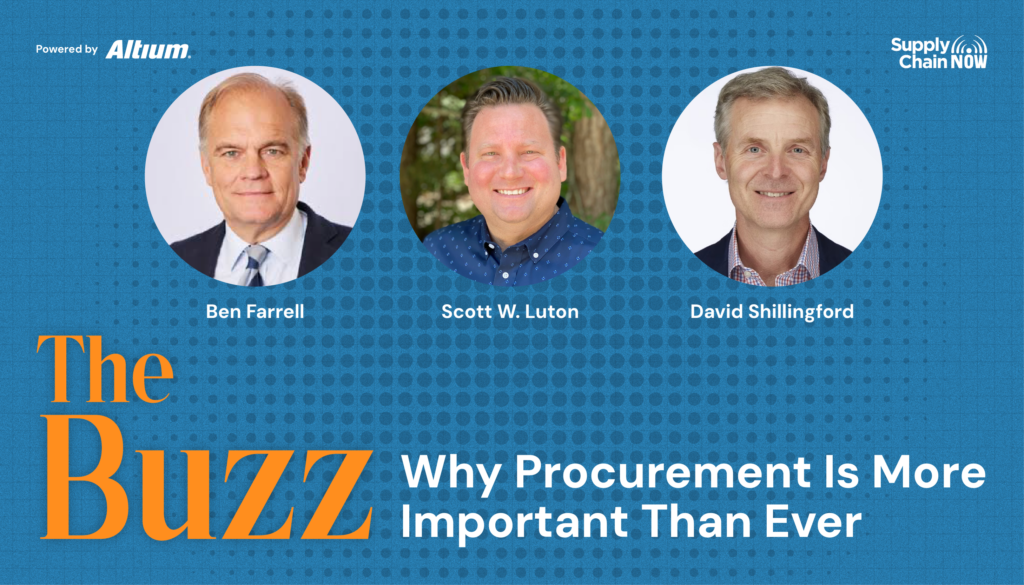
Hey, good morning, good afternoon, good evening, wherever you may be. Scott Luton and David Schillingford here with you on supply chain now. Welcome to today’s live stream. Hey, David, how you doing?
David Shillingford (00:25):
Good. Yeah, it’s a beautiful, sunny, optomnal day up in Northwestern Connecticut. So yeah, happy to be alive.
Scott Luton (00:31):
Outstanding. Well, it’s great to have you here. I can’t wait. We talked about Ben’s here with us. We’ve talked about some of the topics. If there was one thing, David, before we get into three things that we’re going to tackle on the A block here, if there’s one thing you’re looking forward to the most here on the buzz for October 19th, 2026, what would that be, David?
David Shillingford (00:50):
So I’d say that, I don’t want to steal too much of his thunder, but some of the research and surveys that SIPs have been doing recently is really very revealing. They’ve got an enormous reach and that Ben will be sharing it, I’m sure, but there’s some pretty interesting stuff in there.
Scott Luton (01:06):
Outstanding. And as he’s going to touch on, their first of many to come US focused events. So folks get ready for the buzz here today powered by our friends at Altium right here on supply chain now. And by the way, Trisha dropped a link to Altium Develop. Y’all check it out. All right, so David, again, we’re going to tackle three things before Ben joins us here today on the buzz. Up first, we’re going to share the 192nd edition of With That Said published over the weekend. We led with a variety of industry developments, including this, a recent survey of 500 US financial firms showed that 25% of those organizations are paying more to employees that demonstrate AI proficiency. Secondly, we touched on how memory chips pricing, oh my gosh, surged some 400% over the last couple of years, and we shared how the V8 engine is making a comeback in the US automotive world.
(01:59):
It’s kind of counterintuitive given where gas prices are, but all of that newfound popularity is not coming at a cost to other engine types. Get this, David. Some analysts say that hybrid automobiles will grow their market share in the US from 14% last year to 34% by 2030. So if you want power, it’s there. If you want efficiency, it’s there too. Folks, check out all of that much, much more in this edition of With That Said. We also include a snapshot of our live programming so you don’t miss shows and conversations like this one here today. So David, did you get a chance to read this edition of With That Said? What stood out to you?
David Shillingford (02:38):
I sure did. I always read it. I think it’s great. It’s a great summary. You never know quite what’s going to be in it, so always good stuff and relevant. The thing that stood out to me was the discussion around electronic supply chains. I think it’s such an important discussion because for electronic supply chains, understanding what you’re making and what it’s made of and how hard those things are going to be to get has got to be part of product design. If it isn’t, there’s so much strategic risk baked into supply chains and beyond direct suppliers. And we talk about electronic supply chains, there aren’t many supply chains that aren’t at least in part electronic supply chains these days. So it’s a very broad and complex topic.
Scott Luton (03:19):
So true. And you beat me to it on your last thought there because in many ways, not exactly, but in many ways, electronics and electronic supply chains touch anything kind of like diesel fuel. So if you’re having a problem with your electronic supply chain, you’re probably going to have lots of other problems. And we did touch on that and with that said, so check it out folks. You heard from David Schillingford. He reads it every week. That’s high praise. And as you’re going to see here in just a second, David’s pretty plugged in. So Trisha’s dropped link two with that said, and hey, addition number 200 is right around the corner. It’s a bunch of work. No one cares about those numbers, David, except the teams that crank out that content. That’s what I’ve learned in this journey. Does that sound about right?
David Shillingford (04:01):
It’s a good sign. People ask about how many people read my LinkedIn posts, but if my mission caused me to think about things and think differently, then I can achieve that with one like, not even one. So I’m hedged on that one.
Scott Luton (04:15):
I like it. Well said. And speaking of it, that’s a great segue, David. I appreciate that because did you know I start my morning with two things? Well, I guess three, if you include my Kirkland coffee from Costco. Yeah, it’s not real sexy, but it’s good. Goodbye. So the Wall Street Journal’s Logistics Report, number one, I’m a big fan. And number two, the David Schillingford Supply Chain and Global Business Report, which you’re going to find on LinkedIn almost every morning. And I took a snapshot of some of your analysis and perspective over the last month or so, and it’s really a wide range of topics. It’s kind of like the Beskin-Robins approach, which I love. Some folks may not know it, but I don’t like talking about supply chain twenty four seven. There’s much more in this life. So check out some of his recent posts here.
(04:55):
David’s talked about what John Maynard Keynes would say about AI. That is interesting. He’s talked about the challenge of getting past tier one visibility. That’s tough enough still in this days for some folks. And then of course he’s touched on just the far-reaching impacts of diesel prices. And I tell you what, there’s truckers out there that keep our global economy moving forward. And for a lot of those folks, it’s a massive, massive hurdle. This is just a little sampling. And David, I’m curious, I love the comments and the conversations that your posts always create. What’s some of your most interesting feedback you’ve gotten since you’ve been doing this almost every morning?
David Shillingford (05:35):
So I think the thing that stands out for me most about the posts that I do, the thing that I probably enjoy the most is where, because as you say, I write about a pretty wide range of topics. So inevitably there is always someone who knows a lot more about that particular topic than me who is out there. And if that person or some of them read the post and then comment and add their expertise to it, it gets really interesting. I learned something and people who talk to me about my posts, they go, “I really love the comments bit because you add other resources and then people who know far more about it than you, they come in and they add a lot of depth to the post.” So that to me is where the magic happens.
Scott Luton (06:14):
Completely agree. I’m telling you, and as y’all will see here, because I’ve grabbed some comments from some of our posts including today’s discussion, there is such value in the digital exchange from a lot of folks you don’t even know, and there’s a lot of respectful, valuable dialogue and exchange there. David, I want to ask you because I’ve included a link to one of your posts and it’s the one on, I’m probably butchering this individual’s name, this famed economist. John Maynard, is it Keynes?
David Shillingford (06:42):
People say it differently. Keynes, Keynes, either seems to work.
Scott Luton (06:46):
Okay. Well, folks, you can check out some of David’s thoughts and Kayne’s thoughts. Of course, he’s not been with us for about 80 years, but what we think he might would say about AI, check out David’s post right there and make sure you follow or connect with David because you’re going to enjoy his almost daily perspective. Okay, so David, one more thing before we bring on outstanding guests here today on the buzz. We got to talk about what our friends at US Bank are up to. They’re going to be releasing their Q3 2026 freight payment index on Thursday, October 29th, next week. And as we do each quarter, we’re going to be conducting a customary deep dive into the data, but this quarter we’re doing something a little bit differently. We’re going to be doing our analysis before the index’s official release, and we’re going to be doing that with members of the US Bank Freight Payment Advisory Council in the room with us for the live stream.
(07:36):
You heard that right? Pressure’s on. Pressure to perform is on. My co-host, Corinne Bursa and I, we’re going to be also joining with two special guests, Jeff Pape, general manager of the transportation team at US Bank, and Eric Olson is back with us. He’s climbing up the charts in terms of appearances here. He is a support operations director at TQL, and he’s going to join us, both them will join us in person 9:00 AM on Wednesday, October 21st for what promises to be an engaging interactive snyk preview of the Q3 numbers. Really looking forward to joining and being a participant in this extra live live stream, and we invite you to join us. You can find details on the US Bank Strategic Alliance Partner page at supplychainow.com/usbank. And if you can’t be there on the 21st, you can download the Freight Payment Index via the link we’re dropping in the comments.
(08:25):
You can also get it at freight.usbank.com. All right, so David, I am delighted that we’re going to be featuring a special guest here today. Really appreciate any of David Chillingford’s friends. We appreciate in our friends with them equally as much, I hope. So here on The Buzz Today powered by our friends at Altium, our special guest is Ben Ferrell, MBE, global CEO of the Chartered Institute of Procurement and Supply, better known as SIPS. Now Ben brings, as you’re going to find out, a fascinating combination of military leadership and business experience at the table. He spent 23 years in the British Army rising to the rank of Colonel, and Ben was awarded an MBE at just 29 years old. Now, some of you may be like, “Hey, is that an MBA? Is that an educational achievement?” No, that stands for a prestigious member of the most excellent order of the British Empire.
(09:14):
It is a big time accomplishment and recognition. Now, he later held senior leadership roles at the John Lewis Partnership before taking the helm at Sips in 2024. Today, Ben’s helping shape the future of procurement supply chain, advocating for a profession that plays a much bigger strategic role in business, and of course, one across the global economy. Let’s welcome in Ben Ferrell with Sips. Hey Ben, how you doing my friend?
Ben Farrell (09:39):
Hi, Scott. Thank you. Thanks for the introduction. Brilliant. Nice to be here.
Scott Luton (09:44):
Well, it’s great to have you. And as David, as we are talking pre-show, to really get everything, we might be introducing Ben for a couple hours. Is that right, David?
David Shillingford (09:53):
There’s a lot to say about procurement these days, and Ben and his group are pretty plugged into it.
Scott Luton (09:57):
They sure are. Well, great to have y’all both. We’re going to dive into some new stories, but first, Ben and David, I want to start with a little fun warmup question, a little history for all my fellow history nerds out there. I got something for you here today because 41 years ago today, an incredibly consequential event took place that would largely shape global electronics and culture for decades to come. Calls on October 18th, 1985, the Nintendo Entertainment System was released North America in limited markets along with 18 games, including Super Mario Brothers that deserves its own universe, I think. Eventually, about 62 million NES consoles will be sold along with some, some estimate 500 million Nintendo games. And of course, it helped build the future of where the video game industry is today and get this David and Ben. Some analysts show that global video game revenue is going to hit about $213 billion this year.
(10:51):
That’s up 6% from last year. But my question’s this one, and Ben, we’re going to start with you. Whether it was at an arcade in the mall back in the day or with a home console like the NES, what was one of your favorite all-time video games, Ben?
Ben Farrell (11:05):
It has to be Space Invaders. Do you remember when that first came out? I was sent away to a British boarding school, and I can tell you when Space Invaders came out, that was a major excitement in their life. And I think it’s a timeless classic really. It would go well today anywhere.
Scott Luton (11:21):
Ben, I do, and I remember dropping quarter after quarter at the Regency Mall in Augusta, Georgia, playing that game and many others. That’s a good one. David, that’s going to be a tough one to top. What’s one of your favorite video games?
David Shillingford (11:34):
It is. I love Space Invaders as a way of the design fitting the technology available. Like Ben, I was at boarding school in England, so I kind of missed out on a lot of this, a lot of the fun. So I got to catch up when I had kids. And by then we had things like the Nintendo Wi. Playing Super Mario with the kids on the Nintendo Wii was just, to me, magical. Love that.
Scott Luton (11:55):
Love that. That’s awesome. And Wii was a great console too. But I got to tell you, so Ben, I don’t know if you know this, but David’s longtime nickname around here has been the James Bond of Global Supply Chain. And I only bring that up, Ben and David.
David Shillingford (12:10):
Scott calls me this. No one else calls me this.
Ben Farrell (12:13):
This is good. We know him as 007 as well back then.
David Shillingford (12:19):
It might play better to an American audience than to a British. Oh
Scott Luton (12:23):
My goodness. So I bring that up only because of this. In college, I’ll tell you one of my favorite things to do ever, me and my college buddies would grab some cold adult beverages and we’d play the Bond game. I think that was on Super Nintendo, whatever. And we had so much fun sniping each other and just getting into a little bit of trouble. But anyway, video games, folks, who would’ve though that 41 years ago, this is where we’d be, got e-game competitions all nine yards. All right, so Ben and David, thank you for going back with me on Memory Lane. Now we got to get to some work. We got lots of news to talk about. Now I wanted to start with, you almost got me with the 007 comment, Ben, that was good. I want to start here on the Budz, sponsored by our friends at Altium with this article that was published in Supply Chain Dive recently.
(13:10):
Now it offers the perspective of Jet Chanan with EPG, and it focuses on both overrated and underrated supply chain priorities here in 2026. And I love a good list, as does Amanda and Trisha behind the scenes today. Really appreciate their help. I want to summarize these and I’m going to get Ben and David to comment here. So overrated, predicting every disruption, underrated, recovering quickly. Overrated, more dashboards and more visibility. Underrated, fewer decisions. Overrated, full autonomy. Underrated, purposeful autonomy. Overrated, the perfect technology roadmap. Underrated, designing for change. Now that’s an interesting list. We can have a show for every one of those topics. A really quick side note, I enjoyed sitting down with Jet at Modex earlier this year. I think we’re going to drop the link to that in the chat. So Ben, I’m curious to get your reaction to any of those overrated or underrated themes.
Ben Farrell (14:06):
I think not to be too specific on the precise theme, we can come back to the specifics, but I think what was in there was about thoughtfulness as opposed to trying to be prescriptive, not trying to predict every possible thing because we know that’s unrealistic, not trying to be too autonomous because you’re going to find those shortcomings in it. So I think the idea that sits beneath a lot of that was about thoughtfulness and how much more thoughtful we can be about future design and the way we approach problems and managing those problems.
Scott Luton (14:37):
I like that, Ben. And I think it’s being more thoughtful is certainly a charge for leaders everywhere, especially in these times that we’re living through now. David, your reaction… I’m sorry, go ahead, Ben. You had a comment there?
Ben Farrell (14:49):
No, I think it’s such an easy thing to do to imagine that the route is to automate or imagine you can design problems away. I mean, having been a soldier for a very long period of time, I know that you can dream up different scenarios and rehearse and practice them a million different times and it never plays out in that way. So the idea that somehow you can design these things away is I’m afraid for the birds.
Scott Luton (15:14):
Ben, very eloquent way of sharing your perspective there. And David, I’m curious, so whether it’s this article or the broader thoughts like Ben is sharing, your thoughts, David?
David Shillingford (15:24):
I’ll build on two of Ben’s comments. The last one I love because I can’t remember if it was Eisenhower or someone else. He said that plans are useless, but planning is invaluable.
Scott Luton (15:34):
Yes.
David Shillingford (15:34):
And I think that sums up a lot of this, but to the extent that we can automate more things, it should, in theory at least, give us more time to be thoughtful. That’s the outcome. And if I think about the question and I suggest that perhaps the answer depends upon where people sit relative to a process or a technology or whatever, you can take AI and say it’s both. AI is both overrated and underrated. And then it begs the question is, well, what is it that causes that to be the case? And it’s expectations, it’s execution. And I think that mirrors the list that you just read out in some ways.
Scott Luton (16:11):
So again, there’s a lot. I love articles like this because it gives you so much fodder to work through. So I want to give a tip of the hat to both Supply Chain Dive and Jet over at EPG. And I want to pull one out beyond what y’all have shared. It really resonated with me. And we’ve talked about folks out there that tune into any of our shows here. We’ve talked about this before, but I would argue whether from a supply chain perspective or especially as an entrepreneurial perspective, it’s not necessarily all the big decisions you’ve got to make in any given day or any given week, but rather, those are tough too, but rather it’s the cumulative effect of having to make a constant barrage of decisions. And so as Jett wrote there, underrated fewer decisions. I can’t always do this, but I would argue that the more decisions we can just take out of the proverbial day-to-day, oh my gosh, the reward on that is like 10X, maybe 100X.
(17:04):
Ben, your quick reaction to making less decisions, would you agree with that?
Ben Farrell (17:09):
I think so. I was really interested, and I hadn’t thought about this much before. Someone said, “I always wear the same clothes. It wears a black t-shirt and black trans at work every day because of the tyranny of decision making in the morning. So take one decision out of your day, wear the same, off you go.” Because actually there is a thing about that. Sometimes I think it’s also about the way you choose to lead and being able to delegate really effectively so you’re only left with really important decisions. If you find yourself making all the decisions, you’re probably going to ask yourself, “Have you got yourself organized well enough?” But that’s part of it. But I can totally get the fatigue of decision making.
Scott Luton (17:50):
Oh my gosh, that’s such a great call out, especially eliminating that big morning decision. I encourage my kids, pick your clothes out at night. And David, get your quick reaction. By the way, it was Ike mentioned plans are meaningless, but planning is everything. There’s a great quote there. React to the value of being able to make less decisions each day.
David Shillingford (18:11):
First off, I get compliments for having a limited wardrobe so that I can make better decisions, but I just don’t like buying stuff, so it’s a different discussion. I think in terms of decision making, a couple of things to add to what Ben was saying. I think the point on being able to delegate is critical and it sort of comes back to one of the things that people get wrong. Not every decision is the same and small frequent decisions, whether you are making them quickly or delegating them, it’s about moving quickly. And I think Steve Jobs talks about this quite well in terms of there’s big decisions where it’s irreversible, spend time on those. Other things move quickly. So whether you’re automating it or just moving quickly in terms of having the processes, when you automate things, it works well if you already have good processes, the automating.
(19:02):
So that kind of thinking flows into automation and enables the organization to do what it already does well, but to do it quicker and to do it better.
Scott Luton (19:11):
Well said. Don’t spend two hours picking your socks, folks. There’s better time.
Ben Farrell (19:16):
Top tip giving everybody today.
Scott Luton (19:19):
All right. So good stuff there. That’s article number one. Great work. Enjoyed your perspective, David and Ben. And story number two here, part of the B block. I want to get into some polling, some recent industry polling. So I saw about a week and some change ago where our friends at ASCM conducted a poll on the biggest barriers to scaling AI in supply chain. And I think they had about 120 votes here. The results came in like this. Poor data quality came in with the largest share at 39%, followed by security and governance at 26%, workforce readiness at 20%, and unclear ROI at 15%, which is what I voted. So of course, unsurprising to see data challenges came in number one, doesn’t surprise I think many folks. So I try to conduct a poll based on that to dive in a little bit deeper on that one topic.
(20:04):
And I want to say we had about 30 votes or so, so it’s not like we’re setting our earth on fire in terms of survey responses, but it’s tough to do these days. Of the votes that came in, here’s what it ranked. 34% said inaccurate or outdated data. 30% said disconnected data silos. I thought that was going to be number one. 19% said inconsistent data standards and 15% said missing or incomplete data. We also had some interesting comments, but before I share them, I want to point one thing out. LinkedIn, all of our friends at LinkedIn, you got to give me some more characters on these surveys. You’re killing me how succinct we’ve got to be. Anyway, so the comments, Sam shared, looks like he’s a CTO, Sam Ferris said disconnected silos in his experience. The same shipment lives in the TMS, WMS and ERP under different keys, so correct records look inaccurate the moment an agent tries to join them.
(20:52):
Jerry Jose, I think, hope I said that right, said, “Sometimes it’s not just dirty data, but inconsistent data definitions between partners. Even a small mismatch on what counts as delivered trip up an AI rollout fast.” Radu talks about inconsistent standards. Alexandros talks about disconnected silos as well. So kind of a mixture of comments there. Folks, you’ll have to go to the original post to get them all. But Ben, I want to get your reaction both to the broader barriers for more AI success or the more specific, there’s no shortage of data challenges. Your reaction to all of that, Ben.
Ben Farrell (21:29):
First is these organizations that are worrying about their data challenges have obviously got past the question of what AI should they employ in the first place when they’re looking in the ROI. So I find that interesting. It’s a sort of more mature perspective than what I’ve seen to a greater extent is the adoption, this endless conversation about AI and I genuinely believe the majority of organizations are still wondering where to put the big bets with this nevermind the conundrum of thinking is the data good enough to get the value out of the AI in the first place? And then you get onto the data question, which are not in the least bit surprised to some extent. It’s not even a new question when we think about it, is it? When you think about RPA and lots of the big data questions that we had of not many years ago, really you think these are habitual things that have come round and to some extent we have not necessarily improved data.
(22:23):
The question I think that was there was it Rob who said the same data tagged in different TMS or WMS or whatever it was, same thing, telling you a different story, Sam. And I recognize that. I’ve seen it a million times in different forms. So actually it’s how bad organizations are at data capture generally is the underlying thing that’s interesting.
Scott Luton (22:46):
It is. And David, it’s even more interesting. It’s compounded in its interest in how interesting it is. We’re years and years past what became the big data era, right? Years and years, but we still have some of the same fundamental challenges as Ben’s pointing out. David, your reaction here.
David Shillingford (23:04):
Well, how long have we got? A couple of hours, I think you said. I mean, this is where I spend most of my time and the surveys I see talk about poor data. It’s such a multidimensional topic because it’s about your data, it’s about other people’s data, it’s about integration, it’s about expectations, it’s about choosing the right use cases based on where you are with your data and the degree of autonomy that you can put in place based upon how good the data is. In other words, how much you can trust it and how much you can trust the output and the insights. So I think it’s not surprising, but the companies that are making the most progress on AI are the same companies that were making the most progress a year ago and five years ago on processes and systems. They’re better processes, they’re better systems, they have better data, better understanding of their data.
(23:53):
Do
Ben Farrell (23:54):
You think there’s anything in relation to newer organizations as well? I mean, you mentioned I was in the John Lewis partnership. When I think about historic data, as the retail environment’s shifted and changed, their data sets were collected differently, their customer data is different. So trying to make sense of all of that 30, 40 years later is really a difficult job. So I wonder about newer organizations able to… It’s the oldest lesson ever, isn’t it? When you don’t have any legacy to worry about, you’re able to move ahead more quickly.
David Shillingford (24:24):
Yeah. Well, newer and smaller. Well, so in the last seven days I’ve spoken to two chief supply chain officers, both of whom were at Fortune 100 companies and have recently both taken up roles in much smaller companies, plus billion dollar top line, but much, much smaller company. And they’re not new. Well, one of them’s a relatively new company. The other one’s been around for years. But in both cases they said, “I’ve literally got nothing. I haven’t got an ERP.” But they were smiling when they said it.
Ben Farrell (24:51):
It was a relief.
David Shillingford (24:53):
Right. I know what to do and there’s nothing in my way. We can roll it out and it’ll have challenges, but we’ll get it done.
Scott Luton (25:00):
So it sounds like we got a future show. So David and Ben, we’re going to put a pin in this one. Maybe we’ll get those CSCOs, bring them on. But it’s amazing in this golden era of supply chain tech of just general business technology, some of these same constraints that were holding us back in 2002 and now 24 years later and probably 24 years from here, we still haven’t solved and put fully to bed. But folks, check out the surveys. I think we’re dropping a link to that. And I wish I could say with this next story that we’re going to get to that we have lots of good, good news that will nourish your soul like chicken soup, but we don’t have that for our third article here today. Before I crack the cap off of that though, Douglas, tune in from Brazil via LinkedIn.
(25:47):
Great to see you, Douglas. Love to get your comments on anything we talk about here today. All right, so now that I maybe got folks worried about where we’re going next, don’t be worried folks. We’re just going to dive into some frank perspective from Ben and the SIPs team. Its most recent Global Pulse Survey. Now this edition covered Q3 2026, and I would venture to say that the first line in at least the article version of these results, Ben, really summarizes the pain. So businesses and consumers be hit hard in the run up to Christmas 2026 as continued supply chain disruption will see double digit price rises hitting transport, sold staples, food and technology products. Now the survey finds that 36% of procurement professionals expect shipping logistics costs to rise at least 10% in the coming quarter. Another 26% anticipate similar increases for computers and technology while 23% expect food and beverage costs to climb at least 10%.
(26:48):
Diesel, I know we don’t have to talk about diesel fuel anymore because I think it’s on everybody’s radar and then some because it touches everything, but diesel disruptions and rising production costs are creating the perfect storm, especially when you look at fuel price volatility, geopolitical conflicts, shipping disruptions, and shortages of critical materials that are all driving up costs across global supply chains. One final thing here, manufacturers, favorite industry, they’re facing kind of a bit of a double squeeze, paying more to produce goods and more to transport them while consumers are really resisting higher prices. No one’s raising their hand to say, “Hey, yeah, I’ll pay another buck per item on that.” So Ben, we could do a whole show on this survey and all the responses, but what’s a key message or two? We’re dropping a link to the Global Pulse survey in the chat, but from your perspective, what’s a key message or two you really want supply chain organizations to understand from this latest research?
Ben Farrell (27:42):
Two big messages in my mind, the first of which is about the relationship with suppliers. We had in the immediate aftermath of the Stratomus closing a series of webinars, emergency response webinars, and we called on our websites worth visiting the situation room where we brought lots of people together. We had a webinar, two and a half thousand people all across the world, and we got together and it was clear that the organizations that had long-term relationships with suppliers, the supply chain was joined up holistic and worked for collective benefit could withstand the shocks. One was less about price volatility and passing price on recognizing it was potentially a long-term play. And so my encouragement increasingly is around establishment beyond supplier relationship management into collaborative supply bases and conversations that really stand the test of time. So that was my first thing. And the other thing is what I am increasingly calling the supply web.
(28:39):
Rather than having a linear notion about supply chains that tend to think about a single supply base, thinking about supplier web rather like you might have Netflix choices that are served up to you on a daily basis, that you’ll have a supply web that can veer and haul your choices based on situations and input on a daily basis. So I’m thinking about this is about a deeper notion of establishing long-term relationships and choices that get you out of a spot to mitigate price increases. The third thing I think is everybody will be working really hard not to have to pass those increases on because historically we know that once the increase is passed on and tend not to go down. So we’re going to see how the next quarter plays out. But on the face of it, it is a continuum of the last 12 months really, and it’s not surprising the prices are heading north.
Scott Luton (29:33):
And one of your last points there, David Ben spoke about kind of a historic or a universal rule of thumb. Prices are quick to be increased and man, they come down incredibly slow, if ever, in some cases. David, when you think about all that was in this edition of the Global Pulse Survey that’s produced by Ben Sip’s team, what stood out to you, David?
David Shillingford (29:55):
Yeah. Well, I think building on what Ben said, this idea of collaboration And relationships with trading partners is so critical because when disruptions are narrow and impacting a number of companies or a single industry or a single region, then looking for alternatives and being agile is critical. But when it’s more widespread as it is now with inflation, it is those relationships where the advantage occurs because you avoid so much of the sort of billwhip where inflation becomes a self-fulfilling prophecy because people are trying to get ahead of it. And if you’re communicating upstream and downstream well, then you’re going to minimize that and that allows you to modulate more pricing, upstream and downstream and market share, happier customers, that’s the long-term outcome.
Ben Farrell (30:45):
Can I just add one more thing which I find so interesting apart from, I do want to hate to bring it back to this guys, because I saw something that diesel was up to $8 in California today. I mean, that’s just eye watering. It really is and it’s outrageous. And so everything must be done to bring this under control in some way. But I also saw about the chip and the semiconductor market that the volume capacity has been taken up till 2028. So we’ve got not only a demand issue and a cost issue. As the prospect said, compound inflation in this sort of electronics supply chain that we were talking about when you guys were talking when you started, really it is actually a play that we need to encourage governments to start thinking about now and increasing the ability to manage the prices down or thinking differently about national supply bases, I think.
Scott Luton (31:37):
Ben, well said. And gosh, now is like the worst time to be hand to foot to mouth. As the old saying goes, we’re going to get through the immediate term, but we’ve got to be thinking five years, 10 years down the road because many of these issues that we’re seeing will certainly compound and if we think it’s tough now.
Ben Farrell (31:54):
I’ve seen a lot of stuff on organizations looking at alternative fuels now and looking for resilience in pricing as much as supply, which is interesting.
Scott Luton (32:04):
It is interesting and not to derail us David and Ben, but y’all may have seen this too, the rollout of the new Tesla and that car that was doing all kinds of stuff and that, hey –
Ben Farrell (32:14):
Is that AI?
Scott Luton (32:15):
Who knows? Who knows? And I thought it was really cool, but I’m thinking this is awesome, but man, could we just innovate and get to a alternative for diesel fuel or something that slices gas prices in half? Let’s work on innovating there too. Anyway, all right, so David and Ben, good stuff on the B block. We’re about to move into a section. We’re going to pick Ben’s brain a lot more on what he sees out across the global supply chain and what they’re doing at SIPs. But before we do, two things. Number one, Trisha’s shared a link to the SIPs Global Pulse Survey for Q3 2026. Go check it out while you’re there. Make sure you check out that SIPS situation room that Ben mentioned and the great conversation, which we’ll get Ben to tell us about here in a second. And then secondly, we’re all about sharing resources folks, and we also have talked about the electronic supply chain and how that can just give you headaches everywhere.
(33:07):
Well, folks, if your electronics team is still coordinating design work through email threads, spreadsheet bombs and zip file attachments, let me tell you, there’s a much better way. Altium Agile Teams gives multidisciplinary engineering teams, think electrical, mechanical, supply chain, manufacturing. It gives them all one connected workspace without slowing anybody down. We’re talking live bomb intelligence so you can catch those component risks before they become production delays, real-time design visibility, so managers aren’t stuck scheduling status meetings just to find out where things stand. They see what structured collaboration looks like. You can learn more at altiumagileteams@altium.com/agile/teams. And to make it really easy, Trish is dropping the link right there in the chat. All right, so David and Ben. And Ben, I know you’re out and about. Sounds like they’re having a gorgeous luncheon behind you or to your side and it’s making me hungry. And of course it’s a gorgeous venue, but we got a lot I want to pick your brain on, Ben.
(34:07):
And I want to start with this. Some folks may be new to SIPs, not many folks, but some folks may be new to SIPs. Would you tell us what organization does in a nutshell?
Ben Farrell (34:15):
Sure. In a nutshell, three things. Firstly, the custodian of the profession of procurement and supply created in 1932 in order to professionalize and create a profession which has progressed steadily since then. It’s morphed and changed through social, political, economic pressures and circumstances to where it is today. And I could talk for hours about the moment in time what we’re at now, but I won’t. So it’s about being the voice of the profession, the custodian, and we set the global standards, which tells everybody what level they should be at any stage in their career. Second thing is about individual certification and qualification. So you can get qualified in procurement supply through SIPS. So you can have the designation of MSIPs as post-nominals after your name, which reflects you qualified to degree level. And you find individuals who are either members of MSIPs or FSIPs, they are fellows.
(35:12):
So it’s a professional designation rather like you might be a doctor or a lawyer or any other profession. And the third area is around what we call SIPs for business, which is a consultancy about capacity building in organizations. And we spend a lot of time in organizations essentially saying, this is where you might have a skills gap, this is where you need to build capability, this is how you are better at what you are doing. And that is one of the areas we’re concentrating is what would say SIPs for business in artificial intelligence, how you would build a team, how you structure your team, entry level job conversation, that type of thing. So those are broadly speaking the three areas in a nutshell.
Scott Luton (35:49):
I appreciate that. I know there’s a whole bunch more there, Ben, but David, speak to that three-pronged mission that Ben and the SIPs team is on.
David Shillingford (35:56):
Well, I’d say two things. One is that every industry needs something like that. And I think procurement has so many different flavors to it that it’s even more important in the procurement community to have that central body of knowledge, standards, excellence. I think the other thing that I would say is that some of the work that I’ve been doing with Ben and the team recently, it really sort of highlights to me that people are running towards SIPs because of what is going on in the world as we’ve been discussing just now. And I think the mission of SIPS is as relevant today as it ever has been. You can just tell because you have 2000 plus people coming to a webinar, incredible demand.
Scott Luton (36:39):
So I’m curious, Ben, and it may be some of the things we’ve already touched on here today, but given your unique vantage point, especially with this powerful community that we’re all kind of speaking about, SIPs community, and of course we just mentioned in that last story, you can just count off a long list of things that are contributing to friction, geopolitical tensions, tariffs, rising costs. I mean, you name it. What are you hearing from the SIPs community in terms of their top priorities that may be keeping them and their teams up at night?
Ben Farrell (37:07):
It touched on the great conversation. So this year we’ve had what we call the great conversation, which is a global dialogue about the future of the profession in the light of all those things that you’ve described. And broadly speaking, the following things sort of at the top of the list, artificial intelligence comes up continually, but the conversation is pretty dynamic in that and we could spend a lot more time talking about it, but it’s changing and I think it’s getting way more sophisticated and considered about the risks, the economic implications of it. So that’s clearly there. I tell you what I find fascinating in the future generations, I’ve been trying deliberately to listen very carefully to the people who are coming into the profession. They care about ethics, standards and best practice. They’ll be trusted. They want the profession to be a trusted profession, which is hugely important to them.
(37:52):
Leadership is coming up about the nature of leadership in the future and the nature of business in the future. If I said that increasingly organizations are extended enterprise, massive supplier base, people working collaboratively for collective success, the skills and capabilities of procurement professionals, whether it’s what we currently call contracting supply management, these are the skills of the future. So they’re coming up continually and we’re doing a lot of work around that and a lot of work around the future generations and what that means. So we’re focused broadly on priorities along those lines.
Scott Luton (38:26):
David, the future skillsets piece that Ben mentioned, if we aren’t in every industry focused at least partially on that, I think we’re really doing a disservice. But react to what Ben shares some of these hot priorities for the SIPs community.
David Shillingford (38:39):
Yeah, two things stand out. One is trust. I think that is increasingly, it’s always been central to doing business, but I think that is increasingly the case is that whether it’s digital trust or whether it’s interpersonal trust or inter-organizational trust, I think that is something that the gap between situations where there is trust and where there isn’t trust, I think that’s going to get much wider. So organizations that spend time on that I think will be very much rewarded with AI and training. I think it again goes in two different directions. One is understanding AI and how to use it. But the other is I think more interesting, which is what is it that humans are best at that computers are worse at? What is the interpersonal thing? Things like what we’re doing now. And I think we may have done the incoming workforce generation, if I can call them that, a bit of a disservice by not focusing on that enough.
(39:35):
It’s not the end of the world. I hope that their first employer and then on
Scott Luton (39:40):
Do. I love the first thing you mentioned, the whole trust thing. And we’d be remiss if we didn’t mention that October is cybersecurity awareness month each and every year. And folks, if you haven’t brought cyber professionals in your board meetings lately, do that today because that trust piece that David mentioned, that is an evolving, fast evolving world. Speaking of AI, both of y’all touched on AI in your responses there. And Ben, I’m always gathering. I’ve got a warehouse out back full of AI use cases, some good, some bad, some points in between. From your perspective in the SIPS organization, what’s one of your favorite examples of how AI is delivering really meaningful value for procurement leaders out there today?
Ben Farrell (40:24):
I think the area of the world where I’ve seen it most effectively employed so far is the ASEAN region. I was in Malaysia and Kuala Lumpa with a guy who was just showing me some super smart stuff where he was effectively trading cloud-based tech in different currencies based on currency fluctuations. So he was growing margin upside based on his ability to move very quickly between different currencies. And his CEO loved him. He was really at the heart of the business. So I’m seeing a theme where we could say where AI is getting procurement professionals in the business, not necessarily around procurement processing or any of the functionality, but I’m talking about the contribution it’s making to the business outcomes and that’s where the value is being produced, which I love to see.
Scott Luton (41:10):
David, speaking of anyone that’s dealing with pricing and currency changes in this trade war era, my heart goes out to them and hopefully AI can make their days a lot less painful. But your thoughts, David, on what we heard there from Ben?
David Shillingford (41:23):
I hear that and the thing that’s going through my mind around use cases is what are the dimensions that this exhibits? And number one, it’s known data, an exchange rate. Number two, it’s high frequency. And number three, it is changing a lot. And we see the same thing where in logistics, shipments are becoming instrumented. You got high fidelity, high frequency data that then the system can start learning from itself and becoming smarter and being able to understand context more as you have more and more data that the system has actually started to process and understand. So I think those are good examples of use cases where I see a lot of examples of that.
Ben Farrell (42:03):
Yeah, I think David, to add to that, the other example they were using, they were talking about actually the macro trend of regionalization as opposed to globalization in the ASEAN region. And they were using AI around tariff changes and therefore sourcing choices. That exactly the point now, fixed data points. It wasn’t relying on historic data, but changes in current data. So that’s where it was really adding value.
Scott Luton (42:29):
Really quick aside, in a neighboring region, the World Economic Forum put together a great article a few weeks back on how the APAC region of the world and all the different countries and governments are involved, how they’re fostering much better collaboration despite some of the differences. They’re finding a better middle ground and acting on it. I think I’m a big believer that all parts of the world can learn from all the other parts of the world. And I think what y’all are sharing around the ACN part of the world, there’s lessons to be learned as well as in the neighboring APAC region. I think there’s a little line of demarcation between what technically composes those two parts of the world.
Ben Farrell (43:06):
But it’s interesting, Scott, because I see it when I go to Africa, the guys talk to me about Pan-Africanism, the EU, guys pass legislation about buying goods in the EU. So there’s this real change in the notion of what was globalization to, not saying globalization is about to disappear, but there’s actual regional considerations are coming increasingly paramount in supply and sourcing.
Scott Luton (43:30):
I agree with you. I agree with you. And gosh, we could talk about some regionalization with what we’re seeing in North America, but I’m going to save that for the next show, Ben and David. Really quick, I want to turn it back to skill sets. T-Squared says, hey, and he’s kind of speaking to students out there, ground zero experience. If you’re lucky enough to get it early, it’s critical. It needs to be meaningful and not largely menial. That’s a great point, T-squared, and appreciate you holding down the fortforce over on YouTube. I want to turn it back to the planning for future skillsets or skillset evolution, Ben, that you touched on earlier. How do you see SIPs evolving all of its programming, its training, certifications, you name it, for a more AI enabled future? I mean, we’re getting more AI enabled, I think by the hour.
(44:16):
Ben, your thoughts?
Ben Farrell (44:17):
Yeah, no. So we’re doing the great conversation this year to enable the great response in 2027. And in January we are going to completely revise how we think about the profession and think about learning for the future and being equipped for the professional needs of the future. And by that I mean, for example, one of the things we heard in the great conversation is they want the professional body to be always on and providing real-time information as it were up to the date information as well as learning. So we’re launching a new app that’s going to have all the procurement supply and use around the world in real time in one place. We’re going to have all the skills, development, knowledge, all those sorts of things coming together in one single place to help the profession move forward collectively and effectively. And just a few more examples because it’s a sort of subject that’s almost envious, and David mentioned it, is about dialing up the human skills as well.
(45:11):
We’re going to be a lot more around judgmental problem solving, interaction, leading businesses. So combining the technical skills with the human skills that we’ll need for the future, those are very much in our mind as well as ethics. And clearly we need to help people understand the dynamics of artificial intelligence, how you manage your bot, build a bot, all those sorts of agentic skills. But a lot of this is what I’m describing as a complete root and branch revision and refreshing people. There’ll be guys who qualified 20 years ago and I’m saying to them, the shift that SIPS is making is from a qualifying body to your professional partner for life, and we need to provide everybody with the newness that they need to get up to speed to lead effectively in the future. And that’s our job for
Scott Luton (45:56):
- I like it, Ben. And David, one of my favorite parts about Ben’s response there, and I talk about it regularly with my little inner circle of business leaders that we bounce ideas off of. And I think almost to a person, we have more soft skill challenges in our businesses than we do necessarily technology challenges. And I think AI can kind of suck the air out of almost every room, but if we’re not focusing on some of the things that Ben talked about, that was more on the softer side of how we lead ethics and values and how we communicate. I mean, gosh, we’re doing it wrong. But David, what did you hear from Ben there?
David Shillingford (46:31):
Well, two things. One, to build on that, I think it may be a positive yet perhaps unintended consequence of AI, is that it gets us to focus more intentionally on these types of soft skills. We’ve spoken about them for years and there’s been a lot of hand waving around them, but because they’re hard to measure, they haven’t actually been moved forward in the way that they should. So one of my hopes for the AI era is that it gets more intentioned focus because it has to. The other thing I was going to say is that in terms of the great conversation, which I’ve enjoyed being a small part of, I think whether it’s an organization or a company or a parent, we either prescribe without having asked the questions or we ask questions and then we do nothing about the response that we receive. So it’s fantastic that SIPS is doing both at scale.
Scott Luton (47:20):
I agree with you. And that kind of bit, I wish we had another hour with you, Ben.
Ben Farrell (47:23):
Tell me what I’m excited about by the way, I should say this,
(47:26):
Is SIPS, has been asked to go to COP31, the UN Climate Change Conference in Turkey in November. I’m going to go and speak about global supply, the implication of climate. I mean, I’ve seen this firsthand this year in countries like Malawi and Kenya where there’s simply not enough rain to produce food that’s required in those nations on top of the fertilizer disruption from the Stredgerman. So these are issues that are here and now, and I’m very pleased that we as a professional body procurements have been invited to join the most grown up conversation on this issue, which is a reflection on where the profession is, I think.
Scott Luton (48:01):
Well, and Ben, I appreciate that because that’s a perfect segue for one of my last questions I want to ask you is as you and your SIPs colleagues are investing in the profession, in procurement and supply, critical part of the global business, what opportunities do you see to continue to influence in an upward manner the impact and influence that the procurement and supply space can have on the rest of global supply chain? Going to COPS at conference, those are great opportunities. I think lever up this influence. What else do you see, Vin?
Ben Farrell (48:35):
Part of the great response is to go out to other professions, industrial bodies to talk about procurement supply, because we might be at risk of having a conversation in an echo chamber where we all recognize the increasing responsibility of chief supply chain officers, chief procurement officers. But unless we take that to other people and say, this is the contribution people are making, this is when people say to me when I don’t have a seat at the table in the boardroom and say, “This is nonsense. The value you are creating is so immense that it will come, but we need to explain this, I think, outside the walls of the profession.” So that’s one area of influence we really got to get to grips. The other area is about, I think the articulation of the profession and the value of the profession to the younger generations, because typically I talk to people who say, “Well, I fell into it,” which we probably mostly all entirely did.
(49:25):
The second thing people say to me is, “I love it.” And if we could bottle up the energy and commitment people have to the profession and somehow do justice to that, to the younger professions, we would have such an abundance of talent. So that’s really on my mind. Those two things are really on my mind is talking outside the profession and talking to the younger generations to come into the profession in the future, top of the list for 2027 and to really do justice to what’s going on. Because I think when I talk about a great response, we’re going to have to put procurement supply in the context of the impact and all those things in other professions. When I think about the role of the finance director in the future, the role of the marketing director, I can see where the prominence in the nature of business that will be people who manage the ecosystem of vast supplier enabled business, however you describe it, the nuance of that is changing and that’s where the procurement supply chain leaders will be preeminent.
(50:20):
But we need to describe that in a wider context, like the world of 2035. So these are really important conversations and I’ve looked at the growth of professions, not just procurement supply, but it’s architecture, medicine, legal, all those sorts of things. There are social and economic moments which have moved them forward. And I genuinely believe this profession is at one of those. So it’s very, very thoughtful about our response in 27.
Scott Luton (50:44):
We’re out of time, but David, really quick, I want you to react to, especially the front end of Ben’s response, want to be intentional about getting out and getting outside the four walls, talking to other leaders in other spaces, and being very intentional in talking about the younger generations and being intentional about recruiting them into the procurement and supply space. What’d you hear there, David?
David Shillingford (51:05):
I like the phrase supply enabled organization, because I think Ben’s point about speaking to people outside procurement, outside your enterprise, outside your function, I think it’s fundamental to success because procurement without resilience is not a supply enabled organization. And for procurement professionals to do what needs to be done around resilience requires them to be adapting their language to the language of the CFO or whoever, and vice versa, to understand the way that the CFO speaks and to be able to find a way of balancing cost and resilience. And I think that’s a huge topic going forward.
Scott Luton (51:42):
Completely agree. Completely agree. Let’s make sure we can get folks connected. Ben, got your website pulled up here. I think that’s sips.org, if I’ve got that right, Ben.
Ben Farrell (51:52):
Yeah.
Scott Luton (51:53):
Folks can learn more about The Great Conversation.
Ben Farrell (51:56):
There’s a good page on there on The Great Conversation or anyone I’d be delighted to connect with me on LinkedIn. Great. I enjoy hearing from people and hearing perspectives. That’s what the great conversation has been about.
Scott Luton (52:06):
Outstanding. So Ben, folks want to learn more. They can go to sips.org or connect with you on LinkedIn. Is that right?
Ben Farrell (52:12):
Yes, please. Yeah.
Scott Luton (52:13):
Excellent. And Trisha’s Johnny on the spot as always. We’ve got Ben’s direct URL there where you can connect and follow him there on LinkedIn. She’s also dropped the link to sips.org. And folks, would love for you to check out, especially the great conversation. Check out everything, but check out the great conversation, get back to us and let us know what you think. David, how can folks connect with the one and only David Shillingford?
David Shillingford (52:35):
LinkedIn. Simple as that.
Scott Luton (52:37):
It is just that easy. And what’s your next… Give us a sneak peek of one of your next creative, what do I call it? The David Shillingford Global Business and Supply Chain Intelligence Reporter, something like that. What’s one of your next topics, David?
David Shillingford (52:49):
Bananas.
Scott Luton (52:50):
Okay. Interesting.
Ben Farrell (52:51):
Yeah, this is interesting. Yeah.
Scott Luton (52:54):
Well, let me share this.
David Shillingford (52:56):
There’s a lot to be learned from the Banana supply chain. I’ll just leave it at that.
Scott Luton (53:00):
Douglas, again, I think from Brazil says, “Excellent reflections. What a wealth of experience and worldview gathered in a single live stream. You’re all knowledgeable. Never stop speaking about what seems obvious to you because what is obvious to you is gold to many people. Thank you so much, Douglas.
Ben Farrell (53:16):
So can I just say to Douglas, by the way, we’ve got a new partnership with PG Procurement Garage in Brazil where we’ve just started and we’re going across your continent as it were. So great. Thank you for joining. Yeah.
Scott Luton (53:29):
All right, one last thing. I know we’re over a couple minutes, but Ben, also me and Dave were talking about your new event in the US. Yeah. Quick blurb on that, Ben.
Ben Farrell (53:38):
Yeah, we’ve got our first inaugural conference in New York on the 9th and 10th of November where David and I will be, and hopefully Scott might join us as well. It’d be fantastic to see you all out. I tell you what, we are excited to establish a permanent presence in America and contribute to the growth and the continued professionalization of procurement supply in North and South America.
Scott Luton (54:01):
Outstanding. We got a link to that. We got a link to that right there in the chat. Trisha’s been busy. And as Ben mentioned, come see us everybody. That was his challenge, all of you out there. So check out that event. What a great addition in the buzz. Really appreciate Ben Ferrell, MBE, global CEO of SIPS joining us here today. Ben, thanks so much for being here.
Ben Farrell (54:21):
Pleasure.
David Shillingford (54:21):
Thank you, Ben. It was great. It’s
Ben Farrell (54:23):
Great to see you guys. Thank you so much. Really a pleasure.
Scott Luton (54:26):
Well, we’re already planning your subsequent appearance, so stay tuned on that front, Ben. And David Shillingford, thanks for making it happen. Appreciate all of your good work in industry. Thanks for being here, David.
David Shillingford (54:37):
My pleasure.
Scott Luton (54:38):
Folks, big thanks to our friends at Altium. Big thanks to Amanda and Trisha behind the scenes. And most importantly, big thanks to Douglas and Tsquared and all those out there. Appreciate you being here with us, a global audience. You’re our north star for what we do. Keep the feedback coming. And with that said, folks, know your homework. Take one thing you heard here from Ben and from David and do something with it. Put it into practice. Deeds not words. That’s how we’re going to continue transforming global supply chain. And with all that said, on behalf of our team here, Scott Lewton challenge you to do good, give forward, be the change that’s needed. We’ll see you next time right back here on Supply Chain Now. Thanks everybody.
Intro/Outro (55:13):
Join the Supply Chain Now community for more supply chain perspectives, news, and innovation. Check out supplychainnow.com, subscribe to Supply Chain Now on YouTube, and follow and listen to Supply Chain Now wherever you get your podcasts.