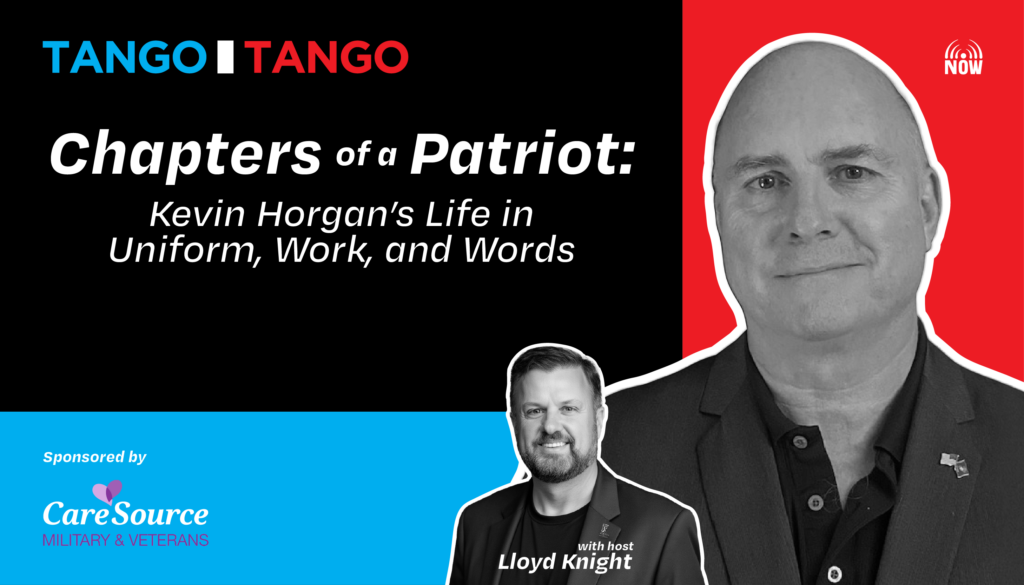
[00:00:00] Kevin Horgan: No one’s an island. and any success I had was the success of the people around me. And I maintained good friendships, and I think that, that was very important. sometimes the buzzsaw of reality catches up with people in a working environment, that when people say, “You can be anything you wanna be,” that’s nonsense.
[00:00:19] Kevin Horgan: You can’t be anything you wanna be. you have to be the best at what you do, so you just have to bring your best, to the game every day.
[00:00:42] Lloyd Knight: As always, I’m your host, retired First Sergeant Lloyd Knight. And as always, I gotta thank CareSource Military and Veteran. It’s who I choose for my healthcare. And today, man, I’ve got somebody that we go way, way back. I mean, really, really far back from my first years in Atlanta.
[00:01:03] Lloyd Knight: He’s been by my side for a very long time through UPS, the Veterans Business Resource Group, through VETLANTA. he’s been a, a mentor, a guidepost for me, a, brother in, in faith, and, and he’s my good friend, a, uh, US Marine Corps veteran, and you guys know how I love Marines, a retired UPSer, and VETLANTA board member, author, and he’s got as many job titles as the Pope, Kevin Horgan.
[00:01:32] Lloyd Knight: Kevin, welcome to the Tango Tango Podcast.
[00:01:34] Kevin Horgan: Lloyd, thanks for having me. Appreciate it
[00:01:37] Lloyd Knight: So we’re gonna- we’re gonna jump in and, and we’re
[00:01:39] Lloyd Knight: gonna- we’re gonna talk a lot. You know, we’re gonna talk about, uh, who you are growing up, your US Marine Corps journey. Kevin always says he didn’t… He’s nothing special. He didn’t do anything special about his Marine Corps journey. So I’m gonna- I’m gonna nip that in the bud now, Kevin, ’cause you raised your hand and, and you were an officer and you were a leader.
[00:01:58] Lloyd Knight: We’ll talk about UPS and his, his commitment to very many things, especially, in the veteran space. So Kevin, where’d you grow up?
[00:02:08] Kevin Horgan: I grew up in the, um, uh, the Garden
[00:02:10] Kevin Horgan: State, New Jersey. I’m a, New Jersey boy, born and bred
[00:02:14] Lloyd Knight: shore, or inland?
[00:02:16] Kevin Horgan: Well, uh, it’s funny. I grew up right in the middle of the state, in a little town called Kendall Park, and we were about 45 minutes from the shore. and that’s what we did on
[00:02:27] Kevin Horgan: weekends. We just shot down there and, and hung out. It was great. It was great
[00:02:31] Lloyd Knight: So in addition to shooting down on the shore, what, what’d your childhood look like, Kevin?
[00:02:36] Kevin Horgan: the simplest way to put it is I grew up in suburbia. Um, I’m the oldest of four. Um, we, uh, we never lacked for anything, I, I could tell you that. Um, but we lived in a kind of a communist household. When we had jobs and, you know, I delivered newspapers, and I was a janitor in high school and all that stuff, we gave the money to my mother.
[00:02:56] Kevin Horgan: All right? And that was the rule. We, we didn’t accumulate our own, uh, wealth, if you will. We gave it to my mother, and if we needed something, uh, my parents provided it. I went to Catholic school my whole life. Grammar school, high school, college, law school. If that gives you an indication of, uh, the kinda, uh, kinda person I grew up to be.
[00:03:16] Kevin Horgan: I liked sports. My father was a Marine Corps officer. He’s, uh, he served in Korea, and, um, I guess that’s part of my problem
[00:03:24] Kevin Horgan: is I was always trying to show my old man I could do a little bit better than him
[00:03:28] Lloyd Knight: So Catholic school and the nuns probably prepared you for the Marine Corps
[00:03:33] Kevin Horgan: I’ll tell you what, that’s a myth that people like perpetuating. Uh, I never saw anybody lay a hand on anybody, and that goes, uh, for priests too, if you understand my meaning. Never saw any of that. I, um, never had any of that. But then again, I was pretty much a goody two-shoes till I got to college, and by then I had everybody conned
[00:03:52] Kevin Horgan: that I was a goody two-shoes, and I pretty much did what I wanted to do
[00:03:55] Lloyd Knight: knowing you, I, I think you’re probably a, a,
[00:03:57] Lloyd Knight: pretty good student in high school
[00:03:59] Kevin Horgan: I was okay. I mean, yeah, I did honor society, but I, I tell you what, I was not a very good student. I just found schoolwork kind of easy. I confess also, I took the easy way out on a lot of these things. Uh, you know, getting A’s was not difficult. Uh, it just wasn’t. I got to college and I got smacked in the face right away.
[00:04:17] Kevin Horgan: A’s were impossible. I only got four A’s in college. But, it’s kind of funny, I really squandered a great education at the time. And now I, I’m a voracious reader and I can’t get enough, and I’m, somewhat of an autodidact in that respect. but you know, what the heck? one day you wake up and, and you decide you’re gonna put your big boy pants on and you’re not gonna be a goofball anymore.
[00:04:40] Kevin Horgan: that’s pretty much defined me getting out of college
[00:04:43] Lloyd Knight: so where’d you go to college at?
[00:04:45] Kevin Horgan: I went to St. Bonaventure University. I was an English literature major. Uh, St. Bonaventure is in the magical and mysterious Allegheny foothills on the southern tier of New York State, about two hours south of Buffalo. Uh, it was wonderful. I met my wife there, uh, and, uh, we have four grown adult children.
[00:05:09] Kevin Horgan: They’re in their 40s, for crying out loud. I, I, I’m struggling with that. We have, we have 10 beautiful grandchildren and, uh, you know, my life
[00:05:16] Kevin Horgan: is greatly enriched because of going to Bonaventure and meeting my bride
[00:05:20] Lloyd Knight: So what was your, uh, pickup line?
[00:05:23] Kevin Horgan: my pickup line?
[00:05:25] Lloyd Knight: Yeah.
[00:05:25] Kevin Horgan: I didn’t really have one. Uh, you know, uh, you could tell from just my, my, my features here, I’m ridiculously good-looking, so I didn’t have to say anything really.
[00:05:34] Kevin Horgan: I just kind of showed up
[00:05:35] Lloyd Knight: Yeah, I get that about you. so so let’s talk a little bit about your Marine Corps journey. Uh, did you always know you were gonna go to the Marines ’cause your, your father was a Marine and you were attracted, or was that something that came on slowly?
[00:05:50] Kevin Horgan: I was always gonna do it. I just didn’t know I was going to do it, um, so quickly. Uh, the summer of 1979, uh, uh, was when I graduated from college and finding … Interest rates were 14%. I mean, I’m really dating myself here. We’re going back almost 50 years. But interest rates were 14%, jobs were scarce, it was really tough, and I just pulled the trigger on it.
[00:06:14] Kevin Horgan: And, um, I literally took the test in July, the, the written test, got all the physicals done, got sworn in the first week in August, and I was in OCS by October 15th. It happened that fast. there were not a lot of people, uh, you know, the times being what they are, nobody was going around saying, “Thank you for your service.”
[00:06:35] Kevin Horgan: No, none of that was going on. Um, so I, um, I, I just walked in and said, “Let’s do this,” and, and we did it, and there you have it. Uh, uh, the interesting thing about OCS, I gotta tell you, we went in October 15th, and then November the 4th of ’79, we were only there three weeks, those crazy idiots in Iran took, took over the US Embassy and held 52 people hostage.
[00:07:00] Kevin Horgan: So we went from nutso at OCS, I mean, it was just crazy, screaming, you know, doing pushups. You can only do so many pushups, right? And, uh, we went from nutso to absolutely stratospheric crazy ’cause we were going to invade Iran. That’s the, that was the mentality. And I was commissioned along with, uh, you know, about 150 other, uh, men and women, on December 21st.
[00:07:25] Lloyd Knight: Wow.
[00:07:25] Kevin Horgan: was an auspicious day, I gotta tell you the story. My parents couldn’t attend my, uh, commissioning ceremony, so I kind of, you know, bummed a ride with a guy named Herb and his dad, Herb’s dad. and it was a little Toyota, and I had to sit in the backseat, and I didn’t even, I didn’t take my alphas off.
[00:07:44] Kevin Horgan: Uh, and they’re the greens, and that’s what we were wearing. and my $50 Corfam’s, and a $50 Corfam shoe, I don’t know what they cost now, but they gotta cost a lot. But, you know, the Corfam’s are, you know, the plastic ones. Uh, I, I had them scuffed on day one, so I was screwed right out of the gate.
[00:08:00] Kevin Horgan: Anyway, I’m sitting in the backseat of the car, and we leave Quantico just as it’s getting dark, and it starts snowing sideways. And I, and Herb Flora and his dad are talking like there’s nothing going on. And I’m figuring, I’m, I’m gonna die in a fiery wreck on I95 going north in the backseat of a Toyota with scuffed Corfam’s
[00:08:20] Kevin Horgan: but I was relieved. I was ready to go home. about halfway through, there’s a, um, and those of you who are familiar with I95 in Maryland, there’s a, a carriage house or something. they have many of them dotted, but there used to be, almost 50 years ago, a great big one, and it was, it was a big deal.
[00:08:37] Kevin Horgan: But there, there were not a lot of places to eat, but there were a lot of, uh, kitschy things going on. But there was a McDonald’s there. So we roll into the McDonald’s, uh, and you know, we walk into McDonald’s. I’m in my alphas, Herb’s in his alphas, uh, Dad’s wearing a suit, I think. I don’t even remember. and we walk in like, uh, the Germans walked into Rick’s Place in Casablanca, you know?
[00:09:00] Kevin Horgan: We walk into McDonald’s you know, I get a Big Mac, fries, a, a Coke, whatever it was. I, I don’t really remember so much what it was. And they’re looking at the, they’re looking at the marquee like they’ve never seen a McDonald’s menu before. There’s only like six items on it. So I grab my stuff and I turn around and the, and McDonald’s had all these Christmas decorations all over the place.
[00:09:21] Kevin Horgan: It was beautiful. It was absolutely gorgeous. And, uh, in the corner, far away, nobody near him, is a Santa Claus. And he’s got, you know, he’s there with his, he’s kind of going like this. And he looks at me and he waves me over. So I go over and I plop my tren- tray down and I’m probably four feet away from the guy, not, not too much.
[00:09:41] Kevin Horgan: I’m eyeballing him, uh, and there’s something’s a little bit off. his eyes are red and rheumy and, he kind of is looking at me, staring at me, and I’m, I’m staring back at him. You know, notice he’s in a wheelchair. All right. So he says to me, “So, Lieutenant, how come you’re in your alphas?”
[00:10:00] Kevin Horgan: So that clued me he must’ve been a Marine or at least in the service. I said, “Yeah, well, I just got commissioned a couple hours ago, as a matter of fact.” And he goes, “Oh, good for you. Good for you. Congratulations.” He, he looks at me. He’s, he’s staring a hole in my head and he goes, “I was in the Marines too.”
[00:10:15] Kevin Horgan: Now he can’t be that old. I don’t think he was 30. but he’s not in good shape at all. from four feet away, I can smell he’s got booze on his breath. so we, you know, chitchat and I go, “So how you doing?” And he goes, “Well, I’m, this is what I’m doing. I’m Santa Claus. I’m lucky I got this job.”
[00:10:29] Kevin Horgan: And he goes, “Hey, Lieutenant, are you gonna do everything by the book?” I mumbled something profound like, “Yeah, yeah, I guess so. I, you know, why not?” Uh, and, and he leaned over about as far as you can lean o- I mean, he got, he tried to get in my grill from a guy who’s, you know, lashed to a wheelchair, and he goes, “You’re never gonna make it.”
[00:10:48] Kevin Horgan: And I went, boom. So here I am. I’m in a McDonald’s. It’s Christmas time. I just got commissioned. I’m wearing my office. I got this, a crippled drunk Santa, I’m gonna get in a fight with this guy. I don’t know what, what’s gonna happen. and just then Herb and his dad slide into the booth with me and Santa says, “Hello, Lieutenant.
[00:11:08] Kevin Horgan: Congratulations. I’ve been talking to your friend here.” And I’m shook, man. I am shook right down to my shoes. we finish our meal. We don’t say anything else to Santa. As I’m walking out,
[00:11:20] Kevin Horgan: I turned around and
[00:11:21] Kevin Horgan: he’s saluting me
[00:11:23] Lloyd Knight: Wow. What, what an initiation on December 21st. So
[00:11:27] Kevin Horgan: Yeah. So I guess if, if I did anything wrong in the re- the 50 years since, um, almost 50 years, I hope I didn’t go by the book when I shouldn’t have. maybe I didn’t, maybe I threw the book out a lot and, you know, explains a lot of things too, but it was, uh, it was profound. So I look at Santas with a whole new respect.
[00:11:47] Kevin Horgan: Now clearly that guy, he was a Marine and he’d been a combat Marine, and he probably had a bad run of it and probably got abused, if you will, by an officer. I never forgot that. Never forgot that at all.
[00:12:00] Lloyd Knight: what did your mom
[00:12:02] Lloyd Knight: and dad… I mean, this is f- this is five years after the, the Vietnam War ended. Uh, what did your mom and dad, uh, each, I, I’m sure they had, both had very different feelings, what did they think about you commissioning into the Marine Corps?
[00:12:15] Kevin Horgan: Well, well, I mean, they were proud of me. I t- I think my father kind of, I think he was impressed, the months leading up to it, the two months leading up to OCS, I, you know, I was coming in late at night, 1:00 or 2:00 in the morning, and, uh, you know, I was having a real good time and, and he was, and he told me I wasn’t gonna cut it if I didn’t start working out, and running.
[00:12:35] Kevin Horgan: So I started running in boots at night. anyway, uh, my mother was, her reaction, I, I’m trying to get the exact words. When I told her I had just made a commitment to the Marine Corps, I’m going OCS and all that stuff, because I didn’t tell them anything until it happened, and her reaction was, I want to get the words right.
[00:12:52] Kevin Horgan: She said, “Oh, sh*t.” what my mother said. And, um, uh, my father was like, “Well, you better get ready.” and he was the one who told me clearly, “Hey, listen, don’t forget, they can’t eat you. You’re gonna think they’re gonna eat you at OCS,” which is not too much different from boot camp. is a little more jockstrap than, uh, harassment, if you will, than, uh, recruit training, uh, enlisted recruit training.
[00:13:18] Kevin Horgan: Uh, and he said, “You can only do so many pushups. I mean, you g- they’re gonna tell you, ‘Keep doing it,’ and if you stop, you stop. Don’t worry about it.” I tried not to
[00:13:25] Kevin Horgan: stop.
[00:13:27] Kevin Horgan: they were happy. They were, they were very happy
[00:13:29] Lloyd Knight: Very good. what was your first assignment?
[00:13:32] Kevin Horgan: part of the journey is I spent a year and a half, and all officers do almost, almost a full year and a half just in, training, okay? Uh, six months of basic officer class, uh, eight weeks of, uh, infantry officer school, and I was, had the privilege of going to scout sniper school and instructor school, for maybe six or eight weeks.
[00:13:52] Kevin Horgan: I don’t, I don’t know what it was. And they only, it was the initial Marine Corps sniper school. Now they don’t even, you know, they got rid of snipers I think. But, it was just fascinating. A- and then, uh, my first assignment was with 2nd Battalion, 5th Marines. I had w- uh, joined Fox Company on New Year’s Eve of 1980, uh, in Camp Pendleton, and I was given the 3rd Platoon.
[00:14:16] Kevin Horgan: it was really enlightening in a lot of respects. you know, we were told, “You’re officers, you got to set the lead by example. Don’t boss people around. Listen carefully,” all those things. And of course we all, we were young lieutenants, we forgot all that sh*t. You know, we just, we acted like idiots.
[00:14:31] Kevin Horgan: my first staff sergeant was a gentleman named, uh, Staff Sergeant Benevente. he’s gone to his great reward now. He was about a foot shorter than me, and he stood right up to me when we first met. He stood right up to me and he goes, “Hey, listen, Lieutenant, you keep your mouth shut for two weeks.
[00:14:50] Kevin Horgan: Do exactly what I tell you. Don’t say a word to anybody. We’re gonna have the best platoon in the battalion.” And I said something to the effect of like, “Okay.” and he was good to his word, too. He would tell, he would come in the hooch and he’d say, “All right, Lieutenant, I want you to go in third rack on the right.
[00:15:05] Kevin Horgan: I want you to rip the, uh, uh, the bedding up, and I want you to go to the biggest guy in the place and you tell him to meet you outside.” I mean, I mean, that’s the kind of stuff we were doing. I just did exactly what he told me to do. And we had, we had the best platoon. I mean, we, we, it, we were recognized by the battalion commander, who was a really cool
[00:15:23] Kevin Horgan: guy.
[00:15:23] Kevin Horgan: and, uh, yeah, we had a good time. We had a good time. I loved it,
[00:15:26] Lloyd Knight: And, uh, h-how many years did you serve in the Marines?
[00:15:30] Kevin Horgan: a total of five years, um, spent with, two five we did, we were preparing for a pump overseas. All Marines deploy as far, part of their first duty station. You, you go someplace, um, which is great. Uh, we went to Okinawa, Thailand, Philippines, trained in all those places.
[00:15:48] Kevin Horgan: by ’81, I was, uh, I was given the 81 81 millimeter mortar platoon, command, and I was also the XO, executive officer, of weapons company in the same battalion. Did that for a little more than a year, and then spent, uh, a year and a half, yeah, about 18 months or so at the recruit training depot in San Diego as a series commander.
[00:16:10] Kevin Horgan: Put through five, uh, recruit training cycles. And then I walked off the depot. It was almost five years to the day. I was a captain at this point and, um, I started going to law school and loading trucks at UPS, uh, on the same day. It was, it was, uh, Founders’ Day 1984,
[00:16:31] Kevin Horgan: which is kind of
[00:16:31] Kevin Horgan: funny. But,
[00:16:32] Kevin Horgan: Yeah, it was pretty cool
[00:16:33] Lloyd Knight: Founders Day. 1984, and we just celebrated our 119th Founders Day.
[00:16:40] Kevin Horgan: Yeah,
[00:16:40] Lloyd Knight: So the, uh… So wow. Um, one, one of the, one of the things I’ve always been im- impressed with you, uh, Kevin, is five years in the Marines, but it had such an impact and an imprint on you. So Kevin still has friends from his days in the Marines, and he knows names.
[00:17:00] Lloyd Knight: I absolutely love that. In fact, I’ve met multiple, uh, friends, brothers in arms of, of Kevin’s over the years and it’s… I think that’s pretty special
[00:17:10] Kevin Horgan: Yeah, it’s great. I, I, um, I think, respecting and maintaining your friendships, real friendships, is crucial to just being happy. you know, you’re always gonna have casual friends and friends who, you know, they cycle out bec- based upon geography, circumstances, family situation. But, um, maintaining good friendships is, is absolutely key to
[00:17:32] Kevin Horgan: happiness
[00:17:33] Lloyd Knight: Yeah, absolutely. So and I appreciate the the, your friendship o-over the years. hard to believe it’s been this many years.
[00:17:40] Lloyd Knight: let’s not fast-forward. Let’s, let’s talk a little bit about law school.
[00:17:43] Lloyd Knight: so y- you go to law school. Where, where’s law school at?
[00:17:47] Kevin Horgan: Well, we landed in New Jersey. We lived in our, uh, my in-law’s basement for a little over a year. Uh, at this point we had two little babies, and, uh, my father-in-law, who was also a Marine Corps officer, by the way, uh, my father-in-law said, uh, “Listen, my daughter and my grandchildren can live here, uh, for free, but you are $400 a month, room and board.”
[00:18:09] Kevin Horgan: So I was working at UPS unloading trucks. I was pulling in about $800 a month. That was my net. Uh, so it didn’t leave a lot of room for anything. but law school I did, I did it at night. the VA paid for it, and I won’t go into all the details on that, but, and I had some Pell Grants and stuff.
[00:18:27] Kevin Horgan: But they paid for one year, and the other three years, UPS had a policy at the time to pay for, uh, education, uh, for full-time, you know,
[00:18:37] Kevin Horgan: for students going towards a specific degree. They paid it all. all.
[00:18:42] Kevin Horgan: right? Now, to put it in perspective, it was only about five grand a semester, so that is not the astronomical thing they go through today.
[00:18:50] Kevin Horgan: It’s, uh, uh, now it’s 30 grand a semester, stupidly so, but there you have it. So I went at night, uh, and then I would go at night. I’d stay in the library, sometimes sleep, sometimes read, and then I would go work in a preload operation. That was my first assignment at UPS. Uh, and then I’d drag my butt in at, you know, 9:30, 10:00 and sleep for four or five hours and then get up and go drive back into Newark, New Jersey.
[00:19:19] Kevin Horgan: That’s where the law school, Seton Hall School of Law. It’s in Newark. I never had a problem there. You know, you know, everybody
[00:19:25] Kevin Horgan: talks about Newark and they’re like, “Ah,” you know? But no, it wasn’t bad at all. Wasn’t bad at all
[00:19:28] Lloyd Knight: Was it bad ’cause you were a Marine?
[00:19:30] Lloyd Knight: And, and knowing Kevin Horgan, he was probably armed as well.
[00:19:34] Kevin Horgan: No, I, I was not. But I think most of the peop- the criminals didn’t bother us because, you know, half the people
[00:19:39] Kevin Horgan: will wind up being public defenders anyway, so
[00:19:41] Kevin Horgan: they wanted to be on good, good terms with us.
[00:19:44] Lloyd Knight: So you were loading trucks for UPS.
[00:19:46] Lloyd Knight: How quickly were you able to move into the, uh, uh, supervisory role?
[00:19:51] Kevin Horgan: funny you mention that. I only, I was only a teamster for, like, a couple of months, and then the supervisor there said, “How would you like to be, a part-time supervisor?” Now I saw how the part-time supervisors work. Uh, now they have, you know, they go over five hours, they get time and a half, all that stuff.
[00:20:05] Kevin Horgan: Now we w- routinely worked eight hours plus f- for a part-time job. That’s, that’s what we did we were trying to show, you know, how good we were. We wanted to be part of the partnership. I was sold. I was there two months and I said, “I could do this.” he asked me if I wanted to be a part-time supervisor, and I said, “No, I don’t, I don’t know if I really wanna be a part-time supervisor.
[00:20:25] Kevin Horgan: I mean, I see how you treat these guys. It’s terrible.” I, and he goes, “Well, you get benefits right away.” Okay. And I said, “Well, I’m your guy,” ’cause my benefits with, uh, you know, my terminal leave had been shot. Now I needed benefits. I didn’t have to wait, uh, at all. So – I took the part-time sup job. By the next summer, by…
[00:20:45] Kevin Horgan: No, excuse me, next April, I was driving. at the time, to go into full-time management, you were required to drive a package car and do the job, you know, delivery and pickup. and I didn’t even know how to drive a stick shift at that point in my life, so that was a, that’s a another crazy story.
[00:21:02] Kevin Horgan: But, so I drove for three months almost to the day, I was promoted in the middle of July of ’15 to a full-time supervisor in the prestigious and fashionable industrial engineering department.
[00:21:16] Kevin Horgan: Now, I, I don’t even know how IE works now. Uh, at the time we were fairly integral for all planning purposes. Now I got to tell you, I have a degree in English. I had to learn how to work a slide rule real quick, and there was another transition there. but I enjoyed it and I liked being in IE and, uh, they thought enough of me.
[00:21:36] Kevin Horgan: I was a supervisor for about three years. They made me a manager, a section leader, and I was a section leader for about six, so, and then they thought enough of me to promote me and, and make me a what’s called a division manager. I, I guess you call them directors now. and my first relocation to, uh, upstate New York, to Syracuse, New York.
[00:21:57] Kevin Horgan: yeah, so I got that promotion within, within 10 years. I thought I was gonna be on the board of directors, all right? And then reality, uh, kind of, came crashing down. I was pretty good at my job. I, at least I think so, and I kept getting more challenging assignments. I met some great friends.
[00:22:13] Kevin Horgan: We had in, in total over the next, I don’t know, 15, 18 years, we had six relocations, which was good. And my last relocation was to Atlanta, completely out of IE. They did a restructuring. And because I had a degree in law and I knew some people in key places, or at least they knew of me, they offered me a really plum assignment, in the, uh, real estate group at the corporate office, as a contract administrator.
[00:22:43] Kevin Horgan: And, uh, uh, a gentleman named Chuck Altomare, who’s since retired also, well, I interviewed with him and he goes, “You got the job. Don’t worry about it.” And I said, “Listen, I haven’t done anything with law.” I mean, I couldn’t you got the wrong guy. I don’t know anything about… He goes, “No, we don’t teach any of this stuff in law school.
[00:22:59] Kevin Horgan: None of it’s taught in law school. I’m gonna teach you how to do this, the thing here.” So I, I did a yeoman’s job. That’s really the way I looked at it. and it was, uh, it was a game-changer for me because being out in the field at UPS is, uh, I’m gonna tell you, it’s awful sometimes. It’s just downright awful.
[00:23:17] Kevin Horgan: And we were bouncing around, we were running around the country, dropping kids off. You know, uh, you know, you go to college here, we’re leaving. We’re going, you know, see you later. , Uh, it turned out all right, but, it was challenging on our family. It was, for me, uh, I wasn’t gonna, I wasn’t gonna be in the corner office, okay?
[00:23:34] Kevin Horgan: But
[00:23:35] Kevin Horgan: I had a good run. I had a really good run. It’s been
[00:23:37] Kevin Horgan: very
[00:23:38] Lloyd Knight: say, let’s, let’s, Let’s talk a little bit about
[00:23:40] Lloyd Knight: that good run.
[00:23:41] Lloyd Knight: because I, I want to take it back and throw some context behind this. So, I made director division manager ver- pretty quickly a- as well, but y- you, you smoked through it. Within 10 years of being an IE division manager is pretty remarkable.
[00:23:57] Lloyd Knight: So that, that says a, a lot about you. And then let everybody know where all your assignments were bef- yeah, before Atlanta
[00:24:06] Kevin Horgan: so after, uh, my Jersey stint, a gentleman named, who’s since gone to his reward, uh, Joe Aquino was the region manager. He got me a plum assignment in, uh, my first, divvy assignment, if you will, in Syracuse, New York. Upstate New York was the district, and it ran all the way from, You know, the, the Hudson Valley up to Plattsburgh and west including Syracuse.
[00:24:30] Kevin Horgan: So it was, territory-wise, it was big. now that territory for the same, uh, gig is three times that size. It’s New York, it’s New Jersey, it’s all kind of things. so we were in Syracuse for three years. Now Syracuse is a wonderful town. We loved it, but it snows every day from Halloween to Mother’s Day.
[00:24:49] Kevin Horgan: Every day, okay? And, becomes a part of your life. after three years there, I was assigned a lateral assignment to, uh, what they call the Laurel Mountain District, which was the western half of Pennsylvania, including, uh, Pittsburgh, and that was really the center of our, uh, operation, and the entire state of West Virginia.
[00:25:11] Kevin Horgan: it was great. We had a six-year run there because I had asked not to relocate. I had kids, at this point, we had kids entering high school and, you know, we wanted to get at least a couple of them out of high school. but it was a great run. Uh, some of those guys, I’m still in touch with all those people.
[00:25:27] Kevin Horgan: It, it’s just, just wonderful. We loved Pittsburgh. Everybody thinks it’s a beer and a shot kind of town. no. It’s a family-oriented place. It’s just wonderful. The weather sucks, but it’s just wonderful. All right? so six years there. and then I went to Northern California, which was, Salinas up to and including the peninsula of, uh, uh, San Francisco, and then up north, just shy of, Montecito.
[00:25:53] Kevin Horgan: All right? So it was, beautiful. It’s just bucolic. I lived about 30 miles away as the crow flies, so it took 90 minutes a day to get into the office, and then I just said, “Screw it. I’ll leave at 4:00 in the morning to go in.” And that’s how I started doing that clock. But, um, San Francisco was a great run.
[00:26:09] Kevin Horgan: It was just a great run. So I was there for three years. I met some wonderful people. And then, and this is the interesting one, they moved me back to North Jersey, the district I started in. I’d been gone for about 15 years. I got to tell you right now, it just rang really true. You never want to return to the scene of the crime,
[00:26:29] Kevin Horgan: and I was returning to the scene of the crime.
[00:26:32] Kevin Horgan: And I, you know, so now I’m there. All these guys that I grew up with at UPS, you know, it’s a, it’s a hard physical environment if you’re not attuned to it. But now now they’re older, they’re a little huskier, they’re grayer, they’re balder, but they’re up to the same goofy sh*t all the time.
[00:26:49] Kevin Horgan: So I, I had to tell them. I, “Hey, listen, man. You tell me something, I have to do something about this. Don’t… I mean, I have a position here.” A- a- as much as I love those guys to death, there was no way I was gonna sacrifice anything for my family. So I, a good three-year run there, okay? It was good. Met some great friends, and managed not to get arrested, okay?
[00:27:13] Kevin Horgan: I just, you know, it just New Jersey, all right? Okay. So then they did a reorg in 2009. They went from, like, 56 districts down to 40, and they expanded some territory. and they said, “How would you like to go to South Carolina?” And I was like, “Who do I– I’m in New Jersey, man.” You know, I, “Who do I have to kill,” okay?
[00:27:38] Kevin Horgan: “To go to South Carolina, were you kidding me?” So boom, we go down to South Carolina. That was move number five. it’s a lateral move. Met some great people, had a great time. We lived on a lake, all right? I didn’t buy a boat. Uh, here’s some cheap advice for people that are not asking for advice. Don’t buy the boat first. Rent a boat from a boat club, and then find the boat you want and then go buy it. and that’s what we did. We joined a boat club. But we were only there one year. year.
[00:28:09] Kevin Horgan: they had another reorg a year later. and we called this one jokingly the hostile takeover.
[00:28:15] Kevin Horgan: They went from now 40 districts to, like, 16, 17. Now, at this point in time, I’m 50, 51, 52 years old in 2010. And, um, they’re not gonna give me one of these districts because early retirement at UPS is 55, right? So now everybody’s hustling around e- and it was all secret stuff and, you know, closed envelopes, meetings, uh, uh, you know, with an HR rep, probably armed in, in case something goes south.
[00:28:46] Kevin Horgan: And a lot of guys, a lot of good friends of mine got screwed. they were handing out demotions like Tic Tacs. I was scared to death that was gonna happen to me, right? Because, you know, they figure out old dog. And then Somebody in the real estate group, one of the lawyers, there’s only, there were only two lawyers besides the boss.
[00:29:04] Kevin Horgan: One of the lawyers decided he was gonna retire and take the package. And that’s where somebody said, “Hey, what about this guy? What about Horgan?” And bang, our lives changed overnight. Our last relo was here to Atlanta in 2010. And it’s made all the difference in my life, my wife’s life, my, our children.
[00:29:24] Kevin Horgan: of the four children, we have two kids and their children, five grandkids. One lives two miles away, another lives 20 miles up the road. this is our life now. It’s wonderful. It’s absolutely wonderful. We have a, a daughter and her husband live in, uh, New Jersey of all places, right?
[00:29:41] Kevin Horgan: And, uh, they have, they have three kids. They live just outside of Philly. And our son, who was a, uh, a Navy pilot, I gotta get that plug in. He was a Navy pilot. Uh, actually he was a, got out as a lieutenant commander after about 13 years. He was a, uh, actually a Top Gun instructor. He was assigned to, uh, Fallon for almost three years.
[00:30:02] Kevin Horgan: and he lives in DC with his wife, who was also a Navy pilot, and, uh, and they have two
[00:30:10] Kevin Horgan: beautiful girls, and they live in DC. Yeah
[00:30:13] Lloyd Knight: Wow. great great story. Uh, Kevin, if you haven’t figured it out, for most of his career in IE, he was the hired gun. So he, he- they would send him, move him to locations to fix things, and he was very effective at it. He, People knew who Kevin was, you were really good at that job.
[00:30:33] Lloyd Knight: I, I… And, he comes to Atlanta. He’s in Atlanta, for maybe a year or two, and, he hits my radar, and I, I love telling this story. So, uh, this predates VETLANTA, it even predates the Veterans Business Resource Group, which is, which is funny. So, uh, maybe 15 years ago. we used to host these American corporate partner events.
[00:31:00] Lloyd Knight: So we would, uh, we would team up with AT&T GE, uh, and the Home Depot, although the Home Depot never hosted. But AT&T, GE, and UPS, we would do quarterly events and, uh, at our offices. And, and we would, uh, hold them, at UPS. And UPS, we, we would go, we would go bigger, uh, than, than anybody else.
[00:31:24] Lloyd Knight: Uh, uh, we were helping veterans. We were helping veterans that were making the transition. Uh, I didn’t have any money at UPS. I, I would send out emails, “If you come to this event, uh, don’t come hungry ’cause we’re not feeding you. And, uh, if you’re lucky, you’re gonna get a bottle of water.” And one of the bigger events we had, I needed a lot of volunteers.
[00:31:44] Lloyd Knight: we had a panel discussion, we were doing mock interviews, we were doing resume reviews. And, and Kevin volunteered, and I had no idea who Kevin was. So the, uh, I am running around, like a madman ’cause I’m, I’m doing everything. Uh, and I used to do everything. And, uh, uh, and, and Kevin would– eventually met me years later, going, “Hey, you’re the face of this.
[00:32:06] Lloyd Knight: You need to shake hands and kiss babies.” But at, at that point in time, I was doing everything. And Kevin comes walking in the room. Kevin is doing a great job, uh, meeting people. But, uh, I’m observing him, and every Marine that he’s talking to, he’s giving them a hard time, ’cause they’re not wearing their Marine Corps lapel pin.
[00:32:25] Lloyd Knight: And then I’m like, “Who the hell is this guy?” Like, right? And I, uh… So I’m like, “What– Why is he giving these young kids a hard time?” like, “This is exactly what I need. I, I need somebody from small package that’s coming in here wearing, wearing a suit, uh, a Marine, uh, in my life. I, I, I need this like I need another hemorrhoid.”
[00:32:49] Lloyd Knight: And but, uh, then I also notice, a-and this is, this is typical Kevin Horgan, And he hates when I say this, but he’s, he’s gruff on the outside and a-warm and, uh, and, and, and fuzzy and cushy in the inside, and squishy in the whole bit. He has lapel pins in his pocket. and every Marine that wasn’t wearing a lapel pin, he’d give them a hard time, and then reach up and put a lapel, pin on their, on their collar.
[00:33:15] Lloyd Knight: from that time, I think we’ve been inseparable. Everything I’ve done, Kevin’s been a part of it. starting the very first Veterans Business Resource Group- he doesn’t get enough credit, but he’s literally one of the co-founders, uh, of VETLANTA. He was very involved in, in helping me get this thing started, uh, from the early days, from, from our early breakfast meetings.
[00:33:40] Lloyd Knight: my position at corporate running veteran affairs now at the corporate office. He’s, he’s always been a guidepost for me there. whatever we’ve done events, Kevin was the first one to raise events. Kevin is an accomplished author, which we’re gonna talk about that. I, when my late wife passed away, I just felt the need to write, and I didn’t know what I was gonna do with that.
[00:34:02] Lloyd Knight: And Kevin was instrumental in, in, in guiding me to help the, write this book, which was very important, for me and my, my journey to he- healing. I was also always a believer. My late wife was always a believer, but, really didn’t go to church. Kevin was one of those people that, uh, when, when she died, I had a, a group of connections that wanted to take me out to go have a drink, which is the last thing I wanted to do was dull the pain, ’cause I would not wanna stop dulling the pain.
[00:34:32] Lloyd Knight: Then I had a whole group of people that were, guiding me to Christ. And, and Kevin was right front and center, him and Chris Peck. And, and that’s, uh, so instrumental in my life today. So, so thank you, Kevin, for, for always being there, for not only being gruff, ’cause sometimes I need gruff, but as well, being, uh, squishy on the inside
[00:34:54] Kevin Horgan: Lloyd, uh, your words are too kind. Um, I am as appreciative as I am unworthy of, any praise. I, I wanna, I wanna qualify one thing, though, about my career. I, I think because there, UPSers might see this that know me, and they’re gonna say, “Well, wait a minute, he screwed up all the time,” you know?
[00:35:13] Kevin Horgan: So I I just wanna make sure that that’s qualified, ’cause I did. I made, I made some real whoppers. if I was successful, it was only because my peers and people that worked with me, uh, helped me, be successful, ’cause that’s what, that’s what you need, especially in an environment like UPS.
[00:35:31] Kevin Horgan: It’s not… No one’s an island. and any success I had was the success of the people around me. And I maintained good friendships, and I think that, that was very important. sometimes the buzzsaw of reality catches up with people in a working environment, that when, when people say, “You can be anything you wanna be,” that’s nonsense.
[00:35:52] Kevin Horgan: You can’t be anything you wanna be. You, you have to be the best at what you do, so you just have to bring your best, to the game every day. Um, sometimes my best was not good enough. I know that. I see that very clearly now. but if, if I gave it my best, I had, uh, nothing else to, uh, qualify it. Uh,
[00:36:13] Kevin Horgan: you know, I know, Suzanne. I know y- you’re ma- you’re married to Sarah now, which is great, and Suzanne’s passing was, like an earthquake. and I think of her often. And, um, and I know that, uh, she’s, she’s at her great reward now, and I’m, I’m sure she’s very happy for you and with you
[00:36:31] Kevin Horgan: and praying for you all the time
[00:36:33] Lloyd Knight: I appreciate that. let’s talk about the books.
[00:36:37] Kevin Horgan: All right. My favorite subject, me.
[00:36:40] Lloyd Knight: Ke- uh, Kevin, Kevin is a, a, an amazing,
[00:36:43] Lloyd Knight: author. And one of the cool things about Kevin is the, diversity of what he writes. I think my favorite thing you ever wrote, Kevin, is the blog that you did, uh, about your time going to the Yankees camp.
[00:36:59] Lloyd Knight: I thought it was brilliant. But let me talk a little bit about what Kevin writes, and I’m gonna turn it over. So Kevin is a blogger, writes about politics, on both sides. You know, the, what both sides do, good, bad, and ugly. He, he writes some, some great funny pieces, like going to the Yankees, camp. He wrote historic, y- uh, books, y- you know, about the, uh, uh, Civil War. He wrote a transition book, a, uh, it’s right behind him, uh, we’re gonna allow him to talk to. He’s, uh, done a series of short stories, he’s helped out with kids books. I think it’s just absolutely fascinating.
[00:37:39] Lloyd Knight: So, you’re an English major. he speaks wonderfully. If you, if you come to a VETLANTA Summit, more time than not, Kevin’s, uh, closing the, the summits, and everybody walks away going, “Damn.” Like, they’re like, re- really, really impressed. And, and every time you don’t close, Sarah gives me a hard time, and it’s like, “Why didn’t Kevin close this time?”
[00:38:03] Lloyd Knight: I think it’s beautiful, but, but let’s talk, let’s go back to your first book you wrote. like, what inspired you to, put pen and paper and then, for, you know, that subject?
[00:38:13] Kevin Horgan: I like to write. Um, I think I do it fairly well, at least in, in a business sense I did fine. Um, and I always wanted to write a book, but where do you start? You need an idea. You need something fresh. You need something interesting. I took an idea, a factual true idea on Bruce Catton’s work, and he was probably the, the greatest narrative, nonfiction writer of the Civil War, Bruce Catton, C-A-T-T-O-N.
[00:38:40] Kevin Horgan: And one of his trilogy of the main treatments of the Civil War was called, A Stillness at Appomattox. And in there, buried in about two or three pages, is a reference to what was then called the Invalid Corps in the Civil War in the Northern Army, uh, and morphed into being called the Veterans Reserve Corps And what happened was, you know, as people are injured, and some amputees, but most, most injuries are, you know, they’re wrenched this, twisted that, amputee, even blind people.
[00:39:13] Kevin Horgan: Now, they were farmers, they were laborers. They, they, they worked with their hands. And now they’re injured and they can’t … They go home, they’re gonna go home, what? To sit on the porch. They can’t do that. They need to eat. So the Union Army said, “Well, we still need people to cook and guard prisoners and, um, play in the band.”
[00:39:33] Kevin Horgan: Bands were big. I mean, you know, uh, as part of the military, it was part of a unit. You had, you had to have it. and perform the kind of duties that didn’t involve standing on a line and walking right into lead. Okay? So at its, at its peak, there were over 60,000 of these invalids, if you will, people that couldn’t serve in a regular capacity, serving in uniform for the Union Army.
[00:39:59] Kevin Horgan: So I took the idea out of Catton’s novel and did a little bit of research. Not … There isn’t a lot tremendous detail here. Some of the research is just from payroll records or letters. And I found one particular regiment, the 6th, and its journey, in a two or three-month period of time. all I did was take the characters.
[00:40:22] Kevin Horgan: I made them up. I made them up. You gotta flesh out the story. Uh, so it’s called historical fiction for a reason, ’cause it is fiction. I just made up some characters and a plot line and a sub-plot line, and I cobbled the thing together. It took me about a year to get it done. and I went with a publishing company called Xulon, X-U-L-O-N.
[00:40:42] Kevin Horgan: And they do a very nice job. they’re not perfect. Nobody’s perfect, but I thought it was one of … I thought it wa- thought it was the best company I could find for what I needed to do. Self-publishing. and there are Half a million books published a year, half a million. And they range from, great novels that we see and that are on the bestseller list to cookbooks, to children’s books and all that kind of stuff.
[00:41:05] Kevin Horgan: getting published per se from a publishing house is not an easy task. It’s, I threw in the towel on that really early, so I went the publish, self-publish route. I like the book. The book’s, you know, the book is my first work, so it’s my favorite.
[00:41:19] Kevin Horgan: It’s like y- you know, your first kid. You know, you’re like, “Ah,” you know, “This is great.” But, a year later I decided I wanted to do a follow-up to it. a couple characters still in it, but not integral, meaning you can read the second book first and the s- the first book second. Doesn’t really matter. And my wife and I are up in, um, Stones River, Tennessee, just south of Nashville, just south of, um, The Hermitage where Andrew Jackson’s home was, and Stones River Battlefield.
[00:41:52] Kevin Horgan: And we were walking the battlefield and, uh, we’re looking at certain murals and it’s g- I mean, it’s gorgeous. It’s meticulous. It’s just very well-maintained. Uh, one of the best kept secrets I think of our national park system is the Stones River Battlefield in Tennessee. … We look at one of the murals and, uh, they talked about the Orphan Brigade, which was, uh, orphans.
[00:42:13] Kevin Horgan: They’re political orphans. Uh, the state of Kentucky, was basically neutral in the Civil War. They had, uh, a star on both the US flag and on the, uh, Confederate flag. They, they were represented both ways. Neighbors who lived in Kentucky, they would decide, “I’m gonna fight with the Union,” “I’m gonna fight with the Confederacy.”
[00:42:34] Kevin Horgan: And that’s what they did. The ones who decided to fight for the Confederacy were called orphans, thence the Orphan Brigade. What’s fascinating about it, Again, a little bit of research can go a long way. Breckinridge, who was the sitting vice president before the Civil War, who ran against Lincoln in 1860, came in second in a four-horse race.
[00:42:55] Kevin Horgan: Breckinridge, he was the sitting vice president. he resigned. He was actually, uh, uh, the rules of the day, he was also became a US senator for, you know, Kentucky. so Breckinridge says, “I gotta go fight for the Confederacy.” And off he goes, and he is the commander of the Orphan Brigade, which is, I thought it was a fascinating piece of history, too.
[00:43:16] Kevin Horgan: So I do a, I, again, made up characters, fleshed out a story, tried to make it interesting and exciting, but I stuck true to the actual battle sequence of the Battle of Stones River, a terrible, bloody engagement the 1st, 2nd, and 3rd of January in, uh, 1863. and I profiled Breckinridge in there.
[00:43:38] Kevin Horgan: I like it. I like it. Okay? And that’s called The March of the Orphans. First one is March of the 18th, that regiment, and then, uh, The March of the Orphans was the second book. third book I wrote is just a, a fiction, a thriller if you will, called A Face on a Flag. it’s about, s- former Marine veterans.
[00:43:55] Kevin Horgan: None of them were lifers. I wasn’t a lifer. I was nothing special. … And, uh, one month in their lives, and all their lives change because of that one month. again, it’s a thriller, you know, can’t describe much more than that. fourth book was, uh, that compilation that, Lloyd referred to called Bedbug Stew.
[00:44:14] Kevin Horgan: And every kid goes ick on that. Uh, you know, Bedbug Stew, what are you talking about? my father used to sing ditties, and, um, among the, the cleanest one I can remember is, and we all sang this at the top of our lungs to the tune of, The Star-Spangled Banner, and the ditty was, “Oh, say can you see any bedbugs on me?
[00:44:37] Kevin Horgan: If you do, pick a few, and we’ll have bed bug stew.” And we used to scream it at the top of our lungs in the car, you know? Dad’s driving us around, whatever. and that always stuck with me. and I liked it as a title for a compilation of short stories and poems I wrote, I like them. You know, it just, it, it’s stuff I wanted to do.
[00:44:58] Kevin Horgan: I wanted to get out there. Now, as an addendum to the book, it’s, what Lloyd refers to, but it’s a one-off event, right? I’m, I’m essentially a fiction writer, and, uh, a one-off event, uh, how do you repeat a one-off event? You don’t. So it, it just stands as its own. I did a, an 11, blog series on my experience at the New York Yankee Men’s Fantasy Camp in, Tampa, Florida, uh, in January of 2023.
[00:45:26] Kevin Horgan: I think that’s when I, uh, we did it. So I just whipped all that toget- stuff together, put it in a book. Bedbug Stew. it’s all out there. Everything, you know, that I mentioned, And I don’t have copies handy. I’m not gonna torture you. and then, uh, I had some f- what I call failed poems that I wanted to write, and I put them, went to my sister-in-law, who is somewhat of a fledgling artist.
[00:45:49] Kevin Horgan: During COVID she took up watercolors, and she does magnificent, beautiful work of animals, birds, dogs, and the like. I put together, I, again, failed poems, if you will, and I put them together. I gave them to her. I say, “Come up with an illustration.” And she did. She did it marvelous. And that’s what really makes the kids book, uh, wonderful, I think
[00:46:11] Kevin Horgan: And then, uh, the most recent one, this one here, I’ve been blogging, I’ve been writing stuff for a decade, right? And, um, I put together a bunch of, of vignettes, if you will, using the Marine Corps leadership traits and principles, and, uh, short shots, if you will, two, three pages, you know, 500 words each on, A Marine Corps trait for leadership that you can morph into the corporate environment, uh, in any kind of business environment, doesn’t matter.
[00:46:42] Kevin Horgan: You don’t have to be a Marine, uh, and you don’t even have to be in, you know, not corporate, you can be in any office environment. kind of dos and don’ts. Now, what I love about the book is it’s not just my crapola in there, there’s plenty of that, but I enjoined 34, uh, Marines that I’ve worked with 45 years ago.
[00:47:03] Kevin Horgan: My original OSO officer, Jim Sfeir, wrote the, uh, introduction. but people I served with 45 years ago in Two Five, enlisted and Marines. A guy I went to high school with that I didn’t serve with, and he was a Marine, all the way to people that I work with today with VETLANTA. they all made contributions.
[00:47:22] Kevin Horgan: Once I explained the nature of it, they got it. I said, “Listen, just talk about your biggest mistake, your best piece of advice. Do we… It doesn’t really matter.” I reserve the right to edit it, and I barely edited anything, ’cause it’s, it’s in there just raw, just like they had it. it’s great. It’s not just advice for Marines transitioning, it’s anybody that’s getting out of the military that wants to not make the same mistakes I made.
[00:47:47] Kevin Horgan: And I made beaucoup. In fact, I, I have a short list, uh, on my desk here of the things I didn’t write about that I could write about. I bought the domain, uh, Corps to Corporate 2 and Corps to Corporate 3 in case I can, con, uh, any of the other Marines or anybody at all that wants to cobble together a book.
[00:48:06] Kevin Horgan: the book on Amazon is 10 bucks. Now, I want to give you the, the numbers on this. This is very important. I don’t, take any royalties for my work. I just, uh, I just don’t. First of all, there ain’t much to begin with, but, I donate them to veteran service organizations. And, and I got a whole line, list of that, and I blogged about that too.
[00:48:26] Kevin Horgan: So, the book, the strike price on Amazon is 10 bucks even. I set that price. To land the book copy, is $3.99. That’s the minimum it can go. it costs another $3.99 is Amazon’s cut. All right? So now we’re at $7.98, right? Okay. So Amazon has to make $3.99. The book, just print the whole thing out, pulp, bang, and it’s a beautiful book, is $7.98.
[00:48:55] Kevin Horgan: Amazon, for another $2.01, they will keep it on their SEO market list and anybody that looks up anything Marine Corps, anything corporate transition. So that’s their piece for marketing, which is, I mean, come on, it’s nonsense, right? I mean, they just flip a switch. They can do anything they want.
[00:49:12] Kevin Horgan: So I’m literally, the royalty is literally one penny. One penny. Now, what’s beautiful, I did it on Ki- I did this one on Kindle Direct Publishing. Kindle Direct Publishing, meaning I put it together, I put it in a Word doc, I had to cobble it together. I had to make sure the pages were, you know, all that kind of blocking and tackling that Xulon takes care of.
[00:49:33] Kevin Horgan: I didn’t wanna do it on that route. I wanted to do the self-pub. It’s kind of an experiment. I don’t know if I’m gonna do that again. I have a couple other projects that I’m gonna put in book form, but I’m unsure. I might, I might, I don’t know. Anyway, uh, it’s work.
[00:49:47] Kevin Horgan: almost the easy part was writing everything. The hard part was making sure it blocked out right, and I th- I think it comes out great. all my books are on my website. one of the beauties of Kindle Direct is they give you an author price. I can get the book, with shipping to my house for $4.75, which is fantastic, right?
[00:50:07] Kevin Horgan: So I offer it to people, uh, for five bucks, I don’t think that’s much. I mean, it costs, you know … Uh, I’m not really making anything on a quarter a book. It’s certainly not, ’cause there’s a lot of ancillary costs and stuff like that. It’s a
[00:50:18] Kevin Horgan: pain, pain in the neck. But,
[00:50:20] Kevin Horgan: you know, so there you have it
[00:50:22] Lloyd Knight: Awesome. Well, I, uh, as always, so this is, this is probably the the fourth or fifth podcast I’ve done with Kevin over the years. And, uh, yeah, and then we’ve appeared on other podcasts just, just BS’ing about our favorite movies and favorite books. And Kevin, it’s always a pleasure to, to get in and, and talk about journeys.
[00:50:44] Lloyd Knight: I’ll see you in a, uh, in a couple short days at the, at the VETLANTA America 250, celebration, although this is going to air after that. So as always, Kevin, thank you for always being there for me. And, uh, thank you for appearing on, Tango Tango podcast.
[00:51:02] Kevin Horgan: And thank you, Lloyd. Thank you for your leadership
[00:51:04] Kevin Horgan: with VETLANTA, And just thank you for doing what you do
[00:51:08] Lloyd Knight: Yeah. Thanks, Kevin. And as always, be like Kevin. Be safe, be kind, and be remarkable