[00:00:00] Michelle Lang: Military marriages are very difficult. Um, no matter what is going on, you have to take ownership of yourself, and that’s not an easy thing to recognize, um, but the only thing that you can ever control is yourself. And like the saying goes, “If the Army wanted you to have a spouse, they would’ve issued you one,” right? they don’t like to make it easy on military spouses, but you have to take ownership of your own mental health.
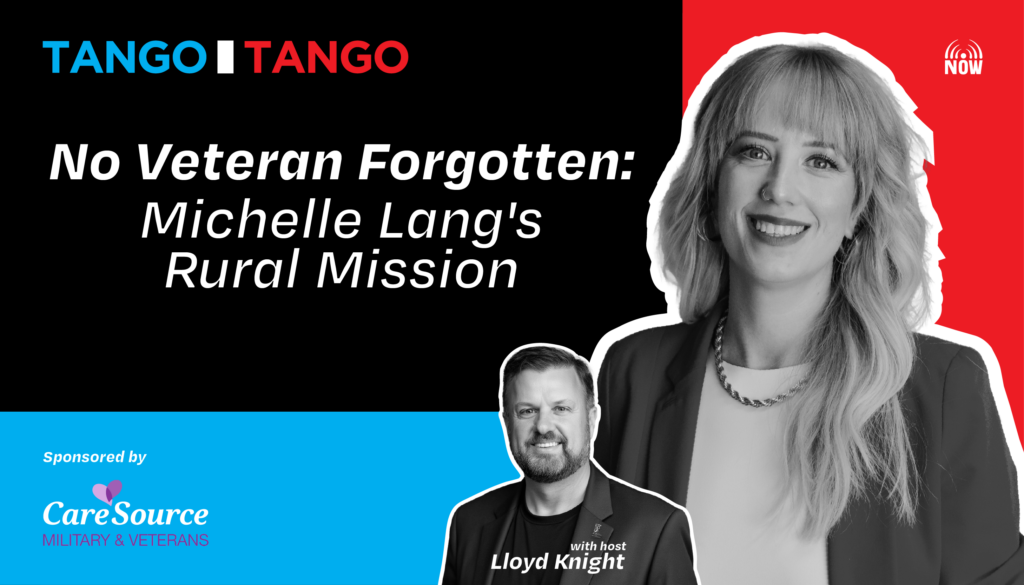
[00:00:42] Lloyd Knight: I have an amazing guest today. But before we get to it, as always, wanna thank a, uh, my friends over at CareSource Military and Veteran, a, uh, for sponsoring this season. And please welcome Michelle Lane. Michelle is the executive director to, I gotta read this to make sure I don’t get it wrong, Operation Honor Rural Salutes.
[00:01:05] Lloyd Knight: I’ve practiced that in my head like five times. And it’s an amazing brand new nonprofit that is doing a, uh, some amazing things in the space that we’re gonna get to, to know about, uh, hear about here in a second. But Michelle’s also one of my Bush Institute’s Veteran Leadership, a, uh, classmates, and we’ve focused a, uh, probably about six or seven to this point, and Michelle is remarkable without an exception, just like the other six or seven ,
[00:01:34] Lloyd Knight: Michelle, thank you so much for coming onto the podcast, and
[00:01:37] Lloyd Knight: welcome.
[00:01:39] Michelle Lang: Yeah, thanks for having me, Lloyd. I love talking with you
[00:01:43] Lloyd Knight: So Michelle, you’re from small town America in Pennsylvania.
[00:01:47] Lloyd Knight: did you, grow up in Pennsylvania or did, or did you
[00:01:49] Lloyd Knight: move there?
[00:01:50] Michelle Lang: I grew up here in Fulton County, Pennsylvania, and I think like our county population is around 5,000 people here. So the town that I grew up in has, um, 1,400, so 1,450 people the last time that I checked
[00:02:08] Lloyd Knight: Holy cow. And what’s, what’s like a, a closer, like bigger city?
[00:02:13] Michelle Lang: some people if they drive through Pennsylvania a lot, they know Bedford, Pennsylvania, um, ’cause the turnpike is there. The other closest big city is Chambersburg,
[00:02:24] Michelle Lang: Pennsylvania. And then our capital, Harrisburg, is like an hour and a half away
[00:02:30] Lloyd Knight: Wow, that is in the middle
[00:02:31] Lloyd Knight: of nowhere. So that’s an amazing, uh, nonprofit called Burrow for Lutes. So what did high school, what, what did, like, your school years look like? You, uh, elementary school, middle school, high school
[00:02:44] Michelle Lang: Well, it’s one of those towns where, you know, everybody knows what you ate for breakfast before you leave the house pretty much. Um, so you had to be careful what you do and who you say, ’cause it would get back to your mama and then she’ll be upset. Uh . Um, so that can be a good thing and a bad thing. But we had– I mean, I graduated with I think 64 people in my class, and pretty much who we started with other than a few is who we ended up graduating with.
[00:03:13] Michelle Lang: So really, really tight-knit, um, classmates. And then you had to make friends with upperclassmen and lowerclassmen, and then keep yourself busy. I played three sports, so, we’re an athletic family. All of us did basketball, volleyball, and track, um, all four years. And the school was so small, if you’re kind of halfway decent, you make the varsity team when you’re a freshman, you know?
[00:03:38] Michelle Lang: So um, keeps you busy. And in the summer, the only thing to do was the community pool, and it was like five miles outside of town, so you’re either hitching a ride
[00:03:48] Michelle Lang: or some people would bicycle there
[00:03:51] Lloyd Knight: Wow. W- and, and what does the job market look like in a, in a town like that?
[00:03:56] Michelle Lang: interestingly enough, there is, um, this company called JLG Industries, and it was founded by John L. Grove. So I’m gonna give you a history lesson. He used to be, um, friends with my uncle who was one of, like, the kind of founders of this town. He ran the IGA in town. There’s just a couple of these men that founded things.
[00:04:17] Michelle Lang: JLG Industries is the biggest industry here. They’re global, and it all starts with– Like, if you see a Humvee go out, Oshkosh acquired them now. But, when things were really kicking off overseas, like, you would just see a parade of… And I don’t know military vehicle names.
[00:04:34] Michelle Lang: Humvees basically, you know, going because our tiny little factory in McConnellsburg produced a ton of them. Um, so they’re the ones that… You know a big boom lift, like the yellow and orange boom lifts? That’s JLG Industries. So
[00:04:50] Michelle Lang: it’s a global industry right here in a town of 1,400 people. That’s their headquarters
[00:04:55] Lloyd Knight: And what did you do when you graduated high school?
[00:04:58] Michelle Lang: so I went to college. I mean, I took a summer job. I was a lifeguard every summer, taught swimming lessons every summer, worked at an insurance agency, all these things. Um, but then I went to school, Juniata College up the road, um, right below State College, and I made my own major ’cause I went to a liberal arts school where you could create your own major.
[00:05:22] Michelle Lang: It was also a tiny school. My best friend from there, she graduated high school with more kids than we graduated college. I think we graduated with, like, 1,200 people. Um, so still, you know, pretty small.
[00:05:34] Michelle Lang: Um, but my, my degree is in sports management with exercise science
[00:05:38] Lloyd Knight: All right.
[00:05:40] Lloyd Knight: Well, and I think I remember reading on your, LinkedIn bio where you, you had a job in sports management. Was it something with your high school softball?
[00:05:49] Michelle Lang: My first big girl job outside of college, so I went back and worked with the, the same insurance agency that I worked during the winters and summer breaks of college. Um, but then my first big girl job was the community health and wellness coordinator up the road at our critical access hospital. So,
[00:06:06] Michelle Lang: um, I got pretty much a job interview and I, I walked into a local Sheetz and the, the, um, public relations director was there and she’s like, “I’ve been meaning to talk to you.
[00:06:16] Michelle Lang: I wanna, I want you to come and interview for a job.” I was like, “Okay, Misty.” But, um, it’s funny ’cause I was just laughing with her about that the other day ’cause I got to come back to the hospital and talk to them about rural veterans now. Um, but that job really, really prepared me for what I do now because it was like drinking from the fire hose of how to get information out to rural America, um, and kind of like quickly gain their trust.
[00:06:47] Michelle Lang: I was in charge of the Affordable Care Act enrollment, so in the health marketplace, and this market here was not loving that. They did not love the policy about it. They did not love that they had to do this now. so that was quite a unique experience to get that done. And I was coaching middle school boys basketball during enrollment,
[00:07:10] Michelle Lang: I learned a lot of lessons during that time
[00:07:13] Lloyd Knight: And did you know anything about the military before you met Chris?
[00:07:17] Michelle Lang: I had no idea. I had none. No, no clue. I was really concerned. He still laughs about this because I was really, really worried ’cause, you know, I’m a struggling young lady out on her own after college. I’m trying to pay my student loans back, you know, making sure, counting, counting pennies at the grocery store and stuff.
[00:07:37] Michelle Lang: And I said he kept coming down to visit me, and it’s like a six-hour drive. And I was like, don’t want you to keep doing this. I know it’s really expensive. Gas is expensive and I– Like, I don’t know what the military is like. Like, I don’t know what your paycheck is like, and I don’t feel like you can afford this.”
[00:07:52] Michelle Lang: He was a, um, I think he was a s- a lieutenant at the time or something, and he’s like, “I– It is okay. Like, I can I literally have no other responsibilities.” I’m like, “Oh, I didn’t know that. I don’t know anything about this.” Um, so yeah, that was another just drinking from the fire hose experience ’cause there was a lot early on in our relationship that looking back now, I would’ve loved to have been more prepared for.
[00:08:19] Lloyd Knight: Wow. And where’d you guys meet at?
[00:08:22] Michelle Lang: So he’s a townie. I married a townie, and my friends make fun of me for it. He- I was back home visiting, um, some college friends who worked at the college, and he was on block leave. And so, um, we met in a dive bar and kind of bonded over, uh, my dislike of UFC women fighting, ’cause that was what was on TV.
[00:08:48] Michelle Lang: And I’m like, “I c- I can’t stand to watch
[00:08:50] Michelle Lang: women fight. I don’t like it.”
[00:08:52] Lloyd Knight: wow. Yeah, very cool. And from that meeting, uh, how many, how long was it before you guys got married?
[00:08:58] Michelle Lang: I felt like it was a really long time. So it was two years, and, um, I had already eight months into dating, I had already quit my job and moved up to Fort Drum. And so I’m like, “When is this gonna happen?” Because I moved up there thinking, um, I would get a job because the director of the wellness center on Drum wanted to hire me to help with the, the programs up there.
[00:09:23] Michelle Lang: I’m like, “Great, that’s perfect.” But it never happened. So finally, I’m like, “Can we just get married so I can have spousal preference, and, you know, do it for the Tricare?” And so I tried to do it for a job, and I still never
[00:09:33] Michelle Lang: got that job.
[00:09:35] Lloyd Knight: my marriage story when I started dating Sarah. So I, I listened to Dr. Laura, like, all the time. I love Dr. Laura. And, uh, Dr. Laura says, “Do not even think about getting married until it’s at least two years.” And I think Sarah used to sit in my Chevy Silverad- Silverado and go, “Ugh, I can’t stand Dr.
[00:09:56] Lloyd Knight: Laura.” So she was really surprised ’cause I asked her to marry me before the two-year
[00:10:01] Lloyd Knight: mark
[00:10:02] Michelle Lang: There you go. I mean, statistically speaking,
[00:10:05] Michelle Lang: people who date longer than two years are more likely to stay together.
[00:10:10] Lloyd Knight: Yeah. So Fort Drum, New York, um, what did life as a military spouse look like in Fort Drum, New York?
[00:10:18] Michelle Lang: it really shaped my opinion of being a military spouse in a negative way when I was up there, to be honest. So it really didn’t set me up for success. There really wasn’t community up there. We didn’t live on base. Um, I really was out of touch with the military community. Most of my friends were actually civilians that I made through, like the gym and work and everything like that.
[00:10:44] Michelle Lang: and I loved that aspect of it. I really loved getting involved with the community. I’ve, I still really love Fort Drum, and I really enjoyed my experience at Watertown, to be honest with you. But moving up there, um, you know, I had to quit my, my really nice job to move up there, and it was really, really, really depressing, and I took a big hit with my mental health not being able to be employed up there.
[00:11:12] Michelle Lang: Like, I would go through, uh, second, third round interviews, and then they would always hire a local. At that time, the town didn’t have a great relationship with the military. They were working on improving it. Um, so I ended up just trying to work myself to death.
[00:11:29] Michelle Lang: I had four jobs at one point, um, just to kind of try and feel like I had some type of self-worth. Um, like I was contributing. Um, and I had like Chris’s coworker want, at the time, like she would essentially call me a dependa because he signed for my student loans, so that way I could get a lower interest rate.
[00:11:53] Michelle Lang: And I’m like, “I can’t, I, I can’t get a job.” Like, I’m, I’m trying. I was working at Zales. I was– You know, I went from a nice job to selling in a mall. And I’m like, “This is horrifying.” and getting bullied by other military spouses coming in there who were so mean. And so I just have really, really negative experience of the military community
[00:12:17] Michelle Lang: up there.
[00:12:18] Michelle Lang: I did really learn to dive into the community that was already there, because at every base you’re at, I love to get to know the locals and have those type of relationships, too. It
[00:12:34] Michelle Lang: just, I don’t know, it makes you feel like it’s home,
[00:12:37] Michelle Lang: you know?
[00:12:38] Lloyd Knight: Absolutely. The, yeah, one of the biggest… I, my late wife, every time we moved, and we moved seven times, that she had to, you know, give up a good job and then struggle finding a job. Like, each and every time. When, when I finally transitioned after 20 years of the military, she was my transition assistance, like, right?
[00:13:02] Lloyd Knight: The TAP program at the time was horrible. It’s a little better now. And, but I just saw all the lessons that she learned job hunting all, all the time, and, and, and that’s a challenge. And then, from base to base, especially the spouse network, you never know what you get. it could be wonderful, uh, in Edwards, California, where we went and, you know, the next one might not have been so great.
[00:13:26] Lloyd Knight: you have to build resilience. Uh, and then especially when you start having kids. So the, uh, the military spouse is, It’s very near and dear to my heart, but, uh, you didn’t sign up for a lot of that stuff that was just put on your plate. were you in Fort Drum the whole time, or did you move?
[00:13:46] Michelle Lang: I was there from like 2015 to 2017, so like two years. And then we went to Fort Benning for like a year and a half, I think. And I really liked Fort Benning. We had a great community there. Um, great group of military spouses. Chris had great coworkers, which makes it so much better. He has worked really, um…
[00:14:11] Michelle Lang: He’s had just an interesting career overall, where he’s usually in these positions with people that are like much, much older. And so I, sometimes I just don’t have any spouses that he works with that are like even remotely close to my age or like have the same interests, you know? So, um, which is, is fine too, but Fort Benning was a really, really nice community, and that’s where we had our first baby.
[00:14:38] Michelle Lang: Um, and Mach, I think the hospital down there, was like brand new and still the nicest
[00:14:45] Michelle Lang: place that I ever had a baby. It’s crazy. It’s really spoiled me, I think
[00:14:51] Lloyd Knight: Hey, the old hospital wasn’t that bad ’cause I was born in that old hospital.
[00:14:55] Michelle Lang: Wishly
[00:14:57] Lloyd Knight: So yeah, very, it is a, it is a very nice hospital, especially for the Army. And then what was after Fort Benning?
[00:15:04] Michelle Lang: Then he got out, so that’s whenever he made sort of like a, a quick transition. Um, so he was at MCCC down there.
[00:15:13] Michelle Lang: Well, he finished the course, but then they sent him out to Fort Irwin. And before the course started, he tried to put in a warrant officer packet, didn’t go through.
[00:15:24] Michelle Lang: At that time, they were not releasing any officers from infantry to any other MOS or any other… They didn’t wanna release them because there was, I guess, a shortage. And he was like, “Well, I don’t have a Ranger tab. I’m never gonna make major, so I’m not gonna go out to the middle of the desert and have my family have a terrible experience for something that’s not even gonna advance my career, ’cause I’m kinda dead in the water,” you know?
[00:15:51] Michelle Lang: So, um, he made the decision to get out. So, like within six months, he was out of Fort Benning, we were back in Pennsylvania. You know, he went through TASP, and six months is not enough time to transition. So, um, he did the best that he could. He got a job, got everything, you know, lined up. We moved back to Lancaster, and then like because of that quick transition- it really kind of put him off base, off balance, if you will. And that’s where we kind of realized it’s really hard to find resources in rural America, because he really needed resources,
[00:16:29] Michelle Lang: and it wasn’t happening
[00:16:32] Lloyd Knight: Yeah, it’s, the transition is, um, tough enough in a community like Atlanta, Georgia where I live that’s got a ton of nonprofits and government agencies and, you know, the, I can hop in the car and drive and, and find everything within arm’s reach. But to be in the middle of nowhere like that, I, I can’t imagine.
[00:16:53] Lloyd Knight: So, so that struggle became the antithesis of, uh, starting Operation Honor Rural Salutes. when did you figure out, like when was that light bulb going off and going, “I wanna help, and I think the best way for me to help is to start my own nonprofit”?
[00:17:11] Michelle Lang: Well, Chris decided he didn’t wanna be a civilian anymore and went into the reserves. And so, um, then that led to him signing up for a deployment without telling me. And so when he was on deployment, I just started talking about our experience, and I had a ton of feedback from other spouses who felt the same thing.
[00:17:38] Michelle Lang: They s- had the same struggles, and I’m like, “Okay, so I’m not just an idiot that couldn’t do it.” Because it really felt like, and I say this a lot, like it feels like you have to know the answer to the question before you even know what questions to ask, because you just straight up don’t know what you don’t know.
[00:17:58] Michelle Lang: And so while he was on deployment, I just kept– I had a lot of time to think about this, ’cause it was COVID too, so he was gone for a year. I had two babies under two. And, um, I mean, not really a lot of time to think, but like a lot of time to think. And I just didn’t want to not be a resource to people who felt the same hopelessness that I had felt, because it was the lowest of low for our family, and it was absolutely
[00:18:34] Michelle Lang: horrifying.
[00:18:35] Lloyd Knight: What was your first step?
[00:18:36] Michelle Lang: yeah, no, like I put like an informal survey out to just the military community. Like, if we did something like this, would it be helpful?
[00:18:44] Michelle Lang: Knowing what I know now, we were already reinventing the wheel. Even though I was saying I don’t wanna reinvent the wheel, we were totally doing that. And so, um, that’s just like further proof that even though I researched everything, because how we started wasn’t necessarily focused on rural, it was really focused on connecting people that live in small towns,
[00:19:09] Michelle Lang: these dogs, to the resources that are in their backyards.
[00:19:13] Michelle Lang: And there’s already stuff like that out there. So
[00:19:18] Michelle Lang: Even though I knew that there was stuff out there, I couldn’t find what I was looking for, so I wanted to recreate that. And I think that goes to nonprofits and even larger organizations not being able to really market their services well, you know? Um, so two years in, we really switched gears to just focus on, um, rural
[00:19:43] Michelle Lang: and small town, because that’s, that’s where my heart was.
[00:19:47] Lloyd Knight: Yeah. And
[00:19:49] Lloyd Knight: as we see, you’re a busy mom. A, um, you know, is, uh, Chris still in the reserves?
[00:19:57] Michelle Lang: Uh, yes, he’s full-time reserve now
[00:19:59] Lloyd Knight: So, so he’s full-time reserve, so you got the full-time military spouse thing going on. And holy cow, you decide to not only start a nonprofit, but you’re the executive director, and you decide to sign up and apply for the Bush Institute Veteran Leadership Program, which is a presidential scholar program, which is about six months of, of like very busy, like for, uh, for six months.
[00:20:24] Lloyd Knight: Um, wow, that’s really impressive. Uh, let’s go to the Bush Institute. What, what helped, was there any like nugget of, of info you got, any connections to, to, to help you go forward with the, uh, this amazing nonprofit?
[00:20:41] Michelle Lang: during it,
[00:20:42] Michelle Lang: I just kept thinking, “Why am I here?” Because everyone else is way cooler than me. Like,
[00:20:48] Lloyd Knight: No, no way.
[00:20:51] Michelle Lang: so it really took me a long time to– I’m– I don’t think I ever got over that imposter syndrome ’cause I’m just like, “Well, I feel so lucky to be in the room with all of you.” ‘Cause it, it really was like, whoa, everyone is so accomplished, they’re so ahead, um, they have so much knowledge and understanding of systems that I don’t.
[00:21:14] Michelle Lang: But I loved listening to the speakers, and I s- I often still think about, um, General Levitt and General Flowers because I think those two really impacted me the most in what they had to say, and they’re just such inspiring people. But, like, the real, the real thing that made a difference for me is the connections with my classmates, like, in between sessions and afterwards.
[00:21:42] Michelle Lang: Like, to me, I feel like the magic has all happened after it has ended. Like, we got really, really great info, but now I have had the opportunity to go really, really deep, um, with a lot of people and collaborate on stuff. Cross-collaboration in the alumni community has just been phenomenal, and I can like pick up the phone and call and just ask questions or panic to somebody or whatever, and, um, it’s great.
[00:22:13] Michelle Lang: I am still trying to figure out what value I add to anybody else, but everybody else,
[00:22:18] Michelle Lang: has added immense value to me.
[00:22:20] Lloyd Knight: Oh, please. Stop it. So the, uh… I, I agree. So the, you know, the, we had some great speakers coming in. Just put some context to the, the listeners and, and viewers. General Lovitt was actually, during my time in the Air Force, and I’ve been retired for 20 years, she was the first, a, uh, female combat, uh, pilot in the, uh, United States Air Force.
[00:22:43] Lloyd Knight: And then General Flowers was… He’s got this pretty cool distinction. He was the longest serving, uh, African American in the US military and, uh, in the US Air Force. Um, love them both. A, uh, General Lovitt, just the determination, like just an unstoppable pilot Like, like, “Hey, I’m gonna do this.”
[00:23:06] Lloyd Knight: The story she tells about, like, she got pretty much threatened, like, “Don’t apply for combat duty. Uh, this’ll be the end of your career.” And, and she goes, “Screw it. I’m gonna apply.” And I, I thought that was, like, ultimate badass. A- and then General Flowers, I think there was, the amazing thing was, was his zeal for life.
[00:23:28] Lloyd Knight: And, uh, you know, one of our disfranchised class members asked him kind of a, a, a BS question of like, “Hey, with everything going on, like, like how do you, how in the world are you so positive?” And I loved his answer. It was like, “Do you have breakfast this morning?” Like, right. “Do you have three square meals?
[00:23:47] Lloyd Knight: Like, you’re in an air condition…” And, you know, uh, General Flowers is like my family. You know, they, they were sharecroppers, and he was like, “If, um, if, if you can’t take what’s going on in America in the context, like, and, and see the good.” Uh, so I absolutely loved. I think the, the speakers were very inspirational, but for me, the real kind of secret sauce has been, um, the fellow classmates.
[00:24:14] Lloyd Knight: So I, I was just up in DC for, for two weeks and, uh, you know, I had different events with seven, seven of our classmates. And yeah, I got to hang out, uh, which was really cool, from, from Casey and Catherine and, and the Washington Tattoo with Mark Reilly and got to see Brandon and meet Brandon’s daughter and, and, and some others.
[00:24:34] Lloyd Knight: I, I think it’s just really, really cool, and I, I can’t wait until the Military Influencers Conference where, uh, we get to be in the room together, uh, a lot of us. So I think that’s been pretty magical. You held your own. I, nobody, nobody… You kept saying imposter syndrome, but, uh, nobody believed it, and, and I’m not believing it.
[00:24:53] Lloyd Knight: My listeners or, or viewers are, are not gonna believe it. Y- you’re doing, you’re doing amazing things. Uh, look at you and your journey so early on and, and what y- what you’re doing. Uh, I mean, you’re, you’re 20 years ahead of, I was. Maybe 30 years ahead of where I was. So I think you’re having a, an impact, and one of the things I really like about you is you’re doing it for the right reasons.
[00:25:17] Lloyd Knight: I mean, uh, you have a, a s- a servant’s heart and, and versus a lot of people who try to do this for the wrong reasons.
[00:25:24] Lloyd Knight: Yeah, I can’t understand that because I’m just like people who start nonprofits thinking they’re gonna be just making some money. And I’m like, “What are you…
[00:25:31] Michelle Lang: We must have got, we must have got different lines of
[00:25:34] Michelle Lang: communication because
[00:25:36] Lloyd Knight: Oh, oh, I, I see, oh, I see so much. I see people thinking they’re gonna get rich. They think they’re gonna get famous. they think all these opportunities are, are just gonna, hit ’em in the, in the face. some people struggle, honestly, in their normal job, so they, uh, s- uh, some, like, go to create a business.
[00:25:56] Lloyd Knight: Some like, “Well, I, I can’t figure out how to, you know, succeed in, in business, so I’m gonna create my own nonprofit.” And, and a nonprofit is all those things, you know? You, you gotta be a mom, you gotta be a dad, you gotta be the CEO, you gotta be the executive director, you gotta be your chief of finance, you gotta be your he- head of fundraising.
[00:26:16] Lloyd Knight: It is, like, so much
[00:26:18] Lloyd Knight: work.
[00:26:19] Lloyd Knight: the see the success you’re having is, is pretty wonderful. So where is the organization now? I, I notive, I notice you, you just had an event in Pennsylvania, which we talked about, but you’ve had multiple events. What are those events and, um, what have you learned from those early events?
[00:26:38] Michelle Lang: Well, every one definitely is a, is a learning experience because I don’t think we’ve found the exact secret sauce yet, but they’re getting better every time. And so we did just start these events in Pennsylvania, and now because of the Bush Institute, we’ve been able to scale to four states. So we, um, did North Carolina, Pennsylvania, and then next we’re going to Georgia and South Carolina.
[00:27:04] Michelle Lang: And what it is, is it’s a weekend event, so hoping more families can come out and come together. Um, we like to bring in– Of course, we have the VA there. We have a whole tent dedicated to the VA, so as many lines of outreach as the VA can bring. We bring in the VBA to do enrollment. Um, the Office of Rural Engagement in DC always comes to support.
[00:27:30] Michelle Lang: And then if there’s a county veteran service officer, if there’s the state department of military veteran affairs, we have them there. Any resources the state can provide, any local nonprofit that we can come, it’s always free to set up. And I think people find that to be crazy, but I never charge for any nonprofits to set up.
[00:27:50] Michelle Lang: Um, and then any, like, organization that serves veterans. For example, we have, like, Grand Canyon University, Columbia Southern University, um, I don’t know, just various things. But then we also have craft vendors. So we like to highlight veteran-owned, military spouse-owned craft vendors. Um, kids games, bounce houses, fire trucks, ambulances, military vehicles, recruiters, um, music, live music, DJ, food trucks. There’s just like a little bit of everything, and we try to make it as kid-friendly and kid-focused as possible. We had a, a petting zoo this year in Pennsylvania, um, a mechanical bull, face painter. And we always pay the face painter so families don’t have to come and feel like they’re getting a nickel and dime for everything because we want, we want people of all ages, ranks, status to be able to come and enjoy the event, event and not feel like they can’t give their kids something.
[00:28:55] Michelle Lang: Do you know what I mean? Because that’s, that’s a really, really bad feeling. And so we do try and make it as accessible as possible. We have speaker panels, um, and our goal is just to give people that sense of community and get the resources and support that they need and allow them to
[00:29:13] Michelle Lang: pick and choose what they wanna use or what path they wanna go down
[00:29:18] Lloyd Knight: Yeah, that’s pretty neat. Uh, hey, a lot of my listeners and viewers are from Georgia, so, uh, where is your Georgia event and when?
[00:29:27] Michelle Lang: Our Georgia event is October 10th at Georgia Military College in Milledgeville. So the Milledgeville campus.
[00:29:34] Lloyd Knight: Yeah, that’s in the buries as well, so good place to have it. It’s really, uh, yeah, uh, amazing. Um, if somebody wants to donate or they want to, hear more about your organization, where can they find this info?
[00:29:48] Michelle Lang: You can head to our website. We have the donation tab up there too, um, or learn more at ohruralsalute.org
[00:29:59] Lloyd Knight: Yeah. Am- amazing. You, you’re doing such good work. I, I want you to lose the term imposter syndrome. Like, forget it. So there, ’cause before you know it, you’re gonna be mentoring people on, on how to start a nonprofit. It doesn’t feel it, feel like that now, but, uh, I’ve been down this path about, uh, maybe 15 years ago, and, and I know how you’re feeling, but, um, it happens very, very quickly.
[00:30:25] Lloyd Knight: You’re just gonna start figuring things out. So what, what advice can you give to a, uh, military spouse that, uh, may be struggling right now that’s, uh, listening to this podcast?
[00:30:38] Michelle Lang: The best piece of advice that I have learned, um, you know, whenever my husband and I were struggling because we, we didn’t always have a happy marriage. It was really stressful being a military spouse. Military marriages are very difficult. Um, no matter what is going on, you have to take ownership of yourself.
[00:30:58] Michelle Lang: And that’s not an easy thing to recognize, um, but the only thing that you can ever control is yourself. And like the saying goes, “If the Army wanted you to have a spouse, they would’ve issued one, issued you one,” right? So, um, they, they don’t like to make it easy on military spouses, but you have to take ownership of your own mental health.
[00:31:21] Michelle Lang: You have to reach out and build your community. And in order to have neighbors, you have to be a good neighbor yourself So I know it’s not the advice a lot of people like to hear, but I
[00:31:33] Michelle Lang: do believe in tough love and, and I had to learn that the hard way.
[00:31:37] Lloyd Knight: It’s, it’s great advice. Uh, the, uh, I, I think sometimes you do have to show tough love. So thanks Michelle for, for coming on Tango Tango. The, uh, I can’t wait to see you at the Military Influencers, Conference. Had such a blast last time. maybe we’ll find a funky Polynesian restaurant in, in Tampa and a, uh, like, like we did in
[00:31:59] Lloyd Knight: Atlanta.
[00:32:00] Lloyd Knight: To my listeners and viewers,
[00:32:02] Lloyd Knight: as, as always, I’m gonna close this. Be like Michelle, be safe, be kind, and be remarkable.