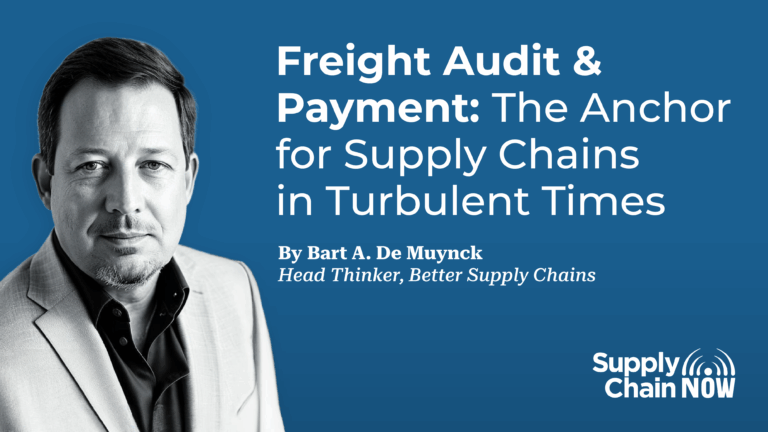
Freight Audit & Payment: The Anchor for Supply Chains in Turbulent Times
Special Guest Blog Post written by Bart A. De Muynck
The past few years have exposed just how fragile our supply chains can be. From tariff shocks to pandemic disruptions, from inflationary pressures to mounting parcel surcharges, the landscape has shifted beneath our feet. Companies that once managed logistics as a back-office function are now grappling with its role as a front-line business risk.
What’s often missed in this conversation is the role of freight audit and payment (FAP). Long considered a tactical necessity, FAP has quietly become a strategic imperative. And as I explored in the Better Supply Chains Market Radar: Freight Audit & Payment, the companies that treat it that way are the ones best equipped to weather today’s volatility.
Why FAP Has Become Mission-Critical
When tariffs can add 15–20% to input costs almost overnight, or when the elimination of the U.S. de minimis exemption threatens to reshape cross-border e-commerce, companies need more than visibility. They need real-time intelligence and agility.
Traditional FAP approaches—manual audits, siloed spreadsheets, reactive error correction—are no longer sufficient. Modern FAP platforms, powered by AI and advanced analytics, enable shippers to:
- Audit with precision at scale, uncovering hidden surcharges and anomalies.
- Compare contract and spot rates dynamically to optimize spend.
- Blend fragmented logistics data into a single, trustworthy source of truth.
- Transform cost control into a forward-looking strategy for resilience.
Data: The Lifeblood of Modern Supply Chains
In my work, I often say that data is to supply chains what oil once was to industry: essential, powerful, but only valuable when refined. AI-driven FAP platforms are only as effective as the quality of the data behind them. That’s why the leaders in this market are not simply deploying automation—they are building robust data foundations that fuel meaningful insights and enable proactive decision-making.
Leadership in a Divided Market
The FAP market today is bifurcated. On one side are long-established players with global reach and deep operational expertise. On the other are innovative SaaS entrants pushing the boundaries of automation and AI. What sets true leaders apart is their ability to balance maturity with innovation—to combine trusted processes with cutting-edge technology.
One such example is Intelligent Audit, which the Market Radar highlights as a strength leader. By pairing high-quality data with advanced AI, they deliver not just audit accuracy but measurable cost savings and improved supply chain efficiency. Their consistently high customer sentiment further underscores the market’s demand for this balance.
From Back Office to Agility Engine
The transformation of FAP reflects a larger truth: supply chain management is no longer about efficiency alone. It’s about resilience, agility, and strategic advantage. Freight audit and payment, once relegated to the background, is now a central lever in achieving those goals.
For shippers navigating uncertainty, the message is clear: it’s time to elevate FAP from an afterthought to an anchor.
Explore the Full Market Radar
In the Better Supply Chains Market Radar: Freight Audit & Payment, I’ve analyzed the major providers, assessed market dynamics, and outlined what companies should prioritize as they evaluate partners. My goal is to help supply chain leaders see FAP not as a cost center, but as a catalyst for agility and growth.
Bart A. De Muynck, Head Thinker at Better Supply Chains, blends thought leadership with business intelligence to enhance commerce and connectivity. A Six Sigma Black Belt, he leverages deep expertise in logistics and technology to drive innovation, foster collaboration, and optimize supply chains for sustainable value and tangible business impact.
More Blogs
From Siloed Functions to Connected Decisions: Unlocking the Next Phase of Supply Chain Digitalization