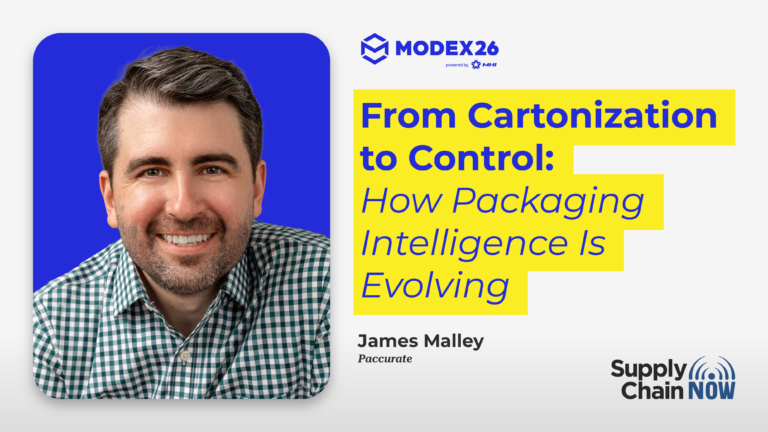
From Cartonization to Control: How Packaging Intelligence Is Evolving
At MODEX 2026 in Atlanta, Scott Luton reconnected with James Malley, Co-Founder and CEO of Paccurate, for a conversation that blended humor, operational insight, and a fresh perspective on where warehouse technology is headed.
While the discussion included everything from Disney World to hot dog bun conspiracies, the core message was serious: supply chain organizations are entering a new phase where control, visibility, and operational simplicity matter more than flashy technology demos.
MODEX 2026: Less Hype, More Optimization
After nearly a decade of attending MODEX events, Malley sees a clear shift in this year’s show floor dynamic.
“I notice in some years at MODEX, there will be all kinds of wild technology that’s kind of futuristic. And in other years, the vibe seems to focus more on the maturation of technology in very established categories,” he explains. “This year is more of the latter.”
In other words, the industry appears to be moving from experimentation toward optimization. Rather than chasing the next shiny object, many supply chain leaders are focusing on getting more value from the systems and automation they already have in place. Deeper analytics, better visibility, and operational refinement are becoming bigger priorities than headline-grabbing robotics demonstrations.
That shift reflects broader economic realities as organizations navigate what Malley describes as a “confluence of cost pressures.”
In uncertain environments, companies become more cautious about massive new investments and instead focus on strengthening existing operations.
The Evolution of Paccurate
Paccurate itself has evolved alongside those changing customer priorities.
When the company first launched, the value proposition centered heavily on cartonization: the process of selecting the right packaging for shipments. At the time, Paccurate largely operated as a point solution focused on transportation savings and packaging efficiency.
Today, the platform has grown into something much broader.
“We call our platform now the Packing Control System,” Malley explains, emphasizing that “control” is now the key word.
That distinction matters because supply chain operators aren’t simply looking for another optimization engine. They are looking for ways to reduce operational friction, simplify decision-making, and gain more control over packaging workflows, rules, and SOPs. As Malley puts it, the conversation shifted from “we’ll save you 6-7% on transportation” to helping operators make their day-to-day lives easier.
Packaging Optimization Impacts More Than Transportation
One of the more interesting themes in the discussion is how packaging decisions now influence much more than parcel costs. Paccurate increasingly works alongside warehouse automation providers, AMR deployments, and storage system technologies. The company has discovered that packaging optimization can directly affect broader warehouse performance and automation ROI.
For example, better packaging decisions can allow autonomous mobile robots to carry more work per trip, improving throughput and changing the economics of an entire deployment.
That’s a far more strategic role than simply reducing shipping expenses. It also reflects a growing industry trend: siloed optimization is giving way to ecosystem-level thinking.
The Hidden Challenge: Data
As operations become more intelligent and interconnected, one foundational challenge continues to stand in the way: data quality. According to Malley, dimensional product data remains one of the biggest barriers for many shippers, especially those managing massive SKU catalogs.
“We have customers with 800,000 discrete product SKUs in their warehouse,” he says.
Capturing accurate dimensions for all those products has historically been labor-intensive, expensive, and easy to deprioritize. But that’s starting to change. The rise of AI has created new executive urgency around data readiness, even in areas that may not initially appear connected to artificial intelligence.
“Executive awareness about AI continues to push forward…they’re beginning to understand they need good data anyway,” Malley explains.
That growing awareness is helping operations teams gain support for initiatives that previously struggled to get funding or executive attention.
Solving Real Problems for Real Operators
One of the most compelling aspects of the conversation is Paccurate’s focus on operational reality.
Malley paints a relatable scenario: a VP of Operations finally takes a family vacation only to receive an urgent text that products are being damaged in transit. Instead of scrambling through spreadsheets or emergency calls, the operator can simply adjust packaging rules remotely within the platform.
The vision is simple but powerful: giving operators the ability to solve problems faster and with less stress. That focus on operational usability may ultimately be one of Paccurate’s biggest differentiators.
Trust Still Matters Most
Despite all the innovation on display at MODEX, Malley emphasizes that trust remains one of the most important currencies in supply chain technology.
One of the most meaningful moments for him at the event wasn’t a flashy product launch. But rather, it was hearing major brands stop by the Paccurate booth and say, “We heard from multiple people that we had to talk to you.”
For a company that started as a niche optimization tool, that level of market validation represents years of credibility-building and customer success.
Final Takeaway: Simplicity Creates Leverage
At MODEX 2026, James Malley’s perspective reflects a broader shift happening across supply chain technology. Organizations are becoming more disciplined. They want fewer disconnected tools and more operational control. They want systems that improve workflows – – not just dashboards. And they want technology partners who understand the realities operators face every day.
As Paccurate’s journey shows, sometimes the biggest innovation isn’t adding complexity. Instead, it’s giving people better control over the complexity they already have.
Where to Learn More
Connect with James Malley on LinkedIn. And learn more about the leading 3PLs, retailers & distributors that are using Paccurate to reduce transportation costs & material waste, while increasing throughput and customer satisfaction: https://paccurate.io/
More Blogs
From Siloed Functions to Connected Decisions: Unlocking the Next Phase of Supply Chain Digitalization