Leading Beyond The Next Disruption
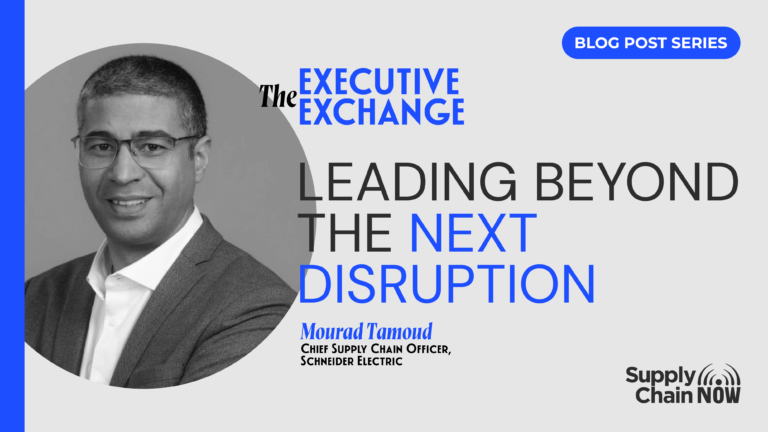
Over the past three decades, supply chain has transformed from a back-office function focused on efficiency into one of the most strategic capabilities in business. Few leaders have witnessed (and helped shape) that evolution more closely than Mourad Tamoud, Chief Supply Chain Officer at Schneider Electric.
In a recent conversation with Scott Luton, Tamoud shared lessons from a career that began as a factory-floor intern and now spans global leadership. His perspective offers a compelling roadmap for organizations navigating AI, digital transformation, resilience, and the ever-changing demands of global supply chains.
Supply Chain Has Become a Strategic Function
Looking back on his early days at Schneider Electric, Tamoud noted just how dramatically the profession has changed.
“When I started, I was coached with the understanding that supply chain was all about the ‘Just in Time’ approach and focused on cost reduction,” he said. “Today, supply chain sits at the center of business strategy. It is about supporting growth, anticipating resilience with agility.”
That evolution has also reshaped leadership itself.
“My biggest lesson has been that leadership is less about having all the answers and more about defining a long-term vision and building great teams, listening and helping people succeed. That’s what creates enduring performance.”
Rather than simply optimizing operations, today’s supply chain leaders are helping shape customer experience, product strategy, sustainability, and business growth.
AI Works Best When People Come First
Schneider Electric has become widely recognized for its leadership in advancing energy technology and digital transformation, particularly through its practical application of AI across forecasting, planning, and manufacturing. According to Tamoud, AI has already exceeded expectations by helping teams make faster, better-informed decisions while eliminating repetitive work. But technology alone isn’t enough.
“Start with people, not technology,” he advised. “The biggest challenge isn’t whether AI works. It’s whether people are comfortable using it every day.”
That philosophy explains why Schneider Electric continues investing heavily in digital talent, AI expertise, and leadership development. Rather than viewing AI as a replacement for employees, the company is focused on equipping its workforce to thrive alongside new technologies.
“When people see AI making their jobs easier,” Tamoud said, “adoption happens naturally.”
Resilience Must Be Designed In
As geopolitical uncertainty, trade policy shifts, and supply disruptions continue to reshape global commerce, resilience has become a defining competitive advantage. For Schneider Electric, that resilience begins with visibility.
“Better visibility has made the biggest difference,” Tamoud explained. “Digital tools help us spot potential issues earlier, while stronger planning and diversified sourcing give us more options when conditions change.”
He also emphasized the importance of designing resilience into the network itself through regional manufacturing, and identifying supply chain choke points before disruptions occur.
Just as importantly, resilience requires collaboration. By involving supply chain early in strategic business discussions, organizations can make decisions that simultaneously improve customer service, operational efficiency, and sustainability.
Sustainability Is Simply Good Business
Schneider Electric has earned global recognition for both operational excellence and sustainability, but Tamoud rejects treating sustainability as a standalone corporate initiative.
“When an initiative improves efficiency, reduces waste, strengthens resilience or helps customers meet their own goals, it becomes part of how we operate,” he said. “Not as an add-on, but as good business.”
That integrated approach demonstrates how environmental responsibility and business performance can reinforce one another rather than compete for investment.
The Next Transformation Won’t Be About AI Alone
Looking ahead, Tamoud believes many organizations are focusing on the wrong challenge.
“AI will continue to reshape industries,” he said, “but the real value doesn’t come from implementing AI on top of existing processes. It comes from completely reshaping the operating model of our supply chain and redesigning it around AI.”
Yet even that transformation won’t ultimately be defined by technology.
“The real differentiator will be engaging teams that are continuously learning, ready to embrace agility by being adaptable, curious and comfortable working alongside new digital tools.”
Final Takeaway
Mourad Tamoud’s message is refreshingly practical: The future of supply chain isn’t about choosing between people and technology, rather, it’s about enabling people through technology.
Organizations that redesign operating models, consistently invest in digital capabilities, strengthen resilience, and cultivate adaptable leaders will be best positioned for whatever comes next.
As supply chains become increasingly intelligent and interconnected, one truth remains unchanged: Sustainable competitive advantage will always begin with empowering talented people that are powerfully aligned around a shared vision.
Where to Learn More
Check out Scott W. Luton’s in-person interview with Mourad here at the Schneider Electric Innovation Summit North America 2025, as well as a variety of interviews that we conducted at the event: click here. We invite you to follow Mourad Tamoud on LinkedIn here, as well as learn more about Schneider Electric via the company website: https://www.se.com/ww/en/
More Blogs

Uncovering Hidden Costs in Supply Chain Planning: Tom Moore of ProvisionAI on What Companies Miss