[00:00:00] Meena Medler: when I work through and evangelize supply chain and some of these things is, how do we do the journey from material management to that is? It’s not about the price, it’s about the waste that we create for each other, and how do we create this journey to be so frictionless that we could share in that value?
[00:00:33] Scott W. Luton: Hey, hey, good morning, good afternoon, good evening, wherever you may be. Scott Luton and Industry Hall of Famer Régine Villain with you here on Supply Chain Now. Now, Régine, how are you doing today, my friend?
[00:00:46] Régine Villain: I am doing swimmingly well. I am actually in Paris today, and I’m sure you’re watching the news about what’s going on. Definitely some of that is going on in the city center, but I’m nowhere near that right now. So I’m still enjoying a beautiful weather here in Paris
[00:01:05] Scott W. Luton: Well, we are all very jealous, and we all also hope that cooler heads will prevail and, and, and things will simmer down, simmer down a bit and, and, uh, we can address all sides there. But regardless, we have all sides represented here today. We have an incredible guest, uh, and I’m so delighted to have you and our guest here today, folks.
[00:01:24] Scott W. Luton: Uh, folks, we’re gonna be s- placing a spotlight once again on a critical industry for everybody, no matter where you live. Like many others, healthcare supply chain leaders are navigating an increasingly complex world, balancing cost, resilience, technology, and operational performance while keeping patient care
[00:01:42] Scott W. Luton: at the center of every decision.
[00:01:44] Scott W. Luton: That’s the North Star. Today, we’re exploring what great healthcare supply chain leadership looks
[00:01:48] Scott W. Luton: like with an exceptional industry leader. We’re gonna be diving into her unique journey, the creation to consumption or care continuum, the opportunities and risk around AI and technology, and what healthcare supply chain leaders need to be ready for next.
[00:02:05] Scott W. Luton: And Régine, given your proven track record of innovation, transformation, and outcomes, especially in the healthcare space, I can’t wait to hear your insights here today. Should be a good one, huh?
[00:02:16] Régine Villain: Should be a great one. Um, Meena is an exceptional guest, and she’s a great friend, so I can’t wait for, for the
[00:02:24] Régine Villain: show. So let’s get to it
[00:02:27] Scott W. Luton: Me and you both. So,
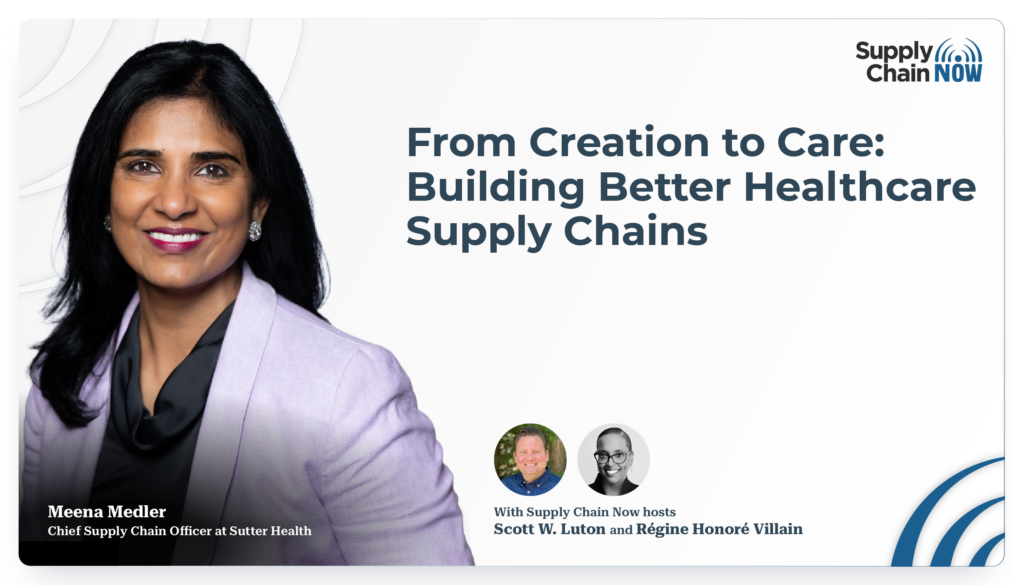
[00:02:28] Scott W. Luton: uh, let’s introduce, uh, Meena Medler, who brings more than
[00:02:33] Scott W. Luton: three decades of experience driving transformation across healthcare. Now, her career has taken her from the clinical frontlines as a physician assistant to leading complex heart and vascular programs to senior roles across supply chain and manufacturing.
[00:02:48] Scott W. Luton: Along the way, she’s built and transformed everything from value analysis to supply continuities to strategic sourcing and supplier partnerships, but our focus remains clear: building a more resilient, innovative, integrated healthcare value chain that delivers better care at a more affordable cost.
[00:03:05] Scott W. Luton: Let’s welcome in Meena Medler, Chief Supply Chain Officer at Sutter Health Hey, hey, Meena. How are you doing today?
[00:03:13] Meena Medler: Great. Doing great. But I am envious of Régine and, you know, the Eiffel Tower in the background. I mean, although I will compete with her, I’m in the Bay Area and it is beautiful here, although I don’t have a window to show you how beautiful it is, but can’t
[00:03:29] Scott W. Luton: time. Next time, Meena. But, uh, I’m, I’m, you know, we’ve had nice weather here in Metro Atlanta, but I’m very jealous of where y’all both are. And Régine just doubles down with that gorgeous background of hers. Uh, so
[00:03:41] Scott W. Luton: let’s do this, Meena and Régine. I want to start with a little fun warm-up questions, kind of what we do around here.
[00:03:46] Scott W. Luton: and Meena I’m gonna start with you. You know, to do what both of y’all have done in your career, uh, I bet time management strategies
[00:03:53] Scott W. Luton: has been like a, a, a top three or four priority.
[00:03:57] Scott W. Luton: What’s one tip that you’ve regularly used that’s fueled
[00:04:00] Scott W. Luton: your, your powerful career forward, Meena?
[00:04:03] Meena Medler: I wanna thank every supply chain, uh, team member out there. Doesn’t matter which side you sit. I have learned, uh– I have gained so much knowledge, ultimate respect for these individuals, no matter which industry, that work every day and make it seem so easy to have the right product, right service, at the right place, at the right time, while ensuring that there is right price.
[00:04:35] Meena Medler: But making sure for healthcare, that, that the care that we provide is never even a miss, and that when patients come in, when clinicians are caring for these patients, that they have everything that they need to get the best care that we can
[00:04:54] Meena Medler: provide. I think I wanna call out to them. Thank you for all that you do every day.
[00:04:58] Meena Medler: And to my Sutter team, my Sutter Health team, supply chain team, thank you. You are amazing, and it’s a privilege to be working with all of you
[00:05:06] Scott W. Luton: So Meena, I gotta, uh, uh, I love how you started, and, and that’s really, really important. I gotta make a quick plug, Régine. I got to. April 29th. April 29th, mark your calendar now,
[00:05:17] Scott W. Luton: National Supply
[00:05:18] Scott W. Luton: Chain Day, which was, uh, started by our colleague here, Mary Kate Love. And Meena, I– none of us could’ve said it better than what you just shared, and I love that you
[00:05:27] Scott W. Luton: shared it with the passion and authenticity you did, because nothing would be possible without our hardworking supply chain professionals across the globe.
[00:05:36] Scott W. Luton: So well done, Meena. And really quick, Régine, uh, hey, change, including the fun warm-up question, that happens from time to time. I know you’re dying to weigh in on Meena’s perspective and, and love for the workforce
[00:05:49] Régine Villain: Absolutely. Um, first of all, uh, as she was talking about that, I said to myself, “I need to also remind the audience that supply chain is more than just a week, right? It’s, it’s a daily thing for supply chain, if not hourly, really, ’cause everything that the supply chain does affects every part of the hospital systems that they’re in.
[00:06:12] Régine Villain: And fortunately for us, you know, the spotlight came on us during COVID, and everybody discovered, I like to say, how supply chain was sexy, but we always knew how sexy supply chain was. And so for us, you know, having
[00:06:29] Régine Villain: that recognition and the spotlight on us during COVID and after, you know, has been absolutely,
[00:06:36] Régine Villain: uh, just validating in a way.
[00:06:38] Régine Villain: However, everything that happens in a hospital when you walk in, from when you
[00:06:44] Régine Villain: walk in to when you
[00:06:45] Régine Villain: leave a hospital system as a patient,
[00:06:48] Régine Villain: as a family member visiting, there is a component ‘
[00:06:53] Régine Villain: of supply chain from the minute you step in the parking lot until you return back again. And so I have to echo
[00:07:02] Régine Villain: what Meena says, nothing happens…
[00:07:05] Régine Villain: my bias is that
[00:07:06] Régine Villain: nothing happens without the supply chain.
[00:07:08] Scott W. Luton: Love it. Love it. Um, Meena and Régine, what a great way to kick off, uh, this conversation
[00:07:15] Scott W. Luton: here today. So thank you so much.
[00:07:17] Meena Medler: I want to answer it.
[00:07:18] Meena Medler: too.
[00:07:18] Meena Medler: Régine, go
[00:07:20] Scott W. Luton: uh,
[00:07:22] Scott W. Luton: let’s
[00:07:22] Scott W. Luton: do it. So
[00:07:23] Meena Medler: Let’s do it.
[00:07:24] Meena Medler: on a serious note, right, one of the things that I- I’ve learned is when am I the best, right?
[00:07:30] Meena Medler: So it’s one of my… One is my mind, and I usually segment my inboxes is what does require for me to really think about what I’m… I- I need to thoughtfully respond to this, and I need to review something or, you know, those really important stuff. I’m a morning person, so I tend to look at those, uh, um, emails, um, and respond them more in the mornings.
[00:07:55] Meena Medler: And then anything else, I usually segment after all meetings that I have towards the end, and those… That’s sort of w- how I work to manage it. Have I ever gotten it to zero? Absolutely not
[00:08:08] Scott W. Luton: All right. So I love this. So Régine, um, I think she’s making a great
[00:08:15] Scott W. Luton: point there
[00:08:16] Scott W. Luton: uh, at least in, my mind, because there are certain days like my coffee
[00:08:19] Scott W. Luton: buzz, if I’m being real frank, I reserve that two hours or so in the mornings,
[00:08:24] Scott W. Luton: whether it’s the weekends or the weekdays, to do some of my most challenging work, right?
[00:08:28] Scott W. Luton: Because I get a couple sips of coffee, couple of cups of coffee, and I can really solve the quadratic equation. I’m not sure what that is, but y’all know what I’m saying. Uh, so I think this is a really great
[00:08:39] Scott W. Luton: practical tip that avoid your… When you got
[00:08:42] Scott W. Luton: to knock out a bunch of emails, a bunch of messages and questions and a bunch of
[00:08:46] Scott W. Luton: work, man, really marry
[00:08:49] Scott W. Luton: that with when your own in the day or the week, what
[00:08:52] Scott W. Luton: have you.
[00:08:52] Scott W. Luton: Régine, though, what is one of your go-to tips for managing time and your pesky email
[00:08:58] Scott W. Luton: inboxes?
[00:08:59] Régine Villain: I don’t know. I
[00:09:01] Régine Villain: think I’m probably gonna be, uh, the renegade here. So when I think
[00:09:05] Régine Villain: about, when I think about the, the
[00:09:08] Régine Villain: inbox, frankly, since we’re talking about supply chain, I feel like I run my inbox the way that I ran inventory. first
[00:09:16] Régine Villain: in, first out. FIFO baby, FIFO. And anything that sits on the shelf for 90 days is obsolete.
[00:09:23] Régine Villain: I write it off and I move on.
[00:09:26] Scott W. Luton: I like that
[00:09:28] Régine Villain: frankly, when I
[00:09:29] Régine Villain: think
[00:09:29] Meena Medler: FIFO. Oh, first in, first out. That’s interesting. Never thought of it, that way
[00:09:35] Régine Villain: it’s, not even to me about inbox zero really. It’s about, to me, if I have to be practical and, and, and, and be a little bit more serious here, decision zero perhaps is what I would call it. Because to me, every message gets one decision the first time I touch it.
[00:09:51] Régine Villain: You know, you act on it, you hand it off, and then you let it go. I think what drains a leader or anybody really is touching the same thing five times, six, seven times, you know? So that’s the way I would say it more pragmatically, but frankly, it’s FIFO
[00:10:07] Scott W. Luton: Yep. Uh, Régine, y- and we all know that excessive touches is certainly a form of waste. I’ve never really applied that to email, but it makes complete
[00:10:15] Scott W. Luton: sense now. Um, well, I’m so glad, Meena and Régine, not only did we celebrate the workforce, but we stuck with the fun warm-up question because I think both of y’all offered some practical advice in a ever-busy and ever fast-moving time.
[00:10:29] Scott W. Luton: And I tell you, uh, protecting that focus and prioritizing and managing our time when everybody’s trying to take it from
[00:10:35] Scott W. Luton: us, it’s really, really important. So really appreciate y’all’s perspective.
[00:10:38] Scott W. Luton: Meena, I think let– I wanna level set a bit. We, in, in the intro with you, we kind of, um, shared
[00:10:45] Scott W. Luton: just a couple of tidbits about your journey. I know there’s so much more there. Uh, but if you could level set, uh, about yourself and about Sutter Health so folks have that context before we move forward. Meena, tell us
[00:10:57] Meena Medler: Um, I joined Sutter Health, um, last Jan– uh, in 2025 January. Uh, Sutter Health is an amazing organization, really focused on patient care, excellent patient care, patient access, mental health, expanding, caring for our, uh, team members that serve, uh, our community every day, and really focused on the clinicians and the employees day in and day out, right?
[00:11:24] Meena Medler: People first, patients always, or patients first, people always. You– I could, I could twist it in either direction, but we are here to do that, and the most amazing thing about this organization is everybody lives those values from top down. And it is an amazing experience for– to work with everybody aligned in the same direction and live those values and being part of this journey that we’re on, um, i-in the most challenging times, um, uh, given the geopolitical situations that we’re dealing with in general, with the supply chain, um, disruptions.
[00:12:03] Meena Medler: And resiliency remains the main focus so that we could– we never disrupt the care continuum for our patients and, uh, ensuring our clinicians have everything. It’s just the best place to be, and I enjoy it. And I have… As I mentioned, I have a great team, and we’re doing some amazing transformation work, So um, it’s, it’s been an honor.
[00:12:23] Meena Medler: It’s been a privilege and an honor
[00:12:25] Scott W. Luton: Okay, Régine, I
[00:12:26] Scott W. Luton: bet that resonates with you, uh, as she talks about, uh, her and her team and their accomplishments
[00:12:32] Scott W. Luton: and, and, and, that constant, uh, battle for resilience. And, and
[00:12:38] Scott W. Luton: that, uh, what that means continues to evolve as well. So the battle continues to evolve. But what’d you hear there, uh, as Meena kind of level set on herself and her organization, Régine?
[00:12:48] Régine Villain: you know, I was in that chair
[00:12:50] Régine Villain: not long ago, and I sat in that chair for about 30 years. And so everything that Meena just said here
[00:12:56] Régine Villain: resonates with me. Uh, what struck me. is that, you know, she put the clinicians and
[00:13:02] Régine Villain: the team right next to the patient, which is
[00:13:05] Régine Villain: really the
[00:13:06] Régine Villain: only way to look at
[00:13:07] Régine Villain: supply chain, to look at healthcare supply chain.
[00:13:10] Régine Villain: Uh, because frankly, people have a tendency of
[00:13:13] Régine Villain: decoupling supply chain with whatever is going
[00:13:16] Régine Villain: on from the clinical enterprise, but frankly, they’re one and the same. Which is why we have all, and I’m saying we because I’m
[00:13:23] Régine Villain: putting myself back in that chair, we have all been
[00:13:27] Régine Villain: pushing
[00:13:28] Régine Villain: for that clinical integration for supply chain.
[00:13:31] Régine Villain: That clinically integrated
[00:13:32] Régine Villain: supply chain is the
[00:13:33] Régine Villain: only way to be. Because in supply chain, we sometimes forget that the person opening the case cart is our customer,
[00:13:39] Régine Villain: too, right? When the shelf is full, the n- the nurse never thinks about us per se, but that’s exactly how it should
[00:13:48] Régine Villain: be. I use the light switch analogy,
[00:13:51] Régine Villain: and I always have used that.
[00:13:52] Régine Villain: You walk into your room, you turn on the light switch, and boom, the light is on. You don’t think about all the million, you know, micro electrons that made the light turn on. But when you walk in that room and you turn on that switch, it’s not on, then you know something’s going on. That’s the same for supply chain.
[00:14:09] Régine Villain: And so I appreciate Meena’s, you know, focus on making sure that the supply chain and the clinicians really are one and the same when it comes to the patient care path
[00:14:21] Scott W. Luton: So, uh, Meena, I’m really curious now that we’ve level set a little bit there. Uh, what in the world got you first into the wide world of healthcare,
[00:14:30] Scott W. Luton: Meena?
[00:14:31] Meena Medler: I, uh, grew up with a lot of… My mom’s a nurse. My aunt, two aunts are nurses. They worked in critical care, um, all in Chicago, and I had a lot of physicians, and that’s all I knew, right? And I loved what they did and the, the care that they provided. Um, my, my oldest aunt worked in the, um, Chicago, um, overseeing the mental health institution there, and one other nurse was an ICU nurse and worked, they worked decades, and my mom was in, uh, general, um,
[00:15:07] Meena Medler: step-down units.
[00:15:08] Meena Medler: And so really
[00:15:10] Meena Medler: working and, and seeing them do what they did and how they cared, I
[00:15:14] Meena Medler: mean, they– my mom and my, um, eldest aunt, they worked until they were
[00:15:18] Meena Medler: practically 70 years old. They cared about their patients. so I grew up with that plus my aunts and uncles and my brother-in-law being physicians and stuff.
[00:15:28] Meena Medler: So they, it’s, this is… They brought that passion for the patient
[00:15:35] Meena Medler: to home
[00:15:36] Meena Medler: as they felt it at work, right? So that’s my journey into it. And then my dad’s an
[00:15:42] Meena Medler: accountant, so imagine I was between human and numbers. M- So really, my– and I it’s a dichotomy of balancing. So I go to supply chain, right? Balancing finances with the human, with the patient, and us in the center of it.
[00:16:03] Meena Medler: And I want you all to, all those that are listening and each one of us, from, I, like I talked about creation to consumption, from conception to whatever happens as we pass on to the, next world, we are patients. We receive care, whether it’s wellness care, it’s vaccinations, it’s routine visits, blood work, to everything that we receive. we have the unique opportunity in this world to impact the product that we receive. so if we put that into the center, you, I mean, if you all ask me what drives me, what makes me wake up every morning no matter what’s happening and do what I do is that whether it’s 1%, .1%, you’re making that impact every day, and you get to do that. and we that’s a privilege. And so I’ll leave you with that
[00:17:04] Régine Villain: Absolutely.
[00:17:06] Scott W. Luton: All right, Régine. Uh, we could be here for an hour, I think probably you and I ruMeenating on what Meena just shared there. But what’s the first thing that comes to mind, es- especially as she shared her why for what she does?
[00:17:18] Régine Villain: Well, I I share so much of what
[00:17:21] Régine Villain: she just said, right? And what I want everyone to hold on
[00:17:26] Régine Villain: to is, uh, Meena, is what you said at the end. Every
[00:17:31] Régine Villain: one of us is a patient at some point, every single one of us. So the person
[00:17:37] Régine Villain: sitting in a contracting meeting today, um, who’s taking a little bit of a break listening to this, is making a decision for their own mother’s bedside
[00:17:45] Régine Villain: tomorrow, right? That changes how you negotiate, and I’ve seen that happen
[00:17:51] Régine Villain: times and times and time again. And so we’re all patients
[00:17:55] Régine Villain: eventually. Supply chain is how we get to care for ourselves before
[00:17:59] Régine Villain: we need it. And I love what you said about
[00:18:02] Régine Villain: the human and the numbers, because between the human and the
[00:18:05] Régine Villain: numbers is exactly where supply
[00:18:07] Régine Villain: chain lives, I think
[00:18:09] Scott W. Luton: all right.
[00:18:09] Scott W. Luton: So, Meena, I
[00:18:11] Scott W. Luton: want to,
[00:18:12] Scott W. Luton: um, kind of go back to,
[00:18:13] Scott W. Luton: all, again, all
[00:18:14] Scott W. Luton: the different hats you’ve worn in your journey thus far, right?
[00:18:17] Scott W. Luton: That rare combination of experiences and leadership
[00:18:20] Scott W. Luton: roles, um, a- as it relates to your journey. You know, from the bed- as I kind of shared some of this in your intro, from the bedside as a clinician to the provider,
[00:18:29] Scott W. Luton: to group purchasing, uh, the distributor side of the business, and much, much more. How have those different perspectives, little two-part question, how have those different perspectives shaped the way you think about
[00:18:40] Scott W. Luton: healthcare supply chain, one? And two, what do you see differently
[00:18:44] Scott W. Luton: today, especially because of having the, um, advantage of, you know, being a part of, uh, so many different sides of the equation, Meena? Your thoughts
[00:18:53] Meena Medler: Um, really, I think, um, I feel like I am constantly learning, right? I think when we’re in our own silo because we’re busy with what we’re doing, we don’t pause to think and put ourselves in somebody else’s shoes. Even when I had the opportunity to go into supply chain, didn’t understand the vast amount of the background that they’ve done.
[00:19:20] Meena Medler: So what I will say today is that I appreciate in that journey, I appreciate the suppliers and their challenges more. I appreciate the, uh, challenges of balancing everything that we do and that, um, every penny counts in a very tough situation and that, you know, we have to be mindful of the quality of care we provide by, by being fiscal, uh, fiscally responsible and being the stewards of the finances so we can commute– continue to invest back.
[00:19:54] Meena Medler: So there’s so much that I’ve learned, but one of the
[00:19:57] Meena Medler: things that I’ve learned is that if we actually pause and I don’t always do this job really well, we actually pause and ask the question and walk in other people’s shoes, we’re gonna get to something. How can we become frictionless and reduce waste And learn, and it’s, it’s together how much more we can accomplish.
[00:20:28] Meena Medler: So it is… That’s what I’ve learned, because each one, when people have given me the opportunity, I take it as I bring my insights. But I’ve learned from leaders like Régine. I’ve learned, I mean, I ask a lot of questions. People do get tired of me. I do ask a lot of questions because without asking questions,
[00:20:46] Régine Villain: Yeah
[00:20:47] Meena Medler: we’re not gonna learn and, and understanding that perspective because, and I will tell you, as a clinician, I never, like Régine said, I, I didn’t know supply chain, and I do not believe most people pause to think about the hundreds of different tasks, nuances we take into account every minute, every day throughout supply chain.
[00:21:12] Meena Medler: From contracting team member, from risk mitigation, to par levels, to, you know, savings, to, uh, making sure our item master is the source of truth, to the intricacies of supply chain. I did not respect that. I didn’t know that. I didn’t understand it. And I… And the true success is when no one… When supply chain is invisible.
[00:21:41] Meena Medler: Their silence is a true success of a supply chain. That’s it. That, that’s what I’ve learned. But, but the, the way Régine said, the intricate wirings and what it takes for electricians and everybody for that light to come on, I think that’s a beautiful way to say it.
[00:22:00] Scott W. Luton: Yeah
[00:22:01] Meena Medler: But we make it, it’s just a switch.
[00:22:03] Meena Medler: And that, the beauty of s- That’s the true success of supply chain
[00:22:07] Scott W. Luton: You know, Régine was also referencing electrons and got all, it got very science-y with us. So I, you know, that’s above my pay grade, Régine and
[00:22:14] Scott W. Luton: Meena.
[00:22:14] Régine Villain: You remember I’m an engineer by, by, by, uh, by background. You know
[00:22:19] Scott W. Luton: That’s right. I do know that. Um, so let me a- so Régine, one thing I heard there, and she, and Meena didn’t say this explicitly, but this is what her response brought to my mind.
[00:22:30] Scott W. Luton: You know, we all know the power of empathy and curiosity, and I think one of the great advantages that leaders like Meena have when they, when they, they have a, a journey that puts them in a lot of different seats, is that gives them lots of, uh, the best, at least, the best leaders I’ve worked with, it gives them lots of empathy and curiosity of all the folks that have come, gotta come together across departments and functional la- layers to either serve customers or patients or just make supply chain happen.
[00:22:58] Scott W. Luton: And I think my hunch is that that empathy and that curiosity that Meena has are superpowers, helps drive the questions, helps drive the change, the transformation, but never losing sight of the e- the natural, genuine empathy she has of all the different, um, players that have, that, uh, have pressure put upon them, uh, to fulfill our mission.
[00:23:22] Scott W. Luton: And I think that is really, um, powerfully unique. But Régine, what did you hear there from Meena?
[00:23:29] Régine Villain: Um, first of all, again, um, the, the idea of… I wanna say something she mentioned at the beginning. She said the question, she’s a very curious person by nature. She asks a lot of questions, and people get tired of her. And frankly, I have to say that for me, it’s like, you know, iron sharpens iron. And I know that I can say that for a lot of other people, uh, Meena, frankly.
[00:23:54] Régine Villain: Um, the reason why I think we can call ourselves even remotely leaders in the supply chain field is because of the ability to ask questions and to be humble about understanding that you don’t know everything. You don’t have all the answers, right? And so I want to bring that up because I think a lot of people confound being a leader or being over- overseeing an area like
[00:24:22] Régine Villain: supply chain, support services, whatever it
[00:24:25] Régine Villain: is, to understanding and knowing every single part of it. What is a beautiful thing here is that you can take a step back and realize that you’re
[00:24:35] Régine Villain: not the smartest person in the room, and you don’t have all the answers, right? It’s that
[00:24:40] Régine Villain: deference to expertise that I always quote. So I want to honor
[00:24:44] Régine Villain: Meena for saying that because
[00:24:46] Régine Villain: it takes a
[00:24:46] Régine Villain: lot of courage for leaders to say
[00:24:48] Régine Villain: that, ’cause a lot of people want to show themselves as having all the answers, and that’s not the case, right? And
[00:24:54] Régine Villain: frankly, when you think about the supply chain, it’s a little bit of
[00:24:58] Régine Villain: the same that we’ve been talking about being silent and like, you know, Meena said, being a little bit invisible. Uh, it- it’s the only, supply
[00:25:07] Régine Villain: chain is the only profession, I think,
[00:25:08] Régine Villain: where the best review you can get is that nobody noticed you.
[00:25:13] Régine Villain: I used to say that the kno- the way that you know that things are working is that you can bravely walk to a floor, an active floor where care is happening. You walk down the hallway, and not one single person stops
[00:25:27] Régine Villain: you. That is the measure
[00:25:29] Régine Villain: of success, right?
[00:25:31] Scott W. Luton: that.
[00:25:31] Régine Villain: It is just amazing how that works, and I know that Meena understands and relates to that
[00:25:37] Scott W. Luton: Y- you know, Meena and Régine, there’s some days that you don’t want to walk through down the hall, at least in my journey, uh, because of that exact reason, Régine.
[00:25:44] Régine Villain: The opposite is true too.
[00:25:46] Régine Villain: Yes
[00:25:47] Scott W. Luton: right.
[00:25:47] Scott W. Luton: all right, so Régine, I think we want to keep driving, uh, with a question kind of reflective to her, um, her journey and all the leadership hats. Your thoughts, Régine. What do we want, where do we want to go next with Meena?
[00:26:00] Régine Villain: So, um, I mean, I know she,
[00:26:03] Régine Villain: she’s addressed a little bit of that journey, right?
[00:26:06] Régine Villain: Um, from being a, a clinician. You know, I think that part definitely we need to bring that up again. Being a clinician, being in the distribution, being in, you know, the GPO space, and then being
[00:26:19] Régine Villain: in actually a provider space, it’s just like, I think she’s almost a unicorn ’cause I don’t know a lot of people who can actually fill all of those shoes.
[00:26:30] Régine Villain: And so
[00:26:31] Régine Villain: Meena, when I think about, um, you and looking across that full continuum, right, that you, call from creation to consumption, um, manufacturing all the way to utilization, right? And then the point of
[00:26:46] Régine Villain: care. So where do you see the biggest opportunities to remove the friction? I used to call it the friction factor, right?
[00:26:57] Régine Villain: The friction, ’cause that’s how you know that either things are working or not working. It’s that friction factor. So where do you see
[00:27:06] Régine Villain: or where did you see the greatest opportunities to remove friction, to improve efficiency, and to better connect that whole journey?
[00:27:14] Meena Medler: I think in two parts. One is internal to us, right?
[00:27:18] Meena Medler: I think that’s The integration into clinical we talked about when we become one in understanding each other and creating collectively what I call and what I was taught at my former organization by leaders when I said, “What’s your five-year plan?” Um, you know, I’ll honor Gary Fennessy who gave me the opportunity to become the supply chain leader.
[00:27:40] Meena Medler: And when I asked him, “What are you trying to… Why, why am I here? What are you trying to accomplish?” He said, “I want to be an integrated… I want to be a value chain in five years.” I didn’t understand it, what it meant, but it means that you, to create value isn’t always about number. It is about becoming that frictionless, that integration, walking in each other’s shoes and creating a product, right?
[00:28:02] Meena Medler: The product or the outcome that is in best interest of all the
[00:28:06] Meena Medler: players that are, all the stakeholders that are involved
[00:28:09] Meena Medler: in it. So I think that value analysis,
[00:28:13] Meena Medler: clinical integration, understanding, and collectively making
[00:28:17] Meena Medler: the investments in our supplies, medical device, services, technology that’s in
[00:28:22] Meena Medler: the best interest of the patient, the clinician, the operational, and the organization in that order, right?
[00:28:30] Meena Medler: How do we look at it in that order is, is, is a value in where we are. We have made inroads in there, but I think there’s still so much more we can continue to do with insights and proactive ways of doing where we continue to impact and maintain high quality with physical, fiscal responsibility, right?
[00:28:50] Meena Medler: Affordable care, um, but highest, uh, level of quality. So that’s one. And I think we, we’ve, we’ve done that over the past 15 years. We’ve, we’ve made inroads in that space. I think the space where I see having been on the supplier, being a general manager, and again, I wanna thank the leaders that gave me the opportunity and believed in me that I could come in and provide my insights, make impact, but also learn through them and, and having been provided those res- uh, those opportunities,
[00:29:20] Meena Medler: the most important thing I’ve learned is the amount. You know, I’ll go back to amount of friction we create for each other. As long as we see supply chain as transactional activity, and every interaction is a transaction, as opposed to taking a step back, like I said, and looking in and say, “How do we create that
[00:29:39] Meena Medler: value?” With a, supplier,
[00:29:42] Meena Medler: taking into resiliency, giving insights upstream,
[00:29:46] Meena Medler: right? And that demand planning is so
[00:29:49] Meena Medler: consistent that you are appropriately
[00:29:54] Meena Medler: using the resources on the supplier side To know how many manufacturing lanes you’re gonna run, how much people you’re gonna have, how are you
[00:30:04] Meena Medler: gonna produce the best quality of product, where there is a
[00:30:08] Meena Medler: consistency of knowing your business, right, Knowing that demand signal to that, that’s where the waste begins.
[00:30:17] Meena Medler: If we nickel and dime ourselves to death on this, sorry for saying that,
[00:30:21] Meena Medler: if we continue in that conversation point where you’re looking at every category, every product as a
[00:30:27] Meena Medler: transaction, that there is a downstream impact.
[00:30:31] Meena Medler: And if we continue, instead of focusing on waste, and if we focus on
[00:30:35] Meena Medler: just that SKU price point, what happens is,
[00:30:38] Meena Medler: and I learned this from, um, um, a lovely, uh, person named Thanvi who taught me the obsolescence,
[00:30:47] Meena Medler: right?
[00:30:47] Meena Medler: If you continue to go for the lowest price point, our downstream raw materials and our, uh, suppliers, secondary suppliers can only do it at a certain cost. So now, instead of having that beautiful competitive market, you start creating oligopoly, duopoly, monopoly. So then what happens is if that goes down, the production impacts.
[00:31:14] Meena Medler: Now you have upstream challenges, right? Whichever way you wanna look at it, one supplier can’t supply, so if that goes down, what happens? We have lived that, right? So I call on my peers and us to look at the… in the challenging times that we’re facing, to look at the ecosystem in a way, right? Each and every one of us has that responsibility that we should stop and think, and I call on leaders to map out this process end to end and say, “Where are we creating that friction, And how do we share in that value so that we are paying the fair price point so that we can go back to that patient care, preventing the highest level of quality, producing the highest quality products that we use to provide the care for our patients?” That’s my, that’s my altruism. That’s my, that’s my North Star, right?
[00:32:14] Meena Medler: That is what I… Like, when I work through and evangelize supply chain and some of these things is, how do we do the journey from material management to that is? It’s not about the price, it’s about the waste that we create for each other, and how do we create this journey to be so frictionless that we could share in that value?
[00:32:35] Meena Medler: And I go back to what Gary Fennessy said, “What’s the value chain? How do we become a value chain in the end-to-end of that journey? is the true Nor- North Star for us
[00:32:49] Scott W. Luton: All right, Régine, uh,
[00:32:51] Régine Villain: I, I feel like I need, I need like a little bell to go ring-a-ding-ding-ding-ding-ding. You know? I, I wanna ring that bell.
[00:32:59] Scott W. Luton: Meena, kidding aside, we could dissect your response in so many different ways and have fodder for a book and a webinar
[00:33:06] Scott W. Luton: series and a
[00:33:07] Scott W. Luton: keynote series. Two quick call-outs, Régine, then I’ll get you to, to react. I love the emphasis
[00:33:13] Scott W. Luton: on, you know, if we’re gonna go after the lowest cost, and that’s
[00:33:16] Scott W. Luton: our top above-and-beyond priority, there’s gonna be certain things that come with that.
[00:33:20] Scott W. Luton: And, and as we all know, we’ve learned the hard way, you know, in the last five or six years. And then secondly,
[00:33:26] Scott W. Luton: um, the, the, the consistency of knowing the, business.
[00:33:31] Scott W. Luton: That, maybe that didn’t hit everybody’s radar in what she shared there, but that, in these ever-changing evolutionary times, where especially an organization as large as Sutter Health
[00:33:41] Scott W. Luton: is, is evolving and it,
[00:33:43] Scott W. Luton: and, and it’s got such a broad mission, man, keeping your finger on the pulse, no matter if it’s a, a rate, a period of fast change or slow change, big change or small change, but constantly relearning the business almost every day allows us, I think, to better lead, better navigate, and, and certainly with clarity.
[00:34:03] Scott W. Luton: And clarity is a beautiful thing that does not get enough attention. But Régine, th- those are two things I picked away from Meena’s response here. What about you?
[00:34:12] Régine Villain: I was gonna, I was gonna double down on what you said here about what she said. Um, uh, I, I wanna try to honor the way she said it. Basically, when we chase the lowest unit price on every SKU, we’re not saving money, right? We’re shrinking the market until you have one plant going down becomes a crisis.
[00:34:33] Régine Villain: And we have absolutely seen that more than once, right? We all have seen it, we have lived it, and we’re carrying the scars for that. Um, I think frankly, nickel and diming is a fine strategy, right, right on, u- up until the point that you’re calling around the country for the last case of something. Um, and that’s something that we don’t necessarily think about.
[00:34:56] Régine Villain: The, the, the real things she said about friction, we’re creating friction for ourselves. And I also want to call out, um, you know, a sector that we have not necessarily amplified as much yet. She did mention the vendors, the suppliers, because, you know, we cannot do what we’re doing without the suppliers as well.
[00:35:15] Régine Villain: You know, it’s that whole thing. It’s the… it’s the ugly cousin who comes to dinner, but you want that cousin to be at
[00:35:22] Régine Villain: dinner.
[00:35:24] Scott W. Luton: I got
[00:35:25] Meena Medler: seriously, the… I love it, but, but I mean, Régine and I had the privilege of…
[00:35:29] Meena Medler: I mean, she has, Um, worked for the same leaders historically, and I, am, and I will call on
[00:35:34] Meena Medler: Warner, Thomas, and Jonathan, who’s our CFO, and these leaders, and I will honor them
[00:35:40] Meena Medler: because they gave me
[00:35:41] Meena Medler: the platform and the ability and see the value in these, right? you cannot do it without the support of these
[00:35:47] Meena Medler: executive leaders looking at it strategically, l- like I said,
[00:35:52] Meena Medler: living and focusing on how do we become those stewards of care, access, Um, affordability. Those three
[00:36:01] Meena Medler: things in working with the patients and making sure
[00:36:04] Meena Medler: and, and always saying we can’t do it alone.
[00:36:07] Meena Medler: And I love what my leader says, “Pause
[00:36:10] Meena Medler: and think.” Not my, not my greatest strength, but really pausing for a
[00:36:15] Meena Medler: minute and thinking and, and the words of empathy and curiosity comes from that right? Each
[00:36:21] Meena Medler: day we’re learning and evolving as leaders, so I wanna call out
[00:36:25] Meena Medler: to these leaders that afforded us this. Régine and I are,
[00:36:29] Meena Medler: you know, had the privilege of that Being
[00:36:31] Meena Medler: able to work for leaders that support and see supply chain as more than
[00:36:38] Meena Medler: a number, right? They are giving it that strategic value thing. So I don’t know. I mean, that’s why I think Régine, I’ve learned a lot from her over the years and, um, being able to call her sh- you know, at nine o’clock at night because I’m six o’clock for me, and still leaning on her to, for insights and things like that You know, it’s a continuous supporting each other and, and working through this, this complicated journey, complicated times, you know, even it, was occurring pre-COVID. How do we really lean on each other and every p- um, stakeholder in this, supply chain journey, and How do we work together? Because none of us can solve this problem alone
[00:37:23] Scott W. Luton: That’s right.
[00:37:24] Scott W. Luton: all right, so Meena and Régine,
[00:37:25] Scott W. Luton: I want to touch on technology really quick, and Régine, I know you’ve got another, another follow-up question related to resilience, but, um, bringing technology into the journey is an incredible age, I tell you.
[00:37:37] Scott W. Luton: Um, and I hope my… Well, my kids have proven to be more technologists than I am, all three of them, and, and some, they’re, they’re coaching me up. But we know the lots of investment going into automation, analytics, and of
[00:37:49] Scott W. Luton: course AI across all industries, including healthcare. I’m curious, Meena, where can these capabilities,
[00:37:55] Scott W. Luton: you think, make the biggest difference across that creation to consumption journey that we’re referencing?
[00:38:00] Scott W. Luton: You, you’ve, you’ve been as part of your mantra. And where do you think industry has got to be a little more careful about not chasing technology for technology’s sake?
[00:38:08] Scott W. Luton: Your
[00:38:08] Scott W. Luton: thoughts, Meena
[00:38:09] Meena Medler: I’m gonna start with a couple of things, right? In the history, human history, we’re always evolving and, and industrial revolution and things of that nature. We’ve all done a great job of thinking about trust is earned through how we implement, not just what we implement, right? I think if you take that into it, we here at Sauder take a very thoughtful approach to implementation through phased rollouts, through evaluation, and the y- in the team being at the center of evaluating this, feedback, ongoing oversight.
[00:38:48] Meena Medler: Uh, building AI in fluency helps teams understand how tools can support their work, how to use them responsibly, and where to go with, uh, questions or feedback But we at Hutter are focused on using digital tools or AI team to support our teams. We talked about friction, right? How do you reduce that unnecessary friction and help people work at the top of their expertise?
[00:39:14] Régine Villain: Mm-hmm.
[00:39:15] Meena Medler: We engage clinicians, nurses, operational leaders, frontline teams throughout this process to help identify opportunities, evaluate solutions, and provide feedback, right? this helps us shape the implementation, the improvements, And the future innovation efforts. We have to be responsible, thoughtful creators of what this technology is going to be. and We have to like we said, this is for our teams. We can never take The human out of making the final decisions in what we do. It is, it is just like another tool. It’s just like the cellphone that We have It’s a tool that We use, but we’re the users and we get to dictate it
[00:40:05] Régine Villain: Yep. Absolutely well said.
[00:40:08] Scott W. Luton: yes. So, uh, uh, I got a couple thoughts, but I’d love for you to react first, Régine, to what Meena just shared there around
[00:40:14] Scott W. Luton: technology
[00:40:15] Régine Villain: Well, um, you know, I’m just gonna say that, uh, you can’t go anywhere these days without hearing those
[00:40:22] Régine Villain: two dreaded letters, right? AI. You hear it everywhere all the time,
[00:40:28] Régine Villain: but, you know, and, and I still think that it’s a little bit of the hype cycle. Um, uh, uh, and I want to… Meena said something that
[00:40:37] Régine Villain: I wanna underline.
[00:40:38] Régine Villain: You know, like for example, she talked about trust. I love that ’cause I, I wrote it
[00:40:43] Régine Villain: down. Trust is earned in how we implement. I, I didn’t want to forget going back to that, not in what we buy, right? I’ve watched a lot of technology land in health systems, and the tool is rarely what fails, right? What fails is the
[00:41:00] Régine Villain: moment nobody owns the decision anymore, which
[00:41:04] Régine Villain: happens a lot. So my view is simple. AI scale, AI, like, basically scales capability. It does not scale accountability. A person still signs their name to the decision, and the patient still deserves to know that someone did that. AI is an enabler, and at this moment, at least as of today, I don’t know what it’s gonna be next year, in five years, or in five months, but today, you know, the concept of accountability tied into the technology is something that folks are tending to forget.
[00:41:46] Scott W. Luton: Mm.
[00:41:47] Régine Villain: pick one place, frankly, um, that, um, Meena talked about is the demand signal that Meena described earlier. So for example, if AI helps us send suppliers a cleaner, steadier signal upstream, we take friction, that’s the word friction again, out of the whole chain, right? And to me, that beats another dashboard every single time.
[00:42:13] Régine Villain: And we probably have some folks here that are listening to us that are probably very capable of helping us to work through that. But frankly, um, when it comes to the ability to use AI as an enabler, uh, we must never forget that. AI is
[00:42:31] Régine Villain: just a tool. It’s the people that are behind it that are making it work in the way that it needs to work
[00:42:38] Meena Medler: I thought about it because it’s my son. Like, we were looking at apartments and somebody said, “Oh my God, I don’t have a dishwasher this apartment,” right? So this was last week. And the reason I
[00:42:49] Meena Medler: say that is there are, you know, I’ll age myself, there are times dishwasher wasn’t a main, main thing.
[00:42:55] Meena Medler: We all
[00:42:56] Meena Medler: washed and there was a friction. Who was gonna wash the dishes? Who was gonna put it away? Who was gonna
[00:43:01] Meena Medler: dry it? We used to have to rinse dishes. We needed to– the technology of the dishwasher, I’m sure people didn’t trust. But look at it right now. Now it says we don’t even
[00:43:14] Meena Medler: have to. It can dry it, it can clean it, it can shine it, it doesn’t have…
[00:43:19] Meena Medler: We don’t have to sit. we all still fight about, “I
[00:43:24] Meena Medler: don’t like the way my husband loads the dishes. I control the way I load the
[00:43:29] Meena Medler: dishes.” See the word control, right? So, so what I’m saying
[00:43:34] Meena Medler: is these are all hypes or
[00:43:37] Meena Medler: not. we as people are involved
[00:43:42] Meena Medler: in the decision-making,
[00:43:43] Meena Medler: the creating, the trust but verify, and designing and adopting it in the way that we see fit,
[00:43:50] Meena Medler: right?
[00:43:51] Meena Medler: So I think just as a clinician, I’ll go back to it, it’s just the way in clinician I come out of research, we have improved care through continuous R&D, evolution, practice, and we’re providing better and better and better care And that’s how I want to look at AI, is just another means. So if we take the, all the other things, we as humans get to shape this tool the way we believe is its fit.
[00:44:26] Meena Medler: And I ask all my peers to shape it Shape it what we want to be. Not what, what… It’s not gonna do stuff to us. We have control over it, Scott. We should have control over it
[00:44:41] Scott W. Luton: We got to have control over it, Right.
[00:44:43] Régine Villain: Yeah. Yeah.
[00:44:44] Régine Villain: So Régine, I know you had a question about resilience.
[00:44:47] Scott W. Luton: Take it away
[00:44:49] Régine Villain: Uh, resiliency. What was I gonna say again? Oh, yeah. um… so basically resiliency, as You
[00:44:57] Régine Villain: know, Meena, has taken, um, you know, we’ve been talking about resiliency increasingly So since
[00:45:04] Régine Villain: COVID, but it’s taken a much broader
[00:45:07] Régine Villain: meaning in recent years. so it’s no longer about whether a supplier, can deliver a product,
[00:45:15] Régine Villain: You know?
[00:45:16] Régine Villain: We’re thinking now about cybersecurity, which is a real
[00:45:19] Régine Villain: threat, because I don’t think there’s a week that goes by that
[00:45:23] Régine Villain: you don’t hear something that happens or a near miss about, around cybersecurity. you mentioned it earlier, geopolitical
[00:45:31] Régine Villain: risk, you know, disruptions, data, and all of that, um, other vulnerabilities.
[00:45:38] Régine Villain: So when you think about supply chain resilience today,
[00:45:43] Régine Villain: um, and what risk, um, healthcare leaders potentially underestimate, how would you define that? How would you, how would you coach that?
[00:45:53] Meena Medler: I think it goes back to partnerships, right? So we talked about, uh, resiliency from the perspective of if one goes down, do I have, um… You know, what is my inventory management strategy? What is my sourcing strategy? Uh, do I have, if, if I am completely consolidated, what is my secondary? So I’m a big on secondary, uh, partner.
[00:46:20] Meena Medler: Overlapping products in a sense so that it doesn’t put a pressure on the supplier, primary supplier, but there is consistency. You have to have overlay of availability of the product. Because again, putting the patient at the center, or patient care at the center of what we do, saying we don’t have products to take care of you is not an option.
[00:46:40] Meena Medler: That is a never, that should be a never event. Disruptions are here to stay. So when we talk about, uh, whether it’s cybersecurity disruption, whether it’s, um, hurricane happening, whether it’s transportation disruption, it, doesn’t matter, right?
[00:46:58] Meena Medler: Whatever we’re looking at, um, we need to have a plan
[00:47:02] Meena Medler: B. And that plan
[00:47:03] Meena Medler: B has to be studied, and you need to s- test it out.
[00:47:07] Meena Medler: We need to have processes. We need to have downtime methodologies. We need to be doing drills on that, right? So if this is there, you can never, there is no never event. If resiliency and disruption is here to stay, and if we think it’s gonna go away, then we’re fooling ourselves, right? So my thing is be prepared.
[00:47:27] Meena Medler: Every strategic decision from who we do business with, how we do it, and we’ve learned this with COVID. Who do you have, uh, you know, only one
[00:47:37] Meena Medler: supplier. What’s your raw material? Where are you making it? What, you know which
[00:47:42] Meena Medler: manufacturing? What’s your downtime plan for your cybersecurity? What additional, um, things
[00:47:49] Meena Medler: that we’re gonna have I think that’s what I ask us, is to be prepared. It’s, it’s more preparation to mitigate it because it is not, you’re
[00:47:58] Meena Medler: not gonna prevent it from happening because it’s multifactorial
[00:48:02] Meena Medler: that could impact a disruption. So as a result, having
[00:48:06] Meena Medler: an option, again, going from let’s not be transactional and be strategic and map it out, that’s the complexity for the, all the supply chain team.
[00:48:15] Meena Medler: And We start out with N- uh, National
[00:48:17] Meena Medler: Healthcare Supply Chain Week, when I said all the nuances
[00:48:21] Meena Medler: and all the decisions, all the microscopic things that we’re dissecting and thinking about and the data we’re,
[00:48:28] Meena Medler: we’re synthesizing to come to
[00:48:30] Meena Medler: that one point of decision That’s the beauty of the work that happens across the nation
[00:48:37] Meena Medler: with every supply chain, with every health player or s- leader like Régine has done
[00:48:42] Meena Medler: for three decades and so on, right?
[00:48:44] Meena Medler: That’s what I would call it is,
[00:48:46] Meena Medler: that’s to me, is the true supply chain resiliency and our supplier partners, our
[00:48:52] Meena Medler: technology partners, our entrepreneurs. We… There is so much work to
[00:48:57] Meena Medler: be done in this ecosystem to be frictionless. How do we become like consumer
[00:49:02] Meena Medler: packaged goods? How do we not lose so much, so many avocados, and how do they manage to it?
[00:49:08] Meena Medler: Because it is the most complex
[00:49:09] Meena Medler: supply chain. and how do we get healthcare to be there should be our, our approach. So that’s what I think about
[00:49:18] Meena Medler: when I think about
[00:49:18] Meena Medler: resiliency. It’s not one.
[00:49:21] Meena Medler: It’s being prepared
[00:49:22] Régine Villain: many.
[00:49:23] Meena Medler: and it’s making the right decision on the front end.
[00:49:25] Scott W. Luton: All right. So I, uh, this, I’ve got 37 more questions. I know me and Régine both do, but I wanna be respect– I wanna be respectful of the time here today, and I really… I know you’ve got a lot, uh, we’re very busy. We’re, uh, I’m glad we went through your agent to secure an hour with you, Meena, uh, and I’m being very respectful for your time.
[00:49:44] Scott W. Luton: But I wanna ask you this, and Régine, I’m gonna get your Pat and Key takeaway in just a second, okay? That’s gonna be a tough question for you ’cause Mi- Meena has really shared a lot of good stuff. So Meena, how can folks connect with you and the Sutter Health team if they wanna learn about anything else, all the cool things and innovative things y’all are doing, how can they connect with you?
[00:50:05] Meena Medler: I mean, reach out to me. I’m really pretty responsive on LinkedIn or our team sites we have. Uh, we’re also, my team is very active in the industry. We’re at, uh, Arm, we’re at IDN Summit, we’re at the, you know, Vizien Summit and various other things. But there is, you? know, um, we’re, we’re pretty responsive to it and, uh, um, we’re approachable and, um, my team is quite insightful.
[00:50:32] Meena Medler: They have wealth and wealth of knowledge, so
[00:50:34] Scott W. Luton: we knew it
[00:50:35] Scott W. Luton: was gonna be a good conversation, Régine. We knew it, right? Uh, I probably assembled way too many questions. I think it was at 72, and, you know, these are
[00:50:43] Scott W. Luton: some big questions. Uh, so we’re, so what that means though, Régine, is we’re gonna, we have to work hard to have Meena Medler come back for a sequel, and we’ll work hard to make that happen.
[00:50:54] Scott W. Luton: But, um, two questions for you, Régine. Uh, let’s see here. First off, folks, I want to encourage you, and we’re talking about, uh, Meena, but also you got to check out Régine Vallet on social, including LinkedIn, where she’s always sharing great perspective like this nugget here: “We prepare for what we can predict.
[00:51:13] Scott W. Luton: We become ready for what we cannot.” Folks, I’m gonna tell you, you got to follow, connect with Régine on LinkedIn. So Régine, is that the best way for folks to connect with you?
[00:51:23] Régine Villain: Absolutely. LinkedIn is always a sure way, and I welcome, you know, people connecting. People have sent me messages that I don’t necessarily know, but, you know, we become great connections. So yes, LinkedIn is a great thing. And, you know, and if we can move the conversation outside of LinkedIn, that’s not an issue whatsoever.
[00:51:43] Régine Villain: But remember, FIFO baby, first in, first out.
[00:51:46] Scott W. Luton: Okay.
[00:51:48] Meena Medler: I don’t know if I buy into it. I don’t know if I buy into it. Be very strategic. When is the best time? When is, when is you can do. checkoff? Remember, that’s my motto
[00:52:00] Scott W. Luton: so Régine, kidding aside, Meena has shared, uh, as we knew she would, uh, tons and tons of actionable perspective here today and things that I think make us all think.
[00:52:12] Scott W. Luton: Well, um, and I wanna ask you, Régine, if you had to pick one thing, your favorite takeaway from Meena here today, what would that be?
[00:52:19] Régine Villain: first of all, there are a couple of, there are a couple of things that came back a couple times around, you know, the word friction I know came back a couple times.
[00:52:27] Régine Villain: And then really it’s the continuity of a clinically integrated supply chain. That’s probably one of the most consequential thing that we can think about as a supply chain, especially in healthcare. You know, ’cause I know, especially you, Scott, you have the privilege of being able to see supply chain basically in a- in almost every industry, right?
[00:52:49] Régine Villain: And in healthcare, the thing that I think we are unique in in healthcare is that we’re not just making things, we are taking care of people, right? We’re taking care of people, and we are doing it with a purpose. And when Meena said that this is what keeps her going every single day, I kid you not, this is exactly what keeps you going every single day.
[00:53:18] Régine Villain: When you think about making a difference in the health outcome of somebody who’s coming in at the most vulnerable time during either their health or a family member or a loved one’s, you know, health episode. And so it’s an absolute privilege to be in a position to be able
[00:53:41] Régine Villain: to
[00:53:41] Régine Villain: do that, right? It is absolutely awesome, and I’m saying awesome to be able to have
[00:53:49] Régine Villain: that.
[00:53:50] Régine Villain: To me, when I think about it,
[00:53:52] Régine Villain: friction and silence were two things that also kind of came up also today. So when you take the friction out, the bedside never hears from us, and I think that’s Meena’s whole philosophy in two word, and I love it
[00:54:08] Scott W. Luton: Yes. Uh, all right. So that was a wonderful key takeaway. I’m not gonna be able to do that justice, but I just wanna add, Meena, friction definitely was one of the big themes of today’s conversation, and I love your observation and your challenge. Whether it’s a supply chain or healthcare or just a humanity thing, we gotta stop creating friction for each other.
[00:54:27] Scott W. Luton: We gotta find a way. Uh, and we can. If you purposefully lean into that, we can find a way each and every day. Uh, but Meena Medler, Sutter Health, I tell you what, you’re the dynamo. Now, Régine said you’re nine feet tall, bulletproof, and to be ready, and I, and, and, and I think still that did not do you justice, Meena.
[00:54:45] Scott W. Luton: But really have enjoyed the session. Meena Medler, chief supply chain officer with Sutter Health.
[00:54:49] Meena Medler: Thank you so
[00:54:50] Scott W. Luton: Meena, wonderful to have you here today, and I can’t wait to have you back again
[00:54:54] Meena Medler: Well, I never say no to Régine, and she’s an amazing, amazing leader. And thank you for the opportunity. It’s always an honor. Uh, I appreciate it. And, you know, again if you want me to do something, just, uh, have Régine ask me, and I’ll probably like, Okay.
[00:55:10] Scott W. Luton: You’re giving away the secret sauce. Uh, well, kidding aside, great to have you here. And of course, Régine Vallet, founder and principal at Reveal, uh, and one of our wonderful co-hosts, talented co-hosts, Hall of Famers here at Supply Chain Now. Régine, really enjoyed your perspective here today as well
[00:55:27] Régine Villain: Yes. I enjoyed the show. I enjoyed, uh, uh, again, like I said, I think th- this, this is not u- unexpected. I think we could talk for, like, a couple hours easily without, uh, missing a beat. Uh, this was absolutely amazing. And Meena, thank you so much for answering the call, and she’s not kidding. She did not even hesitate one second, so I thank you for that.
[00:55:49] Régine Villain: Um, as I said earlier, Scott, uh, you know, deals with supply chain in almost every industry, if not in every industry, but the healthcare portion is the one that’s not so, you know, developed. So I said, “Hey, we’re going to make sure we have a healthcare, you know, series,” because healthcare supply chain is very important
[00:56:11] Scott W. Luton: That’s right. And Régine, appreciate both of y’all, uh, as we look to build a bigger spotlight into exactly what Régine shared. It’s so important, so consequential, and touches everybody. And of course, the stakes are, are very unique as well. So, uh, big thanks to Régine and Meena.
[00:56:27] Scott W. Luton: hopefully y’all can get connected with Meena and Régine and keep the dialogue going, because that’s part of your homework. You got to take one thing Meena and Régine shared. I tell you what, we– I’ve got about 27 pages of notes. Take one thing. Take one thing from what our guests shared here today and do something with it, right?
[00:56:44] Scott W. Luton: Deeds, not words. And on that note, on behalf of the whole team here at Supply Chain Now, Scott Luton challenging you to do good, give forward, be the change that’s needed. We’ll see you next time right back here on Supply Chain Now. Thanks, everybody.