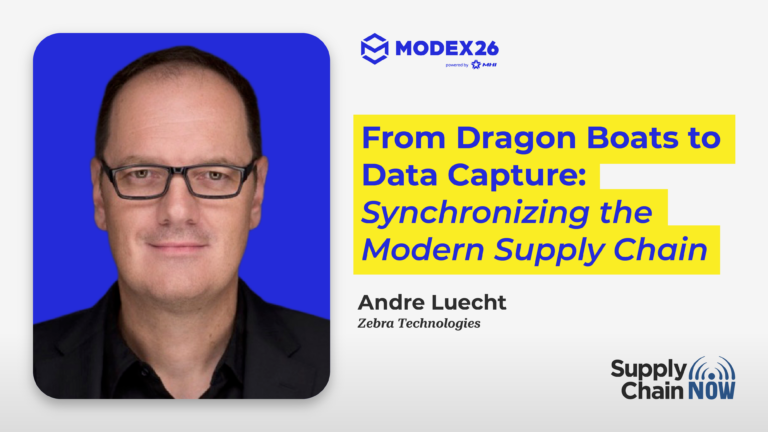
From Dragon Boats to Data Capture: Synchronizing the Modern Supply Chain
At MODEX 2026 in Atlanta, Scott Luton sat down with Andre Luecht, Global Strategy Lead for Transportation, Logistics & Warehousing at Zebra Technologies, to explore how synchronization, visibility, and practical innovation are shaping the next phase of supply chain performance.
Interestingly, the conversation began not with technology, but with competitive dragon boat racing, a hobby of Andre Luecht’s that he enjoys in his free time. For Luecht, the analogy is clear: success depends on alignment.
“The team that is the most synchronized team is the one that wins,” he explains, a principle that applies just as much to supply chains as it does to sport.
Turning Data Into Decisions At the Edge
Zebra Technologies has long been known for enabling visibility across supply chains, from barcode scanning to RFID and beyond. But today, the focus is evolving toward something more powerful: decision-making at the edge.
Luecht describes a world where frontline workers are empowered with real-time intelligence directly on their devices.
“AI… is what you can build into a device in the hand of someone who has to decide what truck a certain pallet goes onto,” he says.
This concept, what Zebra calls “frontline AI”, brings intelligence closer to where work actually happens. Instead of relying on supervisors or centralized systems, workers can access guidance instantly, improving speed, accuracy, and confidence.
The impact is significant. Training timelines, which can range anywhere from 30 to 45 days, can be shortened dramatically. That means faster onboarding, less frustration, and higher retention, critical advantages in today’s tight labor market.
The Rise of Practical Automation
While much of the industry buzzes about fully autonomous, “lights-out” facilities, Luecht sees a different reality taking hold.
“I think we’re seeing a renewed focus on brownfield deployments,” he notes.
Rather than building entirely new, highly automated facilities from scratch, most organizations are investing in what he calls “pocket automation”: targeted improvements within existing operations. These might include automating a single workflow, adding RFID capabilities, or deploying mobile robotics in specific areas.
The appeal is clear: faster ROI, lower upfront investment and immediate operational benefits
Luecht estimates that as much as 90% of supply chain environments fall into this “brownfield” category, making incremental innovation not just practical, but essential.
Frontline AI in Action
One of the most compelling examples shared involves last-mile delivery. Drivers are now required to capture proof-of-delivery images that meet strict quality standards: clear, properly framed, and compliant.
With frontline AI, those requirements are built directly into the device. The system validates the image in real time, eliminating guesswork and reducing errors.
For workers, this means fewer corrections, high productivity and less stress. For organizations, it means improved compliance and customer satisfaction. It’s a simple yet powerful illustration of how intelligent automation can elevate both performance and experience.
Traceability Takes Center Stage
Another major trend highlighted in the conversation is the growing importance of traceability.
Driven by regulatory requirements and customer expectations, companies are increasingly adopting RFID tagging at the item level. Zebra’s latest innovations, including wearable computing solutions, are designed to capture this data seamlessly.
The benefits extend across the ecosystem:
- Workers gain efficiency through hands-free operations
- Businesses achieve real-time visibility
- Customers gain confidence in product authenticity
In Luecht’s words, technologies like RFID are “the overnight sensation 20 years in the making,” finally reaching a tipping point of widespread adoption.
A Surprising Insight: Workers Want More Technology
Zebra’s recent warehouse vision study uncovered a counterintuitive finding: frontline workers aren’t resistant to new technology. Instead, they’re asking for more of it.
“We thought… people might get overwhelmed… but the study showed the exact opposite,” Luecht shares.
Workers increasingly expect the same intuitive, modern tools they use in their personal lives. Outdated systems can actually make them feel undervalued, while advanced technology enhances both productivity and engagement.
This insight reinforces a critical point: investing in technology isn’t just about efficiency. It’s also a key driver of talent attraction and retention.
From AI Hype to Useful AI
Looking ahead, Luecht predicts a continued shift from theoretical AI to more practical, embedded applications.
“We’ll see the transition from AI to useful AI embedded in physical processes,” he says.
This means moving beyond buzzwords and focusing on real-world impact, especially more solutions that improve workflows, enhance decision-making, and deliver measurable results.
At the same time, resilience will remain a top priority, and automation will continue to expand, though not always in the form of humanoid robots or fully autonomous systems.
The Bottom Line: Synchronization Wins
From dragon boats to distribution centers, the lesson is consistent: success depends on alignment.
Whether it’s synchronizing teams, connecting data to decisions, or integrating technology into everyday workflows, the most effective supply chains are those that operate as cohesive systems.
At MODEX 2026, one thing is clear: this isn’t about chasing the next shiny object. It’s about making smarter, more connected decisions today.
And just like in dragon boat racing, the teams that move in sync will be the ones that pull ahead.
Where to Learn More
Connect with Andre Luecht on LinkedIn. Zebra (NASDAQ: ZBRA) provides the foundation for intelligent operations with an award-winning portfolio of connected frontline, asset visibility and automation solutions which empower customers to deploy AI on the frontline. Organizations globally across retail, manufacturing, transportation, logistics, healthcare, and other industries rely on Zebra to deliver outcomes today while driving innovation for what’s next. Learn more at www.zebra.com.
More Blogs

Inside the Supply Chain War Room: Max Garland on Backup Plans, Delivery Costs & the Human Side of Innovation