Razat Gaurav (00:00:00):
Even when the stakes are very high, when you are trying to make big decisions that impact hundreds of millions, sometimes billions of dollars of inventory decisions, or you’re trying to service and fulfill a big contract in an engineer to order business model for a large customer, you’re not going to just let agents drive it. And the big difference between what agents can and cannot do is based on where do you need to drive accountability?
Voice Over (00:00:27):
Welcome to Supply Chain Now, the number one voice of supply chain. Join us as we share critical news, key insights, and real supply chain leadership from across the globe. One conversation at a time.
Scott W. Luton (00:00:40):
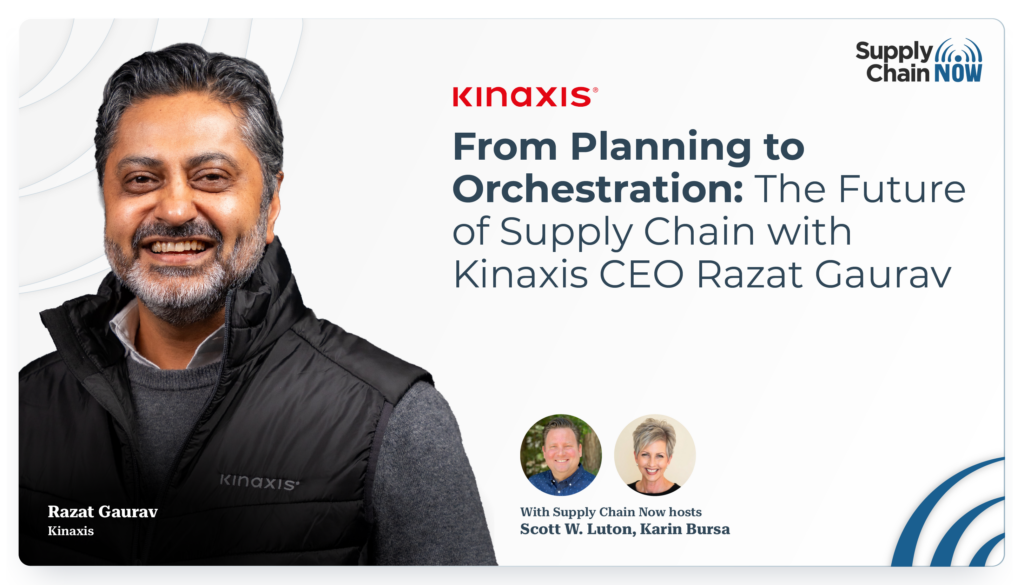
Hey, good morning, good afternoon, good evening, wherever you may be. Scott W. Luton and the one and only, Karin Bursa with you here on Supply Chain Now. Welcome to today’s show, Karin. How you doing today, my friend?
Karin Bursa (00:00:51):
Hey Scott, it’s good to be with you today.
Scott W. Luton (00:00:53):
It is. And gosh, do we have a great show here today? Folks, a few people have had a front row seat to the evolution of supply chain technology, quite like our featured guests here today. Over the last 25 plus years, he’s watched supply chain move from the back room to the boardroom while the technology has evolved from planning and optimization to AI agents, orchestration and beyond. So today we’re going to be exploring what’s really changed, why speed of decision making matters more than ever before, perhaps, how AI continues to reshape the role of the planner, and ultimately what’s going to separate those supply chain leaders who will be thriving in the years ahead. So Karin, those are some big topics and given all of your supply chain leadership for years, not more than two decades, we don’t break that two decade rule, but I can’t wait to hear your take on today’s discussion, huh?
Karin Bursa (00:01:45):
Thank you for limiting it at that 20 year marker. I really appreciate that. Yeah, I’m looking forward to the conversation today. Razat has not just had a seat, he has been part of the individuals who have helped to transform this industry. So I’m really looking forward to hearing what he’s up to these days in his new role with Kinaxis.
Scott W. Luton (00:02:06):
Well said, Karin. All right, so folks, stick around for a great conversation that you know is going to offer up tons of actionable insights by the container load. So I want to welcome in a great guest joining us today, me and Karin are delighted to talk with, and I had to boil this down. We could be here for an hour just introducing our guest, Karin. So folks, this is the TikTok version, okay? Razat joined Kinaxis in January 2026 as chief executive officer where he sets the company’s vision and drives its global strategy, innovation, and long-term value creation. He’s also on the board of directors at Kinaxis. Now, as me and Karin have been alluding to, he’s got over 25 years of experience in the enterprise software and supply chain solution space with a real big track record of driving innovative transformation. Now, prior to his current role, Razat was CEO at Planview and LLamasoft.
(00:02:58):
And prior to that, he held leadership positions at Blue Yonder and i2 Technologies. He’s been recognized by Goldman Sachs as one of the 100 most intriguing entrepreneurs of the year. I think that was in 2020. He has been featured as one of the leading SaaS CEOs by the software report. He’s got a big trophy case, folks. And I love this. Most importantly perhaps, Razat is engaged in various philanthropic and policy initiatives related to some big things, medical research, STEM education across minorities and efforts to reduce carbon emissions. I want to welcome in Razat Gaurav, CEO with Kinaxis. Razat, how you doing?
Razat Gaurav (00:03:42):
Good, Scott. Thanks for having me. Karin, good to see you again.
Karin Bursa (00:03:45):
It’s good to see you.
Scott W. Luton (00:03:46):
And Karin, as I shared, I’ll tell you, it’s tough to summarize. When we meet people and interview people like Razat, it’s really tough to make that a succinct introduction. Have you ever struggled with that, Karin?
Karin Bursa (00:03:57):
I have. I have indeed, but that was quite a list of resume highlights you’ve got there, Scott.
Scott W. Luton (00:04:04):
We tried hard. We tried hard. All right, so Razat, before we get into about 47 topics here on supply chain now with you, I want to start with a little fun warm up question because we learned in the pre-show a couple things about you when it’s not talking supply chain transformation. You love sailing on Lake Michigan. You’re a fellow wine enthusiast. You also enjoy your culinary adventures, but perhaps the biggest thing we learned is you love spending time with family and you’ve got an annual objective, I think it’s annual, to visit at least with your family, visit at least one country a year, not business, but with the family. Is that right, Razat?
Razat Gaurav (00:04:44):
That’s correct. This is something we started as a family a few years ago and all of us traveled so much for work, but it’s so different when you’re able to take the time with a family. And one of the ironic things I’ve learned in life as I’ve taken on more and more responsibilities is the importance of just shutting down. It’s sort of like it’s important to refresh your mind, your head space. And as we all know, these professional journeys that we are all on, they’re marathons, they’re not sprints, so you got to pace yourself. And my family and I, we just love exploring new cultures, new locations, and we’ve been very fortunate to visit many different parts of the world.
Scott W. Luton (00:05:31):
Well, Razat, I’m jealous. Karin, I would love one new country a year with all of your family. How cool would that be, Karin?
Karin Bursa (00:05:40):
I think that’s a great idea. I think you’ve just planted a seed for me, Razat.
Scott W. Luton (00:05:45):
The other thing I really like that he shared, especially, and we’re going to touch on the ever faster pace of everything these days, but being able to unplug and spend uninterrupted time and energy with your family because life is short, that has become one of my top priorities. How about you, Karin?
Karin Bursa (00:06:06):
Yeah, and experiencing something for the first time together I think is a special memory also.
Scott W. Luton (00:06:12):
Yep, I’m with you. All right, so Razat, moving along, I could probably spend a couple hours just on your travel objectives there, but we got a lot to get into and I want to start, Karin and I both were referencing about your time in this industry. And as you said, not just as in the front seat, but actually doing it, driving some of the transformation. I got to ask you, Razat, what feels different about supply chain today compared with earlier in your career?
Razat Gaurav (00:06:39):
Yeah, let me start with firstly, what has not changed because we are allowed to talk about what has changed, but it’s also good to anchor ourselves first on what is still first principles and what has not changed. And I think to anchor, when we think of supply chains, it’s extending all the way from supplier, supplier to customer’s customer and all the gory guts of operations in between from sourcing, manufacturing, producing, distributing, fulfilling, and returning. And there’s all kinds of data flows and product flows that underpin that. But what has not changed is the focus in balancing cost, cash, service. That was true 25, 30 years ago when I started my career in supply chain, that’s still true.
(00:07:36):
The other thing that has not changed despite the ebbs and flows in global trade is that in most industries, supply chains are very global and they’re global because of reasons for sourcing, they’re global because of reasons for manufacturing, they’re global because you’ve got customer base in different parts of the world and global supply chains have not existed just for 50 years or a hundred years, they’ve existed for 5,000 years from the days of spice trading and silk trading. So that’s also true. The third thing I’ll say is while supply chains in most organizations today are a distinct part of the organization, they’re still very intricately tied into the rest of the functions in the organization. So supply chain has to work with finance, supply chain has to work with product development and design or R&D, supply chain have to work with sales and marketing, so that hasn’t changed either.
(00:08:39):
So what has changed? Well, I’ll tell you three things, I can talk about a lot of things, but what has changed, I think the base of change is dramatically more accelerated today than it was, let’s say 20, 25 years ago. It seems like I’ve been talking about chain, chain, change for so many years, but what I can tell you is that basis is just at an all time high today and there are many root causes for it. We can delve into that later. So that’s one thing that’s new and different. Second, I think the underlying framework for making decisions and the ability to access data both within the enterprise and from outside in signals and the ability to utilize or harness that data to inform decisions is so different today than it was 25 years ago. That data and those decisions, they underpin strategic long-term decisions that are informing big CapEx decisions in the supply chain or design decisions.
(00:09:48):
They inform more tactical decisions in the next few weeks to the next 18 months, and they inform the more execution or operational decisions in that time horizon. So I think data and the ability to harness that data is very different today. And then the third aspect that I think is different from 25 years ago, I think supply chains have come from a little bit of a back office, dare I say, backwater function into the boardroom.
(00:10:19):
And of course, COVID exposed that, even events before COVID have been exposing the importance of supply chains and CEOs, CFOs, and board members that I speak to, they’re realizing the importance of balancing demand with supply, managing the trade-offs in making decisions, managing risk, managing the trade-off between cost, cash, service and risk. And when I say cost, I mean both sort of dollarized costs, operating costs, but also cost of carbon emissions. And so all of these things I think are new and different, but this conversation could keep going on. So I’ll just stop at that.
Scott W. Luton (00:11:05):
Okay. Razat, I’ve got a couple follow-up questions based on the third… I think if I was keeping track, and I’ve already got a half page of notes, that was me grabbing another sheet to keep up with you, but I’m going to give you a follow-up question on your third item, both of what hasn’t changed and what has changed. But first, Karin, we’re out of the gates at a hundred miles an hour already. What’d you hear there from Razat?
Karin Bursa (00:11:28):
Well, I agree. I think the pace of change is accelerated significantly. From a technology perspective, I think the way technology can run and produce plans or revise plans has changed as well. So in the past, we were very cadence-based. You would be on a weekly, monthly, quarterly view of your world, and it really limited the ability to sense and respond to changing opportunities or risk factors. So that’s one of the things I agree is very exciting. I also think that technology is now unleashing new insights into data, so not just accessing the data, but uncovering new patterns and new insights for us so that we can in fact make better decisions. So look forward to hearing more about where Razat sees the market going.
Scott W. Luton (00:12:21):
Well, you’re in a good spot, you’re in the right place because we’re going to touch on that here in just a minute. But first, Razat, I want to go back on one of the things, a third thing you mentioned that hasn’t changed. And when I think about earlier in my career, how the supply chain management function and all that encompasses how that was viewed more operationally, and just my opinion, wasn’t nearly as viewed as a big part of the competitive differentiation and competitive advantage as it is today. Now you mentioned earlier that how woven it, the supply chain management, all that, it’s woven across organizations and I certainly agree with that. But how do you see supply chain management as a craft, how that’s evolved and how that has changed in your time?
Razat Gaurav (00:13:08):
Maybe before the term supply chain got coined was more about logistics. So it was very operationally focused to your point. It was sort of, okay, now I’ve got to move the product, I got to distribute it, I’ve got to transport it, I’ve got to manage the logistics elements. And then people realize that really you’ve got to get a handle on your demand patterns because supply chains don’t start with the supply, they start with the demand, the customer demand or sometimes the customer’s customer demand. And with a single view of demand, you need to now plan your supplies, you need to plan your inventories, you need to plan your production, you need to plan your sourcing, and all of that has to be done within the framework of what your business goals are in terms of your revenue targets, your operating costs, your working capital goals.
(00:14:12):
So supply chains are intricately interwoven into the other functions in the organization and that art and signs of having a single view of demand, balancing it with supply, planning your production, your inventory, your sourcing elements, and your logistics and fulfillment in a synchronized way is becoming a huge differentiator because you’ve got many industry, I’ll give you an example of that. In high tech today, there’s surge in demand because of the whole build out of the data center. There is shortfall in capacity and supply and to add additional capacity is a longer lead time, billions of dollars worth of investments. I was talking to one of our customers in the semiconductor industry today to put a new fab in costs anywhere in the 15 to 16 billion range, and it doesn’t happen in a few weeks. It takes quite some time to build out a new fab in new capacity.
(00:15:13):
So I think organizations are realizing the strategic importance of supply chain excellence more and more. Clearly, I think during COVID, that came to a whole heightened level because every single weak link in the supply chain got exposed during COVID.
Scott W. Luton (00:15:35):
So Karin, I’m about to ask about the trade-offs here in a second with Razat, but react to what he just shared there about, as he just put it, how other parts of the organization are now really have been for years now, realizing the importance of being able to execute and on supply chain management, but also offer those commitments and the value proposition to consumers. What’d you hear there, Karin?
Karin Bursa (00:16:00):
I mean, it’s clear that the supply chain has moved. I think Razat said from the backroom to the boardroom. I think of it as moving from the loading dock to the boardroom, from that physical aspect where we can touch the end products that are being shipped or received to the boardroom because it’s such a strategic lever for the business. It completely changes the conversation now. And we’re not just talking about cost and service, although cost and service remain very important to the conversation. We’re also talking about how supply chain can help to stimulate growth, how we can expand margin contribution or optimize the working capital that’s invested in inventory or plant assets or mitigate risk factors or potentially harness new opportunities where we see a market opportunity because maybe one of our competitors has had a challenge that we’ve got a better approach to. And then the end game is simply improving the customer experience.
(00:17:01):
And these are conversations that happen throughout the supply chain organization every day. And so I think you can see where it’s really become a catalyst for business versus a service to the business.
Scott W. Luton (00:17:15):
Well said. Well said. All right, so I hate to move along, but I want to ask you about something else you mentioned, Razat. And I think the third thing you mentioned in terms of things that have changed, you’re referencing trade-offs. And you were also, earlier in your responses, you mentioned returns. I love that you called that out because I find that to be unfortunately way too invisible in our industry and it’s a problem we’ve got to tackle better and better. But Razat, on those trade-offs, a lot of supply chain leaders being asked to reduce costs and inventory and other things and all while improving service and availability and resilience. How do you find the best leaders balancing those trade-offs in this current environment?
Razat Gaurav (00:17:58):
Yeah, look, I think supply chain is a very sort of operational environment. And what I’d like to remind people is supply chain is not in the ether. There’s a physical dimension to supply chains. It exists on shop floors and dot doors and pallets and containers. And all of these physical elements have constraints. They have lead times, they have interdependencies. And so in the spirit of really understanding the network wide trade-offs that are involved, we see companies really investing in being able to model the physical network and all the costs and constraints and the interdependencies into a digital model. And that digital model being able to understand the physics of the supply chain. So if I change demand downstream here, what impact should that have on my production plans upstream? Or if I have an inbound component parts that’s delayed because of port congestion or because of weather on the high seas, what impact is that going to have in my ability to fulfill the finished product that expect against the customer?
(00:19:18):
Both kinds of network-wide interdependencies need to be modeled in a concurrent way. And then with that, scenario planning is very powerful because the reality is you’re going to create a plan and you’ve got to do the best job you can to create a plan, a demand plan, a supply plan and a production plan. But in this operational environment, there are going to be changes. And a lot of those changes are not because of a function or an individual or a team member or an enterprise. It’s because of all the other dependencies you have from an outside in perspective. You’re not going to control the weather. We work with an ice cream company, one of the world’s largest ice cream manufacturers. Weather has a massive impact on their demand patterns. You’re not going to be able to control port congestion by yourself or you’re not going to be able to control fuel prices, which is a big topic these days.
(00:20:20):
As an individual organization, I’m not going to be able to control whether things are moving through the port of Hermes or not. So there’s a lot of outside in dependencies, also tariffs. That’s an input into these supply chain decisions. So being able to model the concurrent supply chain and all the costs and constraints and dependencies and being able to run rapid scenario planning, not in a long batch oriented way, but in a rapid… And these days the architectures and the in-memory architectures allow for that, that’s a very potent way for you to inform those decisions. And of course, a lot of those scenarios require human judgment. Some of those scenarios can be automated and can be identified as well. We could talk about that as well. So trade-offs and analyzing those trade-offs in a very data-driven way, but with the reality of the physical operational elements of the supply chain, I think it’s very critical in navigating through all the variability and the volatility that exists in the supply chains.
Scott W. Luton (00:21:33):
All right. So Karin, well, two things first. Number one, Razat. I know you mentioned the physics of supply chain a couple times in that response, and I’ve done some due diligence because I know you like to reference the dangers for leaders out there that don’t understand those said physics. So I love that. We might revisit that. And then secondly, Karin, we covered a lot of ground there in Razat’s last response. And you mentioned all the things that are still, unfortunately, at least September 2026 are still outside of our control, but the power of scenario planning faster and faster and faster so we can better plan, prepare, and navigate through those times. What did you hear in Razat’s last response though, Karin? Well,
Karin Bursa (00:22:16):
That’s one area of supply chain and where it’s going that is so exciting, quite honestly, is this ability to evaluate a multitude of scenarios. So in the past, we struggled with coming up with a pessimistic or an optimistic and a most likely. We felt really good if we had three scenarios modeled Razat. I remember I lived that myself. And now literally the technology has evolved so much that we can evaluate not just a multitude of variables, we can have precision for specific markets. We may have different business goals and objectives for different channels that we want to implement. And so we get that granularity as well as some of that macro business goal and objective. So the scenario modeling is really exciting to me and the ability to automatically generate or advance some of that I think is going to help to make even better decisions and greater decision velocity as we continue to move forward.
Scott W. Luton (00:23:20):
Yes. Well said, Karin. I’m excited about that too, no doubt. I’m really curious to see where it goes from here. But Razat, as I shift gears here a bit, when I go to church or to tailgates or birthday parties, you name it, I get some version of, “Hey, when’s things getting back to normal?” And I kind of laugh at that, and I bet y’all have a better answer than I do, using mine, some version of I don’t know. But I’m curious to hear your take on this because we talk about a lot, whatever your favorite cliche is, the new normal, the abnormal, whatever it’s been for years now. But if someone is out there, Rasat, and really they’re waiting for global supply chains to return to a stable, predictable state, are they reading the environment and the landscape and the path ahead correctly and even realistically?
Razat Gaurav (00:24:12):
Yeah. Look, I think my personal view on this is waiting for the external environment to be completely static is a misplaced expectation to have because the reality is change in this world, it’s like way Kurzweil taught us this, change is not linear, it’s actually exponential and it’s playing out. And as organizations, we’ve got to make sure we can keep up with the rate of change on the outside because if the rate of change on the outside is faster than the rate of change on the inside, you know what happens? The end is near. Jack Welch said that. And so I really think this is the reality. You can call it the new normal, you can call it whatever you want to call it, but that is the reality of the situation. And organizations and definitely supply chain professionals have to be equipped in how they can create agility and adaptability in a constantly changing landscape.
(00:25:22):
Could anyone have predicted that there would be a change in tariffs between US and Canada a year ago? Probably not. Could anyone have predicted that the strait of Hormuz would be choked up for some time two years ago? Probably not. No one can predict what the price of fuel is going to look like six months from now, 18 months from now, and that has a massive impact on the unit economics and supply chain. But also there’s some other fundamental changes that are happening that are across a longer arc of time. There are behavioral changes in the different generations of consumers. The way my mom shops for groceries is the same as it has been for the last 50 years. She shops for one to two weeks at a time. The way my nephew shops for groceries is for the next 30 minutes.
(00:26:23):
Now you need to think about the supply chain that needs to be designed and orchestrated for a 30 minute order to delivery lead time versus one where the consumer’s going into a bricks and mortar store and shopping for one to two weeks at a time. It’s completely different, right? And those are generational changes that are happening. So I think there’s many different reasons why supply chains are more variable, why you’ve got to be comfortable living in that highly volatile and variable environment. If you’re going to keep waiting for it to be all stable on the outside, I think you’ll be waiting for a long time, if not forever.
Scott W. Luton (00:27:06):
I tend to agree with you. And Karin, using the grocery comments and examples he mentioned, supply chain’s out there, we got to serve and delight Razat’s mom and Razat’s nephew and so many other permutations of these behaviors. But what’d you hear there, Karin, in terms of his prediction of if you’re waiting for things to be normal, whatever that is, you’ve been waiting a long time.
Karin Bursa (00:27:27):
Yeah. I don’t think we’re going to have the stable environment that we all fantasize about, quite honestly. I think we are looking at the never normal, the constant change. And I like that Razat actually added the consumer into that equation as well because as consumers, generationally, we are changing. We do shop differently. We do have different expectations. Razat mentioned returns. Returns are handled quite differently today than they were 10 years ago. And I think all of this is just an evolution of business that supply chain can facilitate and be designed strategically to help the business respond to the opportunities and mitigate the risk around how inventory is positioned as well.
Scott W. Luton (00:28:21):
Just pulling that thread on returns, our expectations, and Razat mentioned the difference in generations around returns management, returns acceptance, all that’s changing as well. I think it’s also creating some opportunities. But one comment here, Razat, I think one of the things in my homework on some of what you share out encourage leaders to do, I think I came across this, one of your mantras, sense, plan, act, and learn continuously, especially given this environment that you both are describing. Would you expound on that really quick? And then I want to talk about latency.
Razat Gaurav (00:28:58):
Yeah. Look, I think we all know, right? I mean, the way companies deal with the imbalances in demand and supply is through buffer inventory. And the world has, any which way you estimated, it has roughly $17 trillion of inventory stuck in the world supply chain. So cut that by a half, that’s still a lot of inventory. Along with that inventory that is stuck there, a good chunk of that goes into waste because things are perishable, they have a life cycle, and it all happens because of these demand supply disconnects. Now, to solve that demand supply disconnect, many of us have been working on this problem for a long time, and my personal learning has been that you’ve got to inform your plans with outside in signals where you need to have that sensing capability. And again, a good example of that is in the consumer products industry.
(00:30:00):
I’ll use the World Cup analogy. If Bape, very famous French soccer player, or if Katy Perry or if Taylor Swift, if they like a certain consumer product like a drink or a t-shirt or a piece of consumer electronic, and they post that on their social media, it spikes and surges in demand. You wouldn’t believe it. You’ve got to be able to sense that. On the flip side, if I know that the weather is building up in the Pacific and it’s going to add two to three days to my transit time for the container ship that’s going to be coming from the port in Shenzhen or Hong Kong into the port of LA, I need to be able to sense that and understand the impact of that. So sensing from these outside in signals, and there’s so many other outside in signals, and they’re all very specific to different industries, different product attributes, but being able to sense these outside in signals and understand what the impact is on your supply chain is really important.
(00:31:08):
With that, you got to be able to plan. Planning is important. Again, planning, it looks different in a strategic time horizon versus a tactical time horizon versus what you have to do within the time horizon of a lead time, which is the execution or operational time horizon. Then being able to operationalize that plan and act on it. And typically, you’ve got to do that across multiple functions because there are organizational functions that make up the end-to-end supply chain. You’ve got to traverse through multiple systems. There is no one single system of record in the supply chain in most organizations. And you’ve got to be able to then not just act and execute, but also as you’re going through the cycle, hopefully you’re learning your way through it. So when you do the next sense and plan cycle, you can inform that through the learnings. The learnings could be, you know what?
(00:32:02):
I thought my lead time was 28 days in reality for this whole ocean container shipment. Actually, the lead time is not a fixed number. The lead time could be anywhere from 22 to 32 days. And here’s what the distribution curve looks like. That could be a learning. That simple learning on the variability in the lead times can have a massive impact in the way you’re making your decisions and you’re creating your plans. So I think it’s this whole idea of sensing, planning, acting, learning. To us, this is what we think of as the orchestration loop in the supply chain, and it needs to happen across the multiple time horizons that exist in the supply chain.
Scott W. Luton (00:32:48):
All right. Karin, since plan, act, learn continuously is a big part of his last response, a big mantra. And I think the continuously part just might be the most important thing there, but your thoughts, Karin?
Karin Bursa (00:33:01):
Yeah, I think it’s a really important distinction in two aspects. One, Razat’s focus on harnessing some of those external signals. So external market signals, whether it’s point of sale data or it’s weather related data, or it could be things like housing starts. I mean, it’s what’s happening in the marketplace beyond what my business has done in the past and really allows us to get a better picture of demand, but get demand granularly in specific regions or channels to be served as well. So I think that that’s one of the most exciting things that we’re seeing here is the ability to not only have a good top level view of our business, but also to get very granular about products, markets, channels and how they’re performing. But the other thing that Razat said that I think is super important is the connection of all of these different planning horizons.
(00:34:02):
Historically, some strategic planning was done in different systems that were then disconnected from the operational systems that were doing planning. So you had all of these disconnects within your supply chain planning organization, right down to execution or distributor order management, whatever aspects that you were looking at, or your ERP system, your system of record from an inventory perspective. So the fact is that now we’re really truly breaking down those barriers and technology is helping us to not just harmonize that data, but to get a clearer picture of not just where we are today, but what opportunities going forward we have for our business. So that multi-horizon aspect is just as exciting as the ability to both plan from a macro level and a granular level.
Scott W. Luton (00:34:55):
All right. Oh my gosh. Razat, I hope you got a few more hours because I’ve got about 37 more questions for you, my friend, between you and Karin. It’s good stuff. You touched on something in your last response, Razat, that I want to pull more on. And of course I mentioned latency. You’ve said multiple times that the deeper problem is not disruption itself, but the delay between recognizing a change and deciding what to do and acting on it. So if you’d speak to where this latency comes from and why it matters.
Razat Gaurav (00:35:29):
Yeah. Look, this latency has been endemic in the supply chain for many years, and it’s part of the reason why we have the whole effect. It’s why we have to have so much buffer inventory to counter the impact of latency. But latency happens for a few reasons. One, there is lag in the information flow and information flow sometimes within an enterprise and obviously across enterprises. So if I’m a semiconductor manufacturer like a TSMC or somebody else, and my product is going into a mobile phone, what’s the lag time of the information flowing on the rate of sale of mobile phones to the time I actually get to see it and do something with it?
(00:36:22):
And so information flow creates a lot of lags, and that’s also because of different systems, different organizations, and these data signals propagating upstream or downstream have a lag time. The second reason I think for the lag time of course is organizational silos. And in supply chains, most organizations have structured their along the typical spore model, including their organizational structure. So the whole plan, buy, make, move, source, those functional silos are existing there. And because there isn’t one single version of the truth, everyone, despite their best efforts to do the best thing possible, because of those silos, there are lag times in how that information and that data flows. And then I think the last reason is a lot of times, even when companies have the data come to them instantly, they’re not able to really take that data and say, “What is the impact in where I sit in the organization or where I sit in the value chain?” So if I have that same example, the high tech example, if I have access to the rate of sale for finished mobile phones or in the automobile industry for finished vehicles, and I’m a tier two, tier three supplier of component parts like chips or component parts in an automobile vehicle, like an engine, how do I take the impact of that point of sale data into how that transforms into the impact for me?
(00:38:11):
And so I think all of these things create lag times. And because of those lag times, we have waste, we have a lot of inventory, and frankly, we have a lot of higher operating costs. So a big part of the art and science of managing supply chains is minimizing the latency in the supply chain. And that doesn’t mean that you’re going to start transponding physical movement of goods. I’m not talking about Star Trek stuff yet, because in moving goods, there’s a lead time. When you’re shipping things from Alabama to let’s say Maine, there’s a lead time to that over the road. It just doesn’t transpond itself. Or if you’re moving things from Asia to Europe or Asia to North America, there’s a lead time to it. There’s also lead time for production and manufacturing and packaging and distribution. So we all understand there’s lead times, but reducing the latency in information flow, data flow, both in the demand side and the supply side, latency in reducing the silos and understanding what the transformed implications are for you with all this data, I think that’s where the big opportunity is in reducing the waste and the cost and the working capital.
Scott W. Luton (00:39:36):
All right. So Karin, Admiral Gaurav with the Federation, I got to play on that Star Trek theme there, Razat. We’re not quite where we can transport stuff or teleport stuff just yet. Who knows next month? But those silos, those pesky silos, one of those culprits he mentioned for some of the lag, what’s the most important thing you think that Razat just shared in his last response, Karin?
Karin Bursa (00:40:00):
Well, I think that Razat really explained the challenges with lead times and lag time for information. As supply chain professionals, we want to replace as much inventory as we can with information, but we can only do that when we’ve got good information, good data to fuel that with. And so I really am excited that we are compressing or accelerating is probably a better word, the decision velocity. So the time it takes to make a decision. If we can capture those signals faster and the data is interpreted and interrogated quicker with technology, we can’t do that in spreadsheets. If you’re still running your supply chain and spreadsheets, which many of the people listening to our discussion today are, it’s just a fact of the world that we’re living in today. You are not able to really harness the advantages of technology to accelerate the decision velocity and do it with higher confidence, higher business confidence.
(00:41:07):
Because the bottom line is lag time and latency are a fact of any business, but your decisions have a shelf life associated with them as well. And so the decision you make today might be very different than the decision you would make a week from now with a similar situation.
Scott W. Luton (00:41:25):
And we were talking about this earlier today, Karin, and I’ll give a shout out to my dear friend Mark Gillum. I think sometimes we got to think of the F1, the Formula one racing where first place and second place is separated.
Karin Bursa (00:41:40):
Just a few seconds.
Scott W. Luton (00:41:41):
Yeah. Yeah, that’s right. So it’s a matter of seconds. And so when I think of lag and information flow and this latency conversations, sometimes I think we can assume a couple extra seconds, but gosh, that can be in F1, that’s the difference between first and second and maybe even worse. So Rosad, I want to move ahead to something here because I think of many of our audience members, if they’re listening or if they’re watching, I think they’re going to feel this topic in their bones, maybe in their nightmares because every supply chain leader out there is being asked, every supply chain professional even is being asked, “Hey, what are you doing with AI?” Karin and I and other co-hosts here at supply chain now, we’ve been talking about pilot fatigue for at least several months, which I think is very palpable across industry. So I want to ask you, what separates meaningful AI adoption from activity that it might sound innovative and it might sound exciting, but it really doesn’t improve a business outcome?
Razat Gaurav (00:42:39):
Yeah, look, I think it’s good to first anchor on what is AI and what is not AI, because there’s a lot of confusion about this in the markets. Most of us that have been building supply chain technologies and supply chain technology products, we’ve been using predictive and prescriptive AI for years, machine learning techniques, reinforcement learning techniques, optimization oriented techniques, and that’s been going on for a long time, and the combination thereof together with heuristics. Those don’t get replaced with generative AI and agentic AI. So generative AI and agentic AI are additive to predictive and prescriptive AI, and those have come about more so in the last three, three and a half years in the commercial space. The power of using generative AI is in the inferencing and the reasoning logic that exists. And in many ways what we are finding is it just democratizes the usage of sophisticated technologies because your interface is natural language.
(00:43:43):
You can speak or type prompts in simple English or any other language you speak, and you’ll be able to interact and get insights and take actions from that conversational interface. So it reduces the barrier to learning how to operate a system down to zero, pretty much. You need to understand the domain, you need to understand what questions to ask, you need to understand what actions to take with all the insights that the system is surfacing to you. So the domain knowledge becomes even doubly more important, but you don’t need to learn how to navigate through the point and click navigation that exists in most enterprise supply chain systems today. So that’s exciting. On the agentic stuff, clearly what we’re finding is that there are repetitive tasks that can just be automated. And also there are many use cases where instead of having a human take eight to 12 days, you can have an always on agent that is doing the needle in the haystack kind of things and is an always on mode and can be doing that on an ongoing basis in the background for you.
(00:44:57):
So when you cut through all the hype, but also all the misconceptions and you focus on the first principles of what is your business problem, what are you trying to accomplish? We are finding that the latest generation of AI, I’m specifically talking about generative AI and agentic AI, one is democratizing the use of these technologies and two is providing all kinds of automation opportunities. And these are exciting and they’re value added, but they’re still fairly incremental in their impact. I think the big value is going to come not by going from 500 people in a supply chain or supply chain planning organization down to five people. Is there value in that? Sure there is. And companies will take advantage of that as appropriate, but that’s a rounding error compared to the inventory and the work capital impact of that inventory, the operating costs, the service level improvements, the revenue impact you can have.
(00:46:06):
Those are the business outcomes that are far more important than just headcount costs, at least in the supply chain domain. And that’s where to really harness the power of predictive, prescriptive, generative and agentic AI in combination, in totality, you’ve got to be able to take the time to rethink and reimagine your ways of working. You’ve got to be able to be willing to transform your ways of working, how you’re making decisions, what your operating governance model is, what your organization structure looks like. And I fully expect, and we are seeing some good early examples of this where humans and agents are going to coexist. Mostly right now, agents are resources to make every human become a superhuman, but in the not so distant future, we’ll see humans and agents be coexisting. Now, does that mean that it takes away the need for human judgment? No, not yet.
(00:47:07):
And I don’t see that happen yet. And especially when the stakes are very high, when you are trying to make big decisions that impact hundreds of millions, sometimes billions of dollars of inventory decisions, or you’re trying to service and fulfill a big contract in an engineer to order business model for a large customer, you’re not going to just let agents drive it. And the big difference between what agents can and cannot do is based on where do you need to drive accountability?
(00:47:36):
None of us can blame an agent and say, “Hey, the agent did this wrong. It’s not my fault.” No, you’ve got to have a human bear the consequences of that in terms of success failure. So there has to be accountability. So that’s the way I see this journey is it’s a combination of predictive, prescriptive, generative and agentic AI. Clearly lots of great use cases to democratize the use of technologies to natural language, lots of great use cases to drive automation and to use agents as an extension of what you can do in a far more productive way. But the big value is going to come with an appetite to transform your ways of working and fundamentally change your operating model, your governance model, and your entire decision-making framework.
Scott W. Luton (00:48:29):
Karin, I’m going to get you to weigh in. One of the things, a couple things that Razat is speaking to there in that last response is, and I’m sure there’s plenty other thoughts he would have, but how the role of the supply chain planner is changing and evolving, and you heard him really spike the football and really drive home a key point of the value of human’s role, especially I think as he said it, especially the big consequential decisions because I’m not sure if it was you and I talk or maybe a different show where AI may have all the answers, but it still struggles to ask which questions are core to some of these conversations and that’s uniquely human superpower. But what did you hear there in Razat’s last response about AI adoption, the ever-changing role of the planner and more?
Karin Bursa (00:49:19):
Yeah. Well, I think one thing that’s really important is what you ended on, and that is that we have to be willing to transform the way of work, the way we’re working today, because to really harness the value of what’s coming with the culmination of all of these different aspects of artificial intelligence. There’s an old saying in Atlanta that says that we paved the cow paths, and that means that we laid asphalt over these winding accidental cattle trails instead of actually planning the city on a grid that was easy to navigate. I think there’s a lesson there for AI as well. I don’t think that we should use AI as a new technology, a new way of calculating what we need in the supply chain and communicating that across the organization simply to make a clunky outdated business process a little bit faster. I think we use this opportunity to step back and rethink the questions to be asked and the job to be done so that we can really address those core workflows so that we can automate where automation makes sense and we can serve up the scenarios and data so that our planning and analyst teams can make better decisions about the business because Razat also said there’s not just one right answer.
(00:50:45):
When we can generate all these different scenarios, that means there’s going to be multiple right ways to solve a problem. And we do that by pulling different levers in the business. So I think that’s where as a human in supply chain, that’s the exciting stuff. That’s where you bring your business knowledge to the table and your innovation to the table and some of your creativity to really evaluate how to make an impact because you’ve got a better set of options in front of you.
Scott W. Luton (00:51:16):
Karin, as you shared that old adage, it struck me, and this is interesting, it’s how different humans perceive different thoughts, but paving the cattle paths, I always took that to mean we’re solutioning when we don’t need the solution because cows don’t need the walk on paved ground, right? The mud, the dirt works just fine. So it’s interesting how there’s two different uses of that. But yeah, by the way, Atlanta traffic, oh man, the struggle is real. Razat, as we come – the
Karin Bursa (00:51:46):
Struggle is real.
Scott W. Luton (00:51:47):
Struggle is real. We’re coming down home stretch here. Razat really have enjoyed your perspective, and I’ll tell you what, I don’t think AI can keep up with Razat, Karin. I don’t know about what you think, but I don’t think they can keep up. Let me ask you this though. There’s so much we could have hours and hours of discussion in terms of how the planning role, the human planning role is changing or how the work of supply chain leaders is changing as organizations move from how planning has always been done to real operational orchestration. But I want to come back to that well one more time because is there one thing in terms of what that new day-to-day looks like for leaders, for planners, for organizations that maybe you haven’t mentioned here today? And then we’re going to get a crystal ball prediction from you.
(00:52:36):
What else, Razat, would you like to share with our audience?
Razat Gaurav (00:52:39):
Yeah, look, I think the role of the planner has been evolving for several years now. You used to have a demand planner by category, you got supply planner, sometimes you have the difference between upstream supply planning separate from distribution planning, DRP planning, et cetera, et cetera. And we’ve seen some companies and we work with some of them who’ve evolved into a network planner role. So they’re really looking across the entire network and being able to make decisions, planning decisions across that network. Clearly as more and more planning becomes autonomous, and by the way, we’ve got many customers, large global multi-business unit, multi-product, multi-regional organizations where anywhere from 75 to 90% of all the planning is autonomous. Then the question becomes, what is the role of those planners? Yes, they have to sometimes manage exceptions, but they really need to transform themselves into orchestrators. That’s our thesis around this.
(00:53:48):
And they need to be able to make sure they’re orchestrating across different functions, different entities, but also across agents, because ultimately those agents that are going to be doing a lot of the autonomous planning, they’re going to need to be governed. They’re going to need to be controlled. They’re going to need to be… And someone is going to have to have that accountability. And then the last thing I’ll say about planners is they’ll be orchestrators, but one of the lessons I’ve learned about orchestration is yes, orchestration requires all the data stitching and the technology and the decisioning, et cetera, but orchestration also requires relationships at times, particularly when it comes to orchestrating across multiple trading partners, across multiple organizations. Relationship makes a huge difference. It sometimes is what distinguishes good orchestration from a great orchestration is relationship and that trust you build. And so I think humans and human planners will translate into orchestrators over time.
(00:54:57):
At the same time, be able to leverage and harness the power of agentic AI and automation and data and technology, but also lean in on what we as humans are uniquely qualified to do, which is around providing judgment, taking on accountability, and striking trust in relationships. I love
Scott W. Luton (00:55:19):
That. Karin, I’m going to get one more question in because he’s kind of predicting the future a little bit with his last parts of his last response, and then I’m going to get you to comment here because here’s a billion dollar question, Razat, and who knows these inflationary times, it might be a trillion dollar question. I’m not sure yet. I’ll leave that to the economists out there. But five years from now, and I think I understand because you’ve really been speaking to this, I think, throughout major parts of this conversation, but I want to ask you to put it in front of you directly. Five years from now, what separates the supply chain leaders who are going to thrive in this environment from those that will continue to struggle?
Razat Gaurav (00:55:55):
In my point of view, clearly an agile and adaptable mindset in an organization that creates a muscle around change. We as human beings, we all hate change. I hated switching from Blackberry to an iPhone, right? It’s human nature. But as organizations with all the change and variability we talked about, and leadership has a big role to play in creating a culture that thrives on change and adapting and being agile around this. So that’s going to be a big piece. Second, I think leadership has a big role to play in focusing the organization and all the technologies on the first principles of the business outcomes. That clarity of what business outcomes you’re trying to drive is important. Somebody keeps asking me, what defines a good plan? How do you know a plan is good or not? And to me, what distinguishes a good plan from a bad plan is nothing except the business outcomes.
(00:57:04):
It’s not all the supply chain metrics we talk about, forecast accuracy and mate levels and the number of inventory turns. The business outcomes come back to the fundamentals of cash, cost, service, risk. So leadership has a big role, and I’ll tell you, I mean, I talk about this with a lot of chief supply chain officers and COOs. I mean, the vernacular between the supply chain organization and the CEO of boardrooms sometimes is broken because we’re talking a different language and we have to bridge those and leadership can play a big role in bridging that gap. And then the last thing I would say is, I mean, I think leaders need to be willing to lean in and experiment with new technologies, go through learning cycles. That’s part of being adaptable, but that’s also part of harnessing the power of these new technologies. I mean, whether we like it or not, supply chains minus the technologies, they just don’t function.
(00:58:08):
And whether it’s robotics in the warehouses, automation equipment in production lines, enterprise decisioning capabilities enabled by planning and decisioning software solutions. I mean, as a supply chain leader, you’ve got to be a lot more savvy about the technologies. You cannot just say, “Oh, that’s for IT.” No, no, no, no. You as a supply chain leader, and I’m talking to a lot of supply chain leaders every day, every week, and they’re becoming more and more savvy about technologies than ever before. And that’s really important because that’s sometimes what will distinguish a successful supply chain versus a not so successful supply chain. So those would be the three things I would recommend for leadership in the future.
Scott W. Luton (00:58:55):
Well, you said three. I think I wrote down about 27, Karin. So agility and adaptability and the power of leadership to focus and bring clarity to conversations and focus on the outcomes and the right technologies, not all the technologies out there because we’re overwhelmed. Come on, we’re in this golden age of supply chain tech. The blessed are the bridge builders certainly because we’re talking different languages within the enterprise, even within teams, and we’ve got to be those bridge builders. And going back to maybe the first thing he mentioned, as humans, we do hate change. He mentioned the Blackberry to iPhone. I still miss typing on those old devices. It’s so much easier in my view than our wonderful iPhones, but change resistance is just something uniquely in our human DNA. And those leaders out there that know how to lean into the right experimentation, and it requires our tolerance as leaders to accept the failures that come with experimentation and encourage our people to go out and fail.
(01:00:00):
Those are just some of the things I picked up on his, I think, wonderful vision for where we’re going and what it takes those that want to succeed. What’d you hear, Karin?
Karin Bursa (01:00:09):
A lot of great themes in there that I really agree with, especially the last point that Razat made that as supply chain professionals, we’ve got to be more savvy about the technology that we’re using. We can’t shy away from those conversations. We need to know what good looks like, what the outcomes are we’re pursuing. But the bottom line is when there’s so many shiny objects, so many opportunities to be pursued, the leadership team has got to keep us focused on the opportunities with big payouts, big outcomes available to us, things that could potentially scale. So we need to try several things and then scale as quickly as possible and realize that technology is moving so quickly that it may improve before we expand what we’re doing, which is exciting as well. We can’t look back at the days when our ERP system got upgraded every five years.
(01:01:11):
In supply chain, the innovation is happening so fast that this is a great time to embrace those capabilities and look for that depth and context. We’re using AI in the context of supply chain, which is very different than the context of human resources or another area of the business and the legal part of our business. So that business context, the understanding of planning and execution and the need to move product to market becomes very critical in the way we adopt new solutions. So the only thing I would add to the great vision that Razat outlined for us is that from a skillset perspective, I think as supply chain professionals, we’ve got to work on our influencing skills because if the technology is going to serve up several different scenarios for us, we need to be able to explain and influence other members of our organization or our trading partners so that we’re all running towards the same goals and that they understand the impact and the reasons behind the decisions that we’re making.
(01:02:25):
And that’s something that probably hasn’t been a part of the typical planner’s profile in the past, but I think it will become increasingly important in the future.
Scott W. Luton (01:02:37):
Well said, Karin. And your last phrase, Razat, I don’t know if this resonated with you too, but these incredible humans that make up the global supply chain workforce, while a lot of folks are running from the friction and the problems, and oftentimes we’re running to the problems to fix and keep the world moving ahead. And that’s one of the special things I think about global supply chain and really admire both of y’all’s perspectives here today. But Razat, if folks want to connect with you and the Kinaxis team on any part of what you shared here today, from where you see this beautiful space going, to what leading organizations are doing today, to even frankly, I’ll say it, not you, but even to how folks can partner with the Kinaxis team and hopefully realize some of the art of the possible, how can folks connect with y’all?
Razat Gaurav (01:03:32):
Yeah, look, definitely you can visit our website, you can visit our LinkedIn page and communicate it with us to them. You can also send me an email directly, and my email is very simple, razatcares@kinaxis.com. So R-A-Z-A-T-C-A-R-E-S, razatcares@kinaxis.com. Send me an email directly and I commit to circling back with you within 48 hours or less.
Scott W. Luton (01:04:01):
That, you are a very unique individual, Razat, and I love it. I wish more CEOs were that accessible and this passionate or display as much passion for continue to drive good change in this industry. So Karin, that’s pretty cool, razatcares@kinaxis.com, huh?
Karin Bursa (01:04:21):
Yeah, that’s great. And it’s clear, Razat, you’re out there talking to supply chain leaders on a regular basis, which I think is really important just to keep your hand on the pulse of what’s happening in the business on a global basis when there’s so much opportunity ahead and I’m really excited to see what’s coming in the next five years.
Scott W. Luton (01:04:45):
Me and you both. And you know what, Karin, your email would be factsnotfeelings@suppachinow.com. We’ll see if we can’t work on that one. Razat, kidding aside, wonderful opportunity to sit down and learn from you and Karin, really am energized with how you see where we are today and where we’re going. And of course, I can’t wait to get you back on. So big thanks to Razat Gaurav, CEO with Kinaxis. Razat, come on back soon, my friend.
Razat Gaurav (01:05:13):
Great. Thank you for having me. And look, supply chain professionals are solving hard problems. I’d encourage you to keep at it because the prize is big. And look, we’re all learning our way through it. This entire community, we’re all in the same learning journey. So thank you so much for that.
Scott W. Luton (01:05:28):
That’s right. Karin Bursa, always a pleasure. This was a great conversation. I’m surprised we got it all almost in an hour because there’s so much more we could talk about, but thanks for being here, Karin.
Karin Bursa (01:05:39):
Oh, I loved it. It was exciting. I’m energized. It’s a great time to be in supply chain, and I really look forward to what the future holds for all of us.
Scott W. Luton (01:05:48):
Me and you both. To our SCN global fam, hey, hope you enjoyed the conversation as much as I have. I got, I don’t know, gosh, I’m scared to count, 27 pages of notes, I think. But if you’re like me, folks, I challenge you to do one thing. Pick just one thing that Razat shared with us here today, one thing of all the good stuff and do something with it. Share it with the team, act on it, implement it, you name it. There’s so much opportunity out there. And with that said, D is not words, immense power there. With all that said, on behalf of the whole supply chain now team, Scott Lewton challenging all y’all out there, do good, give forward, be the change that’s needed. And we’ll see you next time right back here on Supply Chain Now. Thanks everybody.
Voice Over (01:06:30):
Join the Supply Chain Now community for more supply chain perspectives, news, and innovation. Check out supplychainnow.com, subscribe to Supply Chain Now on YouTube, and follow and listen to Supply Chain Now wherever you get your podcasts.