[00:00:00] Charlie Long: You typically save an hour a day for a forklift operator if you stop them from getting on and off the forklift to scan a pallet, right? It seems simple. Like you said before, it’s got a couple of seconds here and there. If you save that operator fifteen seconds on every pallet, you’re saving them an hour a day
[00:00:18] Scott Luton: Man,
[00:00:31] Scott Luton: Hey, good morning, good afternoon, good evening, wherever you may be. Scott Luton and Kim Reuter with you here on Supply Chain Now. Kim, how you doing today, my friend?
[00:00:39] Kimberly Reuter: I am doing great. How are you?
[00:00:41] Scott Luton: Wonderful, wonderful, wonderful. We got a big show teed up. It’s a great day outside. The weather is gorgeous.
[00:00:47] Scott Luton: Holidays are approaching, but we still have plenty of time to optimize our supply chain performance. And we’re talking about today when it comes to warehouse and distribution operations, Kim, everybody wants greater speed, accuracy, and efficiency, but adopting new automation technologies can be intimidating.
[00:01:04] Scott Luton: It can be painful, especially when it comes to cost, complexity, and operational disruption. But we’re exploring how machine vision here today can deliver real value, particularly when organizations take a proven effective approach. We’re diving into that better path forward and a lot more here today with a couple of industry leaders that are helping teams realize the art of the possible and get those big outcomes that we’re all after.
[00:01:31] Scott Luton: So Kim, you have been in, let’s see, last count, 4,272,497 warehouses and logistics operations in your career. This will be a great show coming up,
[00:01:43] Scott Luton: right?
[00:01:43] Kimberly Reuter: Uh, there’s so many personalities on this show. Like, we couldn’t even get through the warm-up without, like tears of laughter
[00:01:52] Scott Luton: And you know what? Laughter and proven expertise and actual insights, folks. Big show coming up. So,
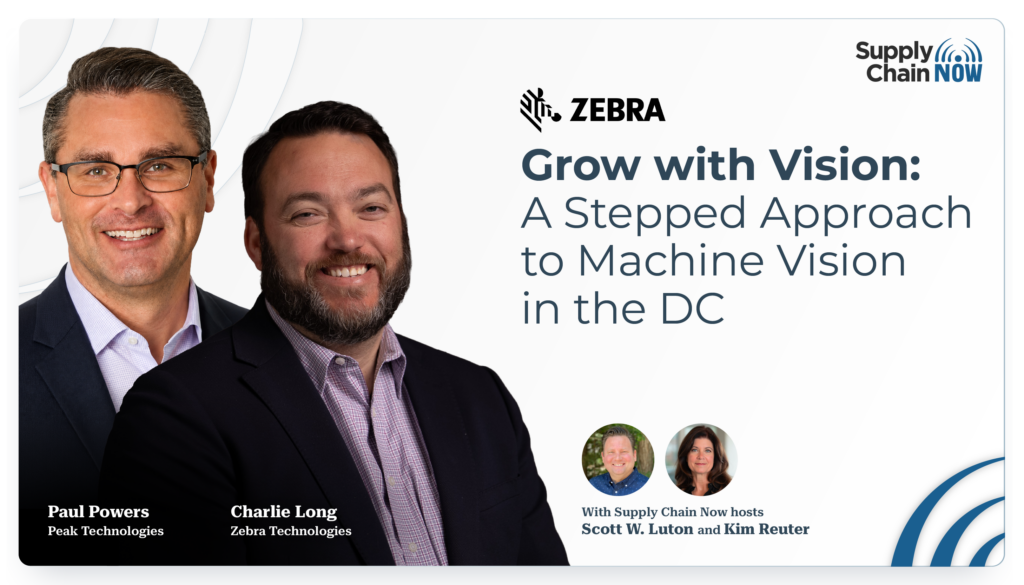
[00:02:00] Scott Luton: Kim, I’m going to introduce this one-two punch panel that we’ve got here today, starting with Paul Powers, Director of Business Development for Smart Technologies with Peak Automation Intelligence.
[00:02:13] Scott Luton: And he’s joined by Charlie Long, Vice President and General Manager for Machine Vision and Fixed Industrial Scanning at Zebra Technologies. Now Kim, as we established in the green room, these leaders got years and years of experience in innovative technologies. They’ve seen it just about all. The book’s coming out next year maybe.
[00:02:32] Scott Luton: So I want to bring in Paul and Charlie Hey, Welcome in, Charlie. How you doing, my friend?
[00:02:37] Charlie Long: Good, Scott. How are you?
[00:02:38] Scott Luton: Wonderful. Great to see you. And Paul Powers, how you doing, friend?
[00:02:42] Paul Powers: And Scott, Kimberly, I’m doing great. How are you guys?
[00:02:45] Scott Luton: Wonderful. So Kim, we were just painting a picture of, of this one-two punch and, uh, they’re about 10 feet tall and bulletproof, uh, and they got stories to prove it. Is that
[00:02:54] Scott Luton: right, Kim?
[00:02:55] Kimberly Reuter: Yes, that’s what they told me in the, uh, in the green room
[00:02:58] Scott Luton: Well, we got the proof coming up soon. But before we get to all of that, we got a fun warm-up question we’re gonna start with. So get this. Today is Chicken Soup for the Soul Day. That’s cool. It’s World Quality Day. It’s National Pizza with the Works Except Anchovies Day.
[00:03:15] Scott Luton: It’s a real day. How about that? Um, and it’s National Happy Hour Day, and that’s the one I’m gonna dive a little deeper on. So p- get this picture. You know, you ever walk into a restaurant, and you’ve got the, they’ve got these beautiful, like, seven-shelf bars from room, you know, wall to wall? Well, that’s where we are, Charlie, Paul, and Kim, and we’re having a great supply chain conversation with some adult beverages.
[00:03:37] Scott Luton: What they have got, uh, this beautiful bar has every drink option known to humanity. And Charlie, with that setting, I wanna ask you, what would be your go-to beverage?
[00:03:50] Charlie Long: So I’m, I’m, a classic guy, right? But I’ve got to be, you know, i- if I’m going to happy hour, I’m trying to get away, so I’m gonna go for the pina colada and pretend even though I’m at happy hour, I’m on the beach ready to relax and check out. That, that’s where I’m headed
[00:04:06] Scott Luton: Okay, pina colada. You know, Paul, I wasn’t sure what I was expecting from Charlie, but that was not what I was expecting. So, so I’m getting a visualization of an umbrella and a drink, and I don’t think I can stand up to that. So I’m not quite as entertaining with my drink selection. Uh, I- I’m traditional as well too. I’m gonna say a good Manhattan
[00:04:25] Scott Luton: Okay. I like that. I like the Manhattan. All right, Kim Reuter,
[00:04:30] Scott Luton: how about you?
[00:04:30] Kimberly Reuter: I’m a Manhattan drinker. That’s what I had. But I mean, if I want to, you know, top it off, it’ll be a Blanton’s Manhattan if you’re paying, Scott. Um, but, uh, yeah, I’m a bourbon lover
[00:04:41] Scott Luton: All right. All those are great guesses. I’m gonna go… N- so normally it’s Chardonnay. It’s my go-to, right? However, when me and Amanda go out for a nice dinner, we both really enjoy, uh, dirty vodka martinis up with extra olives. That’s our go-to, so… And of course, it’s all about the vodka. You gotta got a good, good quality vodka, but…
[00:04:59] Scott Luton: All right, so Charlie, Paul, and Kim, we’ll make that, supply chain conversation, a nice beautiful bar happen soon. But we got a lot to get to here today.
[00:05:07] Scott Luton: So let’s do this. Let’s set the table a bit. Uh, we, we know that your drink, drinks of choice now, but I want to know y’all from a professional standpoint. So Paul, tell us if you would briefly about yourself and Peak Automation Intelligence.
[00:05:20] Paul Powers: Yeah, I, it’s– As I get asked this question, it kind of puts a timetable on, on my, my, not only my career but my life. But 26 years in industrial automation focused in around machine vision, yeah, it does, it goes by fast, right? So, um, yeah, i- multiple verticals, multiple industries that I’ve been able to help.
[00:05:39] Paul Powers: It’s been a blessing to, uh, to, to, you know, have the opportunity to cross over and, you know, not just solely focused in one, one industry such as automotive, which traditional machine vision, we all know that’s kind of where it got its start. and the evolution into warehouse and distribution centers has just been amazing.
[00:05:57] Paul Powers: Um, but, uh, yeah, it, it’s been an exciting career, and it’s not over yet. Retirement isn’t too close. However, with this said, Peak Technologies is a great foundation for me to continue my career on and, and traditional core AIDC company, um, a Zebra partner, uh, for, for many, many years. the company’s evolved, and really we’re diversifying into this industrial automation space, and that’s kind of the role that I fit now in a business development oversight, um, position.
[00:06:27] Paul Powers: And there’s four pillars that really fall underneath here: RFID, autonomous mobile robots, a software, an analytics-based software platform, and what we’re here to talk about today, machine vision as well
[00:06:39] Scott Luton: Hmm. Outstanding. And Paul, just, um, 26 years. Man, you really have seen it all. Uh, and Peak Technologies, of course, is the organization, and then that Peak Automation Intelligence, which we’ll talk on in today’s show, is a big new initiative that’s, uh, pretty exciting, Paul. Do, do I have that right?
[00:06:57] Paul Powers: Yeah, you do. Uh, it’s, it’s, you know, Peak’s grown. We’re a global, uh, global company that has footprint in multiple places, uh, both, both here and in Europe, and we also have brick-and-mortar in, in Australia. We see the benefit of being able to service our customers in multiple ways, and having the resources that are, are planted around, uh, around the globe is important to us.
[00:07:17] Paul Powers: But, uh, industrial automation is, is we’re, we’re taking the intelligence of one square foot and we’re really challenging ourselves to open it up to square feet, and that’s where vision and automation really
[00:07:29] Paul Powers: comes together
[00:07:30] Scott Luton: Outstanding. Uh, well, and that’s only half the equation there, folks. We got Charlie Long as well. Charlie, y- you have spent quite a bit of time, uh, on the cutting edge of technology. Uh, tell us more about yourself and Zebra Technologies.
[00:07:43] Charlie Long: not quite as long in the automation space as, uh, as Paul. I’m 20 years in machine vision and industrial automation. Uh, joined Zebra, uh, just about two years ago. Um, and before that, uh, about 10 years in the, in the military as aircraft mechanic as well. But, uh, ultimately, I’ve seen the, uh, the growth trajectory of especially machine vision technology over the past 20 years.
[00:08:07] Charlie Long: A lot’s changed. Um, and maybe that change in acceleration curve, has picked up a lot in the last few years, with the introduction of AI and what we’ve been able to do more simplistically around the space. So of course, we’ll talk about that more, I’m sure, in the conversation today. but Zebra Technologies, uh, is a, a newer entrant into the machine vision and, uh, and automation space.
[00:08:31] Charlie Long: Uh, we’ve made roughly a billion dollars in investment, in machine vision and automation over the past five years. and we’re really trying to focus on that connected frontline and the empowerment of, the worker and to drive measurable, realistic results, from automation efforts. So looking forward to talking some more today about, what we’re working on and, and where we’re headed in the future
[00:08:55] Scott Luton: Outstanding, Kim. I tell you, we, we could spend hours probably on both of their almost combined 50 years in the industry, but I think we got the right two, one-two punch here today, Kim. Would you agree with that?
[00:09:05] Kimberly Reuter: We do. We definitely do. Um, uh, visioning has come a long way from UPC scanning. and so I am excited. I mean, come on, that’s where we kind of started. and it is way more sophisticated, in today’s market, so I’m excited to hear more
[00:09:20] Scott Luton: I am too. Uh, all right, so as we get in here, now that we’ve set the table, uh, Charlie, I want to, uh, and we’re gonna dive deeper into this in just a second, but I wanna level set with what you have found to be, in your 20 years in this space, to be a proven stepped approach to machine vision. And it really, uh, I think y’all have identified three phases.
[00:09:38] Scott Luton: Walk us through those three phases at a high level, Charlie
[00:09:40] Charlie Long: Yeah, if you look at the, the three phases that, that roughly align with everybody’s machine vision journey, you’ve really got the entry point, right? Which is a lot of times you’ve got a problem that you can’t solve, through typical, binary automation means, right? And that’s where people start to look at machine vision to make more decisions and, and have a more holistic view.
[00:10:02] Charlie Long: but that’s always the, the scariest one, but we’ll dig into that as we go. But, from there, you typically move to that scalable middle where you’ve found some success, around machine vision and you want to expand that to similar applications or across facilities. but then you move into that, integrated enterprise, right?
[00:10:21] Charlie Long: So where machine vision really becomes a staple, and fits industrial scaling, becomes a staple in what you do, and it becomes the– one of the key enablers in all of your automation efforts
[00:10:34] Scott Luton: All right. And we’re gonna dive deeper into each of those in a minute. Kim, you, you know I love a good framework, and Charlie laid out the entry point, the scalable middle, and the inter- integrated enterprise. Your quick reaction to, especially comparing and contrast with what you’ve seen in your career to that three-step
[00:10:48] Scott Luton: framework
[00:10:49] Kimberly Reuter: a great framework to start with. you have to start with the entry point. You have to get yourself set up, first of all, you have to understand what you’re trying to accomplish. I think that’s the number one thing you have to do, is what do we wanna get out of this, uh, new technology?
[00:11:01] Kimberly Reuter: So that’s a great point where you start with the entry point, you establish what it is that you’re trying to, get done, you s- build a good foundation, and then you scale and go from there. A lot of companies jump in and they go all crazy with visioning, and they buy technology they actually can’t even use.
[00:11:17] Kimberly Reuter: Because they don’t have it. They don’t have the, uh, the, I mean, s- s- just the silliest things, like lighting. they don’t have flat spaces. They don’t have all of these little things that are required, so they jump in, and then they don’t see the benefit
[00:11:30] Scott Luton: Mm. And that is no bueno, Kim. Is that right? No bueno. All right. So, uh, Char- Charlie, as a follow-up, uh, explain why some operators are hesitant to adopt the technology and how the Grow With Vision framework that you just kind of walked us through at a high level directly addresses a lot of those concerns.
[00:11:50] Scott Luton: Charlie?
[00:11:51] Charlie Long: Yeah, I mean, if you look at machine vision or even, uh, fixed industrial scanning, Kim, you mentioned, reading UPC codes. you can find as many success stories as you can find horror stories around the technology, right? And that’s really comes down to, to Kim, your mentioning of understanding what problem you’re trying to solve, and especially living inside of that problem, as opposed to, dying by scope creep, which is a, a common problem in all automation efforts, is one of the key points.
[00:12:21] Charlie Long: But it’s also those early adoption into your organization. There’s more naysayers than there are supporters a lot of the time, so you really have to embrace the, the what can we do and, and what’s gonna have a clear ROI, versus, you know, taking on the science project out of the gate
[00:12:38] Scott Luton: Hmm. All right, Charlie, good stuff. And I just emailed you a pina colada so you could s- I know you’ve been leading a lot of conversations today. So, uh, Paul, really quick, I’m gonna continue with Charlie in a second. But, you know, we were just walking through some of the hesitance, some of the headaches, some of the, you know, and I’m not down- I’m not downplaying it.
[00:12:57] Scott Luton: I think change on a human level, none of us really like change all that much. Speak to that operator hesitance that Charlie was just speaking to that you see out in the industry
[00:13:07] Paul Powers: so many times we like to throw technology at problems, uh, and you know, it’s not always the solution. You know, the, the training side of it and the operator hesitancy, we see it all the time. Traditional based machine vision. Can’t tell me how many systems that we’ve set up only to have to go back and find out that it’s not working only because of the, the operator’s hesitancy to use it or, moving of, a mounting point, things like that.
[00:13:32] Paul Powers: So change is real, it’s happening and that’s where partnering with a company sl- such as Zebra or, and Peak Technologies, they really work in the, in kind of the, the, the full service of, of being able to offer not just the sale of the hardware, but also an understanding and to help that user adaptability
[00:13:50] Scott Luton: Mm. The aftercare is what I’m hearing. It’s critical, folks. If you’re not asking about aftercare, you’re not doing your due diligence.
[00:13:57] Scott Luton: all right. So Charlie, circling back to that framework, wanna dive a little deeper into that entry point, right at first, that first level.
[00:14:05] Scott Luton: Uh, how can a facility leverage its existing mobile computers and staff to get started with machine vision, and what kind of immediate ROI can they expect from a, say, a simple point solution?
[00:14:17] Charlie Long: Yeah, that’s, uh, it’s a great, way to look at it and where to start, right? So ultimately, a lot of the times you’ve got operators already on the floor with mobile devices, um, you know, a TC501. I just happen to have one on my desk. But, nevertheless, you’ve got an operator on the floor with those devices already, and they’re doing manual scanning.
[00:14:39] Charlie Long: And one of the quickest ways to bring efficiency into your operation is to introduce some points of fixed industrial scanning or, or hands-free scanning, right? And a lot of times that requires a lot of integration on the back end, and that’s the biggest hesitance for a customer. and really we’ve tried to, you know, streamline that approach where if you put, a base station on a pack bench or at a station where you’ll do fixed industrial scanning, then you can drop a device like our 501 into a cradle and have that fixed industrial scanner plugged into the cradle, and there’s no integration required past that point.
[00:15:17] Charlie Long: It talks to it as if the operator had picked it up and scanned a barcode as normal. And we find that as, as… You can add up to 30% efficiency just by going with that hands-free scan because an operator that’s picking up a box, looking for a barcode, handling a scanner, putting the scanner back down, moving the box, doing the rest of their operation, being able to, to put the scanner in the cradle, go straight to fixed industrial, point scanning allows you to, you know, drive a lot of efficiency, and it really steps away from those manual operations.
[00:15:52] Charlie Long: You know, no different than we were, we were moving away from pen and paper 20 years ago to going digital. This is a very similar transformation that’s, really formative, um, and quick payback
[00:16:04] Scott Luton: All right, so two thoughts before, uh, we move forward to k– Paul with another question, Kim. Um, number one, I love the main theme here. We’re empowering the frontline, making their day easier and more successful. There’s so many opportunities to do that here in, in the golden age of supply chain tech. I love that.
[00:16:20] Scott Luton: But number two, Kim, Charlie showed us a piece of equipment. I went to Google, ’cause I haven’t heard of the TC501. And did you know, Kim, the Zebra TC501 is a rugged AI-powered mobile computer and data collection terminal designed for frontline workers in retail, warehousing, logistics, and field operations.
[00:16:40] Scott Luton: Man, “Star Trek” stuff. Charlie, I love it. Kim, react to what we heard there from Charlie Long.
[00:16:45] Kimberly Reuter: Charlie’s talking about, like, how do we get started, simple processes with the scanning cradle. and you’re right. We all experience this every day. We go to the grocery store, right? And the cashier is like, “Beep, beep, uh, uh, uh, boom. Oh, got it. You know, let me, you know, oh, let me get the dust off of it.”
[00:17:01] Kimberly Reuter: Trying to, “Oh, here we go.” and by then time I’ve run around the store three times to find another one to get back. Um, so this is a real thing, and if you, if you take that and you multiply it times a couple million, right? That a, a warehouse is actually running, and the seconds and minutes that you cut out in just that one simple process of removing the, flipping it around, trying to find it, da, da, da, um, you are saving millions of dollars right there with just a very simple scanning scr- cradle.
[00:17:32] Kimberly Reuter: And this is a real-life situation that we see every day
[00:17:35] Scott Luton: Well, I love that common universal example. It’s a great example, Kim. Uh, and Paul, I want to circle back to you here because Peak Technologies often works with customers at all various stages of automation. There’s lots of them. Um, from your perspective, what are the key triggers that tell a company it’s time to move from that initial entry point to the scalable middle with, say, pre-engineered solutions?
[00:17:59] Paul Powers: Yeah, I– that we talk about that entry point and I– nine times out of 10, the number one question that comes around that, that entry point is return on investment, right? And the benefit when you automate is that you’re going into this and you have a pretty good idea, of, you know, what the ROI is gonna be.
[00:18:16] Paul Powers: There’s some data that you have to collect. However, we’re always hearing the same pain points from these customers. Number one, they’re having capacity constraints, right? How do I get more out of what I have already? What does that look like? not only capacity, but when you’d have to take a look at labor, that’s another big one.
[00:18:34] Paul Powers: And, I’d say that’s the number one reason why somebody contacts us looking for automating a specific process. speaking of processes, that’s another one that we hear quite often is customers will say, “Hey, I think I need to standardize my processes, but I don’t know how to do that.” And so many times we see, and I’m gonna use the term sensor fusion.
[00:18:55] Paul Powers: We see companies that have multiple technologies that are independent, not working together. and, you know, these questions really beg the, the answer of, of, you know, what, what is it that, that we can do by bringing all these technologies together for one, unified outcome
[00:19:13] Scott Luton: All right. So, uh, Charlie, I wanna, uh, pose that same question to you before I, we move on and, and I got another question for Paul, especially from an integrator standpoint. Uh, moving from entry point to scalable middle, what else do you see oftentimes common themes there, Charlie?
[00:19:28] Charlie Long: Yeah. The, the common themes are when you’re going from that entry point, a lot of times, especially in warehouse automation, we talked about the frontline worker. You’re taking things that were done with your hands, and you’re doing them in automation, right? And single point scanning is a great way to look at that, or FIT scanning is a great way to look at that.
[00:19:47] Charlie Long: But then you typically start to scale in that middle when you’re adding conveyance, and you need to read at a higher speed. And that’s why we’ve designed our ecosystem of FS scanners, our fixed industrial scanners, around that notion that you should be able to do the same operations with the same equipment, so you’re not constantly integrating something different.
[00:20:06] Charlie Long: But at the same time, we’ll work with a partner like Peak Technologies to say, “Hey, what if we mount these FIT scanners on your forklift?” That way, when you roll up to a pallet, you’re reading the pallet rack, you’re reading the pallet you’ve picked up, you know what you’re holding onto. The same thing happens when you drop that pallet off on, a wrapper.
[00:20:25] Charlie Long: You know, you’re shrink wrapping, you’re scanning at the same time. You know, you’ve got a scan pillar attached to that shrink wrap, operation, so you know what you’re putting there or something. You know, put a scan portal at the dock door, right? You know what trailer’s parked there. You know what’s going on.
[00:20:39] Charlie Long: Those are really those scalable middle points where you start to expand on what you had before, right? Where the entry level is always typically about making the data acquisition faster and more accurate, right? Where when you look at that scalable middle, it’s about adding data points you never had and unlocking efficiencies you didn’t know were possible, right?
[00:21:03] Charlie Long: I’ll just spend one second on forklift. You typically save an hour a day for a forklift operator if you stop them from getting on and off the forklift to scan a pallet, right? It seems simple. Like you said before, it’s got a couple of seconds here and there. If you save that operator fifteen seconds on every pallet, you’re saving them an hour a day
[00:21:24] Scott Luton: Man, that’s great. A, a great call out there, Charlie. So true. And Kim, really quick before I go circle back to Paul, uh, we were talking pre-show about, uh, since, you know, we spent so much time the last couple responses talking about scalability and expansion. However, Kim, we can’t oversimplify, the s- the scalability factor.
[00:21:44] Scott Luton: Sometimes that can be a big mistake. And, and, and, uh, when we do that, and instead of working with pros like Charlie and Paul to help manage the complexity that sometimes is critical to make scalability easy, I mean, we were talking about this pre-show. Weigh in there,
[00:21:58] Scott Luton: Kim
[00:21:59] Kimberly Reuter: for scalability, first you gotta have a success, right? So we talked about the entry point. Pick a project, pick a lane, pick a process, pick something and prove it out that, hey, using this scaling technology, we’ve saved hours, we’ve saved money, we’ve done whatever it is that we’ve done. But pick one small thing and prove it all the way out.
[00:22:19] Kimberly Reuter: And then when you start to scale, the biggest mistake I see people make is then they wanna start customizing. Because they’ve had one success, they’re like, “Oh, well now we know it. And now we wanna design our own system.” Biggest mistake people make, and that is where they fall over. Because you can leverage people like Peak and Zebra who already know all this, who’ve already done it for hundreds of thousands of companies and have already failed.
[00:22:45] Kimberly Reuter: They’ve already bumped into all the boulders, and you can learn. But a lot of times what I see, especially with these emerging technologies, companies get them and then they wanna customize them, and that’s when it, it falls apart
[00:22:56] Scott Luton: So don’t do that, Kim. That’s a Kimmy
[00:22:58] Scott Luton: keeper. They’re smarter than you. Trust me.
[00:23:03] Scott Luton: So good stuff there, Kim. I love it. Sounds like you’ve had, uh, a couple, what’d you say? Bumping those boulders? It
[00:23:09] Scott Luton: sounds
[00:23:09] Kimberly Reuter: Bumping into the boulders. Yeah. Yep. In the middle of the night. Yep
[00:23:13] Scott Luton: all right. So Paul, we’re– Paul’s, Paul and Charlie are gonna help us avoid those boulders. Paul, as an integrator, how do you help customers ensure that the solutions that are in the scalable middle, like, uh, I bet you’re gonna tell us about a scan tunnel, are deployed with agility and minimal disruption, especially when they need to ramp up for crunch time, peak season?
[00:23:35] Scott Luton: Paul, talk, talk to us about that
[00:23:37] Paul Powers: Yeah, uh, I’d be lying if I said I– we’d never see this happen, right, Charlie? It’s, uh, it’s, it’s always, always, uh, a challenge. And, you know, as a, as being in our industry, we have to be flexible because there are multiple peak times for different industries. So that adaptability is very key. I think the messaging here tells us that we have to align ourselves with good partners.
[00:24:01] Paul Powers: There’s such a thing as an ideal partner profile. Find the ones that work really good for you, that are willing to be adaptive. I think that when it comes to a scan tunnel, that initial design intent and having that scalability built in and working with the right partner that takes that in-into, uh, you know, uh, makes a conscious effort of, of designing that in on the front side is going to be the way to go.
[00:24:23] Paul Powers: I call it the on-deck philosophy. What do we need to have on deck in case this happens, whether it be increased demand, reduction in the workforce? you have to kind of have a bypass plan in that design intent as well, Scott and Kimberly and, and Charlie. Charlie, I don’t know if you have any other thoughts on that and what you’ve seen.
[00:24:41] Paul Powers: However, man, deviation and being able to be on the fly is very
[00:24:45] Paul Powers: important
[00:24:46] Scott Luton: Hmm. Charlie, uh, speak to what Paul’s talking about. Uh, and especially if it’s the first time you’re seeing something on, in the fly, it’s gonna be much painful than if you’ve seen it a thousand times and you want to pivot on the fly. That’s, that’s my take at least. Charlie, your thoughts?
[00:25:02] Charlie Long: No, I have the same take. I, I love the Kimmy keeper. I’m gonna take that probably outside this conversation and, and continue to use that. People will be like, “Who is Kimmy?” It, it’ll open up conversation. It’ll be good. So but no, I mean, that is absolutely right though, and Paul speaks to it as well. A lot of times we’ve got to take on something that’s different or challenging for a customer that, uh, Paul and Kim’s point, we’ve seen a thousand times before.
[00:25:26] Charlie Long: So we’ve already got the solution, we’ve got the, the workflow down, and we can help, you know, mitigate the, uh, the disaster that would ensue if you didn’t know, uh, the potholes along the way that you were gonna step into. So that really makes it a, a much more seamless integration and, and a project that actually achieves the ROI you were aiming for, rather than a project that ate up an extra 100 or 200 hours of engineering cost that you weren’t planning for
[00:25:53] Scott Luton: Mm. A great call out, Charlie. Hey, really quick before I continue with Charlie, um, that customization point that Kim, Kim has seen business leaders and organizations make once they’ve had a couple of wins and they start overly customizing. Do you, have you seen the same thing in your 26-year journey?
[00:26:10] Paul Powers: Yeah. It’s, It’s, And I think we’re, we’re kind of seeing a paradigm shift back to more standardization. Sometimes a homegrown system is the best idea. It makes sense for you and for the customer. However, when it comes to a scalability perspective, man, it, it, it’s hard to be able to scale on a custom base.
[00:26:27] Paul Powers: Uh, it, it just is, Scott
[00:26:29] Kimberly Reuter: Mhm.
[00:26:31] Scott Luton: Been there, done that perspective is my favorite type to amplify here on Supply Chain Now. Okay. Kim, anything else to add? Charlie just shared a couple things. I’m, uh, we’re about to get into the integrated enterprise stage.
[00:26:43] Kimberly Reuter: what Charlie and Paul said are great, and, you know, have some success and, and Paul’s seen it. So many companies, all of a sudden they’re like, “Oh, but we need this and this and this and this and this, and it has to look like this, and it has to look like that, and da, da, da, da, da.” And you’re like, “You didn’t even try what we have.
[00:26:59] Kimberly Reuter: Like, you didn’t even try the actual software. People who work in this industry with c- thousands of other companies design this.” And what happens is they spend, uh, I’m gonna go out and say hundreds of thousands of dollars, ’cause I’ve seen it be in the hundreds of thousands of dollars, to customize something that adds zero value.
[00:27:16] Kimberly Reuter: Because it’s something that they are used to seeing or in a way that they’re used to processing it, and they get really… They hold on to that, and they will not move forward until you give it to them. and that is the worst. And it takes a strong hand to get in there and say, “We’re gonna try it this way first, and we’re gonna give it six months.
[00:27:35] Kimberly Reuter: And if, if we’re not seeing our ROI, we’ll come back. But we’re doing it.” and it will save you hundreds of thousand dollars, and Charlie’s about ready to come out of his chair, he’s shaking so hard. Um, you’ve obviously seen this too, right?
[00:27:46] Charlie Long: I have. I mean, it’s, it’s one of those things where the worst thing we can do is sell you a device that you don’t end up using, right? Or I guess the worst thing we do is sell you hundreds of devices you don’t end up using and, and we’ve done that when you let scope creep kill your project, right? Like, you started off with a problem that you had to solve, and then along the way you added a bunch of problems that somebody might like to solve, but the ROI is not there, and you attach them to something that’s real, and you end up with this thing that only needed to do X and Y, and you ended up wanting to do the rest of the alphabet and then deemed it was, uh, it was unworkable
[00:28:24] Scott Luton: Well, let’s, let’s, uh, let’s do a little deal. I want to get one of those, those, uh, TC501s after the show, Charlie. I got three kids, uh, and I got a couple applications in mind, okay? So we’ll get together and do a deal, okay?
[00:28:34] Charlie Long: No problem. I’ll get you on our e-commerce site, Scott. You’ll be set
[00:28:38] Scott Luton: Okay. So let’s get into the integrated enterprise stage. Now, Charlie, that sounds very powerful and robust, but also very complex, and we’re highlighting, I think just the first half of the show between Charlie and Paul and Kim, y’all are highlighting some of the complexities that for many, especially first-timers, it’s in their blind spot.
[00:28:59] Scott Luton: And that’s the, that’s the value of partnering with folks that have y’all’s, you know, almost combined 50 years of experience. So Charlie, what does it mean to connect machine vision directly to a, uh, a WMS or a WES, and what new capabilities like predictive maintenance, say, does that unlock for a high-volume distribution center?
[00:29:17] Charlie Long: Yeah, that’s, it’s an excellent question, and it’s where you go once you’ve had that initial proven ROI, and you’ve started to expand into the scalable middle, and you’re finding what makes sense for your process, and you’re finding where you can save money or, you know, speed up your process, right? And that’s where you start to scale into the full enterprise, uh, development of your solution, right?
[00:29:41] Charlie Long: So if you’re looking for, uh, as we talked about earlier, adding to your process or gathering information that wasn’t there before, or, you know, you take fixed industrial scanning and you move to full PC-based vision where you’re doing dangerous goods classification or package damage and dimensioning, and you’re doing all this at speed and scale, then the next logical step is to say, “Well, what about my machinery?
[00:30:06] Charlie Long: Am I wearing out machinery too quickly? Are the feet on my cross belt sorters breaking? Are my conveyors wearing and fraying? Am I seeing vibration and crack and movement?” That’s where you can start to scale into a full enterprise solution that leverages AI and leverages analytics through partners like Peak that provide the full analytics solution to really grab all of that data in your full environment and bring it together and allow you to make much better decisions on the short and long term
[00:30:36] Scott Luton: Hmm. Kim, you know, um, we were just get– Charlie was just talking about, uh, the integrated enterprise, um, uh, level of this framework, and of course, we’re, uh, uh, we packaged that question around high-volume DCs. And Kim, you’ve been there in and out of, uh, what… I forgot the count we use on, on the front end, but you’ve seen lots of…
[00:30:57] Kimberly Reuter: something, yeah
[00:30:58] Scott Luton: You’ve seen a lot of high-volume DCs, and it can be a bit of a more of a unique problem to solve. But your thoughts, especially when you move to a, a bigger enterprise, uh, approach to machine
[00:31:07] Scott Luton: vision
[00:31:08] Kimberly Reuter: For some reason when we talk about scanning, we almost always kind of envision a warehouse, right? Like scanning in a warehouse, scanning UPC, scanning something on a conveyor belt, um, scanning things are going into an order. Um, but, uh, scanning goes outside of the warehouse. So they’re scanning on trucks arriving at the, at the yard, right?
[00:31:26] Kimberly Reuter: And then giving them instructions on what door to go to based on that scan information that you’re picking up off the barcode off the side of the truck. You know what’s in it. You know where it’s going next. You know what door it needs to go to. Is there perishable product in there? So scanning goes outside of the warehouse now.
[00:31:40] Kimberly Reuter: We have scanning in stores now, where you can scan a product to see what the price is. Uh, scanning inventory, watching how inventory is moving around, uh, a store using RFID. being able to track something, using it for security purposes. So once you get, once we start talking about enterprise scanning, we start to open up the doors to everything
[00:32:01] Scott Luton: Hmm. Okay. So then Paul, as we lean more into, uh, a wide open cornucopia of new solutions when, when that customer is ready for that full enterprise integration, I’m curious, what is the role of a partner like APEEK Technologies in connecting the hardware with the customer’s enterprise software and most importantly, arguably, is ensuring that smooth, successful deployment where we’re minimizing headaches and friction?
[00:32:30] Scott Luton: Your thoughts, Paul
[00:32:31] Paul Powers: Yeah. Uh, it’s, it’s interesting because you mentioned hardware, and so many times the customer thinks that’s where we start. And to be quite honest, that’s not the best place to start. And where we want to, to focus in on is the process, clearly identifying what that process is. A lot of times what we find is that, these processes aren’t even clearly defined by the customer.
[00:32:53] Paul Powers: They don’t know. So that’s a value that we can bring to the customers to come in and help them identify those processes, record those processes. and definitely, uh, an, an advantage there. I, I think also in an environment we hear the– there’s all these buzz terms that come within our industry, and I know, you know, AI is such a, a prevalent one right now, but there was one not too long ago that we talked about from a digital twin perspective.
[00:33:16] Paul Powers: That is s- still very prevalent in our industry because it allows us to have future sight into maybe how the outcomes will be based. And that’s good information to share with your customers, especially when you’re looking at from a scalability perspective to provide that comfort to move forward.
[00:33:31] Scott Luton: Hmm. Lots of buzzwords, I’ll tell you what. And man, but you know, still, it is an amazing time here in the golden age of supply chain tech to see what’s been done, to see the outcomes, to see the new applications. And even, you know, Kim, like, um, Paul and Charlie both have kind of spoken to a little bit.
[00:33:50] Scott Luton: They’ve been in industry for forever, and they’re still seeing new problems, new ways of solving them. And go- if the experts can see new ways, uh, imagine the, the, the organizational leader out there that’s not a specialist, Kim,
[00:34:04] Kimberly Reuter: Mm-hmm.
[00:34:05] Scott Luton: how everything is new, and that can lead to, to lots of headaches. But Kim, uh, your thoughts
[00:34:09] Scott Luton: there?
[00:34:10] Kimberly Reuter: It’s, um, again, I’m gonna w- go back to this customization. Um, you know, when I was working at Nordstrom over 10 years ago, so way back dated, Nordstrom was actually one of the first companies to do omni-channel fulfillment, believe it or not. I actually didn’t believe it when they told me. I’m like, “No.”
[00:34:24] Kimberly Reuter: And they’re like, “We did.” Um, and, uh, they were doing store fulfillment. And the story is, is they launched it on the day that YSL launched a new lipstick. And they came in the office the next day, or into the stores the next day, and they had run out of register paper, um, running out all these orders, ’cause that’s all that they were doing is they were just printing it to a register in the store.
[00:34:45] Kimberly Reuter: Old days. But they were doing fulfillment with scanning. And way back in the day we were using, like, Apple phones, right? ‘Cause we didn’t have… There was no specialized technology. And it was really cumbersome. they died, they didn’t have battery life, they were constantly updating,
[00:35:01] Scott Luton: All the
[00:35:02] Kimberly Reuter: All the problems of, you know, you say, “Oh, scanning, it’s so easy,” but the hardware was horrible.
[00:35:09] Kimberly Reuter: Um, now again, this was 15 years ago, so it’s come a long way. but now we have so much better technology. We can capture information, different types of information, different types of hardware. I love the finger scanners. I think those are the coolest thing I’ve ever seen, and every time I see somebody using them, I’m like, “That’s so…”
[00:35:27] Kimberly Reuter: Like, I wanna, I… Like,
[00:35:28] Scott Luton: You want one for
[00:35:29] Kimberly Reuter: in a warehouse. Um, so it’s come a long way
[00:35:33] Scott Luton: It has come a long way. All right. So Charlie, my next question, maybe not the Nordstroms of the world, but a mid-size company, right? Give us an example, Charlie, of how a mid-size company might use this framework that you and Paul have been speaking to differently than, say, a large DC or 3PL. Your thoughts, Charlie
[00:35:51] Charlie Long: Yeah. I’m actually gonna use Kim’s example of the, the ring scanner or the finger scanner as the kind of the evolution of the mid-tier company, right? Because if you go from certainly pen and paper to handheld scanning, right, you already made a, uh, a huge transition and you saw, uh, a significant efficiency gain, right?
[00:36:11] Charlie Long: Then when you step from that handheld scanner to the ring-based scanner, you’ve got the ability to move around, you’ve got the ability to easily scan. But I was in a mid-tier company recently that was wearing out their ring-based scanners with, uh, you know, 5 million, uh, triggers, uh, in, in a half, right? So they were moving a lot of packages, and the ring scanners were doing a great job, but, you know, 5 million scans is a lot.
[00:36:38] Charlie Long: And their next evolution was the movement, even at that mid-size business, to fit scanning and then classification, right? Because they needed to stay away from putting dangerous goods in a truck that wasn’t supposed to have dangerous goods in or didn’t have the right, uh, uh, labeling on it, right? So that was– that’s where when you’re looking at a mid-size business, they have just as many problems as a large operator, right?
[00:37:04] Charlie Long: But usually those problems are harder to address because the barrier to entry is bigger. What we’ve done is drawn that, um, used the AI buzzword. We’ve brought the AI tools in and the ease of implementation to make those, uh, problems easier to solve and a lighter weight to integrate. And then we’ve got the, the beautiful partner network that we have to, to provide the help and at every level of organization
[00:37:31] Scott Luton: So a couple things I heard there, and Paul, I want you to speak to this maybe too. Um, ease of implementation, problems that are easier to solve, um, getting a sooner return on investment. I mean, this is why you bring experts in, right? At least in my book. Paul, speak to that because, you know, one really bad implementation could have such a major ripple effect, especially in, in, you know, lar- any organization for that matter.
[00:37:57] Scott Luton: But, there can be also, um, more to lose at times. Paul, speak to, uh, the importance of implementation, implementations done right.
[00:38:06] Paul Powers: It’s our job to go in and paint the picture to our customers to tell them, “This is your current state based on the information you’ve given me, but this is what your future state can look like.” Where that can all fall apart is at the implementation side of it.
[00:38:19] Paul Powers: So aligning yourself again with a team that is vetted, that can, can actually provide these, these solutions, um, is, is going to be key. I mean, at the end of the day, uh, what we do is, like I mentioned this earlier, we’re taking intelligent square foot and expanding that out. We’re taking these sensors that are, um, you know, reading a simple barcode or looking at a smaller field of view to…
[00:38:45] Paul Powers: It’s becoming an operational sensor, right? And, um, you know, the implementation’s part of it. A- as we advance, AI is going to play an important part in the success of that implementation as
[00:38:55] Paul Powers: well too, Scott
[00:38:56] Scott Luton: Undoubtedly. Great points there. Uh, Kim, we’re just, we’re just walking past, earlier chapters in your, your journeys. What, what, I, I can see you capturing some flashback moments right this minute. Is that right,
[00:39:08] Scott Luton: Kim?
[00:39:09] Kimberly Reuter: implementation is actually one of my specialties. and it is, it’s, it, Paul’s right. It’s where things fall apart. Because you, we can paint the prettiest picture and the sales team will come in and tell you that it will make you coffee every morning and bring you hot croissants.
[00:39:22] Kimberly Reuter: It will not. and so the implementation is where we find that out, but we still have to work through it, right? And so the biggest thing that’s going on with the visioning is that this tech is moving extremely fast. It’s innovating like overnight. thin tech is, the new greatest thing that people are talking about.
[00:39:41] Kimberly Reuter: Thin batteries, flexible batteries, thin screens, being able to scan, uh, three-dimensionally is coming up in the future. So the tech is moving extremely fast, so you need to almost implement for the future when you implement, and that can be a challenge. And that’s why you need to partner with people like Peak and Zebra so that you can implement for the future.
[00:40:02] Kimberly Reuter: Because if you don’t, you will implement for right now, and by the time you get done with your implementation, you will have already been passed. So partnering is key, especially in this space
[00:40:13] Scott Luton: That’s a great call-out. What a great boulder you just put, flashed your, your flashlight on top of. Um,
[00:40:21] Scott Luton: all right, so let’s see here. Kim, you were just talking about what we need now versus, you know, what we’ll, you know, a dynamic system, right?
[00:40:28] Scott Luton: And, and you were kind of doing a, a look ahead there, and that’s where I wanna go next with Paul and Charlie. And Paul, I’m gonna pose this question to you first. So i- in a bit of a look ahead, if you’re, uh, well, I tell you what, I bet your technology crystal ball’s working a lot better than at least mine.
[00:40:42] Scott Luton: I bet you and Charlie’s definitely is. So how do you see technologies and AI evolving within the framework that Charlie and that we’ve all been talking about to make machine vision even more accessible and powerful for supply chain operations, Paul?
[00:40:57] Paul Powers: Yeah, and I, I think, Kim, you, you kind of alluded to this a little bit, uh, but we’re moving from a point where traditional machine vision, its job was to detect. And as you bring in artificial intelligence into this, not only is it detecting, but it’s able to understand. and I think that we’re, we’re seeing that now.
[00:41:19] Paul Powers: And I brought up the term earlier about sensor fusion, and that’s really where AI’s gonna play an important role in moving, moving this forward. I know there’s a question about RFID, definitely comes into play with machine vision. historically, machine vision is an edge computing device in some– Whether it– You can even have, you could even have the argument that you’re computing on the edge with a PC-based vision system as opposed to a smart camera, which the reason for that versus a cloud-based system is because it’s much faster.
[00:41:46] Paul Powers: Now, imagine a world with a edge-based computing horsepower, but also adding AI capabilities to that. It’s going to move faster. It’s gonna continue to improve and enhance you guys, and it’s an exciting time because our customers are gonna benefit
[00:42:01] Paul Powers: from it
[00:42:02] Scott Luton: Yeah, I’m with you. And, you know, one quick comment. We can’t talk about this topic here today, but, you know, Kim, we’re– I feel like in part we’re laying out the case why you gotta work with experts, and that’s this, the whole cybersecurity angle. You know, I think I, I’ve, I’ve been able to work with and rub elbows with some of the brightest people in the world, especially in manufacturing.
[00:42:21] Scott Luton: However, talk about things are evolving so fast. The whole cyber angle is evolving so fast, and these systems have to be, have to be. Security is, is table stakes, and that’s one more reason why you gotta work with the pros. Um, all right. So Charlie, coming back to kind of look ahead and how you’re seeing technologies, including AI, you know, um, making machine vision more accessible and powerful.
[00:42:45] Scott Luton: Your thoughts, Charlie?
[00:42:46] Charlie Long: Yeah, I think Paul had a lot of good points there. I know Paul and I might be dating ourselves a little bit with twenty-nine year careers. I, I’m only twenty-nine years old. I must’ve been doing this since birth. But nevertheless, the, uh, if you look at the evolution of PC technology in the early ’80s, right?
[00:43:02] Charlie Long: Back when a couple of K of RAM was enough to get everything you wanted done. but those were the limitations on where we could grow. AI is coming and presenting a lot of new solutions now, or access to solutions and knowledge that you can’t build, uh, that domain knowledge as quickly on your own as you can access it, uh, through the use of AI, especially, uh, agents to help you, you know, design and develop solutions.
[00:43:28] Charlie Long: so we’re leveraging that technology, but especially on the edge and pulling it out of the cloud. If you’ve got a scan tunnel, as we mentioned a minute ago, or a dock door solution that has to run its inference on the cloud or make it, uh, con- or communicate with its model in the cloud, you’re losing four or five hundred milliseconds.
[00:43:46] Charlie Long: It doesn’t seem like a lot, but when you multiply that times, you know, a couple hundred scans a day, then you’re, you’re losing a lot more than you want. So as the computer technology advances or our GPUs and processing capability continues to advance, we’re gonna pull more and more of that AI to the edge.
[00:44:04] Charlie Long: Tim, you mentioned 3D. 3D is one of those things. We’ve got an excellent, uh, image formation solution for 3D, and we can do a lot of inspection on the edge right now if I take my 3D point cloud and I flatten it into a height map. But we’re not far away from doing full-blown 3D inspection on the edge with AI algorithms that are gonna give us those, insights that we’ve never been able to have at that kind of speed, with a low level of complexity, right?
[00:44:31] Charlie Long: So we’ve done things like our on-device agents that answer questions for you that you don’t have to even call our twenty-four/seven helpline, right? You can ask the agent and get that answer so quickly that you’re moving on to the next problem. It’s not a problem, but that’ll be the, the future we continue to grow on
[00:44:51] Kimberly Reuter: Mm-hmm
[00:44:52] Scott Luton: Sounds like a pretty exciting future, uh, that Charlie and Paul are painting. Kim, react to what you heard there, especially with, uh, how you see accessibility and application and outcomes associated with machine vision evolving
[00:45:06] Kimberly Reuter: Mm-hmm. Um, like, so we started, it all started with UPC codes, right? That’s where we started with ca- scanning. we are so past it that people don’t even need UPC codes anymore. We are getting to the point where you can do imaging just based on the actual image of the product. Scanning the product, scanning, uh, you know, that is a OnePlus phone and, and putting it in a box, not even needing to put a, a code on it anymore, being able to actually recognize the item.
[00:45:33] Kimberly Reuter: As I understand it, the color technology still needs some work, so not gonna see this in high fashion anytime soon. Um, but if you’re dealing with, like, bolts and screws and things like that that have a very definitive character, um, we’re able to scan that now. So the scanning technology is just… It’s, that’s what I said before, like, it is jumping so far ahead.
[00:45:54] Kimberly Reuter: And, you know, we’re talking also just about box and package scanning, but when we get into quality assurance scanning, which is what we’re talking about with 3D scanning, now we get into compliance scanning, potentially returns processing. Is it in its box? Has the box been opened? A scanner can now do that for you instead of, again, a person flipping it over, trying to make a decision.
[00:46:15] Kimberly Reuter: And then AI, you layer AI on top of all of that, and now we have almost an autonomous system
[00:46:22] Scott Luton: Kim, goodness gracious, you’ve just painted a vision of where we’re going and, and we might be there as early as next week, especially when you got folks like Charlie and– yeah, Charlie and Paul, uh, helping to bring the fruitu- the future to fruition. Did I say that right? Um, all right. So let’s do this. Uh, I feel like I’ve gotten a bit of a certification today in what’s going on, especially in, uh, machine vision, in real world, where we are today application.
[00:46:49] Scott Luton: We’re not talking future stuff. We’re talking stuff that Paul and Charlie are doing right this minute in their teams.
[00:46:55] Scott Luton: So let’s do this. Um, Charlie,
[00:46:58] Charlie Long: Yes. Yeah
[00:46:58] Scott Luton: tell us about, uh, so we’re back at, we’re back at the bar. You’re, you’re three sips into that pina colada, and, um, w- we wanna connect you with a few folks, right? So I got a two-part question for you. Number one, uh, just how easy is it to get started working with Zebra Technologies?
[00:47:16] Scott Luton: And number two, how can folks track you down not to only enjoy an adult beverage, but to do, t- to, uh, pick your brain on anything we’ve talked about here today?
[00:47:25] Charlie Long: Yeah, absolutely. Love to share a pina colada with anyone anytime, so please keep me in mind. But, uh, to get started with Zebra, we do have a fantastic partner network, uh, but we’ve also got specialist sellers and Zebra sellers on the ground in 150 countries, so we are easy to find. If you wanna start with Zebra, the best place to go from a machine vision perspective is to our website, zebra.com.
[00:47:49] Charlie Long: Uh, if you wanna get more specific, /machine-vision. You know, I love machine vision. Hopefully everybody else loves it as much as I do. And if you just wanna chat with me, I’m easy to find on LinkedIn, um, and love to connect and, uh, and expand across the industry, so please look me up there
[00:48:06] Scott Luton: Outstanding. so Paul, same question, my friend.
[00:48:09] Scott Luton: Let’s see. You were drinking an old fashioned, I think, at the front end. So, uh, uh, so how can… Oh, Manhattan, that’s what it was. Not old fashioned. Manhattan. Th- that’s right. Good, good stuff, Kim.
[00:48:19] Paul Powers: It’s all right. I’ll
[00:48:20] Scott Luton: so Paul, how can folks connect with you, and how easy does, is it to get starting with, uh, Peak Technologies?
[00:48:29] Paul Powers: Yeah, I, you know, I– like most of us here on this call, uh, LinkedIn’s a fantastic networking platform for us to, uh, to engage. You can start there. we’ll be able to provide my email address. I take, uh, personal phone calls up until 11:00 PM. Or is that, that, that’s you, Charlie, right? That takes till 11:00 PM?
[00:48:48] Charlie Long: no, that’s definitely your
[00:48:49] Charlie Long: fault.
[00:48:50] Paul Powers: all right, all right, all right. Um, so at, at Peak, for a majority of what we’re talking about for warehouse-based automation distribution center solutions from an automation perspective, I’m gonna guide everyone to peakautomationintelligence.com. Fantastic resource. It dials into specific use cases.
[00:49:08] Paul Powers: you’ll be able to see, uh, every, multiple things that we talked about here today. Charlie talked about the forklift solution, dock door solutions. Really did a good job of dialing that in, and there’s an inquiry form that you can fill out on there. So, probably the best way, Scott
[00:49:24] Scott Luton: Outstanding. Outstanding. And Kim, we’ve got… So Kim, get ready. You got toughest question of the day, your patented key takeaway. The, the best Kim- Kimmy’s Keeper you can come up with today, and there’s lots of, lots of nominees. Um, let’s see here. We dropped Paul’s LinkedIn on here. We also dropped a link to, as he was talking about, Peak Automation Intelligence, so that is there.
[00:49:47] Scott Luton: Uh, but they brought, also brought some resources. So I want to, uh, share these resources with y’all, starting with you can check out this e-book where you can learn more about how to modernize your conveyor lines with AI-powered jam detection. Who’s got time for jams these days? Nobody. Uh, and you can increase your throughput by up to 30%.
[00:50:07] Scott Luton: That dog will hunt. Uh, so check that out. Secondly, you can check out this guide to machine vision solutions for all sorts of warehousing and logistics solutions. Check that out. And as Paul was just talking about, Peak Automation Intelligence, exciting new, um, initiative from the Peak Technologies team.
[00:50:26] Scott Luton: And as Charlie and, uh, Paul both mentioned, connect or follow with them on LinkedIn. They love this stuff. As y’all, y’all, as y’all could tell, they eat it up. They eat this stuff for breakfast. They’re gonna know more about this stuff than, than I will ever, ever even start to appreciate.
[00:50:42] Scott Luton: Uh, and you wanna deal with pros in this ever, you know, there’s so much pressure on moving fast and, and winning and, and, uh, operating securely and taking care of your team and your suppliers and your customers, of course. That’s table stakes, but you wanna w- you wanna work with pros. Um, Kim, we’ve covered a lot of ground with Charlie and Paul, and I think I just added like a three-letter acronym to the back of my name after, uh, my chat with these guys.
[00:51:05] Scott Luton: Um, what is your patented, though, key takeaway from this chat with Paul and Charlie?
[00:51:11] Kimberly Reuter: It is fast-moving technology that has a lot of risk. We, we just mentioned cybersecurity. We didn’t even get into cybersecurity. Um, so this is definitely an area where you need to partner with someone who is an expert in the space, who can walk you through everything from beginning to end. And on top of that, don’t jump in.
[00:51:33] Kimberly Reuter: Start small, like we talked about today. Start with, uh, one process, one example, win on that, and then scale from there. Those are my two biggest takeaways. But this is really, really fast-moving technology, and it can have a huge impact. Um, so you got to partner on this one
[00:51:51] Scott Luton: That’s right. You can’t be a, a master of everything, folks. Uh, all right. So Charlie Long with Zebra Technologies. Charlie, it’s been a pleasure, your first time with us here on Supply Chain Now. Thanks for being here, my friend
[00:52:05] Charlie Long: you, Scott
[00:52:07] Scott Luton: Uh, and Paul Powers, it’s your first time here on Supply Chain Now. Know where we’ve been.
[00:52:11] Scott Luton: Y’all been doing big things for 50 years. We’re gonna have y’all back soon. Paul Powers with Peak Technologies, and of course, we mentioned Peak Automation Intelligence. S- uh, congrats on that new venture. Uh, Paul, thanks for being here, my friend
[00:52:22] Paul Powers: Scott, thank you. Kimberly, pleasure as well. And Charlie, always good seeing you
[00:52:27] Charlie Long: Likewise, Paul.
[00:52:29] Scott Luton: Kim Reuter, as featured, uh, one, two-pun– actually a one, two, three punch here today. I, I enjoyed your commentary as much as I learned, enjoyed learning from Paul and Charlie. Uh, Kim Reuter, thanks for being here. Looking forward to the next show already
[00:52:42] Kimberly Reuter: Thank you. Thanks for having me
[00:52:44] Scott Luton: You bet. Folks, hope you enjoy this conversation as much as I have.
[00:52:47] Scott Luton: Check out those resources. Uh, make sure you connect with Paul and Charlie and Kim. I think we dropped Kim’s, uh, LinkedIn as well. And, you know, um, asking the right questions of your team, asking, you know, “Are we taking the right approach? Do we have the right expertise on board?” Uh, you know, it’s a great time to call a timeout, especially, well, maybe after, after we get everything out for the holidays.
[00:53:08] Scott Luton: But call timeout ’cause there’s, uh, so much of a better way out there. Uh, and you know your homework. Take one thing that Charlie and Paul and Kim shared here today and do something with it. Deeds not words, folks. And with all that said, on beha- on behalf of the whole Supply Chain Now team, Scott Luton challenging you to do good, give forward, be the change that’s needed.
[00:53:26] Scott Luton: We’ll see you next time right back here on Supply Chain Now. Thanks, everybody.