Intro/Outro (00:02):
Welcome to Supply Chain Now, the number one voice of supply chain. Join us as we share critical news, key insights, and real supply chain leadership from across the globe. One conversation at a time.
Kim Reuter (00:14):
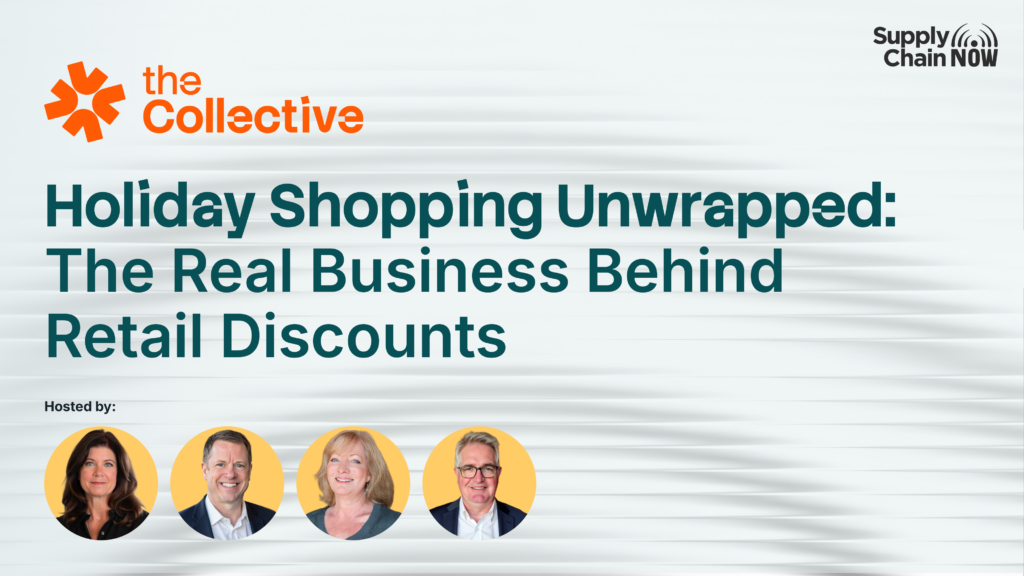
Hi, and welcome to The Collective where we discuss everything supply chain leadership in life. And as the name implies, our podcast brings together four battle-proven e-commerce titans. Collectively, this team architected and built the Amazon that you see today, and they didn’t stop there. These leaders want to lead in trucking, air cargo, luxury retail, and of course, coffee, because you can’t work in Seattle without touching coffee. Now, let me quickly introduce you to our co-host. First up, we have Carrie Morris, global sourcing goddess. She has sourced everything from teak furniture to insulated coffee mugs, and Carrie built Amazon private label from scratch. She introduced their early branch Strathwood and Pinzon and led the first celebrity kitchen co-lab with world famous chef Tom Douglas. Welcome, Carrie.
Kerry Gibson-Morris (01:05):
Hi, Kim. Great to see you.
Kim Reuter (01:07):
I’m so excited that you’re here with such a great topic today.
Kerry Gibson-Morris (01:10):
Oh, so good. And perfect timing.
Kim Reuter (01:13):
All right, we don’t want to spill beans yet. Okay. So second up, we have Jack, our finance guru and army logistics veteran. Jack has built financial models and business plans in just about every industry from truckload carriers to solar panel construction. Jack laid the financial foundation for Amazon’s early import strategies and the Kiva Robotics integration. Welcome, Jack. Hey, Jack.
Jack Mowreader (01:33):
Thanks, Kim. Happy to be here.
Kim Reuter (01:35):
Glad you’re here. All right, let’s bring in our last co-host, Derek Travers. Derek knows everything last mile. Derek has built networks and programs for outbound and inbound and everything in between. Derek led the charge developing Amazon’s last mile delivery and returns program and a little dabble in product fraud in China. Welcome, Derek.
Derreck Travers (01:56):
Hey guys, how are you doing?
Kim Reuter (01:57):
Hey, Derek. This is coming up on your season too, isn’t it? Actually, we’re in it.
Derreck Travers (02:01):
I’ve just got to wait patiently for my turn to talk here. I love this time of year.
Kim Reuter (02:04):
Oh, good. Excellent. We’re going to have plenty of time for you. And last but probably least, I’m your host, Kimberly Reuter. We’ll keep it short and sweet. If it’s shipped across the border, I have probably touched it. I have done everything from server stuck in Singapore, radioactive monkey brains, six karat diamond studs. I have cleared it and moved it. And along the way, I’ve had a hand in building some pretty good tech as well. I’m glad that you were all here. Super excited about our topic today. Welcome to The Collective. Okay, so it’s that time. It’s holiday season. I know. Can we believe it? And it is time for the holiday sales to start. Well, a lot of people probably don’t know that all of that stalking and strategizing you’re doing to try to get that best sale, that might not really truly be a sale.
(02:47):
It may not have really been a true last minute sale. And more than likely the sale that you’re looking at has been planned for months and months and months, if not years, before it actually got to you. So in this episode of The Collective, we lift the veil on holiday sales. Now, unless you work in the industry, you probably don’t know that there’s actually two different types of sales. One is actually called a true inventory adjustment, and these are kind of the sales that we’re used to seeing where they put stuff on the clearance rack. And then there’s this other type called an inspirational sale or also called a market maker. Now, Carrie’s going to talk us into the details of what these are all about, but it’s very important because these two different sales do two entirely different things. We’re also going to get into the finance and logistics aspects, but a little bit of history.
(03:33):
You may not know it, but holiday sales started in the late 1800s and they started in Kansas City with a dry goods company that launched pre-holiday price reductions, and it drove a stampede of sales. And that started the original pre-holiday, pre-Christmas sale. Now this went on and grew and grew until around the 1920s where it really became more people were shopping more, but people really only shopped in a week or two before Christmas. And it wasn’t until 1924 when Macy’s had their first Thanksgiving Day parade. It was actually called the Christmas Parade originally, but Santa arrived at the end and that unofficially marked the official shopping holidays of Christmas, which started in 1924. In 1939, this shopping season was so important that they actually petitioned to move Thanksgiving up a week so they could keep four solid shopping holidays. Now, it turned out that that really didn’t do anything or change shopping behaviors, so they did pass a federal law.
(04:34):
So we don’t move around Thanksgiving anymore, but that is how important this shopping season has become. And let’s not even forget about our famous Black Friday sales now. Those actually started in the ’50s in Philadelphia, and they were so intense and got so out of control that the police had to intervene. Now, I understand that this is also said about Eagles games, so this could just be a Philly thing. I’m not 100% sure. All right, so that’s my only sports joke, okay? So don’t ask for any more. All right, so let’s hear from the team. Carrie, tell us about these two different types of sales, and are there even more that I don’t even know about?
Kerry Gibson-Morris (05:13):
Every day is the day when you can be selling something to a client or a customer. So I consider it a 360-day game, but I will say that there is really unique intentional differences between the two different types of sales. I mean, one of them is actually addressing inventory that you need to move, and there could be so many reasons why you’re trying to move it. You over bought a dog. Yes, there are things out there that we don’t get right. I was thinking about one day I saw on an end cap licorice toothpaste. No thank you. Another time I ran across a fad where somebody had bought a program for yoga pants for their cats and dogs. Again, probably not going to be a barker at the cash register, but these things happen. Sometimes you need to clear space in a warehouse to be able to bring in new and fresh product, and sometimes you’ve just overbought and you were too optimistic about the program.
(06:14):
And so those sales are real and they’re there. And anytime you’re up to one of those unique purchases, you want to take advantage of it and you want to use the tools that are out there to make sure that it’s really a good value and a good discount. The other one though, the inspirational sales, that’s where the merchant starts to come in. That’s where I think about the art and science of merchandising at its best because you are invoking a personal experience or an emotional purchase. And the minute you can have it be more than just dollar and cents, you can increase the spend that your customer makes, you can broaden the assortment that the customer’s purchasing. So those are really important. But I’m going to do a little retro for you as well, Kim, because for me, as much as I’d like to think that I was part of the cutting edge of curated inspirational sales, catalog industry, the fashion magazine industry, the front window of Macy’s store was already doing inspirational sales.
(07:18):
They were putting together curated assortments that wanted you to buy the whole outfit or the whole kitchen or everything that was being merchandised in there. And that is really what inspirational shopping, when you’re looking at a sale like that is doing, is it’s helping you with decision making, but on the back end, we’re hoping you’re going to buy it all because that means we’ll get a higher register ring through our cash. Good stuff, really good stuff.
Kim Reuter (07:45):
So tell us about what goes into planning out an inspirational sale. So walk us through how many months are these planned? Are brands part of it? What is actually going on when we have an inspirational or a market making sale? You talked a little bit about getting people to buy a suite of things. Tell us a little bit more.
Kerry Gibson-Morris (08:03):
Well, one of the things that is so powerful about this type of merchandising, not only does it get the customer excited, which is your end goal always to buy more, it’s also allowing you to have a multi-level strategy. So there’s going to be a hero skew in there. There is going to be one item or two that are going to be a really exciting kind of draw the customer in. And that skew is going to be something that’s probably planned 12, 18 months, maybe two years. You’re going to be looking for either a very strategic brand that’s recognized by the consumer and that takes time to romance and bring that brand along to be part of that sale. It’s not all want to offer a discount on their branded product, or you’re going to be going out to find a really trend or deep discounted item that’s going to make a really great value proposition to the client or customer, but it’s also going to make you margin, going to make you revenue off of this product.
(09:05):
So that hero is the core item. Consumer never knows which one that is though. That’s kind of the modeling here that’s interesting. You could put into an inspirational assortment excess inventory like I talked about earlier. Why not if you’re doing a go ski or go bundle up in a cabin for the winter, the hat might be the key hero item, but the gloves could very well be excess inventory. You’re also going to put in some core items to kind of round out the program and you’re looking at it in two ways. The first way is you’re making sure you have the right assortment that’s going to be inspirational and exciting for the client or customer to buy. But on the other side, you want to be blending your margins so at the end of the day, you’re making the right profit on that assortment. And the risk or the gamble to a retailer is you don’t know if the customer’s going to buy all of those items.
(10:02):
In the perfect model, they buy it all and your margin’s fantastic. But if they start to cherry-pick into that assortment, then you always are going to have exposure in that particular scenario.
Kim Reuter (10:15):
Yes. So I had no idea all of that went into it. The core, the hero, it all makes sense. So tell me a little bit though, I’m going to take you a little bit, I didn’t quite prepare you for this one, but you and I were around for the Elmo days. What creates an Elmo situation?
Kerry Gibson-Morris (10:32):
I will say the first time I saw Devil Wears Prada, which yes, plug for a show, it was such an eye-opening moment for people. Marketing has already decided what you’re going to fall in love with years before you know it. They’re going to tell you you’re going to fall in love with Elmo, and they’re going to position it as the hero and put their innovation and marketing and TV campaigns and cartoons. They’re going to throw everything in the kitchen sink to make that the hero product. Now again, you have the power of influencing a consumer, but you can’t always guarantee they will be influenced. But the right kind of combination of the right product at the right time at the right price and then a whole bunch of marketing love all around it, you’re going to create that frenzy on that item. And by the way, we’re not always right.
(11:28):
There’s a lot of heroes that don’t make that
Kim Reuter (11:33):
Were zeros as it turns out. All right, great. So Derek, let’s start with you. What did you hear there from Carrie about the sales?
Derreck Travers (11:44):
The last one you brought up there was really interesting. I’m wondering though, more recently, when I say more recently, say the last five, six years, how much does impromptu promotions work? So I’m thinking, for example, the lady with the Chebaka mask a few years ago, and that was like nobody was planning on Chebaka masks being a hot item, but all of a sudden they were. From a planning perspective and such, how does merchandisers think about that or think through that?
Kerry Gibson-Morris (12:10):
Merchandising is such a great chase game. You’re chasing for the win that I think there’s always that opportunity to be chasing. I can’t speak specifically about that, but I can tell you a lot of influencers, a lot of TikTokers are actually being fed product through marketing channels.
Kim Reuter (12:31):
And
Kerry Gibson-Morris (12:31):
So they appear to be, look at this amazing, what, that cry wolf t-shirt that came out where everybody and their brother had to have that t-shirt, Amazon was printing them on the demand. There’s always kind of this marketing push that’s pushing some of this product out to influencers to hope that they’ll pick it up and they’ll run with it. So there is kind of that balance. Some of it is kind of created in its own space and others is truly like, can we move fast and can we get our hands on those products?
Kim Reuter (13:03):
Good stuff. Anything else there, Derek?
Derreck Travers (13:05):
No, that was just something that came to my mind.
Kim Reuter (13:07):
It’s great. It really is a great, great, great question. I’m glad you asked it. Jack, what do you have to add here?
Jack Mowreader (13:13):
Well, I think it’s just really interesting when you take a look at these sales, I mean obviously we’re on a supply chain, we’re on a podcast talking about supply chain and all those things. You really have to think about how are you marrying those marketing things with the supply chain and what level of communication are you having and how is that interaction going? Because I’m reflecting back on our time, you might have that hero, but that hero only lasts for so long and you’ve got to cut it off because you either don’t know what that demand is going to be like. You think it’s the hero and you want to curb your buying or you’re saying, “I only want to sell so many of these things because I’ve already created that frenzy, that excitement, all of that, and I don’t want to break my backend.
(13:57):
I don’t want to break my supply chain and I want them to move to something else.” So it’s all of that coordination that comes into what are the objectives? And I know that we’ll talk a little bit more about this detail, but that’s the really cool thing. It’s like you’ve got this marketing size, but you have all of the stuff behind it. How are you measuring all of those things? And so I’m with Derek. I mean, this is just an exciting time to really get all of the pieces together and really have a great strategy discussion.
Kim Reuter (14:25):
That’s awesome. Great, great questions. Carrie, anything else you want to add before we hop on over to Derek?
Kerry Gibson-Morris (14:31):
I think the only other thing that I ran across as I was looking and preparing for this topic was I had an old favorite that I used back in the days at Amazon called Camel, Camel, Camel. And it’s still well before AI came about in 2008, they launched this search pricing tool on Amazon’s platform. And if people are not using Camel, Camel, Camel, it is still the number one ranked price engine. It is not an affiliate of Amazon. They’re not anywhere connected, and it’s just such a powerful tool. I used to use it to check my team to make sure my team was competitive every morning.
Kim Reuter (15:16):
Nice. All right. You heard it here first out there at Camel, Camel, Camel to see what’s going on with pricing. Thanks, Carrie, for that tip. Awesome. So up next, we actually have Jack. I said, Derek, we’re going to go to Jack first and we’re going to hear about the finance perspective. So sales always has a financial impact, we know this, but sometimes it’s good, not necessarily always bad. Jack, tell us a little bit about sales and what’s the financial impact for each one of these type of sales?
Jack Mowreader (15:43):
Well, gosh, we don’t have enough time to talk about all of these different aspects, but I mean, if I’m just looking at the topics that Carrie talked about, it’s are we talking about we’re clearing inventory to make room for new inventory, right? That starts really early in that planning cycle, just like Carrie was talking about years in advance you’re working for your hero. I mean, when you come into the summer, you need to know how are you preparing for that winter and what are you looking at? And you’re constantly looking at your inventory. How’s it sitting? What’s it looking like? Is it aging out? How big is it? How much money’s tied up there? And then what’s coming in? I mean, Kim, you and I, when we were doing imports from China, I mean, it would be January, February, we’re buying all the toys that are coming in.
(16:33):
And so we knew how many containers were coming in and we had to make space for it and we were making… I mean, it was like a collision path, right? It’s all of these containers coming into the network. Do I have a place to put them? And so that starts the time bomb because we’re talking about what’s the inventory carrying cost? How long does it take to come in? I mean, are you going to store it? Are you going to sell it? What’s your next best option for that inventory? I mean, I think that’s a really great aspect. The other piece is when you’re talking about these inspirational sales, are you looking at measuring that direct impact of that margin that Carrie’s talking about? Are we maximizing that hero? Did we get discounts from the suppliers, manufacturers to make that our price point and then everything else is overflow?
(17:22):
Or are we really looking at that as the loss leader and we’re looking at bundling, we’re looking at complimentary things, we’re trying to drive traffic? What is the objective? I think it really goes back to say you really have to be clear on the objectives of what the sale is trying to accomplish, making sure you have clear KPIs around it, everybody’s aligned with those objectives, and you’re also aligned with the volume, timing, all of those things because they all play in, especially when you’re talking about supply chain, you’re looking at product placement on the pages, right, Carrie, where you’re fighting for that space on there. And then you’re also fighting for the timing of when it’s going to come out and what’s your workforce look like and when can you push that out and what time of year it is because your delivery lead times look different at different times of the year.
(18:15):
So all of those things, and that’s what the part that’s so exciting is that no one sale is necessarily the same. They have similar characteristics if you bundle them into different categories, but from a finance perspective, really trying to drill into a mature marketer will have these internal conversations. Somebody else might just say, “Hey, I feel like having a sale today and I don’t know what’s going to happen, but I’m just going to blow it out and we’re going to see what it does to the market.” And depending on the maturity of the organization that you’re in, you’re going to see that coordination at much different levels.
Kim Reuter (18:50):
Yeah. So you brought up a really interesting point that I wanted to dig on a little bit. You talked about the direct impact of a sale. So there are indirect impacts of a sale as well. So when we think about sales, we almost always think about the financial aspects of it. They’ve marked the price down, our margins have gone down, or maybe the margin is even better. There are situations where, Carrie, you probably know about this or can comment on this, where they run a sale and actually make more margin because they’ve worked out a deal with the brand. To the consumer, it’s cheaper, it’s 20% cheaper, but the deal that worked out in
Kerry Gibson-Morris (19:24):
That
Kim Reuter (19:24):
Back end
Kerry Gibson-Morris (19:25):
Is
Kim Reuter (19:25):
Actually much more profitable than it would’ve been at
Kerry Gibson-Morris (19:28):
A
Kim Reuter (19:28):
Full price.
Kerry Gibson-Morris (19:28):
Yes, absolutely.
Kim Reuter (19:30):
So that happens quite often. So it sometimes is a financial piece of it, but Jack, do you feel like there are other impacts of a sale? Do you believe that it helps out with loyalty and things like that? I know that’s a little hard from a finance perspective, but I know you have a perspective on this.
Jack Mowreader (19:46):
No, I mean, it is. I mean, it’s all intertwined. I mean, we go back, I mean, how many times we’re going to refer back to our Amazon days, but it’s the flywheel effect, right? It’s what’s your customer acquisition? Where are you at with your company and how much does it cost for you to acquire? It might be cheaper for you to bring bodies through the door virtually by just buying that goodwill or buying that entry into your storefront. And I think that that’s one aspect. Is it customer acquisition? Is that what you’re going for? Is it brand recognition? Are you going to do this hero product, but then you’re going to discover that you have different colors and shapes and sizes and maybe you get more margin on those and you’re going to get somebody switching. So it’s that loss leader, it’s the Hyundai that is on the lot for 499, and then you come in and you up switch them to another brand.
(20:40):
So what is that that you’re trying to do and what’s that impact? And then also, what’s the retention rate of that customer when they’re coming through and are they going to be sticky or are they going to be very transactional? And I think depending on what you’re selling and what you’re offering, you’re probably going to get a different result because you might find that some items are stickier to retain that customer and they might come back, especially if you’re a specialty retailer or somebody like that. So I think that really to answer your question, there’s so many different layers, but you really need to talk about what is your real time, what’s your overflow into other products, and then what is your long-term retention because those can all play into it. And then that flywheel, it’s more customers, better selections, lower prices, and you’re just turning on that and you can create quite a lot of synergy if you do it right.
Kim Reuter (21:40):
Yeah. I think the thing that I heard from you that really stuck with me is to understand the goal of the sale.
Jack Mowreader (21:45):
It is, absolutely.
Kim Reuter (21:46):
Yeah. Is it loyalty? Is it brand? Is it move inventory? Is it inspire? What are we trying to accomplish? That’s a really good point. So Derek, we’re going to start with you. What did you hear there from Jack?
Derreck Travers (21:58):
Yeah, I think the one thing that stuck out to me that was talking about is with the loyalty programs and how that can help generate sales. So that’s a great mechanism about getting customers to the store, I guess you could say, and start to look around. I kind of wonder sometimes about whether merchandise and stuff, what discipline or what guardrails do they have in place there to ensure that things aren’t being lost at a terrible loss or something like that. And I’m kind of trying to get my head wrapped around how can finance support that?
Jack Mowreader (22:28):
Yeah, I mean, I think that’s great. I think one of the things that I was talking about when I was referring to carry sales is you probably need to have a target number and say, “I’m willing to maybe lose this much,” just like you’re talking about a marketing campaign. It’s like, “All right, I’m going to lose a dollar on every product, but I know that I’m going to create enough traffic that I’m going to do a hundred thousand of these and that’s my bottom line and I’m going to cap it or you’re going to look at it in a different way in that maybe it’s part of a bundle and you’re going to lose it on one product, but get it back on another.” And so I think that’s where that conversation happens where you’re collaborating on the result and your partner can help quantify what that’s going to look like and you can mitigate the risk or eliminate it by doing those caps.
(23:18):
And so that’s really, I mean, I went back to our last podcast that we did. It’s just that collaboration between divisions and they all play together. And if you’re working in a silo, you’re going to get siloed results.
Kim Reuter (23:32):
Carrie, before I get your take on Jack, something just occurred to me, and you will know this as well, is that I believe Nordstrom is the only company that has a sale and then marks it up after.
Kerry Gibson-Morris (23:43):
No, no, that is a very normal mark it up, mark it down, mark it back up. Oh no, there’s elasticity to a price, which is why looking at some of these pricing engine sites can actually show you where that product is actually having that elasticity moment.
Kim Reuter (24:02):
Yeah. All right, good. All right, so Carrie, tell us what you hear from Jack there.
Kerry Gibson-Morris (24:06):
So I really honed in on the stickiness of the customer. I mean, for me, that is something that how you’re merchandising and the types of sales you’re choosing are actually driving that behavior. And I think about all of the above. You want to have a single loss leader, you want to have a hero item, you want to have inspirational curated assortments because for me personally, I found myself in a couple organizations where it was a race to the bottom. And what happens is that customer is honestly, I hate to use the word, but I used to call them bottom feeders. They have no loyalty to the brand. They have no loyalty to your site. They’re just sheer bargain hunters, and they’ll go and look in many different places to find that price. And that’s fine. There’s room for everybody’s shopping behavior, but if that’s your whole model, you’re going to have a really hard time with retention and repeat and loyalty, which is honestly the whole reason why a sale is even there is to be able to drive excitement and bring a repeat customer back into your store.
Kim Reuter (25:22):
Good stuff. Jack, anything else you want to add before we jump over to Derek?
Jack Mowreader (25:25):
No, I’m really interested to see what Derek’s going to have.
Kim Reuter (25:27):
All right. Derek, logistics. Now I know that you’ve been through this, I’ve been through this. So tell me what happens in logistics when we have a sale?
Derreck Travers (25:38):
Yeah, there’s three things that come to mind. I think for the first one is if you look at the promotion event, it’s one part of it, but if you can’t deliver it to the customer and deliver it to them on time, you’ll lose trust from the customer almost right away. And that’s what’s really great about Peak because there’s actually a deadline when everything has to be delivered by and everything has to be there ready for the 25th because that’s the main event. And what’s interesting with a lot of customers is they tend to be a little
Intro/Outro (26:06):
Bit
Derreck Travers (26:07):
Patient. If stuff takes a little bit longer than normal than they’re used to from a particular seller, they’re fine with that as long as it doesn’t get there too late. I think the other part too is it’s really interesting is if you look at different sellers, how they go about committing as to when something will be delivered by, and that kind of ties back into the promotion and the planning that goes into place where a particular item that’s promotional is fulfillment going to prioritize fulfilling those orders versus let’s call it the bottom feeder type products, if you would. And so there’s a lot of coordination. I would say 15 years ago, a lot of this was, I think a lot of people were panicking and trying to figure it out as they go, but it’s pretty impressive with the industry in general how much it’s matured and reliable.
(26:49):
I think this year they’re expecting what the NRF is expecting sales to be kind of flat from last year, I think the last one I read. So from a transportation perspective or even a broader supply chain perspective, I think everyone looks to be in good shape this year. They just have to repeat what they did last year.
Kim Reuter (27:07):
Yeah, there’s hopefully not going to be any sneakies this year. Barring weather, that’s the only thing.
Derreck Travers (27:12):
Well, that’s always the wild card, right?
Kim Reuter (27:14):
That’s always the wild card on that particular piece. All right, so we talked about logistics and actually getting it there to the customer is a really important part of that. And so a lot of times what happens when we do these inventory level sales though is that logistics may not be part of the decision. And then there’s a sale that it’s just, and I know we’ve all kind of lived through these, but Derek, tell us a little bit about that and what can companies do to avoid that?
Derreck Travers (27:40):
Well, I think, and again, this echoes to what Jack was saying earlier, as far as just a lot of coordinating and planning with each other across our different divisions or groups and upward these silos and such. I can’t even stress this enough. It goes pretty good for a lot of these companies. They plan and they coordinate really well. What’s great about on the supply chain side, you’re moving boxes. It doesn’t matter what the item is. It’s in a building and it has to get to the right place. Where they can get into a sticky spot is inventory placement. They have multiple locations and I think everybody does the best they can to figure out how much product to put in what warehouse to minimize expenses, but it’s really tough. No one’s really good at it to be candid. And so that’s where it can kind of, in Jack’s world, kind of turn things upside down where if you’re planning supply chain expenses to be say eight, nine, 10% of the cost of sales, and then all of a sudden you’re long zoning stuff and it increases up to 15 or 20%, that’s where you can get backwards really quickly.
Kim Reuter (28:40):
Yeah. Tell us a little bit more about that because that’s really interesting and it’s another thing people don’t really understand. So tell us a little bit more about that inventory placement and why it’s so key.
Derreck Travers (28:50):
Generally speaking, roughly about 40% of all customers that shop online are in the Northeast. You have roughly about 20% in the Southwest, so call that San Francisco, LA, Phoenix. You got maybe 10% in Florida, maybe another 10% in California, or excuse me, Texas, another 10 maybe up in Chicago, and then everything else fills in the gap. So if you have a warehouse, let’s say in Carlisle, Pennsylvania, and you’re going to be focused on customers in the Northeast there, but all of a sudden the warehouse is focusing on customers say in LA, they run out of inventory for that particular ski or ASIN. Also, now you go from a zone two to a zone eight and expenses will go anywhere from probably close to 10, 12 bucks more a package depending on who your service provider is. So it gets really tough. And the other kind of tough part too in transportation expenses specifically is carriers have introduced a surcharge for shipping at peak.
(29:47):
So if you almost can imagine it’s your one time a year where you’re going to… In a lot of companies it’s make or break you, but now all of a sudden they’re adding 20, 25% to the cost of that bill and your transportation expenses… Typically are the second or third highest on a P&L. So it’s so important to make sure we get the inventory at the right location to lower the distance traveled, which will drive down the cost. And if it goes backwards, yeah, it’s not just the added base freight, the longer transit time, but also these asset serials start to pick up on top of that.
Kim Reuter (30:19):
Yeah. And that’s really an excellent point. And I want to hear Jack’s thoughts on that in a minute because we don’t think about the logistics costs and you make an excellent point. And as you run through your sale, you get less and less skews, right? That’s the whole point. So you get less and less optimized inventory. So to your point, you almost get to a point where you are upside down because you’ve lowered the price so low and inventory is so scattered across the country that your logistics costs are eating up pretty much any margin you’re going to get out of it at that point. So that’s an excellent point. So we talked a lot about outbound. I know that you are also a returns guru. So tell us a little bit about, we are all excited it’s all getting sold. What’s going to happen in January?
Derreck Travers (31:01):
Returns is the greatest opportunity to instill trust in the customer. Unfortunately, what always happens is the third week of December or the early part of January, everyone’s newsfeeds are being fed up about returns and the added expense and such. And there’s a lot of reasons why customers return stuff, but I think the industry has gotten pretty mature where they look at it now as a cost of business. But as you look throughout the year, first quarter, always the focus shifts from peak demand sales to how do we prevent returns or how do we minimize returns from coming back? And really the dirty secret on the returns is that you can have stuff that comes back. Doesn’t mean that you need to discount it to resell it again. In fact, the reality is probably a third of all returns come back just because the product wasn’t able to be delivered to the customer for different reasons.
(31:49):
So it’s literally like a brand new product. It’s taken a little bit of a tour around the country a little bit. So those companies that really focus in on the returns processing and grading the item well and then being able to turn around and sell that again, if they can do that really effectively, they really minimize that expense. But I can tell you stories where I’ve seen return centers that were still processing returns in August from Christmas just because they didn’t put a top priority on it. And you stop to think about the expense of that item sitting there or think of it like a bag of cash. It’s just sitting there and you can’t do anything with it as well as the betrayal to the customer as far as getting the refunds to them.
Kim Reuter (32:29):
Yeah. So when I worked at Nordstrom, these numbers are a little bit dated, but their return rate averaged about 70% because they sold a lot of shoes. Yeah. And what people do when they buy shoes is they buy their size and a size up or a size down because they’re not sure. So it’s almost always going to be a return on a shoe shipment. And with that level of returns, there’s a lot of stuff sitting ready to get processed in store basements, in back rooms, in warehouses, sitting in trucks, in trailers, in truck yards, everywhere. At one point, there was hundreds of millions of dollars of inventory in what we call this return black hole because you can’t sell it, you don’t know where it is, you don’t know what condition it is, you don’t know when you’re going to get it back. And it’s just, as you said, just bags of cash just sitting in trailers waiting to get processed.
(33:24):
And I still don’t understand to this day why it is not a priority to process that inventory. Do you have any thoughts on that?
Derreck Travers (33:30):
I think a lot of it comes down to budgeting. So they budget a lot of labor for the fourth quarter, and of course returns happen in the first quarter. So there’s some budgeting issues there. I would say when I was first introduced to returns to what I see now across many sellers, it’s gotten much better. Even a lot of these sellers or shippers have gotten more sophisticated that once something’s been received from a carrier and they send off their receive scan, they’ll actually refund the customer quickly instead of waiting for it to be processed. And they got guardrails in place that if someone ships a box of sand, then they’ll recharge the credit instrument again and get their money for it. But I know I think we’re going to be talking about returns in future episodes, so I hope our audience here is very anxious and waiting to hear what we talk about that.
(34:16):
But I go back to thinking about returns. It’s actually a really great opportunity to further instill trust with the customer, not just by offering a great promotion that they’re going to love and remember, but also having it be somewhat of a pleasant experience that, hey, no risk. If you don’t like it, send it back.
Kim Reuter (34:32):
Yeah. UPS had a statistic a few years ago that said 80% of all new customers check the return policy before they make a purchase. They want to make sure they’re not getting themselves into a sticky situation. So to your point, the return policy drives the decision to make a purchase.
Derreck Travers (34:46):
Yeah, absolutely.
Kim Reuter (34:47):
Awesome perspective. Thanks, Derek. Jack, let’s start with you. What are your thoughts on what Derek had to say there?
Jack Mowreader (34:52):
Well, there’s a lot to dig into, but I’m thinking about the returns policy, that’s also part of your sale process because it’s like, so if I’m getting rid of inventory, I’m trying to get rid of my summer inner tubes and I don’t want them back, do I have a separate return policy for something like that or do I limit that? Or what does that look like? Did they have to pay postage back? So as a retailer, you have to do that. But I’m also talking about Derek’s, it is really a comfort thing. It’s the Zappos, Nordstrom, “Hey, I’m going to buy more because there’s trust there.” So you have to weigh those two things because they both have an economic impact. Are you giving up revenue to save on returns or are you taking some return risk? And then you said something interesting, Derek, and I’d probably tweak the wording a little bit.
(35:43):
You said budgeting for it, but really it’s prioritization, isn’t it? Because you say, “I’m going to get everything out, but I don’t care. It’s going to come back in and I’m just going to deal with it.” So that budgeting is really allowed through a prioritization that says, “I’m going to prioritize returns.” And I’d say that for the early part of Amazon, we just didn’t even know what to do with it. I mean, we had those same things. We had bounds, we’d send it back to Reno or whatever, and we’d have a return center. And it took a long time to really get that working. And Derek, you’re in the midst of that and trying to figure all of that out. But I think now it’s matured enough that there’s a process around that and it’s just like, “Hey, that’s just the cost of doing business.
(36:24):
I’m going to prioritize it on the front end just as I am the backend. I’m not going to turn around and make it a part of my business model.” So is that fair? I mean, it’s really a prioritization issue.
Derreck Travers (36:34):
Yeah. And that’s what budgets do. It’s a prioritization of what you’re going to spend your money towards and such. But yeah, I agree. But again, I’m just really proud of the industry in general. If we all think back when we were in the fire of it all 20 years ago or whenever it was, and we look at how mature the whole industry is now, I’m actually pretty proud of what’s happened.
Kim Reuter (36:55):
Yeah, it’s way better. We used to wait two weeks for a return to get your money back. And that is unacceptable in today’s standards. So there’s one thing, Derek and Jack, I want to get your point of view on if you have a point of view. And that is there’s this new thing now with returns where they’re like, “You don’t need to send it back. We’ll just give you some of your money back.” Have you guys seen this yet? Yeah. So tell me about that. What is driving that?
Derreck Travers (37:18):
So maybe a little bit of a selfless plug. I was actually part of the team at Amazon that introduced returnless returns or this instant refunds. So what we did is we developed the capability that on the online return center, when a customer was going through and putting in their reasons why they’re returning in and what they’re returning, we would then calculate the expense to have that product come back to us, processed, put it back on the shelf, and then as well as the expense to resell it again. And then we, like anything else, there’s some trust factors you put into your customer if you’re going to be frauded out or something like that, but you factor that in together. We actually got really good at that. And if you think about it, if you’re trying to return a… I’m just trying to look here, this little fidget spinner that Carrie made a name for it back in the day.
(38:07):
If you buy this for eight bucks and you’re going to return it and everything’s going to cost you close to 20 bucks, why would you do that? The partial return is interesting and I don’t know much about that. My guess is to create a little bit of friction to have the customer second guess whether or not they want to return it or not. I’m taking a wild stab at it. It’d be interesting to know if there was a financial aspect to that or a psychological aspect to it, but my guess is they’re trying to do return avoidance if possible.
Kim Reuter (38:38):
Yeah. To your point, it’s going to cost us so much to get this back. We’ll give you 35 bucks if you want to keep it.
Derreck Travers (38:45):
Or just keep it. We won’t give you anything.
Kim Reuter (38:46):
Or just keep it. Yeah. Oh, we’ll refund you $35 and not a full refund, a partial refund. All right, Jack, you look like you got something to say.
Jack Mowreader (38:58):
Yeah. I mean, gosh, this is really interesting because I’ve had a lot of different experiences as we all have buying online. I had some cabinets that came from Home Depot and they came nicked up. I mean, these are big cabinets and I got into negotiation on the phone. I was like, “How bad is that Nick? Is that a $200 Nick or is it a $400 Nick?” Because they didn’t want it back. They just wanted it to stay in my house and then give me something to compensate me for that. So I think that was some kind of a piece that you’re talking about. But on the flip side, I had some cabinet doors from Wayfair and there was a little bit of scratch and a ding and no questions asked. They just sent me out a new one. Those were pretty expensive. And so I was anticipating some kind of similar negotiation.
(39:48):
So it’s really about your customer experience and what you’re expecting and how you’ve built it in. They probably said, “Hey, there’s a certain percentage that I’m just going to write off and that’s just part of it.” But this interesting thing is this variable that says, “How bad do you want it?” Maybe that t-shirt doesn’t fit me great, but if it’s a $10 t-shirt, I don’t want it. But if it’s a $2 t-shirt, sure, I’ll keep it. And so that’s really that sensitivity around the customer because let’s face it, a lot of these things are really expensive and you get them there and maybe it’s not exactly what they want, but for a discount, they’ll keep it and they’ll be satisfied, right?
Kim Reuter (40:26):
Yeah, they’ll be all right with it. So are you doing a kitchen remodel it sounds like potentially here?
Jack Mowreader (40:31):
I’ve done a couple remodels. Yeah, sure.
Kim Reuter (40:33):
All right, Carrie, I know you have a lot to say about this. Let’s hear it.
Kerry Gibson-Morris (40:38):
Well, first of all, kudos to Derek. I didn’t know I’d enjoy a return conversation so much, but just really so many things to think about. I think of returns and how we manage it as a margin recovery moment because there’s things that the merchants do upfront and then there’s a lot of magic that’s happening in the backend that you guys were just sharing, both Derek and Jack. For me, the perspective of what’s the role that a merchant plays is how do we build into our margin expectations what that recovery could be? And so we do actually embed into the margin a return kind of percentage. So you can track and analyze by category. So to your point, shoes are probably the worst, but there’s things where the return rate is virtually under 1%, and so you can actually build that into your margin economics to absorb that return impact.
(41:37):
Also, you want your contract to have a defect percentage rate with the manufacturer or the brand, so you want to recover there as well. Anything that comes back in that was because of manufacturing defects, you are paying for it, not the retailer. And so there’s recovery steps that can happen. And at the end of the day, I remember when the warehouse deals launched at Amazon, it actually became a revenue margin enhancer, not just a recovery model. So it was actually taking returns, inspecting them in good condition, reselling them at the full margin, and you actually started to see a profit line start to come out of all of those economics together.
Kim Reuter (42:24):
Yeah, I forgot about warehouse deals, that that was Amazon’s kind of first foray into reselling return product. Yeah, that was okay. And you still can, by the way, people out there, if you don’t know, you can still go on Amazon and buy used or warehouse deal products. You just have to click on the other purchase options and it’ll show those to you. But yeah, I forgot about that. And that was truly, I think, Derek, we were all kind of part of those conversations in the early days too, what do we do with this stuff?
Derreck Travers (42:54):
Yeah. And again, we’re kind of getting off topic here, but I’ll just say real quick here, there was part of a great opportunity where we actually reduced touches in that whole process that actually helped us get to the point where we’re selling close to 60% of everything at full price and it was only touched once at the return step. Warehouse deals was a second step from that. So you add more cost to that and everything. And some of my fondest times at Amazon was in returns and there were some, I would say today there were just some stupid things we were doing that we stopped doing.
Kim Reuter (43:27):
Oh, like 365-day returns?
Derreck Travers (43:30):
Well, yeah, but again, I echo what Jack said earlier, helping all the different groups and stakeholders get aligned to a common focus and start doing the right things, it’s super powerful what you can do.
Kim Reuter (43:41):
Yeah, it is. And you’re right, we went down the returns rabbit hole there a little bit, but it’s a huge part of the holidays. And that’s why I wanted to make sure that we talk about it because when we’re running into the holidays, we’re not thinking about what’s going to happen in January. And then it almost always sneaks up on everybody when it does sort of peak and it’s disturbing and it does actually have a material impact to people’s revenue. And that’s why as Carrie pointed out, they bake it into their margin and into their product margins when they’re doing the whole gig in the beginning. So good stuff. So this was an amazing conversation about holidays. And Derek, do you want to add anything else before we wrap up? Or Carrie, did you have any more comments?
Derreck Travers (44:19):
I’ll just say one last thing here if I could. I think for a lot of shippers, they think of peak ends on December 23rd. The reality is it ends December 30th, or excuse me, January 30th, and that’s after the return season.
Kim Reuter (44:31):
Yeah, that’s a good point. That’s a really good point. Carrie?
Kerry Gibson-Morris (44:34):
No, I love the topic. Thank you for bringing it forward, Kimberly.
Kim Reuter (44:37):
Well, after all of that, I still believe in Santa Claus, but I want to thank our members of the Collective for sharing their perspectives. And if you are interested in appearing on The Collective, please get in touch with us. We are currently taking guests in sponsorship, and we would love to talk to you about what you’ve got going on in your business, and we can share our perspectives. And if you’re interested also in being Supply Chain Now, you can get in touch with us. Now, hopefully you learned something today, something good, something useful. As you know here at Supply Chain Now, we like to say deeds, not words. And I always like to encourage everyone, if you learned something today, go out, apply it in the world, do something good, and remember to always leave it better than you found it. Thank you.
Intro/Outro (45:18):
Join the Supply Chain Now community for more supply chain perspectives, news, and innovation. Check out supplychainnow.com, subscribe to Supply Chain Now on YouTube, and follow and listen to Supply Chain Now wherever you get your podcasts.