Intro/Outro (00:00:02):
Welcome to Logistics With Purpose, presented by Vector Global Logistics in partnership with Supply Chain Now. We spotlight and celebrate organizations who are dedicated to creating a positive impact. Join us for this behind the scenes glimpse of the origin stories, change making progress and future plans of organizations who are actively making a difference. Our goal isn’t just to entertain you, but to inspire you to go out and change the world. And now here’s today’s episode of Logistics with Purpose.
Enrique Alvarez (00:00:34):
Good morning, good morning, good day. My name’s Enrique Alvarez. I’m the co-host of Logistics with Purpose and I am here with another amazing episode. Christie, good morning. How are you doing today? We have an amazing show.
Kristi Porter (00:00:48):
We do. This is one of those times where we have had a little time with them in advance, know how fun and smart they are. And so we are anticipating a great conversation and the other side of the coin is they’ve known each other forever, so we really also don’t know what’s going to come out here.
Enrique Alvarez (00:01:04):
We had a great prep call yesterday and it was fun and exciting. And I’m very certain that everyone listening to this episode’s going to get away with something meaningful, impactful, and of course very interesting delivered by what they sound to me. Christia’s really good friends on top of Colleague. It was fun. Again, welcome everyone and Christie. Without further ado, I will let you do the honors.
Kristi Porter (00:01:25):
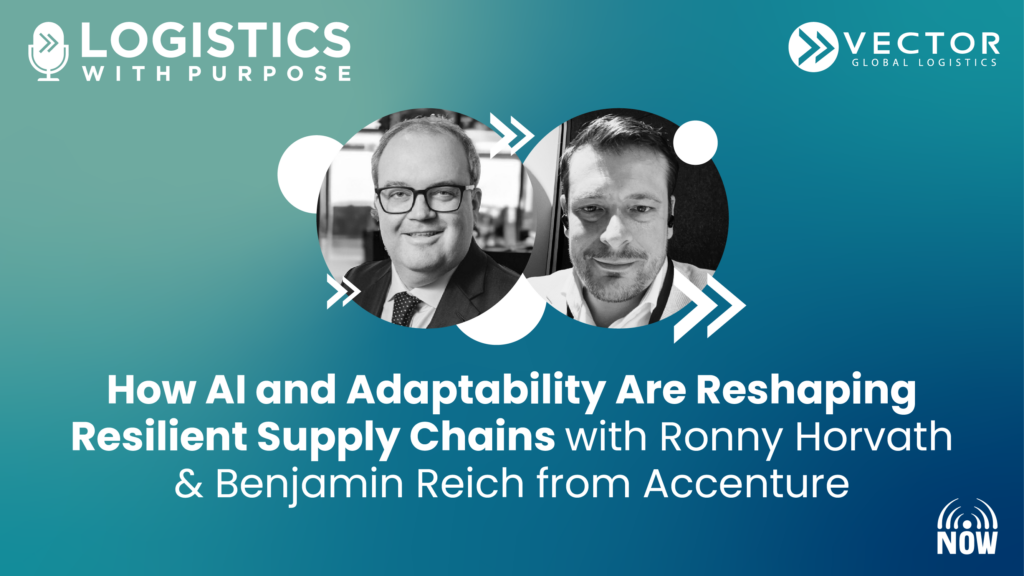
Yes. So today we have the pleasure of being joined by Ronnie Horvett and Benjamin Reich from Accenture and they are at the forefront of supply chain transformation. So first up, Benjamin Riku leads Accenture’s logistics and fulfillment business across the Americas. He works closely with global organizations to think about how our logistics operate end to end from warehousing and transportation to global trade and fulfillment. Of course, these days leveraging digital platforms, AI-driven control towers and automation to drive both performance and resilience. And if any of those topics sound interesting to you, we’re definitely going to get into them. And then of course we have his partner in crime, Ronnie Corp, managing director at Accenture with over 18 years of experience leading large scale supply chain and transformations across North America, Europe, Middle East, and Africa. Ronnie brings deep expertise in enterprise logistics, warehousing, and order management, helping organizations execute complex change at scale.
(00:02:22):
And of course, everyone knows Accenture’s stellar reputation, so this is going to be a terrific conversation. Benjamin, Ronnie, thank you so much for your time and joining us. We’re excited to chat with you.
Benjamin Reich (00:02:33):
Yeah, thank you so much for having us. And Chrissy, we should use you as a promoter. This was spot on. Ever introduced us in any better way.
Ronny Horvath (00:02:41):
Yeah, I like how you both set the bar very high. It’s going to be really interesting. Everybody will have so much value out of this and we will have fun. So I don’t know if it makes all of it, but it’s good. Let’s do it.
Enrique Alvarez (00:02:51):
I feel confident that you guys will deliver. So don’t worry about it at all. I think that it’s been going to be a good show. And of course you guys are so experienced in the industry and you have seen many, many clients and many, many different situations that I think that we’re going to be able to extract a little bit of your expertise and convert it into actionable feedback for our listeners today. And of course, Accenture, as most people know, is helping companies adapt and reinvent. And that’s going to be a big, big topic not only for today’s conversation with you too, but then also a big topic for supply chains around the world right now. And so I would like to start by asking you, how would you define your role in helping organizations evolve? I mean, for people that don’t necessarily know what you do or how you do it, what gives that work meaning for you personally and beyond the results?
(00:03:42):
And I’ll start with you, Benjamin, and then I’ll move on too.
Benjamin Reich (00:03:45):
That’s a great question. I would say everything I liked on my leisure time, I was grateful to see that in my business role as well. So we actually help companies to evolve from seeing logistics as a cost center into logistics as a more strategic capability. So that means that connecting warehouses, the transportation piece of it, the fulfillment, the global trade, automation, data and AI, and build that all into an operating model that is stronger and easier for people to execute. And that sounds very complex and like a very business-driven answer, but what gives it meaning personally is that logistics touches real lives every day. So when logistics works, you don’t see it, you don’t hear it, you don’t smell and feel it. But when medicine arrives, factories run, shelves are stocked and communities are supported. This is where I’m very grateful. So every time I’m ordering something at a global retailer and it arrives at time in my front door, I’m just excited because I know what’s happening in the background to make this happen.
(00:04:44):
So yeah, this is how I would describe it.
Enrique Alvarez (00:04:46):
Ronnie, go ahead. I’ll tell us your take on what you do and your role is and how you actually help companies evolve beyond what they have now.
Ronny Horvath (00:04:55):
Yeah. For me, I always think about my role is to help our clients and with that organizations to become more … And Benny will not like that word resilient because we heard that word every time. There was a time when supply chain was all about cost and making it more efficient. Now it’s making it more resilient. It’s not that much about costs anymore. It’s still important, but I think everybody understood that they have to be more adaptable in a world where disruption just became normal. And I think this is where we can really see the value that we can bring to these clients that we have. And what gives the word meaning for myself, it’s just to see beyond financial metrics because that was typically, as I mentioned in the past, probably we can define it before the pandemic, it was all about cutting costs and be efficient.
(00:05:48):
After the pandemic, it was like really build resiliency. This is, I think for me, meaningful because it’s not just about financial metrics anymore. It’s about really how supply chains can work better, how we can make products more qualitative, how we can react to disruption to changes faster, how we can include our employees, the people who work in the supply chain. And if we do all of that, and I think then it becomes meaningful, but it also becomes, it creates the outcome that everybody is expecting from a supply chain perspective.
Enrique Alvarez (00:06:19):
I love that, because you bring up a lot of really good words like meaningful and purpose and people and the employees. And those are things that really excite us and I think that are very important. It sounds to me that we went from what you said, the cost reduction strategies and trying to minimize cost at all cost, I guess, and then into what was a little more resilience. And you mentioned resilience a couple of times there. So I wanted to ask you, Ronnie, what is resilience? Why are companies struggling so much to build it? And what does it take for you and your experience to make something like this happen?
Ronny Horvath (00:06:53):
I think, again, we heard that word now so many times that Benjamin and I, every presentation we basically already bet when it will come within the first three sentences or in the middle or after. But this is no joke because everybody understood this is important. So it has become one of the most important competitive differentiators right now because if you have a black swan event, something is happening and we’ve seen so many disruptions in the last decade. If something is happening, you’re really basically just reacting to what’s happening if you don’t have any plan B, if you don’t have any measures taken care of. So that’s why I think that the challenge right now for most organizations is operating. They’re operating with fragmented systems in siloed data today. It makes it just harder if something happens from a disruption perspective. And this is what we’re trying to teach our clients and also the organizations that we need to start with some basic steps before we can make you really resilient.
(00:07:46):
However, we also have a complete different approach on how we would potentially give our clients the approach to go to AI, to Agentic AI. So if our clients think that they have to be the perfect data-driven company before they even can start with AI. And Benny A&I, we have a different opinion on that, but maybe we can highlight that a little bit later in the discussion, but that would be for me about resilience and why it is so important. That’s what I would say. And
Benjamin Reich (00:08:10):
Ronnie, I think to add to what you were saying, I would not only focus on PlaqueSwan events. So let’s imagine every year Plaque Friday, Cyber Monday happens. So it’s a planned event, let’s call it a white spawn event, but supply chains disrupt left and right. I ordered a lot on Plaque Friday and I was disappointed. The guarantee and promise on the logistics side was not what you would’ve expected in good functioning supply chain. So the robustness and also the resiliency is built into supply chains far earlier than they happen. And the way how we want to help supply chains out there is being not reactive to all the demand and all the events that are coming, but being more proactive and even better in a way where than with technology involvement, a prescriptive managed supply chain could become reality. So the supply chain solves its problems before they even appear.
(00:09:04):
And that sounds like a paradox on, but that’s actually the highest tier you want to achieve if you want to run a best of class supply chain out there.
Kristi Porter (00:09:12):
Yeah. I want to dig into that a little more. You both kind of talked around this, but I’d like to approach it in another direction as well. So Vend Venture is in 120 countries, so you have a very unique view. You’ve both worked in and out of many countries as well with many different types of companies. So what patterns are you seeing globally and how supply chains are evolving and where are the biggest gaps? It sounds like it may not be a technology or a hardware or something like that gap, but more of a mindset gap if I’m hearing you correctly.
Benjamin Reich (00:09:40):
It’s a great call out. Yeah. I think it’s a lot of things. So first it’s the visibility across inventory orders, the transportation, all the constraints you have in your global networks. And then on the other hand, you have sociopolitical situations, you have trade wars, you have always challenges around the Panama Canal, Canal and other bottlenecks out there. So in order to create that robustness in the supply chain, there is a lot of asks, what is the mitigation strategies to pivot away maybe from a very Asia focused supply chain into finding other areas of the world where you can set up other areas to mitigate or even run a second supply chain, which sounds horrible from a cost and control standpoint, but robustness and resilience as your top priority may lead to that pivot. And you saw it throughout the pandemic. Take the high tech industry, chips were short to producing companies.
(00:10:33):
We’re pivoting away from being solely Asia and China focused into sourcing from other countries in the world and build second supply chains in Vietnam and Southeast Asia. And I think those are the big questions we see out there if you take the global macros into consideration.
Ronny Horvath (00:10:50):
I think we see that supply chain change a litle bit. There’s a shift from linear supply chains to more connected ecosystems. And that’s why I love what I’ve seen right now at the Gartner supply chain event because Gartner has a new magic quadrant where they call it supply chain orchestration. And that I think is also where I see where it’s not just about your supply chain. Like Benny mentioned, for example, it’s about the ecosystem. It’s about your suppliers, your manufacturers, the warehouses you’re using, transportation providers, your customers. And this could be your end customers, could be the shippers, could be a B2B, a vendor where you order things, your inventory positions, your orders, but then also risks and disruptions that you probably have to also consider from outside of your organization. For example, we’re thinking of weather data, geopolitical information that is coming across. And there are data providers, which I don’t want to name here.
(00:11:40):
We don’t want to make any marketing for companies, but that data provides something-
Benjamin Reich (00:11:43):
You just did, Ronnie, for Gartner. I call it out again.
Ronny Horvath (00:11:47):
Right.
Benjamin Reich (00:11:47):
Thanks for that.
Ronny Horvath (00:11:49):
That we can, because it was a showcase and Gartner is like a econostic organization that helps in supply chain. But however, I think there are providers out there who can make help your supply chain more integrated with those ecosystems. And I think this is right now, this is very interesting to see on top of the whole AI adoption that we also see right now there in supply chain, which is happening a lot at this time.
Enrique Alvarez (00:12:12):
Well, and that’s a really good topic that you bring up and we were going to ask you a little more about AI because of course we went from being the pandemic to resilient to a big data to blockchain and of course now AI and everyone’s talking about AI. So when you say or people say out there that you’re leading with AI, what does that really look like on the ground? Because Ronnie, you were saying we went from control towers to now orchestration and it seems like every week or every other week there’s even something more comprehensive, something more powerful and something more interesting in the AI world. So if you want to take the concept and then bring it down for us and for our audience, what does it mean leading with AI right now? What do you see? What can you share in terms of examples, of course, without naming any clients out there and protecting confidential information, but what are you guys seeing and how does it make it real?
Ronny Horvath (00:13:08):
So first of all, let’s acknowledge that AI is moving way faster than anything else we have seen in the world. I mean, if you’re missing right now one week, then I think it’s like almost you miss the year in any other technology. I haven’t seen the speed of adoption that fast in decades or ever actually, to be honest. Even the internet, it just took its time. And right now in AI and in the whole AI race, we just see so much investment and so much progress that if you have to just be on top of it and that’s also for our clients and also for ourselves. Otherwise, we can help our clients in that sense. But on the ground, I think AI becomes valuable when it helps the frontline operations. And with that, I mean the worker. And this is also something that we at Accenture has as a mantra.
(00:13:54):
We have the human in the lead, not just in the loop. And we are confident that AI will not replace humans in every job description that we hear today. And I think there’s also a lot of fear mongering out there within the media. And I think it’s understandable. Why? Because with fear, you get more clicks, right? Right. I mean, fear sales just like a headline is already enough to make you click on something, but we don’t really believe that. We believe that AI will amplify the frontline workers’ experience, make them faster, make them more intelligent, but also push them potentially to do more about themselves and also learn more to get into more job descriptions that they probably haven’t even thought about. And this is, I think, a beautiful thing, right? Because if you think about these modain tasks that we have today in warehouses, like sorting things where we have automation already for 30, 40 years, orders and conveyors have been there forever, but still a tasks out there that are still done by humans and they’re really modain.
(00:14:52):
And we can help our clients and these people to just upskill themselves by using AI, making things faster, making an understanding for them and learning also much more diversified so they can do other tasks. So yeah, maybe Benny- Yeah,
Enrique Alvarez (00:15:08):
I was going to ask you, Benjamin, in terms of AI and what you’re seeing and some of the things that your clients are doing and adopting, is there any particular advice that you would give our audience when it comes to how do you start leading with AI? Because we all use it. We all know it. We all have asked something to ChatGPT here and there, but what does it take as a first couple steps to really be leading with AI, which is something that a lot of people talk about. But I feel like not a lot of them really know what it is.
Benjamin Reich (00:15:40):
And that’s a great question, Enrique. I think we have a lot of clients and us all as private people also, we fell in love with the technology and the tool. And now we try to use that technology to make things better. But first of all, you need to understand the business context around it. And a lot of our clients are afraid that you need to have the best data in the world, the best transformation technology stack in the world in order to leverage AI properly. We don’t think that way. We say if the human brain can make decisions in a supply chain based on disruptive data, not well interconnected systems, disrupted processes, then AI can do anyway. So we would emphasize a more bottom-up approach where you don’t say, let’s clean everything upfront first and then start with AI. No, let’s try to understand where small use cases where we can help you with that great piece of technology.
(00:16:36):
And that means that the humans remain accountable, but also your adoption is driven through trust because if you just develop a black box that does everything for you, how can you trust that if you don’t understand the logic, the algorithm, the responsibility behind that? And also what a lot of ecosystems out there underestimate is how important responsible AI becomes. So do you understand how all the logic, all the models are trained or does it just give you an answer and you’re satisfied with that answer no matter if it comes from the wrong angle? So I think start small, see the human still in the lead and try to drive adoption through trust and trust only works if the human is part of that transformation.
Ronny Horvath (00:17:21):
I think what we see maybe as an example, and this is beautiful with Benny said that we don’t expect data to be perfect in order to start with AI. And for example, for labor allocation like in the warehouse, where you need to know how many people do I need at certain times and how’s my whole dynamics going to be in the warehouse? I think this is where we, for example, take historical data. We take last year’s data, run it through our agentic system like our AI and AI learns based on behaviors that have been done in the past and makes intelligent suggestions how we can optimize things. And this shows the clients also, “Hey, hold on, wait a minute.” So you did that with our data from last year? Absolutely we did that with your data without any cleaning, without anything. And it still came out with some real life examples that made things easier, faster, cheaper.
(00:18:08):
So yeah, these are examples day-to-day that we have.
Intro/Outro (00:18:11):
Love it.
Kristi Porter (00:18:11):
Fantastic. Yeah. I’m loving this conversation and we have more to unpack. I already feel like we could be here for days. I’m going to start calling Benjamin Binny because I feel like I already know him so well.
Ronny Horvath (00:18:22):
You could call me Ronnie, by the way. No problem.
Kristi Porter (00:18:26):
And before we forward though, I want to step back for a second though. So you both started your journeys and lives in Germany. Today you’re leading transformation at a global scale with major household names across the US. Can we step back for a second and ask what led you to this work? It’s clear you’re both passionate about what you do, which I love hearing you not only knowledgeable, but you’re passionate about it. So what led you here and what drew you specifically to this work?
Benjamin Reich (00:18:53):
I’ll let Ronnie answer first.
Kristi Porter (00:18:54):
Good.
Ronny Horvath (00:18:55):
Thank you. So you should age before beauty? I’ll do that. No problem.
Benjamin Reich (00:18:59):
I didn’t want to say it out loud, but we both-
Ronny Horvath (00:19:00):
It’s no problem. So I always was interested in computers and my parents, so I was born and raised in Germany and you said that my parents, they made me do an apprenticeship before I was allowed to go to college. In Germany, it’s like you have two different things. Either you go and learn a trade and you do an apprenticeship or you go to college. And I wanted to go to college because I wanted to study computer science and they said, “You can do whatever you want once you did trade school.” So I did that for three years, learned business. I was working at trade school is always like half work, half school, did that, but immediately understood that I can’t do work like this for like 30 years. I need some change in my life. So that’s why I did go through with it, went to college, study computer science, which I probably would not study anymore.
(00:19:46):
However, I did that. And I was always interested in how computer science or IT can change the business world, specifically because I did start with trade school and I had some interesting encounters with business and such and I wanted to see how can IT help. The problem that I saw is that most of my colleagues went into programming operating systems, large complex things. And also in studies, I was just doing small pieces of code that then was put into a larger piece that then showed any outcome. So for me, I didn’t really see what I was doing and that really bothered me. And that’s why I said I have to go into IT consulting. And that led into working with SAP because it’s what you do. Germany is basically just one product available if we are unfair, it’s SAP. I learned it with them and then from there I met Benny and one of the companies that we joined together from there we’ve been together.
(00:20:36):
It’s about, what is it now? 16 years. We’ve been together in different companies and we’ve been just working alongside and we were lucky to continue from company to company. And then in 2017, moved from Germany to the US for one of our companies and took over the US business and then liked the US so much also because of the growth, the potential and just the change overall to Germany was just so overwhelming. So I’m still here, nine years counting now and I don’t think I will ever leave the US because I really like it here.
Kristi Porter (00:21:06):
Incredible. And what foresight from your parents as well? How many people study things and then don’t end up going to do that. So you had a very practical experience before you could make that decision, which sounds amazing.
Ronny Horvath (00:21:17):
That’s what I thought. And today I’m grateful for it back then. I was not so grateful. It’s typical child-ish behavior, I guess.
Kristi Porter (00:21:24):
Yeah.
Benjamin Reich (00:21:25):
And Chrissy, I think we’re both very grateful that we met each other 16 years ago because I think throughout all those years, all those different countries, a lot of client work, a lot of traveling together, you basically share a life together outside of your private life. And I think that turned into a great friendship. But on the business side, we’re challenging each other hard. So even though there’s deep mutual respect and trust for each other, there’s a lot of people around us in a business setting that don’t think we like each other at all because we fight, we challenge, but always very outcome driven to get a good outcome. And for me, I think I should have not ended up in logistics. Now I’m a big fan and would consider myself a supply chain nerd, but I think one of my first jobs was in a warehouse.
(00:22:10):
I was 16 working in parallel when I was at school because I wanted to buy a car when I was 18 and I’m not from a wealthy background. So I always had to work hard for things in my life. And I was in this warehouse where in summer there was no AC. In winter, there was no heating and I was responsible for picking and packing barely systems. Those were those old AS400 screens like black and green and nothing was interconnected and it took forever to pick something because it was never there where it was supposed to be. So I didn’t like it too much, but it made me afford a car when I was 18, so I’m grateful for that. But I was never meant to be there in the first place because it was cold and it was too hot in summer and I was struggling out there.
(00:22:54):
But what I liked is, and that’s the combination, the earlier stage of my career I was a professional athlete and when you consider how supply chain is lately it’s teamwork. If you understand how a good team functions, then you also understand how global complex supply chain has to work as a team with different technology, different people, different parties involved. So I think that is maybe the connection. And when I met Ronnie in the first place, we were solely focusing on transportation. So transportation was always global, was always international. So even though our back then boutique firm that we had or where we were in, had a German headquarter and was mainly focused on European business, the job was always global. So I got to see Asia and understand how business culture works there. I got to see the US.
(00:23:44):
I got to see the Europe. And if you take the positives and the negatives of all this, you understand pretty well how things work out there and how complex supply chains are besides just moving products from HIB and see the physical flows and help them improve. So I’m very grateful. I do have a funny story that I shared yesterday with you that right before I moved to the US, it was the start of the pandemic and I was in China and in the Hubei province late 2019 where the outbreak started of the pandemic and then a couple of weeks later I was moving to the US and see it firsthand out there. And then how logistics and supply chain in general became prominent out there was quite fascinating to see.
Enrique Alvarez (00:24:25):
Well, thank you so much. And I have a question, but before I ask that one, I want to have a little bit of a side question for both Benny and Ronnie, because you both brought up something that I think it’s worth mentioning. We talked about AI, we talked about technology, but at the same time mentioned this human connection, this personal relationship that you have, this mutual respect and admiration and challenging. And that seems to me like a friendship and it is a friendship and you’ve described it as such. How important is it as we go into this AI dominated world to don’t forget to establish those personal connections, to continue working hard to make those friendships. How strategic from a business standpoint is it and how important do you guys feel it is within what you do and your clients building friendships in general? And I’ll start with you, Ronnie and then Benny.
Ronny Horvath (00:25:17):
I think it will become even more important in the future, but it was always important for me. I’m a very outgoing person and I need to build meaningful relationships, otherwise I can’t function. That’s me. But I think for adoption of any technology, not just AI, it is the trust that Benny mentioned, I think in the first or second question is what needs to be really focused on because people need to trust what they bring in, what they have to adapt to. I mean, their work will change and this is probably also where the fear comes. Change always means uncertainty, uncertainty always instills fear. But on the other hand, every change so far has brought meaningful impact in our lives. I mean, it doesn’t matter how far back you go. At one point, agriculture was automated with tractors and so on. And then the industrial revolution came.
(00:26:00):
So people went from the farm into factories. Every time we had a big transformational disruption, we had something positive come out of it. And I still believe with all the fear mongering out there, I believe AI will bring a positive effect and impact on humanity. And there’s so many things we could talk now, for example, language. Language barrier today is still, for me, one of the biggest problems that I see in terms of wealth distribution in the world because language makes you gain access to knowledge and education. And I do believe that, for example, AI is a prominent or a top contestor to just get rid of the language problem. I tested these synchronized translators already in 2024 CIS, a CES consumer electronic show in Vegas. And it was fascinating. It was almost like Hitchhiker’s guide through the galaxy with Barbofish. Fish in your ear, like one of these earpods, because the other earparts, your counterpart, you have an app and it’s like Hispreek, Suahili, Ice preak English and it works perfectly fine.
(00:27:04):
And this will change the world. And that’s why I believe that trust is the most important. And that’s why meaningful relationships lead to trust. Trust leads to adoption. That’s how I see it.
Enrique Alvarez (00:27:15):
I love that. Benny,
Benjamin Reich (00:27:16):
I love how you … Yeah, he trusts always those simple pictures for very complex isolation. I like that a lot.
Enrique Alvarez (00:27:23):
Very Yoda ours, given that it’s close to fourth of a … Yeah.
Ronny Horvath (00:27:27):
I look like
Enrique Alvarez (00:27:27):
Yoda, but I don’t think … Did not say that at
Benjamin Reich (00:27:30):
All. Enrique, I love the question and I think Ronnie answered it in a very deep way, so I don’t want to build up on that. I think he’s spot on with it. I would use a different angle coming more from a technology angle. If you want to translate good business relationship, our friendship, the challenges, the trust into how AI works and operates, then you are immediately in what you hear us as a firm talking or Nvidia out there talking is an agenda structure. So that means you have different in logistics, different agents that negotiate with each other. There’s a transportation planning agent. There is a transportation execution, visibility agent, and they need to find solutions for challenges out there. So they will challenge each other and it’s not that one agent wins and the other loses. They find a negotiation handshake and this is how friendship and also trust works out there.
(00:28:25):
We need to understand how those agents work with each other and come up with solutions. So that is the tech answer side of it, how I would describe it to that very deep question. But then also there’s the frontline reality, in my opinion, where experience of human beings still matter that cannot be baked into AI yet, which is call it human instincts, 25 years of experience where you know you cannot train an AI model how you make this decision in order to avoid disruption because it’s all in your brain and it’s hard to translate that into technology models and then workers that see operational nuances. We always use a great example because we are out there in warehouses and not always the nicest locations in the world and then you walk through the warehouse shop floor and with your experience, you see things where you think, how would I train a robot or AI to see what I’m seeing right now based on all I’ve seen out there?
(00:29:20):
And there’s easy examples to describe it. You walk through a warehouse and you see a left-handed guy is performing a task that is made for a right-handed human being. So this is where the inefficiency is. So how can AI learn that is the big question, right? So it all goes back to your underlying question, how can we trust AI? It sees what we are supposed to see and what we are supposed to do out there. So translating that back into the underlying deep question you had is that in our experience, the best ideas often come from the floor, people that work in those operations and it will remain work in those operations being supported by AI, but how can we help them and how can Can we build trust for them going back into the agentic concept where you help us left and right that fight with each other, negotiate with each other, but ideally come up with good solutions for you.
(00:30:11):
That was a very tech answer, but I think it shows then all the facets we’re in.
Ronny Horvath (00:30:15):
Yeah.
Enrique Alvarez (00:30:16):
I think it’s a very telling answer. And as Christie was saying, we can probably stay here and talk a little bit about this for a lot longer, but it sounds to me that the more technology advances and the more we try to implement technology in our lives, the more relevant it will be to have personal relationships with human beings, which is somewhat counterintuitive. It might be somewhat ironic, but it feels that personal relationships are going to be even more important than they were before because we rely on trust and trust comes from these friendships. And so it kind of feels like it’s going to be interesting adopting technology, especially if it’s forcing us to trust people and of course it’s going to be forcing us to make more friendships. And in my opinion, culture is critical and I think companies that are going to ultimately win and succeed are the companies that are going to have a big, big component of human culture and processes involved.
(00:31:11):
But looking back to your lives and I’ll change gears very quickly surely, and if you don’t mind sharing a litle bit more of your personal experiences, what’s one person who inspired you and how you see … They inspired you to be the person that you are today. So one person that inspired you to be who you are today. Ronnie, go ahead. I’ll start with you and then Benjamin.
Ronny Horvath (00:31:34):
There’s so many people who inspired me. Picking one is really hard. It’s like asking me for my favorite movie or my favorite book. It’s not fair, to be honest.
Enrique Alvarez (00:31:42):
Those are my next two questions. So if you want to-
Benjamin Reich (00:31:45):
Ronnie, if you need thinking time, I’m happy to help.
Enrique Alvarez (00:31:47):
Benny, take the favorite move a question. Go ahead. Go
Benjamin Reich (00:31:51):
Ahead. I would’ve said Ronnie, but this is too cheesy. And I agree that there is a lot of people that inspired me, but there was one when I started in cultural industrial engineering and I had a professor and he was teaching entrepreneurship and he was very unique character. He founded his own firm. It’s called Germany, which became a huge European retailer. He ended up being a billionaire, but what he was, he was a great philosopher and he was teaching in a way how human-centered leadership and dignity in work is the most important asset and thing you have. So he had a lot of theories, but one of his theories I liked the most was we all have a million weaknesses. And in order to be successful in private as well as in business, as well as in other aspects of life, people always tell you, “Hey, work on your weaknesses, work on this weakness, improve this, improve that.
(00:32:43):
” And we can spend our entire life to try to compensate for our weaknesses and improve them. But for example, with my 2.9 million weaknesses, I have a lifetime long task to become mediocre in things where I’m really not good at. So shall I spend all the time and effort on that particular compensation of weaknesses? Or do I recognize I may have certain strengths where I’m really outshining, but I’m trying to put all my efforts into becoming even stronger in those strengths. That is a leadership capability where you then can translate and say, “Hey, how do you measure your workforce? Do you measure them based on weaknesses and all the mistakes they did? Or do you say they have unique capabilities and unique strength and I want to expose them for their strength and measure them based on their strength?” And this is a very positive leadership point of view where you say, “We hired you for a reason or we will hire you for a reason because you bring something into our team that nobody has.
(00:33:46):
You compensate one of my 12 weaknesses or a hundred of my million weaknesses and we want you there and I don’t tell you what to do. You tell me what to do. This is why we want to have you as part of
Intro/Outro (00:33:59):
The
Benjamin Reich (00:33:59):
Team.” And he was a great philosopher on that. And you can translate that even deeper where you say, “What is good leadership in the end?” Is it you being on stage all the time and getting all the attention or would you feel very grateful and proud if you sit in a cinema and see all your talents where you help them a little bit with their careers on the center stage doing a great performance, improving, growing, does that make you proud or do you need to be the centerpiece of attention? So it’s a very full-fledged leadership model that he- I
Enrique Alvarez (00:34:31):
Like it.
Benjamin Reich (00:34:31):
… emphasized quite early and I liked it a lot and I’m very grateful that I met this person.
Kristi Porter (00:34:36):
Yeah, that’s a beautiful way to look at it.
Ronny Horvath (00:34:38):
That is a beautiful way. I don’t think I can counter that with any other. Honestly, I had so many people who just impacted me. I do like people who go against the mainstream and that might be a little bit too weak, but back then the Costco CEO and co-founder, Jim Sinegal, I think was his name. He always believed in treating his work as well. When the industry was all about low cost, right? We said earlier, right before the pandemic, it was all about meaningful cost takeouts and supply chains and making it as cheap as possible, but never sacrificed the quality. So it was a cost playing game. And back then when he founded Costco, he believed in treating his employees well, paying over market and making sure that they’re happy because he believed happy employees drive happy outcomes and he was right because they flourished.
(00:35:24):
So everybody told him how stupid he is, this cost line item will basically destroy his company and he will probably even have to do chapter 11. But everything that he did was just right. He believed in his team, he believed in his people and his people paid him back. And there’s so many other examples in the world where I see really meaningful guidance where I would like to do the same. Sometimes we can’t because there’s outside forces working against it or we can’t make that decision. It’s on us then if we want to support it anyways. But I think some of these examples are just really beautiful and definitely that Costco example is one that resonated with me. There’s others. I could still say people, and you can always even see some good in every bad that’s out there. For example, Amazon is one of those very positive and negatively seen company because they do so much and they invest so much in technology.
(00:36:18):
They have one million robots out there in their supply chain already and they have a clear target to grow by 20, and this is public knowledge. They have a clear target to grow by 2030 massively and they all want to grow with robotics, but they’re not going to sacrifice human labor for it. They’re just going to not hire that much human labor, but they’re just going to adapt more robots and have automation have them help scale up to their numbers they want to be. And I think these ethical things are the ones that really surprise me the most in a world where it’s all about cost saving, it’s all about money. We all know how capitalism works. I get it. And I’m not a communist, so I understand capitalism is the way to go. But having these examples that do meaningful things really with purpose, that’s I think probably for me the biggest people to look up to.
Benjamin Reich (00:37:05):
And I think Ronnie, there was always our mantra and it also shows that performance and humanity are not opposites. People perform differently as our experience when they feel trusted and empowered. This is then the good leadership you want to bring to the table that you create an environment where it’s fun to work, where people can grow their careers and where you hear and their help a little bit, but let them fly and let them grow. But this also means you need to trust. You hire those people because they have certain strengths that you don’t have. I think a lot of leadership that we experience out there is still based on very old values and I think it’s time to change that out there.
Ronny Horvath (00:37:46):
I totally again, I love how you said performance because we at Accenture, we don’t just believe in cost cutting. We also ask the question, well, why don’t we improve performance? It’s the same thing. You will achieve your targets. And we have a group of people that work, for example, with engineered labor standards within the Wrehouse that help the warehouse staff to significantly increase their performance. We’re talking like up to like 30% and within a very short time window. And this is something that we should also probably put to attention that it’s not only, again, about cost cutting, it’s finding a way to have your current workforce also upskilled so that they can have better performances, which will bring you to the same thing in the end. And
Benjamin Reich (00:38:29):
Incentivize them for the better. Incentivize. Ronnie, I think that’s the model where it’s pretty unique on the market where we say, “Hey, if a warehouse employee works faster, better, less errors and mistakes, there is a reward or a carrot insight where you have a dynamic salary model where you basically get an uplift based on your performance. And
Ronny Horvath (00:38:51):
Now we’re back at the Costco model. Treat your employees well, pay them well. They will work more. They will work longer. They will work better and you will be really surprised what kind of performance increase you will have. ” Yeah, absolutely.
Benjamin Reich (00:39:02):
But Enrique, you have a unique model as well. And if you don’t mind me ask the question back, how do you see that? I mean, what you shared in a previous prep session yesterday was quite inspiring for us as well because we feel a lot of similarities the way how we try to be on the forefront with those topics.
Enrique Alvarez (00:39:20):
Well, thanks for the question. And yes, we strongly believe that purpose is a good strategic competitive advantage of us. So we believe in purpose and we believe in giving back and we believe in our results-based mentality. And that has been completely ingrained into the culture, the processes and how we do things. And we believe that if you really want to maximize value in the long run, not in the next five years, not in the next 10 years, but really maximizing the value of our company, it will have to start with having a positive, impactful company culture that can really make positive impact in the world. And so yeah, we love the culture. We love, of course, this conversation, but I know Christie has another question for you guys that she wants to ask you, but I totally agree. I think purpose, relationships and performance go hand in hand and people should really realize that doing the right things for the right reasons is what will ultimately bring you the returns that you expect in the long term.
Benjamin Reich (00:40:25):
Couldn’t agree more.
Kristi Porter (00:40:26):
Yeah. I love the fact that we’ve had a lot of equal weight in the conversation between AI automation, robotics, things like that in parallel with people and trust and culture. And I think that’s a beautiful example. I love the Costco example. As someone who travels full-time, I see Costco products all over the place. People love Costco and I have a firm belief that if we would have more global meters meeting in Costco food courts, we could get a lot more done because people would be much happier and-
Ronny Horvath (00:40:56):
I agree.
Kristi Porter (00:40:57):
They can not complain about the cost at all. But yeah, it’s an amazing place and people really advocate for working there as well. But yeah, I love the juxtaposition we’ve given to both the future of AI versus the people component and how critical they both are. And you can’t have AI without the people behind it and the trust there. So thank you. Ben, I also wanted to ask earlier in your career, you worked with Porsche, obviously very well known for precision performance. Looking back again as we’ve kind of gone back and forth in your career, from that experience, is there something that you learned there that still shapes that kind of efficiency performance piece that we’ve kind of just been dancing around?
Benjamin Reich (00:41:39):
That’s a pretty good question. That was very early in my career. Fell in love with the product for sure, but what you learned there is how … Well, no, we need to start different. I think because I see Ronnie’s face, he always corrects people what the real name of the firm is. It’s Paul Share. So it’s- No problem, Kristy. I had to clarify that because otherwise he would have had to jump in, see it.
Enrique Alvarez (00:42:03):
I love the nonverbal communication that’s great. And you’re not even on the same city. It’s amazing.
Benjamin Reich (00:42:09):
What I learned there was the obsession with precision and accountability across the entire value chain. So it was a very high performance organization. Small operational decisions, they come behind quickly, but I also learned that sustainable performance came from pride, ownership, teamwork, no fear. So their excellence is rarely one big thing that we also find in very successful supply chain clients out there where they consider all those different angles and aspects and take pride and take their passion that they have for making logistics and supply chains better out there and framing a great product or framing a great ecosystem around that. So that was besides how great those cars are and how great their engineering is, the translation into the supply chain world.
Enrique Alvarez (00:42:59):
Well, Ronnie, I’ll ask a similar question to you. I mean, before Accenture, you were leading the digital supply chain practice at IBM. What’s one key lesson that you learned from that time?
Ronny Horvath (00:43:10):
IBM was definitely about technology, technology adoption. IBM is a technology company and one of the reasons why we joined IBM was because of the audited possible with the technology that we’re working with. So I mean, if you think about it, IBM has been working on AI, artificial intelligence for the last decade or longer. And I think it was 2012 when DeepBlue won against the Jeopardy Champion, meaning Jeopardy Champion. And I think for everybody that didn’t mean much. For me, it was almost like a liberation day back then because like, yes, this is it. Now tomorrow we’re going to get AI. But then it took another 10 years until ChatGPT opened up to everybody. But again, at IBM, I think we joined IBM because of technology and that technology adoption, like being on the forefront, having the newest technology, that was the first time where we really had a playbook of the latest of greatest of what’s available on the market and learning how to adopt newer technology specifically because clients typically react with anxiety if something new comes in, that was a huge learning.
(00:44:12):
And that brings back that whole trust topic that we discussed earlier because specifically if you make changes transformations where you have a portion, like a vertical, your whole supply chain that you basically then relying on new technology that you’ve never used before, that causes a lot of risk adverseness and also a lot of bravery. But I learned a lot in terms of how to make it easier for clients to adopt a new technology. That was definitely something that was a huge learning for me because
Benjamin Reich (00:44:39):
Before- Ronnie, can I chime in here for a second? Because I think for us as supply chain focused people, what was fascinating behind besides all the AI related topics was also the quantum computing evolvement that you see. And if you take big complex supply chains out there as an example, how you optimize them, it’s all classic computing right now. So you work with outdated data, even though you do a simulation through your entire network, you simulate all the performance, you try to have the best plan and the best simulation capabilities from an optimization standpoint in place, you can’t do that with classic computing. So the combination at one point with AI plus quantum computing can solve traveling salesman problems in a heartbeat where you have thousands and thousands of criteria that you can put into a simulation engine and say, “Hey, what happens if this changes?
(00:45:33):
What happens if we have a performance issue there? How can we proactively solve that before the problem even appears?” And I think that is the next big trend that we will see the combination of those two technologies for us as in supply chain to solve the big complex problems from a simulation standpoint out there.
Ronny Horvath (00:45:52):
Yeah, we’re excited about that. That will definitely be the next forefront, but like compute power and also quantum computing. It will change a lot of things that we today are having workarounds for, like Benny mentioned, because it’s all about in the end it’s bringing back a result for a client, let’s say transportation planning, bringing back a result that works for the client. And it doesn’t have to be 100%. It can be 90. So at one point after certain permutations, we can say, “Okay, stop it now. The 90% is now perfectly fine for us. Let’s give it as a result to the client.” Because otherwise you just do five, 10 more minutes longer calculations-
Enrique Alvarez (00:46:27):
We have the diminishing returns, right?
Ronny Horvath (00:46:29):
Exactly. But at the end, later if something changes, you actually want to run it again. And this is where then typically the fatigue comes in by what we see at clients because they’re saying, if I now press that button to rerun it again and I have to go get another coffee until it’s back because it takes 15 minutes, yeah, it’s going to be a blink of an eye. And that’s what we are really looking forward to because that would be just changing everything that we know so far.
Kristi Porter (00:46:53):
Yeah, absolutely. Thank you for the thoughts on that. Appreciate that so much. And it’s clear again that you both have not only a great amount of expertise but passion for the work you do, really strong friendship as well, which again just leans more into the conversation. So we love that. And so I want to pivot as we sort of start closing things out, I want to pivot back to the people part because that’s also kind of at the heart of our conversation as well. And so Accenture is an enormous company. It has a global footprint. It has thousands and thousands of employees. So I think a lot of us, when we think of companies that size, probably the word culture doesn’t come to mind, but we’ve talked about that a little bit as well. And so with teams being distributed and remote and global, and to your point earlier about just learning the languages and how to interact with different cultures and things, give us a little more insight onto the culture of Accenture.
(00:47:43):
And so what is something that you see that shows up as whether it is implicit or something that’s stated somewhere that shows up every day for the employees and really guides how decisions get made?
Ronny Horvath (00:47:56):
Yeah. I think when I joined Accenture, I thought to myself, wow, I’m really excited on how culture would really look like in a company that has 800,000 people. But I was very surprised to see that culture is very important. We don’t take it for granted. I think genuinely stands out for Accenture is that we basically use it or we make every decision by involving the needed parties. If it’s technology experts, industry specialists, even data scientists for technology, operations leaders. So we make sure that the right people are at the table to make the best decision in the end for our clients because every decision we make is for our client to generate value for our client. And that’s what really surprised me the most that decisions are not just taken lightly, but they really want to make sure that it’s the right decision and they bring everybody to the table who are needed.
(00:48:47):
And that shows a lot about culture because you could think of a very much top-down driven culture in an organization that big, but I was surprised that it’s not that top-down driven. And I really like that and I enjoy that because I kind of feel that also my opinion carries weight and I can make my opinion heard and also influence some of the decisions even though we are that big. So that’s at least what showed me that this culture is a really strong topic that we don’t take just lightly.
Benjamin Reich (00:49:15):
And how easy you answer that, Rani, normally you get like a 15-minute monologue if you ask people how that partners are in a firm, but I like it a lot. For me, it was always how we bring all our people, capabilities, strength together acros industries, countries, functions, you called it out Chrissy already, technologies to really solve complex problems out there. And what we learned is, and that goes throughout our entire career in order to make good decisions and have good outcomes, those outcomes are rarely made in isolation. So we combine strategy, operations, technology, data, and then change expertise. And for us, the culture real element that we see here and that matters most for us is the collaboration with accountability. So bringing the right people into the room, challenging each other constructively, staying focused on client outcomes. And we both are a great example too.
(00:50:08):
So when we go together to a client, we have different strengths, but we trust each other enough to challenge ideas and make them better. So the whole headline around that, how I see it is that the best ideas usually come from collaboration across disciplines and not from hierarchy. I think that’s how I would describe the cultural value there, which is fascinating in such a big firm.
Intro/Outro (00:50:32):
Yes.
Ronny Horvath (00:50:32):
Yeah, because you always think what people think in a large room, you’re just a number. That’s what I heard most of the time. You’re not a human anymore. And that is what I have to really go against because I don’t think that’s the case and not at Accenture. So I don’t feel like a number. I feel like a human. That’s a good thing. And I know my colleagues do too. So otherwise I think the concept wouldn’t work.
Enrique Alvarez (00:50:53):
Yeah. Accenture’s a very strategic company. Of course, that’s pretty much what you guys are selling out there. And so it seems to me that culture and not being a number is part of the strategy. I mean, the moment that you start to become a number, then I’m sure I guess the company will start to be less accessible. And so companies out there that are really just considering numbers for the sake of numbers or people just as outputs into the processes are probably going to start to be less competitive down the road and eventually just go under or be swallowed by other more successful competitive companies. But if someone’s listening, which I’m sure a lot of our audience is listening right now and everyone’s thinking, well, how can I create more impact in my company? So regardless of their position or hierarchy, where should they start?
(00:51:41):
What would be your quick suggestion to our audience as of where should they start? What should they start thinking if they want to create more impact for their companies, regardless whether they’re in the warehouse or they’re in the C-suite, what should there be their first step? And I’ll start with you, Benjamin, and then Ronnie.
Benjamin Reich (00:51:59):
Yeah, I would answer it in two ways. So first of all, if you are in the early stage of your career or still in the career finding stage, try to answer a few questions. Does it excite you if you order something from Amazon and think about how complex it is that it arrives at the right point in time. It’s almost never late because it’s very prescriptive and proactive from their supply chain. If that excites you, you are maybe in the right spot. But then a few more underlying questions. Are you fine with not being in the nicest locations in the world? Because quite often strategic distribution centers are not in the nice cities. They’re somewhere in the suburbs or outside. So are you fin with being in the middle of nowhere in a cold warehouse and still get excited about the potential every distribution center has?
(00:52:43):
Challenge if you see automation, does your engineering mind kicks in and do you want to help? Do you want to see humanized robots in the distribution center? So this is more the advertisement, then you are in the right field, it’s logistics and you’re going to have a lot of fun out there. On top of that, you see what you can improve or you see what you can do out there because goods are physically moving. So it’s a process that you can visually scan with your eyes and improve there. So it is the whole system around logistics. On the company side, if I’m either on the C level or in the warehouse as an employee, just be curious, ask the right questions and walk through your warehousing side and think about what can be approved and why are things not as efficient as they maybe should be.
(00:53:29):
And going back to my initial example, if you walk through a warehouse and you see that those tasks are made for right-handed people but performed by left-handed workforce and this is the reason for inefficiencies, I think it’s a great way in. And then on the C-level side, more the complex questions because you have big costs right now ask the insourcing versus outsourcing question because technology evolves so fast right now. So we saw a decade ago the whole outsourcing trend in logistics, 3PLs became pretty big and prominent out there. And right now there is also insourcing trends and insourcing questions you could ask, what part of my process that is currently in the hand of a 3PL can be taken back under my control, full visibility. I have all the financial control and the operational control of specific processes. I think those are the big questions out there right now.
Enrique Alvarez (00:54:20):
Thank you. Ronnie, same question to you. I mean, if someone wants- I think
Ronny Horvath (00:54:24):
Everything perfectly answered by him. I think if you start new in this, I think you have it easier if you start new because if you’re already a professional in this area, then I think it’s harder probably to change. I’m not saying that it’s for everyone, but if you start fresh, obviously you will pick up whatever that is new out there, probably your mind is fresh. You’d have the willingness to learn continuously, that’s fine. I think this is what everybody has to adopt, even the professionals out there in the industry. And for that, I also mean our clients, please. Just be open to try new things and adopt and learn continuously because if you don’t, guess what, then you’re missing the train. And again, I don’t want to fear monger. You can still start in a few months from now or next year, but at one point it’s clear AI is here to stay and we just have to take in that reality and we just have to be flexible and have an open mind to try certain things.
(00:55:18):
I mean, if you don’t are using AI heavily in private life as well as in your business context, then you are already, I would say late to be very honest. And I want to be sounding a litle bit drastic here. It’s almost like coming in the 90s into your office and saying, “I heard about these things called computer, but I don’t use this. I’m like a pen and paper guy and I’m going to stay like this. ” Or once the iPhone came out with the adaptive touchscreen and so on, like, “Oh, no, no, I’m fine with Blackberry. I’m all good. I don’t want to change.” Well, we all seen what the results will be. And that’s why I think adapting and change is so important and that’s why I hope that everybody of my clients are listening to this podcast. So please be open-minded, try new things and you will see just brings you benefits.
(00:56:01):
As we said earlier, every transformation, no matter how hard it sounds, no matter how long, we’ll bring new benefits for you.
Benjamin Reich (00:56:08):
And Ron, did you compliment me in the beginning on livestream? That never happened. I wrote it down here, compliment saving on this.
Ronny Horvath (00:56:15):
I did comprehend you one more time and you forgot I’m really offended. It was November 2015. It was in Braman when I told you I’m very proud of you on how you sold that project and you forgot that is really-
Kristi Porter (00:56:30):
It’s all on the record now.
Ronny Horvath (00:56:31):
Painful. It’s painful.
Enrique Alvarez (00:56:32):
Now it’s recorded, November 15th.
Benjamin Reich (00:56:35):
And that is 11 years ago. Yeah.
Enrique Alvarez (00:56:37):
There might be a new compliment coming up soon, but you got to work harder and reopen to try new things. No, so thank you both. What I heard is, so be curious, ask a lot of questions insourcing, outsourcing, start fresh, open to try new things and be adaptable, be flexible. And of course, Ronnie, your last point was very straightforward. Just use AI. If you haven’t done so, just use it. It’s coming, it’s here and you just have to go ahead and try it and test it and don’t be afraid of opening to new things. Kristin-
Ronny Horvath (00:57:11):
If you can’t try it in your business, try it at home. So many examples that you could use at homes.
Kristi Porter (00:57:15):
Yeah. I feel like curiosity has come up in several conversations recently and I love that. There’s a great book by Brian Grazer called The Curiosity Conversation as well. One of the questions we love to ask people, and I’m already excited to hear how you’ll answer this, each of you, but what does, I’ll start with you, Benny, what does the phrase logistics with purpose mean to you?
Benjamin Reich (00:57:35):
Wow, that’s a good one. I’ll answer are short. For me, logistics is not just movement, it’s enabling modern life. So with purpose means logistics is reliable, supply chain robustness, enabling all the modern life and you need to understand that behind every shipment out there, there are workers, families, patients, customers, communities. So the future for me of logistics belongs to organizations that combine technology with humanity and I think that suits well in that overall headline where for example, AI supports people, supply chain robustness protects community and leaders never lose sight of the human impact. I think if we can consider it from that angle, we’re good out there.
Kristi Porter (00:58:16):
Thank you. Ronnie?
Ronny Horvath (00:58:18):
For me, I think I’m just so happy that supply chain became more relevant. It is sad that something horrible has to happen to impact any change. But for me, the fact that supply chain now is a board topic and it’s more important than ever is already creating the purpose for me personally. So everything else that Benny said, again, this is a compliment Benny perfectly said.
Benjamin Reich (00:58:39):
But
Ronny Horvath (00:58:40):
For me, just the fact that I come to a party and people just because earlier it’s just like, “What are you doing?” “Well, I’m working in logistics. “Ah, logistics. Okay, whatever. Now it’s like, ” Oh, you work in logistics. Where are you working upstream, downstream? Are you like, what are you doing? Transportation, warehousing. “And this is something you really feel that it is on top of mind for so many people right now and they understand really what it is. And that already for me brings so much purpose because it brings up all the problems that we can solution for. Love it.
Enrique Alvarez (00:59:06):
Well, thank you. Thank you so much. I got to say May 7th, 2026, the other compliment that Benny got, it sounded a little bit forced. I’m not going to lie.
Benjamin Reich (00:59:16):
Enrique, normally I’m noting down only the strikes and there’s then 1250 strikes in an all day.
Ronny Horvath (00:59:24):
He perfectly said what I wanted to say and this is kind of scary a litle
Enrique Alvarez (00:59:29):
Bit.This has been a pleasure talking to you both. It’s been a really exciting conversation. It’s been effortless, yet inspiring and fun. And so I think that if the goals at the initial of our conversation were to have a conversation that was going to be interesting and exciting and fun, I think you both more than accomplished those goals. I want to thank you for being here. I want to thank you for doing what you’re doing. I want to thank you for bringing all this passion not only into the business and technology side of things, but for reminding us that part of business and part of successful companies purpose and humanity and people are still the key. So thank you both. How can our listeners connect with you and learn more about Accenture and the amazing job that Accenture is doing?
Ronny Horvath (01:00:19):
Accenture.com for Accenture and we are both on LinkedIn, so feel free to reach out. Happy to chat. Always interested in a good chat about logistics.
Benjamin Reich (01:00:29):
Yeah. And Big, thank you to both of you for hosting and making this a phenomenal hour or a bit more than an hour. And we are very grateful for your podcast that we need to inspire more people about logistics and get that ecosystem bigger and bigger because there is a lot of meaningful work that has to be done in the next near and long-term future. So we appreciate your marketing and we hope we get more people joining that industry, which is a very fascinating one. Thank you so much for having us.
Ronny Horvath (01:00:57):
Yeah. And finally, positive news, not just negative news about AI replacing jobs and all these things. I think this is very welcome, this podcast. Thank you so much. Appreciate it.
Kristi Porter (01:01:09):
Thank you guys. Thank you both. This was a really fun conversation and very educational and informational as well. So it was a pleasure chatting with you both and such fun to see your dynamic as well. So thank you for being here. To as always, our audience, thank you for being here with us. If you loved this conversation and get inspired by people who are a force for good in supply chain and to hear leaders creating a positive impact, then remember to subscribe to Logistics With Purpose on your favorite podcast platform, YouTube. We are the only podcast dedicated to supply chain’s positive impact, so why wouldn’t you want to get on board with that? So we thank you all so much for your time and we’ll see you again in two weeks. Thanks so much. Bye-bye.
Benjamin Reich (01:01:48):
Thank you.
Intro/Outro (01:01:48):
Thank you.