[00:00:00] Katherine Torres-Pummill: The explosion that you see is because we actually are making impact. Going out there to try to change lives, to bring the community together, to get this in front of as many people as possible. The mic is not really in our hand. We might join a conversation or two if we’re asked to, or we might join a conversation because somebody on our team is the best person to talk about that particular thing, but it’s not really about us. It’s really about the community. I think people are seeing that and they’re seeing that we are practicing what we preach.
[00:00:30] Voice Over: Welcome to the Tango Tango Podcast, real, raw, and unfiltered conversations with veterans and those who support them. Tune in, be inspired and walk away stronger.
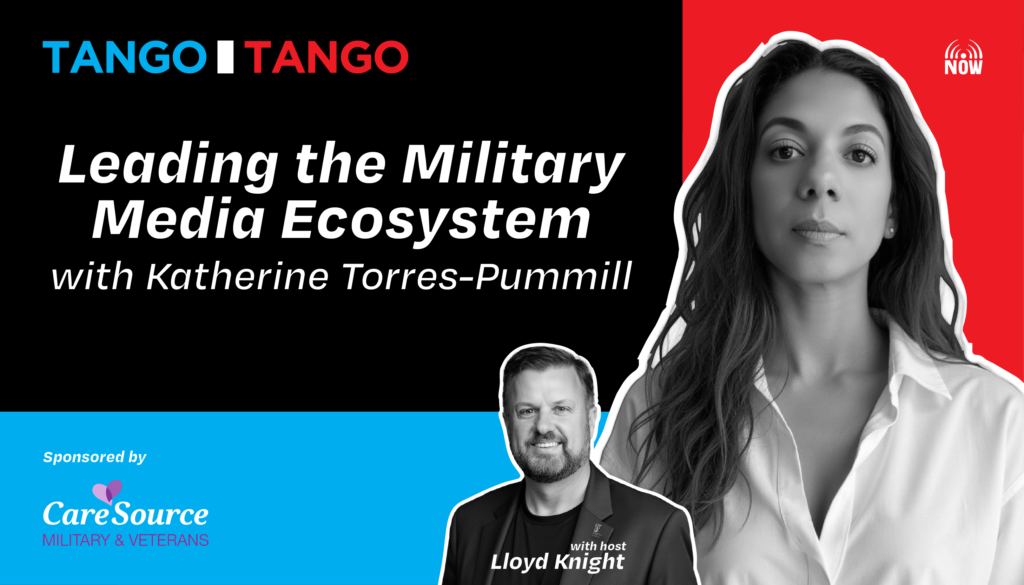
[00:00:45] Lloyd Knight: I’m your host, retired First Sergeant Lloyd Knight, and this whole season is brought to us by CareSource Military and Veterans. And today I’m pumped. We got one of my friends from the Bush Institute. Actually, we’ve been friends for a little bit longer than that. Kathy, Katherine Torres-Pummill. And Kathy is General Manager of Military & Defense for Recurrent Ventures. And Recurrent Ventures, a lot of people know Recurrent Ventures from Military Influencers Conference, but it’s much more than that. She represents, then the brand represents We Are The Mighty, Task & Purpose, The War Zone, and MilSpouseFest. And we’re going to talk about all those things here in a little bit, but we’re going to get to know Kathy. So Kathy, first and foremost, thanks for coming on my podcast. I know you don’t dig this, so it’s a real honor for you to jump on, especially I know how busy you are.
[00:01:39] Katherine Torres-Pummill: No, thank you for having me. I’m warming up to the idea. I’ve been doing a lot more media interviews, et cetera. It’s hard when you’re working in media your entire career being on this side of the aisle when I’ve gotten so used to being in the background of everything that happens. But I’m excited to be here.
[00:02:00] Lloyd Knight: And you are a rockstar in front of camera, so you need to do more of that. And I think you showed it at the last Military Influencer Conference in Veterans City USA. Yes, that is Atlanta. You did a great job and represented the brands very well. So hey, before we get in and talk about the company and talk a little bit about the Bush Institute and everything you’re up to, let’s talk about this tough girl from New York. Kathy is one of the toughest, not only girls, she is one of the toughest people I know. And in this job, trust me, she’s got to be tough. I’ve seen that toughness come through in such good ways, but New York City. So what part of New York are you from?
[00:02:47] Katherine Torres-Pummill: I am from Queens, New York. So I was born in Elmhurst, Queens in Elmhurst Hospital actually. So just to paint the picture for everyone, it is a very diverse immigrant hub of New York City. Elmhurst, Jackson Heights, the area that I was born in was actually ground zero for COVID. And so the name Elmhurst sometimes has familiarity now because it was literally where it had the biggest impact during COVID.
[00:03:16] Lloyd Knight: Wow. What did your childhood look like, Kathy?
[00:03:19] Katherine Torres-Pummill: Let’s see. I was raised, I mean, it’s a little bit of a, I’m going to say the word cliche because I can’t think of another one, but I was raised by a single mom, single mother of three kids, was born in Elmhurst. We lived in Brooklyn for a little bit, Cypress Hills, which is probably where that tough girl persona might come from. But we lived in Cypress Hills, Brooklyn for a little bit and then moved back to Elmhurst, Queens, where we just kind of stayed until I was 18, I want to say, when I left. It was hard. There’s unique experiences with being born first generation, but when I look back on it, it was lovely. I grew up playing in the concrete jungle, as they say, in the streets. We always had friends and neighbors from all different parts of the world. My mom is tougher than I am.
[00:04:08] Katherine Torres-Pummill: You’ll get to meet her at MIC this year in Tampa because she’s Florida based, but my mom was strong. She was resilient. She did what she had to do. My siblings and I are all pretty successful. We all live great lives. So it was good. Surrounded by family, very, very, very first generation. So I am fluent in Spanish. I actually learned English a bit later on in life. And so culture was just all around me all the time.
[00:04:33] Lloyd Knight: What kind of student were you?
[00:04:37] Katherine Torres-Pummill: Let me know if this shocks you. I was the one picking a seat in the first row of the classroom. I wrote down everything the teacher said. I was a straight A student until I wasn’t, but I was a straight A student, always prepared. I would freak out if I didn’t submit something on time or if I didn’t do well, very hard on myself. And then there was a little time during my high school years where I was cutting class to go hang out in Manhattan, which what does my mom always say? Youth is wasted on the young. But for the most part, no, very, very responsible, high grades, always had perfect GPA, et cetera.
[00:05:19] Lloyd Knight: None of that shocks me. And hard on yourself. Oh my gosh, none of that shocks me. Yeah. Kathy and I had an opportunity to spend some great quality time at the Bush Institute in their Veteran Leadership Program. She would freak out because she didn’t think she was prepared enough because she was still working like a dog in her main job. And then she did this really cool thing. One of the big parts of this scholar program is our final leadership project that we have to do. So people think about this leadership project for actually months and even some for years going into it. And definitely a lot of folks started from like day one of being selected and Kathy did too. And then she had a great idea come to mind and she came to me one day and she goes, “I think I’m going to change my leadership project.
[00:06:15] Lloyd Knight: What do you think?” And she told me what it was and I thought it was absolutely amazing. But again, you put a lot of pressure on yourself, but you did it for the right reasons.
[00:06:26] Katherine Torres-Pummill: I can add some context to that actually because when I applied for the VLP program, my project was not military based because it was VLP though, I had to add some type of military component to it. And so my project was media literacy. The militarizing it, if you will, was adding this component where it’s like, well, now it’s for military kids. And if you look at the research, they move around a lot. They use media as a way of keeping their relationships. So they over index on using social media from a younger age, et cetera. So that was my project. And then I realized that there was this huge gap in the community and specifically with military connected nonprofits. The gap exists period, but especially with the nonprofits that serve our community and in reality, they’re like, they’re doing the boots on the ground work, but the visibility isn’t there.
[00:07:15] Katherine Torres-Pummill: So that’s what ended up making me shift the project. I did have three weeks to come up with it and complete it, which I did. But the exciting part is that we’re actually launching the Impact Awards at the Military Influencer Conference and we got Amazon to back us on this. And so we are going to be highlighting these smaller nonprofits that are actually doing the work on the ground and can’t get that leg up. And then furthermore, just the visibility that it gives them. We have the prize money and that’s great, but the visibility that it’s going to give these organizations at the conference, I’m excited.
[00:07:54] Lloyd Knight: Yeah, me too. It was absolutely a tremendous idea. And then she had to present in front of the class and she was sicker than a dog.
[00:08:02] Katherine Torres-Pummill: My Sudafed overdose.
[00:08:06] Lloyd Knight: But you did a great job. You probably don’t remember how good of a job you did, but you did a great job. Yeah. Going back to your childhood, beside playing in the concrete jungle, what were your interests? Was being where you’re at now in the media, were you interested in writing? Kind of give us an idea what 16-year-old Kathy was like.
[00:08:26] Katherine Torres-Pummill: Man, absolutely not interested in writing. I did not see myself in a career in media. I wanted to be a lawyer. So from the age of four, I guess my earliest memory, my entire family was always telling me that I was meant to be a lawyer. And so that kind of just got stuck in my head. It’s what I studied in undergrad. My dream was to run for office. My dream was to be a politician. And I’m not saying that I wanted to be AOC, I don’t, but her district is where I grew up. And so when you’re looking at, like I said, it was an immigrant hub in New York City and you’re seeing all these issues and you have this dream of getting out of there and doing more and being more. For me, it was like, well, I genuinely till today still believe in public service.
[00:09:13] Katherine Torres-Pummill: And to me it was like, how can I use my experience to affect real change in these types of communities? Because I lived it, I grew up in it. So no, not media. I did not think I was going to be a storyteller. I actually wanted to be in public service and be a politician.
[00:09:29] Lloyd Knight: Wow, that’s fascinating because one, you’re a professional arguer. I get it. I wouldn’t want to be on the other side of the bench from you, but we’re going to talk about your career in a second. I mean, your entire career has been in media with some very big names. But before we get to that, let’s talk about college. So you’re a straight A student and you end up going to school right in New York. Yeah, correct me if I’m wrong.
[00:09:54] Katherine Torres-Pummill: I did. So I went to Queens College, which is part of the CUNY system, the City University of New York. I left my home when I was 17, so I’ve been on my own. And the reason why, it wasn’t anything more than my mom was moving from Queens to Brooklyn, she bought a house and my entire life was set up in Queens and I didn’t want that commute. Anybody who lived in New York knows exactly what I’m referring to. And so I stayed and I actually didn’t go to college till a little bit later because I had to work to pay my rent, pay my bills, kind of find my way. And so I went to college at 24 and that’s why I was at CUNY Queens College because I actually worked full-time during the day and then I went to school at night. So I would go to school, I would work from like 9:00 to five in Manhattan and then I would commute out to Queens College and I would be in school from 6:00, 6:30 till about 9:30 PM every day.
[00:10:49] Katherine Torres-Pummill: And then I would be in there all day Saturday and all day Sunday just to make sure that I wasn’t going to fall behind and so that I can graduate on time.
[00:10:57] Lloyd Knight: I see where some of that true grit came from. What kind of jobs were you working?
[00:11:03] Katherine Torres-Pummill: So at the time I was already working in media. So I was working at what is now Outfront Media, but at the time was CBS Outdoor. So outdoor advertising first job was in the Chrysler Building actually in New York. It was beautiful dream come true. And so I was already working in media while I was going to school.
[00:11:25] Lloyd Knight: And what’d you get your degree in?
[00:11:26] Katherine Torres-Pummill: Political science.
[00:11:30] Lloyd Knight: At what point in time did you decide that or have you decided media is where it’s at?
[00:11:38] Katherine Torres-Pummill: That’s an interesting point. So I graduated college. I went to work for the Associated Press. I was working at AP. I had Jude. So Jude is my son who’s about to be 14 years old and Lloyd, you know him well. I didn’t want to give up on my dream of going to law school. At that point, I still, I was like, nope, law school’s where it’s at. Media is a way to pay the bills. And so I took the LSAT. I started looking into my applications for law school, but me being the ultimate geek that I am, I took all of the steps that they tell you to take when you’re wanting to go to law school. I was interviewing lawyers in different fields. I was actually doing the telephone or buying them a cup of coffee and asking all these questions. I wanted to go into public interest law and one of the hardest things that a lot of people don’t realize is people think like lawyers make so much money.
[00:12:31] Katherine Torres-Pummill: They do, but it depends on what field you’re going into. Sticking with public interest, there’s no real money in that. If you’re doing it, it’s a form of public service. And the reality is I knew that sitting in contracts all day, every day wasn’t going to fulfill me. I wasn’t going to last long in that. And part of it was because I was sitting in contracts all day at AP as well, because I was doing content licensing. And so I took the LSAT, I was starting my applications. If anybody’s curious, I was looking at NYU and Brooklyn Law and I had kind of like this come to Jesus moment where I realized that I actually enjoy media. I do have a creative side to me. I do see the importance of media. I talk about this all the time and I think you’ve probably heard me say it, but I don’t think that a lot of people understand that journalists have to take a code of ethics just the way doctors do.
[00:13:25] Katherine Torres-Pummill: And so I decided I wanted to stay in media. And so what that looked like was packing up my nine-month-old baby, taking the train into the city and walking into The New School with my transcripts in hand and applying and getting in on the spot two weeks before school started.
[00:13:44] Lloyd Knight: Wow. Hey, tell me a little bit about The New School because I had looked it up because a lot of people might not be familiar with, but wow, it’s a prestigious college. It’s been in the org since I think it was 1919. So tell us a little bit about that.
[00:13:59] Katherine Torres-Pummill: It is an amazing, amazing school. They actually do have a military program. They have a military initiative. They want service members and veterans and spouses to actually be aware of their programs. It is a school for a lot of creatives. People who want a career in media or fashion or music, but it is very prestigious. They have their New York City campus in Union Square, and then they also have a campus in Paris as well. Parsons School of Design is The New School. That’s their largest and most prestigious program. It is a great school. And the reason why I ended up picking them specifically was because it was between them and NYU. They both had the media program that I was looking for. And the reason why I ended up going with The New School was because of the flexibility. So at that point, my son’s dad was in Afghanistan.
[00:14:46] Katherine Torres-Pummill: I had Jude, I was working full-time at the AP and so I need a program that would actually give me the flexibility of being able to choose between in-person or online if I needed to. And The New School offered all of that. The program was incredible. Ironically, all of my professors taught at NYU as well. They actually share a library. The setup of The New School, they actually take into account that you do have a life outside of school and so they try to build it in a way that supports that.
[00:15:16] Lloyd Knight: Wow, very cool. And what did your professional career, for your professional life, look like after graduation?
[00:15:24] Katherine Torres-Pummill: I finished grad school and I was thinking about my next steps. So my capstone project, since I was still at the AP, I had resources available to me. My capstone was about repurposing content. That was the premise of the capstone. There are stories that have been told throughout time in one way or fashion and how do we take those stories and turn it into something else and continue sharing the message as a way of not letting these stories die. AP did this amazing, amazing reporting. It was like cops going into inner cities and they basically told a story from both sides. They actually showed where the communities came together with the police force. And so I took that and I repurposed it into a series and created this whole business plan and I won’t bore you. But after that, what I realized was I had this experience in outdoor advertising.
[00:16:19] Katherine Torres-Pummill: I had experience in print, I had experience in news and licensing, but I didn’t have digital experience. And the reality was that even at that time, I knew that that’s where the future was heading. And so I decided to leave AP and I took a heck of a chance and I left AP for this teeny, tiny startup in Hollywood, California called We Are The Mighty, and that started my military media career.
[00:16:47] Lloyd Knight: And what was your first role at We Are The Mighty?
[00:16:49] Katherine Torres-Pummill: I was director of partnerships. So I went in under a sales capacity.
[00:16:54] Lloyd Knight: I’m assuming that’s Recurrent, purchased We Are The Mighty, and that’s how you landed that first role there?
[00:17:02] Katherine Torres-Pummill: Yeah, kind of. So I worked at We Are The Mighty. I left for a bit and then they asked me to come back. When I came back, it was November 2019, officially came back January of 2020 and the company was not doing well from a revenue standpoint. So they asked me to come back and just kind of revive it and figure out how to fix this and move it forward and I did. So remember it was January 2020. I built this huge pipeline and then at the end of March, it all fell apart because COVID hit, right? I did. I kept pushing and by the end of 2020, we were profitable. The company was back to being profitable. They asked me, they were like, “Hey, we want you to talk to this guy. You’ve met him briefly, but his name is Kurtez Riggs. He’s the founder of the Military Influencer Conference and he’s tired of doing this alone and he’s kind of giving us first right of refusal if we want to take this on or not.
[00:17:56] Katherine Torres-Pummill: So the real story of how these five brands came together or how I became part of these five brands actually started with MIC. So I hopped on a call with Kurtez. I did not know him well at all, but we ended up being on the call for almost four hours just talking, talking everything about MIC, about himself, his experience. He had a bunch of questions for me. And so we acquired MIC in 2021 and then in 2022, we both got acquired by Recurrent.
[00:18:24] Lloyd Knight: And things have exploded, haven’t they? They’ve exploded for MIC and all the brands? Can you talk our listeners and your viewers through that beside your tremendous leadership and then Kurtez’s vision with MIC, why the explosion?
[00:18:41] Katherine Torres-Pummill: At my core, I’m a marketer. I think that there’s multiple parts to this. One of the first things that I did when I joined Recurrent, so I was the first employee to sit across all five of the brands. When I joined Recurrent, they asked me immediately to take over partnerships for all of the military brands. And so the first thing that I did was that I actually brought them under one umbrella and that’s where Recurrent Military and Defense really started to come alive and it wasn’t just me. I mean, Matt Vanek on my team, he’s my marketing guy. You know Matt, genius. He can take something out of my head. He can make it real and he can make it beautiful. But I really did. I tasked the team with a mission. We’re not like five different brands. We’re one brand under an umbrella using our resources, pulling out what’s our story.
[00:19:31] Katherine Torres-Pummill: So I rebranded every single one of our brands based on the mission, what do you excel at, what makes you unique? And then I pull that all under Recurrent Military and really the story is, well, now all of these brands, but what is Recurrent Military’s mission? What makes them unique? Why do we stand out? It’s been a lot of work, but I think the key thing here is the explosion that you see is because we actually are making impact. We are actually going out there to try to change lives, to bring the community together, to get this in front of as many people as possible. One unique thing that you won’t really see coming out of this and you’ve been to MIC enough time to understand, the mic is not really in our hand. We’ll open it. We might join a conversation or two if we’re asked to, or we might join a conversation because somebody on our team is the best person to talk about that particular thing, but it’s not really about us.
[00:20:29] Katherine Torres-Pummill: It’s really about the community. I think people are seeing that and they’re seeing that we are practicing what we preach.
[00:20:35] Lloyd Knight: Yeah, absolutely. I think you’re authentic. Every one of the brands is authentic and then you guys work hard. I mean, you work hard, you’re working long hours. I was really thrilled to see the growth and that you added new team members this year because I was like, the burnout’s real. So yeah, I was really happy. Let’s walk through each of the brands because some of our viewers and listeners might not be familiar with. So starting with Military Influencer Conference, exactly what is it?
[00:21:04] Katherine Torres-Pummill: I’m going to start off by saying is just put what you know about the word influencer out of your mind. MIC is really, it’s our event brand. So it’s our flagship event brand. MIC happens once a year. We do move it around every couple of years. So this year we’re headed into Tampa. At its core, the Military Influencer Conference is a conference for influence. So we bring leaders, entrepreneurs, content creators, service members, veterans, spouses, et cetera. We bring everybody together once a year to talk about where is the military community today and what does it need to look like tomorrow. That’s one side of it, but it’s also a place where people can actually come and network. They can come and not only just make new friends, but they can find resources for them, for their families, for their business, et cetera. It’s somehow been dubbed, and I didn’t know this until it came up three times in conversation.
[00:22:02] Katherine Torres-Pummill: First time I overheard someone talking about it without knowing who I was or that I was associated with it, but it’s kind of like the annual family reunion, right? That’s what it is becoming. There’s tons of success stories that come out of MIC every year that really warms us as hard as it is to put this conference together, it really keeps us going because we’re able to see the impact. The one thing that I stress to everybody that’s coming to the conference, I think you might’ve heard me say this multiple times too, is this isn’t a place for egos. It’s not a place for titles. It’s not a place for anything, but people who are coming in with an open heart and open mind and wanting to truly, truly help each other.
[00:22:41] Lloyd Knight: Yeah, I love that because there’s so many bad veteran events out there and they’re ego driven. When MIC first hit my radar and it was in Vegas and I knew some big egos that went to it, I was like, “Yeah, I’m not going to go to it.” And then it showed up in my backyard and it was everything that you said it is, Kathy. I will tell people like I tell what VETLANTA is Atlanta Summit, seeing is believing. I try not to convince anybody to come to a summit. I’m like, “Just come and you’ll see it. You’ll see the goodness.” And that’s what MIC is. There’s something for everybody and the networking is the piece that I absolutely love. Yeah, I absolutely love the brand, love the events. I think you do it well. I know how complex it is, all those moving pieces and then controlling egos that want to be involved and want to take over and all the vetting that you have to do to keep it legit.
[00:23:41] Lloyd Knight: So you guys do a great job and you and Kurtez are tough and you have to be tough to control this piece. So next up is MilSpouseFest.
[00:23:52] Katherine Torres-Pummill: Oh, MilSpouseFest is my baby. So MilSpouseFest is exactly what it sounds like. It is a celebration of military spouses. It is a one-day event. They happen multiple times a year. The point of MilSpouseFest is celebrating our military spouses because my goodness, they deserve it. Bringing resources to them, having conversations, not just a one-way conversation because MilSpouseFest is not just about somebody grabbing a mic and like you sitting there and hearing people talk all day every day. It is meant to be a dual discussion. We won’t know how to help our military spouses if we’re not listening to them. So it is about networking. It’s about them finding a network. One thing that I keep noticing over and over again with MilSpouseFest is how many spouses actually show up alone. We’ve changed it. We’re like, bring your babies.
[00:24:40] Katherine Torres-Pummill: For Recurrent Military and Defense at this point, anybody who on my team who goes to an MSF, you’re going to find us with a baby in hand and then we’ll have a cold later because they are like germ spreaders, but bring your baby. The whole point is come in, take a day off, let us shower you, not just with resources, but we actually give away gifts. We give gift cards away. You’re more likely to make money attending an MSF. It’s completely free. The unique thing about MSF is just the connections that happen there, the stories that come out. We’ve had spouses tell us like, “I met my best friend at an MSF event three years ago and I’m able to now go to school or I’m able to go get my nails done.” I mean, think about something that small of taking a break and actually being able to gain some independence just because they came to this event or even resources, I’m stuck with the VA or I don’t know how to handle X, Y, Z.
[00:25:37] Katherine Torres-Pummill: Or this school actually has the type of program that I can do because I learned about them at an MSF and that they built these programs specifically for military spouses. That’s what MilSpouseFest is in reality. And then it’s just fun. Tess and Jess, you’ve seen them live in action. They are loads, loads of fun. This year we are headed to South Korea. So we’ll be hosting two events in South Korea and then we’re also headed to San Juan, Puerto Rico. So we’re trying to expand MilSpouseFest and consider the spouses that have PCS and are living overseas and tend to feel forgotten because that’s something that we hear a lot as well. And then even with going to San Juan, Puerto Rico, there’s a very active guard community there. And so a lot of them are native born to the island. We want them to remember that we do remember them and that we want to come and celebrate them and celebrate their culture and their contributions to the military community.
[00:26:39] Lloyd Knight: It’s amazing. Whose idea was it?
[00:26:42] Katherine Torres-Pummill: Mine. I’ve been dying to do this forever. I’m just so grateful. USAA was like, “Yeah, let’s do it.” I pitched it and I think they even cut me off halfway through and they were like, “Yeah, we’re so in.” So 2027 will be going out to more places as well, but we want to make sure that we’re meeting our spouses where they’re at.
[00:27:01] Lloyd Knight: Yeah, great. We Are The Mighty.
[00:27:03] Katherine Torres-Pummill: We Are The Mighty is all about celebration of service and storytelling. The origins of We Are The Mighty. So David Gale started We Are The Mighty. David Gale was, he actually ran MTV Films. So the films, Varsity Blues and Election, and he hates when I say this, but Pootie Tang, those were all under David Gale.
[00:27:27] Katherine Torres-Pummill: Every time I said that, he would be like, “Can you just not mention the Pootie Tang?” And I’m like, “But why?” Because that’s the one that makes everybody laugh and smile. Napoleon Dynamite, I still quote today, those are all under David Gale. And so what David Gale was seeing, he saw this very unique opportunity. There are no authentic, true military storytelling media companies. We have military films, we have military shows, et cetera, but he wanted this to be authentic. He wanted it to be military led. And so that’s how We Are The Mighty came about. We’ll have hard conversations on We Are The Mighty, but it’s really about telling these stories of what makes this community unique. It’s about humanizing the military community. So think about also helping that military civilian divide. That’s really what We Are The Mighty is about. Entertainment, celebration and just keeping the legacy and these stories alive throughout the community.
[00:28:23] Lloyd Knight: Wow, very cool. Task & Purpose.
[00:28:26] Katherine Torres-Pummill: Task & Purpose. That is my journalistic brand. So Task & Purpose was created for the enlisted community. Let’s not forget that that is the majority of the military community, but it really is a news site. They have a mission to inform and protect the military community and that’s what they do every day. They are breaking stories. They are making people aware of what’s going on in the community. They have had impact on the Hill because of their reporting. And so that’s really at its core what Task & Purpose is about. Yes, they’ll cover some lifestyle content, but at the end of the day, it is informing the military community as a way to also protect them and make sure that they understand what’s going on in our world.
[00:29:12] Lloyd Knight: And number five, The War Zone.
[00:29:15] Katherine Torres-Pummill: The War Zone. That’s our defense brand. So same thing. There’s definitely an investigative journalism approach to what Tyler and The War Zone team does. They cover defense news, they cover defense innovation, they cover anything that has to do with the world of defense. And the unique thing about TWZ, because we did rebrand it this year and we cut the name down, it’s now known as TWZ. It’s going to take even me a while to get used to it, but Tyler has done something that I think is very unique to media brands. People wake up in the morning and they type in twz.com just to see what Tyler and his team are putting out that day. I mean, think about that. What he has done is he has created the most respected defense media publisher in the world. And because of that, he has a, I’m going to say cult following around the world that are logging in to their computers and going in just to see what he has to share for today.
[00:30:14] Lloyd Knight: Yeah. Amazing. So Kathy, somebody who wants to invest or advertise, how do they find Recurrent?
[00:30:22] Katherine Torres-Pummill: We’re everywhere all at once, like you said. We work really hard. Recurrentmilitary.com is going to be the easiest way. Well, I guess we didn’t talk about technically the sixth brand that we have, which is our agency model. One of the first things that I realized was just the gap of these brands and advertisers who wanted to get in front of this community but didn’t know how. So we do have an entire creative arm that sits under Recurrent Military that creates marketing, messaging, strategy, assets, et cetera. There’s a whole content creator studio under all of our five brands as well.
[00:30:59] Lloyd Knight: Amazing. So what’s next for all these brands? What’s next for you?
[00:31:04] Katherine Torres-Pummill: There are some exciting things coming up that I don’t want to spill yet, but we are definitely going to expand our media capabilities. We are looking into some long form content. We Are The Mighty had a show on Roku and they also had a show on KCET, which is PBS out here in LA. Stay tuned. I don’t know how long it’s going to take me because I’m only one person. We did expand our events as well. So last year we tested it out and we saw it worked very well, but Kurtez and I get asked all the time, when is MIC coming to my city? When is MIC coming here? When is MIC coming there? And the reality is that it’s impossible and it’s also very hard to find the right city when you look at all of the different things that you need to balance out.
[00:31:46] Katherine Torres-Pummill: And so what we did was that we created a MIC Unplugged series that we launched this year and has been doing amazingly well. And so we’re going to continue growing that. We’re going to continue strategizing on the best way to do that. But MIC Unplugged is essentially one evening networking event that kind of brings the magic of MIC on a smaller scale to cities around the country as well.
[00:32:09] Lloyd Knight: Great. And we know the only logical city for MIC to be in is Atlanta, Georgia.
[00:32:14] Katherine Torres-Pummill: Listen,
[00:32:16] Katherine Torres-Pummill: I got to be honest with you, I love Atlanta so much that it was a very, very, very hard decision to move MIC out of Atlanta. And we actually considered just keeping it there for forever. We felt the magic of the city. We love the city. I may or may not have tried to convince my son to move out there and he’s put a kibosh on it. We loved it. The reason why we move MIC around every couple of years at least is because what ends up happening with the Military Influencer Conference is that we embed ourselves into the local community. You saw us do it in Atlanta. We’re now doing it in Tampa. And because so many people are flying in from around the country, so many leaders and influential people in our space are flying in, we’re able to actually raise issues within that local community and bring those resources into whatever city we land in.
[00:33:08] Katherine Torres-Pummill: And so think of it as a responsibility factor of moving that conference around.
[00:33:14] Lloyd Knight: Yeah, I get it. But you’ll eventually be coming back to Atlanta, I’m sure.
[00:33:17] Katherine Torres-Pummill: We will. We’ll be there in November. So we’re hosting a MIC Unplugged because I did promise the people of Atlanta that we would be back and that we weren’t going to just pack up our stuff and go. We’ll be in Atlanta for MIC Unplugged in November this year.
[00:33:28] Lloyd Knight: It’s December 1st and it’s going to be in partnership with Vetlanta.
[00:33:34] Katherine Torres-Pummill: It can’t be December 1st because I forgot where we need… There’s something going on December 1st.
[00:33:38] Lloyd Knight: Well, that’s what you think. More to come on that. But hey, thank you so much for coming on the show, Kathy. And I’m going to leave it up to you to make some closing comments.
[00:33:49] Katherine Torres-Pummill: Thank you for having me. We did know each other before VLP, but then we really got to know each other at VLP and you have become one of my dearest friends and I think the world of you and I’m so excited for everything that you’re doing and the impact that you make. You are the type of person that makes what I’m doing so much easier and so much more comforting. So thank you and thank you for having me on. It means the world to me. I am open to anyone who wants to ask me any questions. Please find me on LinkedIn or find me or one of my team members somewhere around the country. I hope everybody can join us at MIC. I hope people can go to Task & Purpose, go to We Are The Mighty, check out The War Zone and just kind of see what we’re up to and what we’re reporting on the stories that we’re telling.
[00:34:34] Katherine Torres-Pummill: We love to hear feedback. We love to hear from the community. It’s how we learn and how we become better. So thank you.
[00:34:40] Lloyd Knight: Awesome. Thank you, Kathy. And I’m going to close it like I always close it. So be like Kathy, be safe, be kind and be remarkable.
[00:34:49] Katherine Torres-Pummill: Go Knicks.
[00:34:53] Voice Over: The Tango Tango Podcast is proudly sponsored by Supply Chain Now. Join the Tango Tango community for more inspiring stories. Follow us on Facebook, X and LinkedIn. Subscribe to the Tango Tango YouTube channel and follow and listen to Tango Tango wherever you get your podcasts.