[00:00:00] Andrew Rice: When I, tell friends and family that I, I work at a winery or they find out, their eyes always light up and sparkle as they imagine themselves, you know, walking through vineyards and touching the leaves and tasting the grapes. And the complexity is really the scale,
[00:00:18] Andrew Rice: you know, we also ship hundreds and hundreds of rail cars of finished product and have hundreds of truckloads, tanks filled with wine and spirits. Uh, you know, the scale is, is what surprises people.
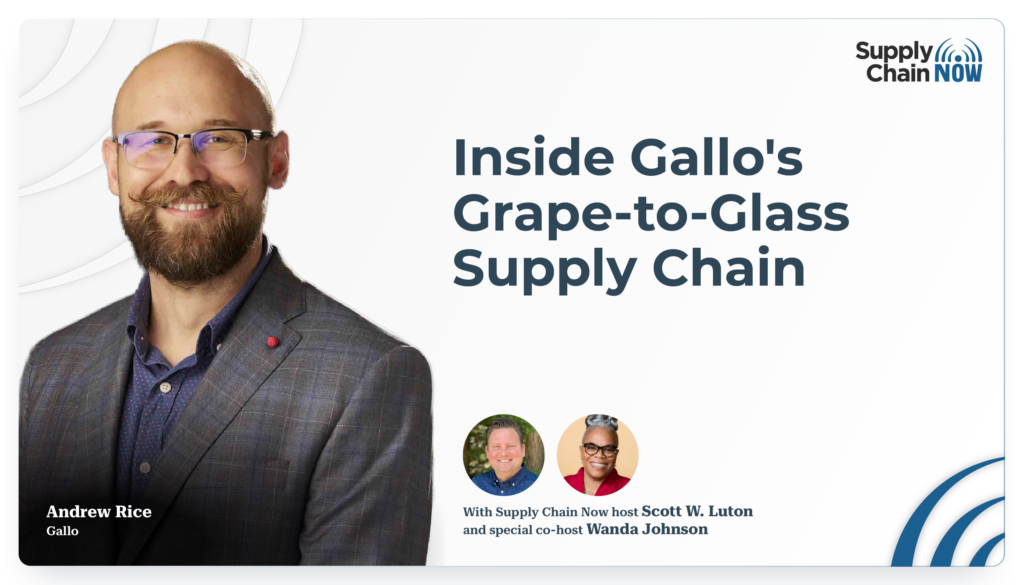
[00:00:44] Scott W. Luton: Hey, good morning, good afternoon, good evening, wherever you may be. Scott Luton and special guest co-host Wanda Riddick Johnson with you here on Supply Chain Now. Welcome to today’s show. Wanda, how you been, my friend?
[00:00:58] Wanda Johnson: I’ve been doing great, Scott. It’s been wonderful. Hot summer here in North Carolina, South Carolina
[00:01:03] Scott W. Luton: Oh, my– And in Georgia, and in Kentucky, and in France, everywhere. It’s hot everywhere it feels like, Wanda. We gotta fix that, huh?
[00:01:13] Wanda Johnson: Yes, we’re gonna cool it down with some wine.
[00:01:15] Scott W. Luton: Yes, you’re right. Folks, we got a great show teed up here today. A great show. Uh, if, if you love wine and supply chain, folks, as Wanda says, you’re in for a treat here today. We’re gonna be speaking with a leader from one of the preeminent wine-making companies really in the world, and we’re gonna be diving into the wine supply chain, including how things like weather, hot weather, harvest conditions, all that stuff impact all the planning that takes place.
[00:01:45] Scott W. Luton: We’re gonna talk about what surprises a lot of people when it comes to the complexity in the industry, and, hey, how has technology helped to transform wine supply chain operations? All that and much, much more here today. Now, Wanda, I am so– uh, I can’t wait to dive into our guest’s, uh, perspective here today.
[00:02:04] Scott W. Luton: But I’m tickled that you could join us, especially given all of your industry leadership, especially when it comes to transformation. So I can’t wait to see your take on today’s conversation. Should be a, a big show, huh?
[00:02:16] Wanda Johnson: It will be, especially when it comes to wine, it’s just, it’s a product that from cold to hot and it’s just so much. So I’m looking forward to this conversation.
[00:02:27] Scott W. Luton: Me and you both. So folks, stick around for a great conversation that’s gonna offer up tons of actionable insights by the truckload. All right, so I wanna welcome in our outstanding guest here today joining me and Wanda. Folks, Andrew Rice has spent over 15 years at the intersection of supply chain operations and enterprise technology, leading the programs that actually stick, as he likes to say.
[00:02:52] Scott W. Luton: Amongst other things, Andrew leads the AI roadmap and automation strategy for supply chain operations at Gallo, one of the world’s largest wine producers. Andrew’s, uh, Al- Andrew also had a session as keynote panelist at MODEX 2026 here in Atlanta that drew rave reviews. I was surprised we were able to get him on the show.
[00:03:10] Scott W. Luton: Had to work hard through his agent. So let’s welcome in Andrew Rice, senior ERP manager at Gallo. Andrew, how you doing?
[00:03:19] Andrew Rice: Doing very well. Thank you so much, Scott, uh, for the invite and for this opportunity. Great to be here
[00:03:25] Scott W. Luton: Well, we can’t wait to dive in. Wanda and I, we, we’ve been talking with you two and, and, and other friends of the show for quite some time. Wanda, this has been a project, little, little passion project for us, huh?
[00:03:36] Wanda Johnson: Yes, it has. You know, we talked about this at MODEX in April, and we had a wonderful Camille Blake, um, on there talking about her, um, experience with wine, and this is just gonna be a continuation of a great conversation
[00:03:51] Scott W. Luton: I agree with you. And folks, go check that out. You know, we had lots of, uh, terrific, uh, interviews at MODEX, but one of my favorites was getting Wanda and Camille to b- uh, together. And we also learned, Andrew, Andrew, did you know Wanda’s holding out on us? We’re talking, Andrew, with the mayor of MODEX right here, Wanda Riddick Johnson.
[00:04:09] Scott W. Luton: Did you know that, Andrew?
[00:04:11] Andrew Rice: I, I, uh, I’ve heard, I’ve heard tales and rumors, but, uh, maybe she’s the one whose agent you need to work through
[00:04:17] Scott W. Luton: Yes. I tell you what. All right. Well, anyway, kidding aside, let’s do this. We got a lot to get to here today as we explore the wine supply chain. But I wanna start with a fun warm-up question because, you know, as much as we all love supply chain, we also have personal lives and passions and hobbies. And Andrew, one of the things we learned about you in the, uh, pre-show is that not only do you love to write, but you’re a published author, and out of all the genres out there, you are publishing in one of the most popular, I think one of the most popular genres for film, books, you name it.
[00:04:51] Scott W. Luton: That’s the horror, uh, genre. Tell us more, Andrew
[00:04:54] Andrew Rice: Yeah. When I’m not, uh, deep in supply chain living in the light, I like to write, uh, some dark horror novels. Uh, and been doing it for, for many years. Got into it because I really feel that horror is a genre that you can explore the human condition and really rationalize the world. So through COVID, thought it was a good, uh, cathartic experience and been doing it ever since.
[00:05:16] Scott W. Luton: Wow. So I’m curious, I’m gonna ask a dumb question, right? But I bet you get asked this a lot. Any relation, isn’t Anne Rice a famous novelist? No relation?
[00:05:29] Andrew Rice: I can only say that I wish. I wish that I had, uh, half her talent and abilities and, uh, half of her, uh, uh, publication ability as well, and her audience would be great
[00:05:40] Scott W. Luton: But we’ll see where all of your horror, um, writing takes you. And I’ll, hey, it, it’s so important to find these therapeutic releases, right? Supply, there’s a lot of pressure to perform in supply chain, and I can’t wait to pick up one of your, uh, novels, Andrew. Um, all right. So Wanda, you know, I, I, I’ve told myself I’m not gonna bring up this topic that you and I have talked about countless times, but I got to because you’ve got a big family, uh, uh, reunion coming up, and I think one of the traditions is eating delicious barbecue.
[00:06:11] Scott W. Luton: Tell me about what’s coming up
[00:06:13] Wanda Johnson: What’s coming up is, um, down in Lewisburg, North Carolina, we will have a whole hog that’s gonna be roasting overnight, and I can’t wait to stand in line to pull that pork and all the other good, um, drippings off that hog. But it’s just a great time to get together with your family, people that you have not seen in a while, um, good food, good conversation, and dancing with great music.
[00:06:39] Wanda Johnson: But the food brings great conversation. And then also we probably have a little wine too. I would say a little wine, but we probably have a lot of wine.
[00:06:47] Scott W. Luton: Hey, we keep it real. We keep it real around here.
[00:06:53] Andrew Rice: Thank you for keeping the industry alive. Appreciate it.
[00:06:58] Scott W. Luton: I look forward to seeing the pictures and hearing the stories and, um, I tell you, it’s good, it’s good to get the family together, especially over great eats and drinks. So, hey, one other quick question, Wanda. You’ve got a- another big trip coming up. You’re going up to, uh, the US Open, uh, coming up soon. Tell us what you- one thing you’re looking forward to the most there
[00:07:18] Wanda Johnson: well, number one, I’ve never been before, so my daughter and I are going. And on that Sunday is the opening. But that Saturday, what I’m looking for is the fan, access, where we can go in and see the people that pr- uh, practice beforehand, all of that. Just that community, and then they have a lot of different events that go on, so.
[00:07:38] Wanda Johnson: But I can’t wait to sit courtside. Well, not courtside, but close to. Won’t be down there, but I’m gonna be close enough I can at least see the back of their heads throwing, um, hitting a ball back and forth. And maybe, um, Serena or one of, uh, Venus may show up, and if I do, I will take a picture and send it to you, Scott.
[00:07:55] Wanda Johnson: Let’s do it
[00:07:58] Scott W. Luton: maybe much– Well, I bet much like many of our audience members, I was enthralled with, um, that, uh, deep last run Serena had, I think a couple years ago. I watched more tennis then than I think I have in my life. So I can’t wait to hear about your experiences, Wanda Alright. So we got a lot to get to here today, A-Andrew and Wanda.
[00:08:19] Scott W. Luton: We’re gonna be talking about wine supply chain extensively. And, uh, Andrew, as we get started here, you know, when a lot of people think about wine, I would probably suggest they think about vineyards and tasting rooms or relaxing with family, family reunions, you name it. But like a lot of cus- consumers, they don’t necessarily think about supply chain, right?
[00:08:43] Scott W. Luton: I think the pandemic has changed that a little bit as part of the silver lining maybe. But I want to start, give us the 30,000-foot view of what makes the wine supply chain unique.
[00:08:55] Andrew Rice: Yeah, definitely. Thank you for the question. So first off, those, uh, amazing moments that you were talking about is definitely, uh, the points of joy in people’s lives, the moments of joy that, that we’re striving to, uh, to make sure that you have the right products in hand, uh, for.
[00:09:10] Andrew Rice: So having said that, some of the unique aspects of, the supply chain I’ve been in a lot of different, organizations in my career. I’ve done supply chain over 17 years, and everyone thinks that their, you know, their supply chain is unique, and many of them are for one reason or another. But definitely the alcohol industry has a lot of unique aspects because of two things, particularly wine.
[00:09:34] Andrew Rice: Government regulation being the first one. This isn’t just government regulation at a, federal level. Of course, there’s that too. The government cares very much about alcohol. It wants to regulate it, store it correctly, make sure that it’s safe, and that, you know, making money off it as well. but it’s not just the federal level, it’s state level regulation and local level regulation.
[00:09:57] Andrew Rice: I’m sure, where you, uh, have traveled to or are from, you’ve seen some counties are dry, some counties are wet, some counties are somewhat in between. You can’t buy alcohol at a certain point on a Sunday. And all of that regulation leads to challenges and complexity, uh, in the supply chain itself, how we track tax, uh, the unit of measure we track tax against, the approvals that have to go through or have to be in place before we can ship product to a specific, location.
[00:10:27] Andrew Rice: all of those are, uh, again, tons of complexity, to work through from a supply chain level. A couple things to bring up here before I move on to the next thing. Uh, there is a three-tier system in alcohol, which is a very unique aspect of this, uh, that we have to, again, factor in from a supply chain perspective.
[00:10:44] Andrew Rice: The people who, uh, distill and manufacture, uh, you know, they have to pass it through a distributor network, who then have to pass it off to a customer, you know, who might sell it downstream. And so this three-tier system, as that alcohol works through, uh, the supply chain, is, uh, a legally binding, regulation.
[00:11:03] Andrew Rice: It’s law. We have to do that. it both provides for and inspires innovation in how we can be effective as a supply chain considering those limitations, and it also, can be, uh, challenging to, to work with at times. so finally, uh, on this topic, and just as a point in case example, there are things called Bellman states in the US, and those are states that heavily regulate the, specific SKUs that can be, shipped into their state.
[00:11:33] Andrew Rice: and so there’s special approvals, you know, that are needed, before, products can be sold there, and special, uh, approvals that are also needed, uh, before they can be, you know, stored there, distributed. and it’s, it’s a whole, uh, a whole administrative process, uh, before. So that adds additional complexity.
[00:11:51] Andrew Rice: Again, that’s all due to regulation So the second aspect that’s unique to alcohol is, uh, as you alluded to during the introduction, the aging process of, uh, alcohol. And, you know, you can imagine that because certain products get better with age, because certain products may need to be aged for days, weeks, months, uh, you know, that adds, uh, nuance to where that product should be to get it as close to the selling point as possible, while considering forecasts, while considering sales.
[00:12:25] Andrew Rice: adding that aging factor is definitely a part and a nuance of the supply chain complexity as well.
[00:12:31] Scott W. Luton: All right. So Andrew, you gave us a lot to think about in that first response. And Wanda, you know, I use the word occasionally, permutations. I was not good at math, but I remember permutations for all the various variables, right? That go into var- all these different, uh, permutations. And what I heard there from Andrew is some unique permutations on the complexity of the wine supply chain that other products don’t have to worry about, especially regulatory induced.
[00:13:01] Scott W. Luton: I mean, all those inputs based on Sundays in some places or, or Bl- Blues laws in other places to the three-tiered system. There’s a lot more inputs, I think, in the wine supply chain permutation than many other products. What’d you hear there from Andrew, Wanda?
[00:13:19] Wanda Johnson: Well, the number one thing I heard was the story about wine is much bigger than the grapes and the bottle
[00:13:27] Scott W. Luton: That’s right.
[00:13:28] Wanda Johnson: It spans across the, you know, the regulatory piece is the challenge. ‘Cause I’m thinking about within supply chain, when you have to s- you know, I’m technology, so when you have to set up that system, and you got to set up the shipping of that product out of the state of California or whatever state you’re shipping out of to the state you’re shipping to, you’re shipping to a individual house, you have to really understand all the parameters for each one of those different types of wine in that SKU.
[00:14:00] Wanda Johnson: So look at, if you really think about the SKU master and how many SKUs are out there for the different types of red wines that you have, and you start breaking that down to make sure you can ship that out, um, it’s, it’s not just about, “Hey, I want… Scott loves the red Gallo, Cabernet.” Well, but Scott, you live in South Carolina, or no, you live in North Caro- you live in Georgia.
[00:14:27] Wanda Johnson: Well, in Georgia, in that county, they may not be able to ship to you. So how do you actually continue to get your customer base of the wine that they really want? Because they can’t get it shipped to that state at all. How do you actually do that effectively and make sure that you continue to grow? And I think I heard in the green room, like, you know, Andrew stated about it’s Gallo.
[00:14:54] Wanda Johnson: Gallo is more than just wine. So I think actually you have to continue to evolve in these companies to make sure you can continue to sustain and get the products that all your clients or your customers need. I think, you know, that’s how, but bottom line, it’s not, it’s more than grapes and bottles
[00:15:13] Scott W. Luton: That’s right. It’s not a three-chapter story for sure. It might be, it’s one of Andrew Rice’s, uh, uh, not a horror genre, but it’s one of those novels is the wine supply chain story.
[00:15:24] Andrew Rice: Suspense.
[00:15:25] Scott W. Luton: That’s right. All right. So, um, let’s… When you think of the major supply chain functions, Andrew, as we try to map this out a bit more, and you think kind of with that story that Wanda was referencing a couple times, you know, from grape to glass or grape to consumer, whatever y- whatever phraseology you wanna put there, sh- walk us through some of those major functions there.
[00:15:50] Andrew Rice: So Gallo is a very vertically integrated company, and so we have a huge expanse of, uh, supply chain functions that we undertake and execute against to get the, uh, ultimately to get the, the wine to the consumer. Uh, I’m gonna list the, the major buckets. Uh, and before I do, I wanna say the thing that, I’m not going to call out through each step, but is embedded in every step of the process is our quality management.
[00:16:16] Andrew Rice: Uh, from when we harvest the grape and the checks that occur there through the crush and, and so forth and so on through bottling, uh, there’s always, uh, you know, a, a healthy and persistent quality process involved in those steps so… All right. Having said that, let’s start from the beginning. you know, grapes, wine comes from grapes, uh, of course.
[00:16:39] Andrew Rice: I think most of us know that, and those grapes either need to be grown or purchased. So what we’re talking about there is we’re either talking about sourcing or from an agricultural perspective, field management, water management, uh, the factors of, of weather and land use as it relates to a short-term and long-term planning and forecast.
[00:17:01] Andrew Rice: So they have to be grown, they have to be harvested, uh, and then after they’re harvested, uh, which is the next function, they have to be crushed. And what this requires is, of course, specialized transport, uh, specialized, facilities to, uh, filter out, uh, debris and, uh, you know, even grapes themselves.
[00:17:22] Andrew Rice: It’s interesting, the grape varieties and the type of wine that it’s going to make involve a certain number of presses. So a certain brand or a certain, uh, wine that has a, a specific price point may get, uh, the first press, we call it, or, the more, uh, commercial premium brands may get three or four presses.
[00:17:44] Andrew Rice: There are different level of presses which require different levels of planning, different levels of, uh, transportation and factoring into that. Uh, so after the wine and grapes are harvested and crushed, uh, they are, of course, fermented. That’s how wine is made. You know, the, the little bacterias, or sorry, the little yeasts make the, uh, make the alcohol from consuming the sugars from the wine.
[00:18:07] Andrew Rice: Uh, so they are fermented, which happens in gigantic tanks. If you ever, uh, have the opportunity, uh, Scott, I know Wanda you’ve already come here, to come to the Gallo facility, be happy to show you around, and some of these tanks are so large you could drink, uh, a bottle of wine every day from them and only, you know, over the course of your, of the course of your entire life, uh, reduce it by an inch.
[00:18:28] Scott W. Luton: I’ll see you tomorrow, Andrew.
[00:18:29] Andrew Rice: I know.
[00:18:29] Scott W. Luton: You tomorrow.
[00:18:30] Andrew Rice: Yeah, challenge accepted, right? Uh, so they are– uh, the wine is fermented, uh, and stored, which of course leads to its own complexities. rarely For, for the majority of wine is a single batch of wine, a single grape harvest going to be, bottled into a single, portfolio or a single brand or a single product, right?
[00:18:53] Andrew Rice: There’s mixtures that happen, and of course, that leads to its own complexity to get the right level of taste. So fermentation, uh, which then passes on to bottling. and from bottling, after it finishes, it goes to our, uh, warehousing to get stored, uh, and aged, um, or shipped immediately to our regional distribution centers to age there perhaps, or if we’re waiting on, as I mentioned before, Belmont state approvals.
[00:19:16] Andrew Rice: Uh, in bottling, of course, you have to factor in the tons of component planning that goes into ensuring, uh, we have what we need and on time . Uh, and so of course, there’s those forecasts, there’s sourcing involved there. And finally, you know, a lot of logistics after it gets stored and distributed, uh, to, to either an RDC again, or to a distributors where it eventually ends up in, say, a Kroger’s or a Publix or a, um, Raley’s or, you know, a wine shop somewhere.
[00:19:43] Andrew Rice: and of course, as the final point I wanna say here, That is the chiefly domestic side of wine, uh, supply chain. We have a huge, uh, international, uh, supply chain presence as well, and so that involves purchasing wines from, uh, from other countries or shipping, uh, large bulk bags filled with wines, uh, to Europe to bottle there, so that the weight of the glass is not factored into the overall freight cost, uh, you know, with what we sell in Europe, so
[00:20:12] Scott W. Luton: Right. My
[00:20:14] Wanda Johnson: What?
[00:20:15] Scott W. Luton: So many questions, so little time. All right. So Wanda, couple things there. I’d love to get your reaction to what Andrew kind of walked us through there. Number one, he meant, he started out, important point he made, quality’s baked into every single step. Now, I bet me and Wanda can personally attest to that, Wanda.
[00:20:33] Scott W. Luton: Is that right? We can start there, right?
[00:20:35] Wanda Johnson: Yes, we can
[00:20:36] Scott W. Luton: High high quality, whether it’s Cabernet or Chardonnay. If it starts with W- got me, uh, Andrew, right? It starts with W-I. The other thing that I wanted to, uh, to share there is, um, like most supply chains, there’s a lot of, um, processes, a lot of, uh, you know, it was kind of like map- mapping out the supply chain there, right?
[00:21:01] Scott W. Luton: Some, some value stream mapping. But that doesn’t even, as he was talking about, labels or the different varietals or domestic versus in, uh, international. I am struck, Wanda, by even as a wine enjoyer and drinker myself, just the sheer complexity. And we’re ab- we’re about to add some more factors of complexity in a moment.
[00:21:23] Scott W. Luton: But Wanda, react to as he walked us through those main, um, uh, the main path of how we go from grape to glass
[00:21:32] Wanda Johnson: Well, one of the main things that I heard is the planning piece can be very uncertain. The reason why I’m bringing that up is ’cause you start with the process of the grape and the growing process. And with that growing process, it’s the weather, right? You don’t know, and, and I think that’s one thing you brought up with your quality control, how you, you can actually go to and buy the grapes and how that process went.
[00:22:03] Wanda Johnson: So you have a contingency in there in case you have some type of weather or any type of, any type of disaster that comes through, you know you have a backup plan. But then also, you know that as you go through that quality control process of the crushing, um, what if it’s not crushed properly? Who’s gonna be the Inspector Gadget, I know I said Inspector Gadget, out there inspecting that to make sure that process is correct?
[00:22:33] Wanda Johnson: And we’re not, we’re j- you know, if you think about it, you’re only talking it, you can… You’re not talking about just one type of grape, one type of wine. this is a value chain that actually runs in parallel multiple, several times over, You think about that, not only now, Evie, that’s not even getting it into the warehouse.
[00:22:57] Wanda Johnson: You haven’t even gotten it to… You’re just harvesting it, you’re getting it to production line, and then once you do that, you’re doing multiple checks along the way because Gallo wants to make sure the quality and that number that’s on that wine bottle speaks to their value, and that when it goes to that customer and they drink that bottle at the restaurant, at their home, that they know it comes back to their name.
[00:23:25] Wanda Johnson: And that… But, you know, you have to think about all those little things that go into value and checking that. And that’s not even getting into the warehouse. Once you get into the warehouse, as Andrew was talking about, you still got to get it bottled, you got to get it packaged. Well, your packaging is one key piece, right?
[00:23:44] Wanda Johnson: That you wanna make sure it’s packaged right. You got to make sure that bottle is nice and clean, no br- um, cracks in it or anything. That’s a quality piece that you got to think about, too. That’s before you even get to shipping it out.
[00:23:57] Scott W. Luton: Right.
[00:23:58] Wanda Johnson: And I know I want to keep going, but it’s a lot of stuff in there that you have to r- really think about before production even begins, right?
[00:24:08] Scott W. Luton: right. And all that rolls up, all that and more, to your point, Wanda, rolls up into that brand commitment that Gallo is making to every single consumer, no matter what their favorite varietal is or, or, you know, where they buy it, or you name it. Um, let me– I, I wanna ask you, Wanda touched on weather, Andrew, and we don’t have to dive into this, but, you know, there’s all sorts of, uh, predictions in terms of how El Niño is gonna play out this year.
[00:24:35] Scott W. Luton: Some are saying it could be the worst since like 1950. We shall see. But I’m really curious to pick up on one, one, one of the things Wanda mentioned. When it comes to weather and harvest conditions, crop yields, um, how does all that impact planning and, and whether it’s downstream or wherever? Andrew, tell us, talk to us about that
[00:24:55] Andrew Rice: Yeah. Uh, it definitely has, has an impact. Uh, supply is bl- based on harvest, and harvest is based on nature. And so any, uh, weather considerations and the impact thereof is, is going to have, uh, you know, be major. There is– So what you mentioned before, I want to dive into a little more, uh, around, hey, we get this wine, it tastes like this wine, and I want to talk a little bit about the complexity as it relates to weather and harvest conditions.
[00:25:25] Andrew Rice: So, you know, Gallo has some very luxury brands, and, you know, each of those are based on a harvest, say from an estate or from, you know, a s- very, um, specific regional vineyard, uh, say some of the, the Napa brands. And so When, when people drink that wine year over year, they’re expecting nuance to the flavor profile, and that’s okay.
[00:25:52] Andrew Rice: You know, maybe it was hotter and so the grapes ripened earlier and, you know, this added, it imparted a certain flavor and, know, they’re expecting, the consumers are expecting that, that difference, uh, and that’s good. So harvest, weather, it impacts that in, you know, a potentially positive way. Now, for the commercial brands, say for example, when we were talking, uh, in the pre-show about the, the Chardonnay, that you enjoy, that Chardonnay has to taste like that Chardonnay, uh, every time you get it.
[00:26:26] Andrew Rice: And that is challenging, and Gallo does it very well to do when you are by and large at the mercy of nature. You know, there are tiny compounds in wine itself called, uh, phenols, uh, that determine a lot of those flavor profiles, and you really have to ensure that regardless of what’s happening with the weather, you can create that Chardonnay, uh, in, in mass, um, you know, as regardless of, again, regardless of what’s happening.
[00:26:57] Andrew Rice: And so there is, uh, a big impact there and a lot of complexity, but again, Gallo, uh, Gallo does it well. So for example, my favorite, uh, one of my favorite wines, uh, is Barefoot Pinot Grigio. It’s just, it’s a great wine. It just tastes so good. but it tastes the same regardless of what’s happening, uh, wherever those grapes are harvested from.
[00:27:16] Andrew Rice: You know, here in California, it’s hot, it’s cold. When I get that Barefoot, it’s gonna, it’s gonna be the same, and I definitely appreciate that. Uh, but it’s hard to manage. so one quick example that I wanted to give at the end, uh, is related to, uh, the large fires that broke out in Napa, just as a sort of real world context people can conceptualize this challenge against.
[00:27:37] Andrew Rice: You know, after the fire was extinguished, uh, the region began ex- assessing, uh, you know, all the damage and how they were gonna rebuild and, you know, as questions arose, uh, regarding that, questions also arose on, “Hey, how do we salvage these grapes and, uh, ensure they can still produce, uh, the same quality wine?”
[00:27:55] Andrew Rice: And it was interesting to be a part of those discussions, not from the, uh, the biochemistry or technical angles, um, but just to overhear them and, and listen to people talk about, “Hey, is the smoke gonna be good? Is the smoke gonna be bad?” Uh, you know, how much grapes are gonna, are we gonna have to, uh, you know, have to, to negate certain effects the, of these different flavor profiles that, you know, the smoke might impart.
[00:28:18] Andrew Rice: And so nature is always there, al- always present and, you know, we have to work with it and work through it
[00:28:23] Scott W. Luton: Andrew, all of that is fascinating to me. And, you know, one of the thing– one of the many, many things I heard there, Wanda, and again, as Andrew mentioned, the, the Chardonnay, the Gallo Chardonnay is something we’ve been cooking and, and sipping on for a very long time. The consistency. When you hear the word consistency when it comes to, like, um, food and beverage, I th- I bet a lot of folks think of Chick-fil-A, right?
[00:28:45] Scott W. Luton: Because almost every Chick-fil-A you go to, goodness gracious, you’re gonna have the, a very consistent experience, service, and food quality. Wanda, the Gallo a-and folks, again, I am a, um, a shameless fan of the Gallo, uh, brand of products, but that consistency, they’ve nailed it in that Chardonnay, and it’s amazing how that can be accomplished.
[00:29:08] Scott W. Luton: Uh, Wanda, what’d you hear there from Andrew?
[00:29:10] Wanda Johnson: What I heard is what he talked about earlier, quality, quality control. That quality process is very important. And I think a lot of times when you look in food industry, in beverage indus- industry, the process changes. But what I heard from Andrew is they looked at that process, they know they want their consumer to continue to drink that Barefoot that you like, that Chardonnay that you like, and they know that that consistency makes a difference.
[00:29:41] Wanda Johnson: So when they are in their, in their production process, they know that, “Hey, I have someone tasting this that understands what that quality tastes like.” It’s not just about you got the grape, it’s about the continuous, as we say, the end-to-end, I hate to say end-to-end visibility, end-to-end value chain of your product.
[00:30:06] Wanda Johnson: What you’re saying to us, Andrew, is when I pick up a bottle of anything that’s made by Gallo, that Luxry or whatever it is, I know that the process it took to get to that shelf, they cared about it. Yeah. And they made sure, especially when you start talking about the fires, when we talked about the weather and all that, but they want to, no matter what, when it comes out, if it does not taste right to what I heard, you’re not gonna put it on that shelf. You wanna make sure what’s on that shelf is gonna be what the consumer is always used to. And that tells you something, um, about the character of Gallo and what they really care about is their consumer products.
[00:30:47] Scott W. Luton: Well said, Wanda. And I, you know, I’m not smart enough to go into the, uh, the biochemistry, I think is the word Andrew used. The, the phenols, I, I wrote that down. I probably misspelled– I’m sure I misspelled it. But all of that aside, it’s, it’s, it’s, it’s really interesting to me how supply chain management science factors greatly into, , even the flavor profiles and certainly the consistency.
[00:31:13] Scott W. Luton: You know, thinking of how the fi- Andrew, to go back to your anecdote about the fires and the, the conversations they were having about, you know, how will this, uh, you know, how does this impact the quality or the consistency or the flavor, you name it. It is, um, it’s fascinating. And then one last thing I’ll point out, um, Wanda, is when you was talking about some of the, um, and Andrew, what was the phrase you used?
[00:31:34] Scott W. Luton: Some of the really, uh, luxury brands, maybe? Is that right?
[00:31:38] Andrew Rice: Yeah, luxury and then commercial premium
[00:31:40] Scott W. Luton: Okay. So the luxury brands where, and I’m just gonna make something up because that, you know, I hope, I hope to be there one day where I can enjoy, but like a 1982 Bordeaux or something, right? That’s always fascinating to me where you capture a certain year, a certain weather, a certain crop, a certain location, you know, whatever it is, um, in a bottle.
[00:32:03] Scott W. Luton: Wanda, that is, that is fascinating to me and, and, you know, and how you can compare and contrast that moment in time, right? Or, uh, those moments of joy, to use a phrase Andrew said earlier. That is a fascinating part of the wine industry. React to that, Wanda, and then I’m gonna get back with my next question to Andrew
[00:32:22] Wanda Johnson: thing is w- and most people don’t even realize this is the beginning of the supply chain for wine, and how- Sure … it’s so complex, but how when you look at the end-to-end process for any, for wine and to get it out to your shelf, is how you need to really understand it’s not just about, “Hey, I want to just get this out for this price.”
[00:32:46] Wanda Johnson: I want to get it out to make sure it’s right. Right. And it stands behind the Gallo name. It stands behind, I know that this story that I’m telling about the journey of a grape to the shelf, it’s gonna be quality control, it’s gonna be the communica- And you know, think about it. We’re not even, we haven’t even touched on how we actually get it packaged into or, um, a, a pallet and all that.
[00:33:16] Wanda Johnson: We’re just talking about the upfront planning and making sure that’s right. And I think that’s what we really have to hit home, is no matter where you are in your supply chain, what type of product, it’s not about just getting it shipped to the customer, it’s about prior to that, how do you make sure your product is the right product to get on that shelf and that it’s sustainable, and the consumer’s gonna buy it?
[00:33:39] Wanda Johnson: Like you, you know you’re gonna go and get you that bottle of luxury, um, brand, that Bordeaux that’s from 1829. I’m just
[00:33:49] Scott W. Luton: One day, Wanda. One day, one day. But y- k- all kidding aside, you’re right. Um, and, and you know, you, we, we, I think you and my both are kind of, and you know the industry, the wine industry better. You, you’ve made the tour. Andrew, I look forward to making that happen at some point. But you mentioned we both are kind of reacting to the complexity that Andrew is sharing.
[00:34:10] Scott W. Luton: And I want to ask you, Andrew, you know, w- when you think of all the conversations you’ve had since you’ve been in the wine industry, you know, consumers, supply chain folks, non-supply chain folks, friends, neighbors, you name it, what surprises folks the most about the complexity in your industry?
[00:34:27] Andrew Rice: When I, uh, tell friends and family that I, I work at a winery or they find out, their eyes always light up and sparkle as they imagine themselves, you know, walking through vineyards and touching the leaves and tasting the grapes. And the complexity is really the scale, because there is some of that, of course there’s some of that.
[00:34:48] Andrew Rice: We have lots of vineyards and, you know, we also ship hundreds and hundreds of rail cars of finished product and have hundreds of truckloads, tanks filled with wine and spirits. Uh, you know, the scale is, is what surprises people. Um, there’s a lot of wine drinkers out, out there, uh, luckily , fortunately, and, uh, you know, people just, people don’t expect that.
[00:35:13] Andrew Rice: They think it’s a boutique experience, and it can be, but not always
[00:35:16] Scott W. Luton: Andrew, that, that is, uh, I w- I was thinking as I was constructing this interview framework of what might surprise folks the most, but that was not on my radar, I gotta tell you. And Wanda, you know, I’ve managed to, to venture out to some of the vineyards we’ve got in North Georgia, and they’re mainly, you know, a lot of those vineyards are, are kind of mom-and-pop operations, which I love. But the scale when it comes to Gallo, and then how the scale has to overcome everything we’ve already pointed out. You know, the regulatory challenges that are very unique, um, the production and all those factors that, that we’ve talked about and s- and plenty we haven’t, uh, you name it. That is, um, that is impressive to s- and, and surprising to say the least.
[00:36:01] Scott W. Luton: Wanda, what, what, what do you think?
[00:36:02] Wanda Johnson: Well, one, um, I, I have been out to theirs, and then I’ve been to the small wineries in North Carolina. North Carolina has a lot of wineries. And what Andrew said is when people come in and they think about and they see that bottle on the shelf, they never ever think about what goes behind getting that bottle on the shelf and the complexity of that process.
[00:36:26] Wanda Johnson: From planning, uh, to the regulatory compliance, what we talked about, through the production, the scheduling, the inventory management, and keeping track of all of those different SKUs. And then not only that, once you keep track of all of that, comes in place. Quality control was at the beginning, but for a quality…
[00:36:48] Wanda Johnson: I’m gonna bring that back up because it’s in that process. But what is really invisible is that so many times I know that I have went online and ordered alcohol, and I was like, “Why is that gonna ship to my house?” And you never even think about all of the regulatory compliances and the government regulations of reason why it would not ship.
[00:37:10] Wanda Johnson: But not only that, but I know I can go in the store and pick up that bottle. And when I pick up that bottle, I pop it open, but I never think about what goes on behind the scenes,
[00:37:20] Scott W. Luton: Ja.
[00:37:21] Wanda Johnson: From production all the way to getting it on that shelf. And that’s really the complexity that’s invisible to the customer
[00:37:32] Scott W. Luton: You know, it, it is. And, and I’m, I think I mentioned this earlier. You know, I’m, I’m for– I am grateful for one silver lining of the pandemic. As all, all, every, all the bad stuff it brought, at least there was a lot more consumers that connected the dots. They finally figured out what supply chain meant, and that, you know, we gotta count our blessings, and then that’s the big one.
[00:37:53] Scott W. Luton: But even then, Wanda, kind of to your point, we still are so oblivious, all of us as consumers. It’s like, uh, when we flip a switch, we expect the light to come on. We don’t even think about all everything that’s gotta go on to make that happen. It’s very similar. A- as you were saying, you pick up the bottle, you enjoy the bottle.
[00:38:10] Scott W. Luton: You don’t stop and think about all the, the, the hard work a- and, and a lot more behind it.
[00:38:15] Scott W. Luton: When we think about it, how resilient it is, the supply chain for wine, and how it balances so many things that, you know, some things they can control, some things they can’t control, but the resiliency of that really is very important people, for people to know.
[00:38:33] Scott W. Luton: Yes. I’m with you. Real, tangible, not lip service res- resilience. Very tangible resilience. It’s a great point. Um, all right, so Andrew, a- as I was saying a minute ago, I’m gonna kind of ask you a, uh, a second cousin to a question I asked you earlier, and I, I’m kind of curious how you’re gonna react here because, you know, we were talking about the pandemic a couple times here.
[00:38:55] Scott W. Luton: We all got to know way too much about the toilet paper industry during that pandemic, right? I think we’ll all hope we never have to dive into those conversations again. But kidding aside, what’s one thing in terms of how wine is much different than other consumer products? I’ve got a hunch where you may go, but what’s, what’s your thought that comes to your mind?
[00:39:18] Andrew Rice: Wine making and wine consumption, uh, are both very ancient. They’re ancient arts, and they go back farther than recorded history. And so the difference in wine is that this ancient tradition and the passion around it, uh, and the joy that it brings, uh, is really underpinning modern wine production and the modern wine supply chain
[00:39:47] Scott W. Luton: Okay, Andrew. You know, just when I think I might have smart people figured out, you go and surprise me. That’s n- that’s one element, Wanda, I wasn’t thinking about, right? It’s been around since the beginning of time. What, what– Your thoughts, Wanda
[00:40:01] Wanda Johnson: Well, if you think about it, you know, when I went to Rome and I visited a lot of those wineries, and they had these bottles, and I was joking with you about 1829, but it’s not really a joke. You’re seeing these old bottles with the dust and everything on it. But the evolution of where it started to where it is today and what he just said, we have to understand.
[00:40:27] Wanda Johnson: That’s why I love going to these small wineries. You get educated on that process. But not only that, you get educated on, if you think about you buying that bottle of wine and the process. Now, anyone that’s listened to this podcast, when they go and buy a bottle, they’re gonna think about how did it start?
[00:40:46] Wanda Johnson: Where did, you know, what was that process? But if we really look at the supply chain and how this is actually tied into this, this is a very good example of the beginning of a supply chain to the end. But now also, it’s, it’s a good example of how you stay resilient, how you stay on top of quality, how you make sure your customer, um, gets it.
[00:41:12] Wanda Johnson: But also, we’re all talking about the external people. What about the people that’s actually doing this job day in and day out?
[00:41:20] Wanda Johnson: Andrew, he’s the systems guy. But think about the person that’s actually out there that actually is making sure that bottle is correct, making sure that when that, um, it pours into each one of the bottles, that label that goes on that bottle.
[00:41:36] Wanda Johnson: All those… That’s, you have to think about the people within those four walls of the manufacturing plant or the distribution center that actually is touching this project, product day in and day out. And automation may not be in some of this, because some parts it can’t be automated, but some parts can be.
[00:41:54] Wanda Johnson: But thinking about that whole process and then getting it to your door or getting it to your store
[00:41:59] Scott W. Luton: Um, y-you got, you had me back talking about Rome and that, that 1829 bottle of wine. We’re gonna have to compare notes on that, Wanda. and the other thing I got me thinking about as you were talking about the di- various talented people that are involved in not only wine industry, but global supply chain in general.
[00:42:18] Scott W. Luton: Andrew, I put in a application to be in your quality control department, and I’m hoping you can, you can…
[00:42:25] Andrew Rice: sampler only, right?
[00:42:27] Scott W. Luton: All right, kidding aside, uh, and we’re gonna talk about the technology piece in a second, right? We could probably do a whole show on that. But first, uh, inventory. So, you know, when I first was thinking about inventory when it comes to the wine industry, my first thought was, “Well, wine, it, it, it gets better with age.”
[00:42:46] Scott W. Luton: But then I, I th- thought quickly a second thought, “Well, I bet some wine…” Certainly I’ve got some wine down in my basement that I’m hoping to uncork, you know, down the road, and it’s gonna be incredible. But s- I bet some wine is meant to be e-enjoyed much, much sooner. H- how did, give me some, some of your thoughts around inventory management in your industry, Andrew.
[00:43:06] Andrew Rice: Inventory management is a huge, uh, complexity in the wine industry. Uh, it is, uh, commonly thought that most wine or all wine gets better with age, and that’s actually not true. Most wine is meant to be consumed within one to five years, and so the wine that gets better with age, uh, is typically, uh, either, uh, has a higher acidic profile or a higher, uh, tannic profile.
[00:43:30] Andrew Rice: And the, you know, the rest of it that doesn’t have that really should be consumed quite quickly. And so if you think about that complexity as it relates to inventory, now you have some products that, uh, get better, uh, and potentially more, uh, you know, cost more with age. Uh, and you have some products that, uh, need to be, um, consumed, uh, at the same time.
[00:43:54] Andrew Rice: Then you have products that are also supposed to age before they’re getting consumed, and then need to be consumed within that time period. Uh, and there is, uh, for certain products, as a final example here, the aging part of the process, say, for example, with champagne, uh, is a part of the manufacturing process, you know, so it gets bubbly, uh, for example, um, before it goes through what’s called, uh, what’s called tirage.
[00:44:21] Andrew Rice: And so the aging portion of this leads to a lot of complexities and a lot of challenges around when to ship, uh, you know, forecasting accurately. Uh, and again, that all needs to be tied with, with weather and, and crop yields. And so hugely, hugely complex because of that, uh, because of that aging, uh, aspect.
[00:44:43] Andrew Rice: Now, it does allow us, as a final word here, it does allow us to do some cool things. Uh, for example, uh, as I mentioned earlier in this podcast, uh, being able to position the product correctly in the network, uh, to allow for it to age, uh, closest to the customer as possible, right? So you don’t have to let it age somewhere and then ship it.
[00:45:03] Andrew Rice: You can age it, uh, you know, close, close to where it’s going to be consumed. Uh, and so, you know, cool stuff like that, uh, which also is some additional, uh, additional complexity
[00:45:13] Scott W. Luton: That, uh, equation I was referencing earlier, and I don’t know if I used the word permutation correctly or not, it made sense in my mind. But that equation we were talking about earlier just continues to gain more variables, many more variables, Wanda. And when you think of the, the inventory management, just that alone to manage all the different things that Andrew’s touched on and we’ve touched on, I’ll tell you what, they have got to have some, blue ribbon supply chain pros like Andrew in the wine industry just to have a shot at running a successful business, huh?
[00:45:46] Wanda Johnson: Yeah, that’s no doubt, because if you think about inventory management at that scale and managing that in your system to understand when I need to ship out, when I need to hold it, I know that this wine will last for one to five years. You don’t want it to sit in your distribution center. You want to make sure that it gets to your customer, but you want to make sure that customer knows, um, and I’m saying like a grocery store distribution center, that when they, it gets to their distribution center, what is the time?
[00:46:19] Wanda Johnson: So, you know, Andrew, I’m assuming they have lot numbers, they have all this data that y- they have to capture. So you’re gonna have all those controls in place to know that this type A through C, I know that I need to ship it by this timeframe. But that inventory management department and your forecasting and understanding how to manage all that is, is complex in itself.
[00:46:47] Wanda Johnson: We talked about the other complexities. This, you just can really truly see the complexities through this supply chain, um, um, steps, the steps they’re going through. Um, but when it comes to inventory, um, everybody thinks I can keep this bottle of wine for five, six years and it’s gonna be great. But then you open that cork up and it tastes whatever it tastes.
[00:47:10] Wanda Johnson: It doesn’t taste that great.
[00:47:12] Scott W. Luton: Hmm
[00:47:12] Wanda Johnson: But just consider h- you know, we talk about aging. The aging of wine is very important from the point of production to the time that it gets to the consumer. And understand, I, I think I was thinking about the shelf life, the cost, the cash flow, all of that. And then how do you market that to make sure your consumer knows the different types?
[00:47:36] Wanda Johnson: ‘Cause a lot of people probably don’t realize that some wines you can only, it’s only really good between, with that first year or five years. And they think, you know, you always hear, you know, wine a, um, the aging of wine, it, it gets better and better, but truly it does not.
[00:47:53] Scott W. Luton: Wanda, you, you’ve put a little shiver up my spine. I, I need to go down and inspect the bottles I’ve been holding, ’cause I wonder if I’ve made a mistake with a couple of these. Uh, I’ll report back to you both, Andrew and Wanda, and I won’t tell myself if I’ve really made some mistakes. Man, that’d be terrible.
[00:48:11] Scott W. Luton: Uh, but Wanda, I want to pick up on the technology component. And I know this is really, you know, Wanda, you b- you, uh, are involved in a lot of technology transformations across businesses, and I’m really curious, Andrew, and again, we can make this one question, you know, a 10-hour long podcast. But when you think of just a couple of things on the list of how technology has transformed Wanda’s supply chain operations, Andrew, what’s a couple things you’d share with us?
[00:48:37] Andrew Rice: Sure. So, Gallo is a, a very tech forward company. Uh, we’re leveraging a variety of modern platforms to analyze massive data sets. Uh, we have a, a host of, uh, robotics platforms throughout the manufacturing and warehouse, uh, warehousing complexes, uh, processes. And, uh, recently, um, from a technology standpoint, uh, we’ve also put ourselves, uh, transformed onto a modern WMS system, and we’re already on a modern ERP system, so, you know, S/4HANA and then EWM.
[00:49:11] Andrew Rice: And what this allows for is really integrity of intent and movement, planning, and product quality. And it’s allowed us to, uh, automate decisions and workflows and really address those complex challenges that we’ve been talking about through this, uh, through this podcast. And I want to add a little bit of flavor at the end here.
[00:49:29] Andrew Rice: Uh, recently, uh, with the advent of agentic,
[00:49:35] Andrew Rice: um, you know, agentic AI and, and all the, the technology that’s stemming from that, you know, there has been a host of, new, uh, boutique robotics, uh, companies as well. and it’s also led Gallo to explore those things as well as, you know, citizen developers, which are coming more into, uh, more in vogue, uh, again, as this, uh, as this AI world, uh, continues on.
[00:50:02] Andrew Rice: And as we look to leverage this new world, you know, we are constantly, uh, reassessing, again, being a tech forward company, “Hey, do we build? Do we buy?” You know, if we do buy, you know, what’s the, um, you know, what is this service going to do for us long term, et cetera? Uh, so lots, a lot in the tech front, and as you mentioned, it could be a 10-hour conversation with tons of detail.
[00:50:27] Scott W. Luton: Yes. And I could easily get out above my pay grade, uh, with that 10-hour conversation. Wanda, how cool, you know, I think one interesting wrinkle here, going, going back to, um, our conversation earlier about this being one of the oldest industries in the world, right? Contrasting that with being a, a really tech-forward culture that they have at Gallo.
[00:50:51] Scott W. Luton: That’s a pretty good, pretty good mix. What’d you hear there from Andrew, Wanda?
[00:50:54] Wanda Johnson: One thing it did here is how they know, they know based on, let’s talk about inventory visibility. Using that automation, the AI, agentic AI that Andrew brought up, that’s how you can actually track the inventory of the different levels of, I know this wine in this batch that’s in this big container, it can only stay here for X amount of days.
[00:51:20] Wanda Johnson: How you can actually use business intelligence, they have S/4HANA, how do they use that business intelligence to write these reports and these dashboards as real time to see how that’s moving and where I need to move this inventory to, and how do I need to actually now get it out the building? Not only that, it’s what he, he touched on a little bit, but I think about IoT and the sensors that you could put on your pallets that’s sitting out there that’s gonna go on a rail car that has to go cross-country.
[00:51:48] Wanda Johnson: How do I actually monitor and see that and make sure it gets there on time? Um, really the analytics part, but you know, I know I’ve been in that warehouse, um, in their distribution center. I know they have ASRS, and they have other technologies they use to actually improve that process, continue to actually evolve, saying that how can I actually make sure…
[00:52:10] Wanda Johnson: Because if you think about it, a pallet of wine, how heavy is that? So back before, you used a forklift, either a pallet jack. Now, how do I eliminate any safety issues for my employees? So how do I… And he, he talked about, you know, maybe they’re invested into small boutiques that come in that say, “Hey, I know I did this process today.
[00:52:34] Wanda Johnson: I moved this pallet from here to here, and this took this long. How can I actually make that faster?” But actually bringing that associate along that journey, I always like to talk about change management in this process, but how do they actually get them to understand that? I know I talked about a lot, but it’s from the automation piece, from forecasting to visibility of your inventory, using AI to help you with the business intelligence and how you use the analytical data that you’re capturing to actually continue to make you move forward.
[00:53:04] Scott W. Luton: Mm. And all of that at the scale that a company, an enterprise the size of, of Gallo, um, operates at, it really is mind-boggling. Um, I wish we had your, another hour or so of your time, Andrew. I’ve got a lot more questions, but I’ll, as we start to wrap up here, I wanna ask you this. Uh, so when me and Wanda and many, many other consumers that enjoy Gallo products, uh, rai- open a bottle and raise a glass this weekend, I’d love to know one thing that you wish that all these consu- all us consumers know, would know about the people and the planning and the supply chain effort, all the things we’ve touched on here today that go into making that, what you call that moment of joy possible.
[00:53:51] Scott W. Luton: What’s, what’s one thing you wish more people knew?
[00:53:53] Andrew Rice: Yeah, and it has been, uh, brought up several times in this podcast and, you know, I want to say it directly as well. One thing that I wish they, uh, every consumer of, of this product knew is how much passion is in each bottle. my colleagues generally, they genuinely care about this, uh, this historic industry.
[00:54:12] Andrew Rice: I got into this industry because of my, uh, passion, uh, having experienced it, uh, elsewhere before joining Gallo. we really care. And so whether it’s a, a farmer or a winemaker, someone in the cellar, bottling, quality, logistics, we want, as Gallo says, to serve joy in moments that matter to our, uh, to our customers.
[00:54:33] Scott W. Luton: Hmm. Outstanding. Can we expect a novel on, driven by the passion and, uh, that you have for this industry maybe in the future, Andrew? Maybe in a different genre?
[00:54:46] Andrew Rice: Maybe a different genre. Yes, a wine connoisseur, uh, genre or, you know, wine could just be a, be a main character. We’ll see
[00:54:53] Scott W. Luton: all right. How about I’m gonna keep my fingers crossed. Uh, Wanda, that passion that he, he spoke of and, and the, the, the people, you know, uniquely human element, might I add, in this golden age of supply chain tech, uh, just kind of adds to the superpowers that humans still bring in amazing ways to what we all do in our industry.
[00:55:15] Scott W. Luton: What’d you hear there, Wanda?
[00:55:17] Wanda Johnson: Well, what I heard was, I think I said it earlier, but I’m gonna bring it back up about the passion in the bottle. But every bottle tells a supply chain story. Okay. And every bottle tells a story about somebody’s life or personal accomplishment, no matter what it is. But it, that bottle actually reflects back to what happens from the point of production, from harvesting, all the way to the consumer picking that bottle up.
[00:55:46] Wanda Johnson: It gives you that end-to-end story. Sure.
[00:55:49] Scott W. Luton: It’s worthy of what… I, I, I can’t remember the awards they give in the publishing industry, uh, other than I guess the Nobel Peace Prize has been awarded to some authors. But, uh, what, what comes to mind, Andrew? Because these stories that each bottle tells should be up for, um, these book awards, Andrew.
[00:56:09] Scott W. Luton: What comes to mind? What are you striving for as an author?
[00:56:12] Andrew Rice: As an author- is it like a Newbery? I, I want to say a Newbery Award. Is that a
[00:56:16] Andrew Rice: There, yeah, there is a host of, host of awards depending on the genre that you fall in. Uh, and for me as an author, when I, when I read a book that, that matters to me, it is, uh, something that I, I ruminate on. I might stop in a sentence and think about it for, you know, minutes on end or perhaps for days.
[00:56:36] Andrew Rice: And my hope as an author truly is just that, you know, if anyone reads, if anyone reads my books, that they have those moments of introspection and, and, you know, rumination
[00:56:45] Scott W. Luton: So perfect. Uh, that is a perfect answer because, uh, all those stories you speak of, Wanda, the each, each unique story, each unique bottle delivers. Maybe they’re not striving for awards, they’re striving for great experiences as folks try to rest and relax and enjoy themselves after a hard week of work.
[00:57:04] Scott W. Luton: And, uh, Gallo is delivering that, um, day in and day out. And Andrew, I really appreciate you and Wanda, of course, shedding some light on aspects of the wine supply chain that certainly I did not appreciate, uh, prior to sitting down here today. So Andrew and Wanda, I got a couple more final questions. Wanda, you’ve got the toughest question coming up in a second.
[00:57:24] Scott W. Luton: But first, Andrew, how can folks connect with you, my friend?
[00:57:29] Andrew Rice: Absolutely. So the company website, our company website is gallo.com. So you can, of course, find more information on, uh, our, our products, our brand, uh, through that website. Uh, personally, you can find me, uh, at LinkedIn, so that’s Andrew-Rice-SupplyChain. That’s my, uh, profile, and I’m looking forward to, uh, to engaging if you, uh, if you wanna reach out.
[00:57:53] Andrew Rice: So thank you
[00:57:54] Scott W. Luton: Outstanding. And I heard big things about your MODEX, um, uh, panel session. Uh, I bet you can’t get out too often, but folks can reach out to you to, to, to have you keynote and sit on panels. Is that something you enjoy doing, Andrew?
[00:58:08] Andrew Rice: Uh, it is, yes. Uh, I really appreciated and enjoyed the experience. It was, it was great. Uh, it was a great opportunity. And so yeah, anything like that, please feel free to, uh, to reach out. I’m more than happy to, uh, to engage.
[00:58:21] Scott W. Luton: Awesome. And Mayor Modek, I know you, uh, uh, hit a home run in Atlanta just a few months ago. I also really enjoyed, again, you and Camille sitting down and, and as we talked about the automotive industry and many other things. But Wanda, let’s first make sure folks know how to connect with you. How, how– What’s the easiest way for folks to do that?
[00:58:40] Wanda Johnson: Easiest way is to connect with me through LinkedIn. Um, my profile is, um, out there. And also if you want to, you can, uh, connect me through
[00:58:54] Wanda Johnson: Devoe, wanda.johnson@wanda, wjohnson@devoe.com. But it’s be best if you connect with me through LinkedIn. I love telling stories about how supply chains connect people. That’s how I met Andrew, … and that’s how we connected. and that really makes a difference. And I think what people really need to take home, I know you didn’t ask me this, Scott,
[00:59:16] Scott W. Luton: Please
[00:59:18] Wanda Johnson: but we really need to take home from think about from the vineyard to your glass. And if your glass is full, think about the different complexities we took you through to get you that glass of wine. From the point of the complex of the people, the decisions that they had to make, the decisions they made through technology, how they made the inventory decisions, how they made sure that logistically you got it working all together.
[00:59:47] Wanda Johnson: I think that’s what we really need to take home. And I, it, it– I love talking about, you know, Scott, me and him talk about barbecue and all that, but this is really, talks about a great process that you go from end to end, and you probably never even thought about it when you go. So now when you go and pick up that bottle of wine off the shelf, you can go back and think about all the things Andrew talked about.
[01:00:13] Wanda Johnson: That’s right.
[01:00:15] Scott W. Luton: When I enjoy that next
[01:00:17] Wanda Johnson: glass of Chardonnay
[01:00:19] Scott W. Luton: I’m gonna think of, thinking of Andrew Rice with Gallo. So Andrew, you’re gonna be, uh, uh, you’re gonna be alive and well at the Luton household. And Wanda, uh, if I’m listening to you in terms of that take home, you are, uh, proactively answering the q- next question I was gonna ask you, which is your favorite takeaway.
[01:00:37] Scott W. Luton: That clearly is what you’re urging folks to take away from this conversation. Is that right, Wanda?
[01:00:43] Wanda Johnson: Yes. You know, you’re spending the right product at the right time on the, in the right place. That’s what you need to… And it goes back to you’re telling a story. That bottle tells a story
[01:00:55] Scott W. Luton: All right. Well, folks, we got to leave it there. Uh, what a outstanding conversation here today. I’ve really enjoyed, uh, our time. I want to thank, uh, first starting with Andrew Rice with Gallo. Andrew, thank you so much for taking the time to sit down and walk us through what is a fascinating, intriguing industry.
[01:01:12] Scott W. Luton: And I know we just got the tip of the iceberg, but we’ll have to have you back for another Bite of the Elephant. How’s that sound, Andrew?
[01:01:17] Andrew Rice: Sounds great. Yeah, and appreciate the invitation, Scott. Thank you
[01:01:20] Scott W. Luton: Uh, also, uh, Wanda Riddick Johnson, always a pleasure. W- you know, you’ve got a big hosting future, uh, i- is what my crystal ball tells me. Uh, y- we’re gonna have to do a lot more shows together, Wanda. I really enjoyed, uh, facil- working with you to make this one happen, but also I loved your perspective as we walked through this, um, supply chain story here today
[01:01:43] Wanda Johnson: Yes. And Scott, you know, I always love coming on, giving my perspective, but also I enjoy just meeting the guests and just talking about things, about all, about supply chain, which is
[01:01:55] Scott W. Luton: Well said, Wanda. And hey, I gotta put out there, since we mentioned barbecue a couple times, me and Wanda, so I grew up in South Carolina, she grew up in North Carolina, and Andrew, we came up with the grand barbecue compromise when we were at, uh, Manifest, I think, together. And what we agreed on, and that means all the world bodies of barbecue had to, um, you know, they were waiting on us to, to, to negotiate and to arrive at this compromise, that as long as barbecue incl- as long as barbecue included hush puppies, there can be world peace, and no matter what the rest of the stuff plays out.
[01:02:29] Scott W. Luton: So Andrew, can you sign on to that treaty?
[01:02:31] Andrew Rice: Yeah, for sure. So I’ll put my stamp wherever. That sounds good to me.
[01:02:34] Scott W. Luton: All right. All right. Awesome. Well, Andrew, Wanda, thank you again. Really enjoyed today. to our SCN global fam, hey, I hope you enjoyed this conversation here today. I bet, I bet we told you some stuff that you may have guessed, ’cause we got a, we got the sharpest audience in all global supply chain. But I bet we shared a lot of things that you didn’t know was involved with wine supply chain.
[01:02:55] Scott W. Luton: But your homework is always take one thing from all the great stuff that Andrew and Wanda shared here today and do something with it. Deeds not words. That’s how we’re gonna keep transforming global supply chain and leave no one behind. And with that said, on behalf of the whole team here at Supply Chain Now, Scott Luton challenging you to do good, give forward, be the change that’s needed.
[01:03:13] Scott W. Luton: We’ll see you next time right back here on Supply Chain Now. Thanks everybody.