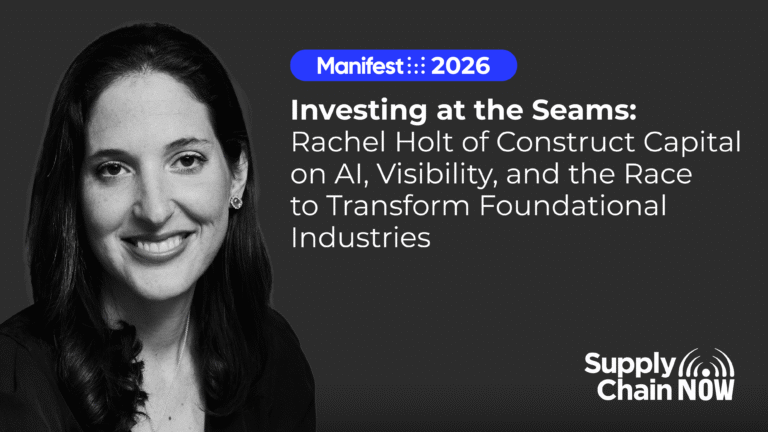
Investing at the Seams: Rachel Holt of Construct Capital on AI, Visibility, and the Race to Transform Foundational Industries
From Uber to Foundational Industries
At Manifest 2026, Scott Luton sat down with Rachel Holt, Co-Founder and Managing Partner of Construct Capital, to explore how venture capital is fueling the next era of supply chain innovation.
Construct Capital, now six years old, was founded in early 2020 with a bold thesis: transform foundational industries that represent nearly half of GDP: supply chain, logistics, manufacturing, mobility, infrastructure, and defense.
When the fund launched, Holt recalls many skeptics asking whether supply chain and logistics were truly venture-scale opportunities. It echoed what she heard when she joined Uber in 2011, when transportation was considered slow moving and heavily regulated. Yet Uber went on to redefine personal logistics.
Her final years at Uber brought a pivotal lesson. While the rides business operated with second-by-second visibility, the company’s e-bike and scooter supply chain operated in near darkness. Products shipped from China would disappear for weeks at sea, briefly reappear at ports, then stall again in customs. “We had no visibility, we had no ability to reroute,” Holt shared, as this Eureka moment would go on to help shape her investment focus.
The Visibility Gap at the Seams
Supply chain, Holt emphasized, is not monolithic. “It is literally a chain.” The biggest breakdowns often occur at the seams; between tools, platforms, and stakeholders.
While vertical solutions are thriving, horizontal integration remains complex. Bringing multiple stakeholders onto a single platform is difficult, but the opportunity to close visibility gaps across the full chain is enormous.
Entrepreneurs are stepping into that opportunity, building both focused vertical tools and broader infrastructure platforms to connect fragmented systems.
AI: Beyond Labor Efficiency
If 2025 was defined by volatility, 2026 is shaping up as the year of practical AI adoption.
“We are getting much more signal from customers around how they’re using AI this year,” Holt explained. The shift is notable: AI is moving beyond labor efficiency and into direct spend optimization.
Rather than simply making procurement teams incrementally more efficient, AI platforms are driving better rates across tens or hundreds of millions of dollars in spend. The opportunity lies in transforming major cost centers, not just trimming overhead.
Much of AI’s value in supply chain is tied to risk mitigation: rerouting when disruptions occur and ensuring resilience when something inevitably breaks.
Startups vs. Incumbents: A Two-Sided Race
Holt described a dynamic tension between startups and large enterprises.
For startups, the challenge is speed; winning customers and turning pilots into sticky, long-term adoption. For large companies, the risk is falling behind.
The AI-first era is lowering adoption barriers. Usage-based pricing, shorter implementation cycles, and modular deployments allow companies to start small, prove value, and scale quickly.
At the same time, big organizations must balance decentralized experimentation with data governance and security, a long-term tension that will shape how innovation unfolds.
Unleashing What’s Next
Construct Capital’s role is to back the entrepreneurs driving that transformation. With more than 50 portfolio companies across foundational industries, the firm is investing in automation, AI-enabled systems, logistics intelligence, and next-generation mobility.
Many AI tools now sit alongside existing teams, capturing institutional knowledge and productizing it for the next generation of workers.
In a world defined by volatility and accelerating capability, the race is not only about invention; it is about integration and execution.
As Holt’s journey illustrates, even industries once labeled ‘boring’ can be redefined. The next frontier lies in closing the seams, embracing AI-first thinking, and investing in the entrepreneurs bold enough to transform foundational industries.
Where to Learn More
Connect with Rachel Holt on LinkedIn, as well as on email: rachel@constructcap.com. Follow Construct Capital on LinkedIn here and learn more via the company website: https://www.constructcap.com/
More Blogs
5 questions I frequently get asked about automating operations with AI