September 15, 2026
data-driven operations

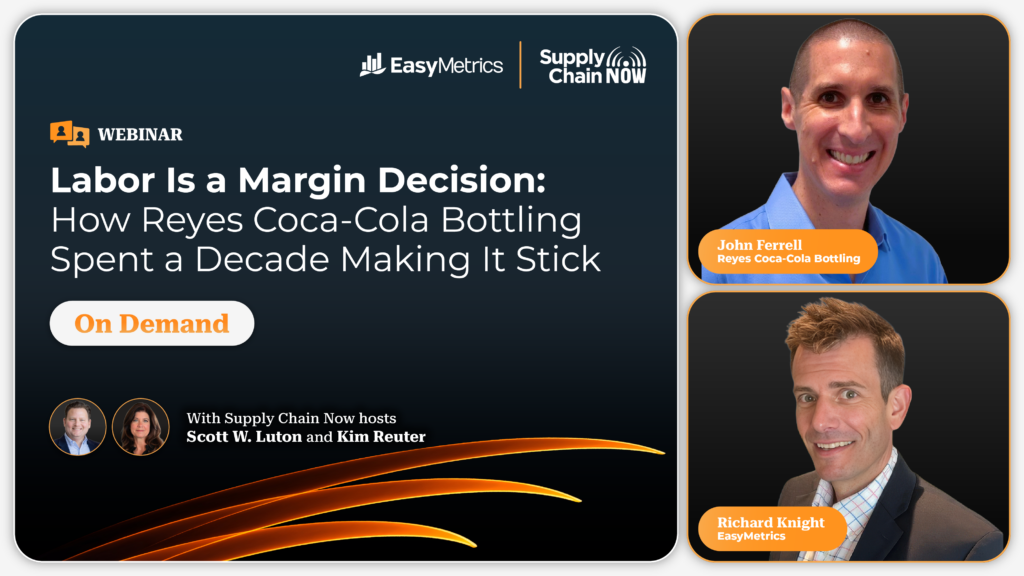
WEBINAR: Labor Is a Margin Decision: How Reyes Coca-Cola Bottling Spent a Decade Making It Stick

Share:

WEBINAR: Labor Is a Margin Decision: How Reyes Coca-Cola Bottling Spent a Decade Making It Stick

Reyes Coca-Cola Bottling has spent a decade getting to a place most operators never reach: labor performance that drives financial outcomes, not just an operations metric.

In this webinar hosted by Scott Luton & Kim Reuter, John Ferrell, Field Operations Manager at Reyes Coca-Cola Bottling, and Richard Knight, Senior Director of Solutions at Easy Metrics, will share what that looks like in practice, and what other leaders can learn from it.

The conversation centers on cost and margin rather than throughput alone, and on how leading operators are reframing labor performance as a financial lever rather than a productivity one. At Reyes, that reframe took both: unified data practices, where integrating labor and workflow data exposed exactly where time and cost were going each day, and the mindset shifts and phased rollout that made it hold.

John and Richard will get into why the financial outcome depended on the second as much as the first. A firsthand story rounds out the discussion: using efficiency gains to support and strengthen the workforce, with less overtime and more normalized workdays, not just a better balance sheet.

The discussion will also touch on how sustained labor performance can inform bigger-picture decisions, including how operators think about capital investment and automation timing.

Key Takeaways

  • From early adoption to a mature, data-driven operation, with less overtime and more normalized workdays
  • How integrated data exposes where time and cost really go
  • What it takes to scale: phased rollout and change management that make it stick
  • How labor performance can factor into capital and automation investment decisions

More Webinars
decarbonize
play-button-webinar
webinar-person
Webinar
September 30, 2025

From Compliance to Impact and Competitive Advantage: How to Decarbonize Your Supply Chain

Regulatory frameworks like the CSRD in the EU, SRS in the UK, and SB 253 & SB 261 in California are pushing sustainability to the top of the corporate agenda, but compliance is just the beginning. The real challenge and opportunity lie in taking the next step: decarbonizing the supply chain.   Join us for an interactive webinar where we bring together key perspectives of P3 Group, a strategic consulting partner with deep, hands-on sustainability experience in the automotive industry, and SAP, a leading enabler and technology provider supporting sustainable transformation.   Together, we’ll explore what it takes to move from reporting to real results. What changes are needed in your organization, your processes, and your technology stack to turn sustainability goals into measurable supply chain impact? How can decarbonization enhance your supply chain’s resilience and drive competitive advantage in international markets? Whether you’re just getting started or looking to accelerate your journey to net zero, this session will provide actionable insights you won’t want to miss.   Key takeaways   New regulatory frameworks are making sustainability reporting a mandatory part of corporate governance. Meeting regulatory requirements is essential, but the real value lies in going beyond reporting to drive…
supply chain orchestration
play-button-webinar
webinar-person
Webinar
September 23, 2026

Operational AI in the Supply Chain: How Context Empowers Agents and Humans to Operate Side by Side

The path to autonomous supply chain operations requires more than just transparency and generic AI solutions. It requires technologies that understand your company’s operational realities—a connecting link that ties together all your internal silos, external suppliers, and customers to create a contextual foundation for coordinated, autonomous AI agents that collaborate with humans. In this Supply Chain Now and Celonis webinar, hosted by Scott Luton and Jake Barr, Alejandra Quinones and Christoph Schettler of Celonis will explore how creating this unique operational context enables human experts and AI agents alike to understand past performance, monitor current operations, and make better decisions about future “what if” scenarios. This contextual foundation helps ensure AI agents act appropriately within defined parameters while accelerating decision making across your entire value chain. Key Takeaways: Why generic AI fails without an understanding of your organization’s unique operational DNA How operational context bridges departmental silos and drives cross functional collaboration Best practices for establishing a context layer that supports autonomous decision making