Share:

Leading Transformation in the AI Era: Why Digital Success Starts with People

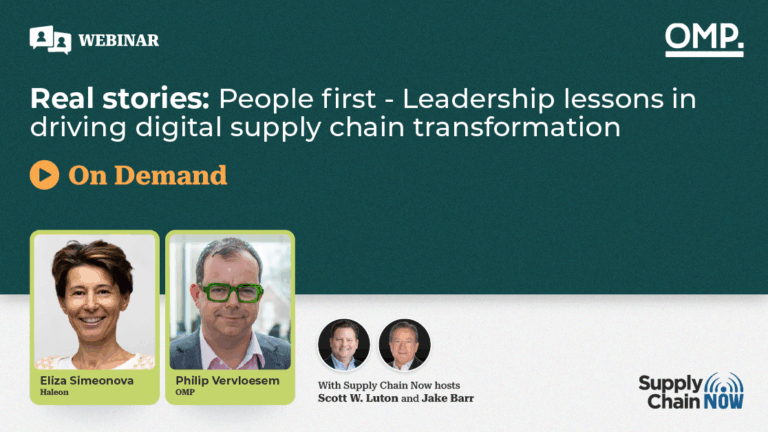
In today’s supply chain landscape, digital transformation is no longer optional—but as the panelists in the latest Supply Chain Now webinar revealed, it’s also not just about technology.

Hosted by Scott Luton and Jake Barr, this conversation brought together two powerhouse leaders: Eliza Simeonova, Quality Supply Chain Operations Officer at Haleon, and Philip Vervloesem, Chief Commercial & Markets Officer at OMP. Together, they tackled one of the most pressing challenges of our time—how to lead meaningful, people-centered transformation in an age increasingly defined by AI.

A few insights stood out:

  • Technology isn’t the hero—people are. True digital transformation begins with clarity of purpose, disciplined simplification, and leaders who stay close to the work.

  • AI amplifies human intelligence, it doesn’t replace it. The most successful organizations empower their teams to collaborate with technology, not compete against it.

  • Waiting for perfection is the biggest risk. Progress comes from experimentation, agility, and the courage to act before every variable is known.

From redefining leadership mindsets to practical strategies for upskilling teams, this discussion offered an inspiring roadmap for supply chain leaders ready to embrace what’s next.

Watch the full webinar on demand: Register to view the replay »
Download the companion resource: 5 Must-Know Planning Strategies for Supply Chain Leaders »

More Blogs
supply chain control tower technology
Blogs
December 15, 2025

Control Tower Technology: The Command Center for Modern Supply Chains

This post is written by our friends at e2open. E2open is the connected supply chain software platform that enables the world’s largest companies to transform the way they make, move, and sell goods and services. Moving as one.™ Learn More: www.e2open.com.   Global supply chains are under pressure like never before, and disruptions aren’t rare events anymore—they’re structural, constant, and often originate outside your four walls. A single weak link in your supplier network can ripple across production schedules, customer commitments, and brand reputation. The old playbook of reacting to occasional crises doesn’t cut it. To thrive in 2025 and beyond, companies need real-time visibility, predictive insights, and agile execution. That’s where supply chain control tower technology comes in.   What is a supply chain control tower, really? A control tower acts as the command center for your supply chain. It gathers and visualizes data, analyzes disruption impacts, and provides actionable recommendations before problems escalate. Advanced solutions can even automate responses to routine issues and enable cross-functional collaboration to ensure that decisions aren’t just well-informed, they’re executed across the supply chain as well.   Why control towers matter now Supply chain risk isn’t a passing cloud; it’s a thunderstorm that…
audit
Blogs
September 18, 2025

Freight Audit & Payment: The Anchor for Supply Chains in Turbulent Times

Special Guest Blog Post written by Bart A. De Muynck   The past few years have exposed just how fragile our supply chains can be. From tariff shocks to pandemic disruptions, from inflationary pressures to mounting parcel surcharges, the landscape has shifted beneath our feet. Companies that once managed logistics as a back-office function are now grappling with its role as a front-line business risk.   What’s often missed in this conversation is the role of freight audit and payment (FAP). Long considered a tactical necessity, FAP has quietly become a strategic imperative. And as I explored in the Better Supply Chains Market Radar: Freight Audit & Payment, the companies that treat it that way are the ones best equipped to weather today’s volatility.   Why FAP Has Become Mission-Critical   When tariffs can add 15–20% to input costs almost overnight, or when the elimination of the U.S. de minimis exemption threatens to reshape cross-border e-commerce, companies need more than visibility. They need real-time intelligence and agility.   Traditional FAP approaches—manual audits, siloed spreadsheets, reactive error correction—are no longer sufficient. Modern FAP platforms, powered by AI and advanced analytics, enable shippers to:   Audit with precision at scale, uncovering hidden…