Intro/Outro (00:02):
Welcome to Supply Chain Now, the number one voice of supply chain. Join us as we share critical news, key insights, and real supply chain leadership from across the globe. One conversation at a time.
Scott Luton (00:14):
Hey, good morning, good afternoon, good evening, wherever you may be. Scott Luton and the one and only Tevin E. Taylor with you here on Supply Chain Now. Welcome to today’s show. Tevin, how are you doing my friend?
Tevon Taylor (00:26):
I’m doing great. Just living the logistics dream. Happy to get to hump day.
Scott Luton (00:30):
Man, I’ll tell you, sometimes we got to be thankful hour by hour, day by day. Is that right?
Tevon Taylor (00:35):
Yes, sir. Absolutely.
Scott Luton (00:38):
Well, folks, we got a great episode here today, a unique episode really, because we’re featuring a leader from the railroad industry, of course, a critical aspect of global supply chain. We’re going to be exploring a variety of topics, including the trade-offs behind smarter transportation strategies. While certainty may be even more valuable than many shippers even realize, we’re going to be shining a light into customer mindsets, especially when it comes to logistics. And we might even debate if an industry overflowing with technology, data, and options has actually made logistics too complicated. All that and much, much more. And Tevin, given your esteemed track record when it comes to supply chain leadership, I look forward to your take on today’s conversation. Should be a good one, huh? It’s
Tevon Taylor (01:23):
Going to be a really good one. And people kind of forget about the rail. What David’s going to share with us today will be enlightening and a little bit of change from what we’ve heard in the past.
Scott Luton (01:32):
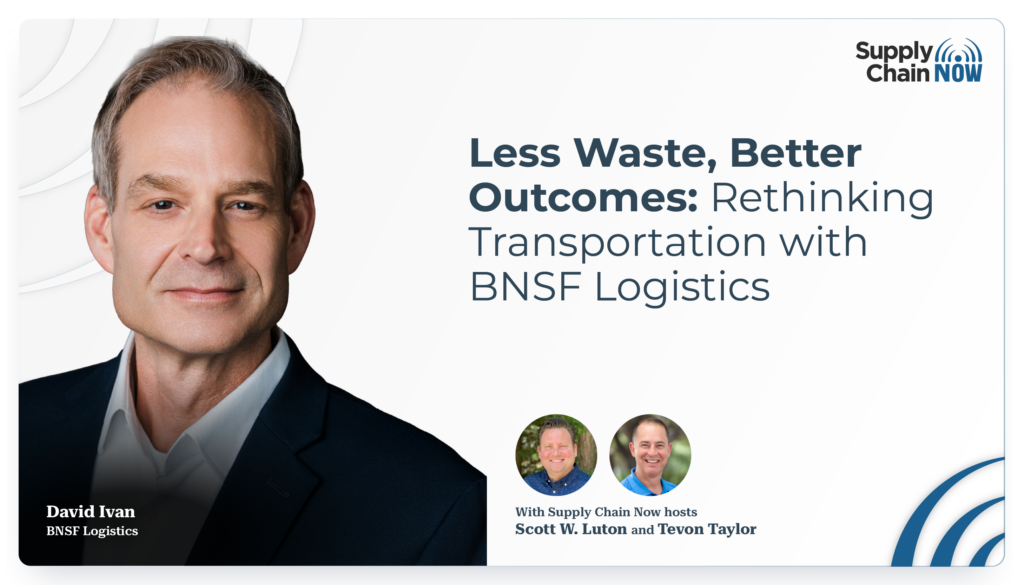
I agree with you, and I’m going to keep it real. It is my least understood aspect of global supply chain, probably the one I’ve spent the least amount of time on. So folks, if you’re like me, come learn with us here today. So stick around for a great conversation. It’s going to offer up tons of actionable insights, maybe some eureka moments by the rail car load. So I want to welcome in a special guest joining me and Tevin here today. David Ivan is president and CEO of BNSF Logistics, but he brings a somewhat different perspective to logistics industry because he spent most of his career as the customer. I think that’s a great thing. Over more than 25 years, David has led manufacturing operations and supply chain organizations at companies including Vestas, Gates Corporation, Danaher, and Cummins. Now today he brings that operator’s mindset to BNSF Logistics where his team solves challenges and optimizes transportation strategies and performance for their customers.
(02:30):
He’s a manufacturing engineer at Six Sigma Black Belt. How about that? And a longtime lean practitioner, Deadly Mix. David believes the best supply chains aren’t simply about moving freight at the lowest cost, they’re about removing friction, improving performance and creating competitive advantage for the customer. With all that said, I want to welcome in David Ivan, president and CEO of BNSF Logistics. David, how you doing today?
David Ivan (02:55):
I’m doing great, Scott. Tevin, great to see you. Thank you gentlemen for inviting me.
Scott Luton (02:59):
You bet. And let me just throw out here, we’re talking about this on the green room. We all got the blue shirt memo today, David. Is that right?
David Ivan (03:06):
It is. It is. I appreciate that this morning for sure.
Scott Luton (03:10):
All right. So Tevin, I’m really excited about this conversation because you’re right, David’s got some unique perspective that really makes this a unique episode and I can’t wait to dive in. But Tevin, you know I’m a bit of a nerd. I like starting with the fun warmup questions. And we were just talking about the heat earlier, but that hasn’t stopped David Ivan from getting out and enjoying the outdoors. David, when you’re not doing big things in global supply chain, what do you do outdoors?
David Ivan (03:37):
Honestly, I think being out in nature, coming from Colorado for 12 years, exploring mountains at 12,000 feet, whether it’s mountain biking or hiking with my family, it is absolutely my happy place. It is what kind of brings me back to, oh, I’d say a very relaxed moment. Although many of the things we deal with in business are much less relaxed, it brings me back to a normal spot.
Scott Luton (04:01):
I like that. Now I got to ask you one quick follow-up. I like the outdoors, maybe in a different vein. I’m a big bird nerd as Tevin knows, David. So I try to capture, I’m not a good photographer, but I try to capture a lot of the gorgeous bird life we have here. I bet in Colorado and even in the Dallas area. Are you somewhat of a bird nerd, David, when you get outside?
David Ivan (04:21):
I really can’t say that I am. I might notice a turkey or something on the side of the trail, but other than that, there’s just a lot of birds, I guess.
Scott Luton (04:28):
Fair enough. Hey, sometimes you catch those turkeys in offices, Tevin, is that right?
Tevon Taylor (04:32):
There are plenty of turkeys in my office, but I will say I like shooting birds. I don’t really watch them. Sorry, it’s dove season here in Texas, but look, the older I get, the more I’m like, oh, I’ll put a hummingbird feeder in my yard and it’s kind of nice. But with the drought we’re having in North Texas, I don’t think there are many birds flying around last time I checked.
Scott Luton (04:52):
I’m going to tell you, that’s another thing we were talking about, the weather and not only the heat, but we’re missing out on some rain down here in Georgia too, David. Maybe some of the weather patterns will bring us a wetter fall than normal, David. What you think?
David Ivan (05:03):
Well, let’s hope so. I think this is probably the longest period in my entire life. I’ve been at over a hundred degree days, so 50 something days here in DFW. Isn’t that right, Tevin? It’s
Tevon Taylor (05:14):
Probably 50 more than we want, that’s for
David Ivan (05:16):
Sure. Yeah, exactly. But I’m still getting outside. It just happens to come with a tremendous amount of sweat.
Scott Luton (05:21):
It does, but like you were saying earlier, however you get them, whether it’s outside, whether it’s reading a book, however you get them, that downtime that you can kind of de-stress a bit, that’s so important in these everfast removing times. So I appreciate that, David. All right, so we got a lot to get into here today. Delighted to have you with us here on Supply Chain now. And Tevin, I’m looking forward to your take on all these topics that we’re posing to David. I want to start with this one because we kind of shared in your introduction a little bit what’s a little bit different about your background because for the most part, you’ve been on the customer side of transportation and I think that’s really valuable, especially with someone in your role. I want to ask you this, how has sitting in the customer’s chair, so to speak, really shaped the way you now lead the logistics provider organization?
David Ivan (06:07):
What brought me here is actually quite interesting as well, I think in terms of, I’ve spent 30 years from a manufacturing perspective as a buyer of logistics, and logistics was never necessarily a focus. Nobody goes out and says, “Hey, I’m going to buy a truck. I’m going to buy 1500 miles.” It’s more the reality that it’s a business problem you’re trying to solve and it’s one of many business problems. And I think earlier in my career, from a lean perspective as well, it really got focused on minimum transportation. That still sits with me today. Customers are really searching for an outcome. You wouldn’t move it unless you had to, is really the ultimate goal for a lot of this stuff. So for me, from the approach of this company’s perspective is we’ve got to look at understanding what the customer’s trying to achieve first before we start getting into solution mode, whether it’s mode choice from a transportation perspective, or is there further things that can be done up and down the value stream in order to simplify even this piece of that logistics, that transport move?
Scott Luton (07:10):
Yep. All right, so David, quick follow up before I get Tevin’s comment here. Now check me if I’m wrong, because I may well be wrong, but I have come up through the lean and the Lean Six Sigma path in life, and I think wasted movement is technically one of the original seven wastes. Is that right, David?
David Ivan (07:27):
Yeah, transportation is classified as one of the seven wastes, that’s for sure. So
Scott Luton (07:32):
I really appreciate your comments there around really less movement and starting first, Tevin, with outcomes and objectives and what is success. I think that’s my favorite part I think that David just shared. What’d you hear there, Tevin?
Tevon Taylor (07:45):
The first time I ever had a conversation with David, he said something I’d never thought about. He said the ideal state would be where manufacturing sits right next door to the customer, so you basically just hand it off to the customer. And I never thought about it that way, but when he said that, my brain went right to an accordion. And when that accordion expands, you can think of every spot in that accordion as cost and waste, and it just gets longer and longer. And your goal as a logistician is to try to figure out how to get it back together or at least closer together. So it’s very humbling to take that approach because I think a lot of people don’t want to talk about waste or they don’t want to focus on that as a problem, but it’s truly the most important thing to look at is how can you optimize, make it more efficient and truly reduce the cost, the total cost of ownership, not just one leg, not just the price per mile, but focus on the entire solution by looking at the outcome first and working backwards into it.
(08:42):
That’s what I’m hearing. And I love that he said it again because David, I don’t know if you remember saying that to me about the optimal state, but it’s something I never heard before and I’m like, “This guy’s really smart.” I mean, as a matter of fact, after that conversation, I’m like, “We’ve got to get him on this show.”
Scott Luton (08:56):
David, I thought Tevin, I liked his according analogy. I thought he was about to come up with a pulka analogy for transportation or something. David, huh? Is that what you heard too?
David Ivan (09:05):
I went directly to value streams, right? I mean, if you think about it, this time is about lead time, which includes transport distance, that adds time, it includes inventory in the play. So you’ve really got to take a value stream level approach to it. And I don’t really want to dive into a nerd lead conversation. We’ll get deep very quickly with formulas, but everything has a component to it. And going back to my manufacturing days, I’d say the optimum ways that we reduced waste was through connecting process. If you’re doing a grinding operation to a cutting operation to a painting operation, pick up the part once, do all the work you can to it before you put that part down. And you take that same approach to transportation, which is a very, very difficult thing to do. I think there’s a complexity in today’s world which is driven somewhat by globalization.
(09:57):
We’ve got supply chains that are so spread out. Getting to a single location with the least amount of touches is still the goal. It just happens to be a lot more complicated than an internal factory. And
Scott Luton (10:09):
To your point, we’re seeing big trends with large enterprises trying to take touches or nodes out of their global supply chain and shorten that accordion. Tevin, you keep using that analogy. I wish I could play an accordion one day, but we’ll save that for a later show. Let’s do this. David, I’m curious, in your experience, both as a longtime customer and now where you’re leading a powerful logistics provider, what do you think other logistics providers sometimes really misunderstand about what customers actually want?
David Ivan (10:40):
It kind of goes back to I think what you said earlier, it’s we’re offering a solution. I’ve got a screwdriver and I’m selling you a screwdriver. And I think that’s a lot of the way transportation companies work, whether I’m a truck brokerage operator or a railroad or a warehouse supplier, we’re taking our product and we’re trying to apply it to your problem. And I think you really got to back up and say, what does this customer need? And if you can remain agnostic on the solution or mode even, we are a transportation company as well, but I like to think of it as a solution provider. And sometimes the solution might not be optimum for you. And that’s a tough thing to do, especially when you have a commercial team that has metrics and everything as well. But I think it’s absolutely important in building the right relationship with your customer.
Scott Luton (11:27):
Tevin, agree, disagree? What’d you hear there from David?
Tevon Taylor (11:30):
No, I agree. And what I’m hearing is really what both parties are measuring. So as a logistics provider, if you’re focused on optimizing what you’re measuring, your cost per mile capacity utilization, and the customer’s focused on something upstream or different like inventory carrying cost or something about their customer, the disconnect’s not effort. Both parties are putting out effort. It’s what each side is actually being measured on. And I’ve found this with my customers, we’re not aligned on metrics because they have a different metric internally than we’re focused on because I’m focused on a warehouse. I’m just kind of leaning into that. Well, I forgot to ask the customer, well, what’s important to you? What are you actually trying to address or resolve? That’s what I need to focus on. That’s the measurement, not my internal constraints.
Scott Luton (12:18):
Y’all both may not be saying this, but this is kind of what I’m hearing. The customer metrics matter a whole heck of a lot more than our metrics do, right?
Intro/Outro (12:27):
Correct. Yeah,
David Ivan (12:27):
100%. And I think there’s even a level of depth that’s beyond just the company customer metrics. And this really wasn’t apparent to me until I joined. I mean, again, I think you said it earlier, two years into trying to be a logistics guy, but I’ve had 30 years of practice coming up to this. And in that practice, I dealt with a lot of suppliers and vendors and challenges from a business perspective. Getting on this side and then understanding what the transportation buyer, not just the company, the transportation buyer is worried about actually opens up a whole lot of doors because a lot of times they may be at the end of the value stream, they’re in a whip, they’re under pressure, there’s a lot of things. It might not be a strategic decision. They are looking for an easy button sometimes and not only understanding the customer problem, but it’s understanding that specific buyer’s desire, what are they trying to solve can really go a long way as well in helping them out because it’s not a simple answer sometimes.
(13:27):
You’ve got to understand what he’s being measured by or he or she really needs from you.
Scott Luton (13:31):
Yep. So I’m going to follow up. We’re going to have to be the lean nerds today, David, because I’m really a lean nerd at heart. I love how that part of your journey can be so powerfully relevant in what you’re doing today. So you’ve really built a career and some of those pillars that have been part of your journey have been continuous improvement, lean operating environments and the like, and now you’re in the CEO chair, right? Take another step at telling us what those lean principles, those continuous improvement experiences, how that influences the way you especially lead people today.
David Ivan (14:04):
There’s so many things. I think number one is just respect for people. I mean, there is probably nobody that understands the problem better than those that are closest to the work. And as a CEO, you almost feel further removed from where the work actually happens sometimes. So I think it’s critically important to maintain that view. So there’s that component. There’s this should be process, there’s a design process, and then there’s always the as is, and you can’t understand that until your boots on the ground most of the time. So I think that’s something fundamentally important from that perspective. And then I think you mentioned just the relentless focus on waste.People talk about lean from a tool perspective a lot. And yes, it’s true. There’s a whole host of tools that come with it, but the philosophy’s this simple. It’s really your hypothesis testing. It’s like, how can I do this the best way possible?
(14:55):
Let me try this. Let me try that. You build systems around exposing problems, not hiding them. And that’s the whole reason for standardization and create a process, the process goes wrong, gives you an opportunity to get better. It’s that easy.
Scott Luton (15:10):
Quick follow up, David, because in my experience, Tevin, I’m going to get your comments in just one second. In my experience, lean’s gotten arguably a little bit of a bad name again, because so many organizations call it one thing and it’s not. They put a lean label on things and it’s just not lean thinking. You mentioned waste a couple of times. And in my experience, just those organizations that train their teams, their workforces around what is waste in all of its forms has been transformational. Speak to that really quick, David. I’m assuming you’ve seen the same thing. Oh
David Ivan (15:42):
Yeah, 100% right. And the hardest part about getting rid of waste is identifying it because I think there’s a lot of things that are just necessary components from a business perspective that are inherently, why do we do this? Because that’s what we do.
Intro/Outro (15:56):
One
David Ivan (15:56):
Of those type of answers. At the end of the day, you got to go back and say, well, what’s the value of that? Why? And situations change so rapidly that we just bake waste into our processes sometimes. So it’s that identification of waste is the hardest step in getting rid of it. Getting rid of it’s usually not that hard. It’s that classifying it as waste and then just going after it. We
Scott Luton (16:16):
Cling to it because we haven’t identified it as waste yet, but once we identified its waste, to your point, it can be easy to 86, so to speak. All right, so Tevin, we covered a lot of ground. Weigh in, whether it’s on the lean side or his customer perspective side, what have you heard there from David?
Tevon Taylor (16:31):
Yeah. I mean, essentially he’s saying, look, lean isn’t just a toolkit you apply to the warehouse floor to your transportation team and you set it aside and then you go to your corner office. It’s a discipline, it’s part of your culture. It’s something you want to help expose where decisions get made on assumption instead of data, and you want to make sure you lead your people the same way. So making sure they know it’s safe to bring up there’s waste, make it exciting, have idea boards, have it where the team wants to talk about inefficiencies and make sure that they’re part of the solution. Because one thing he said that’s key is the people closest to the work are the ones that know the work best, and they also know about the waste and potentially how to fix the waste as well.
Scott Luton (17:13):
Devin, a thousand percent. And I don’t know about y’all. I like studying leadership and this is anecdotal. It’s not scientific data driven, but what I’ve observed is that how CEOs lead has been evolving much earlier in my career. A lot of CEOs were like, “No, I know best.” And that has largely been evolving to where now subscribing to what both of y’all have said, “Hey, going to the Gimba, going to it,” that’s where the value’s created, that’s where the subject matter experts are. And I think anecdotally, that’s becoming more prevalent and that is a welcome, welcome trend. David, are you seeing the same thing?
David Ivan (17:51):
Yeah, probably the subject matter expertise is getting deeper as well. You’re seeing a lot more individual contributors that are key players within organizations, and I think that just really opens the door for less hierarchical leadership, to be honest with you. And I think you just can’t be an expert in everything. And if you can’t multiply the talent around you, you’re probably in the wrong seat because that really good talent will disappear and then you’ll look around and you’ll have the wrong people sitting next to you. And
Scott Luton (18:19):
That’s no good. That’s no good.
David Ivan (18:21):
Does not bode well, for sure. So
Scott Luton (18:23):
Let’s do this. Tevin, you and I grabbed a quote as we were getting ready to sit down with David. We were kind of comparing notes, and David shared this quote with us, which I think I like, and I’m going to get your reaction in just a second. He said, “A well-planned and executed transportation strategy can create competitive advantage, but transportation is still a cost. And through a lean lens, it’s essentially waste.” So David, how does that reality shape the way you think about designing transportation solutions for customers?
David Ivan (18:52):
First, it starts with approach, right? I mean, again, cost matters. Tevin, I think we talked about this a bit too. It’s easy to say that, “Hey, I’m the best value provider and I can maximize my gross margins from a company perspective.” All those things can be true, but at the end of the day, you are taking profit away from the organization that is buying your service. They’re focused on their business problem. It’s the inventory costs, it’s this, it’s the lead time, the transport. And if you can’t look at it from a minimization perspective, now again, sometimes you have to add to minimize for simplicity, but it really needs to be that focus and that customer needs to feel that’s your approach as well. So
Scott Luton (19:33):
Tevin, react to that quote and to how he just expounded on it. And you
Tevon Taylor (19:38):
Have the CEO of a transportation company saying it, so I think everybody should listen. Calling transportation waste isn’t a knock on the work, it’s just a discipline. If you start from this is a cost, the customer would eliminate if they could, you design differently. So what you really have to do is stop selling the capability for its own sake, start asking what’s the leanest path towards reliability? Find that minimalist approach, right? So every mile and every touch you can’t justify is margin dilution, so it’s hitting that profit he mentioned. So you’re taking that right away from the customer, not adding for them. So
Scott Luton (20:11):
David, I didn’t build this interview like this, but I think there was a famous game show back in the day of who said it or something, like a quiz show or something. And we gathered another something you’ve shared here, David, because you’ve said that customers fundamentally want three things from transportation, simplicity, certainty, and cost. You’ve said that depending on the market and mode, you can’t always maximize all three, right? Sometimes we get two out of three, and as Jack Nicholson said in when Mars attacks, “Hey, two out of three, and that ain’t bad.”
David Ivan (20:44):
Situations change, there’s no one right or wrong answer, and it’s going to be different for different time periods as well as different customers. But I think if you’re in a very disruptive market, I think you start looking for certainty, whether that be certain. I mean, let’s take the trucking industry today, the price of trucks. I think people who are stuck in contracts without maybe the proper indexation are probably hurting a little bit right now, whether it’s fuel chargers or capacity. And that would entail to maybe certainty’s better than price, because at least I know what to expect at the end of the day. Surprises are the one thing in business that you can’t work with very well, that variation. The lead time variation is I could get three days or I get eight days. Is that better than just always knowing it’s going to be there in five days?
(21:30):
And I think that’s probably something you can plan with. It’s very formulaic. If you take it back to a lean perspective, that matters. So certainty can be really important. Cost is always going to be in there, but cost is that trade-off factor between those couple of things. And then simplicity, you talk about rail, and this is an area that I’m quite passionate about just because I feel like this mode of transportation, I think you said it, it’s kind of forgotten about.
Intro/Outro (21:55):
Sure.
David Ivan (21:56):
It’s not necessarily, I mean, it’s a couple hundred-year-old industry in the US and they’re a long time country was kind of created by it and it’s still relevant, which is quite unique for some technology that’s not changed a whole lot. To be honest with you, the guys will kill me if they hear me say that, but it is still one of the safest ways to move product most efficiently. Think about it. There’s a lot of these new technologies moving around today. I mean, best units, data centers, pretty hot topic right now. A lot of these things are moving on roads and you’ve got these battery units with five gigawatts or five megawatts of batteries in them. Do you want that unit sitting next to you at a traffic light or would you like that on a pretty nice secure railway moving all on its own?
(22:40):
I mean, if you just think about from a safety aspect, your mind it’s five times more efficient environmentally, whether it’s diesel electric versus a diesel truck. So there’s just a lot of pluses for me from a rail, but it isn’t for everything, that’s for sure. So
Scott Luton (22:54):
I’m going to come back to certainty in just a second, that three-legged stool that you were talking about a second ago. Tevin, it’s interesting his comments about the railroad industry, because I think even folks that have been in supply chain for a long time, there’s a lot of folks at least that I’ve rubbed elbows with that really don’t understand the railroad industry, and it still plays, to David’s point, such a critical part. I mean, it’s not a perfect comparison. So David, you and your army of colleagues don’t tackle me for this, but Tevin, I think of it a lot as the barge industry. Here in the States, no one thinks about the barge industry until that Mississippi is really down in terms of water volume because of lack of rain and other things, and it also still plays a major role in the supply chain industry.
(23:39):
Tevin, react to that or what we were hearing about David as we’re trying to manage simplicity, certainty, and cost. Well,
Tevon Taylor (23:46):
Obviously with his background with the rail, I mean, that’s a great example. I would’ve never thought of that, especially with the batteries, because we get opportunities in my business to move those and I’m like, “No, I need to be talking to David about that because I don’t want that on a truck. I don’t want it in my warehouse. I’d love to put that on a rail.” One thing I’m hearing is, I mean, if you look at simplicity, certainty, cost trade-offs, you’ll never get to maximize all three at once. It just won’t happen. So you’re kind of throttling. In a capacity type market, certainty gets expensive really fast and shippers will trade simplicity for it. In a softer market, cost dominates and everyone’s going to rediscover how much complexity they’re willing to tolerate to save one point of margin. So that hierarchy, it’s not fixed. It’s really a read on the market.
(24:30):
And for his example, a read on the product and what you’re actually handling. So really you got a lot of toggles in that arena, but you really could bucket it like here are the three, pick two, right? But you got to decide how that’s going to work between simplicity and certainty. What is that cost trade-off? It’s
Scott Luton (24:47):
Kind of like going to a barbecue joint in Texas. You can’t have it all, but you can get that too. You can.
Tevon Taylor (24:53):
It’ll
Scott Luton (24:53):
Cost
Tevon Taylor (24:54):
You a lot of money.
Scott Luton (24:55):
That’s right. That’s better. All right, so David, I’m going to ask you about. We’re going to dive a little deeper on certainty first, but David, react to what Tevin said. He mentioned this hierarchy and how the hierarchy can change as market conditions change. Your last thought along those lines, David? Yeah,
David Ivan (25:13):
No, completely aligned. I think this trade-off between simplicity and certainty does switch priorities depending upon the market conditions. But I also think simplicity is by nature of the organizations you’re dealing with sometimes. There is turnover, there’s talent, there’s complexity, there’s vertical integration. You start to see a lot of companies become more reliant on those around them. Maybe vertical integration is going backwards. We’re becoming much more focused on our product. You tend to see people choose a very simple method. Hey, what’s the easiest method I can call somebody? Maybe it comes down to a truck brokerage or truck board or something. People are choosing that simplicity without really having a complete picture because just the, I’d say, evolution of some of the businesses in the US too. So you’re losing experience in some of these places. Well,
Scott Luton (26:06):
Hold that thought because we’re going to talk more about simplicity in just a minute because sometimes we are inventing a lot of needless complexity, but I want to go back certainty first because you were talking about this earlier. We spend enormous amounts of time talking about transportation cost, but what is certainty worth to a shipper? In some cases, it’s tough to quantify. But David, how should companies think about the business value of knowing when freight will actually arrive? Your thoughts there? Yeah,
David Ivan (26:34):
I mean, you can take it all the way down to the receiving level if you want. It’s like I work for an organization that was pretty good about schedule and a truck was to arrive between 2:00 and 3:00 PM. Guess when I knew I needed to be ready to get that. I didn’t have an entire fleet of people waiting on a dock for trucks to arrive all day long. Comes with a real tangible cost. The other example is the far extreme from a project cargo perspective. If you are performing a $2 billion capital project in the middle of nowhere, you have a lot of resources deployed, whether it’s cranes, crews, trucks, these things come with six figure numbers on the per hour basis. If you can’t predict when the products arrive, it gets very expensive very quickly. So there is a cost you can put to it.
(27:20):
It’s going to be somewhere in between those two things though, most likely. Devin,
Scott Luton (27:24):
Certainty. Man, we were complaining on the front end or maybe in the green room about how we don’t have enough rain and precipitation. Oh my gosh, I’ve been looking under every rock, under every chair, looking for as much certainty as I can find. What’d you hear there from David? I
Tevon Taylor (27:38):
Wish we had certainty with the weatherman.
Scott Luton (27:41):
That’s true. That’s true too. I
Tevon Taylor (27:43):
Mean, look, certainty doesn’t show up as a line item. It’s undervalued. And the reason why is because uncertainty is what you pay for. For every day, something doesn’t exist. Could be safety stock, could be expedite fees, meetings your ops team spends explaining why something’s late instead of doing the next thing. I mean, that’s the cost, right? So I wish certainty could be something like, “Hey, the reason we pay this is the certainty of the execution or the outcome.” But unfortunately, you don’t see that. You see the uncertainty. It’s almost easier to quantify uncertainty than certainty, because when things are screwed up, you can put a dollar amount to the safety stock, the expedite fees, things like that. But it’s undervalued because it’s not a line item, but those costs, I always tell customers you’ve got to look at the total cost of what you’re doing, and when you’re bleeding out or having damages or things are late, what is the cost?
(28:34):
Because what you pay in a premium might be the premium towards that certainty, but it makes you feel a lot better because you’re actually doing what you’re supposed to be doing.
Scott Luton (28:42):
I think we can talk about this for a couple hours. Certainty is usually a good thing. However, it can be a bad thing because I am certain that the Atlanta Falcons are not making the playoffs in 2026, whatever it is. It’s going to be a tough football season, I think, on a variety of levels. David, earlier you were talking about, you mentioned simplicity a couple different times, and I want to circle back to that as well. It’s almost inarguable that we’ve got more data, certainly more technology, providers, modes, all kinds of optimization tools, platforms, apps, you name it, all than ever before. Logistics doesn’t necessarily feel simpler or easier in most cases. So I want to ask you, David, have we overcomplicated transportation and where do you see the greatest opportunities to take at least chunks of complexity out of the equation? I mean,
David Ivan (29:33):
It’s a great question, and coming from a background where I’ve had 17 different suppliers to deal with on a single transport route that might’ve hit two continents and then show up at your door, finding a throat to choke is really difficult in this world sometimes, especially in that market. But I think it’s also comes with a lot of noise when you start talking about simplicity. There’s a lot of things that you probably force and it could Come through optimization of cost. I think we talked about trade-offs. If you’re trying to optimize cost, you might opt for something that’s less bundle. There is one of the class ones that’s really good about bundling freight. It looks door to door, but it’s actually a complex solution. But what you see at the end of the day is just kind of a single number. So sometimes we do it to ourselves in that component, but it’s hard to say because you’ve got complexity with technology rolling in at the same time.
(30:26):
Just the globalization has driven the complexity levels up. I mean, take Rouge, the Ford Rouge plant, take it back to 1900s. I mean, they even had their own steelworks on site.
(30:38):
So they had casting frames, everything was there. It really simplified, I guess, the operation in terms of certainty. But obviously you’re not taking advantage of subject matter expertise from around the world because you have to know everything. But that’s an extreme example of optimization of cost, I guess.
Scott Luton (30:56):
It’s a great example. And folks, if you’re not a history nerd, like I am at least, I’m not calling anyone else nerds here today, but that Rouge plant, I think at the time, David, was one of the biggest manufacturing plants in the world. And I think it was completely vertically integrated to your point. There was nothing they couldn’t do at this mega facility. And also to your point, it may not be a good fit today. It’s not really what companies tend to do these days. But at the time, you could argue that it is what helped make Ford what Ford has become to be. So Tevin, before y’all pardon me, because I’m going to talk out both sides of my mouth. On one hand, we’re going to talk about how all those things, including technology, has added too much complexity, but we’re going to talk about some innovative technology and what it’s doing in this amazing time we’re living in.
(31:43):
But Tevin, talk about taking complexity out. What we heard there from David philosophy, but also operationally. What’d you hear there?
Tevon Taylor (31:49):
He and I are in the same space to a certain degree. At the end, the customer really doesn’t care, and I hate to cliche how the sausage is made. They want to know that the dinner is served on their plate. So what’s the outcome? And how do you collapse all the decisions and all the touch points to fewer people who actually own that outcome? That’s what you’re looking for.
Intro/Outro (32:10):
So
Tevon Taylor (32:11):
If you outsource something to a transportation provider, don’t over complicate it where they’ve got to go to multiple places for track and trace. Don’t overcomplicate it where they talk to 16 different people. You mentioned one throat to choke. Have that bottle where, I mean, you can basically talk to one person, deal with one portal, everything’s in one spot. It doesn’t matter if you outsource all of it. It’s just the fact they want to deal with fewer and fewer people. And we’ll talk about technology in a minute, but that’s the technology too. Don’t make the tech stack so difficult where it’s hard to understand. Make it simple.
Scott Luton (32:43):
Yes. When David said that throat to choke, I immediately thought, because Tevin, I’ve heard you use that phraseology numerous times and oftentimes you add that single throat to choke, meaning not advocating violence folks, but meaning you know where to go when things go wrong because things are going to go wrong as part of how industry goes. But in this era, and David, I love you to weigh in before we taught technology. Just a minute ago, I’m not going to name names, one of the technologies I use regularly, I’ve been a longtime customer, and we ran out of our contract a couple years ago. So we’ve been going month to month. And the person that I had dealt with, I couldn’t get ahold of. And y’all know how it goes. You try them on a Tuesday and it might be a year later for you if you don’t get them that you try it again because it’s just not that important.
(33:28):
Plus you want to go straight to one individual rather than go back through the main 800 number and all that, at least I do. And I think that really is where so much of industry is going. And I’m not talking supply chain, I’m talking generally, where we’re getting pushed oftentimes as customers back into queues, talking chat bots. There’s a lot of layers before you can finally get to a fellow human. And oftentimes despite technology’s gains, they’re more complicated than fixing this character or fixing this thing. And you won’t, just from a psychologist standpoint, you want to connect with a human that says, “You know what? I empathize with what you need and I understand your problem and this is what I’m going to do to fix it.” That’s like manna from heaven. Ava, do you see, like I was just trying to describe, when it comes to that single throat to choke, we’re kind of moving in the opposite direction where there’s not always that point of clarity in many of our relationships.
(34:25):
Do you see the same thing?
David Ivan (34:26):
Yeah, absolutely. I think I’ll correct with saying, “Hey, a single back to pat maybe will evolve to the terminology, but a hundred percent.” And I think the intentions are pure. It’s how do we become more efficient through process? But if you’re automating provides no benefit,
Intro/Outro (34:45):
You’re
David Ivan (34:45):
Basically taking and you’re automating a bad process and you’re just doing it more efficiently. And that’s not a good thing at the end of the day. So it’s really, you got to take it back to saying, “Hey, what’s broken in the first place in this process?” And then maybe there we can focus on the simplicity of it.
Scott Luton (35:01):
I like it. And Tevin, same question. Do you see that same? And by the way, to finish my story, I finally broke through going through the main number, ended up saving a couple hundred bucks a month because once your contract expires, you were paying rack rates, basically is what they were calling it. And had I just called earlier, I didn’t have that single point of contact, that single bat. What’d you say, David? Back to pat? Yeah, back to
David Ivan (35:24):
Pat. I’m going to
Scott Luton (35:25):
Try that. I’m going to try that. But Tevin, is this kind of how industry’s shifting over too?
Tevon Taylor (35:30):
Yeah. I mean, it started with customer service, customer care where they do the routings and the phone trees. It used to be just you’d always talk to somebody different that didn’t know you, didn’t know your business, didn’t know anything about you. And you get handed off to the next person who didn’t know you. But then they got smart and said, okay, let’s have a system where you at least acknowledge you know who’s calling. But it’s even regressed. If you ever have a healthcare provider, you call the hospital phone tree and it goes all over the place. And then for every different type of issue, it goes like the routing’s so complex now. I think they hope you hang up. I think they probably have some kind of ratio going, hey, 60% of the people will give up. And I mean, I’m one of those guys for $17 on a preventative care bill where I’m like, why do you charge me $17?
(36:16):
I’ve just tested it just to see how awful the process is. I’ve chatted with people, they’ve redirected me. They’ve told me they’re treating me for things that I don’t have wrong with me. I’m like, it’s preventative care. There should not be a bill. But that’s what resonates here because I think someone came up usually in a finance accounting role as like, hey, we can save money by doing this. You can automate it, you can reduce the head count, but the experience is horrible where it makes you not like your healthcare and honestly makes me not want to talk to a doctor because I feel like every time I do, I get billed that I can’t talk to a human being now. I hope we don’t go to that. And logistics, I mean our business models and I’m not selling my company, but we have dedicated account management because I want the people we move freight for to know exactly who to call and they got a cell phone number.
(37:03):
It’s not a phone tree. It’s not 20 different people you have to talk to. That’s the world I want to live in.
Scott Luton (37:09):
Tevin, I’m with you. And David, can you see when Tevin E. Taylor shows up on IDs? Oh man, Tevin’s calling us again. I’m going to reroute him. But kidding aside, David, that’s part of the complexity and the complexity is a very long equation with many, many things. And I know you’re passionate about pulling friction out for customers. And I think what Tevin and I both are describing, that can certainly be part of the ambiguous complexity out there and that can certainly interrupt even the most successful move or shipment or what have you. So David, I want to talk technology again because we live in this golden age of supply chain tech. It’s amazing. It really is amazing to be in global supply chain at this moment in 2026. AI is reshaping virtually every supply chain conversation, outcome, strategy, you name it. I’m curious from your perspective as an operator, where can AI and technology in your view genuinely make transportation simpler, more predictable, less expensive, more successful?
(38:09):
What are you seeing, David?
David Ivan (38:10):
Yeah, it’s a great question and I think I’m probably no different than the two of you where you’ve gotten about five hits per day from somebody with a great solution to really solve all your problems. And I’m like, wow, I’m impressed you know all my problems to be honest with you. That would be a point one, but I believe it’s just a phenomenal tool for aggregating data for organization. It can do things that I think can take me a week of study in seconds. And that’s where I’ve found probably the most value. I think if you’ve got bad data underlying a system, which I don’t know, Tevin, I mean I think we all have historical values, but it’s a dynamic world and being able to predict using historical values and forward is not necessarily proven to been great. I mean 2020, I think it was, or 2019 port strike, 2020 COVID, we had the canal got clogged up with the ship.
(39:06):
I mean every year everybody says, oh, it was a special circumstance, Ukraine war. It’s always something and you’ve got to be able to be much more dynamic. And I think that’s where technology can somehow lead you astray, put false certainty by using that information rather than looking forward. But I’m a huge advocate for it. But again, I don’t think it takes people out of the process and it can’t replace though and risk a risk mitigation.
Scott Luton (39:33):
David, I tend to agree with you. And Tevin, get your thoughts. I would add to that short list David started being able to give your team back and rather than going into specifics, AI, technology, how can we largely automate, especially the most mundane blocking and tackling that so many humans don’t want to do anymore and free up their time where they can tackle some of the more value-driven work, really leveraging their very unique, powerful human brain, except my brain. Tevin, what’d you hear there, especially when it comes to technology and the utilization of technology that David was talking about?
Tevon Taylor (40:07):
I mean, look, technology is getting stronger and stronger. I think there’s a genuine, a better use for prediction and pattern matching, but he mentioned it. It’s only as good as the data that’s in there. So as the data gets more cleaned up, I think the decision making, the pattern matching, the prediction will get better. But where the industry, I believe, gets ahead of itself is treating technology or AI as a replacement for judgment on the exceptions themselves. So a model can tell you a shipment might be at risk, but I still want a human being who understands the customer’s business to make that decision on what trade-off to make about it. It’s the same thing about airplanes. Airplanes are great when they’re flying and there’s no issues, but I want a pilot. When something’s going wrong, I want a pilot to try to troubleshoot that, not the computer.
(40:52):
It’s the old airplane movie where I don’t want the airplane to take over.
Scott Luton (40:56):
Tevin, same.
David Ivan (40:58):
David. It’s that customer service example. It’s exception management. Process should work when it doesn’t help.
Scott Luton (41:08):
I think the point Devin brings up, David, is something we’re spending a lot of time talking about in a lot of our shows here. And that is at what point where do humans still need to be involved? I think every organization is really addressing that on a variety of levels. And we had one guest had a great webinar not too long ago, and one of their litmus tests was, and look, for different organizations, different things, but one of their litmus tests they were advocating is if a decision is irreversible, you want a human on the tail end just making sure that’s the appropriate path. And there’s plenty of other litmus tests. But David, your quick comments on where we must still include, again, the human superpowers that every organization depends on.
David Ivan (41:53):
Yeah. And maybe I’d say where I would focus more on the technology side, the flip of that is if it’s dirty, difficult, dumb, or dangerous, that’s where automation really helps. I mean, those are the things that we don’t want people doing for the most part for one of those four reasons. And we’ve applied that to automation from an engineering perspective a lot. It applies to AI too, I think, very well. And that’s the take that we use today internally here. We’re still trying to figure it out as well as I think everybody is, what is the right use.
Scott Luton (42:25):
Yeah. It’s certainly been the golden age of AI to this point, but you know that the most fascinating thing, David and Tevin, is we don’t know what next month holds, maybe even next week holds. I mean, at the rate of velocity of innovation and how the code’s being unlocked, it really is just an amazing time, but good and bad because the good actors and the bad actors unfortunately have access to the same technology in many ways. All right, but on a lighter note, we’re going to kind of bring it full circle here, David. And I love the timing of this next question. So BNSF logistics works across rail and truck and transload, warehousing, engineering, complex and heavy project logistics rather than operating just around a single transportation mode. So when we talk about technology, we often hear many leaders jump straight to the technology without really understanding if it’s the right approach.
(43:18):
Well, I want you on a similar lens, how important is it to start with the customer’s business problem rather than beginning with a preferred transportation mode? Your thoughts, David?
David Ivan (43:29):
It’s probably the most important piece in finding the optimum solution. You can get the job done in a lot of different ways and there’s not that many ways to move something. We haven’t got the teleportation yet, so there’s still a physical act that’s taking place in our world, which is good for us to be honest with you. And I think that always puts that link into humans at least for now. But I think even defining the problem with the customer is important because if you’re not bringing some level of expertise to their problem solving, they might just describe an A to B situation. Again, it could be much broader than that. And I think that’s where if you can engage with the customer and we try to do that. I know a lot of organizations try to do that, understand a little bit bigger picture to really define the problem and then you can start moving forward.
(44:16):
But it’s really easy to get into, oh, that’s a truck move, that’s a rail move, but it’s not quite that simple always.
Scott Luton (44:23):
David, I’m with you. And your response there, we’re going to nerd out one more time on lean stuff because one of my favorite simple tools in the lean world least where, I mean, it’s probably universal, but the five whys. Can’t stop at the answer to the first, why does this happen? Because we got to get the root cause. Otherwise, we’re just applying bandaids and we’re really not, to your point, understanding the customer’s problem. React to that really quick, David, before I bring in Tevin’s voice.
David Ivan (44:52):
Super powerful. And again, it usually leads you to a process that needs to be fixed or an opportunity that wasn’t presented in the first place. And I think that’s really that partnership approach that you can take with the right customers. And then there’s other things, just move it, just do it. It’s also a good solution in some circumstances.
Scott Luton (45:10):
That’s a good point. And folks, if you haven’t heard of the five whys, it’s simple. It might not be five, it might be four sometimes, or seven sometimes, maybe it’s 17, but constantly getting to rather than the surface level answers to the questions we’re asking, dive deeper, dive deeper because usually the first answer to a why does this happen, maybe even the second or third answer, it doesn’t really get to the root of it all. Tevin, weigh in. I mean, bringing all that back to when you’re talking about optimizing what transportation success really means for customers out there and starting with what they’re trying to do rather than say, oh, right away you need product A or service B. I mean, weigh in, Tevin.
Tevon Taylor (45:51):
Yeah. I mean, what you’re naming there is the cardinal sin of sales is feature dumping. When you just spit up on the customer, all the things you do and you provide, you’re failing to acknowledge that you need to identify their problem. And sometimes, like David said it earlier, and this is why it’d be easy to do business with David, is sometimes you have to be agnostic and you might recommend doing less business for yourself. You’re building trust with the customer, you’re trying to solution sell to them. That customer opportunity, it’s not just about filling your trucks, it’s about solving their problems. And you’ve got to start with the end in mind and the end should be solving the customer’s problem. And it might be telling them, “Hey, you need to use BNSF, not Pegasus, and this is why, because they’re good at cranes and heavy lifts.” So as much as I’d like to say, I haven’t said that lately, I always have to remind the salespeople, you don’t need to just spit up what we do.
(46:44):
You need to ask questions and learn about the customer because you’re building trust, rapport, and trying to understand what you’re solving for.
Scott Luton (46:51):
Well said, Tevin. Well said. I wish that was a more common approach that folks take, but well said. All right. We’re just really scraping the tip of the iceberg, David, on your journey, your perspective, the great things you are doing at BNSF Logistics. If folks want to learn more about any of that, how would you suggest folks connect with you and your organization? What are a couple things you’d suggest?
David Ivan (47:16):
LinkedIn, obviously, whether it’s BNSF Logistics or myself personally, bnsflogistics.com is available. Lots of ways to contact us, phone or email.
Scott Luton (47:26):
Outstanding. It’s just that easy. Tevin, I’m going to get your key takeaway, your toughest question of the day in just a second because we heard a lot from David. But really quick, Tevin, how can folks connect with you and the Pegasus team?
Tevon Taylor (47:39):
LinkedIn is the best approach. I used to give my phone number, but that never works out long term. Give me phone calls, but LinkedIn, connect with me and be glad to help you or coach you in the right direction.
Scott Luton (47:50):
Outstanding. All right. So we heard a bunch from David Ivan with president CEO with BNSF Logistics. Tevin, if you had to dial it in on your favorite thing that you’d suggest folks, if you forget everything else we’ve talked about here today, don’t forget this one nugget from David. What would that be, Tevin?
Tevon Taylor (48:09):
He had so many good nuggets that I took notes on. I like the, because he comes from manufacturing, the pick up the part once, comparing that to transportation, do as much as you can once you pick up that part, but the less touches, the less moves. Now, transportation isn’t just a cost to be minimized, of course, but it’s a lever to help you with competitive advantage. And he said respect the people when it comes to lean and optimization. Gosh, the simplicity, certainty, cost trade-offs, that was by far one of the favorite buckets. That’s what I’m going to take back to my team. But I felt like I really got a history of not only David, but what I should already know in the business. But I will go back to my first point where the accordion, I love when he said, “Look, the best state is manufacturing customers sitting next door to each other.
(48:55):
Everything else, once you start pulling them apart, that is waste and you have to find a way to reduce that waste. Focus on the customer outcome, not your core set, not your outcome or measurement, and then go win business and satisfy customers, right?
Scott Luton (49:09):
Man, you gave us a package deal in those key takeaways day. I like it, Tevin. He
Tevon Taylor (49:14):
Had so many. I feel like I really short sheeted that one. I felt like I could have done better.
Scott Luton (49:20):
Well, I would just double down on one thing you shared that David shared earlier that he started with. I can’t remember the question it was. It might’ve been what he really applies from his continuous improvement background to his role as CEO, and that was respect to the people. The folks that are closest to the process, the folks on the line, out in our facilities, they know best. And we really do a disservice on so many levels when we assume because of titles or roles or whatever, that it’s anything other than that, because that’s, I think, been the universal truth in my journey. So respecting our incredibly talented human workforce, David, I really appreciate your passion there amongst many other things. All right, so David, we got to have you back. My friend really enjoyed our time together and I really appreciate, I think maybe outsider is not the right adjective or noun, whatever that is.
(50:13):
I don’t mean to let my English teachers down, but maybe that’s not the right terminology, David. But I really appreciate how you spent a chunk of your career, as Tevin mentioned, the manufacturing, kind of being the shipper, and then you step in to lead this organization that’s serving so many customers. That is very valuable perspective, huh?
David Ivan (50:32):
And I’m learning every day from people like Tevin, my own team internally. So I’m super appreciative of the opportunity to apply a different perspective.
Scott Luton (50:40):
We look forward to getting an update soon. Thanks so much. We’ve been talking with David Ivan, president, CEO, BNSF Logistics. David, thanks so much for being here.
David Ivan (50:50):
Thank you. Thank you both.
Scott Luton (50:52):
And I’ve had the pleasure of co-hosting today with Tevin E. Taylor, of course, with Pegasus, but we’re very fortunate to have Tevin join us several times a month on a variety of shows. Tevin, a pleasure to knock out another conversation with you.
Tevon Taylor (51:05):
Hey, it’s my honor. I appreciate you letting me be on the show.
Scott Luton (51:09):
And folks, to our SCN GlobalFam, hopefully you enjoyed the conversation as much as I have here today. I think in part, it certainly illustrates, we got so much to learn. So many folks, I’ll just point at myself, have so much to learn about this longstanding aspect of the global supply chain ecosystem. That’s a railroad industry. So folks, let us know your take on today’s conversation. Feedback is a blessing. Keep it coming. But the challenge remains the same, right? What was that? The song remains the same. I think that was a Led Zeppe album or song. Anyway, the challenge remains the same. Take one thing from all the good stuff we heard here from David and from Tevin and do something with it, right? Deed’s not words. That’s how we’re going to continue transforming global supply chain and leave no one behind. And with that said, on behalf of the whole Supply Chain Now team, Scott Luten challenging you do good, get forward, be the change that’s needed.
(51:59):
We’ll see you next time right back here on Supply Chain Now. Thanks everybody.
Intro/Outro (52:04):
Join the Supply Chain Now community for more supply chain perspectives, news, and innovation. Check out supplychainnow.com. Subscribe to Supply Chain Now on YouTube and follow and listen to Supply Chain Now wherever you get your podcasts.